ABSTRACT
Background: Smartphone addiction has recently been highlighted as a major health issue among adolescents. In this study, we assessed the degree of agreement between adolescents' and parents' ratings of adolescents' smartphone addiction. Additionally, we evaluated the psychosocial factors associated with adolescents' and parents' ratings of adolescents' smartphone addiction.
Methods: In total, 158 adolescents aged 12–19 years and their parents participated in this study. The adolescents completed the Smartphone Addiction Scale (SAS) and the Isolated Peer Relationship Inventory (IPRI). Their parents also completed the SAS (about their adolescents), SAS-Short Version (SAS-SV; about themselves), Generalized Anxiety Disorder-7 (GAD-7), and Patient Health Questionnaire-9 (PHQ-9). We used the paired t-test, McNemar test, and Pearson's correlation analyses.
Results: Percentage of risk users was higher in parents' ratings of adolescents' smartphone addiction than ratings of adolescents themselves. There was disagreement between the SAS and SAS-parent report total scores and subscale scores on positive anticipation, withdrawal, and cyberspace-oriented relationship. SAS scores were positively associated with average minutes of weekday/holiday smartphone use and scores on the IPRI and father's GAD-7 and PHQ-9 scores.
Additionally, SAS-parent report scores showed positive associations with average minutes of weekday/holiday smartphone use and each parent's SAS-SV, GAD-7, and PHQ-9 scores.
Conclusion: The results suggest that clinicians need to consider both adolescents' and parents' reports when assessing adolescents' smartphone addiction, and be aware of the possibility of under- or overestimation. Our results cannot only be a reference in assessing adolescents' smartphone addiction, but also provide inspiration for future studies.
Keywords: Addictive Behavior; Adolescent; Depression; Parents; Smartphone
Original Article
HyunChul Youn ,1 Soyoung Irene Lee ,2 So Hee Lee ,3 Ji-Youn Kim ,4 Ji-Hoon Kim ,5 Eun Jin Park ,6 June Sung Park ,7 Soo-Young Bhang ,8 Moon-Soo Lee ,1 Yeon Jung Lee ,9 Sang-Cheol Choi ,10 Tae Young Choi ,11 A-Reum Lee ,2 and Dae-Jin Kim 12
1Department of Psychiatry, Korea University Guro Hospital, Korea University College of Medicine, Seoul, Korea
2Department of Psychiatry, Soonchunhyang University Bucheon Hospital, Bucheon, Korea
3Department of Psychiatry, National Medical Center, Seoul, Korea
4Joenmaem Psychiatry Clinic, Suwon, Korea
5Department of Psychiatry, Pusan National University Yangsan Hospital, Pusan, Korea
6Department of Psychiatry, Ilsan Paik Hospital, Inje University, Goyang, Korea
7Dodream Psychiatry Clinic, Bucheon, Korea
8Department of Psychiatry, Eulji University Eulji General Hospital, Seoul, Korea
9Department of Psychiatry, Soonchunhyang University Seoul Hospital, Seoul, Korea
10Didim Psychiatry Clinic, Seoul, Korea
11Department of Psychiatry, Catholic University of Daegu School of Medicine, Daegu, Korea
12 Department of Psychiatry, Seoul St. Mary's Hospital, College of Medicine, The Catholic University of Korea, Seoul, Korea
Exploring the Differences between Adolescents' and Parents' Ratings on Adolescents' Smartphone Addiction
Received: Jun 20, 2018 Accepted: Sep 6, 2018 Address for Correspondence:
Soyoung Irene Lee, MD, PhD
Department of Psychiatry, Soonchunhyang University Bucheon Hospital, 170 Jomaru-ro, Wonmi-gu, Bucheon 14584, Republic of Korea.
E-mail: [email protected]
© 2018 The Korean Academy of Medical Sciences.
This is an Open Access article distributed under the terms of the Creative Commons Attribution Non-Commercial License (https://
creativecommons.org/licenses/by-nc/4.0/) which permits unrestricted non-commercial use, distribution, and reproduction in any medium, provided the original work is properly cited.
ORCID iDs HyunChul Youn
https://orcid.org/0000-0002-6557-5628 Soyoung Irene Lee
https://orcid.org/0000-0003-2473-2954 So Hee Lee
https://orcid.org/0000-0002-9005-3207 Ji-Youn Kim
https://orcid.org/0000-0003-1735-7279 Ji-Hoon Kim
https://orcid.org/0000-0001-8132-2359 Eun Jin Park
https://orcid.org/0000-0003-4046-1517 June Sung Park
https://orcid.org/0000-0001-5489-9646 Soo-Young Bhang
https://orcid.org/0000-0001-5254-0314 Moon-Soo Lee
https://orcid.org/0000-0003-0729-6943
Psychiatry & Psychology
Yeon Jung Lee
https://orcid.org/0000-0001-8953-5893 Sang-Cheol Choi
https://orcid.org/0000-0003-4391-4454 Tae Young Choi
https://orcid.org/0000-0003-2677-9297 A-Reum Lee
https://orcid.org/0000-0001-6931-8488 Dae-Jin Kim
https://orcid.org/0000-0001-9408-5639 Funding
This work was supported by the Soonchunhyang University Research Fund (2014).
Disclosure
The authors have no potential conflicts of interest to disclose.
Author Contributions
Conceptualization: Lee SI, Kim DJ. Data curation: Youn H, Lee SI, Lee AR. Formal analysis: Youn H. Funding acquisition: Lee SI. Investigation: Lee SI, Lee SH, Kim JY, Kim JH, Park EJ, Park JS, Bhang SY, Lee MS, Lee YJ, Choi SC, Choi TY, Lee AR. Methodology:
Lee SI, Kim DJ. Project administration: Lee SI. Resources: Lee SI, Kim DJ. Supervision:
Lee SI, Kim DJ. Visualization: Youn H. Writing - original draft: Youn H. Writing - review &
editing: Youn H, Lee SI, Lee SH, Kim JY, Kim JH, Park EJ, Park JS, Bhang SY, Lee MS, Lee YJ, Choi SC, Choi TY, Lee AR. Kim DJ.
INTRODUCTION
Given their convenience, social networking advantages, and variety of functions,
smartphones are pervasively popular.1 However, their use can lead to many side effects, such as lightheadedness, blurred vision, and sleep disturbances.2-4 A recent systematic review showed that depression, anxiety, and chronic stress were related to problematic smartphone use or smartphone addiction.5 Smartphone use can also reduce the amount of in-person social interaction and academic achievement, as well as generate relationship problems.6-8 Furthermore, Cazzulino et al.9 mentioned health hazards such as texting while driving.
The boom in smartphone use and the potential problems caused by smartphones has brought more attention to the issue of smartphone addiction. Although evidence-based research was not sufficient for smartphone addiction to be included in the most recent version of the Diagnostic and Statistical Manual for Mental Disorders (DSM-5),10 recent studies have demonstrated that it may be a behavioral addiction, as it demonstrates all the usual features of addiction such as tolerance, withdrawal symptoms, dependence, and social problems.1-3,11,12
In Korea, smartphone addiction in adolescents has been regarded as a major health issue.
Approximately 85% of Korean adolescents have their own smartphone, and adolescents use their smartphones (for everything except calling) for around 170 minutes per day, on average.13,14 The Korea Internet and Security Agency reported that the percentage of smartphone users exhibiting symptoms of addiction was highest in adolescents.15 To understand the smartphone addiction phenomena in adolescents, the first and essential step is to identify those with addiction problems. There is a strong consensus that the assessment of adolescents' psychopathology requires data from multiple informants.16,17 Indeed, numerous researchers have reported significant discrepancies between adolescent- reported and parent-reported psychopathology.18,19 Although smartphones are widely used and many adolescents have problems related to smartphone use, there is a relative lack of acknowledgement that they can be smartphone addicted.2,20 This can result in the neglect of adolescents' smartphone addiction, especially in the case where assessment only depends on the view of adolescents themselves.20 However, despite the necessity of reports of multiple informants on adolescents' smartphone addiction, few studies have focused on the discrepancy issue of adolescents' behavioral addiction, much less on smartphone addiction in particular. Therefore, we investigated differences in adolescents' and parents' ratings in order to properly assess adolescents' smartphone addiction.
We assessed the degree of agreement between adolescents' and parents' ratings of adolescents' smartphone addiction, hypothesizing that there would be significant discrepancies based on previous studies of several psychopathologies. Additionally, we also assessed the psychosocial factors associated with adolescents' and parents' ratings of adolescents' smartphone addiction.
Previous studies have shown that isolated adolescents–namely, those without close peers–
are at a higher risk for problems such as anxiety, depression, gaming addiction, and low physical activity.21,22 Furthermore, it is widely believed that parental psychopathology, such as anxiety and depression, can influence offspring in numerous ways.23,24 Thus, we intended to investigate the possibility of peer relationship isolation in adolescents, and parental smartphone addiction, anxiety, and depression as potential psychosocial factors associated with adolescents' smartphone addiction.
As far as we know, this is the first study to assess the differences between adolescents' and parents' ratings on adolescents' smartphone addiction and the associations between parental psychopathology and adolescents' smartphone addiction. We expect that our analysis can be a reference in assessing adolescents' smartphone addiction.
METHODS
Participants and procedure
Adolescents aged 12–19 years and their parents were included in this study. Participants were recruited among audience of the annual lectures held by the Korean Academy of Child and Adolescent Psychiatry for general population. The subject of the lectures were about parenting in the digital age. Detailed research and instruction packages were sent to the home address of all participants. The questionnaire comprised two parts — one for adolescents and one for parents. Participants had to complete all questions anonymously, and then return the packages by mail. Of the 300 initial participants, 167 returned the answers by mail. Nine additional subjects were excluded because the adolescents' age was unsuitable or the adolescents' part of the questionnaire was missing. The final total sample size was 158.
Measures
The questionnaire contained items assessing sociodemographic and clinical characteristics.
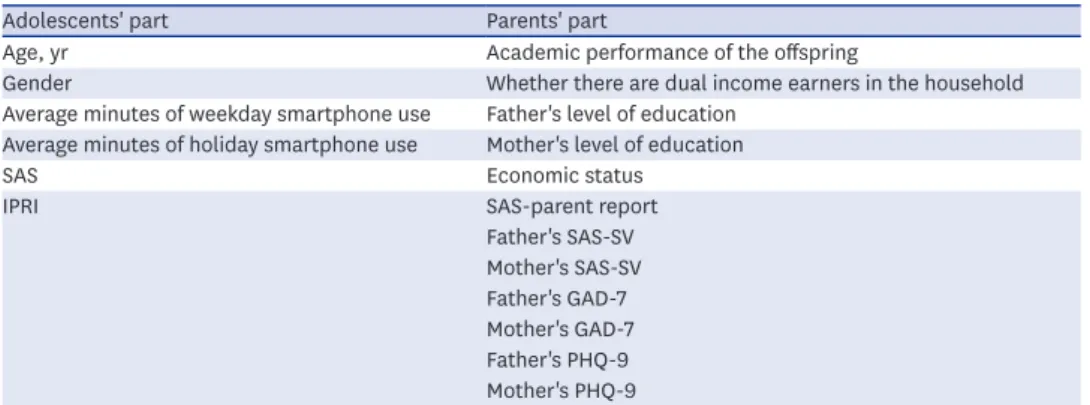
All questionnaires were in self-reported format. Table 1 describes the composition of the questionnaire.
The Smartphone Addiction Scale (SAS)2 was used to assess smartphone addiction. The SAS contains 33 items rated on a six-point scale ranging from 1 (strongly disagree) to 6 (strongly agree). Based on their total scores, individuals can be described as no problem (total score
≤ 100), caution needed (total score = 101–126), and clinically significant (total score ≥ 127).25 We regarded the caution needed and clinically significant groups as risk users in this study.
The SAS comprises six subscales: 1) daily-life disturbance, 2) positive anticipation, 3) withdrawal, 4) cyberspace-oriented relationships, 5) overuse, and 6) tolerance. The cutoff scores for each subscale used to discriminate between no problem and risk users were 18, 23, 18, 19, 16, and 8, respectively. We included the SAS in both the adolescent and parent questionnaires. It was emphasized to parents to rate the adolescents' smartphone addiction.
Table 1. The composition of the questionnaire
Adolescents' part Parents' part
Age, yr Academic performance of the offspring
Gender Whether there are dual income earners in the household
Average minutes of weekday smartphone use Father's level of education Average minutes of holiday smartphone use Mother's level of education
SAS Economic status
IPRI SAS-parent report
Father's SAS-SV Mother's SAS-SV Father's GAD-7 Mother's GAD-7 Father's PHQ-9 Mother's PHQ-9
SAS = Smartphone Addiction Scale, IPRI = Isolated Peer Relationship Inventory, SAS-SV = Smartphone Addiction Scale-Short Version, GAD = Generalized Anxiety Disorder, PHQ = Patient Health Questionnaire.
We refer to the response of parents on their offspring's smartphone usage as the SAS-parent report. In this study, Cronbach's alphas of the SAS and SAS-parent report were 0.967 and 0.975, respectively.
The Isolated Peer Relationship Inventory (IPRI)21 was used to assess the degree of peer relationship isolation. The IPRI contains 16 items rated on a four-point scale ranging from 1 (never) to 4 (almost always), and includes subscales on isolation/loneliness, social competence, and mutual interaction with peers. Items 4, 9, 12, 13, 15, and 16 are reverse scored. We included the IPRI in only the adolescent questionnaire. Cronbach's alpha was 0.876 for IPRI in this study.
Parental smartphone addiction was assessed using the SAS-Short Version (SAS-SV).2 The SAS-SV is a short version of the SAS containing only 10 items rated on a six-point scale ranging from 1 (strongly disagree) to 6 (strongly agree). We included two copies of the SAS- SV in the parent questionnaire, one each for the father and mother. Cronbach's alphas for father's and mother's SAS-SV in this study were 0.942 and 0.934, respectively.
The Patient Health Questionnaire (PHQ)26 is a commonly used, well-validated self-report tool for screening of mental health disorders. We used the Generalized Anxiety Disorder-7 (GAD-7) and PHQ-9, both of which were adapted from the PHQ, for assessing anxiety and depression, respectively. A higher score on the GAD-7 or PHQ-9 indicates a higher possibility of having anxiety or depressive disorder, respectively. These scales have been translated into Korean and their reliability and validity have been confirmed.27,28 We included two copies of the GAD-7 and PHQ-9 in the parent questionnaire, one each for the father and mother. In this study, Cronbach's alphas were 0.886, 0.877, 0.824, and 0.816 for father's GAD, mother's GAD, father's PHQ-9, and mother's PHQ-9, respectively.
Statistical analysis
Descriptive statistics were calculated for all variables (i.e., means and standard deviations [SDs] for continuous variables and percentages for categorical variables). We compared the SAS and SAS-parent report scores using a paired t-test. To compare number (and percentage) of smartphone risk users as rated by SAS and SAS-parent report, the McNemar test was used. Associations between the SAS/SAS-parent report and other variables were evaluated using Pearson's correlation analyses. A P value of less than 0.05 was considered indicative of statistical significance. All statistical analyses were performed using PASW Statistics 18.0 (i.e., SPSS/IBM Corporation, Somers, NY, USA) for Windows.
Ethics statement
Ethical approval was received from the Institutional Review Board at Soonchunhyang University Bucheon Hospital (2014-07-032-001) before the initiation of the study. All participants were informed of the study protocol, and all adolescents and their parents gave their written informed consent.
RESULTS
Table 2 shows the sociodemographic and clinical characteristics of all study participants. A total of 158 adolescents aged 12–19 years were included (53.2% men, n = 84; 46.8% women, n = 74). The mean (M) age of participants was 15.32 (SD = 1.80) years.
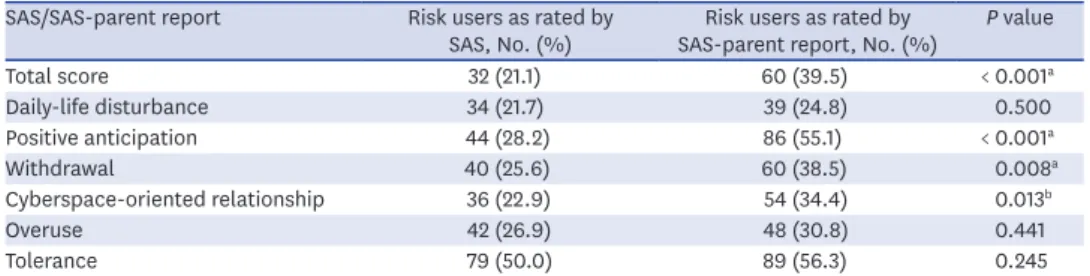
The mean SAS-parent report score (M, 91.26; SD, 33.42) was significantly higher than the mean SAS score (M, 80.03; SD, 32.21). The risk users according to SAS and SAS-parent report scores were 32 (21.0%) and 60 (39.4%) adolescents, respectively. Twenty-five participants (16.4%) were classified as risk users by both adolescents and parents. The McNemar test showed a statistically significant disagreement between the SAS and SAS-parent report total scores and scores on the positive anticipation, withdrawal, and cyberspace-oriented relationship subscales (Table 3).
Table 4 shows the Pearson correlation coefficients for the SAS and SAS-parent report with other variables. SAS scores were positively associated with average minutes of weekday/
Table 2. Sociodemographic and clinical characteristics of study participants
Variables Categories No. (%) or M ± SD
Age, yr 15.32 ± 1.80
Gender Men 84 (53.2)
Women 74 (46.8)
Academic performance of the offspring Top 20% 33 (21.0)
Second 20% 54 (34.4)
Third 20% 43 (27.4)
Fourth 20% 17 (10.8)
Bottom 20% 10 (6.4)
From a dual income household Yes 83 (52.5)
No 75 (47.5)
Father's level of education Middle school graduate or less 2 (1.5)
High school graduate 31 (23.5)
College graduate or more 99 (75.0)
Mother's level of education Middle school graduate or less 0 (0)
High school graduate 48 (33.6)
College graduate or more 95 (66.4)
Economic status High 8 (5.1)
Upper middle 27 (17.1)
Middle 86 (54.4)
Lower middle 31 (19.6)
Low 6 (3.8)
Average minutes of weekday smartphone use 185.95 ± 154.18
Average minutes of holiday smartphone use 273.37 ± 211.22
IPRI 7.63 ± 7.23
Father's SAS-SV 18.28 ± 8.55
Mother's SAS-SV 18.74 ± 8.28
Father's GAD-7 1.60 ± 2.53
Mother's GAD-7 1.56 ± 2.55
Father's PHQ-9 2.20 ± 2.91
Mother's PHQ-9 1.88 ± 2.67
M = mean, SD = standard deviation, IPRI = Isolated Peer Relationship Inventory, SAS-SV = Smartphone Addiction Scale-Short Version, GAD = Generalized Anxiety Disorder, PHQ = Patient Health Questionnaire.
Table 3. Smartphone risk users as rated by adolescents and parents SAS/SAS-parent report Risk users as rated by
SAS, No. (%) Risk users as rated by
SAS-parent report, No. (%) P value
Total score 32 (21.1) 60 (39.5) < 0.001a
Daily-life disturbance 34 (21.7) 39 (24.8) 0.500
Positive anticipation 44 (28.2) 86 (55.1) < 0.001a
Withdrawal 40 (25.6) 60 (38.5) 0.008a
Cyberspace-oriented relationship 36 (22.9) 54 (34.4) 0.013b
Overuse 42 (26.9) 48 (30.8) 0.441
Tolerance 79 (50.0) 89 (56.3) 0.245
SAS = Smartphone Addiction Scale.
aP < 0.01; bP < 0.05.
holiday smartphone use and scores for the IPRI and father's GAD-7 and PHQ-9 scores.
Additionally, SAS-parent report scores showed positive associations with average minutes of weekday/holiday smartphone use and each parent's SAS-SV, GAD-7, and PHQ-9 scores.
DISCUSSION
This study compared adolescents' and parents' ratings on adolescents' smartphone addiction. The mean score of parents' ratings was higher than that of adolescents' ratings.
Additionally, percentage of risk users was higher in parents' ratings of adolescents' smartphone addiction than ratings of adolescents themselves. The McNemar test also indicated significant differences in parents' and adolescents' ratings of smartphone addiction as well as in the areas of positive anticipation, withdrawal, and cyberspace- oriented relationship, whereas there were no significant differences with regard to daily-life disturbance, overuse, and tolerance.
Overall, the findings showed significant differences between adolescents' and parents' ratings on the adolescents' smartphone use at risk. The results were consistent with our expectations. We found that parents tended to estimate their adolescents' smartphone addiction as more risky than did adolescents toward themselves. Previous studies on psychopathology in youth have revealed that youth ratings of severity tend to be lower than the parent ratings in clinical samples.18,29 Salbach-Andrae et al.18 explained that these differences are due to parental distress and adolescents' lack of insight. Although the adolescents in our study were not from a clinical population, we believe that our results are nevertheless in part due to parental distress and adolescents' lack of insight. Excessive smartphone use can cause numerous problems such as depression, anxiety, and physical difficulties, and is increasingly considered a serious public health problem.1,2,5 In addition, it can be associated with reduced social interaction and poor academic achievement,6 which is the main concern of Korean parents.30 We believe that these might stimulate parental distress. As mentioned above, most adolescents in Korea have their own smartphone and spend considerable time using it. We believe that the popularity of smartphones possibly prevents adolescents' insight into the fact that their smartphone use can be problematic.
Furthermore, one study on perceived smartphone addiction among Korean adolescents showed that around 30% of a high-risk group perceived their statuses as non-problematic.20 Table 4. Correlation coefficients of scores on adolescents' and parents' ratings of adolescents' smartphone addiction with other variables
Variables SAS SAS-parent report
SAS 1
SAS-parent report 0.474a 1
Age, yr −0.028 −0.086
Average minutes of weekday smartphone use 0.503a 0.408a
Average minutes of holiday smartphone use 0.538a 0.415a
IPRI 0.224a 0.104
Father's SAS-SV 0.054 0.257a
Mother's SAS-SV 0.023 0.357a
Father's GAD-7 0.231a 0.256a
Mother's GAD-7 0.125 0.305a
Father's PHQ-9 0.212b 0.251a
Mother's PHQ-9 0.166 0.355a
SAS = Smartphone Addiction Scale, IPRI = Isolated Peer Relationship Inventory, SAS-SV = Smartphone Addiction Scale-Short Version, GAD = Generalized Anxiety Disorder, PHQ = Patient Health Questionnaire.
aP < 0.01; bP < 0.05.
These factors may account for why parents estimated their adolescents' smartphone addiction more risky than did adolescents themselves.
As for the subscales of the SAS, some showed significant disagreement, while others did not. In general, previous studies have found greater parent–adolescent agreement for externalizing problems compared to internalizing problems.18,31,32 This may be because externalizing problems are more openly observable and directed at others, whereas internalizing problems are more subtle and difficult to perceive.18 Aggression, hyperactivity/
inattention, and oppositional behavior are examples of externalizing problems, whereas depression, anxiety, and obsessive thoughts are examples of internalizing problems.18,31 Positive anticipation refers to the feelings of excitement about and stress relief through using a smartphone, as well as feelings of emptiness without a smartphone.2 We believe that positive anticipation has similar qualities to internalizing problems because it concerns subjective feelings. Likewise, withdrawal and cyberspace-oriented relationship also represent subjective feelings and internalizing problems.2 By contrast, daily-life disturbance, overuse, and tolerance refer to behaviors that can be observed by others.2 Therefore, our results are consistent with the results of previous studies showing differences in parent–adolescent agreement between internalizing and externalizing problems.
Additionally, we assessed the association between the SAS/SAS-parent report and other variables. Adolescent reported smartphone addiction was associated with adolescents' and father's factors ― average minutes of weekday/holiday smartphone use, peer relationship isolation, and father's anxiety/depression. There have been few studies on the association between smartphone addiction and peer relationships. However, Enez Darcin et al.33 reported that feelings of loneliness was positively correlated with smartphone addiction, especially cyberspace-oriented relationship. In addition, peer relationship isolation has been associated with anxiety, depression, and low self-esteem.34 Previous studies reported that anxiety and depression were risk factors for smartphone addiction.1,3,5,35 Hong et al.36 reported that low self-esteem was associated with mobile phone addiction. Pantic et al.37 also showed a negative correlation between Internet addiction and self-esteem. We speculate that these previous studies can account for our results.
It is widely recognized that parental psychological problems can negatively affect their offspring.38,39 Beardslee et al.40 reported that a child has a 40% chance of developing depression at the age of 18 when one parent is depressed. Other studies also showed the association between parental depression and anxiety in offspring.41,42 In addition, children with a parent with anxiety disorder have an increased risk for anxiety disorder.43 Anxiety and depression are risk factors for smartphone addiction.1,3,35 Therefore, these findings may relate to our results about the association between adolescent reported smartphone addiction and father's anxiety/depression. However, in our study, only father's anxiety/depression was the risk factor for adolescent reported smartphone addiction as opposed to mother's anxiety/
depression. There have been few studies on father's psychopathology and adolescents' mental health.39 Verona and Kilmer revealed that women under high stress and negative affect responded with less aggression, and that men under high stress and negative affect responded with continued increases in aggression.44 We reason that father's externalized affect might influence their offspring, but more studies and discussions are needed.
Parents' reports of adolescents' smartphone addiction was mainly associated with parental factors; that is, the parent's smartphone addiction, anxiety, and depression were related to the
parent's report of the adolescent's smartphone addiction. These findings suggest that parents reported adolescent's smartphone addiction may represent parents' psychopathology as well as their view of the adolescent's smartphone addiction. Parents reported adolescent's smartphone addiction also related to average minutes of weekday/holiday smartphone use. The time of smartphone use can be observed by others. We believe that this can account for our results.
This study has several limitations. First, the generalizability of the findings is limited because this study focused only on adolescents and their parents, and the sample size was small.
Considering that excessive smartphone use is prevalent in other age groups, such as those in childhood or their twenties,15 further studies including various other age groups are needed.
Second, participants were recruited as volunteers from among the attendees of annual national public lectures. Although these lectures were held for the general population, our participants might be more concerned about smartphone addiction. This may be associated with selection bias. Third, our participants were not from a clinical population and did not exhibit significant functional impairment, although we cannot completely exclude the possibility of such impairments, given that they were not specifically addressed in this study. Therefore, further studies with clinical samples are needed to generalize these results to the clinical setting. Finally, our study mainly focused on parental psychopathology as the psychosocial factors, rather than adolescent psychopathology. It is likely that there are other psychosocial factors associated with adolescents' smartphone addiction beyond those measured in this study.
As mentioned in the introduction, data from multiple informants are essential for assessing adolescents' psychopathology. Our study suggests that this can also be applied in the evaluation of adolescents' smartphone addiction. Clinicians need to consider both adolescents' and parents' reports when assessing adolescents' smartphone addiction, and be aware of the possibility of under- or overestimation. Our results also represent that parents' reports of externalizing problems are more close to the reports of adolescents themselves than are their reports of internalizing problems. We believe that this result can be utilized in further research, such as for developing a new “parent-report SAS” (to assess their offspring's smartphone addiction). In addition, our results suggest that more attention to smartphone addiction in adolescents may be needed, especially with regard to poor peer relationships.
Clinicians also need to be aware that when parents assess their offspring's smartphone addiction, the psychopathology of the parents may affect the ratings.
Smartphone addiction is a relatively new area of behavioral addiction, although studies have recently begun to increasingly focus on understanding it. As far as we know, this research study was the first to examine differences between adolescents' and parents' ratings on adolescents' smartphone addiction. We believe that our results can not only be a reference in assessing adolescents' smartphone addiction, but also provide inspiration for future studies.
REFERENCES
1. Choi SW, Kim DJ, Choi JS, Ahn H, Choi EJ, Song WY, et al. Comparison of risk and protective factors associated with smartphone addiction and internet addiction. J Behav Addict 2015;4(4):308-14.
PUBMED | CROSSREF
2. Kwon M, Lee JY, Won WY, Park JW, Min JA, Hahn C, et al. Development and validation of a smartphone addiction scale (SAS). PLoS One 2013;8(2):e56936.
PUBMED | CROSSREF
3. Demirci K, Akgönül M, Akpinar A. Relationship of smartphone use severity with sleep quality, depression, and anxiety in university students. J Behav Addict 2015;4(2):85-92.
PUBMED | CROSSREF
4. Lee JE, Jang SI, Ju YJ, Kim W, Lee HJ, Park EC. Relationship between mobile phone addiction and the incidence of poor and short sleep among Korean adolescents: a longitudinal study of the Korean children
& youth panel survey. J Korean Med Sci 2017;32(7):1166-72.
PUBMED | CROSSREF
5. Elhai JD, Dvorak RD, Levine JC, Hall BJ. Problematic smartphone use: a conceptual overview and systematic review of relations with anxiety and depression psychopathology. J Affect Disord 2017;207:251-9.
PUBMED | CROSSREF
6. Kuss DJ, Griffiths MD. Online social networking and addiction--a review of the psychological literature.
Int J Environ Res Public Health 2011;8(9):3528-52.
PUBMED | CROSSREF
7. Park KW, Kim KS. A study on smartphone addiction level of middle school students and effects of related variables. J Fam Relat 2015;20(1):51-74.
8. Cho GY, Kim YH. Factors affecting smartphone addiction among university students. J Korea Acad Ind Coop Soc 2014;15(3):1632-40.
9. Cazzulino F, Burke RV, Muller V, Arbogast H, Upperman JS. Cell phones and young drivers: a systematic review regarding the association between psychological factors and prevention. Traffic Inj Prev
2014;15(3):234-42.
PUBMED | CROSSREF
10. American Psychiatric Association. Diagnostic and Statistical Manual of Mental Disorders: DSM-5. Arlington, VA:
American Psychiatric Association; 2013.
11. Matar Boumosleh J, Jaalouk D. Depression, anxiety, and smartphone addiction in university students- a cross sectional study. PLoS One 2017;12(8):e0182239.
PUBMED | CROSSREF
12. Kim SM, Huh HJ, Cho H, Kwon M, Choi JH, Ahn HJ, et al. The effect of depression, impulsivity, and resilience on smartphone addiction in university students. J Korean Neuropsychiatr Assoc 2014;53(4):214-20.
CROSSREF
13. Ministry of Gender Equality & Family. 2013 A Comprehensive Survey on Use of Media in Adolescents. Seoul:
Ministry of Gender Equality & Family; 2013.
14. Cheil Data and Analytics Center. Timetables of Mobile Apps in Korean. Seoul: Cheil Worldwide; 2015.
15. Korea Internet & Security Agency. 2013 Research on the Mobile Internet Use. Seoul: Korea Internet & Security Agency; 2013.
16. Comer JS, Kendall PC. A symptom-level examination of parent-child agreement in the diagnosis of anxious youths. J Am Acad Child Adolesc Psychiatry 2004;43(7):878-86.
PUBMED | CROSSREF
17. Hunsley J, Mash EJ. Evidence-based assessment. Annu Rev Clin Psychol 2007;3(1):29-51.
PUBMED | CROSSREF
18. Salbach-Andrae H, Klinkowski N, Lenz K, Lehmkuhl U. Agreement between youth-reported and parent- reported psychopathology in a referred sample. Eur Child Adolesc Psychiatry 2009;18(3):136-43.
PUBMED | CROSSREF
19. Vuori M, Autti-Rämö I, Junttila N, Vauras M, Tuulio-Henriksson A. Discrepancies between self- and adult-perceptions of social competence in children with neuropsychiatric disorders. Child Care Health Dev 2017;43(5):670-8.
PUBMED | CROSSREF
20. Kim S, Jeong IS. Agreement between smartphone addiction and perceived smartphone addiction among adolescents. J Korean Soc Sch Community Health Educ 2014;15(2):91-101.
21. Lee SH, Kim EJ, Kim MY, Kim JY, Lee KM, Koo JG. The Psychosocial Characteristics of Oiettolie Adolescents.
Seoul: Samsung Social Mental Health Institute Samsung Medical Center; 2000.
22. Park SY, Kim KW. The relationship between children's oiettolie traits and their risks of gaming addiction.
Korean J Couns Psychother 2008;20(3):839-61.
23. Goodman SH, Gotlib IH. Risk for psychopathology in the children of depressed mothers: a
developmental model for understanding mechanisms of transmission. Psychol Rev 1999;106(3):458-90.
PUBMED | CROSSREF
24. Connell AM, Goodman SH. The association between psychopathology in fathers versus mothers and children's internalizing and externalizing behavior problems: a meta-analysis. Psychol Bull 2002;128(5):746-73.
PUBMED | CROSSREF
25. Kim DJ, editor. Cognitive Function and Aggressiveness Related to Internet Addiction in Korea. 11th World Congress of Biological Psychiatry; 2013 June 20–23; Kyoto. Barsbüttel: World Federation of Societies of Biological Psychiatry; 2013.
26. Spitzer RL, Kroenke K, Williams JB. Validation and utility of a self-report version of PRIME-MD: the PHQ primary care study. Primary Care Evaluation of Mental Disorders. Patient Health Questionnaire. JAMA 1999;282(18):1737-44.
PUBMED | CROSSREF
27. Choi HS, Choi JH, Park KH, Joo KJ, Ga H, Ko HJ, et al. Standardization of the Korean version of patient health questionnaire-9 as a screening instrument for major depressive disorder. J Korean Acad Fam Med 2007;28(2):114-9.
28. Seo JG, Cho YW, Lee SJ, Lee JJ, Kim JE, Moon HJ, et al. Validation of the generalized anxiety disorder-7 in people with epilepsy: a MEPSY study. Epilepsy Behav 2014;35:59-63.
PUBMED | CROSSREF
29. Phares V, Danforth JS. Adolescents', parents', and teachers' distress over adolescents' behavior. J Abnorm Child Psychol 1994;22(6):721-32.
PUBMED | CROSSREF
30. Youn CK, Song MK, Moon KS, Min SH. The Consequences of Overseas Study in Early Ages and Policy Direction.
Seoul: National Youth Policy Institute; 2009.
31. Salbach-Andrae H, Lenz K, Lehmkuhl U. Patterns of agreement among parent, teacher and youth ratings in a referred sample. Eur Psychiatry 2009;24(5):345-51.
PUBMED | CROSSREF
32. Seiffge-Krenke I, Kollmar F. Discrepancies between mothers' and fathers' perceptions of sons' and daughters' problem behaviour: a longitudinal analysis of parent-adolescent agreement on internalising and externalising problem behaviour. J Child Psychol Psychiatry 1998;39(5):687-97.
PUBMED | CROSSREF
33. Enez Darcin A, Kose S, Noyan CO, Nurmedov S, Yılmaz O, Dilbaz N. Smartphone addiction and its relationship with social anxiety and loneliness. Behav Inf Technol 2016;35(7):520-5.
CROSSREF
34. Lee KM, Koo JG, Kim EJ, Lee SH. The psychosocial characteristics of oiettolie adolescents. Korean J Couns Psychother 2001;13(1):147-62.
35. Lee KE, Kim SH, Ha TY, Yoo YM, Han JJ, Jung JH, et al. Dependency on smartphone use and its association with anxiety in Korea. Public Health Rep 2016;131(3):411-9.
PUBMED | CROSSREF
36. Hong FY, Chiu SI, Huang DH. A model of the relationship between psychological characteristics, mobile phone addiction and use of mobile phones by Taiwanese university female students. Comput Human Behav 2012;28(6):2152-9.
CROSSREF
37. Pantic I, Milanovic A, Loboda B, Błachnio A, Przepiorka A, Nesic D, et al. Association between physiological oscillations in self-esteem, narcissism and internet addiction: a cross-sectional study.
Psychiatry Res 2017;258:239-43.
PUBMED | CROSSREF
38. Dean K, Stevens H, Mortensen PB, Murray RM, Walsh E, Pedersen CB. Full spectrum of psychiatric outcomes among offspring with parental history of mental disorder. Arch Gen Psychiatry 2010;67(8):822-9.
PUBMED | CROSSREF
39. Leijdesdorff S, van Doesum K, Popma A, Klaassen R, van Amelsvoort T. Prevalence of psychopathology in children of parents with mental illness and/or addiction: an up to date narrative review. Curr Opin Psychiatry 2017;30(4):312-7.
PUBMED | CROSSREF
40. Beardslee WR, Keller MB, Lavori PW, Staley J, Sacks N. The impact of parental affective disorder on depression in offspring: a longitudinal follow-up in a nonreferred sample. J Am Acad Child Adolesc Psychiatry 1993;32(4):723-30.
PUBMED | CROSSREF
41. Lieb R, Isensee B, Höfler M, Pfister H, Wittchen HU. Parental major depression and the risk of depression and other mental disorders in offspring: a prospective-longitudinal community study. Arch Gen Psychiatry 2002;59(4):365-74.
PUBMED | CROSSREF
42. Hirshfeld-Becker DR, Micco JA, Henin A, Petty C, Faraone SV, Mazursky H, et al. Psychopathology in adolescent offspring of parents with panic disorder, major depression, or both: a 10-year follow-up. Am J Psychiatry 2012;169(11):1175-84.
PUBMED | CROSSREF
43. Reupert AE, J Maybery D, Kowalenko NM. Children whose parents have a mental illness: prevalence, need and treatment. Med J Aust 2013;199(3 Suppl):S7-9.
PUBMED | CROSSREF
44. Verona E, Kilmer A. Stress exposure and affective modulation of aggressive behavior in men and women. J Abnorm Psychol 2007;116(2):410-21.
PUBMED | CROSSREF