INTRODUCTION
The global prevalence and economic burden of allergic dis- eases has increased.1-5 The prevalence of allergic rhinitis, aller- gic conjunctivitis and asthma are 38.7%, 18.3%, and 10.3%, re- spectively, in Korean school-aged children.1 For Korean adults, allergic rhinitis and asthma are 20.9% and 11.7%, respectively.6 Environmental factors are considered more crucial than genet- ic factors for the recent increase in the prevalence of allergic dis- eases.7 Environmental factors such as smoking, lifestyle, obesity, pets, diet, and air pollution are considered causative or aug- menting factors of allergic diseases.8-10 House dust is an impor- tant indoor pollutant due to its inclusion of various indoor al- lergens such as house dust mites (HDM), animal dander, cock- roach allergen, and adjuvant materials from microbiologic or- ganisms such as chitin, endotoxins, and β-glucan.11 HDMs are the primary inhalant allergen,12-14 and about 60% of the Korean
A Nationwide Survey of Inhalant Allergens Sensitization and Levels of Indoor Major Allergens in Korea
Hye Jung Park,
1,2Jae-Hyun Lee,
1,2Kyung Hee Park,
1,2Hea Won Ann,
3Moo-Nyun Jin,
3Soo-Young Choi,
2Yong-Won Lee,
1,2Chein-Soo Hong,
1,2Jung-Won Park
1,2*
1Division of Allergy and Immunology, Department of Internal Medicine, Yonsei University College of Medicine, Seoul, Korea
2Institute of Allergy, Yonsei University College of Medicine, Seoul, Korea
3Department of Internal Medicine, Yonsei University College of Medicine, Seoul, Korea
population is sensitized to HDM.6,15
The Korean National Health and Nutrition Examination Sur- vey (KNHANES) has been conducted by the Korean Centers for Disease Control and Prevention since 1998 to compile basic re- sources for national health information; in addition, a Phase IV survey was conducted from 2007 to 2009. We conducted a na- tionwide survey in the autumn and winter in specific Korean localities to determine the distribution of allergic diseases and important indoor aeroallergens.
Allergy Asthma Immunol Res. 2014 May;6(3):222-227.
http://dx.doi.org/10.4168/aair.2014.6.3.222 pISSN 2092-7355 • eISSN 2092-7363
Purpose: The higher prevalence of respiratory allergic disease may be due to increased exposure to inhalation allergens. We conducted a survey of allergic diseases in autumn and winter with detection of major indoor allergens in major cities in Korea. Methods: We enrolled 110 subjects from the fourth Korea National Health and Nutrition Examination Survey with stratified, cluster, and systematic sampling procedures. All participants answered a health questionnaire as well as underwent a skin prick test (SPT) and ImmunoCAP for 11 indoor major allergens. We also measured the levels of 5 major allergens (Der f 1, Der p 1, Can f 1, Bla g 1, and Asp f 1) in fine indoor dust from the houses of 60 subjects with a 2-site ELISA. Results: The prevalence of allergic rhinitis and asthma were 25.5% and 7.3%, respectively. The most common sensitized allergens identified by SPT and Immuno- CAP were Dermatophagoides farinae (40.9%, 36.8%), followed by cockroach (23.6%, 19.5%), mugwort (13.6%, 22.9%), oak (9.1%, 22.9%), Japanese hop (9.1%, 8.6%), and dog dander (8.2%, 6.9%). There was a modest discrepancy between SPT and ImmunoCAP. Der f 1 and Der p 1 were detected in 91.7% and 45.0% of the enrolled houses, respectively. Der f 1 indicated high concentrations in all specific provinces in Korea; however, Der p 1 mea- sured high only in the south. Dog dander allergens were present in 71.7% of houses; however, Bla g 1 was present in only 11.7% of houses and Asp f 1 was not detected in any houses. Conclusions: The most important inhalant allergens in Korea are house dust mites followed by cockroach, mug- wort, oak, Japanese hop, and dog dander in indoor environment, in which The dominant species of house dust mites were different according to region.
Key Words: Allergen; skin test; dust; indoor; Korea
This is an Open Access article distributed under the terms of the Creative Commons Attribution Non-Commercial License (http://creativecommons.org/licenses/by-nc/3.0/) which permits unrestricted non-commercial use, distribution, and reproduction in any medium, provided the original work is properly cited.
Correspondence to: Jung-Won Park, MD, PhD, Division of Allergy and Immunology, Department of Internal Medicine, Yonsei University College of Medicine, 50 Yonsei-ro, Seodaemun-gu, Seoul 120-752, Korea.
Tel: +82-2-2228-1961; Fax: +82-2-393-6884; E-mail: [email protected] Received: May 13, 2013; Revised: September 2, 2013
Accepted: September 3, 2013
•There are no financial or other issues that might lead to conflict of interest.
MATERIALS AND METHODS Participants
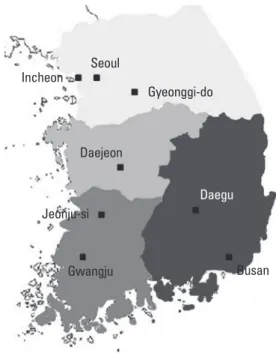
This study applied stratified, cluster, and systematic sampling procedures to select enumeration districts based on population, housing data and enumeration district information from the 2005 Population and Housing Census. Stratification variables were region, dong (neighborhood), eup (town), myeon (town- ship), and housing type. The sample composition was adjusted to be representative of the population; subsequently, sampling was conducted by dividing the population into 4 spheres split into 2 to 4 regions that formed 2 to 3 layers. Following the prin- ciple of a percentage quota for each layer, 200 samples were al- located to each. The allocated sample dong, eup, and myeon were extracted through probability sampling proportional to size based on the number of enumeration districts. We applied systematic sampling procedures to extract and investigate apartment and conventional dwelling enumeration districts based on the characteristics of the selected sample dong, eup, and myeon according to housing type. All 4,600 household members were included as research subjects. Among them, 219 general subjects were selected for the preliminary investi- gation after consultation with the Chronic Disease Investiga- tion Division (the department initiating the research). Four spheres nationwide (Seoul, Busan, Gwangju, Daejeon, Daegu, Incheon, Jeonju, and Gyeonggi-do) were evenly included in the preliminary investigation; subsequently, the proportion of housing type was 3:2 for apartments and conventional dwell- ings (row houses) (Fig. 1).
Among the 219 candidates, we invited 171 candidates who
were 10 years of age or older to participate in this study. Among these, 110 candidates (in 60 families comprised of 36 apartment families and 24 detached house families) who understood the survey and volunteered to participate were enrolled in the al- lergic disease survey and SPT from November 3, 2009 to Febru- ary 26, 2010. Among the 110 candidates, 12 candidates were under 18 years old (mean age 14.3 years). Candidates complet- ed a health questionnaire that included information on the presence of allergic disease (such as asthma, allergic rhinitis, atopic dermatitis, and allergic conjunctivitis) and pet inhabit- ance. Atopy was defined by the presence of specific IgE to any 11 aeroallergens determined by SPT or ImmunoCAP.
Questionnaire survey for the presence of allergic diseases and indoor air condition
The KNHANES Phase IV questionnaire included questions on asthma and allergic rhinoconjunctivitis. We used an ISAAC sur- vey questionnaire that included a KNHANES Phase IV ques- tionnaire with questions on atopic dermatitis, drug allergy and pet inhabitance.9
Skin prick test
The allergy skin prick test (SPT) utilized 11 common aeroal- lergens (Allergopharma, Hamburg, Germany): D. farinae, D.
pteronyssinus, cockroach, Alternaria, cat dander, dog dander, oak, birch, grass, mugwort, ragweed, and Japanese hop. We also included a positive control (1% histamine in saline with 0.3%
phenol and 50% glycerol) and negative control (saline with 0.3%
phenol and 50% glycerol). Candidates who had received anti- histamines 7 days prior to the test were excluded from the SPT.
The results were read 15 minutes after the SPT and a wheal larg- er than 3 mm (compared to the negative control) for each aller- gen was defined as positive.
Serum IgE measurement
We used the ImmunoCAP® system to measure the levels of specific IgE to 6 aeroallergens (D. farinae, Blattella germanica, dog dander, oak, mugwort and Japanese hop) in 110 participants.
Results greater than 0.35 kU/L for specific IgE were defined as positive.
Protein extraction from house dust and major allergen measurements
House dust was collected from the bedclothes of candidates using the same vacuum cleaner (LG Electronics, Changwon, Korea) for 2 minutes per 1 m2 of bedding. The power of the vac- uum was 500 W. Collected house dust (100 mg) was placed into 2 mL of borated buffered saline (pH 8.0) and extracted for 24 hours at 4°C and then centrifuged. The supernatants were stored at -20°C until measured. The levels of 5 major allergens in the supernatants were measured by a 2-site ELISA (INDOOR Bio- technologies Inc. [IBI], Charlottesville, Virginia, USA).
Seoul
Gyeonggi-do Incheon
Daejeon
Daegu
Busan Gwangju
Jeonju-si
Fig. 1. A map of Korea presenting 4 spheres and specific 8 localities.
Statistical analysis
Statistical analyses were performed using SPSS version 12.0 (SPSS Inc., Chicago, IL, USA). Variables were compared using a chi-square test. The concordance between the 2 methods was established using Kappa statistics and an A P value less than 0.05 was considered statistically significant.
RESULTS
Prevalence of respiratory allergic diseases and inhalant allergen sensitization determined by skin prick test or ImmunoCAP
The prevalence of asthma and allergic rhinitis was 7.3% and 25.5%, respectively, which corresponded to the results of the previous study.6 Fig. 2 shows the sensitization rate to each aller- gen by SPT and ImmunoCAP IgE measurements. According to the SPT, the prevalence of atopy was 56%. The highest rates were observed in D. farinae (40.9%), followed by cockroach (23.6%), mugwort (13.6%), ragweed (10%), oak (9.1%), Japanese hop (9.1%), and dog dander (8.2%) by SPT. A total of 83.9% of total atopy patients were positive to D. farinae and/or cockroach and 94.6% of atopy patients were positive to either D. farinae, cock- roach, oak, or Japanese hop. We measured 6 important inhal-
ant allergens sIgE by ImmunoCAP. The most common sensitiz- ers were D. farinae (36.8%), mugwort (22.9%), oak (22.9%), cockroach (19.5%), Japanese hop (8.6%), and dog dander (6.9%).
Concordance rate of SPT and ImmunoCAP
Table 1 shows the kappa statistics with concordance rates be- tween SPT and ImmunoCAP tests. Only the kappa statistics of mugwort and D. farinae were higher than 0.6, and cockroach was 0.507. The value of other allergens such as dog dander (0.389) and oak (0.353) are not satisfactory for concordance and Japa- nese hop even indicated a negative value.
Inter-group analysis by atopy
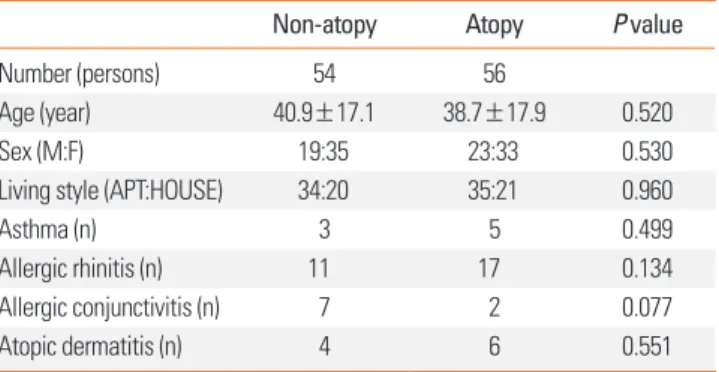
We divided participants into 2 groups according to presence of atopy. There were no differences in age, sex, life style, pres- ence of asthma, allergic rhinitis, allergic conjunctivitis, and atop- ic dermatitis as determined by the Korean version of ISAAC questionnaire (Table 2).
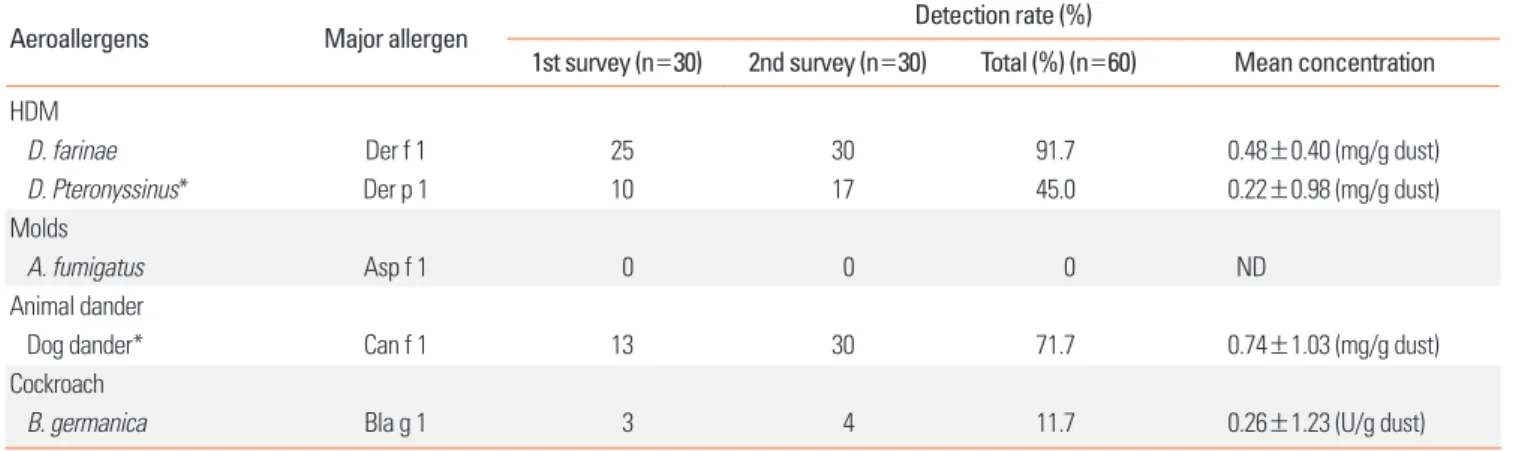
Detection of indoor major allergens in fine bedding dust Table 3 shows the detection rates for 5 major allergens mea- sured by a 2-site ELISA. Der f 1 in house dust was detected in 91.7% of enrolled houses and Der p 1 was detected in 45.0% of houses. Geographically, D. farinae was detected evenly nation- wide; however, D. pteronyssinus was detected only in cities lo- cated in southern provinces such as Busan and Gwangju (Fig. 3).
Can f 1 had higher rates in the 5 houses with dogs compared with houses without dogs (Fig. 4). Group 1 major allergen of As- pergillus fumigatus was not detected in any house.
DISCUSSION
It is important to accurately investigate the prevalence of al- lergic diseases and the level of exposure to indoor allergens from indoor environments. However, the previous Phase 1-3 KNHNES was insufficient to determine the prevalence of aller- gic diseases or to determine the exposure from Korean domes- tic indoor environments. Therefore, we conducted a nation- 50
40 30 20 10 0
SPT positivity rate (%) sIgE positivity rate (%) 40.9
23.6
13.6 9.1 9.1 8.2 10
5.5 5.5 5.5 5.5
D. farinaeCockroach Mugwort Oak
Japanese hopDog dander RagweedCat dander Birch
RyegrassAlternaria Total IgE 36.8
19.5 22.9 22.9 8.6 6.9
42.5
Fig. 2. Positive rate to skin prick test and specific IgE determined by Immuno- CAP. SPT, skin prick test; sIgE, specific immunoglobulin E; D. farina, Derma- tophagoides farinae.
Table 1. Kappa statistics showing the concordance rate of specific IgE and SPT for each allergen
Allergen Kappa P value
D. farinae 0.601 <0.001
Cockroach 0.507 <0.001
Dog dander 0.389 <0.001
Oak 0.353 <0.006
Mugwort 0.756 <0.001
Japanese hop -0.078 0.561
SPT, skin prick test; D. farina, Dermatophagoides farinae.
Table 2. Clinical characteristics of the study subjects according to atopy status
Non-atopy Atopy P value
Number (persons) 54 56
Age (year) 40.9±17.1 38.7±17.9 0.520
Sex (M:F) 19:35 23:33 0.530
Living style (APT:HOUSE) 34:20 35:21 0.960
Asthma (n) 3 5 0.499
Allergic rhinitis (n) 11 17 0.134
Allergic conjunctivitis (n) 7 2 0.077
Atopic dermatitis (n) 4 6 0.551
APT, apartment.
wide survey on allergic diseases in autumn and winter and the levels of indoor allergens using various diagnostic tools. The data showed that HDM, cockroach, mugwort, oak, Japanese hop, ragweed, and dog dander are important inhalant allergens in Korea. The number of households with pets has increased and pet inhabitancy has became one of the major risk factors for the development of allergic diseases.16 Grass is the most im- portant global pollen; however, this study did not include grass pollen for the SPT and ImmunoCAP specific IgE measurement due to the low rate of exposure to grass pollen in Korea.17,18
The data indicated a significant discrepancy between the re- sults of SPT and ImmunoCAP IgE measurement. The value of the agreement can be defined by the kappa value. Usually, a kap- pa value higher than 0.6 is considered a substantial or almost perfect concordance.19 Only the kappa value of mugwort and D.
farinae was acceptable. Other allergens such as cockroach, oak, dog dander were not sufficient to assume concordance and an even a negative kappa value was found for (Table 1).
A SPT is time-consuming (taking about 30 minutes) and the results of the SPT depend on the investigator, drug history, and skin status. Investigators may inject the allergens in different
ways and to various depths; consequently, the SPT may be in- appropriate for large epidemiologic studies. The measurement of specific IgE in serum can be more appropriate as it is faster and does not depend on the investigator, drug history, or skin status. However, cost is a drawback of ImmunoCAP measure- ment in epidemiologic studies. There are various tools available to measure specific IgE. Multiplex measurement methods such as the multiple allergen simultaneous test, AdvanSure (LG Life Science, Daejeon), and RIDA (R-Biopharm, Germany) can measure 36-40 specific IgEs in serum simultaneously. Howev- er, the correlation and concordance rates between multiplex measurement and ImmunoCAP in some inhalant allergens are unsatisfactory because each test can vary in sensitivity and specificity.20,21 The measurement of specific IgEs by the Immu- noCAP system is highly sensitive, specific, and convenient;
consequently, we recommend that laboratory tests include the ImmunoCAP system to measure specific IgE levels in serum.
This survey has some limitations. We diagnosed allergic dis- eases by a Korean version of the ISSAC questionnaire that is de- pendent on the memory of respondents. An accurate diagnosis of allergic diseases must be supplemented by in vivo or in vitro diagnostic procedures. In the present study, allergic conjuncti- vitis was more prevalent in the non-atopy group, which suggests Table 3. Detection of major allergens in fine house dust (bedding)
Aeroallergens Major allergen Detection rate (%)
1st survey (n=30) 2nd survey (n=30) Total (%) (n=60) Mean concentration HDM
D. farinae Der f 1 25 30 91.7 0.48±0.40 (mg/g dust)
D. Pteronyssinus* Der p 1 10 17 45.0 0.22±0.98 (mg/g dust)
Molds
A. fumigatus Asp f 1 0 0 0 ND
Animal dander
Dog dander* Can f 1 13 30 71.7 0.74±1.03 (mg/g dust)
Cockroach
B. germanica Bla g 1 3 4 11.7 0.26±1.23 (U/g dust)
*P<0.05, significantly increased level in 2nd survey (winter) compared with 1st survey (late autumn).
HDM, house dust mite; D. farina, Dermatophagoides farinae; D. pteronyssinus, Dermatophagoides pteronyssinus; A. fumigates, Aspergillus fumigatus; B. germani- ca, Blattella germanica, ND, not detected.
4.0 3.5 3.0 2.5 2.0 1.5 1.0 0.5 0
μg/g dust
Dog (-) (n=55) Dog (+) (n=5)
Can f 1 P<0.05
Fig. 4. Group 1 major allergen of dog dander levels determined by a 2-site ELISA according to dog inhabitance.
DOG (+), Houses with dogs; DOG (-), Houses without dogs.
0.7 0.6 0.50.4 0.30.2 0.10
μg/g dust
Der f 1 Der p 1
Seoul Gyeonggi &
Incheon Daejeon Daegu &
Busan Gwangju &
Jeonju P<0.05
Fig. 3. Nationwide geographical distribution of group 1 major allergens of house dust mites.
that supplementary diagnostic tools or allergy specialist inter- view and physical examination are essential for accurate evalua- tion.
We conducted a 2-site ELISA to measure the levels of indoor aeroallergens using monoclonal antibodies. Monoclonal anti- bodies are epitope specific and may not detect all isoallergens of major allergens;22 consequently, this method has not yet been validated for the standardization of allergen extract.23,24 Measurement results are dependent of the type of 2-site ELISA kit; consequently, the Committee for Biologics Equivalent Re- search (CBER) of FDA use polyclonal antibodies for allergen standardization. Aspergillus fungus is ubiquitous and a well- known indoor fungus; however, we were unable to detect Asp f 1. This suggests that the exposure of Aspergillus fumigatus is not serious in Korea and may explain the low incidence of allergic bronchopulmonary aspergillosis in Korea.25
The level of aeroallergens can vary by geography. Fig. 2 shows that Der p 1 was only detected in a small number of houses in the middle province of Korea; however, the level of Der p 1 is similar to Der f 1in the southern part of the Korean peninsula and suggests that D. pteronyssinus is the co-predominant HDM with D. farinae in these areas. These results corresponded to a previous study that indicated that the presence of D. farinae was nationwide (Seoul 63.6%; Gwangju 63.6%, Busan 79.6%; Incheon 96.5%; Daejon 83.9%; Jeonju 87.2%, Chongju 95.2%); however, D.
pteronyssinus was detected predominantly in Busan (Yongk- wan-ub 72.5%, Yongdo 64.9%).26
Another limitation of the present survey is that it was con- ducted only in the autumn and winter; consequently, the levels of HDM, cockroach, and Aspergillus fumigatus allergens may be higher in the summer.27
Levels of allergens can vary by pet inhabitancy.28,29 There was no difference in Fel d 1 level between houses with cats and houses without; however, the results may be due to the small sample size of only 2 houses with cats. We may have obtained better results if more houses with cats had been included in the samples. Despite this limitation, Can f 1 and Fel d 1 were de- tected in 71.7% and 66.7% of total houses, respectively, which suggests that pet allergen plays a major role for the develop- ment of allergic diseases in Korea. The high detection rate of Can f 1 and Fel d 1 in houses without cats and dogs is caused by the physical characteristics of animal dander.30 Dog and cat dander easily spreads to other areas due to its easy adherence to clothes, carpet and furniture; consequently, Can f 1 and Fel d 1 can be detected in many houses without pets.31,32 So, pet own- ership is not always correlated with the development of sensiti- zation to pets.33
The present study represents a nationwide survey on allergic disease in autumn and winter in major cities in Korea. We pro- pose an indoor aeroallergen and allergic disease survey model in accordance with the KNHANES and recommend an Immu- noCAP system to diagnose atopy and a 2-site ELISA test to mea-
sure aeroallergens in indoor environments.
REFERENCES
1. Suh M, Kim HH, Sohn MH, Kim KE, Kim C, Shin DC. Prevalence of allergic diseases among Korean school-age children: a nationwide cross-sectional questionnaire study. J Korean Med Sci 2011;26:332- 8.
2. Lee SI, Shin MH, Lee HB, Lee JS, Son BK, Koh YY, Kim KE, Ahn YO.
Prevalences of symptoms of asthma and other allergic diseases in korean children: a nationwide questionnaire survey. J Korean Med Sci 2001;16:155-64.
3. Beasley R, Ellwood P, Asher I. International patterns of the preva- lence of pediatric asthma the ISAAC program. Pediatr Clin North Am 2003;50:539-53.
4. Bateman ED, Hurd SS, Barnes PJ, Bousquet J, Drazen JM, FitzGer- ald M, Gibson P, Ohta K, O’Byrne P, Pedersen SE, Pizzichini E, Sul- livan SD, Wenzel SE, Zar HJ. Global strategy for asthma manage- ment and prevention: GINA executive summary. Eur Respir J 2008;
31:143-78.
5. Downs SH, Marks GB, Sporik R, Belosouva EG, Car NG, Peat JK.
Continued increase in the prevalence of asthma and atopy. Arch Dis Child 2001;84:20-3.
6. Park HS, Choi GS, Cho JS, Kim YY. Epidemiology and current status of allergic rhinitis, asthma, and associated allergic diseases in Ko- rea: ARIA Asia-Pacific workshop report. Asian Pac J Allergy Immu- nol 2009;27:167-71.
7. Strachan DP. The role of environmental factors in asthma. Br Med Bull 2000;56:865-82.
8. Worldwide variation in prevalence of symptoms of asthma, allergic rhinoconjunctivitis, and atopic eczema: ISAAC. The International Study of Asthma and Allergies in Childhood (ISAAC) Steering Committee. Lancet 1998;351:1225-32.
9. Ellwood P, Asher MI, Beasley R, Clayton TO, Stewart AW; ISAAC Steering Committee. The international study of asthma and aller- gies in childhood (ISAAC): phase three rationale and methods. Int J Tuberc Lung Dis 2005;9:10-6.
10. Hong SJ, Lee MS, Sohn MH, Shim JY, Han YS, Park KS, Ahn YM, Son BK, Lee HB; Korean ISAAC Study Group. Self-reported preva- lence and risk factors of asthma among Korean adolescents: 5-year follow-up study, 1995-2000. Clin Exp Allergy 2004;34:1556-62.
11. Jeong KY, Hong CS, Lee JS, Park JW. Optimization of allergen stan- dardization. Yonsei Med J 2011;52:393-400.
12. Voorhorst R, Spieksma FT, Varekamp H, Leupen MJ, Lyklema AW.
The house-dust mite (Dermatophagoides pteronyssinus) and the allergens it produces. Identity with the house-dust allergen. J Aller- gy 1967;39:325-39.
13. Miyamoto T, Oshima S, Ishizaki T, Sato SH. Allergenic identity be- tween the common floor mite (Dermatophagoides farinae Hughes, 1961) and house dust as a causative antigen in bronchial asthma. J Allergy 1968;42:14-28.
14. Jeong KY, Park JW, Hong CS. House dust mite allergy in Korea: the most important inhalant allergen in current and future. Allergy Asthma Immunol Res 2012;4:313-25.
15. Lee SY, Kwon JW, Seo JH, Song YH, Kim BJ, Yu J, Park KS, Kim H, Kim EJ, Lee JS, Hong SJ. Prevalence of atopy and allergic diseases in Korean children: associations with a farming environment and ru- ral lifestyle. Int Arch Allergy Immunol 2012;158:168-74.
16. Morris DO. Human allergy to environmental pet danders: a public
health perspective. Vet Dermatol 2010;21:441-9.
17. Oh JW, Kang IJ, Kim SW, Kook MH, Kim BS, Cheong JT, Lee HB.
The association between the concentration of pollen and outbreak of pollinosis in childhood. Pediatr Allergy Respir Dis 2009;19:4-11.
18. Oh JW, Lee HR, Kim JS, Lee KI, Kang YJ, Kim SW, Kook MH, Kang HY, Kim JS, Lee MH, Lee HB, Kim KE, Pyun BY, Lee SI, Han MJ.
Aerobiological study of pollen and mold in the 10 states of Korea.
Pediatr Allergy Respir Dis 2000;10:22-33.
19. Landis JR, Koch GG. The measurement of observer agreement for categorical data. Biometrics 1977;33:159-74.
20. Lee YW, Sohn JH, Lee JH, Hong CS, Park JW. Allergen-specific IgE measurement with the IMMULITE 2000 system: intermethod com- parison of detection performance for allergen-specific IgE antibod- ies from Korean allergic patients. Clin Chim Acta 2009;401:25-32.
21. Lee JH, Park KH, Kim HS, Kim KW, Sohn MH, Kim CH, Lee JS, Hong CS, Park JW. Specific IgE measurement using AdvanSure®
system: Comparison of detection performance with ImmunoCAP®
system in Korean allergy patients. Clin Chim Acta 2012;413:914-9.
22. Park JW, Kim KS, Jin HS, Kim CW, Kang DB, Choi SY, Yong TS, Oh SH, Hong CS. Der p 2 isoallergens have different allergenicity, and quantification with 2-site ELISA using monoclonal antibodies is influenced by the isoallergens. Clin Exp Allergy 2002;32:1042-7.
23. van Ree R, Chapman MD, Ferreira F, Vieths S, Bryan D, Cromwell O, Villalba M, Durham SR, Becker WM, Aalbers M, André C, Barber D, Cistero Bahima A, Custovic A, Didierlaurent A, Dolman C, Dorpe- ma JW, Di Felice G, Eberhardt F, Fernandez Caldas E, Fernandez Rivas M, Fiebig H, Focke M, Fötisch K, Gadermaier G, Das RG, Gonzalez Mancebo E, Himly M, Kinaciyan T, Knulst AC, Kroon AM, Lepp U, Marco FM, Mari A, Moingeon P, Monsalve R, Neu- bauer A, Notten S, Ooievaar-de Heer P, Pauli G, Pini C, Purohit A, Quiralte J, Rak S, Raulf-Heimsoth M, San Miguel Moncin MM, Simpson B, Tsay A, Vailes L, Wallner M, Weber B. The CREATE project: development of certified reference materials for allergenic products and validation of methods for their quantification. Aller-
gy 2008;63:310-26.
24. van Ree R. Indoor allergens: relevance of major allergen measure- ments and standardization. J Allergy Clin Immunol 2007;119:270-7.
25. Park JW, Kim HS, Byen JW, Koe SH, Hong YK, Kim CW, Choe K, Hong CS. The prevalence of allergic bronchopulmonary aspergil- losis in asthmatics with positive skin reactivity to Aspergillus fu- migatus antigens. Korean J Allergy 1997;17:510-21.
26. Ree HI, Jeon SH, Lee IY, Hong CS, Lee DK. Fauna and geographical distribution of house dust mites in Korea. Korean J Parasitol 1997;35:
9-17.
27. Kosik-Bogacka DI, Kalisinska E, Henszel L, Kuzna-Grygiel W. Sea- sonal dynamics of house dust mites in dust samples collected from sleeping places in north-western Poland. Zoonoses Public Health 2012;59:8-15.
28. Medjo B, Atanaskovic-Markovic M, Nikolic D, Spasojevic-Dimitri- jeva B, Ivanovski P, Djukic S. Association between pet-keeping and asthma in school children. Pediatr Int 2013;55:133-7.
29. Smallwood J, Ownby D. Exposure to dog allergens and subsequent allergic sensitization: an updated review. Curr Allergy Asthma Rep 2012;12:424-8.
30. Ling M, Long AA. Pet dander and difficult-to-control asthma: ther- apeutic options. Allergy Asthma Proc 2010;31:385-91.
31. Berge M, Munir AK, Dreborg S. Concentrations of cat (Fel d1), dog (Can f1) and mite (Der f1 and Der p1) allergens in the clothing and school environment of Swedish schoolchildren with and without pets at home. Pediatr Allergy Immunol 1998;9:25-30.
32. Patchett K, Lewis S, Crane J, Fitzharris P. Cat allergen (Fel d 1) levels on school children’s clothing and in primary school classrooms in Wellington, New Zealand. J Allergy Clin Immunol 1997;100:755-9.
33. Park YB, Mo EK, Lee JY, Kim JH, Kim CH, Hyun IG, Choi JH. Asso- ciation Between Pet Ownership and the Sensitization to Pet Aller- gens in Adults With Various Allergic Diseases. Allergy Asthma Im- munol Res 2013;5:295-300.