Post-Traumatic Cognition Mediates the Relationship between a History of Sexual Abuse and the Post-Traumatic Stress Symptoms in Sexual Assault Victims
More than half of all sexual assault victims report experiencing sexual victimization more than once. The aim of this paper was to determine the role post-traumatic cognition plays in the relationship between a history of sexual abuse and post-traumatic stress symptoms in sexual assault victims. The relationship between a history of sexual assault and the severity of post-traumatic stress symptoms was investigated retrospectively using data from a sexual assault crisis center in Korea. Data on psychological symptoms were collected in person at the initial assessment and by telephone 1 month later using the Post-traumatic Cognitions Inventory and the Post-traumatic Stress Disorder Symptoms Scale: Self-report Version. Of 105 women included in the analysis, 10 (9.5%) reported prior sexual abuse and were classified as sexually revictimized. Revictimized women had more post-traumatic negative cognition at initial assessment (t = −2.98; P = 0.004) and more post-traumatic symptoms at 1 month follow-up (t = −2.39; P = 0.019) than singly victimized women. At 1 month follow-up, the severity of post-traumatic stress symptoms had increased in revictimized women but had decreased slightly in singly victimized women. Negative post- traumatic cognition fully mediated the association between a history of sexual abuse and the severity of post-traumatic stress symptoms. Early detection of sexually revictimized women and tailored service and treatment intervention is needed to better serve this group of victims. Interventions targeted at preventing revictimization or post crime victimization may also help victims recover from the trauma and prevent future abuse.
Keywords: Sexual Abuse; Revictimization; Posttraumatic Stress Kyoung Min Shin,1 Young Ki Chung,2,3,4
Yee Jin Shin,5 Miran Kim,6 Nam Hee Kim,2,4 Kyoung Ah Kim,3,4 Hanbyul Lee,3 and Hyoung Yoon Chang2,3,4
1Department of Counseling Psychology, Hanyang Cyber University, Seoul, Korea; 2Department of Psychiatry and Behavioral Sciences, Ajou University School of Medicine, Suwon, Korea; 3Sunflower Center of Southern Gyeonggi for Women and Children Victims of Violence, Suwon, Korea;
4Center for Traumatic Stress, Ajou University Medical Center, Suwon, Korea; 5Department of Psychiatry and Behavioral Sciences, Yonsei University College of Medicine, Seoul, Korea;
6Department of Obstetrics and Gynecology, Ajou University School of Medicine, Suwon, Korea Received: 23 February 2017
Accepted: 15 July 2017 Address for Correspondence:
Hyoung Yoon Chang, MD, PhD
Department of Psychiatry, Ajou University School of Medicine, 164 World cup-ro, Yeongtong-gu, Suwon 16409, Republic of Korea
E-mail: [email protected]
Funding: The study was supported by a fund from the Ministry of Gender Equality and Family, Republic of Korea.
https://doi.org/10.3346/jkms.2017.32.10.1680 • J Korean Med Sci 2017; 32: 1680-1686
INTRODUCTION
More than half of all sexual assault victims report experiencing sexual victimization more than once (1). In a recent Korean na- tional survey, 52.2% of victims of sexual violence reported hav- ing been victimized more than once (2). These revictimized women experience more emotional distress and psychopathol- ogy, including post-traumatic stress disorder (PTSD) (3) and suicide attempts (4) than sexual assault victims who are singly victimized. Furthermore, revictimized women were at higher risk of engaging in prostitution and were less likely to use con- doms consistently than women who had been sexually abused only as a child or an adult (5), resulting in higher social cost.
Several studies have focused on the risk factors of revictimiza- tion, such as childhood abuse (6), risk recognition (7), and sex- ual assertiveness (8). PTSD symptoms (9) and depression and anxiety (10) have also been proposed as risk factors for rape and revictimization.
Post-traumatic negative cognition affects post-traumatic stress
symptoms and prognosis in traumatized victims (11). Thoughts about one’s perceived weaknesses and the dangers of the world play an important role in the development of PTSD (12). Sever- al trauma theorists have proposed that negative thoughts about the world and one’s incompetence mediate the development of PTSD after sexual assault (13,14). In other studies, avoidance- coping embedded dysfunctional cognitions (e.g., “the world is dangerous,” “the accident was my fault”) are associated with greater levels of post-traumatic stress symptoms (15,16). How- ever, how post-traumatic cognition contributes to the link be- tween a history of sexual abuse and post-traumatic stress symp- toms in sexual assault victims in Korea remains unclear.
Given that women with a history of sexual abuse show higher post-traumatic symptoms than women without a history of sex- ual abuse, it is important to determine which factors lead to a poor prognosis to develop intervention strategies that reduce symptoms in sexually revictimized women. Negative post-trau- matic cognition is widely recognized as being important in the exploration of the relationship between negative cognition and ORIGINAL ARTICLE
Psychiatry & Psychology
2017-03-16 https://crossmark-cdn.crossref.org/widget/v2.0/logos/CROSSMARK_Color_square.svg
post-traumatic stress symptoms. The aim of this paper was to determine the role post-traumatic cognition plays in the rela- tionship between a history of sexual abuse and post-traumatic stress symptoms in sexual assault victims in Korea. We hypoth- esized that revictimized women would show more severe post- traumatic stress symptoms than singly victimized women, and that these symptoms would be mediated by post-traumatic neg- ative cognition. The study was conducted using data from a Sun- flower Center, a crisis intervention center for sexual assault vic- tims, in Korea.
MATERIALS AND METHODS Participants and procedure
Data were obtained from victim records at the Sunflower Cen- ter of Southern Gyeonggi for Women and Children Victims of Violence and Ajou University Hospital in Korea. The Sunflower Center is a government-funded, hospital-based, crisis interven- tion service center that provides counseling, legal and investi- gative support, and medical and psychological treatment for victims of sexual violence, domestic violence, and sex traffick- ing in Korea. For this study, we retrospectively evaluated the re- cords of victims who visited the center between December 2014 and June 2016, and excluded victims of domestic violence or sex trafficking, male victims, victims with intellectual disabili- ties and those without Korean nationality, as well as victims whose crime report was considered unreliable.
Demographic characteristics and the features of the assault were obtained from data recorded at the initial baseline assess- ment. At this baseline assessment, victims completed self-re- port questionnaires to evaluate post-traumatic cognition and the severity of post-traumatic stress symptoms, anxiety, and de- pression. One month after the initial assessment, victims were contacted by telephone and re-completed the self-report ques- tionnaire to evaluate the severity of post-traumatic stress symp- toms.
Measures
At the initial assessment, victims completed the Post-traumatic Cognitions Inventory (PTCI) to evaluate negative trauma-relat- ed thoughts and beliefs. The PTCI consists of 36 items, which are divided into three subscales: negative cognitions about self (21 items; negative self), negative cognitions about the world (7 items; negative world), and self-blame for trauma (5 items; self- blame). Each item is scored on a seven-point Likert scale. The PTCI subscales have good test-retest reliability (0.75–0.89), good internal consistency (Cronbach’s α, 0.86–0.97), and moderate- to-high correlations with post-traumatic stress symptom sever- ity (17). The PTCI items were translated into Korean by the first author, and then reviewed by a fluent bilingual psychiatrist. Cron- bach’s α in the present study was 0.95.
At the initial assessment and 1 month later, victims complet- ed the PTSD Symptoms Scale: Self-Report Version (PSS-SR) to evaluate the severity of post-traumatic stress symptoms. The PSS-SR consists of 17 items that correspond to the PTSD symp- toms listed in the Diagnostic and Statistical Manual of Mental Disorders, 4th edition (DSM-IV). The PSS-SR has an acceptable- to-good reliability and validity, and provides a measure of symp- tom severity (18). The PSS-SR used in this study was composed of items derived from the PTSD diagnostic criteria in the Kore- an version of the Structured Clinical Interview for the DSM-IV (19).
At the initial assessment, victims completed the Korean ver- sion of the Beck Depression Inventory (BDI) (20) and Beck Anx- iety Inventory (BAI) (21) to evaluate depression and anxiety, re- spectively. The BDI is a 21-item self-report scale that evaluates the severity of depressive symptoms. The Korean version of the BDI has good psychometric properties, with internal consisten- cy of 0.92 (22). The BAI is a 21-item self-report questionnaire designed to evaluate the frequency of anxiety symptoms over a 1-week period. We administered a Korean version of the BAI that demonstrates good psychometric properties. The internal consistency coefficient of the BAI is 0.93, and test-retest reliabil- ity is 0.84 (23).
Data analysis
All statistical analyses were conducted using SAS, version 9.4 (SAS Institute Inc., Cary, NC, USA). Women who reported hav- ing experienced prior sexual abuse were classified as sexually revictimized. Women who reported no prior sexual abuse were classified as singly victimized. Chi-square and Fisher’s exact tests were used to compare the distribution of categorical vari- ables between groups. Independent samples t-test was used to compare PSS-SR scores, PTCI scores, BDI score, and BAI score between revictimized and singly victimized women. The paired t-test was performed to compare the PSS-SR score at initial as- sessment and at 1 month follow-up.
To test whether post-traumatic negative cognition mediated the relation between a history of sexual abuse and severity of post-traumatic stress symptoms, we first tested the bivariate correlation between a history of sexual abuse (coded as 0 for no, 1 for yes) and PTCI scores (total score, negative self-subscale score, negative world subscale score, and self-blame subscale score) at initial assessment and PSS-SR scores (total score, re- experiencing subscale score, avoidance subscale score, and hy- perarousal subscale score) at 1 month follow-up. We conducted regression analysis with and without adjusting for PTCI scores to test the direct and indirect pathways connecting a history of sexual abuse with the severity of post-traumatic stress symp- toms. All regression analyses were adjusted for age, marital sta- tus, and type of violence.
Table 1. Characteristics of the participants
Characteristics Total
(n = 105)
History of sexual violence
P value Yes
(n = 10) No (n = 95)
Age, yr 0.433
16–19 24 (22.9) 3 (30.0) 21 (22.1)
20–29 67 (63.8) 7 (70.0) 60 (63.2)
30–39 14 (13.3) 0 (0.0) 14 (14.7)
Marital status 0.683
Never married 85 (81.0) 9 (90.0) 76 (80.0)
Other 20 (19.0) 1 (10.0) 19 (20.0)
Type of violence 0.684
Rape 83 (79.1) 9 (90.0) 74 (77.9)
Sexual assault other than rape 22 (21.0) 1 (10.0) 21 (22.1)
Time until reporting 0.805
Within 24 hr 63 (60.0) 6 (60.0) 57 (60.0)
Within 1 wk 24 (22.9) 3 (30.0) 21 (22.1)
After 1 wk 18 (17.1) 1 (10.0) 17 (17.9)
Type of perpetuator 0.890
Stranger 43 (41.0) 4 (40.0) 39 (41.1)
Acquaintance 54 (51.4) 5 (50.0) 49 (51.6) Family member/lover 8 (7.6) 1 (10.0) 7 (7.4) Drunk during the assault 68 (64.8) 8 (80.0) 60 (63.2) 0.488 Experienced violence during the assault 24 (22.9) 3 (30.0) 21 (22.1) 0.692 Photographs taken during the assault 6 (5.7) 2 (20.0) 4 (4.2) 0.100 Data are presented as number (%). P values were obtained using Fisher's exact tests.
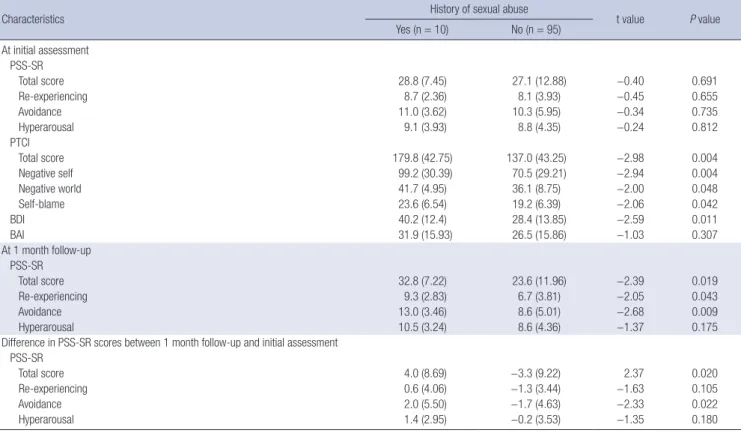
Table 2. Severity of PTSD symptoms and post-traumatic negative cognition at initial assessment and 1 month follow-up in sexually assaulted women with and without a history of sexual abuse
Characteristics History of sexual abuse
t value P value Yes (n = 10) No (n = 95)
At initial assessment PSS-SR
Total score 28.8 (7.45) 27.1 (12.88) −0.40 0.691
Re-experiencing 8.7 (2.36) 8.1 (3.93) −0.45 0.655
Avoidance 11.0 (3.62) 10.3 (5.95) −0.34 0.735
Hyperarousal 9.1 (3.93) 8.8 (4.35) −0.24 0.812
PTCI
Total score 179.8 (42.75) 137.0 (43.25) −2.98 0.004
Negative self 99.2 (30.39) 70.5 (29.21) −2.94 0.004
Negative world 41.7 (4.95) 36.1 (8.75) −2.00 0.048
Self-blame 23.6 (6.54) 19.2 (6.39) −2.06 0.042
BDI 40.2 (12.4) 28.4 (13.85) −2.59 0.011
BAI 31.9 (15.93) 26.5 (15.86) −1.03 0.307
At 1 month follow-up PSS-SR
Total score 32.8 (7.22) 23.6 (11.96) −2.39 0.019
Re-experiencing 9.3 (2.83) 6.7 (3.81) −2.05 0.043
Avoidance 13.0 (3.46) 8.6 (5.01) −2.68 0.009
Hyperarousal 10.5 (3.24) 8.6 (4.36) −1.37 0.175
Difference in PSS-SR scores between 1 month follow-up and initial assessment PSS-SR
Total score 4.0 (8.69) −3.3 (9.22) 2.37 0.020
Re-experiencing 0.6 (4.06) −1.3 (3.44) −1.63 0.105
Avoidance 2.0 (5.50) −1.7 (4.63) −2.33 0.022
Hyperarousal 1.4 (2.95) −0.2 (3.53) −1.35 0.180
Data are presented as mean (standard deviation).
PTSD = post-traumatic stress disorder, PSS-SR = Post-traumatic Stress Disorder Symptoms Scale: Self-Report Version, PTCI = Post-traumatic Cognitions Inventory, BDI = Beck Depression Inventory, BAI = Beck Anxiety Inventory.
Ethics statement
The present study protocol was reviewed and approved by the Institutional Review Board of Ajou University Medical Center (IRB No. SBR-MDB-15-139). Informed consent was waivered due to retrospective design of the study.
RESULTS
A total of 646 people reporting sexual victimization visited the Center between December 2014 and December 2015. One hun- dred and forty-six of these were excluded (8 men and 82 wom- en with intellectual disabilities, 9 women with foreign nationali- ties, and 13 women with unreliable crime reports). The remain- ing 157 (31.4%) of the 500 women had completed the psycho- logical measures (PTCI, PSS-SR, BDI, and BAI) at the initial as- sessment. Those who did not complete the questionnaires were either victims too agitated or too drunk to fill in the question- naires, victims with limited ability to understand the Korean language, and those who refused to answer the questionnaires.
Fifty-two of these women were lost to follow-up, and 105 (66.9%) participated in a telephone survey at 1 month after the initial assessment. These 80 women were included in the analysis. Vic- tims who did not complete the baseline psychological assess-
ment (n = 239) were more likely to be aged over 30 years, assault- ed rather than raped, and not drunk at the time of the crime than victims who did complete the baseline psychological as- sessment (n = 121; data not shown, available on request). The type of perpetuator differed between victims who were lost to follow-up (n = 41) and victims who were not lost to follow-up (n = 80; data not shown, available on request). However, vic- tims included in and excluded from the analysis did not differ in the main exposure variable, whether or not they reported be- ing exposed to prior sexual abuse.
Among the 105 female victims included in the analysis, 83 (79.1%) reported having been raped, and 63 (60.0%) visited the center within 24 hours of the crime. 10 (9.5%) reported that they had been sexually victimized before, and were classified as revic- timized. The remaining 95 women were classified as singly vic- timized. Revictimized women showed a trend of being more likely to have had a photograph taken during the assault (Table 1).
The PSS-SR score at initial assessment did not differ between revictimized and singly victimized women. The PTCI and BDI scores at initial assessment and PSS-SR score at 1 month follow- up were significantly higher for revictimized women than for singly victimized women. There was a statistically significant difference (mean [standard deviation], 4.0 [8.69] vs. −3.3 [9.22];
P value = 0.020) (Table 2) in the differences in PSS-SR scores at 1 month follow-up and at initial assessment between victims with and without a history of sexual abuse. PSS-SR scores were significantly decreased for singly victimized women (P value = 0.001), whereas they were increased for revictimized women (P value = 0.180) (Fig. 1).
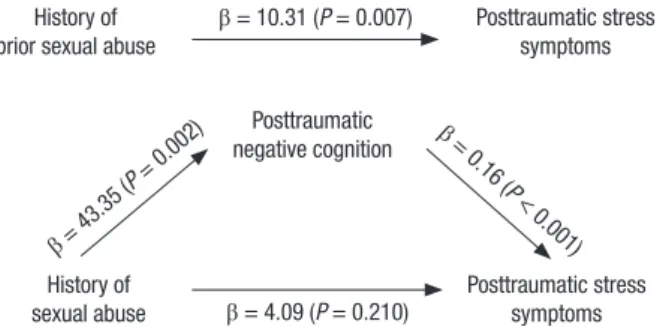
The association between a history of sexual abuse and PSS- SR score was attenuated after adjusting for PTCI score (Fig. 2).
DISCUSSION
Only 9.5% of the victims were classified as sexually revictimized.
At initial assessment, revictimized women had a higher PTCI total score than singly victimized women, indicating greater post-traumatic negative cognition. The change in symptom se- verity during the first month after the visit was significantly dif- ferent between revictimized and singly victimized women. Al- though not statistically significant, probably because of the small sample size (10), the PSS-SR score of revictimized women at 1 month follow-up had increased, indicating an increase in the severity of post-traumatic stress symptoms, whereas that of sin- gly victimized women had decreased. Post-traumatic negative cognition fully mediated the association between a history of sexual abuse and the severity of post-traumatic stress symptoms.
Several limitations should be taken into account when inter- preting these results. First, only one-third of the women who were eligible to be included in the analysis had completed the psychological questionnaires at the initial assessment. Howev- er, those included in and excluded from the analysis did not differ in the main exposure variable, i.e., whether or not they had been exposed to prior sexual abuse, and we believe that the low inclusion rate would not have had a major impact on the results. Also, while a larger sample size would have been more ideal, current analysis nonetheless yielded statistical sig- nificance. Second, only about 9% of the women included in the study reported prior sexual abuse. This is a much smaller pro- portion than in extant studies (2,3). This difference may be due to a number of factors. The Sunflower Center is an emergency support center, and acute victims may be more likely to seek such support than chronically victimized women who have ex- perienced multiple attacks. It is also possible that some women did not report their abuse history, possibly due to shame or fear of being blamed, or to avoid being disadvantaged in the investi- gative or legal process. However, this potential misclassification Fig. 1. Boxplot of PSS-SR scores of victims with and without a history of sexual abuse
at initial assessment and at 1 month follow-up.
PSS-SR = Post-traumatic Stress Disorder Symptoms Scale: Self-Report Version.
Posttraumatic stress symptoms
Visit
At initial assessment At 1 month follow-up 50
40 30 20 10 0
P = 0.180 P = 0.001
History of sexual abuse No Yes
Fig. 2. Direct and indirect pathways connecting a history of sexual abuse with the severity of post-traumatic stress symptoms. Data on history of sexual abuse was cod- ed as 1: yes, 0: no. The severity of post-traumatic stress symptoms was evaluated at 1 month follow-up using the PSS-SR. Post-traumatic negative cognition was evaluat- ed at initial assessment using the PTCI.
PSS-SR = Post-traumatic Stress Disorder Symptoms Scale: Self-Report Version, PTCI
= Post-traumatic Cognitions Inventory.
History of
prior sexual abuse Posttraumatic stress
symptoms β = 10.31 (P = 0.007)
Posttraumatic negative cognition
History of
sexual abuse Posttraumatic stress
symptoms β = 43.35 (
P = 0.002)
β = 0.16 ( P < 0.001)
β = 4.09 (P = 0.210)
bias towards the null and reduces the power of the study, mak- ing our results more conservative. Third, although a thorough evaluation of past life events and trauma history, including child- hood abuse and physical victimization, would have yielded a more fruitful analysis and allowed us to compare the effect of sexual violence on post-traumatic stress symptoms with that of other types of traumas, this was beyond the scope of the current study. In addition, a structured interview would have provided more objective information on the psychiatric status and psy- chological functioning of the victims than the self-report ques- tionnaires used. However, the data collected reflect an acute stage of trauma.
Despite these limitations, our analyses exhibit several strengths that warrant attention. First, psychological status was assessed at the acute stage after the sexual assault. The majority of the women included in the analysis underwent the initial evalua- tion within 3 months of experiencing the sexual assault, and about two-thirds underwent the evaluation within 24 hours.
Second, although the follow-up was short in duration, longitu- dinal data were acquired through the 1 month telephone fol- low-up survey, and allowed us to understand the short-term trajectory of post-traumatic stress symptoms in sexual assault victims.
Acute post-traumatic stress symptoms gradually improve with time (24); however, revictimized women had a higher PSS- SR score, indicating more severe symptoms, at 1 month follow- up than at the initial assessment. There may be several explana- tions for this. First, revictimized victims may have experienced additional traumatic events in the 1 month-interval between initial assessment and follow-up. Revictimized victims may ex- hibit a number of risk factors, including maladaptive coping strategies or risk recognition ability, that make them prone to additional traumatic events, such as post crime victimization, i.e., victim blaming or inappropriate post-assault behavior by medical or investigative personnel. Maladaptive coping strategy is one of the risk factors for sexual revictimization (25). Individ- uals who reported both childhood and adulthood sexual assault had more post-traumatic stress symptoms and were more likely to use drugs or alcohol to cope, act out sexually, withdraw from people, and seek therapy services than individuals who report- ed only adulthood sexual assault without childhood sexual as- sault (25). Risk recognition ability has also been associated with interpersonal revictimization (7,26). Second, dissociation in the acute stages after the assault may have been more prevalent in revictimized women than in singly victimized women, and post- traumatic stress symptoms may have therefore worsened in these women as dissociation dissipated with time (7).
Previous researches have shown that maladaptive beliefs re- lated to the trauma play an important role in the development and maintenance of PSTD symptoms and are predictive of high- er PTSD symptom severity (11,16,17). In our study, revictimized
women similarly had more maladaptive cognitions regarding their trauma than singly victimized women. Especially, revic- timized women showed higher scores in the Self (negative cog- nitions about the self) and Blame (self-blame for trauma) sub- scales of the PTCI than singly victimized women. Previous stud- ies indicated that Asian cultures endorse more rapist-support- ive attitudes such as women are responsible for preventing rape and victims cause rape (27,28). A recent study also suggested that Asian American college women showed more maladaptive beliefs about the sexual assault than White American college women (29). Our results suggest that revictimized women showed more negative cognitions about the self than singly victimized women, which in turn was associated with higher PTSD symp- tom severity. Compared with previous study which emphasized the role of cognitive appraisals concerning the dangerousness of the world in maintaining the PTSD symptoms in Korean vic- tims of sexual trauma (16), revictimized women are endorsing negative attitudes about themselves as a result of the repeated trauma.
These findings suggest that revictimized women are a dis- tinct group, with different psychological profiles and 1 month symptom trajectories to those of singly victimized women. As Cloitre (30) argued, the response to a victim of sexual assault should be based on that victim’s characteristics. We believe that evidence-based protocols are required to enable revictimized women to be identified and enable tailored support and servic- es to be provided to these women. Personnel working with this population should be aware of the characteristics and respond accordingly.
When providing services for victims of sexual violence, treat- ment of post-traumatic symptoms may not be enough. Revic- timized women may benefit from interventions focused on post- traumatic negative cognition, such as trauma focused cognitive behavioral therapy (31,32). Interventions targeted at preventing revictimization should also be included, because revictimized women report more severe symptoms. Social learning or femi- nist intervention and risk detection or executive function inter- ventions significantly reduced the risk of sexual revictimization, and should be considered as part of the service provided for victims of sexual violence (33). A mindfulness-based program aimed at reducing sexual revictimization also had a large effect;
women with a history of child sexual abuse who participated in such a program were less likely to be sexually assaulted and raped at 2-month follow-up (34). In addition, problematic alcohol drink- ing has been proposed as a predictor of sexual revictimization (35,36). In a sexual assault risk reduction intervention study, a program that targeted both sexual assault and alcohol use was the most effective way of reducing the risk of sexual assault (37).
Early detection of sexually revictimized women and tailored service and treatment intervention is needed to serve better this group of victims. Interventions targeted at preventing revictim-
ization or post crime victimization may also help victims recov- er from the trauma and prevent future abuse.
DISCLOSURE
The authors have no potential conflicts of interest to disclose.
AUTHOR CONTRIBUTION
Conceptualization: Shin KM, Chung YK, Chang HY. Data cura- tion: Kim KA, Lee H. Investigation: Shin KM, Chang HY. Writing - original draft: Shin KM, Chang HY. Writing - review & editing:
Shin YJ, Kim M, Kim NH.
ORCID
Kyoung Min Shin https://orcid.org/0000-0002-6385-2169 Young Ki Chung https://orcid.org/0000-0002-7822-6152 Yee Jin Shin https://orcid.org/0000-0001-8573-4342 Miran Kim https://orcid.org/0000-0001-5553-5334 Nam Hee Kim https://orcid.org/0000-0002-9381-0613 Kyoung Ah Kim https://orcid.org/0000-0002-5949-3968 Hanbyul Lee https://orcid.org/0000-0003-0903-3952 Hyoung Yoon Chang https://orcid.org/0000-0002-5248-3433
REFERENCES
1. Classen CC, Palesh OG, Aggarwal R. Sexual revictimization: a review of the empirical literature. Trauma Violence Abuse 2005; 6: 103-29.
2. Korean Women’s Development Institute. The Sexual Violence Survey in 2013. Seoul, Ministry of Gender Equality and Family, 2013.
3. Walsh K, Danielson CK, McCauley JL, Saunders BE, Kilpatrick DG, Resn- ick HS. National prevalence of posttraumatic stress disorder among sexu- ally revictimized adolescent, college, and adult household-residing wom- en. Arch Gen Psychiatry 2012; 69: 935-42.
4. Lau M, Kristensen E. Sexual revictimization in a clinical sample of wom- en reporting childhood sexual abuse. Nord J Psychiatry 2010; 64: 4-10.
5. Miner MH, Flitter JM, Robinson BB. Association of sexual revictimization with sexuality and psychological function. J Interpers Violence 2006; 21:
503-24.
6. Messman-Moore TL, Long PJ. The role of childhood sexual abuse sequel- ae in the sexual revictimization of women: an empirical review and theo- retical reformulation. Clin Psychol Rev 2003; 23: 537-71.
7. Bockers E, Roepke S, Michael L, Renneberg B, Knaevelsrud C. Risk recog- nition, attachment anxiety, self-efficacy, and state dissociation predict revictimization. PLoS One 2014; 9: e108206.
8. Kearns MC, Calhoun KS. Sexual revictimization and interpersonal effec- tiveness. Violence Vict 2010; 25: 504-17.
9. Arata CM. From child victim to adult victim: a model for predicting sexu- al revictimization. Child Maltreat 2000; 5: 28-38.
10. Gidycz CA, Coble CN, Latham L, Layman MJ. Sexual assault experience in adulthood and prior victimization experiences. Psychol Women Q 1993;
17: 151-68.
11. Dunmore E, Clark DM, Ehlers A. A prospective investigation of the role of cognitive factors in persistent posttraumatic stress disorder (PTSD) after physical or sexual assault. Behav Res Ther 2001; 39: 1063-84.
12. Resick PA, Schnicke M. Cognitive Processing Therapy for Rape Victims: a Treatment Manual (Vol. 4). Thousand Oaks, CA, Sage, 1993.
13. Foa EB, Riggs DS. Post-traumatic stress disorder in rape victims. In: Old- ham JM, Riba MB, Tasman A, editors. American Psychiatric Press Review of Psychiatry, Volume 12. Washington, D.C., American Psychiatric Press, 1993, p272-303.
14. Foa EB, Rothbaum BO. Treating the Trauma of Rape: Cognitive-behav- ioral Therapy for PTSD. New York, NY, Guilford, 2001.
15. Shin KM, Chang HY, Cho SM, Kim NH, Kim KA, Chung YK. Avoidance symptoms and delayed verbal memory are associated with post-traumat- ic stress symptoms in female victims of sexual violence. J Affect Disord 2015; 184: 145-8.
16. Shin KM, Cho SM, Lee SH, Chung YK. A pilot prospective study of the re- lationship among cognitive factors, shame, and guilt proneness on post- traumatic stress disorder symptoms in female victims of sexual violence.
J Korean Med Sci 2014; 29: 831-6.
17. Foa EB, Ehlers A, Clark DM, Tolin DF, Orsillo SM. The Posttraumatic Cog- nitions Inventory (PTCI): development and validation. Psychol Assess 1999;
11: 303-14.
18. Foa EB, Riggs DS, Dancu CV, Rothbaum BO. Reliability and validity of a brief instrument for assessing post-traumatic stress disorder. J Trauma Stress 1993; 6: 459-73.
19. Han OS, Hong JP. Korean Version of the Structured Clinical Interview for DSM-IV. Seoul, Hana Medical Publishing Company, 2000.
20. Korea Psychology. Manual for the K-BDI-II. Daegu, Korea Psychology, 2014.
21. Korea Psychology. Manual for the K-BAI. Daegu, Korea Psychology, 2014.
22. Lee YS, Song JY. A Study of reliability and validity of the BDI, SDS, and the MMPI-D scales. Korean J Clin Psychol 1991; 10: 98-113.
23. Han EK, Cho YR, Park SH, Kim HR, Kim SH. Factor structure of the Kore- an version of the Beck Anxiety Inventory: an application of confirmatory factor analysis in psychiatric patients. Korean J Clin Psychol 2003; 22: 261- 70.
24. Morina N, Wicherts JM, Lobbrecht J, Priebe S. Remission from post-trau- matic stress disorder in adults: a systematic review and meta-analysis of long term outcome studies. Clin Psychol Rev 2014; 34: 249-55.
25. Filipas HH, Ullman SE. Child sexual abuse, coping responses, self-blame, posttraumatic stress disorder, and adult sexual revictimization. J Interpers Violence 2006; 21: 652-72.
26. Messman-Moore TL, Brown AL. Risk perception, rape, and sexual revic- timization: a prospective study of college women. Psychol Women Q 2006;
30: 159-72.
27. Koo KH, Stephens KA, Lindgren KP, George WH. Misogyny, acculturation, and ethnic identity: relation to rape-supportive attitudes in Asian Ameri- can college men. Arch Sex Behav 2012; 41: 1005-14.
28. Mills CS, Granoff BJ. Date and acquaintance rape among a sample of col- lege students. Soc Work 1992; 37: 504-9.
29. Koo KH, Nguyen HV, Gilmore AK, Blayney JA, Kaysen DL. Posttraumatic cognitions, somatization, and PTSD severity among Asian American and White college women with sexual trauma histories. Psychol Trauma 2014;
6: 337-44.
30. Cloitre M. The “one size fits all” approach to trauma treatment: should we be satisfied? Eur J Psychotraumatol 2015; 6: 27344.
31. Konanur S, Muller RT, Cinamon JS, Thornback K, Zorzella KP. Effective- ness of trauma-focused cognitive behavioral therapy in a community-based program. Child Abuse Negl 2015; 50: 159-70.
32. Kim S, Noh D, Kim H. A Summary of selective experimental research on psychosocial interventions for sexually abused children. J Child Sex Abuse 2016; 25: 597-617.
33. DePrince AP, Chu AT, Labus J, Shirk SR, Potter C. Testing two approaches to revictimization prevention among adolescent girls in the child welfare system. J Adolesc Health 2015; 56: S33-9.
34. Hill JM, Vernig PM, Lee JK, Brown C, Orsillo SM. The development of a brief acceptance and mindfulness-based program aimed at reducing sex- ual revictimization among college women with a history of childhood
sexual abuse. J Clin Psychol 2011; 67: 969-80.
35. Valenstein-Mah H, Larimer M, Zoellner L, Kaysen D. Blackout drinking predicts sexual revictimization in a college sample of binge-drinking wom- en. J Trauma Stress 2015; 28: 484-8.
36. Walsh K, Resnick HS, Danielson CK, McCauley JL, Saunders BE, Kilpat- rick DG. Patterns of drug and alcohol use associated with lifetime sexual revictimization and current posttraumatic stress disorder among three national samples of adolescent, college, and household-residing women.
Addict Behav 2014; 39: 684-9.
37. Gilmore AK, Lewis MA, George WH. A randomized controlled trial tar- geting alcohol use and sexual assault risk among college women at high risk for victimization. Behav Res Ther 2015; 74: 38-49.