The ankle is the most common location of injury during sports activities.1) Ankle sprains account for 76.7% of in- juries, followed by skeletal injuries. Lateral ankle sprains account for 13% to 56% of all injuries in sports requiring running or jumping, such as soccer, basketball, and vol- leyball.2) Lateral ankle sprain can be treated conservatively with casting, bracing, medications, and rehabilitation exer- cises. Despite adequate trials with conservative treatment, about 30% of all patients with acute ligamentous injuries
have chronic symptoms. Chronic ankle instability is one of the most common of these residual problems.3,4)
When conservative treatments fail to give satisfac- tory function and stability, operative treatment should be considered. Reports on the modified Broström operation (MBO) have demonstrated promising functional out- comes in the literature, with the majority of patients hav- ing good-to-excellent results.5-7) This surgical procedure is the gold standard for the treatment of patients with objec- tive and subjective instability. Lee et al.6) reported excellent long-term results at a mean of 10.6 years following MBO without calcaneofibular ligament reconstruction, with 28 of the 30 patients returning to their preinjury levels.
When treating elite athletes, one of the first ques- tions asked of the doctors is when they will be able to train and go back to field again. The average time to return to activities in a general population may not be applicable
Return to Play after Modified Broström Operation for Chronic Ankle Instability in Elite Athletes
Kyungtai Lee, MD, Hyuk Jegal, MD, Heewoong Chung, MD*, Younguk Park, MD*
Foot and Ankle Service, KT Lee’s Orthopedic Hospital, Seoul,
*Department of Orthopedic Surgery, Ajou University Hospital, Ajou University School of Medicine, Suwon, Korea
Background: This study assessed the average time to return to training and official game participation after modified Broström operation (MBO) in elite athletes.
Methods: Sixty athletes diagnosed with lateral ankle instability underwent MBO from October 2011 to December 2013. Their average age was 19.3 years, and the average follow-up time was 28.8 months. We measured the time sequence of three phases of rehabilitation: start of personal training, start of team training, and start of the first official game after recovery. Patients were divided into an early return to play (RTP) group and late RTP group. The groups were compared to identify possible risk factors af- fecting the RTP time.
Results: The mean length of time to return to personal training was 1.9 months, return to team training was 2.9 months, and return to competitive play was 3.9 months. There were no significant differences of any variables including age, sex, body mass index, level of sports, grade of instability, presence of os subfibulare, and preoperative functional score between the early RTP and late RTP groups.
Conclusions: The RTP was 83.3% at 4 months after lateral ankle ligament repair and 100% at 8 months postoperatively. The re- sults provide reference data for orthopedic surgeons in evaluating surgical results and informing patients about expectations after surgery in terms of performance level and timing of return to sports.
Keywords: Lateral ankle instability, Modified Broström operation, Return to play
Copyright © 2019 by The Korean Orthopaedic Association
This is an Open Access article distributed under the terms of the Creative Commons Attribution Non-Commercial License (http://creativecommons.org/licenses/by-nc/4.0) which permits unrestricted non-commercial use, distribution, and reproduction in any medium, provided the original work is properly cited.
Clinics in Orthopedic Surgery • pISSN 2005-291X eISSN 2005-4408 Received August 28, 2018; Accepted November 5, 2018
Correspondence to: Younguk Park, MD
Department of Orthopedic Surgery, Ajou University Hospital, Ajou University School of Medicine, 164 World cup-ro, Yeongtong-gu, Suwon 16499, Korea
Tel: +82-31-219-5220, Fax: +82-31-219-5229 E-mail: [email protected]
to the elite athlete. Obviously, this problem is not a “black or white” decision. Rather, the return is a gradual process.
Nevertheless, it should be decided when this process can be initiated. If this decision is not made carefully, sub- stantial consequences as well as prolonged absence might result.8)
MBO was hypothesized to be a safe and effective surgical method for chronic ankle instability and provide an expected return to competitive play at approximately 4 months. There has been scarce literature to guide athletes as to their predicted time to return to training and to com- petitive sport. The purpose of the study was to assess the average time to return to training and return to play (RTP) following MBO in elite Korean athletes. The second aim was to find out the rate of return to previous level of sports activity, performance level at the final follow-up and, fi- nally, rational causes of delayed recovery.
METHODS
This study was approved by the Institutional Review Board of Ajou University Hospital (IRB No. AJIRB-MED- MDB-16-097). Between August 2013 and December 2013, A total of 54 athletes underwent MBO for chronic ankle instability by a single surgeon (YP). These patients were retrospectively reviewed under IRB-approved waived consent. The elite athletes included in the study were reg- istered on the Korean high level or junior level athlete lists.
The indications for operative intervention were in- tractable pain or symptom of instability after remote ankle sprain affecting sports performance refractory to conser- vative treatment like strengthening exercises and physical rehabilitation for at least 3 to 6 months. Thirty-six pa- tients (36 feet) were excluded from this study due to short follow-up period (< 2 years, n = 7), additional surgery (n
= 20), previous surgery (n = 6), and lower limb malalign- ment requiring surgery (n = 3). A total of 18 patients were included in this study (nine males and nine females; aver- age age, 19.3 years; range, 13 to 23 years). Seven patients were junior level and 11 were high level athletes. Sports activities at the onset of symptom included soccer (n = 8), basketball (n = 2), ballet and gymnastics (n = 3), martial arts (n = 2), and others (n = 3).
Surgical Procedure
The surgical procedure involved was anterior talofibular ligament imbrication with reinforcement of the inferior extensor retinaculum.6) Detailed procedures were identi- cal to those described in the previous literature.9) Stability was then checked and the skin was closed. After surgery,
ankles were protected by immobilization for 4 weeks and an ankle brace (Aircast Air-Stirrupbrace; DJO Global, Vista, CA, USA) for 2 weeks. At 4 weeks postoperatively, gentle range of motion (ROM) exercises were encouraged as much as possible. At 6 weeks, strengthening exercises of the ankle and Achilles tendon stretching exercises were started. Full weight bearing was allowed when a patient achieved full ankle ROM. Six weeks after surgery, patients could progress from walking, to jogging, to running, to figure of eight running, and to lateral cutting back and forth. Details of rehabilitation were previously described.10)
We reviewed our clinical and operative notes. We measured the time sequence of three phases of rehabilita- tion: start of personal training (jogging or jumping and late rehabilitation phase), start of team training (return to sport), and start of the first official game (i.e., RTP). We divided the patients into the early RTP group and late RTP group based on the mean time to RTP (start of the first of- ficial game). Variables including age, sex, body mass index (BMI), presence of os subfibulare, and grade of instability were compared between the two groups to identify pos- sible risk factors that can affect the RTP time.
Statistical Analyses
All continuous variables are expressed in terms of the mean and standard deviation. Some ordinal variables (grade of instability and level of sports) were expressed for each number of ranks. A nonparametric statistical analysis method (Mann-Whitney U-test) was employed to compare the two groups with respect to age, BMI, grade of instability, and level of sports. Chi-square test was used to evaluate the effect of sex and the presence of os subfibu- lare. Statistical significance was accepted for p < 0.05.
RESULTS
All eighteen patients returned to the previous level of ac- tivities without any surgical complications. All patients were continuing to train and compete symptom-free at an average follow-up of 28 months. There were no reopera- tions, infections, or neurovascular damage.
The mean follow-up was 28.8 ± 4.3 months (range, 25 to 38 months). The average age of the players was 19.3
± 3.0 years (range, 13 to 24 years). The mean length of time to return to personal training postoperatively was 1.9
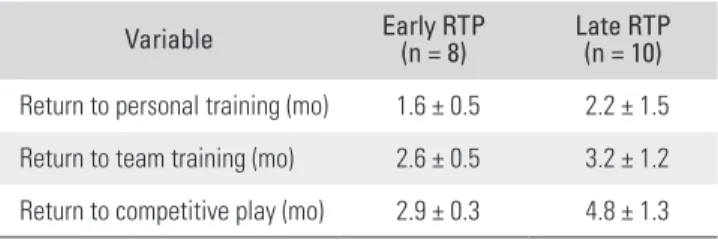
± 1.2 months (range, 1 to 6 months), return to team train- ing was 2.9 ± 1.0 months (range, 1 to 6 months), and RTP was 3.9 ± 1.4 months (range, 2 to 7 months). The RTP was by 4 months in 15 patients and 7 months in the remaining 3 (Table 1).
The patients were divided by the mean time to return to competitive play at 3.9 months. The athletes who returned to competitive play before 3.9 months were assigned to the early RTP group and the athletes who returned later than 3.9 months were allocated to the late RTP group. There were no significant differences in age, sex, BMI, level of sports, grade of instability, presence of os subfibulare, and preoperative functional score (Ameri- can Orthopedic Foot and Ankle Society Ankle-Hindfoot score) between the early and late RTP groups (Table 2).
DISCUSSION
Recovery progression after an injury or surgery in an elite athlete may be different from that of the recreational sports person. One might assume that, because of the very high levels of performance expected, the elite athlete may take longer to return to a preinjury level than the average person. However, better access to expert aftercare by dedi- cated physical therapists and issues of motivation often
mean that a high-performance athlete rehabilitates more quickly.8)
Running is allowed in more than 16 weeks after Broström repair in general;10) providing a reference for return to running. Athletic patients will often be signifi- cantly quicker than this. RTP can vary in meaning from study to study. We measured the time sequence of three phases of rehabilitation: start of personal training, start of team training (return to sport), and start of first official game (RTP). Therefore, our results provide a reference for the sequence of decisions that need to be made for the ul- timate goal of RTP.
White et al.11) reported early resumption of athletic activity after surgery. Based on club medical records, the median time to return to training for athletes was 63 days (range, 49 to 152 days) and the median time to play was 77 days (range, 56 to 178 days). The timings reflected the judgment that the athletes were medically fit and avail- able for team selection. This is a bit different from our definition, the time from surgery to participation in the first official game. In terms of return to team training (2.9 months) and first official game (3.9 months) in this series, the results are similar with those in the literature.10,12,13)
In the current study, possible variables that might delay RTP were compared between the early and late RTP groups. These included age, sex, BMI, grade of instability, presence of os subfibulare. Younger athletes are more likely to return to their preinjury level of sport after anterior cru- ciate ligament reconstruction.14) Men are approximately 1.5 times more likely than women to return to either their previous level of sport or competitive sport.15) In the cur- rent study, there were no differences in age, sex and BMI Table 1. Time to Return to Each Activity in Two Groups
Variable Early RTP
(n = 8) Late RTP (n = 10) Return to personal training (mo) 1.6 ± 0.5 2.2 ± 1.5 Return to team training (mo) 2.6 ± 0.5 3.2 ± 1.2 Return to competitive play (mo) 2.9 ± 0.3 4.8 ± 1.3 Values are presented as mean ± standard deviation.
RTP: return to play.
Table 2. Possible Factors Influencing Return to Play
Variable Early RTP (n = 8) Late RTP (n = 10) p-value
Age (yr) 18.1 ± 3.1 20.3 ± 2.8 0.173
Sex (male:female) 5:3 4:6 0.637
Body mass index (kg/m2) 22.5 ± 1.2 21.2 ± 1.5 0.068
AOFAS Ankle-Hindfoot score (preoperative) 69.9 ± 6.5 69.8 ± 6.4 0.965
AT 6.2 ± 1.0 6.5 ± 1.3 0.965
TTA 14.3 ± 2.5 16.0 ± 3.4 0.274
ADT 3.0 ± 0.0 2.7 ± 0.5 0.315
Presence of os subfibulare 3 3 0.142
Values are presented as mean ± standard deviation.
RTP: return to play, AOFAS: American Orthopedic Foot and Ankle Society, AT: anterior translation on anterior drawer stress radiographs before operation, TTA: talar tilt angle on varus stress radiographs before operation, ADT: grade of anterior drawer test before operation.
between the two groups.
Athletes should be aware that associated injuries may delay return and symptoms may continue.11) White et al.11) reported that the median time to full training was sta- tistically significant between athletes with isolated lateral ligament injuries and those with associated injuries. We tried to find out the cause of delay of return. MBO with subfibular ossicle excision reportedly provides similarly good clinical and radiographic outcomes compared with the same procedure without subfibular ossicle excision.16) In this study, there was no significant difference in the presence of os subfibulare between the two groups. Also, there was no significant difference in the time to RTP be- tween the ossicle group and no ossicle group (p = 0.964).
MBO has been shown to produce good results for patients with chronic ankle instability, regardless of the grade of instability on the preoperative stress radio- graphs.17) Similarly, we did not observe any significant dif- ference in the grade of instability between the two groups.
Generalized laxity is associated with recurrent insta- bility after ankle ligament reconstruction.18,19) Direct repair of the ligaments in patients with generalized joint hyper- mobility presents a significant risk for mechanical failure of the procedure.19) Gross ligamentous laxity (Beighton score > 4) was suggested as a possible indicator of in- creased risk of reinjury.20) A more recent study reported that the MBO may be successful in patients with chronic ankle instability and with generalized laxity, as determined by a Beighton score > 4.21) Presently, three patients experi-
enced a later return to competitive athletics (Table 3). They were relatively young and female (one was a ballerina and two were gymnasts). Their Beighton scores were 9, 9, and 7. This might be associated with their very late RTP.
The current study has some limitations. The pri- mary limitation is the small number of individuals. We ex- cluded 36 patients among 54. Major exclusion criteria were additional surgery and short follow-up. An athlete seldom experiences just a ligament problem; usually, cartilage or tendon or other problems are present. Another limitation of this study is that different sports or athletic activities were involved, making it impossible to assess the influence of different characteristics of each sport. However, we be- lieve that the results can be a general guideline for diverse sports and athletic activities.
Most athletes (83.3%) returned to preinjury level sports activity by 4 months and all resumed participation 8 months after lateral ankle ligament repair. All were actively participating in their sports or athletic activity at the final follow-up. The results could provide reference information for orthopedic surgeons to evaluate surgical results and in- form patients about what they should expect after surgery in terms of performance level and timing of RTP.
CONFLICT OF INTEREST
No potential conflict of interest relevant to this article was reported.
REFERENCES
1. Gabbe BJ, Finch CF, Wajswelner H, Bennell KL. Predictors of lower extremity injuries at the community level of Aus- tralian football. Clin J Sport Med. 2004;14(2):56-63.
2. Ferkel RD, Chams RN. Chronic lateral instability: ar- throscopic findings and long-term results. Foot Ankle Int.
2007;28(1):24-31.
3. Hertel J. Functional anatomy, pathomechanics, and pathophysiology of lateral ankle instability. J Athl Train.
2002;37(4):364-75.
4. van Rijn RM, van Os AG, Bernsen RM, Luijsterburg PA, Koes BW, Bierma-Zeinstra SM. What is the clinical course of acute ankle sprains? A systematic literature review. Am J Med. 2008;121(4):324-31.e6.
5. Bell SJ, Mologne TS, Sitler DF, Cox JS. Twenty-six-year results after Brostrom procedure for chronic lateral ankle instability. Am J Sports Med. 2006;34(6):975-8.
Table 3. Details of the Three Delayed Return to Play Cases
No. Age (yr) Sex Sports Beighton
score Return to
personal training (wk) Return to
team training (wk) Return to competitive play (wk)
1 19 Female Ballet 9 24 24 28
2 22 Female Gymnast 9 4 4 28
3 23 Female Gymnast 7 4 12 24
6. Lee KT, Park YU, Kim JS, Kim JB, Kim KC, Kang SK. Long- term results after modified Brostrom procedure without calcaneofibular ligament reconstruction. Foot Ankle Int.
2011;32(2):153-7.
7. Tourne Y, Mabit C, Moroney PJ, Chaussard C, Saragaglia D.
Long-term follow-up of lateral reconstruction with extensor retinaculum flap for chronic ankle instability. Foot Ankle Int. 2012;33(12):1079-86.
8. Calder JD, Sexton SA, Pearce CJ. Return to training and playing after posterior ankle arthroscopy for posterior im- pingement in elite professional soccer. Am J Sports Med.
2010;38(1):120-4.
9. Gould N, Seligson D, Gassman J. Early and late repair of lat- eral ligament of the ankle. Foot Ankle. 1980;1(2):84-9.
10. Pearce CJ, Tourne Y, Zellers J, et al. Rehabilitation after ana- tomical ankle ligament repair or reconstruction. Knee Surg Sports Traumatol Arthrosc. 2016;24(4):1130-9.
11. White WJ, McCollum GA, Calder JD. Return to sport following acute lateral ligament repair of the ankle in pro- fessional athletes. Knee Surg Sports Traumatol Arthrosc.
2016;24(4):1124-9.
12. Li X, Killie H, Guerrero P, Busconi BD. Anatomical recon- struction for chronic lateral ankle instability in the high- demand athlete: functional outcomes after the modified Brostrom repair using suture anchors. Am J Sports Med.
2009;37(3):488-94.
13. Miyamoto W, Takao M, Yamada K, Matsushita T. Accelerat- ed versus traditional rehabilitation after anterior talofibular ligament reconstruction for chronic lateral instability of the ankle in athletes. Am J Sports Med. 2014;42(6):1441-7.
14. Ardern CL, Taylor NF, Feller JA, Webster KE. Fifty-five per cent return to competitive sport following anterior cruci- ate ligament reconstruction surgery: an updated systematic review and meta-analysis including aspects of physi- cal functioning and contextual factors. Br J Sports Med.
2014;48(21):1543-52.
15. Kondric M, Sindik J, Furjan-Mandic G, Schiefler B. Par- ticipation motivation and student's physical activity among sport students in three countries. J Sports Sci Med.
2013;12(1):10-8.
16. Ahn HW, Lee KB. Comparison of the modified Brostrom procedure for chronic lateral ankle instability with and with- out subfibular ossicle. Am J Sports Med. 2016;44(12):3158- 64.
17. Jeong BO, Kim TY, Song WJ. Effect of preoperative stress radiographic findings on radiographic and clinical out- comes of the modified Brostrom procedure for chronic ankle instability. J Foot Ankle Surg. 2016;55(1):125-8.
18. Colville MR. Reconstruction of the lateral ankle ligaments.
Instr Course Lect. 1995;44:341-8.
19. Karlsson J, Bergsten T, Lansinger O, Peterson L. Reconstruc- tion of the lateral ligaments of the ankle for chronic lateral instability. J Bone Joint Surg Am. 1988;70(4):581-8.
20. Petrera M, Dwyer T, Theodoropoulos JS, Ogilvie-Harris DJ.
Short- to medium-term outcomes after a modified Brostrom repair for lateral ankle instability with immediate postopera- tive weightbearing. Am J Sports Med. 2014;42(7):1542-8.
21. Huang B, Kim YT, Kim JU, Shin JH, Park YW, Kim HN.
Modified Brostrom procedure for chronic ankle instabil- ity with generalized joint hypermobility. Am J Sports Med.
2016;44(4):1011-6.