Nonalcoholic Fatty Liver Disease and Abdominal Fat Accumulation According to Vitamin D Status in
Patients with Type 2 Diabetes
Dug-Hyun Choi, Chan-Hee Jung, Ji-Oh Mok, Chul-Hee Kim, Sung Koo Kang, Bo-Yeon Kim*
Division of Endocrinology and Metabolism, Department of Internal Medicine, Soonchunhyang University Bucheon Hospital, Soonchunhyang University College of Medicine, Bucheon, Korea
Background: Vitamin D deficiency is known to increase the incidence of metabolic syndrome. Nonalcoholic fatty liver disease is a common metabolic disease in patients with type 2 diabetes. This study evaluated nonalco- holic fatty liver disease and abdominal fat accumulation according to 25-hydroxyvitamin D status in patients with type 2 diabetes.
Methods: The study comprised 302 patients with type 2 diabetes. Patients were divided into three groups based upon their 25-hydroxyvitamin D status: vitamin D deficient group (<10 ng/mL), vitamin D insufficient group (≥10 to <20 ng/mL) and vitamin D sufficient group (≥20 ng/mL). Patient clinical and laboratory markers were evaluated retrospectively.
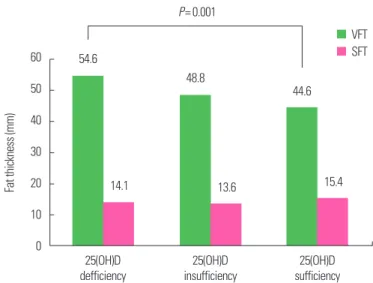
Results: Visceral fat thickness was significantly higher in the vitamin D deficient group. There were no differenc- es in glycemic control, body mass index, and subcutaneous fat thickness correlated with 25-hydroxyvitamin D status. The prevalence of nonalcoholic fatty liver disease was significantly higher in the vitamin D deficient group compared to the vitamin D sufficient and vitamin D insufficient groups. In multivariate logistic analysis, after ad- justment for age, sex, body mass index, glycated hemoglobin and homeostasis model assessment of insulin re- sistance, patients with type 2 diabetes in the vitamin D sufficient group showed significantly lower odds ratio for nonalcoholic fatty liver disease than those within the vitamin D deficient group.
Conclusion: In type 2 diabetes, the vitamin D deficient group showed thicker visceral fat thickness and higher nonalcoholic fatty liver disease prevalence.
Key words: Non-alcoholic fatty liver disease, Vitamin D, Type 2 diabetes mellitus
Received October 30, 2017 Reviewed November 23, 2017 Accepted December 22, 2017
* Corresponding author Bo-Yeon Kim
https://orcid.org/0000-0002-3658-2351 Division of Endocrinology and Metabolism, Department of Internal Medicine, Soonchunhyang University Bucheon Hospital, Soonchunhyang University College of Medicine, 170 Jomaru-ro, Wonmi-gu, Bucheon 14584, Korea
Tel: +82-32-621-5157 Fax: +82-32-621-5017 E-mail: [email protected]
INTRODUCTION
Recently, vitamin D has been studied as an important factor in the development of many diseases, and its importance is not limit- ed to its classic role in bone health. Many previous works have shown an association between vitamin D deficiency or insufficien- cy and many disease like cardiovascular disease
1,2, cancer
3,4, and in- fection.
5The relationship between vitamin D levels and the devel- opment of type 2 diabetes mellitus
6-8and metabolic syndrome
9-11has also been a recent focus and many studies have reported that low vitamin D levels are associated with insulin resistance and the onset of metabolic syndrome.
Nonalcoholic fatty liver disease (NAFLD) is a metabolic disease of liver associated with insulin resistance. NAFLD is a common condition among patients with type 2 diabetes and according to a meta-analysis reported in 2016, its comorbidity with type 2 diabe- tes is about 22.51%.
12The presence of NAFLD in type 2 diabetes can increase the incidence of vascular complications including car-
Copyright © 2018 Korean Society for the Study of Obesity
This is an Open Access article distributed under the terms of the Creative Commons Attribution Non-Commercial License (http://creativecommons.org/licenses/by-nc/4.0/) which per- mits unrestricted non-commercial use, distribution, and reproduction in any medium, provided the original work is properly cited.
Original Article eISSN 2508-7576
2017-03-16 https://crossmark-cdn.crossref.org/widget/v2.0/logos/CROSSMARK_Color_square.svg