大 韓 不 妊 學 會 誌 : 第 32 卷 第 2 號 2005 Kor. J. Fertil. Steril., Vol. 32, No. 2, 2005, 6
Effect of Fertilization Promoting Peptide (FPP) on the Acrosome Status of Cryopreserved Human Sperm
Se Pill Park
1#*, Hyun Ah Shin
1#, Eun Young Kim
1, Won Don Lee
2, Jin Ho Lim
21
Maria Infertility Hospital Medical Institute/Maria Biotech,
2Maria Hospital
Fertilization Promoting Peptide (FPP)가 동결 보존 사람정자의 첨체 상태에 미치는 영향
1
마리아 기초의학 연구소
1/마리아 생명공학연구소,
2마리아 병원 박세필1#*·신현아
1#·김은영
1·이원돈
2·임진호
2
연구목적: 정자의 첨체상태는 수정능과 상관관계가 있다. 본 연구는 사람 정자의 동결보존 시 Fertilization promoting peptide (FPP) 처리가 첨체 유지에 효과가 있는지를 알아보고자 실시하였다.
연구재료 및 방법: 사람 정자는 정액검사를 의뢰한 시료를 사용하였으며, 적정농도를 조사하기 위하 여 25, 50, 100 nM FPP를 신선정자에 처리한 뒤 시간별로 첨체의 변화를 조사하였다. 또한 적정화된 50 nM FPP를 정자의 동결-융해 시에 처리한 뒤 첨체 변화를 조사하였다. 첨체 변화는 FITC - pisum sativum lectin (PSA) 염색방법을 이용하여 조사하였다.
결 과: FPP 농도 변화와 처리시간에 따른 사람 정자의 첨체 변화를 조사하였던 바, 50 nM FPP 처리 군에서 대조군보다 높은 온전한 첨체비율을 얻을 수 있었다. 정자의 동결-융해 시, 동결액과 융해액에 50 nM FPP 첨가가 온전한 첨체를 유지하는 비율을 조사하였던 바, 신선 정자의 결과보다는 유의하게 낮지만 무 처리군보다 유의적으로 높은 온전한 첨체를 얻을 수 있는 것을 알 수 있었다. 또한 동결액에만 또는 융해액에만 50 nM FPP 처리를 하더라도 무 처리군보다 유의하게 높은 온전한 첨체 비율을 획득할 수 있음을 알 수 있었다 (p<0.001).
결 론: 사람 정자의 동결보존 시 50 nM FPP 첨가는 자발적으로 발생하는 첨체반응을 억제하고, 온전 한 첨체를 유지할 수 있어 수정능 보유에 기여할 수 있을 것으로 사료된다.
Key Words: Human sperm, Fertilizing promoting peptide (FPP), Acrosome, FITC-PSA
Cryopreservation of human sperm is widely used in assisted conception units to preserve male gamete and provide the opportunity for future fer- tility. However, it has been known that current pro- cedures of cryopreservation have detrimental effects on the metabolism and motility of spermatozoa, as well as on the status of sperm membrane doma-
ins
1,2and activity of acrosome protease and acro- sin.
3~5The structural damage is principally in the peripheral sperm membrane and quite often there is considerable damage to the acrosome with the leakage of the acrosome membrane and contents.
4,5The fertilizing ability of human spermatozoa is more reduced after cryopreservation, which can be
Corresponding Author: Se Pill Park, Maria Infertilty Hospital Medical Institute/Maria Biotech, 103-11 Sinseol-dong, Dongdaemun-gu, Seoul 130-812, Korea. Tel: (02) 924-8757, Fax: (02) 924-9083, e-mail: [email protected]
# These two authors contributed equally to this work.
*This study was supported by a grant (01-PJ10-PG8-01EC01-0010) of the Korea Health 21 R&D Project, Ministry of Health &
Welfare, Republic of Korea.
explained partially by a reduction in the percen- tage of normal intact acrosomes and in total acro- sin activity.
3Therefore, lower pregnancy rates have been reported both in intrauterine insemination and in vitro fertilization/ intracytoplasmic spermatozoa injection programmes using cryopreserved sper- matozoa compared with fresh semen.
6Recently, it was demonstrated that progesterone, platelet acti- vating factor, fertilization promoting peptide (FPP) and adenosine, are rapid and potent activator of human sperm fertilizing ability. Especially, FPP (pGlu-Glu-ProNH
2), structurally similar to thyro- trophin releasing (pGlu-His-ProNH
2), is produced by the prostate gland and secreted into seminal plasma.
7,8The relative abundant of this tripeptide in human seminal plasma (49.5±10.3 nM) sug- gests possible biological activity relating to sper- matozoa which would be exposed to the peptide at ejaculation.
9In vivo, a mechanism that would pro- mote capacitation but inhibit spontaneous acrosome loss and help to maximize the number of function- ally competent spermatozoa capable of undergoing acrosomal exocytosis. FPP probably binds to sperm when they contact seminal plasma and then re- mains bound for some time, exerting a stimulatory effect on capacitation as spermatozoa move up through the female tract.
10This study was to investigate whether the FPP treatment on spermatozoa during freezing and tha- wing makes effect reducing spontaneous acrosome loss using FITC-PSA staining.
MATERIALS AND METHODS
1. Semen sample
Twenty-five seman samples were obtained by masturbation following at least 3 days of absti- nence from the healthy men. After liquefaction, routine semen analysis was performed according to World Health Organization guidelines (WHO, 1999). Sperm morphology was determined using
the strict criteria laid down by Kruger et al.
11Only normal ranged sperm were used.
2. Medium and Reagents
The basic medium for sperm incubation was Ham's F-10 containing 0.3% BSA. FPP, FITC-PSA, calcium ionophore A23187, and bis-benzimide (Hoechst 33342) were supplied by Sigma chemical company and their stock solutions were prepared into 1 µM, 1 mg/ml, 5 mM and 1 mg/ml, respec- tively. TEST yolk-buffer freezing medium was purchased from Irvine Scientific (Santa Ana, CA, USA).
3. FITC-PSA staining and acrosome status assessment
Acrosome status was assessed in only viable sperm with FITC-PSA stain, in conjunction with bis-benzimide stain. For the viability check, sperm suspension was treated with 10 µg/mL Hoechst 33342 for 7 min. Sperm were then washed in PVP-40 solution by centrifugation at 600 g for 5 min. A 10 µl aliquots of this suspension was smea- red on a slide glass and allowed to air-dry. Air- dried slides were immersed in ice-cold 95% ethanol for 5 min and allowed to air dry. The fixed smears were covered with a 100 µl drop of 100 µg/ml FITC-PSA and placed in a dark humidified cham- ber at 4℃ for 15 min. Slide was washed thoro- ughly using distilled water to remove excess stain.
A drop of 0.22 M 1,4-diazabicyclo [2,2,2] octan (Sigma) was used to retard fading of fluorescence.
Assessment was carried out under a Nikon epi-
fluorescence microscope. To begin with, sperm
were confirmed live and dead status using ultra-
violet filter and then subsequently acrosome status
of viable sperm was assessed using green filter. A
minimum of 10 fields per slide (>100 sperm) were
observed.
4. Experimental design
Experiment 1. Effect of 25, 50 and 100 nM FPP on fresh human sperm
To investigate the effect of FPP concentration and treatment time variation to the acrosome status, fresh and normal ranged motile sperm were obtai- ned using 90% percoll column and centrifugation at 600 g for 5 min. For each treatment, at least 2×
10
5/ml motile sperm suspension was prepared.
Each sample was divided into five aliquots, for control as no treatment, Ca
2+ionophore treatment as negative control of acrosome reaction, 25 nM FPP, 50 nM FPP and 100 nM FPP treatment. All treatment groups were incubated for 1, 3, 6 and 24 h in 37℃, 5% CO
2incubator and then their acro- some status was assessed. Calcium ionophore- induced AR was measured using control sperm at each time. For each ionophore challenge, sperm suspension was divided into two aliquots. One was challenged with 10 µM A23187 stock, and the other was treated with DMSO working solution to serve as a control. Both aliquots were then incu- bated for 30 min under the same conditions.
Experiment 2. Effect of FPP treatment on the cryopreserved human sperm
For freezing, liquefied semen was layered on top of the 90% percoll and centrifuged at 600 g for 20 min. The final sperm pellet was suspended in a suitable volume of Ham's F-10 (5×10
6spe- matozoa/ml). This suspension was divided into two aliquots. An aliquots from each sample was diluted (1:1) with TYB freezing medium which was slowly added dropwise. The one suspension was received 50 nM FPP (+/) and the other was remained 50 nM FPP-deficient (-/). Before an equilibration period at 4℃ for 30 min, the mixture was aspirated into 0.25 ml straw, which were po- wder sealed. The straws were frozen in liquid nitrogen vapour and then plunged into liquid nitro- gen. For dilution, straws were removed from liquid
nitrogen and left until thaw at room temperature.
When samples were totally thawed, 3 ml of Ham's F-10 medium was added to cornical tube and the sperm were centrifuged at 600 g for 5 min to remove any traces of TYB freezing medium. The supernatant was removed and the pellet was resu- spended in Ham's F-10. Two suspensions were subdivided into two groups, one receiving 50 nM FPP (+/+ and -/+) and the other remaining FPP- deficient (+/- and -/-); all treatment groups were incubated for 3 h in 37℃, 5% CO
2incubator and then they were stained using bis-benzimide and FITC-PSA for assessment.
5. Statistical analysis
Statistical analyses of FPP treatments in four or five replicate experiments for treatment compari- sons were carried out by Duncan's multiple range test. Data are expressed as mean ± SEM and p<
0.05 was considered to be statistical significance.
RESULTS
Experiment 1. Effect of 25, 50 and 100 nM FPP on fresh human sperm
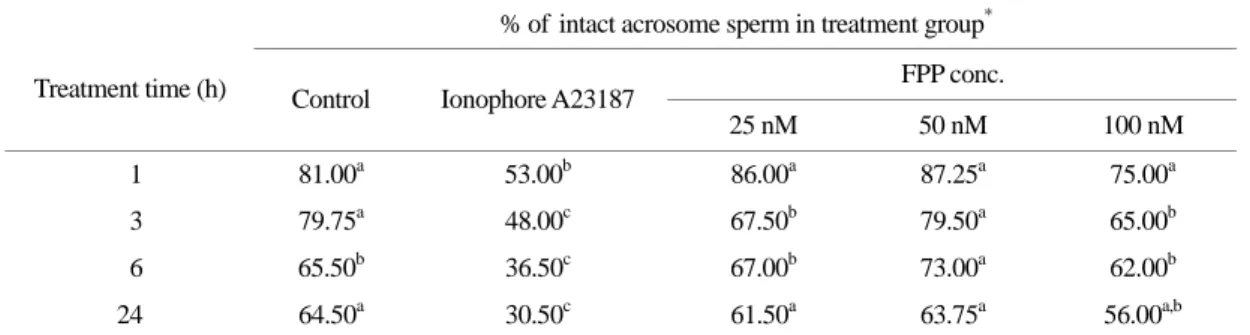
When modulation effect of FPP concentration
(25, 50 or 100 nM) and treatment time (1, 3, 6 and
24 h) to the sperm acrosome status was examined,
as shown in Table 1, there were significant differe-
nces among the treatment groups (p<0.001). Espe-
cially, 50 nM FPP treatment group has presented
the most stable intact acrosome sperm (1 h; 87.25%,
3 h; 79.50%, 6 h; 73.00% and 24 h; 63.75%). It
means 50 nM FPP help inhibition of spontaneous
acrosome loss of sperm. As negative control, Iono-
phore A23187 treatment produced the lowest acro-
some intact sperm by artificial induction of acro-
some reaction.
Experiment 2. Effect of FPP treatment on the cryopreserved human sperm
When the effect of 50 nM FPP treatment during freezing or/and thawing procedures was examined, as shown in Table 2. even it was added, intact acro- some percentages of cryopreserved sperm were significantly decreased than that of control (p<
0.001). Among the treatment groups, the best re- sult was obtained in freezing and thawing all trea- tment group (+/+, 71.94%). However, one-side treatment groups (-/+, 61.00%; +/-, 64.20%) bet- ween freezing and thawing procedure were also indicated significantly better effect to maintain in- tact acrosome than that of no treatment group (-/-, 50.20%) (p<0.001). However, dead sperm count was excluded from FITC-PSA count.
DISCUSSION
This study demonstrated that the FPP treatment on sperm during freezing and thawing procedures function to reduce spontaneous acrosome loss through the pseudo-effect similar to seminal plasma.
In fertilization, only spermatozoa with normal in- tact acrosomes can undergo acrosome reaction Table 1. Effect of FPP concentration and treatment time on the acrosome status of fresh human sperm
% of intact acrosome sperm in treatment group
*FPP conc.
Treatment time (h) Control Ionophore A23187
25 nM 50 nM 100 nM
1 81.00
a53.00
b86.00
a87.25
a75.00
a3 79.75
a48.00
c67.50
b79.50
a65.00
b6 65.50
b36.50
c67.00
b73.00
a62.00
b24 64.50
a30.50
c61.50
a63.75
a56.00
a,b*
Acrosome intact level was counted using FITC-PSA staining and dead sperm count was excluded by Hoechst staining.
a-d
Values within the rows with different superscripts differ (p<0.001)
Table 2. Effect of 50 nM FPP on the acrosome status of cryopreserved human sperm
% of intact acrosome sperm in treatment group FPP (freezing/thawing)
**Control
*-/- -/+ +/- +/+
88.30
a50.20
d61.00
c64.20
b,c71.94
b*
Control means sperm before freezing.
**
- or + means no treatment or treatment 50 nM FPP during freezing or/and thawing of sperm.
a-d