■
Jae-Hyoung Lee, PT, PhD; Chan-Eui Park, PT, MD
1; Rae-Joon Park, PT, PhD
2■
Department of Physical Therapy, Wonkwang Health Science University;
1Department of Physical Therapy, College of Physical Therapy, Southwestern University;
2Department of Physical Therapy, College of Rehabilitation Sciences, Daegu University
Purpose: The purpose of this study was to investigate the effect of electrical stimulation (ES) on the wound closure rate, collagen deposition, and TGF-β1 mRNA expression in skin wound of rat.
Methods: Twenty male Sprague-Dawley rats (222~271 g) were randomly divided into ES (n=10) and control group (n=10).
The ES group received a cathodal stimulation with 50 V at 100 pps for 30 minutes for 7 days, while the control group was not given electrical stimulation. The wound closure rate, collagen density and TGF-β1 mRNA ratio were measured.
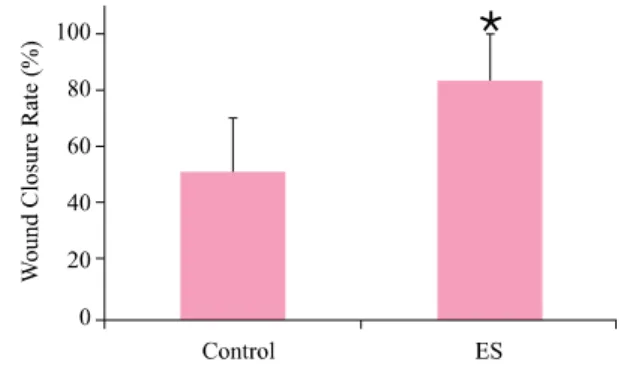
Results: The mean wound closure rates in the ES and control groups were 83.79±16.35% and 51.57±17.76%, respectively (p<0.001). The collagen density in the ES and control groups were 46.67±10.68% and 25.03±13.09%, respectively (p<0.001).
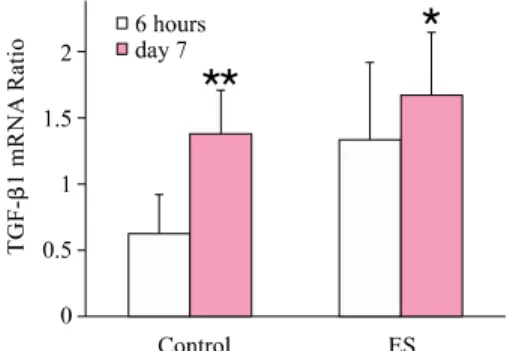
The TGF-β1 mRNA ratio in the ES and control groups were 1.35±0.60 and 0.63±0.30, respectively at 6 hours post-wound (p<0.01) and 1.69±0.47 and 1.32±0.28, respectively, at 7 days post-wound (p<0.05).
Conclusions: ES accelerated the wound closure rate of skin incision wounds and was accompanied by an increase in collagen deposition in the regenerating dermis. In addition, ES increased TGF-β1 mRNA expression during wound healing process. These findings suggest that ES may activate TGF-β1 expression, and may increase synthesis activities of fibroblasts in regenerating skin wounds in rats.
Keywords: Electrical stimulation, Wound healing, Collagen density, TGF-β1 mRNA, Rat Received: February 5, 2010
Revised: March 20, 2010 Accepted: March 31, 2010
Corresponding author: Jae-Hyoung Lee, [email protected]
TGF-β1 mRNA Expression in Skin Wound of Rat
The Journal Korean Society of Physical Therapy