568 PISSN 0304-128X, EISSN 2233-9558
박스-벤켄 설계법을 이용한 폐감귤박 활성탄에 의한 수용액 중의 항생제 Trimethoprim 의 흡착 연구
이민규* · 감상규† 제주대학교 환경공학과
63243 제주특별자치도 제주시 제주대학로 102
*부경대학교 화학공학과 48547 부산광역시 남구 신선로 365
(2018년 4월 5일 접수, 2018년 5월 21일 수정본 접수, 2018년 5월 24일 채택)
Study on the Adsorption of Antibiotics Trimethoprim in Aqueous Solution by Activated Carbon Prepared from Waste Citrus Peel Using Box-Behnken Design
Min-Gyu Lee* and Sang-Kyu Kam†
Department of Environmental Engineering, Jeju National University, 102, Jejudaehak-ro, Jeju-si, Jeju-do, 63243, Korea
*Department of Chemical Engineering, Pukyong National University, 365, Sinseon-ro, Nam-gu, Busan, 48547, Korea (Received 5 April 2018; Received in revised form 21 May 2018; accepted 24 May 2018)
요 약
폐감귤박으로 제조한 활성탄(WCAC, waste citrus peel based activated carbon)에 의한 항생제 trimethoprim (TMP) 의 흡착 특성을 조사하기 위해 반응표면법(RSM, response surface methodology)을 사용하여 TMP 흡착에 대한 운전인 자들의 영향을 조사하였다. 농도(X1: 50-150 mg/L), pH (X2: 4-10), 온도(X3: 293-323 K), 흡착제 투여량(X4: 0.05-0.15 g) 의 4가지 입력 파라미터를 가진 4-요인 Box-Behnken 실험 설계에 따라 회분식 실험을 수행하고, 얻어진 실험 결과를 다중 회귀 분석으로 2차 다항식에 맞추고 통계적 방법을 사용하여 검토하였다. 독립 변수 및 변수들 간의 교호 작용의 유의성은 ANOVA 및 t-검정 통계기법으로 평가하였으며, 통계적 결과는 TMP 농도가 다른 요인들에 비하여 가장 많은 영향을 미치는 운전인자라는 것을 보여 주었다. 흡착공정은 유사 2차 속도식에 잘 부합하였으며, 등온흡착평형관계는 Langmuir 식이 Freundlich 식 보다 잘 부합하였다. Langmuir 등온식으로 부터 계산한 WCAC에 의한 TMP의 최대 흡 착량은 293 K에서 144.9 mg/g이었다.
Abstract − In order to investigate the adsorption characteristics of the antibiotics trimethoprim (TMP) by activated carbon (WCAC) prepared from waste citrus peel, the effects of operating parameters on the TMP adsorption were inves- tigated by using a response surface methodology (RSM). Batch experiments were carried out according to a four-factor Box–Behnken experimental design with four input parameters : concentration (X1: 50-150 mg/L), pH (X2: 4-10), tem- perature (X3: 293-323 K), adsorbent dose (X4: 0.05-0.15 g). The experimental data were fitted to a second-order poly- nomial equation by the multiple regression analysis and examined using statistical methods. The significance of the independent variables and their interactions was assessed by ANOVA and t-test statistical techniques. Statistical results showed that concentration of TMP was the most effective parameter in comparison with others. The adsorption process can be well described by the pseudo-second order kinetic model. The experimental data of isotherm followed the Lang- muir isotherm model. The maximum adsorption amount of TMP by WCAC calculated from the Langmuir isotherm model was 144.9 mg/g at 293 K.
Key words: Activated carbon, Waste citrus peel, Trimethoprim, Box-Behnken design, Antibiotics, Adsorption
†To whom correspondence should be addressed.
E-mail: [email protected]
This is an Open-Access article distributed under the terms of the Creative Com- mons Attribution Non-Commercial License (http://creativecommons.org/licenses/by- nc/3.0) which permits unrestricted non-commercial use, distribution, and reproduc- tion in any medium, provided the original work is properly cited.
1. 서 론
최근 항생물질들을 인간의 질병예방과 치료 목적, 가축, 양식 어 류의 질병구제 및 성장촉진 목적으로 남용한 결과로 인하여 항생물 질들이 다양한 경로를 통해 자연환경에 노출되고 있다. 이러한 항 생물질들의 일부는 자연 중에서 분해되지 않고 그대로 잔류하며, 이렇게 잔류된 항생물질은 물질 자체의 독성으로 인한 피해뿐만 아 니라 항생물질에 강한 내성을 가진 병원균들의 출현에 기여하면서 인간 및 자연 생태계를 위협하는 문제가 심각해지고 있다[1].
Trimethoprim (5-(3,4,5-trimethoxybenzyl)pyrimidine-2,4-diamine, TMP)은 디하이드로폴레이트(dihydrofolate)를 테트라하이드로폴레 이트(tetrahydrofolate)로 변환하는 엽산대사경로에서 디히드로플레 이트(dihydroflate) 환원효소의 활성을 억제하는 작용을 하는 매우 효과적인 항엽산 약제로써[2], 전 세계적으로 인간과 동물 의약품 으로 사용되는 가장 중요한 합성 항생제 중의 하나이다[3].
이러한 항생물질을 수중에서 제거하는 데 사용되는 가장 유망한 기술 중의 하나가 흡착이다[4]. 흡착법은 조작이 쉽고, 제거능이 우 수하며, 유해 물질을 생성하지 않기 때문에 수용액 중의 오염물질 제거에 있어서 다른 수처리 기술에 비해 우수한 것으로 알려져 있 다[5]. 흡착제로는 제올라이트, clay, 활성탄 및 이온교환 수지 등과 같은 다양한 흡착제가 사용되고 있으나 특히 항생제와 같은 소수성 오염물질을 제거하는데 있어서는 활성탄이 많은 관심을 받고 있다[6].
Ternes 등[7]은 활성탄을 흡착제로 사용하여 음용수 중의 의약물질 제거에 관한 연구를 하였으며, Putra 등[8] 및 Chayid와 Ahmed[9]는 amoxicillin을 제거하는 연구를 하였다. Méndez-Díaz 등[10]과 Ocampo-Pérez 등[11]은 각각 활성탄 및 활성탄소섬유를 사용하여 nitroimidazole을 흡착 제거하는 연구를 하였으며, Çahşkan와 Göktürka[12]는 활성탄을 이용하여 두 가지 항생제인 sulfamethoxazole 과 metronidazole을 흡착 제거하는 연구를 하였다.
그러나 활성탄으로 수중의 항생물질과 같은 오염물질들을 제거 하는 것이 효과적이기는 하지만, 상업용 활성탄은 높은 생산 비용 과 재생 비용이 상업적으로 광범위하게 적용하는데 단점이 되고 있 다[13,14]. 따라서 최근에는 상업용 활성탄 대신에 농업 폐기물이나 부산물과 같은 원료물질을 이용하여 저가의 활성탄을 제조하여 흡 착제로 이용하는 연구가 많이 되고 있다[15]. Baccar 등[16]은 농업 부산물인 올리브 폐기물을 이용하여 ibuprofen, ketoprofen naproxen 및 diclofenac을 제거하는 연구를 하였으며, Flores-Cano 등[17]은 아몬드 껍질과 커피 찌꺼기로 만든 활성탄을 사용하여 metronidazole, dimetridazole 및 diatrizoate를 제거하는 연구를 하였고, Wan 등[18]은 유칼립투스 나무 톱밥으로 만든 biochar를 사용하여 항생제인 nitroimidazole을 제거하는 연구를 하였다. 본 연구자들도 제주도의 지역내 총생산의 15% 이상의 큰 비중을 차지하는 감귤산업에서 감 귤 가공공정에서 다량 발생하고 있는 폐감귤박을 효율적으로 재활 용하는 방안으로 KOH 활성화법에 의하여 폐감귤박 활성탄 (WCAC, waste citrus peel based activated carbon)을 제조하고[19], 이를 흡착제로 사용하여 수용액 중의 2,4-dichlorophenol[20] 및 염료 Eosin Y[21]를 제거하는 연구를 수행한 바 있다.
본 연구에서는 폐감귤박의 재활용 방안의 일환으로 폐감귤박으로 제조한 활성탄인 WCAC를 흡착제로 사용하여 최근 환경문제로 대 두되고 있는 수용액 중의 항생제 TMP에 대한 흡착특성을 알아보 기 위하여 실험계획법 중 Box-Behnken 법(Box-Behnken design,
BBD)으로 설계된 실험을 수행하고 TMP의 흡착에서 주요 인자들 이 반응에 미치는 영향을 평가하였다. 또한 WCAC에 의한 TMP의 흡착속도, 등온흡착 및 열역학적 특성을 검토하였다.
2. 재료 및 방법 2-1. 실험 재료
본 연구에서 흡착제는 국내 제주지역에서 발생하고 있는 폐감귤 박을 이용하여 선행 연구[19]에서와 같이 폐감귤박 활성탄(WCAC)을 제조하여 사용하였으며, 제조된 WCAC의 비표면적은 1,527 m2/g, 기공 부피는 1.004 cm3/g, 평균 기공크기는 20.7Å 이었다. 흡착질로는 trimethoprim (TMP, Tokyo chemical industry Co., EP)을 사용하였다.
TMP의 분자식은 C14H18N4O3, 분자량은 290.32, CAS No.는 738- 70-5, pKa = 7.2이다.
TMP를 초순수(Milli-Q Millipore 18.2 MΩ-1 conductivity)에 녹여 실험에 필요한 농도로 제조하여 사용하였다. 용액의 pH는 1 M HCl(Samchun, EP)와 1 M NaOH(Samchun, EP)으로 조절하였으며, pH meter (Istek, AJ-7724)를 통해 용액의 pH를 측정하였다.
2-2. 실험 방법
WCAC에 의한 TMP 흡착 실험은 회분식으로 수행하였으며, TMP 농도(50-150 mg/L), pH (4-10), 온도(293-323 K), 활성탄 투 여량(0.04-0.15 g) 등 4가지 운전인자의 영향을 조사하였다. 500 mL 삼각플라스크에 일정농도의 TMP 용액 200 mL와 활성탄 일정량을 넣고 용액의 pH를 일정하게 조정한 후 수평진탕기(Johnsam, JS- FS-2500)를 사용하여 180 rpm으로 교반하였다. 일정시간 간격마다 시료를 채취하여 원심분리기(Eppendorf, centrifuge 5415c)로 10,000 rpm에서 5 min 동안 원심 분리한 후 상등액을 채취하여 자 외선-가시광선 흡수분광계(UV-visible spectrophotometer (Shimadzu, UV-mini1240)로 TMP의 파장인 278 nm에서 흡광도를 분석하였다.
이 때 반응계의 온도는 항온조를 사용하여 일정온도로 유지시켰다.
폐감귤박 활성탄(WCAC)에 대한 TMP의 흡착량(qt)은 다음과 같이 계산하였다.
(1)
2-3. 실험계획법
흡착공정은 주로 흡착질의 농도, 용액의 pH, 흡착제의 양, 접촉 시간, 공정온도, 교반속도에 의해 영향을 받는다[22]. 이러한 여러 가지 인자들이 흡착에 미치는 영향을 규명하는 데 있어서 이전의 연구에서 주로 사용하고 있는 전통적인 단일 변수에 대한 실험방식 대신에 실험계획법을 사용하면 실험의 횟수와 시간 및 전체적인 연 구비용을 줄일 수 있다[23]. 반응표면법(response surface methodology, RSM)은 여러 가지 수많은 요인들과 그들 간의 상호작용이 반응 (response)에 미치는 영향을 적은 횟수의 실험으로도 수학적, 통계 적으로 분석하여 최적화된 조건을 얻어낼 수 있는 매우 유용한 실 험계획방법이다[24,25]. Box-Behnken 법(Box-Behnken design, BBD)은 반응표면설계의 또 다른 방법으로 적은 실험횟수로 분석이 가능하 다는 장점이 있다. 본 연구에서 RSM의 BBD로 설계된 실험을 수 행하고 얻어진 실험결과는 Minitab 16 (Minitab Inc.)을 사용하여 분산분석(analysis of variance: ANOVA) 및 통계 분석을 하였다.
qt (Co–Ct)V ---m
=
3. 결과 및 고찰 3-1. 실험설계 및 통계분석
흡착제 WCAC를 이용하여 항생제 TMP를 흡착 제거하는데 있 어서 TMP의 흡착특성에 영향을 미치는 용액의 온도, pH, TMP 농도 및 흡착제 양을 독립변수로 선정하고 종속변수인 TMP의 흡착량에 미치는 이들 4가지 독립변수의 영향을 검토하기 위하여 BBD로 설 계된 27가지의 실험을 수행하였다. 각 변수에 따라 설정한 수준은 Table 1에 나타내었으며, 설계된 실험의 조건들과 각 조건에 대한 흡착량의 결과는 Table 2에 나타내었다.
BBD를 이용해 구한 실험 결과는 다음과 같은 2차 다항식으로 나 타낼 수 있다.
(2)
여기서 Y는 TMP의 흡착량이며 β0는 상수항, βi는 선형항 상수, βii는
이차항 상수, βij는 교차항 상수, 그리고 Xi, Xj는 독립변수이다.
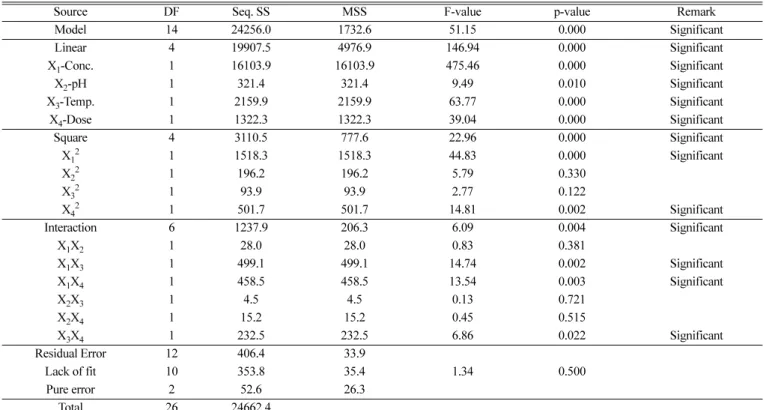
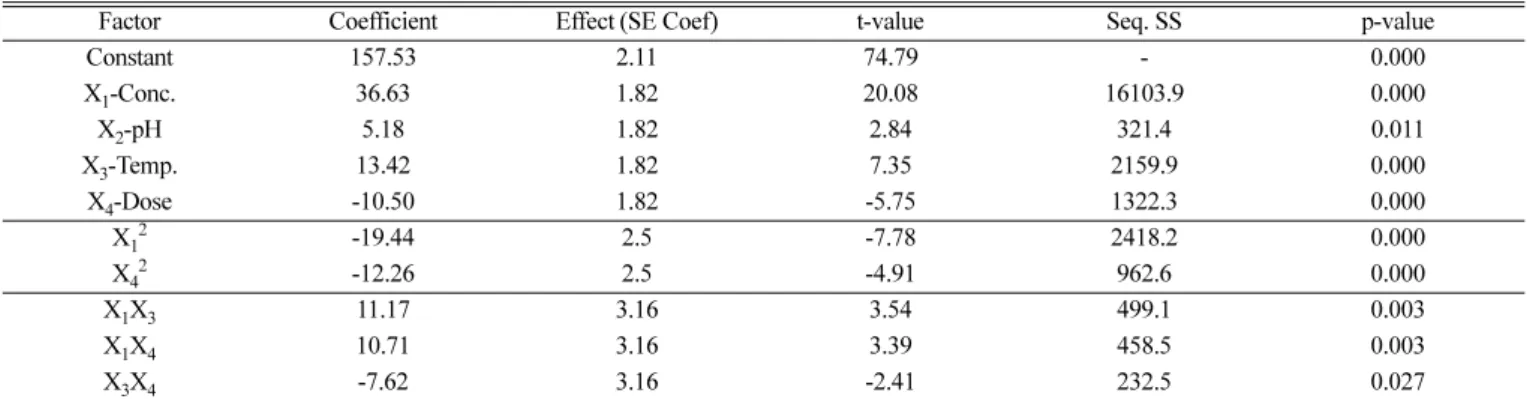
위 모델식의 타당성은 ANOVA를 통해 검정하였다. Table 3은 ANOVA 결과로서 선형항에서는 모든 인자들이 매우 높은 유의성 을 보이고 있으며, 2차 항에서 X12과 X42의 p 값이 0.000으로 높은 유의성을 보이고 있다. 교호항에서는 X1X3, X1X4, X3X4의 항에 대 해서만 높은 유의성을 보이고 이를 제외한 나머지 항들은 유의성이 낮아서 유의하지 않은 항들을 후방소거법(backward elimination)에 의해 제거한 결과를 Table 4에 나타내었다. ANOVA에서 적합성 결 여의 값이 0.454로서 유의 수준 0.05보다 크므로, 현재의 모델에 결 과가 적합한 것으로 분석되었다. 분산분석과 모델의 적합화를 행한 후에 TMP의 흡착량에 대하여 회귀계수를 Table 5에 나타내었으며, 이에 따른 추정 모델식은 다음과 같다.
(3) Fig. 1은 WCAC에 의한 TMP의 흡착에 있어서 실제 실험값과 Y β0 βi
i 1=
∑
n Xi βii i 1=∑
n Xi2 βijXiXj j 1=∑
n i 1= n 1–∑
+ + +
=
Y=157.53 36.63X+ 1+5.18X2+13.42X3–10.50X4 +11.17X1X3+10.71X1X4–7.62X3X4–19.44X12–12.26X42
Table 1. Experimental design levels of chosen variables
Variables Factors Level
Xi Low (-1) Middle (0) High (+1)
Concentration (mg/L) X1 50 100 150
pH X2 4 7 10
Temperature (K) X3 293 308 323
Dose (g) X4 0.05 0.1 0.15
Table 2. Experimental design matrix and experimental and predicted values of response
Run Variables Responses
X1 X2 X3 X4 Yobs Ypre
1 -1(50) -1(4) 0(308) 0(0.10) 94.681 96.282
2 +1(150) -1(4) 0(308) 0(0.10) 170.745 169.549
3 -1(50) +1(10) 0(308) 0(0.10) 116.489 106.634
4 +1(150) +1(10) 0(308) 0(0.10) 181.967 179.900
5 0(100) 0(7) -1(293) -1(0.05) 142.553 134.723
6 0(100) 0(7) +1(323) -1(0.05) 178.723 176.803
7 0(100) 0(7) -1(293) +1(0.15) 129.078 128.976
8 0(100) 0(7) +1(323) +1(0.15 134.752 140.560
9 -1(50) 0(7) 0(308) -1(0.05) 108.511 110.398
10 +1(150) 0(7) 0(308) -1(0.05) 161.658 162.251
11 -1(50) 0(7) 0(308) +1(0.15 68.794 67.990
12 +1(150) 0(7) 0(308) +1(0.15 164.767 162.670
13 0(100) -1(4) -1(293) 0(0.10) 142.553 138.938
14 0(100) +1(10) -1(293) 0(0.10) 148.936 149.289
15 0(100) -1(4) +1(323) 0(0.10) 174.468 165.770
16 0(100) +1(10) +1(323) 0(0.10) 185.106 176.121
17 -1(50) 0(7) -1(293) 0(0.10) 96.277 99.212
18 +1(150) 0(7) -1(293) 0(0.10) 148.404 150.138
19 -1(50) 0(7) +1(323) 0(0.10) 99.468 103.704
20 +1(150) 0(7) +1(323) 0(0.10) 196.277 199.311
21 0(100) -1(4) 0(308) -1(0.05) 151.064 150.587
22 0(100) +1(10) 0(308) -1(0.05) 153.191 160.938
23 0(100) -1(4) 0(308) +1(0.15 131.206 129.592
24 0(100) +1(10) 0(308) +1(0.15 141.135 139.944
25 0(100) 0(7) 0(308) 0(0.10) 145.936 157.529
26 0(100) 0(7) 0(308) 0(0.10) 150.000 157.529
27 0(100) 0(7) 0(308) 0(0.10) 156.128 157.529
식 (3)에 의한 예측값 사이의 상관관계를 나타낸 것이다. 그림에서 보는 바와 같이, 대각선 주위에 점들이 모여 있으며 반응결과에 대 한 결정계수(r2) 값이 0.9725로 매우 높은데, 이는 실험결과와 예측 결과 사이에 신뢰수준 97.3%의 좋은 상관관계가 있고 실험값과 예 측값 사이의 편차가 적기 때문에 모델의 적합성이 우수하다는 것을 나타낸다. 또한, 예측 결정계수(r2Pred)의 값이 0.9382로써 수정 결정 계수(adj-r2)의 값 0.9579과 합리적인 범위에서 잘 일치하므로 모델의 높은 신뢰도를 보여 주었다.
또한, 얻어진 2차 모델식에 대한 적합성은 오차항에 대한 잔차 분석을 통하여 확인할 수 있다. 잔차(residual)는 회귀모델의 예측값과 실제 실험에서 얻어진 실험값의 차로 정의된다. 각 반응치에 대한 잔차가 정규성(normality)과 등분산성(equal variation)을 만족하면 적합한 모델이라고 판단 할 수 있다[26]. Fig. 2(a)의 정규 확률도에 서 보면 모든 데이터들이 직선적으로 분포됨에 따라 정규분포를 나 타내고 있어 잔차의 정규성을 만족하고, Fig. 2(b)에서 잔차-적합치의 경우 잔차 분포가 0을 중심으로 랜덤하게 분포되어 있어 등분산성을 Table 3. ANOVA results for response surface quadratic models
Source DF Seq. SS MSS F-value p-value Remark
Model 14 24256.0 1732.6 51.15 0.000 Significant
Linear 4 19907.5 4976.9 146.94 0.000 Significant
X1-Conc. 1 16103.9 16103.9 475.46 0.000 Significant
X2-pH 1 321.4 321.4 9.49 0.010 Significant
X3-Temp. 1 2159.9 2159.9 63.77 0.000 Significant
X4-Dose 1 1322.3 1322.3 39.04 0.000 Significant
Square 4 3110.5 777.6 22.96 0.000 Significant
X12 1 1518.3 1518.3 44.83 0.000 Significant
X22 1 196.2 196.2 5.79 0.330
X32 1 93.9 93.9 2.77 0.122
X42 1 501.7 501.7 14.81 0.002 Significant
Interaction 6 1237.9 206.3 6.09 0.004 Significant
X1X2 1 28.0 28.0 0.83 0.381
X1X3 1 499.1 499.1 14.74 0.002 Significant
X1X4 1 458.5 458.5 13.54 0.003 Significant
X2X3 1 4.5 4.5 0.13 0.721
X2X4 1 15.2 15.2 0.45 0.515
X3X4 1 232.5 232.5 6.86 0.022 Significant
Residual Error 12 406.4 33.9
Lack of fit 10 353.8 35.4 1.34 0.500
Pure error 2 52.6 26.3
Total 26 24662.4
DF : Degree of freedom, Seq. SS: Sum of square, MSS: Mean sum of squares
Table 4. ANOVA results for response surface quadratic models after pulling
Source DF Seq. SS MSS F-value p-value Remark
Model 9 23983.6 2664.8 66.74 0.000 Significant
Linear 4 19907.5 4976.9 124.65 0.000 Significant
X1-Conc. 1 16103.9 16103.9 403.32 0.000 Significant
X2-pH 1 321.4 321.4 8.05 0.010 Significant
X3-Temp. 1 2159.9 2159.9 54.09 0.000 Significant
X4-Dose 1 1322.3 1322.3 33.12 0.000 Significant
Square 2 2886.0 1443.0 36.14 0.000 Significant
X12 1 2418.2 2418.2 60.56 0.000 Significant
X42 1 962.6 962.6 24.11 0.000 Significant
Interaction 3 1190.1 396.7 9.94 0.001 Significant
X1X3 1 499.1 499.1 12.50 0.003 Significant
X1X4 1 458.5 458.5 11.48 0.003 Significant
X3X4 1 232.5 232.5 5.82 0.027 Significant
Residual Error 17 678.8 39.9
Lack of fit 15 626.1 41.7 1.59 0.454
Pure error 2 52.6 26.3 r2 adj-r2 pred-r2
Total 26 24662.4 0.9725 0.9579 0.9382
DF : Degree of freedom, Seq. SS: Sum of square, MSS: Mean sum of squares
만족하므로 얻어진 모델은 적합한 것으로 판단할 수 있다.
Fig. 3은 TMP의 흡착량에 대한 주효과도를 나타낸 것이다. 주효 과도에서 각 인자의 선이 수평이 아니므로, 4가지 인자 모두 TMP의 흡착량에 영향을 미치는 것으로 해석되며 그 중에서도 농도가 가장 큰 영향을 미치는 것으로 판단된다. 또한 농도를 비롯하여 pH와 온
도는 설정된 조건에서 값이 증가할수록 흡착량 또한 증가하고 있지 만 흡착제 양은 일정 수준에서 최대 흡착량을 나타내고 그 이후의 값에서는 흡착량이 감소하고 있다. 낮은 pH에서 TMP 분자는 양성 자화된 형태로 존재하고 pH가 감소함에 따라 용액 내의 H+이온 양이 증가하게 되는데, 이들 TMP 분자와 H+ 이온은 흡착제의 흡착 부위를 경쟁하기 때문에 pH가 낮아질수록 흡착량은 감소하며, 농 도가 증가함에서는 따라 물질 전달구동력인 농도차가 증가함에 따 라 흡착량이 증가한 것으로 사료된다. 또한 온도가 증가할수록 TMP 분자가 활발하게 움직여 활성탄과의 충돌횟수가 증가하게 되고 이로 인해서 흡착이 활발히 일어나 흡착량이 증가하는 것으로 생각 된다. 그리고 흡착제 주입량이 증가함에 따라 흡착제 표면적 증가에 따른 흡착 활성점의 수가 증가하기 때문에 흡착량이 증가하다가 단 위부피내의 흡착제의 양이 일정량 이상으로 많아짐에 따라서는 흡 착제간의 거리가 상대적으로 가까워져 흡착질의 흡착 부위가 공유 되거나 흡착질 사이의 상호 방해작용 등에 의해 기인되는 것으로 사료된다[27].
Fig. 4는 모든 요인 수준의 조합에 대한 반응 값의 변화를 2차원 형태로 등고선도를 나타낸 것이다. 등고선도에서 각 그래프의 고정 값으로는 농도는 100 mg/L, pH는 7, 온도는 308 K, 흡착제 양은 0.1 g으로 각각 설정한 수준의 중간 값으로 설정하였다. Fig. 4(a)는 농도와 pH에 대한 등고선으로 pH보다는 농도에 대한 영향이 크며 농도와 pH가 클수록 흡착량 또한 증가함을 알 수 있다. 농도와 온 Table 5. Multiple regression results and significance of components for quadratic model
Factor Coefficient Effect (SE Coef) t-value Seq. SS p-value
Constant 157.53 2.11 74.79 - 0.000
X1-Conc. 36.63 1.82 20.08 16103.9 0.000
X2-pH 5.18 1.82 2.84 321.4 0.011
X3-Temp. 13.42 1.82 7.35 2159.9 0.000
X4-Dose -10.50 1.82 -5.75 1322.3 0.000
X12 -19.44 2.5 -7.78 2418.2 0.000
X42 -12.26 2.5 -4.91 962.6 0.000
X1X3 11.17 3.16 3.54 499.1 0.003
X1X4 10.71 3.16 3.39 458.5 0.003
X3X4 -7.62 3.16 -2.41 232.5 0.027
Seq. SS : Sum of square
Fig. 1. Comparison between the experimental values and model predicted values for the adsorption of TMP by WCAC.
Fig. 2. Residual plots of model for error values: (a) Normal probability plot of the residuals and (b) Residuals versus the fitted values.
도에 대한 흡착량의 그래프를 나타낸 Fig. 4(b)에서는 대체적으로 낮은 농도보다 높은 농도일 때 온도의 영향이 큰 것으로 보이며 전 체적으로 농도와 온도의 증가에 따라 흡착량이 증가하고 있다. Fig.
4(c)는 농도와 흡착제의 양에 대한 등고선도이며, 농도가 증가함에 따라 흡착량은 증가하고 있지만 흡착제의 양에 대해서는 최적값이 존재함을 알 수 있다. 따라서 농도는 130 mg/L, pH는 7, 온도는 313 K이상일 때, 흡착제의 양은 0.1 g 정도일 때 높은 흡착량을 얻을 수 있음을 알 수 있었다.
3-2. 흡착 속도 해석
본 연구에서 회분식 흡착 실험결과로부터 얻어진 결과를 유사 1 차 속도식과 유사 2차 속도식에 적용하여 검토하였다.
유사 1차 속도식은 Lagergern[28]에 의해 소개된 모델로 다음과 같으며,
(3)
유사 2차 속도식은 Ho와 McKay[29]에 의해 소개된 모델로 다음과 같다.
(4)
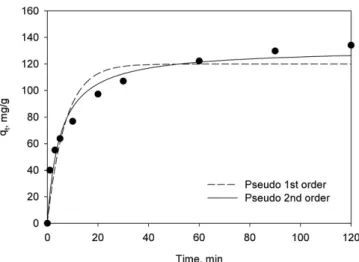
Fig. 5는 TMP의 농도 100 mg/L, WCAC 0.1 g, pH 7, 온도 293 K 로 운전한 경우에 얻어진 시간에 따른 흡착량의 실험결과와 식 (3)과
(4)로부터 계산한 결과를 비교하여 나타낸 것이며, Table 6은 구해 진 속도 파라미터들 나타낸 것이다. Fig. 5 및 Table 6에서 보듯이 실험결과는 유사 1차식(r2=0.9034)보다는 유사 2차식(r2=0.9609)에 더 잘 부합하였다. 이 결과는 WCAC에 의한 TMP의 제거 과정이 속도 조절 단계로서 화학 흡착임을 시사해주며, 이러한 결과는 Méndez-Díaz 등[10]이 활성탄을 이용한 nitroimidazole계 항생제인 dimetridazole, methoridazole, ronidazole, tinidazole의 흡착연구와 dq
---dt=k1(qe–qt)
dqt
---dt =k2(qe–qt)2
Fig. 4. Contour plots for the adsorption of TMP by WCAC. (a) Effect of initial concentration and pH, (b) Effect of initial concentration and temperature, and (c) Effect of initial concentration and dose.
Fig. 5. The nonlinear plots of kinetics for the adsorption of TMP by WCAC (Concentration : 100 mg/L, pH : 7, Temperature : 293 K, Dose of adsorbent : 0.1 g).
Fig. 3. Main effect plots for the adsorption of TMP by WCAC.
Aksu와 Tunç[13]이 활성탄을 이용하여 페니실린계 항생제 중 하나 인 penicillin G를 제거하는 연구에서의 결과와 유사하였다.
3-3. 흡착 등온 해석
Langmuir 모델식은 단분자층 흡착을 기초로 하여 만들어진 가장 일반적인 등온 모델식으로 다음과 같다[30].
(5)
Freundlich 모델식은 흡착제와 흡착질 분자 사이의 다분자층 흡 착을 설명하며 아래와 같다[31].
(6) Fig. 6은 온도 293, 308, 323 K에 대한 흡착 등온실험 결과와 식 (5) 및 식 (6)으로부터 계산한 결과를 비교하여 나타내었으며, 계산 된 등온 파라미터는 Table 7에 나타내었다. Langmuir 모델식의 경우 결정계수(r2) 값이 0.9947~0.9995이며, Freundlich의 경우 0.9852~
0.9903으로 Freundlich 모델식보다는 Langmuir 모델식에 더욱 잘 부합하였다. 즉, 본 연구의 폐감귤박 활성탄에 의한 TMP의 흡착은 단분자층 흡착이 다분자층 흡착보다 더 우세한 것으로 판단된다.
이러한 결과는 Kim 등[32]이 활성탄을 사용한 TMP의 흡착연구와 Putra 등[8]이 활성탄과 벤토나이트를 이용한 amoxicillin의 흡착 경 우에서와 결과와 일치하였다. 온도가 293, 308 및 323 K로 증가함에
따라서 최대 흡착량은 각각 144.90, 166.29 및 182.12 mg/L으로 증 가하였다.
4. 결 론
본 연구에서는 폐감귤박 활성탄(WCAC)을 이용하여 수중의 항 생제인 trimethoprim (TMP)의 흡착특성을 알아보기 위하여 초기농 도, pH, 온도, 흡착제의 양의 4가지 인자를 독립변수로 설정하여 4- 요인 Box-Behnken 실험 설계에 따라 회분식 실험을 수행하였다.
얻어진 실험 데이터를 다중 회귀 분석을 통해 2차 다항식에 맞추고 통계적 방법을 사용하여 조사하였다. 얻어진 2차 다항식의 적합성 에 대한 결정계수 r2는 0.9725으로 신뢰수준 97.3%의 우수한 상관 관계를 보여 얻어진 2차 다항식의 적합성이 우수하였다. 또한, 정규 확률도에서 모든 데이터들이 직선적으로 분포됨에 따라 정규분포 를 나타내고 있어 잔차의 정규성을 만족하고, 잔차-적합치의 경우 잔차분포가 0을 중심으로 랜덤하게 분포되어 등분산성을 만족하므 로 얻어진 모델은 적합한 것으로 판단할 수 있었다. 독립 변수 및 변수들 간의 상호 작용의 유의성은 ANOVA 및 t-검정 통계기법으 로 평가하였으며, 얻어진 방정식은 응답과 독립 변수 간의 관계를 적합하게 잘 설명하였다. 통계적 결과는 TMP 농도가 다른 요인들 에 비하여 가장 많은 영향을 미치는 운전인자라는 것을 보여 주었 으며, 각 인자에 대한 P-value의 값은 모두 유의 수준인 0.05보다 낮아 모든 인자들이 흡착반응에 유의함을 알 수 있었다. 실험변수 들은 흡착반응에 농도 > 흡착제 양 > 온도 > pH의 순서로 영향을 미치는 것으로 나타났다. WCAC를 이용한 TMP의 흡착반응속도 는 유사 2차 속도식에 더 잘 부합하였으며, 등온흡착평형관계는 Langmuir 식이 Freundlich 식 보다 더 잘 부합하였다.
Nomenclature Ce : equilibrium concentration [mg/L]
Co : initial concentration [mg/L]
Ct : concentration at time t [mg/L]
k1 : pseudo-first-order rate constant [1/min]
k2 : pseudo-second-order rate constant [g/mg·h]
KF : Freundlich isotherm constant [mg/g][L/mg]1/n KL : Langmuir isotherm constant [L/mg]
m : mass of absorbent [g]
n : Freundlich isotherm constant related to adsorption intensity qe qmKLCe
1 K+ LCe ---
=
qe=KFCe1/n
Fig. 6. Experimental equilibrium data and isotherm plot for the adsorption of TMP by WCAC.
Table 7. Isotherm parameters for the adsorption of TMP by WCAC
T(K) Langmuir Freundlich
qm(mg/g) KL(L/mg) r2 KF((mg/g)(L/mg)1/n) n r2
293 144.90 1.4654 0.9995 99.635 13.025 0.9891
308 166.29 1.7680 0.9955 107.303 10.739 0.9903
323 182.12 4.4385 0.9947 122.178 11.400 0.9852
Table 6. Kinetics parameters for the adsorption of TMP by WCAC qe,exp
(mg/g)
Pseudo first order model Pseudo second order model
qe,cal(mg/g) k1 (1/min) r2 qe,cal(mg/g) k2 (g/mg·min) r2
134.05 119.91 0.1401 0.9034 131.63 0.0015 0.9609
qe : adsorption capacity at equilibrium [mg/g]
qt : adsorption capacity at time t [mg/g]
qe,exp : adsorption capacity at equilibrium obtained from experiments [mg/g]
qe,cal : adsorption capacity at equilibrium calculated from models [mg/g]
qm : maximum adsorption capacity [mg/g]
r2 : determination coefficient T : absolute temperature [K]
t : time [min]
V : volume of solution [L]
References
1. Jo, J. H., Lim, D. H. and Seo, G. T., “A Study on the Adsorption of Sulfonamide Antibiotics on Activated Carbon Using Density Functional Theory,” J. Kor. Soc. Environ. Eng., 35(7), 457-463 (2013).
2. Dominguez-Vargas, J. R., Carrillo-Perez, V., Gonzalez-Montero, T. and Cuerda-Correa, E. M., “Removal of Trimethoprim by a Low-Cost Adsorbent: Influence of Operation Conditions,”
Water Air Soil Pollut., 223, 4577-4588(2012).
3. Pedrouzo, M., Borrull, F., Pocurull, E. and Marce, R. M., “Pres- ence of Pharmaceuticals and Hormones in Waters from Sewage Treatment Plants,” Water Air Soil Pollut., 217, 267-281(2011).
4. Fukahori, S., Fujiwara, T., Ito, R. and Funamizu, N., “pH-Depen- dent Adsorption of Sulfa Drugs on High Silica Zeolite: Model- ing and Kinetic Study,” Desalination, 275, 237-242(2011).
5. Dardouri, S. and Sghaier, J., “Adsorptive Removal of Methylene Blue from Aqueous Solution using Different Agricultural Wastes as Adsorbents,” Korean J. Chem. Eng., 34(4), 1037-1043(2017).
6. Snyder, S., Westerhoff, P., Yoon, Y. and Sedlak, D. L., “Pharma- ceuticals, Personal Care Products, and Endocrine Disruptors in Water: Implications for the Water Industry,” Environ. Eng. Sci., 20, 449-469(2003).
7. Ternes, T. A., Meisenheimer, M., McDowell, D., Sacher, F., Brauch, H.-J., Haist-Gulde, B., Preuss, G., Wilme, U. and Zulei-Seibert, N., “Removal of Pharmaceuticals During Drinking Water Treat- ment,” Environ. Sci. Technol., 36(17), 3855-3863(2002).
8. Putra, E. K., Pranowo, R., Sunarso, J., Indraswati, N. and Ismadji, S., “Performance of Activated Carbon and Bentonite for Adsorp- tion of Amoxicillin from Wastewater: Mechanisms, Isotherms and Kinetics,” Water Res., 43, 2419-2430(2009).
9. Chayid, M. A. and Ahmed, M. A., “Amoxicillin Adsorption on Microwave Prepared Activated Carbon from Arundo donax Linn:
Isotherms, Kinetics, and Thermodynamics Studies,” J. Environ.
Chem. Eng., 3, 1592-1601(2015).
10. Méndez-Díaz, J. D., Prados-Joya, G., Rivera-Utrilla, J., Leyva- Ramos, R., Sánchez-Polo, M., Ferro-García, M. A. and Medellín- Castillo, N. A., “Kinetic Study of the Adsorption of Nitroimid- azole Antibiotics on Activated Carbons in Aqueous Phase,” J.
Colloid Interface Sci., 345, 481-490(2010).
11. Ocampo-Pérez, R., Orellana-Garcia, F., Sánchez-Polo, M., Rivera- Utrilla, J., Velo-Gala, I., López-Ramón, M. V. and Alvarez-Merino, M. A., “Nitroimidazoles Adsorption on Activated Carbon Cloth
from Aqueous Solution,” J. Colloid Interface Sci., 401, 116-124 (2013).
12. Çahşkan, E. and Göktürka, S., “Adsorption Characteristics of Sul- famethoxazole and Metronidazole on Activated Carbon,” Sep.
Sci. Technol., 45(2), 244-255(2010).
13. Aksu, Z. and Tunc,, O., “Application of Biosorption for Penicillin G Removal: Comparison with Activated Carbon,” Process Bio- chem., 40, 831-847(2005).
14. Crisafully, R., Milhome, M. A. L., Cavalcante, R. M., Silveira, E. R., Keukeleire, D. De and Nascimento, R. F., “Removal of Some Polycyclic Aromatic Hydrocarbons from Petrochemical Wastewater Using Low-Cost Adsorbents of Natural Origin,”
Bioresour. Technol., 99(10), 4515-4519(2008).
15. Xu, X., Cao, X. and Zhao, L., “Comparison of Rice Husk-and Dairy Manure-Derived Biochars for Simultaneously Removing Heavy Metals from Aqueous Solutions: Role of Mineral Com- ponents in Biochars,” Chemosphere, 92(8), 955-961(2013).
16. Baccar, R., Sarrà, M., Bouzid, J., Feki, M. and Blánquez, P.,
“Removal of Pharmaceutical Compounds by Activated Carbon Prepared from Agricultural By-Product,” Chem. Eng. J., 211- 212, 310-317(2012).
17. Flores-Cano, J. V., Sanchez-Polo, M., Messoud, J., Ocampo- Perez, R. and Rivera-Utrilla, J., “Overall Adsorption Rate of Met- ronidazole, Dimetridazole and Diatrizoate on Activated Carbons Prepared from Coffee Residues and Almond Shells,” J. Environ.
Manage., 169, 116-125(2016).
18. Wan, S., Hua, Z., Sun, L., Bai, X. and Liang, L., “Biosorption of Nitroimidazole Antibiotics onto Chemically Modified Porous Biochar Prepared by Experimental Design: Kinetics, Thermody- namics, and Equilibrium Analysis,” Process Safety Environ. Pro- tection, 104, 422-435(2016).
19. Kam, S. K., Kang, K. H. and Lee, M. G., “Characterisitics of Activated Carbon Prepared from Waste Citrus Peel by KOH Activation,” Appl. Chem. Eng., 28(6), 649-654(2017).
20. Lee, C. H., Kam, S. K. and Lee, M. G., “Adsorption Character- istics Analysis of 2,4-Dichlorophenol in Aqueous Solution with Activated Carbon Prepared from Waste Citrus Peel Using Response Surface Modeling Approach,” Korean Chem. Eng. Res., 55(5), 723-730(2017).
21. Kam, S. K. and Lee, M. G., “Response Surface Modeling for the Adsorption of Dye Eosin Y by Activated Carbon Prepared from Waste Citrus Peel,” Appl. Chem. Eng., 29(3), 270-277(2018).
22. Alam, Z., Muyibi, S. A. and Toramae, J., “Statistical Optimiza- tion of Adsorption Processes for Removal of 2,4-Dichlorophe- nol by Activated Carbon Derived from Oil Palm Empty Fruit Bunches,” J. Environ. Sci., 19, 674-677(2007).
23. Saadat, S. and Karimi-Jashni, A., “Optimization of Pb(II) Adsorp- tion onto Modified Walnut Shells Using Factorial Design and Simplex Methodologies,” Chem. Eng. J., 173, 743-749(2011).
24. Kim, D. S. and Park, Y. S., “Disinfection of E. coli Using Elec- tro-UV Complex Process: Disinfection Characteristics and Opti- mization by the Design of Experiment Based on the Box-Behnken Technique,” J. Environ. Sci. Int., 19(7), 889-900(2010).
25. Park, H. E. and Row, K. H., “Optimization of Synthesis Condition of Monolithic Sorbent Using Rsponse Surface Methodology,”
Appl. Chem. Eng., 24(3), 299-304(2013).
26. Lee, S. E., Kim, J. K., Han, S. K., Chae, J. S., Lee, K. D. and
Koo, K. K., “Optimization of a Crystallization Process by Response Surface Methodology,” Appl. Chem. Eng., 26(6), 730-736(2015).
27. Kam, S. K., Hyun, S. S. and Lee, M. G., “Removal of Divalent Heavy Metal Ions by Na-P1 Synthesized from Jeju Scoria,” J.
Environ. Sci. Intern., 20(10), 1337-1345(2011).
28. Lagergren, S., “About the Theory of So-Called Adsorption of Soluble Substances,” Kunglia Svenska Vetenskapsa-kademiens Handlingar, 24, 1-39(1898).
29. Ho, Y. S. and McKay, G., “The Kinetics of Sorption of Basic
Dyes from Aqueous Solution by Sphagnum Moss Peat,” Can. J.
Chem. Eng., 76, 822-827(1998).
30. Langmuir, I., “The Adsorption of Gases on Plane Surface of Glass, Mica and Platinum,” J. Am. Chem. Soc., 40, 1361-1403(1918).
31. Freundlich, H. M. F., “Over the Adsorption in Solution,” J. Phys.
Chem., 57, 385-470(1906).
32. Kim, S. H., Shon, H. K. and Ngo, H. H., “Adsorption Charac- teristics of Antibiotics Trimethoprim on Powdered and Granular Activated Carbon,” J. Ind. Eng. Chem., 16, 344-349(2010).