387 https://doi.org/10.9713/kcer.2019.57.3.387
PISSN 0304-128X, EISSN 2233-9558
Ni Nanoparticles Supported on MIL-101 as a Potential Catalyst for Urea Oxidation in Direct Urea Fuel Cells
Ngan Thao Quynh Tran*, Hyo Sun Gil**, Gautam Das**, Bo Hyun Kim** and Hyon Hee Yoon**,†
*Department of machine and Equipment, Industrial University of Ho Chi Minh City, Nguyen Van Bao, HCMC, Vietnam
**Department of Chemical and Bio Engineering, Gachon University, 1342, Seongnam-daero, Sujeong-gu, Seongnam-si, Gyeonggi-do, 13120, Korea (Received 21 January 2019; Received in revised form 27 March 2019; accepted 28 March 2019)
Abstract − A highly porous Ni@MIL-101catalyst for urea oxidation was synthesized by anchoring Ni into a Cr-based metal-organic framework, MIL-101, particles. The morphology, structure, and composition of as synthesized Ni@MIL- 101 catalysts were characterized by X-Ray diffraction, Fourier transform infrared spectroscopy, scanning electron microscopy, and transmission electron microscopy. The electro-catalytic activity of the Ni@MIL-101catalysts towards urea oxidation was investigated using cyclic voltammetry. It was found that the structure of Ni@MIL-101 retained that of the parent MIL-101, featuring a high BET surface area of 916 m2 g-1, and thus excellent electro-catalytic activity for urea oxidation. A urea/H2O2 fuel cell with Ni@MIL-101 as anode material exhibited an excellent performance with maximum power density of 8.7 mWcm-2 with an open circuit voltage of 0.7 V. Thus, this work shows that the highly porous three-dimensional Ni@MIL-101 catalysts can be used for urea oxidation and as an efficient anode material for urea fuel cells.
Key words: Urea oxidation, Urea fuel cell, Ni catalysts, Metal organic framework, MIL-101, Ni@MIL-101
1. Introduction
The non-toxicity, affordability, and ease of storage/transport of urea make urea fuel cells promising power sources [1,2]. In a urea/
H2O2 fuel cell, urea is electro-oxidized at the anode (Eq. 1), while H2O2 is reduced at the cathode (Eq. 2):
Anode: CO(NH2)2 + 8KOH → N2 + 6H2O + K2CO3 + 6K+ + 6e– (1) Cathode: 3H2O2 + 3H2SO4 + 6K+ + 6e– → 6H2O + 3K2SO4 (2) Overall: CO(NH2)2 + 3H2O2 + 3H2SO4 + 8KOH → K2CO3
+ 3K2SO4 +N2 + 12H2O (3)
The theoretical cell voltage of a direct urea/H2O2 fuel cell equals 2.509 V, which is higher than other types of fuel cells [3]. The H2O2 can be electro-reduced in basic media; however, the theoretical cell voltage is 1.63 V [4]. Moreover, oxygen can be used as cathodic oxidant with the theoretical cell voltage of 1.15 V. However, the practical implementation of the direct urea fuel cells is hindered by their rela- tively low power density. Hence, most research efforts are directed at the development of suitable anode catalysts to speed up the sluggish kinetics of the six-electron-transfer urea oxidation reaction [5]. Cur- rently, non-precious Ni-based catalysts are considered as the most efficient anode materials in the urea fuel cells [5,6]. To enhance the activity and stability of the Ni-based catalysts, various metals including
Co, Mo, Cr, W, and Fe have been doped [7-10] and/or composited with carbon-based nanostructures such as carbon nanotubes, graphene, and aerogels [11-14].
In this study, we propose Ni nanoparticles impregnated into highly porous three-dimensional nanostructured metal-organic frameworks (MOFs) as an efficient electro-catalyst for urea oxidation reaction in direct urea fuel cells. A Cr-based metal-organic framework, MIL 101, was chosen as the MOF because it has a high surface area and high porosity with a pore size of 2.9-3.4 nm [15-17], which makes it favorable for catalysis material because catalyst pore sizes of 2-10 nm range are known to be preferable for electrochemical applications, because not only do these pores serve as a good reaction sites, they also shorten the path length the fuel and the ions have to travel [18,19]. In addition, Cr is known to enhance the catalytic activity of Ni for urea oxidation reaction [9]. The Ni-anchored MIL-101 catalyst (Ni@MIL-101) was subjected to structural, morphological, and electrochemical characterization. The performance of a urea/H2O2 fuel cell comprising the Ni@MIL as anode materials was evaluated.
2. Experimental
MIL-101 was synthesized by a hydrothermal procedure [20-22].
Briefly, a mixture of C6H4(CO2H)2 (H2BDC), HF, Cr(NO3)3·9H2O, and C17H35CO2H in de-ionized (DI) water was placed in a 100 ml Teflon-lined autoclave at 220 °C for 8 h. After cooling to ambient temperature, the green powder was collected by centrifugation and purified by solvothermal treatment in ethanol at 80 °C for 24 h. Then, the green solid product was soaked in NH4F solution at 70 °C for 24 h.
†To whom correspondence should be addressed.
E-mail: [email protected]
‡This article is dedicated to Prof. Yong-Gun Shul on the occasion of his retirement from Yonsei University
This is an Open-Access article distributed under the terms of the Creative Com- mons Attribution Non-Commercial License (http://creativecommons.org/licenses/by- nc/3.0) which permits unrestricted non-commercial use, distribution, and reproduc- tion in any medium, provided the original work is properly cited.
After centrifuging, the final solid product (MIL-101) was dried in a vacuum oven at 70 °C overnight. The as-synthesized MIL-101 (100 mg) was mixed with 10 mL of 0.2 M Ni(NO3)2·6H2O in DI water and continuously stirred overnight at room temperature. To the resulting green suspension, NaBH4 and H3NBH3 were added under vigorous stirring at 273 K. The mixture was centrifuged and dried to yield Ni@MIL-101 particles.
To prepare catalyst inks, as synthesized catalyst powder (Ni@MIL- 101) was dispersed in dimethyl formamide and mixed with a Nafion solution (Nafion 117, 5 wt% in isopropanol). After homogenization, the resulting anode catalyst ink was coated onto a carbon paper (TGP-H-60 Toray) to achieve a catalyst loading of 2 mg cm-2. Similarly, a commercial Pt/C (40 wt%, E-TEK)-coated carbon paper with a Pt loading of 2 mg cm-2 was used as a cathode. A cation exchange membrane (Nafion 115) was used as a polymer electrolyte.
A graphitic plate with serpentine flow channels and gold-coated stainless current collector were used for the single cell test. An aqueous solution of urea and KOH was fed into the anode side at a rate of 5 mL min-1, and 2 M H2O2 in 2 M H2SO4 solution was supplied to the cathode a rate of 5 mL min-1.
The catalyst powders were characterized using X-ray diffraction (XRD; Rigaku DMAX), Fourier transform infrared spectroscopy (FTIR; JASCO FT-IR 300E), scanning electron microscopy (SEM;
Hitachi S-4700, Japan), focused ion-beam SEM (FIB-SEM; Hitachi, Japan), and transmission electron microscopy (TEM; Tecnai G2 F30 S-Twin, USA). The specific surface area and pore size distribution were measured by N2 adsorption/desorption isotherms at liquid nitrogen temperature (77 K) on a Micromeritics ASAP 2020. The electrochemical measurements were by cyclic voltammetry (CV) using a potentiostat-galvanostat (VSP, Bio-Logic) on conventional three electrode cells setup. Ag/AgCl electrode was used as a reference electrode and a Pt wire as a counter electrode. Catalyst powder applied on carbon paper (as described above) cut into 5 mm×5 mm was used as working electrode. Fuel cell performance was evaluated utilizing the potentiostat-galvanostat interfaced with EC-lab 11.01 data acquisition software.
3. Results and Discussion
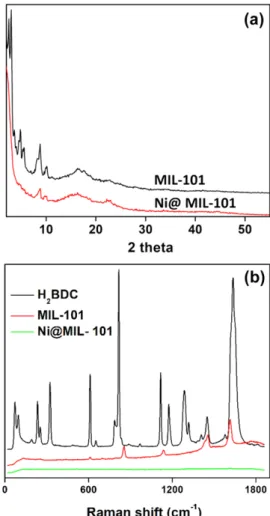
The XRD patterns of as prepared MIL-101 and Ni@MIL-101 particles are shown in Fig. 1a. The XRD patterns of MIL-101 were consistent with the simulated one with formula of Cr3F(H2O)2O [(O2C)C6H4(CO2)]3·nH2O (n = ~25) (CCDC No. 605510) [23,24].
In addition, no peaks for H2BDC were observed, confirming the successful synthesis of phase pure MIL-101(Cr). The XRD patterns of Ni@MIL-101 were intact with those of MIL-101, implying a good dispersion of Ni in the MIL-101 structure because metal nanoparticles would exhibit no characteristic peaks if dispersed as a monolayer or submonolayer [25,26]. The XRD pattern of Ni@MIL-101 was similar to those of MIL-101. Some peaks disappeared by the presence of Ni, indicating possible structural deformation of MIL-101 by the Ni.
However, no extra peak appeared by the presence of Ni, implying a good dispersion of Ni in the MIL-101 structure because metal nanoparticles would exhibit no characteristic peaks if dispersed as a monolayer or submonolayer [25,26].
A comparative Raman spectra (Fig. 1b) revealed that MIL-101 had peaks for H2BDC but, however, Ni@MIL-101 had no peaks for H2BDC, further indicating the successful synthesis of pure Ni@MIL-101.
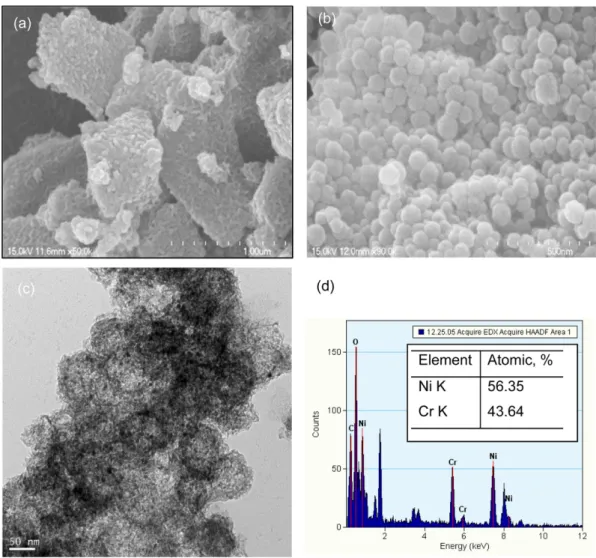
Fig. 2 shows SEM, cross-sectional FIB-SEM, and TEM images of as prepared Ni@MIL-101. The cross-sectional FIB-SEM revealed that Ni@MIL-101 comprised of nano-sized subunits featured a highly porous structure. The spherical subunit particles were uniformly distributed with average sizes of ~50 nm. In addition, Ni nanoparticles, appearing as dark gray areas in TEM image, were well dispersed throughout the MIL-101 crystal, as shown in Fig. 2c. The Ni and Cr composition ratio in the Ni@MIL-101 samples was approximately 56:44 (Ni/Cr) as determined by EDX spectra (Fig. 2d).
The BET specific surface area and pore volume, determined from nitrogen adsorption-desorption isotherms as shown in Fig. 3, of the MIL-101 were 1731 m2 g-1 and 0.40 cm3 g-1, respectively. After the anchoring of Ni in MIL-101, the BET specific surface area and pore volume of the Ni@MIL-101 decreased to 916 m2 g-1 and 0.22 cm3 g-1, respectively, probably due to the increased density by the addition of Fig. 1. XRD patterns (a) and Raman spectra (b) of MIL-101 and
Ni@MIL-101.
Ni and/or pore blocking by Ni particles.
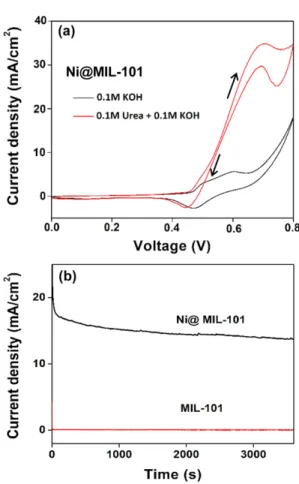
The catalytic activity of Ni@MIL-101 for urea electro-oxidation was examined by cyclic voltammetry (CV) measurements as shown in Fig. 4. The CV curves of the Ni-based catalyst in the absence of urea exhibited a pair of redox peaks at 0.55~0.6 and 0.4~0.5 V vs.
Ag/AgCl, which corresponded to anodic and cathodic peak potentials,
respectively, and indicated the previously reported inter-conversion of Ni2+/Ni3+ in alkaline medium [27,28]. In the presence of 0.1 M urea in 0.1 M KOH, the Ni-based catalysts exhibited redox peaks (with increased oxidation peak intensity and decreased reduction peak intensity) at the similar potentials as those observed in 0.1 M KOH, which confirmed the activity of these catalysts for urea oxidation Fig. 2. SEM (a), cross-sectional FIB-SEM (b), TEM (c) images, and (d) EDX spectrum of as synthesized Ni@MIL-101 particles.
Fig. 3. N2 sorption isotherm (a), and pore size distribution (b) of MIL-101 and Ni@MIL-101.
occurring via Ni2+/Ni3+ redox pathway. The results, therefore, indicated that urea oxidation occurred via an indirect mechanism involving the reduction of NiOOH to Ni(OH)2 and the electrochemical regeneration of Ni(OH)2 to NiOOH as reported previously [12,28]. Ni@MIL-101 exhibited a higher peak current density of 35.3 mA cm-2, whereas values of 14.6 mA cm-2 were obtained for Ni/MIL-101/bulk. The results suggested that the addition of stearic acid was critical in the preparation of suitable MIL-101 for Ni-doping. The electro-catalytic activity of Ni@MIL-101 catalyst was further examined by chronoamperometric measurements at 0.6 V in 0.1 M urea in 0.1 M KOH, as shown in Fig. 4c. The Ni@MIL-101 catalyst exhibited stable current responses.
A urea/H2O2 type fuel cell was fabricated using Ni@MIL-101 catalyst as anode materials. The I-V polarization and power density curves of this cell recorded in 0.3 M urea in 1.0 M KOH at 70 °C are shown in Fig. 5. The open circuit voltage (OCV) of the urea fuel cell was around 0.7 V, which is comparable with previously reported values (0.6-0.8V) [2,3,29]. The maximum power density was obtained as 8.7 mW cm-2. The excellent performance of the Ni@MIL anode was mainly attributed to its high specific surface area and mesoporous structure, which provided a high number of active Ni-catalyst sites and allowed fast mass transfer of urea and products in the anode.
4. Conclusion
Highly porous nanostructured Ni@MIL-101catalyst for urea oxidation was synthesized by doping Ni into MIL-101 particles. The prepared Ni@MIL-101catalyst exhibited a high specific surface area and thus featured excellent electro-catalytic activity for urea oxida- tion. A DUFC containing Ni@MIL as an anode catalyst achieved a maximum power density of 8.7 mW cm-2 in 0.3 M urea and 1 M KOH at 70 °C. The result suggests that the simply prepared nanostructured Ni@MIL-101 catalysts are suitable anode materials for DUFCs.
Acknowledgment
This work was supported by the Korea Institute of Energy Tech- nology Evaluation and Planning (KETEP) and the Ministry of Trade, Industry & Energy (MOTIE) of the Republic of Korea (No.
20194030202290) and the Basic Science Research Program through the National Research Foundation of Korea (NRF) funded by the Ministry of Education, Science and Technology (2017R1AB4002083).
References
1. Lan, R., Tao, S. and Irvine, J. T. S., “A Direct Urea Fuel Cell- Power From Fertiliser and Waste,” Energy Environ. Sci. 3, 438- 441(2010).
2. Xu, W., Zhang, H., Li, G. and Wu, Z., “Nickel-cobalt Bimetallic Anode Catalysts for Direct Urea Fuel Cell,” Sci. Rep. 4, 5863 (2014).
3. Guo, F., Cao, D., Du, M., Ye, K., Wang, G., Zhang, W., Gao, Y.
and Cheng, K., “Enhancement of Direct Urea-hydrogen Perox- ide Fuel Cell Performance by Three-dimensional Porous Nickel- cobalt Anode,” J. Power Sources, 307, 697-704(2016).
4. Ye, K., Wang, G., Cao, D. and Wang, G., “Recent Advances in the Electro-Oxidation of Urea for Direct Urea Fuel Cell and Urea Electrolysis,” Topics in Current Chemistry, 376, 42(2018).
5. Xu, W., Wu, Z. and Tao, S., “Urea-Based Fuel Cells and Elec- trocatalysts for Urea Oxidation,” Energy Technol. 4, 1-10(2016).
Fig. 4. (a) CV curves of Ni@MIL-101 recorded in the absence (black) and presence of 0.1 M urea (red) in 0.1 M KOH at scan rate of 10 mV s-1, and (b) chronoamperometric responses of MIL- 101, and Ni@MIL-101 in 0.1 M urea in 0.1 M KOH at 0.6 V.
Fig. 5. I-V and power density curves of a urea/H2O2 cell with Ni@
MIL-101 as anode at 0.3 M urea in 1 M KOH at 70 °C.
6. Yan, W., Wang, D. and Botte, G. G., “Electrochemical Decomposi- tion of Urea with Ni-based Catalysts,” Appl Catal B-Environ.
127, 221-226(2012).
7. Wang, L., Du, T., Cheng, J., Xie, X., Yang, B. and Li, M., “Enhanced Activity of Urea Electrooxidation on Nickel Catalysts Supported on Tungsten Carbides/carbon Nanotubes,” J. Power Sources, 280, 550-554(2015).
8. Shi, W., Ding, R., Li, X., Xu, Q. and Liu, E., “Enhanced Perfor- mance and Electrocatalytic Kinetics of Ni-Mo/Graphene Nano- catalysts Towards Alkaline Urea Oxidation Reaction,” Electrochim.
Acta. 242, 247-259(2017).
9. Kumar, R. and Schechter, A., “Electroactivity of Urea Oxidation on NiCr Catalysts in Alkaline Electrolyte,” ChemCatChem. 9, 3374- 3379(2017).
10. Xu, W., Du, D., Lan, R., Humphreys, J. and Wu, Z.,“Highly Active Ni-Fe Double Hydroxides as Anode Catalysts for Elec- trooxidation of Urea,” New J. Chem. 41, 4190-4196(2017).
11. Hameed, R. M. A. and Medany, S. S., “Influence of Support Mate- rial on the Electrocatalytic Activity of Nickel Oxide Nanoparti- cles for Urea Electro-oxidation Reaction,” J. Colloid Interface Sci., 513, 536-548(2018).
12. Nguyen, N. S., Das, G. and Yoon, H. H., “Nickel/cobalt Oxide- decorated 3D Graphene Nanocomposite Electrode for Enhanced Electrochemical Detection of Urea,” Biosen. Bioelectron., 77, 372- 377(2016).
13. Das, G., Tesfaye, R. M., Won, Y. and Yoon, H. H., “NiO-Fe2O3 Based Graphene Aerogel as Urea Electrooxidation Catalyst,”
Electrochim. Acta, 237, 171-176(2017).
14. Barakat, N. A. M., El-Newehy, M. H., Yasin, A. S., Ghouri, Z.
K. and Al-Deyab, S. S., “Ni&Mn Nanoparticles-decorated Car- bon Nanofibers as Effective Electrocatalyst for Urea Oxidation,”
Appl. Catal. A-Gen., 510, 180-188(2016).
15. Bhattacharjee, S., Chen, C. and Ahn, W. S., “Chromium Tere- phthalate Metal-organic Framework MIL-101: Synthesis, Func- tionalization, and Applications for Adsorption and Catalysis,” RSC Adv., 4, 52500-52525(2014).
16. Sabouni, R., Kazemian, H. and Rohani, S., “Carbon Dioxide Adsorption in Microwave-synthesized Metal Organic Framework CPM-5: Equilibrium and Kinetics Study,” Microporous Meso- porous Mater., 175, 85-91(2013).
17. Mishra, P., Mekala, S., Dreisbach, F., Mandal, B. and Gumma, S., “Adsorption of CO2, CO, CH4 and N2 on a Zinc Based Metal Organic Framework,” Sep. Purif. Technol., 94, 124-130(2012).
18. Li, W., Liu, J. and Zhao, D., “Mesoporous Materials for Energy Conversion and Storage Devices,” Nat. Rev. Mater., 1, 16023- 16040(2016).
19. Hibino, T., Kobayashi, K., Ito, M., Nagao, M., Fukui, M. and Teranishi, S., “Direct Electrolysis of Waste Newspaper for Sus- tainable Hydrogen Production: An Oxygen-functionalized Porous Carbon Anode,” Appl. Catal. B-Environ. 231, 191-199(2018).
20. Ferey, G., Mellot-Draznieks, C., Serre, C., Millange, F., Dutour, J., Surble, S. and Margiolaki, I., “A Chromium Terephthalate-based Solid with Unusually Large Pore Volumes and Surface Area,”
Science, 309, 2040-2042(2005).
21. Montazerolghaem, M., Aghamiri, S. F., Tangestaninejad, S. and Talaie, M. R., “A Metal-organic Framework MIL-101 Doped with Metal Nanoparticles (Ni & Cu) and Its Effect on CO2 Adsorp- tion Properties,” RSC Adv., 6, 632-640(2016).
22. Jiang, D., Burrows, A. D. and Edler, K. J., “Size-controlled Syn- thesis of MIL-101(Cr) Nanoparticles with Enhanced Selectivity for CO2 over N2,” CrystEngComm., 13, 6916-6919(2011).
23. Kenarsari, S. D., Yang, D., Jiang, G., Zhang, S., Wang, J., Rus- sell, A. G., Wei, Q. and Fan, M., “Review of Recent Advances in Carbon Dioxide Separation and Capture,” RSC Adv., 3, 22739- 22773(2013).
24. Sumida, K, Rogow, D. L., Mason, J. A., McDonald, T. M., Bloch, E. D., Herm, Z. R., Bae, T. H. and Long, J. R., “Carbon Dioxide Capture in Metal-organic Frameworks,” Chem. Rev., 112, 724- 781(2012).
25. Moon, H. R., Lim, D. W. and Suh, M. P., “Fabrication of Metal Nanoparticles in Metal-organic Frameworks,” Chem. Soc. Rev. 42, 1807-1824(2013).
26. Saha, D. and Deng, H., “Hydrogen Adsorption on Ordered Mes- oporous Carbons Doped with Pd, Pt, Ni, and Ru,” Langmuir, 25, 12550-12560(2009).
27. Tran, T. Q. N., Das, G. and Yoon, H. H., “Nickel-metal Organic Framework/MWCNT Composite Electrode for Non-enzymatic Urea Detection,” Sensors and Actuators, B: Chemical. 243, 78- 83(2017).
28. Vedharathinam, V. and Botte, G. G., “Understanding the Electro- catalytic Oxidation Mechanism of Urea on Nickel Electrodes in Alkaline Medium,” Electrochimica Acta. 81, 292-300(2012).
29. Lan, R. and Tao, S., “Preparation of Nano-sized Nickel as Anode Catalyst for Direct Urea and Urine Fuel Cells,” J. Power Sources, 196, 5021-5026(2011).