501 https://doi.org/10.9713/kcer.2019.57.4.501
PISSN 0304-128X, EISSN 2233-9558
Synthesis of Acetins from Glycerol using Lipase from Wheat Extract
Pradima J†, Rajeswari M Kulkarni, Archna Narula, Sravanthi V, Rakshith R and Nawal Rabia Nizar Department of Chemical Engineering, M S Ramaiah Institute of Technology, MSR Nagar, Bangalore-560054, Karnataka, India.
(Received 4 January 2019; Received in revised form 7 April 2019; accepted 13 May 2019)
Abstract − New technology-driven biocatalysts are revolutionizing the biochemical industries. With maximum utilization of renewable feedstock, biocatalysts have been the basis for a major breakthrough. Lipases are the most widely established catalysts used for hydrolysis, esterification and transesterification reactions. In this research, a biochemical process that combines extraction of lipase enzyme from germinated wheat seeds and its application to valorize glycerol to acetins by esterification is presented. Acetins are among highly rated, value-added products derived from glycerol. The favorable conditions for the enzymatic conversion of glycerol were observed as glycerol to acetic acid molar ratio (1:5), reaction temperature (40oC) and the amount of enzyme (20% v/v). 65.93% of glycerol conversion was achieved for duration of 15 h with the use of tert-butanol solvent. This method proposes to explore the viability of a biological route to convert glycerol derived from biodiesel industry to acetins with further streamlining.
Key words: Glycerol, Fuel additives, Enzyme catalysts, Kinetics, Lipase
1. Introduction
New energy resources, such as biomass, wind and solar, are becoming well-established over fossil fuels on a commercial scale and are considered an important technological advancement. These new energy resources aim to limit green house gas emissions, improve air quality and diminish air pollution hazards [1,2]. The major by- product of one such fuel production (biodiesel) is glycerol at an approximate rate of 10 wt% [3]. The surplus availability of bio- glycerol results in price decline, which otherwise is highly priced and is an attractive feedstock for the synthesis of various valuable platform chemicals [4]. Many reaction pathways such as esterification, selective oxidation, acetylation, etherification and transesterification, have been applied to convert glycerol to a valuable commodity. Glycerol acetins, one such important category of glycerol derivatives, is obtained by esterification reaction of glycerol with acetic group compounds.
The general nomenclature of acetins is as mono, di and triacetyl/acyl of glycerol, commonly known as monoacetin (MA), diacetin (DA) and triacetin (TA) [5]. They find wide application in pharmaceutical, cosmetics, food and fuel industries [6-8]. In recent years, there has been continuing research interest in acetin production due to its physicochemical and biological properties. For instance, monoacylglycerol and diacylglycerol have been used as surfactants, emulsifiers, food additives and as anti- staling agents [9].
Acetins are industrially synthesized via chemical routes using bases, acids as a catalyst or at a high reaction temperature. Use of
homogeneous catalysts such as acidic ionic liquids, sulfuric acid, hydrochloric acid and phosphoric acid have reported high corrosion to the equipment, toxicity to the environment and difficulty in recycling [10]. Considering this drawback, heterogeneous catalysts are preferred and considered relatively environment-friendly [11].
Different types of heterogeneous chemical catalyst used in acetin synthesis as reported by some of the researchers include metal oxides, zeolites, Amberlyst-15, sulfonic or phosphonic mesostructured silica with their catalytic activity related to acid capacities and surface density of the active sites [12,13]. These industrial processes typically require elevated operating temperatures and under these conditions undesirable reactions such as oxidation, dehydration, inter-esterification may occur [14]. Enzyme catalytic processes are safer than the aforementioned routes due to ambient reaction conditions, simplicity in product purification, and are environment-friendly.
Lipases (triacylglycerol acyl hydrolase EC 3.1.1.3) are among the most commonly used biocatalysts that have the capacity to break down lipids with wide substrate specificity and selectivity [15]. Present in almost all living organisms, they catalyze various reactions such as transesterification, hydrolysis, etherification and acidolysis with high activity, specificity and over a wide media range such as organic solvents and ionic liquids [16,17]. Produced by plants, animals and microorganisms, they are applied to processes based on their regioselective properties and enantioselective catalytic behavior [13]. Presently, there has been great interest concerning the extraction of plant lipase.
Though different uses of plant lipases are well documented, their applications for industrial processes are yet to be fully determined.
Plant lipases are attractive owing to their low cost, ease of purification and diversity. Lipases from different seed plant sources such as castor bean, sunflower, corn, and passion fruit have been applied for the hydrolysis of different vegetable oils. Studies have also shown
†To whom correspondence should be addressed.
E-mail: [email protected]
This is an Open-Access article distributed under the terms of the Creative Com- mons Attribution Non-Commercial License (http://creativecommons.org/licenses/by- nc/3.0) which permits unrestricted non-commercial use, distribution, and reproduc- tion in any medium, provided the original work is properly cited.
that seed lipases show the highest activity during grain germination [18,19]. Since it is extracted from the germinated seed, it can be applied directly without purification thereby lowering the cost of production.
Enzymatic synthesis of acetins using acetic acid is not well explored in the literature. Dlugy et al. used immobilized lipase Candida antartica lipase B to perform resolution of 2-heptyl acetate and 2-octyl acetate racemates and observed 50% conversion [20]. Oh et al. reported glycerol conversion of 5.73% using lipase Amano AK as a catalyst.
They also reported 40.37% conversion using Novozyme 435 as a catalyst at 1:5 molar ratio and with methyl acetate as substrate [21].
Wong et al. reported 22.96% conversion for esterification of glycerol and capric acid catalyzed by Candida rugosa in the presence of isooctane as solvent [22].
As a continuation of our research towards the application of enzymes as catalysts, we focused our attention on the performance of lipase from wheat extract. Currently, enzyme-catalyzed processes are costlier than chemical processes due to the higher cost of the enzyme. To address this problem, lipase from agricultural sources such as plant seeds was investigated.
In this study, we evaluated a biochemical process combining the extraction of lipase enzyme from germinated wheat seeds and bio- catalysis of glycerol to acetins using the extracted lipase enzyme.
The effects of various parameters on the esterification reaction under mild reaction conditions and the percentage conversion of glycerol with and without the use of solvent were also studied. The scheme of acetins synthesis from glycerol is as represented below (Fig. 1).
2. Materials and Methods
2-1. Materials
Wheat seeds (Triticum aestivum) obtained from a local wheat mill in Bangalore, India were germinated. The sprouted seeds were then stored at room temperature until further use (for extraction of lipase enzyme). All the other chemicals used in this experiment, such as anhydrous glycerol, glacial acetic acid, acetone, sodium phosphate buffer, tert-butanol and sodium hydroxide, were of analytical grade and procured from Sigma Aldrich, India.
2-2. Extraction of lipase enzyme from germinated wheat seeds For the process of germination, 100 g of wheat seeds was sprinkled with distilled water at room temperature (30oC) and placed in a
petri-dish over moist cotton. The contents of the dish were placed in a growth chamber for 52 h. The germinated wheat seeds were then collected and ground with pestle and mortar to form a paste. The resultant paste was blended with 100 mL of sodium phosphate buffer, placed over an ice bath for 30 minutes. The samples were then mixed with chilled acetone at 150 rpm and allowed to settle for an hour. The degreased samples were later filtered using a vacuum Buchner funnel and kept in an open flask for acetone to evaporate. The methodology followed was as described by [23,24]. The product obtained is the extracted lipase enzyme which was used for esterification studies.
2-3. Catalytic activity studies
The activity of the lipase extract from the germinated wheat seeds was determined by hydrogenation of emulsified olive oil according to the methodology described by Soares et al. with some modifications [25]. The enzyme hydrolytic activity was assayed by a reaction using olive oil as substrate and followed by alkali titration. 50 mL of olive oil was emulsified with 150 g gum arabic solution in 100 mL sodium phosphate buffer and blended at 300 rpm. 2 mL sample of the crude enzyme was added to 18 mL of this emulsion and mixed in a shaker and incubated for 15 min at room temperature. The reaction was arrested by the addition of 20 mL ethanol. The amount of fatty acid liberated was titrated with 0.05N NaOH. Lipase activity measurements were made in duplicate. One international unit (IU) of activity was defined as the amount of enzyme that liberates 1 µmol free fatty acid per minute (1IU) under assay conditions. Lipase from wheat seeds showed activity of 93.34 U/g.
2-4. Acetins synthesis
The esterification reaction with a predetermined amount of glycerol and acetic acid was carried out with extracted lipase enzyme as a catalyst in a 250 mL three-necked round bottom flask, placed over an oil bath. Heating was facilitated by a mantle equipped with a magnetic stirrer. The temperature of the reaction mixture was maintained at 40oC by a PID controller. Liebig condenser was attached to the reactor to prevent any loss of reactants and products. The reaction was carried out with various molar ratio of glycerol to acetic acid (1:1, 1:3, 1:5, 1:10 and 1:20), different enzyme catalyst concentration (10, 20, 30 and 40% v/v) and with different amounts of organic solvent (2.5, 5, 10 and 20 mL). As the reaction proceeded, glycerol was converted to acetins. The samples were then withdrawn periodically from the reaction setup, centrifuged to allow any particulate matter to Fig. 1. Scheme of synthesis of acetins, from glycerol and acetic acid [11,12].
settle down and the upper clear liquid was taken for the analysis. The samples were analyzed by gas chromatography (GC) equipped with FID and a non-polar capillary column. The calculations were based on the limiting reactant glycerol. The product (acetins) and all the other components were confirmed by the GC instrument. The effects of molar ratio, enzyme concentration and the organic solvent were investigated by changing one parameter at a time, maintaining others constant. The reaction time, 15 h was selected because glycerol conversion was not enhanced significantly after 15 h.
2-5. Analytical methods 2-5-1. Gas chromatography
The analyses of products (Monoacetin, Diacetin and Triacetin) were done using gas chromatography (GC). Reaction samples (0.5 µL) were analyzed on a GC-1100 (Mayura Analytical LLP) equipped with a flame ionization detector (FID) and a silphenylene polysiloxane capillary column (30 m, 250 µm, 0.25 µm). Both the injector and detector were held at a constant temperature of 250oC. Initially, 0.5 µL of the sample was injected at 120oC oven temperature and raised to 150oC with the rate of 6oC min-1 and heldfor 1 min. Nitrogen was used as a carrier gas at 35 mL min-1. The products formed were determined by relative peak areas.
2-5-2. FT-IR spectroscopy
IR Spectra of extracted lipase enzyme were obtained by FTIR instrument (Bruker model, Alpha Echo ATR) in the 400-4000 cm-1 wave number range.
3. Results and Discussion
3-1. Esterification studies
The influence of the molar ratio of glycerol to acetic acid, catalyst amount and solvent concentration on the conversion of glycerol using extracted wheat lipase was estimated and the results obtained are discussed in the following sections.
3-2. Enzyme concentration effect
Influence of enzyme concentration on the esterification reaction was studied and glycerol conversions obtained were 34.60%, 52.60%, 43.71%, and 32.45% at 10, 20, 30 and 40% v/v extracted lipase concentration, respectively (Fig. 2). The conversion of glycerol increased significantly when the catalyst amount increased from 10 to 20% v/v.
This is due to the availability of active sites leading to the formation of enzyme-substrate complex yielding products. With further increase in enzyme concentration (30 and 40% v/v), the catalyst activity dropped and hence the conversion of glycerol. This relatively low conversion is due to the antagonistic effect on the reaction caused by the excess amount of enzyme for the given fixed reaction volume, coupled with mass transfer limitations [26,27]. Lipase activity mainly depends on their affinity to short chain acyl donors, enzyme denaturation, byproducts formed etc. Enzyme concentration is an important factor owing to its
economic cost and obviously, lower the amount of enzyme, the more cost-effective the process. Also, enzyme substrate complexes may not be formed due to lack of substrates at high enzyme concentration. It can also be stated that, while lipase catalyzes esterification reaction, it can also catalyze reverse reactions.
3-3. Molar ratio effect
The effect of substrate molar ratio is considered an important factor in the enzymatic synthesis of green chemicals. From Fig. 3, when the molar ratio of glycerol to acetic acid was increased from 1:1 to 1:5, the conversion was found to increase from 18.26% to 52.60%. This is due to (i) surplus acetate groups available for the reaction and (ii) increased collision between the reactants and the catalysts. However, with further increase in molar ratio, the conversion was found to decrease. At 1:20 substrate molar ratio, the conversion dropped to 14.40%. This implies that the excessive acetate molecules might show substrate inhibition effect on lipase activity. Also, excess acetic acid decreases the accessibility of glycerol at the acid sites of Fig. 2. Effect of enzyme concentration on glycerol conversion. Experi- mental conditions: 1:5 molar ratio glycerol/acetic acid at tem- perature 40oC, 15 h reaction time.
Fig. 3. Effect of molar ratio of glycerol: acetic acid on glycerol con- version. Experimental conditions: 15 h reaction time, 20%
v/v extracted lipase enzyme at temperature 40oC.
the catalyst to form an intermediate compound [22-28]. Hence 1:5 molar ratio of glycerol to acetic acid was selected for further study.
3-4. Organic solvent effect
Organic solvent plays a significant role in any enzymatic reaction.
The most important criteria for choosing a proper solvent are substrate solubility, enzyme stability and product recovery. Many supporting documents are available in the literature to indicate that solvent can alter enzyme activity, reaction rate and selectivity by changing enzyme conformational structure [29]. Tert-butanol was found to be highly miscible with the selected reaction mixture, and hence it was used as a solvent to blend the substrates. The influence of organic solvent, tert-butanol on the esterification reaction between glycerol and acetic acid was evaluated and is summarized in Fig. 4. The experiments were carried out using 2.5, 5, 10 and 20 mL solvent with an extracted enzyme concentration of 20% v/v at 40oC and mole ratio of glycerol to acetic acid of 1:5. Samples were withdrawn at regular time intervals during the 15 h study. The highest conversion (65.93%) was obtained when 5 mL of organic solvent was used, and the lowest (37.25%) was found when 20 mL was used. As depicted in Fig. 5, a higher extent
of esterification of 65.93% was observed with tert-butanol solvent as compared to 52.60% without solvent. This clearly correlates with the reported literature that tert-butanol improves the enzymatic reaction by lowering the viscosity of the reaction mixture and enhancing substrate diffusion to the enzyme active sites [30,31].
3-5. Fourier Transform-Infrared spectroscopy
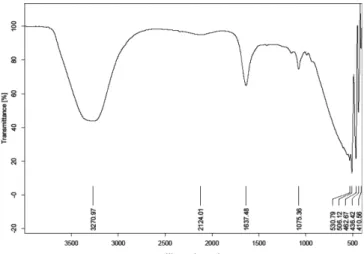
FT-IR spectroscopy was performed to identify the major functional groups of lipase enzyme extracted (Fig. 6). The FTIR spectrum of lipase usually reveals three major band vibrations due to peptide groups in the range of 1800~1200 cm-1 [32]. The functional group region between 1600 cm-1 and 1800 cm-1 is useful for the identification and quantification of lipase. The peaks in this region are caused by vibrations in the ester and carboxylic groups. Two strong and sharp peaks at 3270 cm-1 and 2124 cm-1 correspond to the asymmetric and symmetric stretching of carboxylic acid and alkane group respectively.
Also, spectrum intensity of several typical peaks between 1075 cm-1 and 410 cm-1 can be assigned to C-O stretching of acetyl group present on the surface of the catalyst. The presence of these bands with wave number indicates that the enzyme can actively participate in forming an enzyme-substrate complex [33].
3-6. Kinetic parameters
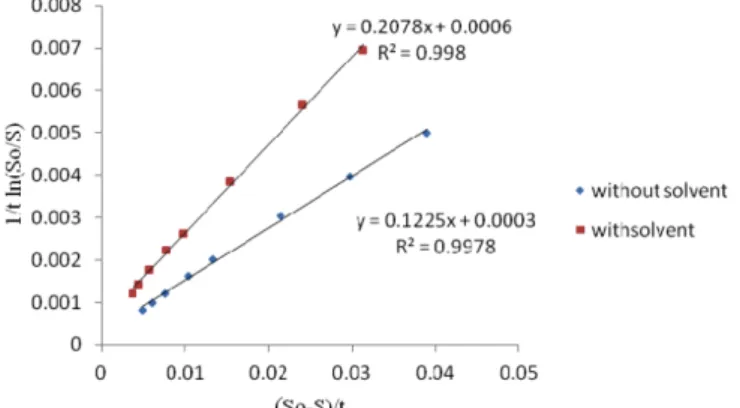
An investigation of Michaelis-Menten kinetics was carried out with glycerol concentration and time data obtained in the presence and absence of organic solvent. It was assumed that the enzyme- substrate complex was formed rapidly and the rate of reverse reaction was negligible.
The Michaelis-Menten constants (Km) and the maximum reaction velocity (Vmax) values were calculated by plotting 1/t ln (So/S) Vs (So-S)/t (Fig. 7). The Michaelis-Menten constants (Km) values with and without solvent calculated were 4.8123 and 8.163 mM, respectively.
Maximum reaction velocity (Vmax) values calculated for with and without solvent were 0.00288 and 0.00244 mM min-1, respectively.
The affinity between enzyme and substrate is associated with Km. Km is solely a function of rate parameters. A low value of Km and a high Fig. 4. Effect of organic solvent on the conversion of glycerol. Experi-
mental conditions: 1:5 molar ratio glycerol/acetic acid at temperature 40oC, 15 h reaction time, 20% v/v extracted lipase enzyme concentration.
Fig. 5. Comparison of glycerol conversion with and without organic solvent at different time intervals. Experimental conditions:
1:5 molar ratio glycerol/acetic acid at temperature 40oC, 20% v/v extracted lipase enzyme concentration.
Fig. 6. FT-IR spectra of extracted Lipase enzyme.
value of Vm suggest that lipase has a higher affinity for the substrates in the presence of organic solvent. This specifies that enzymes form complexes with substrates much more easily and have reasonably high catalytic efficiency. A similar pattern is available in the literature suggesting this to be either due to effective conformation of lipase or to the different orientation of substrates leading to accessible active sites and hence to improved affinity [34].
4. Conclusions
Wheat lipase-catalyzed enzymatic synthesis of acetins from glycerol and acetic acid was investigated in the batch system. The reaction rate and conversion were enhanced between glycerol and acetic acid by the use of tert-butanol. The best conditions for glycerol conversion in the presence of wheat lipase enzyme as a catalyst were determined as follows: molar ratio of glycerol to acetic acid was 1:5, amount of enzyme (20% v/v) and 5 mL of organic solvent. Acetins were successfully synthesized with the conversion of 52.60% glycerol for the study duration of 15 h. The enzymatic synthesis of acetins was performed under mild conditions than the existing chemical methods.
Moreover, enzymatic methods contribute largely to environmental conservation by replacing acid and base catalysts with the enzyme.
The use of tert-butanol as the solvent effectively enhanced the conversion to 65.93%. According to the results, the application of a low-cost lipase extract from germinated wheat seeds showed satisfactory results on the esterification reaction of glycerol with acetic acid.
Further intensive investigation on the continuous mode of operation, temperature variations and selectivity of products formed needs to be undertaken, and this method can be economically attractive for small scale, in-situ batch production of an important class of chemical compounds.
Acknowledgement
The authors acknowledge The Institution of Engineers (India), KSCST and VGST for the financial support and the Department of Chemical Engineering, MSRIT, Bangalore.
References
1. Amini, Z., Ong, H. C., Harrison, M. D., Kusumo, F., Mazaheri, H. and Ilham, Z., “Biodiesel Production by Lipase-catalyzed Transesterification of Ocimum basilicum L. (sweet basil) Seed Oil,” Energ. Convers. Manage., 132, 82-90(2017).
2. Sharma, A., Ghosh, A., Pandey, R. A. and Mudliar, S. N., “Wet Air Oxidation Pretreatment of Mixed Lignocellulosic Biomass to Enhance Enzymatic Convertibility,” Korean J. Chem. Eng., 53(2), 216-223(2015).
3. Shafiei, A., Rastegari, H., Ghaziaskar, H. S. and Yalpani, M.,
“Glycerol Transesterification with Ethyl Acetate to Synthesize Acetins Using Ethyl Acetate as Reactant and Entrainer,” Biofuel Research J., 4(1), 565-570(2017).
4. Bedogni, G. A., Acevedo, M. D., Aguzín, F., Okulik, N. B. and Padró, C. L., “Synthesis of Bioadditives of Fuels from Biodiesel- derived Glycerol by Esterification with Acetic Acid on Solid Catalysts,” Environ. Technol., 39(15), 1955-1966(2018).
5. Testa, M. L., La Parola, V., Liotta, L. F. and Venezia, A. M.,
“Screening of Different Solid Acid Catalysts for Glycerol Acetyla- tion,” J. Mol. Catal. A-Chem., 367, 69-76(2013).
6. Costa, I. C., Itabaiana Jr, I., Flores, M. C., Lourenço, A. C., Leite, S. G., de M.e Miranda, L. S., Leal, I. C. and de Souza, R.O.,
“Bio-catalyzed Acetins Production Under Continuous-flow Condi- tions: Valorization of Glycerol Derived from Biodiesel Indus- try,” J. Flow Chem., 3(2), 41-45(2013).
7. Liao, X., Zhu, Y., Wang, S. G., Chen, H. and Li, Y., “Theoretical Elucidation of Acetylating Glycerol with Acetic Acid and Ace- tic Anhydride,” Appl. Catal. B-Environ., 94(1-2), 64-70(2010).
8. Ghaziaskar, H. S., Afsari, S., Rezayat, M. and Rastegari, H.,
“Quaternary Solubility of Acetic Acid, Diacetin and Triacetin in Supercritical Carbon Dioxide,” J. Supercrit. Fluid., 119, 52-57 (2017).
9. Pradima, J. and Kulkarni, M. R., “Review on Enzymatic Synthe- sis of Value Added Products of Glycerol, a by-product Derived From Biodiesel Production,” Resource-Efficient Technologies., 3(4), 394- 405(2017).
10. Cahyono, R. B., Mufrodi, Z., Hidayat, A. and Budiman, A., “Acetyl- ation of Glycerol for Triacetin Production using Zr-Natural Zeo- lite Catalyst,” ARPN J. Appl. Sci., 11(8), (2016).
11. Dalla Costa, B. O., Decolatti, H. P., Legnoverde, M. S. and Quer- ini, C. A., “Influence of Acidic Properties of Different Solid Acid Catalysts for Glycerol Acetylation,” Catal. Today., 289, 222-230 (2017).
12. Zhou, L., Nguyen, T. H. and Adesina, A. A., “The Acetylation of Glycerol over Amberlyst-15: Kinetic and Product Distribu- tion,” Fuel Process Technol., 104, 310-318(2012).
13. Sun, J., Tong, X., Yu, L. and Wan, J., “An Efficient and Sustainable Production of Triacetin from the Acetylation of Glycerol Using Magnetic Solid Acid Catalysts Under Mild Conditions,” Catal Today., 264, 115-122(2016).
14. Veluturla, S., Archna, N., Subba Rao, D., Hezil, N., Indraja, I. S.
and Spoorthi, S., “Catalytic Valorization of Raw Glycerol Derived from Biodiesel: a Review,” Biofuels, 9(3), 305-314(2018).
15. Testa, M. L., La Parola, V., Mesrar, F., Ouanji, F., Kacimi, M., Ziyad, M. and Liotta, L. F., “Use of Zirconium Phosphate-Sulphate as Acid Catalyst for Synthesis of Glycerol-Based Fuel Additives,”
Fig. 7. Enzyme kinetics for acetin production with and without sol- vent.
Catalysts, 9(2), 148(2019).
16. Asmat, S., Husain, Q. and Azam, A., “Lipase Immobilization on Facile Synthesized Polyaniline-coated Silver-functionalized Graphene Oxide Nanocomposites as Novel Biocatalysts: Stability and Activ- ity Insights,” RSC Advances, 7(9), 5019-5029(2017).
17. Hirata, D. B., Albuquerque, T. L., Rueda, N., Virgen-Ortíz, J. J., Tacias-Pascacio, V. G. and Fernandez-Lafuente, R., “Evaluation of Different Immobilized Lipases in Transesterification Reac- tions Using Tributyrin: Advantages of the Heterofunctional Octyl Agarose Beads,” J. Mol. Catal. B-Enzym., 133, 117-123(2016).
18. Barros, M., Fleuri, L. F. and Macedo, G. A., “Seed Lipases: Sources, Applications and Properties-a Review,” Braz J. Chem. Eng., 27(1), 15-29(2010).
19. Boukid, F., Folloni, S., Ranieri, R. and Vittadini, E., “A Com- pendium of Wheat Germ: Separation, Stabilization and Food Applications,” Trends Food Sci Tech., 78, 120-133(2018).
20. Dlugy, C. and Wolfson, A., “Lipase Catalyse Glycerolysis for Kinetic Resolution of Racemates,” Bioproc Biosyst Eng., 30(5), 327-330 (2007).
21. Oh, S. and Park, C., “Enzymatic Production of Glycerol Acetate from Glycerol,” Enzyme Microb. Tech., 69, 19-23(2015).
22. Wong, W. C., Basri, M., Razak, C. N. A. and Salleh, A. B., “Syn- thesis of Medium-chain gLycerides Using Lipase from Candida Rugosa,” J. Am Oil Chem. Soc., 77(1), 85-88(2000).
23. Pierozan, M. K., da Costa, R. J., Antunes, O. A., Oestreicher, E.
G., Oliveira, J. V., Cansian, R. L., Treichel, H. and de Oliveira, D., “Optimization of Extraction of Lipase from Wheat Seeds (Triticum aestivum) by Response Surface Methodology,” J. Agr.
Food Chem., 57(20), 9716-9721(2009).
24. Avelar, M. H., Cassimiro, D. M., Santos, K. C., Domingues, R.
C., de Castro, H. F. and Mendes, A. A., “Hydrolysis of Vegetable Oils Catalyzed by Lipase Extract Powder from Dormant Castor Bean Seeds,” Ind. Crop. Prod., 44, 452-458(2013).
25. Soares, C. M., De Castro, H. F., De Moraes, F. F. and Zanin, G.
M., “Characterization and Utilization of Candida Rugosa Lipase Immobilized on Controlled Pore Silica,” Appl. Biochem. Biotech- nol., 77-79, 745-757(1999).
26. Verdasco-Martín, C. M., Garcia-Verdugo, E., Porcar, R., Fernan- dez-Lafuente, R. and Otero, C., “Selective Synthesis of Partial Glycerides of Conjugated Linoleic Acids via Modulation of the Catalytic Properties of Lipases by Immobilization on Different Supports,” Food Chem., 245, 39-46(2018).
27. Chakraborty, R., Mukhopadhyay, P. and Kumar, B., “Optimal Biodiesel-additive Synthesis Under Infrared Excitation Using Pork Bone Supported-Sb Catalyst: Engine Performance and Emission Analyses,” Energ. Convers. Manage., 126, 32-41(2016).
28. Tudorache, M., Protesescu, L., Coman, S. and Parvulescu, V. I.,
“Efficient Bio-conversion of Glycerol to Glycerol Carbonate Cata- lyzed by Lipase Extracted from Aspergillus niger,” Green Chem., 14(2), 478-482(2012).
29. Jung, H., Lee, Y., Kim, D., Han, S. O., Kim, S. W., Lee, J., Kim, Y. H. and Park, C., “Enzymatic Production of Glycerol Carbonate from by-product After Biodiesel Manufacturing Process,” Enzyme Microb. Tech., 51(3), 143-147(2012).
30. Devendran, S. and Yadav, G. D., “Lipase-catalyzed Kinetic Res- olution of (±)-1-(2-furyl) Ethanol in Nonaqueous Media,” Chiral- ity, 26(6), 286-292(2014).
31. Taher, H. and Al-Zuhair, S., “The Use of Alternative Solvents in Enzymatic Biodiesel Production: a Review,” Biofuel. Bioprod.
Bior., 11(1), 168-194(2017).
32. Teng, W. K., Ngoh, G. C., Yusoff, R. and Aroua, M. K., “A Review on the Performance of Glycerol Carbonate Production via Catalytic Transesterification: Effects of Influencing Parame- ters,” Energ. Convers. Manage., 88, 484-497(2014).
33. Paula, A. V., Urioste, D., Santos, J. C. and de Castro, H. F., “Porcine Pancreatic Lipase Immobilized on Polysiloxane-polyvinyl Alcohol Hybrid Matrix: Catalytic Properties and Feasibility to Mediate Synthesis of Surfactants and Biodiesel,” J. Chem. Technol. Biot., Inter- national Research in Process, Environmental & Clean Technol- ogy, 82(3), 281-288(2007).
34. Jiang, H., Zhang, Y. and Wang, X., “Effect of Lipases on the Surface Properties of Wheat Straw,” Ind. Crop. Prod., 30(2), 304- 310(2009).