75 http://dx.doi.org/10.9713/kcer.2014.52.1.75
PISSN 0304-128X, EISSN 2233-9558
Effects of Solutally Dominant Convection on Physical Vapor Transport for a Mixture of Hg
2Br
2and Br
2under Microgravity Environments
Geug-Tae Kim† and Moo Hyun Kwon*
Department of Chemical Engineering, Hannam University, 1646 Yuseong-daero, Yuseong-gu, Daejeon 305-811, Korea
*Department of Applied Chemistry, Woosuk University, 443 Samnye-ro, Samnye-eup, Wanju-gun, Jeonbuk 565-701, Korea (Received 16 November 2013; Received in revised form 26 December 2013; accepted 2 January 2014)
Abstract − The convective flow structures in the vapor phase on earth are shown to be single unicellular, indicating the solutally dominant convection is important. These findings reflect that the total molar fluxes show asymmetrical pat- terns in a viewpoint of interfacial distributions. With decreasing the gravitational level form 1 g0 down to 1.0 × 10⁻⁴ g0, the total molar fluxes decay first order exponentially. It is also found that the total molar fluxes decay first order expo- nentially with increasing the partial pressure of component B, PB (Torr) form 5 Torr up to 400 Torr. Under microgravity environments less than 1 g0, a diffusive-convection mode is dominant and, results in much uniformity in front of the crystal regions in comparisons with a normal gravity acceleration of 1 g0.
Key words: Solutally Dominant Convection, Microgravity Environment
1. INTRODUCTION
Recently Choubey et al. [1] have characterized (Cd, Zn)Te crys- tals grown by the multi-tube physical vapor transport (PVT) method, using X-ray diffraction (XRD), infra-red (IR) mapping, photolumi- nescence (PL), mobility lifetime and current-voltage measurements.
They have reported the materials exhibit a resistivity in the 2×10⁹ ohm cm range and planar devices from these materials of 4.07×10⁻³ cm2V-1 electron mobility. Shi et al. [2] utilized the physical vapor transport technique to prepare 6H-type silicon carbide whiskers and to investigate the mechanism of nucleation and the growth of SiC whiskers. In the paper, two key factors of (1) the evaporation of raw materials, and (2) the transportation and transition of the vapor spe- cies were found. Zotov et al. [3] prepared dense La-Sr-Fe-Co oxgen transport membranes on metal supports deposited by low plasma spraying physical vapor deposition. Fanton et al. [4] dealt with the effect of hydrogen on the properties of SiC crystals grown by the PVT in view of thermodynamic considerations and experimental results. They showed the level of boron contamination in all samples was not affected by the addition of hydrogen. Su et al. [5] used the self-seeded PVT method in horizontal orientations to prepare ZnSe crystals. In particular, the effects of convection on the vapor phase within the ampoule during the PVT processes are presented. Paorici et al. [6] have performed the experiments of PVT techniques for urotropine to prove one-dimensional diffusion model to get qualita- tive results: low mass transport rates of polycrystalline urotropine imply high amounts of volatile impurities.
Even though the process of PVT is an important crystal growth process in applications for acousto-optic materials [1-6], until now a better and thorough understanding of convection is required as a basis on the ground for space experiments in the future. This motiva- tion causes us to investigate effects of solutally dominant convection on PVT for a mixture of Hg2Br2 and Br2 under microgravity envi- ronments. In particular, the microgravity environments allow the authors to find out the essence of convection. Because space experi- ments require much expense, such research projects should be gener- ally performed through the aids of various government research consortiums. A mixture of Hg2Br2 and Br2 is chosen as a systematic model study for further study into microgravity environments. In this study we present the fundamental essence of solutally dominant con- vection in the PVT processes of Hg2Br2 crystal growth under the microgravity environments.
2. ANALYSIS OF SYSTEM
For analysis of a system, we consider a rectangular enclosure of height H and transport length L, shown in Fig. 1. The physical and mathematical formulations and many assumptions could be found in Refs. [7-20]. For simplicity, detailed assumptions used in this analy- sis are not described here. ux, uy denote the velocity components along the x- and y-coordinates in the x, y rectangular coordinate, and T, ωA, p denote the temperature, mass fraction of species A (Hg2Br2) and pressure, respectively, where the superscript of * denotes the dimensionless [13-17].
(1)
, (2)
∇*•V*=0
V*•∇*V* –∇*p* Pr Ar∇*2V* Ra Pr⋅ --- TAr ⋅ ⋅* eg
⋅ – +
=
†To whom correspondence should be addressed.
E-mail: [email protected]
This is an Open-Access article distributed under the terms of the Creative Com- mons Attribution Non-Commercial License (http://creativecommons.org/licenses/by- nc/3.0) which permits unrestricted non-commercial use, distribution, and reproduc- tion in any medium, provided the original work is properly cited.
(3) (4)
On the walls (0 < x*< L/H, y*=0 and 1):
(5)
,
On the source (x* = 0, 0 < y* < 1):
On the crystal (x* = L/H, 0 < y* < 1):
(7)
, , ,
The linear temperature profiles at wall boundary conditions only are considered. It should be emphasized that the finite normal veloci- ties at the interfaces can be expressed by Stefan flow deduced from the one-dimensional diffusion-limited model [21]. The thermo-phys- ical properties and seven dimensionless parameters of solutal Grashof number, thermal Grashof number, aspect ratio, Prandtl num- ber, Lewis number, concentration number, and Peclet number are listed in Table 1. Note that the thermo-physical properties and seven dimensionless parameters are typical operating conditions used in this study. The numerical verifications of our results have been done in Refs. [18-20].
3. RESULTS AND DISCUSSION
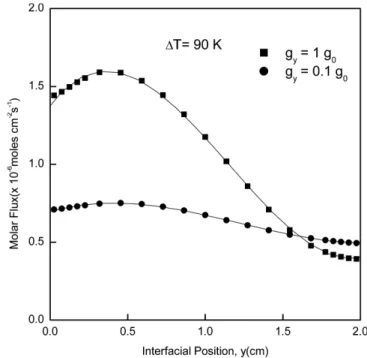
Fig. 2 shows the interfacial distributions of molar flux (moles cm-2s-1) of Hg2Br2 for two gravity accelerations (1g0 and 0.1g0, where 1g0 = 981 cm s-2), based on ΔT = 90 K (623K→533K), PB = 20 Torr, Ar = 5.0, Pr = 0.79, Le = 0.78, Grt = 9.85 × 10⁴, Grs = 6.79 × 10⁶, Pe = 4.1, Cv = 1.01. The horizontal orientations and the linear temperature pro- files at walls are considered in this study. Here, the subscript of 0 denotes the normal gravity acceleration of 981 cm s-2. With decreas- ing the gravitational acceleration from 1 g0 down to 0.1 g0, the total molar flux for 0.1 g0, 1.33×10⁻⁵ moles cm-2s-1,is reduced by a factor of 0.61, in comparison with 1 g0, 2.18×10⁻⁵ moles cm-2s-1. As depicted V*•∇*T*=Ar∇*2T*
V*•∇*ωA* Ar Le---∇*2ωA*
=
u*(x*,0) u= *(x*,1) v= *(x*,0) v= *(x*,1) 0=
∂ωA*(x*,0)
∂y*
--- ∂ωA*(x*,1)
∂y* --- 0
= =
T*(x*,0) T*(x*,1) T T– c Ts–Tc ---
= =
u*(0 y, *) 1 Le--- Δω
1–ωA s,
( )
---∂ωA*(0 y, *)
∂x* --- –
=
v*(0 y, *) 0= T*(0 y, *) 1= ωA*(0 y, *) 1=
u*(L/H y, *) 1 Le--- Δω
1–ωA c,
( )
---∂ωA*(L/H y, *)
∂x* --- –
=
v*(L/H y, *) 0= T*(L/H y, *) 0= ωA*(L/H y, *) 0=
Fig. 1. Schematic and coordinates for modelling and simulation of PVT crystal growth reactor of Hg2Br2(A)-Br2(B), adapted from Ref.
[7].
Table 1. Typical thermo-physical properties (MA=560.988, MB= 159.808)
Transport length, L 10 cm
Height, H 2 cm
Source temperature, Ts 623 K
Crystal temperature, Tc 533 K
Density of a mixture in the vapor phase, ρ 0.0031 g/cm3 Dynamic viscosity, μ 0.00033 g/(cm⋅sec) Binary diffusivity, DAB 0.17 cm2/s Coefficient of thermal expansion, β 0.0016 K-1
Prandtl number, Pr 0.79
Lewis number, Le 0.78
Peclet number, Pe 4.1
Concentration number, Cv 1.01
Total system pressure, PT
Partial pressure of component B,PB
430.05 Torr 20 Torr Thermal Grashof number, Grt 9.85 × 10⁴ Solutal Grashof number, Grs 6.79 × 10⁵
Fig. 2. Interfacial distributions of molar flux (moles cm-2s-1) of Hg2Br2 for two gravity accelerations (1 g0 and 0.1 g0, where 1 g0 = 981 cm s-2), based on ΔT = 90 K (623K→533K), PB = 20 Torr, Ar
= 5.0, Pr = 0.79, Le = 0.78, Grt = 9.85 × 10⁴, Grs = 6.79 × 10⁶, Pe = 4.1, Cv = 1.01.
in Fig. 2, similar to the earlier results of Markham et al. [11], one sees that the convective flow can cause significant non-uniformities in the molar flux, with the specific distribution revealing dominance of solutally dominant convection. Even though not shown here, the sin- gle convection cell flows towards the growing interface in the lower half of the growth ampoule, thus better supplying this part of the interface with vapor supersaturated in component A. Note that if there is thermal convection alone, with the left part of the ampoule warmer than the right part, an oppositely rotating roll would appear and, thus, result in enhancing the growth of crystal in the upper half of the interface [11]. As shown in Fig. 2, the interfacial distributions of molar flux show asymmetry with respect to y = 1.0 cm, which indicates the presence of asymmetrical convection. Therefore, the asymmetrical convection cell in front of the crystal interface indi- cates three dimensional flow structures. It is also obvious that from the point of view of the uniformity, the molar flux along the interfa- cial positions at gy= 0.1 g0 exhibits a relatively flat structure com- pared to that at gy= 1 g0. It indicates a factor of one tenth reduction in the gravitational level is enough to suppress solutally dominant con- vective effects on the crystal growth flux.
Fig. 3 shows interfacial distributions of molar flux (moles cm-2s-1) of Hg2Br2 for two gravity accelerations (1g0 and 0.1g0, where 1g0 = 981 cm s-2), based on ΔT = 30 K (623K→593K), PB = 20 Torr, Ar = 5.0, Pr = 0.83, Le = 0.44, Grt = 9.3×10⁴, Grs = 9.8×10⁵, Pe = 3.1, Cv = 1.04. In PVT processes, the temperature difference between source and crystal is one of the major parameters as well as a driving force for the mass transport. Under otherwise unchanged process condi- tions, decreasing the temperature difference for Ar = 5 gives similar results to Fig. 2. This suggests that even under the gravity environ-
ment of 0.1 g0, the variations in the temperature differences between source and crystal have little effect on the pattern of the molar fluxes in the interfacial distributions (Fig. 2), without the drawback of decreased solutally dominant convection that would result from these measures on ground experiments. Compared with Figs. 2 and 3, it is clear that the effects of thermally buoyancy driven convection are also important even in reduced gravity environments. The maxi- mum molar flux at ΔT = 90 K reaches at 1.59 × 10⁻⁶ moles cm-2s-1, and the maximum flux of 1.12 × 10⁻⁶ moles cm-2s-1 is obtained at ΔT
= 30 K. When the temperature difference is decreased from 623 K by a factor of 0.33, i.e., ΔT = 90 K→ΔT = 30 K, the corresponding max- imum molar flux is also decreased from 1.59 x 10⁻⁶ moles cm-2s-1 by a factor of 0.70, i.e., 1.59 × 10⁻⁶ moles cm-2s-1→1.12 × 10⁻⁶ moles cm-2s-1. Note that the total molar flux is greater by one order of magnitude than molar flux for both cases of ΔT = 90 K and 30 K.
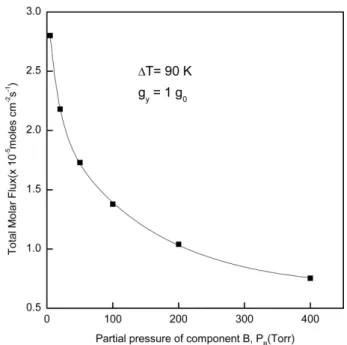
Fig. 4 shows the effects of partial pressure of component B, PB (Torr) on the total molar flux of Hg2Br2 in terms of moles cm-2s-1 for various partial pressures of component B, PB (Torr), 5 PB 400, based on ΔT = 90 K (623K→533K), one gravity acceleration (1g0, where 1g0= 981 cm s-2), with the linear temperature profiles at walls. As plotted in Fig. 4, the total molar fluxes decay first order exponen- tially with the partial pressure of component B, PB (Torr) for 5 Torr≤ PB≤ 400 Torr. For the range of 5 Torr ≤ PB≤ 100 Torr, the molar fluxes drop significantly, and, for 100 Torr≤ PB≤ 400 Torr, decreases slowly. In other words, the total molar fluxes decrease much sharply near PB = 5 Torr, and, then since PB = 100 Torr, decrease slowly until at PB = 400 Torr. Moreover, as the PB is increased from 100 Torr to 400 Torr, i.e. by a factor of 4, and the total molar flux is decreased from 1.37 × 10⁻⁵ moles cm-2s-1 down to 7.53 × 10⁻⁶ moles cm-2s-1 by
Fig. 3. Interfacial distributions of molar flux (moles cm-2s-1) of Hg2Br2 for two gravity accelerations (1 g0 and 0.1 g0,where1 g0= 981 cm s-2), based on ΔT = 30 K (623K→593K), PB = 20 Torr, Ar
= 5.0, Pr = 0.83, Le = 0.44, Grt = 9.3 × 10⁴, Grs = 9.8 × 10⁵, Pe = 3.1, Cv = 1.04.
Fig. 4. Effects of partial pressure of component B, PB (Torr) on the total molar flux of Hg2Br2 in terms of moles cm-2s-1 for var- ious partial pressures of component B, PB (Torr), 5 Torr PB 400 Torr, based on ΔT = 90 K (623K→533K), one gravity accelerations (1 g0, where 1 g0= 981 cm s-2).
a factor of 0.54. On the other hand, as the PB is increased from 20 Torr to 100 Torr, i.e. by a factor of 5, and the total molar flux is decreased from 2.18 × 10⁻⁵ moles cm-2s-1 down to 1.37 × 10⁻⁵ moles cm-2s-1 by a factor of 0.62. Consequently, the factor of decrease in the total molar flux for 20 Torr≤ PB≤ 100 Torr, i.e., 0.62 is approximately same as for 100 Torr≤ PB≤ 400 Torr, i.e., 0.54, considering the fac- tor of increase in the partial pressure of component B, PB (Torr).
Fig. 5 shows the total molar flux of Hg2Br2 in terms of moles cm-2s-1 as a function of gravity acceleration, 10-4 g0≤ gy≤ 1 g0, based on PB
= 20 Torr and ΔT = 90 K. The solutally dominant convection mode is predominant over the diffusion mode for 10-1 g0≤ gy ≤ 1 g0. The solutally dominant convection mode is transited into the diffusion mode at gy = 0.1 g0 and, since gy = 0. 1 g0, down to gy = 10-4 g0, the dif- fusion becomes predominant. As seen in Fig. 5, the total molar fluxes drop sharply for 10-1 g0≤ gy ≤ 1 g0. This indicates the mass transport is diffusion-dominated under the microgravity environments less than 0.1 g0. One can see that the effect of solutally dominant convec- tion is first important and then decreases rapidly and eventually the mode of transport becomes largely diffusion. Therefore, the gravita- tional parameter is significantly important, which gives us deep motivations to perform numerical studies under microgravity envi- ronments.
Fig. 6 shows the interfacial distributions of total molar flux (moles cm-2s-1) of Hg2Br2 for various molecular weight of component B, MB, 2≤ MB≤ 159, based on Ar = 5 Torr and ΔT = 90 K. One also investigated situations when thermal convection might dominate solutal convection. This could occur when an inert gas having a molecu- lar weight MB closer to that of the crystallizing material is used. With varying molecular weight of component B from 2 up to 400, one can see that the effect of solutal convection decreases rapidly for 2≤ MB
≤ 50, and, for 50 ≤ MB≤ 159, eventually the transport becomes largely diffusive. For conditions under consideration, note that only when the molecular weights of A and B are equal does the thermal density gradient overcome the solutal gradient. It is concluded that unless the two components have molecular weights very close to each other, the dominant mode of convection is likely to be solutal. It is empha- sized that the effects of solutally dominant convection are reflected through the density gradient and binary diffusivity coefficient. The maximum molar fluxes occur in the main in the neighborhood of y = Fig. 5. Total molar flux of Hg2Br2 in terms of moles cm-2s-1 as a func-
tion of gravity accelerations, 10-4 g0 gy 1 g0, based on PB= 20 Torr and ΔT = 90 K (623K→533K).
Fig. 6. Total molar flux (moles cm-2s-1) of Hg2Br2 for various molec- ular weight of component B, MB, 2≤ MB≤ 159, based on Ar
= 5 and ΔT = 90 K (623K→533K).
Fig. 7. Relationship between total molar flux (moles cm-2s-1) of Hg2Br2 and the temperature difference between the source and the crystal regions, 10 Torr≤ ΔT ≤ 90K, based on Ar = 5 and PB
= 20 Torr.
0.5, not shown here.
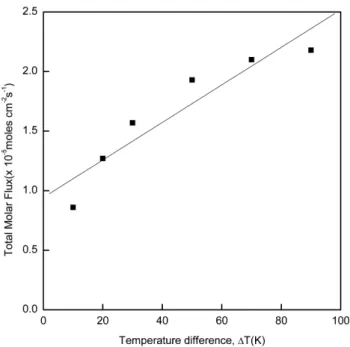
Fig. 7 shows the relationship between total molar flux (moles cm-2s-1) of Hg2Br2 and the temperature difference between the source and the crystal regions, 10 K≤ ΔT ≤ 90 K, based on Ar = 5 and PB= 20 Torr. As shown in Fig. 7, the total molar flux of Hg2Br2 for various temperature difference between the source and the crystal regions, 10 K≤ ΔT ≤ 90 K, has a direct and linearly relationship with the tempera- ture difference, ΔT. For 10 K ≤ ΔT ≤ 30 K, the total molar flux is sig- nificantly dependent on the temperature difference, while for 50 K≤ ΔT ≤ 90 K, it varies slightly with the temperature difference. The temperature gradient for 10 K≤ ΔT ≤ 30 K is, 0.0355 moles cm-2s-1K-1 and 0.00625 moles cm-2s-1K-1 for 50 K≤ ΔT ≤ 90 K. Therefore, the temperature gradient for 10 K≤ ΔT ≤ 30 K is greater than for 50 K
≤ ΔT ≤ 90 K by a factor of 5.68. This reflects an increase in the intensity of thermally buoyancy driven convection with increasing the driving force of crystal growth, i.e., the temperature difference.
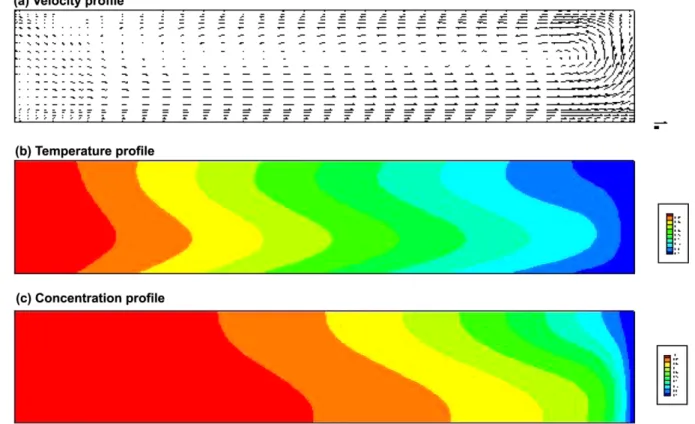
In order to get a deep understanding and further insight into the essence of solutally dominant convection in the vapor phase during the PVT processes of Hg2Br2, the velocity vector, temperature, and concentration profiles are shown in Fig. 8. The single cellular con- vective cell occurs in the vapor phase due to density gradients from unequal molecular weights of A and B, associated with gravitational acceleration on earth. As shown in Fig. 8(a), the magnitudes of velocity vector near the source region are shown to be greater than those near the crystal region. The unicellular convective structure implies three dimensional convective flow structures. The magnitudes of velocity
vector in the lower half region are greater than those in the upper half region along the centerline, dimensionless y*= 0.5, i.e., y = 1 cm, which indicates a strong convective structure under operating condi- tions of ΔT = 80 K (623K→543K), and 1 g0, PB = 20 Torr, Ar = 5.0, Pr = 0.80, Le = 0.69, Grt = 9.57 × 10⁴, Grs = 7.69 × 10⁵, Pe = 3.96, Cv = 1.01, thermal diffusivity of 0.11 cm2s-1, kinematic viscosity of 0.095 cm2s-1, binary diffusivity of 0.17 cm2s-1. The temperature profile along the centerline of dimensionless y*= 0.5, i.e., y = 1 cm exhibits symme- try, indicating a uniform imposed temperature profile on ampoule walls. As shown in Fig. 8(c), with regards to concentration profile, the concentrations in front of the source regions are uniform, and sig- nificantly varied near the crystal regions. A relative velocity vector with 50 magnitudes has 0.3 cm. The dimensionless maximum mag- nitude of velocity vector is 63.5, and the corresponding dimensional maximum magnitude of velocity vector is 0.76 cm s-1.
4. CONCLUSIONS
It is concluded that the solutally dominant convection during the physical vapor transport of Hg2Br2-Br2 appears to be predominant over the diffusive transport for near normal gravity acceleration levels more than 0.1 g0. The single asymmetrical unicellular convection indicates three dimensional flow structures, and the variations in convective flow structures are significantly important near the crys- tal regions than the source regions. In particular, from the point of view of the uniformity, such convective flow structures are associ- Fig. 8. (a) Velocity profile, (b) temperature profile, (c) concentration profile, based on ΔT = 80K (623K→543K), and 1 g0. A relative velocity
vector with 50 magnitudes has 0.3 cm. The dimensional maximum magnitude of velocity vector is 0.76 cm s-1.
ated with the total molar flux along the crystal interfacial positions.
Unless the two components have molecular weights very close to each other, it is concluded that for 2≤ MB≤ 50, the dominant mode of convection is solutal. For the range of 5 Torr≤ PB≤ 100 Torr, the molar fluxes drop significantly, and, for 100 Torr≤ PB≤ 400 Torr, decreases slowly, and, for 5 Torr≤ PB≤ 400 Torr, the total molar fluxes decay first order exponentially with the partial pressure of component B, PB.
ACKNOWLEDGEMENT
This work was financially supported by the Hannam University under Grant No. 2013A087 (April 1, 2013 through March 31, 2014).
REFERENCES
1. Choubey, A., Veeramani, P., Pym, A. T. G., Mullins, J. T., Sellin, P. J., Brinkman, A. W., Radley, I., Basu, A. and Tanner, B. K.,
“Growth by the Multi-tube Physical Vapour Transport Method and Characterization of Bulk (Cd, Zn)Te,” J. Cryst. Growth, 352, 120-123(2012).
2. Shi, Y., Yang, J. F., Liu, H., Dai, P., Liu, B., Jin, Z., Qiao, G. and Li, H., “Fabrication and Mechanism of 6H-type Silicon Carbide Whiskers by Physical Vapor Transport Technique,” J. Cryst. Growth, 349, 68-74(2012).
3. Zotov, N., Baumann, S., Meulenberg, W. A. and Vaßen, R., “La- Sr-Fe-Co Oxygen Transport Membranes on Metal Supports Depos- ited by Low Pressure Plasma Spraying-Physical Vapour Deposi- tion,” J. Membr. Sci., 442, 119-123(2013).
4. Fanton, M. A., Li, Q., Polyakov, A. Y., Skowronski, M., Cavalero, R. and Ray, R., “Effects of Hydrogen on the Properties of SiC Crystals Grown by Physical Vapor Transport: Thermodynamic Con- siderations and Experimental Results,” J. Cryst. Growth, 287, 339-343(2006).
5. Su, C. H., George, M. A., Palosz, W., Feth, S. and Lehoczky, S.
L., “Contactless Growth of ZnSe Single Crystals by Physical Vapor Transport,” J. Cryst. Growth, 213, 267-275(2000).
6. Paorici, C., Razzetti, C., Zha, M., Zanotti, L., Carotenuto, L. and Ceglia, M., “Physical Vapour Transport of Urotropine: One-Dimen- sional Model,” Mater. Chem. Phys., 66, 132-137(2000).
7. Lee, Y. K. and Kim, G. T., “Effects of Convection on Physical Vapor Transport of Hg2Cl2 in the Presence of Kr- Part I: Under Microgravity Environments,” J. Korean Crystal Growth and Crys- tal Tech., 23, 20-26(2013).
8. Greenwell, D. W., Markham, B. L. and Rosenberger, F., “Numeri-
cal Modeling of Diffusive Physical Vapor Transport in Cylindri- cal Ampoules,” J. Cryst. Growth, 51, 413-425(1981).
9. Markham, B. L., Greenwell, D. W. and Rosenberger, F., “Numeri- cal Modeling of Diffusive-Convective Physical Vapor Transport in Cylindrical Vertical Ampoules,” J. Cryst. Growth, 51, 426-437 (1981).
10. Jhaveri, B. S. and Rosenberger, F., “Expansive Convection in Vapor Transport across Horizontal Enclosures,” J. Cryst. Growth, 57, 57-64(1982).
11. Markham, B. L. and Rosenberger, F., “Diffusive-Convective Vapor Transport across Horizontal and Inclined Rectangular Enclo- sures,” J. Cryst. Growth, 67, 241-254(1984).
12. Nadarajah, A., Rosenberger, F. and Alexander, J., “Effects of Buoy- ancy-Driven Flow and Thermal Boundary Conditions on Physi- cal Vapor Transport,” J. Cryst. Growth, 118, 49-59(1992).
13. Zhou, H., Zebib, A., Trivedi, S. and Duval, W. M. B., “Physical Vapor Transport of Zinc-Telluride by Dissociative Sublimation,” J. Cryst.
Growth, 167, 534-542(1996).
14. Duval, W. M. B., “Convective Effects during the Physical Vapor Transport Process-I: Thermal Convection,” J. Mater. Proc. Man- ufacturing Sci., 1, 83-104(1992).
15. Duval, W. M. B., “Convective Effects during the Physical Vapor Transport Process-II: Thermosolutal Convection,” J. Mater. Proc.
Manufacturing Sci., 1, 295-313(1993).
16. Duval, W. M. B., Glicksman, N. E. and Singh, B., “Physical Vapor Transport of Mercurous Chloride Crystals; Design of a Micrograv- ity Experiment,” J. Cryst. Growth, 174, 120-129(1997).
17. Tebbe, P. A., Loyalka, S. K. and Duval, W. M. B., “Finite Element Modeling of Asymmetric and Transient Flow Fields during Physical Vapor Transport,” Finite Elements in Analysis and Design, 40, 1499-1519(2004).
18. Kim, G. T., Duval, W. M. B., Singh, N. B. and Glickman, M. E.,
“Thermal Convective Effects on Physical Vapor Transport Growth of Mercurous Chloride Crystals (Hg2C12) for Axisymmetric 2-D Cylindrical Enclosure,” Model. Simul. Mater. Sci. Eng., 3, 331- 357(1995).
19. Kim, G. T., Duval, W. M. B. and Glickman, M. E., “Thermal Con- vection in Physical Vapour Transport of Mercurous Chloride (Hg2Cl2) for Rectangular Enclosures,” Model. Simul. Mater. Sci. Eng., 5, 289-309(1997).
20. Kim, G. T., Duval, W. M. B. and Glickman, M. E., “Effects of Asym- metric Temperature Profiles on Thermal Convection during Physical Vapor Transport of Hg2Cl2,” Chem. Eng. Comm., 162, 45-61 (1997).
21. Rosenberger, F. and Müller, G., “Interfacial Transport in Crystal Growth, a Parameter Comparison of Convective Effects,” J. Cryst.
Growth, 65, 91-104(1983).