PGHN
Original Article
Clinical Characteristics of Failure to Thrive in Infant and Toddler: Organic vs. Nonorganic
Suk Dong Yoo, Eun-Ha Hwang, Yeoun Joo Lee and Jae Hong Park
Department of Pediatrics, Pusan National University School of Medicine, Yangsan, Korea
Purpose: To investigate the clinical characteristics and outcomes among infants and toddlers with failure to thrive (FTT).
Methods: This retrospective study was done with 123 patients who had visited Pusan National University Children’s Hospital during their first two years of life and had received an FTT diagnosis. We compared the clinical characteristics of the patients based on the causes of their FTT and their ages at the time of first hospital visit. We investigated triggering factors, feeding practices, and outcomes in 25 patients with nonorganic FTT (NOFTT).
Results: Eighty cases (65.0%) were NOFTT. The gestational ages, birth weights, and weights at the first visits were significantly lower in patients with organic FTT (OFTT) (p<0.05). Infants who had first visited the clinic at age <6 months had the least z-score. The percentage of patients with severe weight decline was higher in OFTT than in NOFTT (60.0% vs. 17.3%). The z-scores at the follow-up visits were improved after treatment in both of the groups.
Preceding infection was the most common triggering factor of NOFTT and persecutory feeding as abnormal behavior of caregiver was observed in 22 cases (88.0%). After treatment with feeding method modification, all patients with NOFTT showed normal growth.
Conclusion: Weight decline is more severe in OFTT patients and in younger patients at the first visit. Infants with FTT can attain normal weight gain growth by treating organic diseases and supplying proper nutrition in OFTT, and by correct- ing abnormal dietary behavior of caregiver in NOFTT.
Key Words: Failure to thrive, Infant
Received:October 6, 2013, Revised:October 18, 2013, Accepted:November 13, 2013
Corresponding author: Jae Hong Park, Department of Pediatrics, Pusan National University Yangsan Hospital, 20, Geumo-ro, Mulgeum-eup, Yangsan 626-770, Korea. Tel: +82-55-360-2180, Fax: +82-55-360-2181, E-mail: [email protected]
Copyright ⓒ 2013 by The Korean Society of Pediatric Gastroenterology, Hepatology and Nutrition
This is an openaccess article distributed under the terms of the Creative Commons Attribution NonCommercial License (http://creativecommons.org/licenses/by-nc/3.0/) which permits unrestricted noncommercial use, distribution, and reproduction in any medium, provided the original work is properly cited.
INTRODUCTION
Failure to thrive (FTT), a term that refers to infants and toddlers whose weights or weight gaining rates are strikingly lower than expected from children of
the same ages, genders, and ethnicities, is used for cases where there are no effects on the height and head circumference or just slight influence is found despite underweight. It appears mainly in 1-2 year old children but can occur at any moment in one’s
childhood. Data about its prevalence are not suffi- cient and it varies with diagnostic criteria and sub- ject populations. In the case of the USA, 5-10% of children in primary care settings, and 3-5% of chil- dren in hospital care settings have been reported to fall within this category [1].
Currently, there is no established consensus about anthropometric standards for diagnosing FTT [2,3].
Three criteria for weight are used for the diagnosis. A child under the age of 2 can be determined as having FTT when his or her weight for age is under the 3 or 5 percentile at least once, his or her weight is under 80% of the ideal weight for his or her age, and he or she loses weight across 2 major percentile lines in a standard growth table that uses the 5, 10, 25, 50, 75, 90 percentiles as major percentiles [4].
Though it occurs for various reasons, most FTT cases are due to insufficient nutritional intake for be- havioral or psycho-social factors [5]. It is classified into organic FTT (OFTT) and nonorganic FTT (NOFTT) based on the presence and absence of un- derlying conditions that can trigger growth re- striction, but there are many cases where the two are mixed [5,6]. Studies vary in reporting OFTT ranging 15-58% [7-9].
Moon et al. [10] investigated 74 patients aged 1 month-13 years to report that intrauterine growth restriction and familial short stature were main causes in patients under the age of 3 and familial short stature and constitutional growth restriction in patients aged 3 or older, and that their average calo- rie intakes was 76.2% of the recommended amount.
Lee et al. [11] investigated etiologic diseases in 83 children under the age of 2 who had not gain weight for current 2 weeks to conclude that gastrointestinal milk allergy, milk protein induced enterocolitis, gas- troesophageal reflux etc. were main causes. Nam et al. [12] and Lim and Kim [13] explored the anthro- pometric measurements of 80 FTT children at the age of 2 and at the age of 3 and the causes of their FTT, and claimed that OFTT was the cause in about 80% of the patients.
Lee’s study [14] investigated the differences be- tween healthy children and 25 NOFTT patients along
with their mothers. The conclusion is that the NOFTT cases occurred complicatedly due to the pa- tients’ particular characters and low appetites and their mothers’ lack of skills and knowledge in nu- trition rather than their psychopathology.
Early detection and treatment of FTT is very im- portant because it can result in disorders not only in physical growth but also in cognitive and behavioral development, and appropriate treatment can prevent long term complications [15-18]. However, most of the literature just emphasize in principle that appro- priate calorie supply is the most important in the treatment of FTT, but overlook the reasons of low cal- orie intake observed in NOFTT patients who account for the majority of FTT patients. Tube feeding in the child who does not grow well and refuse to eat can be considered if no cause is found and other therapies fail. However, this can reinforce to feed [19].
We have no domestic reports so far that compared and analyzed the clinical differences between OFTT and NOFTT cases and their time of first visiting, and addressed triggering factors and treatment re- sponses of NOFTT. In particular, there has been only one paper [14] on NOFTT patients who account for the majority of outpatients. Thus, the authors took as the subjects of this study, patients with FTT visiting the Clinic for Pediatric Gastroenterology and Nutrition at Pusan National University Children’s Hospital to compare their clinical differences accord- ing to the causes of FTT and their time of first visit- ing, and in particular, take a look at the triggering factors of NOFTT and their treatments results.
MATERIALS AND METHODS
We carried out a retrospective study with 123 in- fants and toddlers under the age of 24 months who visited the Outpatient Clinic for Pediatric Gastroen- terology and Nutrition at Pusan National University Children’s Hospital from November 2008 to May 2013 for the reason that they did not gain weight well. A patient with FTT is defined as one whose weight or height for age is under the 5 percentile (z-score<–1.645) or whose height for weight is un-
der the 10 percentile (z-score<–1.281). We used the percentiles in the 2007 Korean Children and Adolescents Growth Standard [20]. Patients with low weight due to short stature, and patients in weight controlling for normal weight restoration from overweight were excluded. We recognized sig- nificant weight gaining for age as normal growth.
For patients with FTT diagnosis, we judged whether there were underlying diseases by hearing their medical histories including their birth and ac- companied conditions and conducting physical examinations. Also, we determined their nutritional statuses including the presence or absence of iron deficiency anemia by conducting general blood tests including total protein, albumin, white blood cells, total lymphocytes, and hemoglobin, and made de- tailed questions about the types, amounts, and fre- quencies of their daily diets, based on which we eval- uated the adequacy of their currently provided nutrition. We arranged appropriate nutritional sup- plies in parallel with the treatment of underlying dis- eases when OFTT was determined, while we ana- lyzed triggering factors and the caregivers’ feeding behavior to educate them to improve their problems when NOFTT was determined. Then, we followed up and observed them every week or every two weeks.
That is to say, we did not force patients rejecting milk-feeding to eat, lengthened milk-breeding inter- vals when they were short, inhibited feeding during sleeping, and encouraged patients resisting weaning foods to change their diets into weaning foods. In follow-up, we checked their dietary diaries for evalu- ating their calorie intake, and re-evaluated the ex- tents of their growth by measuring their heights, weights, and head circumferences.
We analyzed whether there were differences in an- thropometric measurements and blood test results between OFTT and NOFTT patients, and compared their weights at birth, at hospital visiting, and at fol- low-up observation within less than 6 months to evaluate their weight gaining. Also, as for NOFTT cas- es, we investigated triggering factors, onset ages, ab- normal dietary behavior, treatment methods, and treatment responses. The patients were classified in-
to three groups based on their ages at first hospital visit (younger than 6 months, 7-12 months old, and 13-24 months old) to analyze whether there were dif- ferences in anthropometric measurements and blood test results, and then compared their weights at birth, at hospital visit, and at follow-up observation within less than 6 months to evaluate their weight gaining. We used z-score to compare the patients’ an- thropometric indices of height, weight, and head circumference. In order to evaluate severity of FTT, we arbitrarily classified into grade as follow: –2.0≤
z-score<–1.645 is mild, –3.0≤z-score<–2.0 is mod- erate and z-score<–3.0 is severe.
The results of their examination at hospital visit were analyzed in descriptive statistics, and paired t-test was conducted for the comparison of the dif- ferences at birth, at hospital visit, and at follow-up observation. Independent t-test and ANOVA were performed to compare the groups. The IBM SPSS Statistics program version 21.0 (IBM Co., Armonk, NY, USA) was used to carry out the statistical analy- sis, and statistical significance was recognized when p<0.05.
RESULTS
The number of females out of a total of 123 sub- jects was 66 (53.7%). As for the history of birth, the gestational age was 38.7±2.5, the weight at birth 2.77±0.58 kg, the height 46.5±3.09 cm, and the head circumference 32.2±2.09 cm. Ninety subjects (73.2%) were adequate for gestational age, 21 (17.1%) were small for gestational age, 108 (87.8%) were born as full-term. The age at the first hospital visit was 11.2±6.7 months.
Eighty subjects (65.0%) were NOFTT patients and 43 (35.0%) OFTT patients. As for organic causes, gas- troenterologic disorder cases were 14, which ac- counted for the majority (11.4%). In turn, cardiac disease cases (6.5%), premature infant/intrauterine growth restriction cases (5.7%), neurodevelop- mental disorder cases (4.1%), endocrinologic dis- order cases (2.5%), and genetic disorder cases (1.6%) occupied the next portions in that order. The gastro-
Fig. 1. Changes of z-score of weight at birth, first visit and follow-up visit in patients with organic and nonorganic failure to thrive. There was marked decline of z-score at first visit in organic failure to thrive (p<0.001) and improvement of z-score in both groups at follow-up visit, especially in organic failure to thrive (p=0.037).
Table 1.Comparison of Clinical Characteristics of the Patients Classified by Causes of Failure to Thrive
Characteristic NOFTT OFTT p-value
Sex (male : female) Gestational age (week) Birth weight (kg) First visit data (z-score) Body weight
Height Follow up visit Body weight (z-score) Severity of FTT
Mild Moderate Severe
Laboratory findings Protein (g/dL) Albumin (g/dL) White blood cell (/mm3) Hemoglobin (g/dL) Lymphocyte (/mm3)
34 : 46 (80) 39.30±1.80 (72) 2.85±0.51 (72)
–2.36±0.84 (80) –1.51±1.37 (54)
–2.17±0.98 (28)
–1.43±0.87 (21) –2.46±0.27 (46) –3.47±0.52 (13)
6.67±0.58 4.36±0.29 10,713±3,501
11.90±1.10 6,243±2,142
23 : 20 (43) 37.90±3.00 (41) 2.63±0.67 (41)
–3.33±1.41 (43) –2.46±1.74 (37)
–3.19±2.25 (30)
–1.37±0.72 (7) –2.56±0.30 (12) –4.28±1.01 (24)
6.46±0.94 4.14±0.54 10,932±4,275
11.56±1.66 5,399±2,209
0.124
<0.001
<0.009
<0.001 0.005
0.098
0.861 0.283 0.003
0.185 0.016 0.962 0.268 0.025
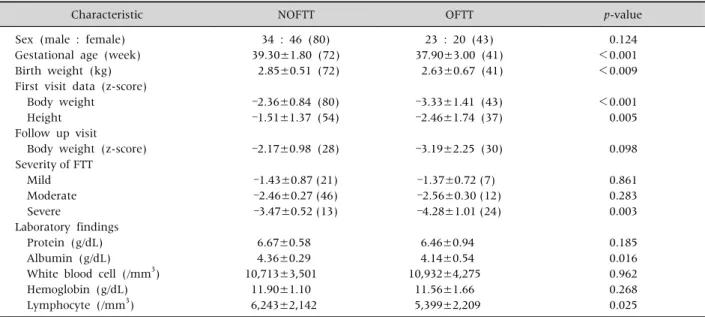
Values are presented as mean±standard deviation (number). NOFTT: non organic failure to thrive, OFTT: organic failure to thrive, FTT: failure to thrive, severity of FTT mild: –2.0≤z-score<–1.645, severity of FTT moderate: –3.0≤z-score<–2.0, severity of FTT severe:
z-score<–3.0.
enterologic disorders included esophageal stricture, gastroesophageal reflux, congenital megacolon, chronic diarrhea, and milk-protein induced entero- colitis. The genetic disorders included Noonan syn- drome, 46,XX,del(10)(q26.2), the oncologic dis- orders were pineal tumor and atypical rhabdoid tu- mor, the immunodeficiency disorders included hy- per IgE syndrome, and the respiratory diseases in- cluded subglottic stricture.
The OFTT patients had significantly lower gesta- tional ages, and significantly lower weights at birth and at the first hospital visit than the NOFTT pa- tients (p<0.05). Both the z-scores of the weights and heights at the first hospital visit were sig- nificantly low in OFTT cases (p<0.05, Table 1).
Though the z-scores of the weights at follow-up ob- servation were improved in both the two groups, sig- nificant improvement was observed from the OFTT group (p<0.05, Fig. 1). It was found from the inves- tigation of severity in underweight that severe cases (z-score<–3.0) were much more in the OFTT cases than in the NOFTT cases (17.3% vs. 60.0%) (p
<0.05). Laboratory findings showed significant dif-
ferences in albumin and total lymphocytes (p
<0.05), but they were within the normal range (Table 1).
We classified the patients into three groups based
Fig. 2. Changes of z-score of weight at birth, first visit and follow-up visit according to age group. There was marked decline of z-score in the patients whose age at first visit was less than 6 months (p<0.001). The patients of this group showed also significant improvement of z-score at follow-up visit (p=0.017).
Table 2.Comparison of Clinical Characteristics of the Patients Classified by Age at First Visit Age at first visit (month)
p-value
≤6 7-12 13-24
Sex (male : female) NOFTT : OFTT Gestational age (week) Birth weight (kg) First visit (z-score) Body weight Height
Follow up visit Body weight (z-score) Severity of FTT
Mild Moderate Severe
Laboratory findings Protein (g/dL) Albumin (g/dL) White blood cell (/mm3) Hemoglobin (g/dL) Lymphocyte (/mm3)
13 : 21 (34) 17 : 17 39.10±1.50
2.82±0.57 (33)
–3.22±1.13 (34) –2.55±2.01 (26) –2.44±1.85 (22)
–1.79±0.17 (8) –2.63±0.187 (7) –4.07±0.76 (19)
6.13±0.63 4.00±0.40 11,480±4,193
11.14±1.85 5,657±2,660
12 : 16 (28) 20 : 8 37.80±3.20
2.58±0.64 (28)
–2.65±1.04 (28) –2.24±1.30 (16) –2.80±1.43 (17)
–0.49±1.15 (4) –2.49±0.30 (17) –3.85±1.04 (7)
6.48±0.99 4.26±0.56 11,424±3,598
11.90±1.36 6,949±1,911
32 : 29 (61) 45 : 16 39.00±2.30
2.84±0.54 (52)
–2.48±1.08 (61) –1.45±1.28 (49) –2.91±2.11 (19)
1.47±0.80 (16) –2.45±0.28 (34) –4.01±1.25 (11)
6.90±0.46 4.44±0.22 10,061±3,575
12.14±0.86 5,548±1,896
0.383 0.066 0.098 0.111
0.008 0.011 0.666
0.029 0.280 0.408
<0.001
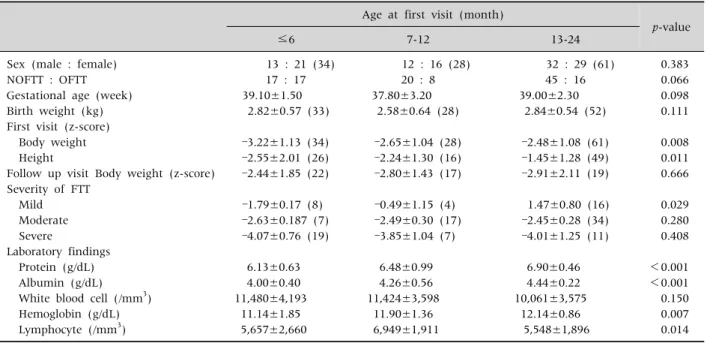
<0.001 0.150 0.007 0.014 Values are presented as mean±standard deviation (number). NOFTT: non organic failure to thrive, OFTT: organic failure to thrive, FTT: failure to thrive, severity of FTT mild: –2.0≤z-score<–1.645, severity of FTT moderate: –3.0≤z-score<–2.0, severity of FTT severe:
z-score<–3.0.
on their ages at first visit (younger than 6 months, 7-12 months old, and 13-24 months old) to compare their clinical findings. The earlier a patient’s first
hospital visit, the higher the chance for him or her to be an OFTT patient (50.0% vs. 37.5% vs. 26.2%) (Table 2). The z-score was the lowest in the group younger than 6 months at first visit (p<0.05), the number of severe patients was great, and their z-score of weights were significantly improved in fol- low-up (p<0.05). There was no evidence of sig- nificant z-score increase in the other groups (Table 2, Fig. 2).
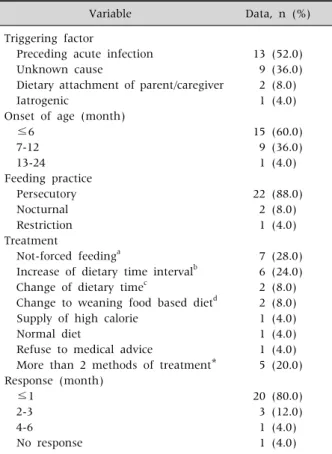
As a result of the analysis of the 25 NOFTT patients who were possible to be subject to follow-up ob- servation, it was found out that the average time of the onset of FTT was at the 5.7 month, and the most frequent triggering factor was preceding infection (13 subjects, 52.0%). The persecutory feeding was found from 22 caregivers (88.0%) who forced their children to eat even if they rejected feeding. For the treatment of FTT, they were encouraged to stop forc- ing their children to eat, lengthen milk-feeding in- tervals and change their diets into weaning foods if possible. In the one single case where FTT occurred as the patient with chronic nonspecific diarrhea had
Table 3.Detail Information of 25 Patients with Nonorganic Failure to Thrive
Variable Data, n (%)
Triggering factor
Preceding acute infection Unknown cause
Dietary attachment of parent/caregiver Iatrogenic
Onset of age (month) ≤6
7-12 13-24 Feeding practice Persecutory Nocturnal Restriction Treatment
Not-forced feedinga
Increase of dietary time intervalb Change of dietary timec
Change to weaning food based dietd Supply of high calorie
Normal diet
Refuse to medical advice
More than 2 methods of treatment*
Response (month) ≤1
2-3 4-6 No response
13 (52.0) 9 (36.0) 2 (8.0) 1 (4.0)
15 (60.0) 9 (36.0) 1 (4.0)
22 (88.0) 2 (8.0) 1 (4.0)
7 (28.0) 6 (24.0) 2 (8.0) 2 (8.0) 1 (4.0) 1 (4.0) 1 (4.0) 5 (20.0)
20 (80.0) 3 (12.0) 1 (4.0) 1 (4.0)
*a+b 3 cases; b+c 1 case; c+d 1 case.
been subject to dietary restriction, the patient showed normal growth after led to normal diet without dietary restriction. Every subject except one who rejected the doctors’ recommendation showed normal growth. As for treatment responses, 20 sub- jects (80.0%) showed responses within a month (Table 3).
DISCUSSION
Generally, cases where a child has a weight under the 5 percentile, or he or she loses weight across 2 major percentile curves are defined as FTT. However, in the case of severe FTT, as the patient’s weight and height were placed on the bottom of the growth curve graphs, it is difficult to visually clarify severity, and it is uneasy to judge how far his or her condition is improved in follow-up. Thus, there have been sev-
eral studies that tried to approach the issue by classi- fying the degrees of severity [21,22], and this study also used z-score to compare severity degrees.
The result of this study that 65% of the subjects were NOFTT patients contrasts with the existing do- mestic studies [12,13] reporting that OFTT patients accounted for the majority. Gastroenterologic dis- orders accounted for 11.4% of the causes of OFTT, and cardiac diseases 6.5%. While in Lee et al.’s study [11], gastroenterologic disorders accounted for 97.7% of the patients, another study that analyzed patients visiting a pediatric endocrine clinic [23] re- ported that endocrine conditions (28.9%) occupied a greater portion than gastroenterologic disorders (15.5%). The reason why the number of congenital cardiac patients was great in this study seems to be that there were many patients undergoing cardiac surgery due to the characteristics of our hospital.
Thus, it is possible to know that there are many dif- ferences in the result of study based on the study populations.
Research results about the onset of FTT vary in that Moon et al. [10] reported it was the 8 month, Olsen et al. [24] the 8.3 month, and Daniel et al. [23]
the 18.7 month. The average time of the patients’
first hospital visit in this study was the 11.2 month, and the average time of the onset of FTT in the NOFTT patients was the 5.7 month. The possibility of early manifestation of FTT is high with OFTT as OFTT is much related with congenital conditions, while the onset of FTT could be relatively belated with NOFTT as NOFTT occurs when some special trigger- ing factors are added in the course of normal growth.
In this study, the onset of NOFTT in the subjects tended to occur in the middle infanthood as it was deeply related with preceding infection. McDougall et al.’s study [25] claims that evaluation of growth at 6-8 weeks of age is necessary because infants whose early weight gain is slow can frequently have feeding problems than controls and be related to devel- opmental delay.
In this study, OFTT patients had more significan- tly low gestational ages, and weights at birth and at first visit than NOFTT patients. Also, the z-scores of
their weights at first visit and heights were sig- nificantly lower, and the number of severe patients (z-score<–3.0) were a lot greater in the OFTT patients. That is to say, the OFTT patients showed differences in growth from their birth, and had se- vere growth retardation when they visited the hospital. However, the z-score of weight was im- proved in both the groups after the treatment of FTT, but significant improvement was seen from the OFTT group. Such differences are believed to result from more positive nutritional treatment in addition to the treatment of organic diseases in the OFTT patients.
When the whole patients were compared in their time of first visit, the rate of OFTT patients were higher and the z-scores of their weights were lower as their time of first visit was earlier. Also, the num- ber of severe patients was the greatest in the OFTT group, and significant improvement was observed in follow-up. This also suggests that the possibility of organic causes is higher and the degree of FTT is more severe in younger patients. The result of this study that rapid improvement is expected when a patient visits a hospital earlier to receive appropriate nutritional treatment and education is the same as other studies’ [18,26,27] conclusions. Schmitt and Mauro’s study [28] reported that patients showed faster weight gaining within 6-8 months after treat- ment, and they recommended that infants be subject to follow-up observation while receiving weight measurement every week and in the case of older in- fants, at intervals 2 weeks.
As a result of the analysis of the 25 NOFTT pa- tients, it was found out that half the patients had preceding infection and mainly acute gastroenteritis or upper respiratory infection was the cause. It was conjectured that NOFTT was induced by those care- givers who did not understand their children’s tran- sient low appetite due to such infections and insisted their old milk-feeding methods to make their chil- dren dislike food intake. Caregivers’ insistence on forcing patients who won’t eat to take foods in was observed in 88% of the cases. That is to say, infants dislike food intake due to caregivers’ abnormal feed-
ing practices. Long lasting these patterns lead to NOFTT. Levy et al. [19] reported that food refusal, head turning, anticipatory gagging, meal-related gagging etc. were significantly observed from NOFTT patients, and that abnormal parental feeding practi- ces including nocturnal feeding, forcing feeding, persecutory feeding, mechanistic feeding, prolonged feeding, conditional distraction etc. were sig- nificantly frequent in NOFTT cases. Meanwhile, there was one case where FTT occurred due to the re- striction on a chronic nonspecific diarrhea patient’s diet, which suggests attention to iatrogenic FTT.
As for FTT treatment, the OFTT patients recom- mended to receive treatment of their underlying dis- eases and appropriate nutritional supply, and the NOFTT patients were led to improve their dietary methods. That is to say, treatment response was showed by dietary methods modification only with- out using milk additives or special formula. This re- sult shows that one can lead a patient to normal growth in a short time period without any un- necessary tests or special therapies by analyzing and correcting inducing factors and feeding behavior in terms of thorough hearing of medical history from NOFTT patients including their diet diaries.
In papers reported domestic FTT cases [10-14], the span of the ages of the patients were wide, patients without growth in a short period of time were in- cluded, the rate of OFTT patients were high, and pa- tients with low weights due to short heights were included. In comparison, this study included infants and toddlers under the age of 2 years, and patients with low weight due to short stature were excluded.
It is also rather significant as it has higher composi- tion of NOFTT, compared OFTT and NOFTT cases, and analyzed moments of the first hospital visit, trig- gering factors of NOFTT and treatment responses.
However, this study was not able to get necessary in- formation from every patient as it was a retrospective study analyzing medical records, and has limitations in follow-up observation of a sufficient number of patients as it took outpatients as its subjects. It is be- lieved that a prospective study with a large number of patients as subjects is necessary in future.
REFERENCES
1. Cole SZ, Lanham JS. Failure to thrive: an update. Am Fam Physician 2011;83:829-34.
2. Olsen EM. Failure to thrive: still a problem of definition.
Clin Pediatr (Phila) 2006;45:1-6.
3. Olsen EM, Petersen J, Skovgaard AM, Weile B, Jørgensen T, Wright CM. Failure to thrive: the preva- lence and concurrence of anthropometric criteria in a general infant population. Arch Dis Child 2007;92:
109-14.
4. Zenel JA Jr. Failure to thrive: a general pediatrician's perspective. Pediatr Rev 1997;18:371-8.
5. Emond A, Drewett R, Blair P, Emmett P. Postnatal fac- tors associated with failure to thrive in term infants in the Avon Longitudinal Study of Parents and Children.
Arch Dis Child 2007;92:115-9.
6. Homer C, Ludwig S. Categorization of etiology of failure to thrive. Am J Dis Child 1981;135:848-51.
7. Bauchner H. Failure to thrive. In: Kliegman RM, Behrman RE, Jenson HB, Stanton BF, eds. Nelson text- book of pediatrics. 18th ed. Philadelphia: Elsevier Saunders, 2007:184-7.
8. Schwartz ID. Failure to thrive: an old nemesis in the new millennium. Pediatr Rev 2000;21:257-64.
9. Powell GF. Nonorganic failure to thrive in infancy: an update on nutrition, behavior, and growth. J Am Coll Nutr 1988;7:345-53.
10. Moon JH, Beck NS, Kim JY. Clinical manifestation of children with failure to thrive. Korean J Pediatr Gastroenterol Nutr 2000;3:68-74.
11. Lee BC, Kim HR, Sohn CL, Kam S, Hwang JB. Clinical outcomes of infants with failure to gain weight among out-patients. Korean J Pediatr 2004;47:604-10.
12. Nam HK, Lee MI, Ahn DH, Sohn KC. Study on the clin- ical aspect of failure to thrive. J Korean Pediatr Soc 1989;32:303-10.
13. Lim YT, Kim CY. A clinical observation on failure to thrive. J Korean Pediatr Soc 1987;30:259-65.
14. Lee K. A study on non-organic failure to thrive infants.
J Korean Pediatr Soc 1994;37:464-71.
15. Dykman RA, Casey PH, Ackerman PT, McPherson WB.
Behavioral and cognitive status in school-aged children with a history of failure to thrive during early childhood.
Clin Pediatr (Phila) 2001;40:63-70.
16. Kristiansson B, Fällström SP. Growth at the age of 4 years subsequent to early failure to thrive. Child Abuse Negl 1987;11:35-40.
17. Drewett RF, Corbett SS, Wright CM. Cognitive and ed- ucational attainments at school age of children who failed to thrive in infancy: a population-based study. J Child Psychol Psychiatry 1999;40:551-61.
18. Black MM, Dubowitz H, Krishnakumar A, Starr RH Jr.
Early intervention and recovery among children with failure to thrive: follow-up at age 8. Pediatrics 2007;120:
59-69.
19. Levy Y, Levy A, Zangen T, Kornfeld L, Dalal I, Samuel E, et al. Diagnostic clues for identification of nonorganic vs organic causes of food refusal and poor feeding. J Pediatr Gastroenterol Nutr 2009;48:355-62.
20. Korea Center for Disease Control and Prevention; The Korean Pediatric Society; The Committee for the Development of Growth Standard for Korean Children and Adolescents. 2007 Korean Children and Adolescents Growth Standard (commentary for the de- velopment of 2007 growth chart) [Government report online]. Seoul: Division of Chronic Disease Surveil- lance; 2007 [cited 2007 Nov]. Available from:
http://www.cdc.go.kr/.
21. Waterlow JC. Note on the assessment and classification of protein-energy malnutrition in children. Lancet 1973;2:87-9.
22. Hosseini F, Borzouei B, Vahabian M. Failure to thrive severity determination by new design curves in stand- ard growth charts. Acta Med Iran 2011;49:795-800.
23. Daniel M, Kleis L, Cemeroglu AP. Etiology of failure to thrive in infants and toddlers referred to a pediatric en- docrinology outpatient clinic. Clin Pediatr (Phila) 2008;47:762-5.
24. Olsen EM, Skovgaard AM, Weile B, Jørgensen T. Risk factors for failure to thrive in infancy depend on the an- thropometric definitions used: the Copenhagen County Child Cohort. Paediatr Perinat Epidemiol 2007;21:
418-31.
25. McDougall P, Drewett RF, Hungin AP, Wright CM. The detection of early weight faltering at the 6-8-week check and its association with family factors, feeding and be- havioural development. Arch Dis Child 2009;94:549-52.
26. Tolia V. Very early onset nonorganic failure to thrive in infants. J Pediatr Gastroenterol Nutr 1995;20:73-80.
27. Rudolf MC, Logan S. What is the long term outcome for children who fail to thrive? A systematic review. Arch Dis Child 2005;90:925-31.
28. Schmitt BD, Mauro RD. Nonorganic failure to thrive:
an outpatient approach. Child Abuse Negl 1989;13:
235-48.