https://doi.org/10.14734/PN.2021.32.2.90 pISSN 2508-4887•eISSN 2508-4895
Jae Hun Jung, MD1,2, Jin Young Park, MD, PhD2,3, Sook-Hyun Park, MD, PhD1,2
1Department of Pediatrics, School of Medicine, Kyunpook National University, 2Kyunpook National University Chilgok Hospital,
3Department of Surgery, School of Medicine, Kyunpook National University, Daegu, Korea
Intussusception is a common cause of intestinal obstruction in 6-18 months of age. However, in preterm infants, it is an extremely rare disease. The symptoms of intussusception in preterm infants are similar to those of necrotizing enterocolitis (NEC). Most preterm infants can often be clinically diagnosed with NEC. The NEC and small bowel intussusception treatments are different. In case of NEC, antibiotics and nothing per oral should be used, but small bowel intussusception could be resolved by spontaneous reduction or it should be treated with bowel reduction or bowel resection with laparotomy in case of symptomatic patients. Because of different treatments, an accurate and urgent diagnosis following clinical suspicion is critical using abdominal X-ray and ultrasonography. In this report, we present a case of small bowel intussusception in a premature infant with gestational age of 27 weeks and birth weight of 1,070 g who was diagnosed based on rapid clinical suspicion and prompt image studies.
Key Words: Intussusception; Necrotizing enterocolitis; Infant, Premature
Introduction
Intussusception is one of the most common causes of intestinal obstruction in children aged 6-18 months. However, in preterm infants, it is an extremely rare disease. Its incidence in neonates is 0.3-1.3 per 6,000 cases.1 In Korea, a few case reports, including a preterm infant born at 23 weeks gestation were found.2-5 Because necrotizing enterocolitis (NEC) is the most serious cause of intestinal manifestation in preterm infants, differential diagnosis is required for several intestinal diseases including NEC in preterm infants with intestinal manifestation.1,6,7 The NEC and intussusception treatments are different. Most reported cases of intussusception have been diagnosed intraoperatively in preterm infants because the diagnosis rate of ultrasonography (USG) is 14% and that of barium enema is 8% in intussusception in preterm infants.1,2,4 Therefore, establishing an accurate diagnosis based on clinical suspicion, abdominal radiography, and USG is important. In this report, we present a case of small bowel intussusception in a preterm infant with 27 weeks of gestational age (GA) and 1,070 g of birth weight who was diagnosed based on rapid clinical suspicion and prompt image studies.
Case
We present a case of a male baby who was born at GA of 27 weeks via normal spontane- ous vaginal delivery because of preterm premature rupture of fetal membranes. Due to vaginal bleeding at 27 weeks of gestation and preterm labor, his mother visited Kyungpook Received: 10 September 2020
Revised: 19 November 2020 Accepted: 29 January 2021 Correspondence to Sook-Hyun Park, MD, PhD
Department of Pediatrics, Kyunpook National University Chilgok Hospital, 807 Hoguk-ro, Buk-gu, Daegu 41404, Korea
Tel: +82-53-200-5704 Fax: +82-53-425-6683 E-mail: [email protected]
Copyright© 2021 by The Korean Society of Perinatology
This is an Open Access article distributed under the terms of the Creative Com- mons Attribution Non-Commercial License (http://creativecommons.org/
license/by-nc/4.0/), which permits unrestricted non-commercial use, distribution, and reproduction in any
Small Bowel Intussusception in a Preterm
Infant
a 27-weeks preterm infant was born through normal spon- taneous vaginal delivery. Antenatal steroid was administered incompletely. His birth weight was 1,070 g, and Apgar scores were 4 at 1 minute, 7 at 5 minutes, and 9 at 10 minutes. In the vaginal swab, which was conducted at admission, Group B streptococcus (GBS) colonization was found. Placenta biopsy revealed acute chorioamnionitis. After birth, the baby was diagnosed with respiratory distress syndrome and treated with surfactant replace ment following endotracheal intubation and with a conventional mechanical ventilator. It was difficult to distinguish between respiratory distress syndrome and GBS early-onset sepsis based on the clinical symptoms and chest radiography; therefore, antibiotic medication (ampicillin and gentamycin) was started. On the day of birth, routine laboratory tests, including white blood cells (WBC), 4,270/mm3 (neutrophils, 37%; lymphocytes, 52%; monocytes, 7%); hemoglobin (Hb), 16.1 mg/dL; hematocrit, 49%; and platelet, 171,000/mm3, were per- formed. The blood chemistry test results were normal except C-reactive protein (CRP) that was elevated to 1.62 mg/dL, and combined respiratory and metabolic acidosis was found in gas analysis (pH 7.14, pCO2 53 mmHg, HCO3 18 mmol/L, base excess -11 mEq/L). After birth, he was started on a diet with a trophic feeding (20 mL/kg/day).
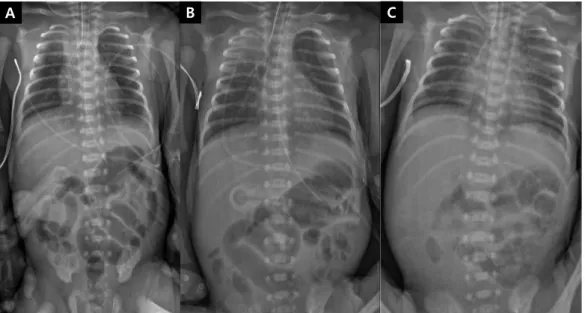
On the second day of life, he presented with abdominal disten- sion and failure to pass meconium by himself. The abdominal
radiograph showed mild ileus (Fig. 1A). The physical examination revealed abdominal distension; however, the abdomen was soft.
Moreover, no residual volume was found with trophic feeding.
Therefore, his diet was continued, and he was given daily enema treatment. On the fifth day, abdominal distension was aggravated, and bilious residual gastric content was found. The abdominal radiography showed that the ileus was aggravated compared to that on the second day (Fig. 1B). Until this day, he passed normal stool with an appropriate amount by daily enema. On the fifth day, he passed bloody stool. Stool occult blood was positive. Laboratory tests included the following:
WBC count 18,140/mm3, Hb 15.7 mg/dL, platelet count 175,000/
A B C
Fig. 1. (A) Abdominal X-ray on 2nd day of life showed mild ileus. (B) Abdominal X-ray on 5th day of life showed aggravated ileus. (C) Post-operative abdominal x-ray showed improved bowel ileus.
Fig. 2. Abdominal ultrasonography showing target sign at the ileum area. The arrow points to small bowel intussusception.
unclear. In full-term infants, intussusception was asso ciated with identifiable lead points, such as diverticulum, polyps, duplication cyst, hamartoma, and Meckel’s diverticulum.1,8 There was no association between most cases of intussusception in preterm infants and any lead points.9 Avansino et al.1 in their review paper studied 35 cases of intussusception in preterm infant (GA 28.4±0.68 weeks) and have stated that there was a lead in 3 of 35 patients (8.6%), including a polypoid mass, meconium plug, and Meckel’s diverticulum. In other patients, no obvious etiology could be identified.1 The common perinatal risk factors that cause intestinal hypoperfusion, hypoxia, dys- motility, and stricture formation may act as the lead point for intussusception in preterm infants.9,10 A recent study on 14 neonates by Ueki et al.11 revealed that the hypoxic events were shown to play a crucial role in the pathogenesis of late-onset neonatal intussusceptions. In our case, a lead point caused by a duplicated cyst was expected. However, surgical findings were unremarkable.
The clinical symptoms of intussusception that are usually observed in older infants and toddlers, including palpable abdominal mass and colicky abdominal pain, are rarely found in neonates. In neonates, the manifestations of intussusception were similar to those of NEC, including abdominal distension, bilious vomiting, feeding intolerance, and bloody stools.9,10,12 In case of bilious vomiting and abdominal distension in neonate, it should be assumed to be due to intestinal obstruction, and the following diseases should be considered: duodenal atresia, malrotation, small bowel atresia, meconium ileus, meconium plug syndrome, and Hirschsprung’s disease.13 NEC, spontaneous intestinal perforation, and meconium obstruction should be mm3, CRP 0.25 mg/dL, sodium 138 mmol/L, and potassium 5.6
mmol/L. In the gas analysis, metabolic acidosis (pH 7.15, pCO2 42 mmHg, HCO3 15 mmol/L, and base excess -14 mEq/L) was found. Clinically, NEC was not excluded. Therefore, we switched to broad-spectrum antibiotics (vancomycin, cefotaxime, and metronidazole). The USG performed on the sixth day after birth revealed small bowel intussusception probably having a lead point, such as duplication cyst (Fig. 2). Following a diagnosis of small bowel intussusception, diagnostic and therapeutic laparo- tomy was planned for small bowel intussusception. When the operation was performed, his body weight was 970 g. Intra- operatively, at about 5 cm of the ileum in the 20 cm area from the ileocecal valve, intussusception was found. The proximal small bowel was dilated, and the distal bowel was collapsed (Fig. 3A).
The pediatric general surgeon tried to perform manual reduction;
however, this attempt was unsuccessful. Segmental resection of the ileum and end-to-end anastomosis were performed.
Duplicated cyst was not found in the intussusception (Fig. 3B).
Following the diagnostic laparotomy, radiography showed improve ment in terms of abdominal distension and ileus (Fig.
1C). On the sixth day after surgery, enteral feeding was started with parenteral nutrition. On the twenty-sixth day after surgery, full feeding was done. At 40 weeks' postmenstrual age, he was discharged from the hospital with good weight gain and full enteral feeding.
Discussion
In preterm infants, the etiology of intussusception remains
A B
Fig. 3. (A) Proximal small bowel was dilated and distal bowel was collapsed. (B) Specimen of bowel resection showed necrotic change caused by intussusception (arrow).
that early diagnosis of intussusception is possible in neonates with the use of USG.8
Contrast enemas are also commonly used for diagnosing intussusception in full-term neonates because it commonly occurs at the ileocolic junction.1 However, in preterm infants, intussusception is not commonly associated with a colonic component. In a review study by Avansino et al.1, contrast enemas were performed in 12 of 35 neonates and resulted in a diagnosis in 1 neonate with intussusception. The preterm neonate diagnosed with a contrast enema required an emergent laparotomy due to the perforated viscus.1 Diagnostic and thera- peutic use of contrast enema increased the risk of perforation.1,7
As mentioned earlier, abdominal USG is a useful tool for the diagnosis of intussusception in neonate. However, only 14%
of cases were diagnosed as intussusception of preterm infants through USG.1 In cases of intussusception in Korea, there was one case diagnosed by USG and the other cases were not found on USG or on laparotomy in case of intestinal perforation.2-4 In our case, through abdominal USG, we were able to quickly diagnose intussusception. Additionally, through the clinician’s suspicion and use of image modality, this was possible, and we were able to reduce the time taken to surgery after diagnosis.
In literature reviews, after a median of 7 days following clinical deterioration with the occurrence of bloody stools, a palpable abdominal mass, or signs of perforation, explorative laparotomy was performed.9
Intussusception is a common cause of intestinal obstruction in children. However, the prevalence of intussusception in neo- nates, especially preterm infants, is very rare. In preterm infants, the manifestations of intussusception are similar to those of NEC. Distinguishing intussusception from NEC is challenging;
thus, accurate diagnosis is delayed, and intestinal perforation may occur. Therefore, the clinician’s suspicion, stable course compared to that in NEC, abdominal radiography, and early USG are important for an accurate and early diagnosis.
Conflict of interest
No potential conflict of interest relevant to this article was reported.
References
considered in a preterm infant with bilious vomiting.13 When these clinical symptoms are observed in preterm infants, because of relatively high prevalence in the preterm infant period, the patient could be often misdiagnosed with NEC and treated with the applicable protocol that involves the use of antibiotics and NPO. In cases where intussusception is initially misdiagnosed as NEC, there is a delay of about 7 days in establishing the correct diagnosis.10,14
The clinician’s suspicion, manifestation of neonate, laboratory tests, and imaging modalities are important for an accurate diagnosis of intussusception and NEC. As mentioned above, the clinical manifestations of the two diseases are the same.
Therefore, considering other factors comprehensively is im- portant. Neonatal intussusception does not show any classical radiologic signs. Dilatation of the bowel loops and gas-fluid level are the most common radiologic findings in neonate intus- susception. Pneumatosis intestinalis and portal venous gas that are characteristic features of NEC are not obvious radiologic findings in neonate intussusception.10,12 The radiographic exami - nation showed dilatation of the bowel loop and ileus without any evidence indicating NEC. The laboratory findings help to diagnose intussusception. In NEC infants, inflammation is commonly observed, indicated by elevated CRP levels, decre- ased platelet count, and metabolic acidosis.10 In our case, at the time when abdominal symptoms appeared, the laboratory test showed normal complete blood count, elevated CRP (1.62 mg/dL), and metabolic acidosis. So, it is difficult to distinguish between NEC and intussusception by the laboratory test. In this case, the abdominal X-ray showed that there were no typical findings, such as pneumatosis intestinalis and portal vein gas, seen in the NEC. And there were no typical X-ray findings of duodenal atresia or malrotation, such as double bubble sign or asymmetric gas pattern. In this case, only mechanical ileus could be identified with bilious vomiting. Considering these findings, it was difficult to clearly diagnose NEC. Therefore, abdominal USG was performed to diagnose other causes of bilious vomit ing and ileus, considering the possibility of intussusception, duodenal atresia, malrotation, and other gastrointestinal anomalies, al- though the incidence is low in preterm infants. While abdominal USG is useful for establishing a diagnosis of intussusception in older infants, it has not yet been established in the investigation of small preterm infants.9 In recent studies, it has been shown
1) Avansino JR, Bjerke S, Hendrickson M, Stelzner M, Sawin R. Clinical features and treatment outcome of intussusception in premature neonates. J Pediatr Surg 2003;38:1818-21.
2) Lee BY, Kim YH, Hwang JB, Kim CS, Lee SL, Kwon TC, et al. A case of ileao- ileal intrauterine intussusception in a preterm neonate. Korean J Pediatr Gastroenterol Nutr 2005;8:247-51.
3) Goo HW, Kim EA, Pi SY, Yoon CH. Sonographic diagnosis of neonatal intussusception with perforation in a premature neonate. AJR Am J Roentgenol 2002;178:515-6.
4) Kim HS, Kim HA, Kim SH, Byun SY, Kim MJ. Multiple intussusceptions in an extremely premature infant. Korean J Perinatol 2014;25:202-5.
5) Park JY, Kim YG, Lee NM, Cha SJ. Double intussusceptions with necro- tizing enterocolitis diagnosed in a premature infant. Neonatal Med 2015;22:213-6.
6) Martínez Biarge M, García-Alix A, Luisa del Hoyo M, Alarcón A, Sáenz de Pipaón M, Hernández F, et al. Intussusception in a preterm neonate; a very rare, major intestinal problem--systematic review of cases. J Perinat Med 2004;32:190-4.
7) Aydin E. Intussusception in a preterm newborn. Pediatr Neonatol 2018;
59:312-4.
8) Prakash A, Doshi B, Singh S, Vyas T, Jain A. Intussusception in a premature neonate: a rare and often misdiagnosed clinical entity. Afr J Paediatr Surg 2015;12:82-5.
9) Görgen-Pauly U, Schultz C, Kohl M, Sigge W, Möller J, Gortner L.
Intussusception in preterm infants: case report and literature review.
Eur J Pediatr 1999;158:830-2.
10) Loukas I, Baltogiannis N, Plataras C, Skiathitou AV, Siahanidou S, Geroulanos G. Intussusception in a premature neonate: a rare often misdiagnosed cause of intestinal obstruction. Case Rep Med 2009;2009:
607989.
11) Ueki I, Nakashima E, Kumagai M, Tananari Y, Kimura A, Fukuda S, et al.
Intussusception in neonates: analysis of 14 Japanese patients. J Paediatr Child Health 2004;40:388-91.
12) Raza HA, Basamad MS, El Komy MS, Al Maghrabi A, Habbach H, Abokrecha AY. Diagnosing intussusception in preterm neonates: case report and overview. J Clin Neonatol 2014;3:103-5.
13) Burge DM. The management of bilious vomiting in the neonate. Early Hum Dev 2016;102:41-5.
14) Margenthaler JA, Vogler C, Guerra OM, Limpert JN, Weber TR, Keller MS.
Pediatric surgical images: small bowel intussusception in a preterm infant. J Pediatr Surg 2002;37:1515-7.