1. Introduction
Reinforced concrete is used as a complex construction material at variable fields related to our life such as air- port, bridge, and ocean concrete structure, etc. In case of concrete, it has high resistivity and especially forms high-alkaline environment with water. The rebar can be prevented from the corrosion in the high alkaline environ- ment because the passive layer is formed [1]. If the alka- line environment is changed to neutral or acid by contain- ing abnormal factors, however, the corrosion of rebar oc- curs [2-5]. Moreover, the passive layer on the rebar is broken by chloride contents, which are leading to severe pitting corrosion. In general corrosion of the concrete, the volume of corrosive products is increased and the concrete is spalled partially [6]. The crack on the concrete allows corrosive environment factors such as oxygen, water, and others to invade easily and accelerate the corrosion rate.
When making design of structure, service life of the build- ing is determined and then it is built by the confirmed plan. However, the service life of the building is reduced more strikingly in the harsh corrosive environment than
the planned life. So, the repair of the building has been needed to maintain the service life to the planned lifetime.
Therefore, this status makes enormous economic problem as well as the safety problem of human life [7].
Cathodic protection is a way to change the position from corrosion area to immune area by using electrons.
People in many fields has been inventing and studying to protect from the corrosion in the concrete structures and steel products. Cathodic protection is divided into two methods which are sacrificial anode cathodic protection (SACP) and impressed current cathodic protection (ICCP) [8-10]. These ways respectively have merits in order to be installed on the structures and other systems. So, a number of authors have studied the cathodic protection to prohibit the corrosion of metals. Although the purpose of their study is respectively different, most of studies are both the feasibility and efficiency of the cathodic protection.
C. Christodoulou et al. [11] evaluated the long period benefit of the ICCP. They tried to search the merits of the ICCP system through a number of test on the structures. thus, the existence of persistent protective ef- fects was found that it had occurred by it. Guofu Qiao et al. [12] studied the numerical optimization method of
A Study on the Effect of the ICCP System in Reinforced Concrete Specimens of Slab Type
Jin-A Jeong1, Kwon-Heum Ko2,†, Mun-Su Kim2, and Du-Hyeong Lee2
1Department of Ship Operation, Korea Maritime & Ocean University, 1 Dongsam-dong, Youngdo-ku, Busan, Korea
2Department of Marine Engineering, Graduate School, Korea Maritime & Ocean University, 1 Dongsam-dong, Youngdo-ku, Busan, Korea
(Received November 12, 2018; Revised November 28, 2018; Accepted December 03, 2018)
Reinforced concrete (RC) has been used as a construction material in various environments, such as airports, bridges, and ocean concrete structures, etc. Over time, however, rebar in the concrete is prone to corrosion from environmental forces and structural defects of the concrete. Cathodic protection (CP) was invented to prevent problems with corrosion and is widely used for different applications. Cathodic protection is divided into two types: sacrificial anode cathodic protection (SACP) and impressed current cathodic protection (ICCP). There are several limitations to the use of sacrificial anode cathodic protection in complex reinforced concrete structures, including concrete resistivity, throwing power of the CP, and environmental conditions.
These limitations can affect the protection performance of SACP. Therefore, we used impressed current cathodic protection in our study. We tested Ti-Mesh, Ti-Rod, and Ti-Ribbon anodes in slab type reinforced concrete specimens. Electrochemical tests were conducted to confirm the impressed current cathodic protection performance under different environmental conditions.
Keywords: Reinforced concrete, Cathodic protection, Concrete resistivity, Throwing power
†Corresponding author: [email protected]
the ICCP system for the RC structures. The numerical model of the ICCP is built to find the optimal cathodic protection way. After conducting the experimental test, they compared with the simulation. Xun Xi et al.[13] stud- ied the time to occur surface crack and crack width on the structure by the corrosion. They tried to find the time to be surface crack by the corrosion and mechanical pa- rameters on the simulation. By the simulated models, they found that the factors which are breaking the structures like ambient temperature, chloride content and corrosion rate affected on the time. When the steel constantly is corroding, the volume of this gradually is increasing.
Thus, the concrete is broken and the corrosion rate sharply is increasing. Keir Wilson et al. [14] investigated the se- lection and use of cathodic protection systems for the re- pair of reinforced concrete structures. They had compared the benefits, practicality, economic feasibility of the CP between ICCP and SACP. The factors comparing on the research are the service life, constructing cost and repair- ing cost, etc. They found the results through their experi- ence that the SACP is proper to small and target repair.
In addition, it is suitable to apply it on the structures whose service life is less than 10 years. Reversely, the ICCP is a significant way to protect the corrosion of steel in concrete. This system can be utilized the large structure in which service life is more 25 years and the great area in the corrosion environment. Chloride contents com- monly is a major factor to occur the corrosion of metals on the structures. Binbin Zhou et al. [15] examined elec- trochemical parameters related to corroded rebars in con- crete under chloride environments. They studied the polar- ization behavior of rebars in concrete is evaluated by five factors which are relative humidity, Cl- content, rebar di- ameter, water-cement ratio, and corrosion duration. They found that cathodic exchange current density has the most significant effects on corrosion rate and A practical model for the corrosion rate of rebars in concrete is proposed.
J. Carmona Calero et al. [16] studied how different ways of chloride contamination can affect the efficiency of cathodic protection. They utilize two different versions of cathodic protection on lab specimens. And then two differ- ent ways were applied permanent immersion in a NaCl solution and periodic pouring of a NaCl solution with at- mospheric exposure. They found the useful results which are particular features on the study in each case. Luca Bertolini et al. [17] investigated the throwing power of cathodic prevention with the sacrificial anode. They tried to find the throwing power data in partially submerged marine reinforced concrete file. They also compared the experimental test and the simulation programs installed the sacrificial anodes immersed in the seawater is made
to investigate throwing power and corrosion condition of the examine. Luca Bertolini et al. [18] studied the sacrifi- cial anode for cathodic protection in seawater. For the steel, it is divided to in chloride free concrete and chloride contaminated concrete. Moreover, the submerged zone of reinforced concrete columns was depolarized to 200 mV.
The results show that the sacrificial anodes are an effective and economical method for preventing corrosion in the submersed zone.
As mentioned earlier, the ICCP system generally is con- sidered an attractive way to protect corrosion of various metals and alloys. And this method globally has been used to extend the service life of structures. Prasad V. Bahekar et al. [19] investigated in the effectiveness of ICCP used the anode as CFRP laminate. And then they evaluated this by half-cell potential, LPR, bond stress and mass loss.
In addition, the corrosion level is separated by them to three steps. Standard Code of practices has suggested cathodic protection current densities ranging between 2 mA/m2 and 20 mA/m2. However, this study concludes that the most appropriate protection current density against corrosion in all corrosion levels is 5 mA/m2 because it ensures the longer service life of RC structures that are vulnerable to rebar corrosion. Mochammad Syaiful Anwar et al. [20] studied Lightweight cementitious anode for ICCP system using pumice aggregate (PA). The anode is composed as follows; pumice aggregate (fine), carbon fibers and cement with MMO-Ti. The examination is con- ducted the process such as accelerated galvanic test, con- ductivity measurement, dry density, and compressive strength. In addition, It compared with the cement mortar without fibers. In conclusion, the weight loss of the anode occurred and reduced the half of the weight. They assert these anodes is proper to use as an anode for cathodic protection verified by polarization and impedance test.
Ji-hua Zhu et al. [21] studied the corrosion protection us- ing ICCP and structure strengthening technique for the columns. They argued the ICCP-SS system is not only effective to protect the corrosion of the steel but also im- proves durability against the compression force of the cor- roded columns. Jing Xu et al. [22] studied the current distribution of impressed current protection with con- ductive mortar overlay anode in reinforced concrete. The results of initial half cell potential and corrosion rate with or without chloride is indicated and shows another im- portant effect of concrete resistivity on the current dis- tribution is discrepancy among the currents by the rebars present at different cover depths. The results measured this test represent the initial corrosion rate on the steel has an effect on the protection current distribution.
Moreover, the corrosion rate has limited value.
Therefore, when evaluating the cathodic protection effi- ciency of the ICCP, various factors, arrangement of rebars, concrete-water ratio, type and the arrangement of in- soluble anode and exposed condition of the RC, etc, should be investigated for the uniform protection of the whole structure by applying the ICCP.
The purpose of this study was to find the proper ICCP method in the complex structure where it is difficult to install the anodes. For instance, when using one anode, it is less likely to protect from the corrosion of rebars totally in complicated structure because the above factors such as the experimental environment and the type of anode disturb the cathodic protection. Moreover, if the particular anode cannot be installed in the complicated structure, it results in the severe corrosion.
In this study, the anode for the ICCP was applied as different shapes such as Ti-Rod, Ti-Mesh, and Ti-Ribbon and then was mounted on the concrete specimen. In addi- tion, the electrochemical test as follows was carried out to find the optimal cathodic protection efficiency on RC specimens of slab type according to the experimental environments.
2. Experimental Procedure
2.1 Specimens
The specimens are fabricated such as slap type in order to find an optimal impressed current cathodic protection system. In the method of cathodic protection at present, it uses only one type of anode for protecting against corro- sion but there is a problem that it would not be able to supply constant protection current to the specimen perfectly.
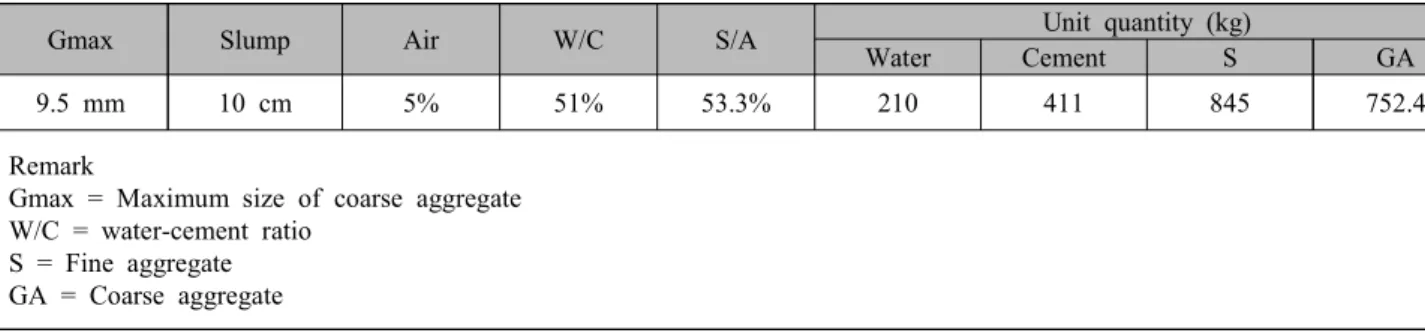
In this study, the diverse shapes of the anode for the ICCP were utilized on the complex structure of the building to find the proper cathodic protection. In addition, those an- odes were manufactured to be installed easily on the com- plicated structure. The concrete mixed design is shown in Table 1. The specimens were built in an atmosphere
for 28 days and then the reinforced steel was a typical carbon steel for the construction on KS D16 (ASTM #5).
A slab type specimens were fabricated with six reinforced steels being 700 mm long and these were located at an interval of 60 mm each. The dimensions of the specimens are with a height of 70 mm, width of 400 mm and a length of 400 mm. Fig. 1 represents the slab type specimen with a water container.
2.2 Installation of anodes for the ICCP
Anode for the ICCP was separated 3-type in accordance with their shape in order to be installed conveniently. The anode is an insoluble metal such as titanium, which was fabricated to diverse types such as ribbon, rod, and mesh.
The anodes of Ti-Ribbon were used with 300 mm × 20 mm and then the Ti-Mesh was 100 mm × 100 mm.
Table 1 Detail contents of the reinforced concrete specimen
Gmax Slump Air W/C S/A Unit quantity (kg)
Water Cement S GA
9.5 mm 10 cm 5% 51% 53.3% 210 411 845 752.4
Remark
Gmax = Maximum size of coarse aggregate W/C = water-cement ratio
S = Fine aggregate GA = Coarse aggregate
Fig. 1 Dimension of slab type specimen.
Besides, these anodes respectively were grouted by the mortar as shown in Fig. 2. The anodes were installed on the slab type specimen and then are indicated in Fig. 3.
The anode of Ti-Ribbon was installed parallel on top of first reinforced steel (S1) and the Ti-Mesh was installed top of between the fifth and sixth steel. As shown in Fig.
3. The Ti-Rod was inserted to the hole which had been drilled 20 mm and this hole was plugged by the mortar.
2.3 Installation of test devices
Before installing the test equipment, several processes were conducted in order to carry out the test conveniently.
The end of reinforced steels was made a hole by drilling and be connected electric wire to set up the devices for potential measurement and protection on the slab type specimens. In addition, the wire was fixed by screws. The anodes were located on the end of steel and were fixed by soldering to minimize the contact resistance. Moreover, the contacting part was covered with epoxy and then the current was not to flow. The outside of the specimens except for the part of water container was put on the enam- el in order to prohibit the evaporation of experimental liquid. Therefore, the liquid was able to be absorbed only through the underside.
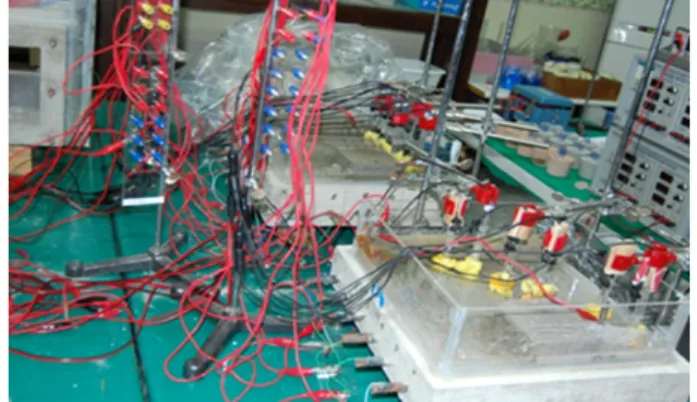
Fig. 4 shows the picture for cathodic protection on the specimens. The rectifier called CR-1212 multichannel power supply was utilized to supply CP current, which is able to monitor not only CP potential and current but also 4 hours depolarization potential. As shown in Fig.
5, the input and output port on the terminal of power sup- ply was connected with the reinforced steel in the speci-
mens, the anodes for the ICCP and the reference electro- des to conduct the test. The silver-silver chloride electrode (SSCE) was used as the reference electrode during this study. Six SSCEs were fixed respectively on top of the steel in the specimens. In addition, the porous sponge is applied on the end of the reference electrode to reduce the contact resistance between the concrete surface and it.
2.4 Procedures & analysis
Silver-silver chloride electrode (SSCE) was used as the reference electrode and then Fluke digital multimeter was applied as the potentiometer during the measurement.
When the specimen was measured the cathodic protection potential in the atmosphere, it is difficult to gauge the value of those because it had the error by contact resist- ance between the reference electrode and the concrete.
So, some sponges with fresh water were attached on the end of the reference electrode to remove it. This is because the error by contact resistance was eliminated as making the path of the electrolyte. In others case, when measuring the cathodic protection potential of the specimen in fresh water and natural sea water, the reference electrode was submerged. Behaviors of the protection potential were Fig. 4 Picture of cathodic protection test on the RC specimens.
Fig. 5 Schematic diagram of slab type specimen installed anode and reference electrodes for cathodic protection.
Fig. 2 Ti-Ribbon and Ti-Mesh anode grouted by mortar.
Fig. 3 Installation of 3 types of anode in RC specimens.
compared according to the exposed environment of the specimens and the anode type. All data values automati- cally were measured and monitored at an interval of 1 minute during the test.
The depolarization potential on the specimen was meas- ured to confirm the condition of cathodic protection ac- cording to 100 mV depolarization criteria by NACE. When examining the depolarization on the specimen, negative terminal on the supply unit was connected with the rebar of the specimen and then positive terminal was linked with the anode of the ICCP. Moreover, the protection current was supplied from the anode. In addition, the value of cathodic protection potential was decided by the type of specimens; it is - 600 mV/SSCE at each specimen. The RC specimens of slab type also were measured the catho- dic protection potential in different corrosive environ- ments such as atmosphere, fresh water and natural sea water conditions. When powering off on the system tem- porarily, the potential was rapidly increased. However, the rising rate of potential gradually became slow over time.
The initial potential was increased by IR-drop occasion- ally and then the change of depolarization except the IR-drop was the real degree of depolarization. In this study, 4 hours depolarization criteria were adopted.
Additionally, in case of slab type specimen, after adding the other anode such as Ti-Ribbon, Ti-Mesh, and Ti-Rod at S5 - S6 position, the potential of the slab type specimen was measured again.
3. Results and Discussion
Fig. 6 shows the cathodic protection potential curve of the RC specimens. Constant Voltage Mode was applied for the measurement to maintain output voltage for the power supplier. When setting the output voltage to 2.0 V during the test, the cathodic protection potential was not affected crucially by the experimental environment
such as atmosphere, fresh water, sea water condition and kind of insoluble anodes. Moreover, the cathodic pro- tection potential was in the range - 1,300 to - 1,200 mV/SSCE. As shown in Fig. 6, the cathodic protection efficiency was good to protect the concrete structure in all experimental environments regardless of the anode such as Ti-Rod, Ti-Ribbon, and Ti-Mesh.
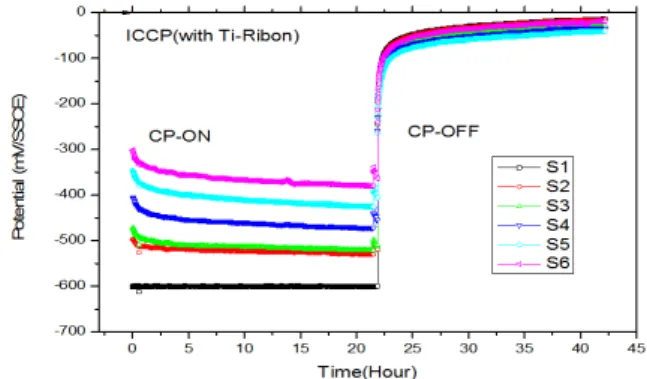
After removing solution in a water container of the specimens, the setting value of cathodic protection poten- tial fixed to -600 mV/SSCE by CR-1212, the depolariza- tion potential measurement of the slab type specimens was carried out at atmospheric condition, and the depolariza- tion potential results varying with the type and arrange- ment of the anodes are seen in Fig. 7-9.
In Fig. 7, the Ti-Ribbon anode was installed on the end of steel (S1) in the slab type specimens. Besides, the reference electrodes were installed the closest surface nearby each steel (S1 ~ S6). The cathodic protection po- tential of S1 initially maintained to - 600 mV/SSCE be- cause Ti-Ribbon anode had been installed near S1 and its set point was - 600 mV/SSCE. And then those of S2 and S3 maintained to about -520 mV/SSCE. Those of S4, S5, and S6 are - 470 mV/SSCE, - 420 mV/SSCE and - 370 mV/SSCE respectively. That is, as the distance was farther from the anode of ICCP to the cathode such as rebar in the specimen, the cathodic protection potentials was dropped less than the setpoint - 600 mV/SSCE.
Briefly, the distance of between steels in the specimen was 60 mm and then each of the cathodic protection poten- tial was not dropped to the set point totally. the gap of those values was 50 mV/SSCE per 60 mm from the anode for ICCP. After powering off the cathodic protection sys- tem temporarily, the degree of depolarization was meas- ured each of steels in the specimen. As the distance was farther from the anode of ICCP to the cathode such as rebar in the specimen, the degree of depolarization on each steel was smaller depending on it.
Fig. 6 The variation of cathodic protection potential in different anodes and experimental environments.
Fig. 7 Potential shift variation of RC specimen applied with a Ti-Ribbon anode.
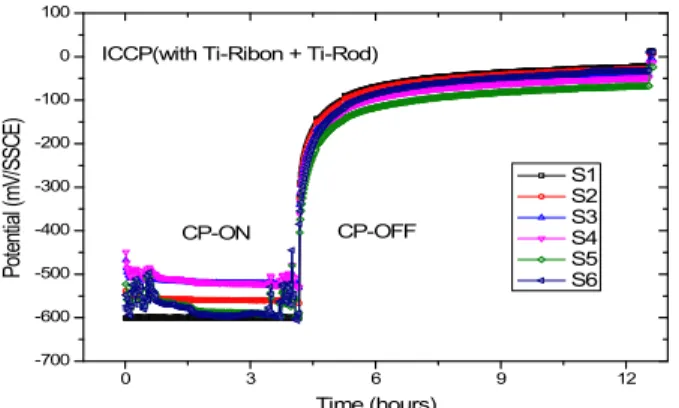
Fig. 8 represents the results of corrosion protection po- tential on the specimen after adding Ti-Rod anode on the S6 position additionally. The protection potential main- tained to - 530 mV/SSCE whose value is similar to setting the value of CR-1212. Besides, the degree of depolariza- tion also kept above - 500 mV/SSCE after shutting off the power supply. Thus, it is a proper protection condition.
The change of cathodic protection potential by adding the anode for ICCP was shown in Fig. 9. The anodes which were composed Ti-Ribbon and Ti-Mesh were used togeth- er in Fig. 9. The protection potential of the six steels (S1
~ S6) has different values between 10 ~ 50 mV after add- ing Ti-Mesh anode on the S6 position additionally.
However, these only were in the range - 540 ~ - 600 mV/SSCE. Besides, the depolarization potential was above 500 mV and it is a good protection condition.
As any anodes were utilized during the test, it was found that the cathodic protection effect was similar in the con- crete structure. In addition, the throwing power of the ICCP in RC structure was 150 mm from the anode for the ICCP in case of being exposed at atmospheric
condition. If the anode is installed at distance of 300 mm, the cathodic protection can be applied to protect the corro- sion of complex reinforced concrete structure uniformly.
4. Conclusion
For this study, the anode for the ICCP system such as Ti-Mesh, Ti-Rod, and Ti-Ribbon was installed on the reinforced concrete specimen of slab type. In addition, the cathodic protection and depolarization potential meas- urements were conducted to confirm the cathodic pro- tection performance depending on the exposed environ- ment and the kind of anode in RC structure applied with the ICCP system.
The following results about the cathodic protection effi- ciency have been obtained through the present study.
1) The cathodic protection potential was gauged by the galvanostatic method after applying with the ICCP system.
The type and shape of anode had not a major effect on the behavior of cathodic protection potential. In addition, the value of protection potential was tended to decrease in the order of atmosphere, fresh water, and sea water condition and then it was the trivial difference between them.
2) The cathodic protection potential was evaluated on the slab type specimen. When the distance from the anode to the rebar (cathode) is closer, the protection potential was lower by the concrete resistivity. Additionally, the potential difference represented proportionally 50 mV per 60 mm which was the distance between the rebar.
3) In protecting the RC specimen of the slab type by the ICCP system, as the distance between the location of rebar and the anode was farther, the concrete resistivity was increased more and then the supply of protection cur- rent was limited. However, after installing the anode at regular distance supplementarily, the unprotected rebar was enabled to protect well totally.
4) It would be able to find the maximum protection distance which is about 150 mm to the rebar from the anode. That is, the anode should be installed at an interval of about 300 mm to protect the whole structure uniformly without the unprotected area.
5) It was found that the type and shape of anodes used in the ICCP system had an insignificant effect on the pro- tection efficiency. The protection efficiency of the ICCP system was changed in accordance with the spacing be- tween the anode and rebar, and the location of the anode.
So, it should consider those points thoroughly in designing the ICCP system. In addition, if the proper cathodic pro- tection is applied to the RC structures, the enormous eco- nomic problems by the corrosion will be resolved as well
0 3 6 9 12
-700 -600 -500 -400 -300 -200 -100 0 100
CP-ON CP-OFF
S1 S2 S3 S4 S5 Potential (mV/SSCE) S6
Time (hours) ICCP(with Ti-Ribon + Ti-Rod)
Fig. 8 Potential shift variation of the RC specimen applied with a Ti-Ribbon anode and a Ti-Rod anode.
0 20 40 60 80 100
-700 -600 -500 -400 -300 -200 -100 0 100
CP-OFF
Potential (mV/SSCE)
Time (hours)
S1 S2 S3 S4 S5 S6 CP-ON
ICCP(with Ti-Ribon + Ti-Mesh)
Fig. 9 Potential shift variation of the RC specimen applied with a Ti-Ribbon anode and a Ti-Mesh anode.
as the safety for human life.
Reference
1. K. Subbiah, S. Velu, S. -J. Kwon, H. -S. Lee, N. Rethinam, and D.-J. Park, Electrochim. Acta, 259, 1129 (2018).
2. F. J. Luna Molina, M. C. Alonso Alonso, M. Sánchez Moreno, and R. Jarabo Centenero, Constr. Build. Mater., 156, 468 (2017).
3. M. Cabrini, S. Lorenzi, T. Pastore, and S. Pellegrini, Corros. Sci. Tech., 17, 203 (2018).
4. Moe M. S. Cheung and C. Cao, Constr. Build. Mater., 45, 199 (2013).
5. T. J. Kim, K. A. Kim, J. Y. Lee, and H. J. Jang, Corros.
Sci. Tech., 17, 225 (2018).
6. B. Sanz, J. Planas, and José M. Sancho, Constr. Build.
Mater., 160, 598 (2018).
7. G. T. Parthiban, T. Parthiban, R. Ravi, V. Saraswathy, N. Palaniswamy, and V. Sivan, Corros. Sci., 50, 3329 (2008).
8. S. H. Xing, Y. Li, H. Q. Song, Y. G. Yan, and M. X.
Sun, Ocean Eng., 113, 144 (2016).
9. E. Redaelli, F. Lollini, and L. Bertolini, Constr. Build.
Mater., 39, 95 (2013).
10. Ph. Refait, M. Jeannin, R. Sabot, H. Antony, and S. Pineau, Corros. Sci. 90, 375 (2015).
11. C. Christodoulou, G. Glass, J. Webb, S. Austin, and C.
Goodier, Corros. Sci., 52, 2671 (2010).
12. G. Qiao, B. Guo, J. Ou, F. Xu, and Z. Li, Constr. Build.
Mater., 119, 260 (2016).
13. X. Xi and S. Yang, Constr. Build. Mater., 155, 114 (2017).
14. K. Wilson, M. Jawed, amd V. Ngala, Constr. Build. Mater., 39, 19 (2013).
15. B. Zhou, X. Gu, H. Guo, W. Zhang, Q. Huang, Constr.
Build. Mater., 164, 877 (2018).
16. J. Carmona Calero, M.A. Climent Llorca, and P. Garcés Terradillos, J. Electroanal. Chem., 793, 8 (2017).
17. L. Bertolini and E. Redaelli, Corros. Sci., 51, 2218 (2009).
18. L. Bertolini, M. Gastaldi, M. Pedeferri, and E. Redaelli, Corros. Sci., 44, 1497 (2002).
19. P. V. Bahekar and S. S. Gadve, Constr. Build. Mater., 156, 242 (2017).
20. M. S. Anwar, B. Sujitha, and R. Vedalakshmi, Constr.
Build. Mater., 71, 167 (2014).
21. J-h Zhu, M-n Su, J-y Huang, T. Ueda, and F. Xing, Constr.
Build.Mater., 167, 669, (2018).
22. J. Xu and W. Yao, Constr. Build. Mater., 23, 2220 (2009).