< 목 차 >
Ⅰ. 서 론
Ⅱ. 실험재료 및 방법
Ⅲ. 실험성적
Ⅳ. 총괄 및 고찰
Ⅴ. 결 론 참고문헌 영문초록
I. 서 론
도재소부전장관은 심미성과 생체 적합성이 우수하 지만, 복잡한 제작과정과 도재, 합금의 상이한 열적
성질 등(1~4)으로 인하여 변연 적합도의 불량과 도재파
절(5)등이 문제점으로 지적되고 있다.
완성된 금속관의 변연적합도가 불량한 경우 잔존 치질의 우식중, 추수질환 및 주위조직의 염증성 병볍
등(6, 7)이 야기되므로 도재소성과정에 의한 변형을 줄
여, 적합도를 증진 시킬 수 있는 방법이 연구되어 왔 다. 그러한 방안으로 metal coping의 적절한 두께(2,
8), 강도와 융점이 높은 합금의 선택(9~11), 그리고 저융 도재의 개발(12)등이 제시되었으며, Andou(12)는 전처 리가열 후 주조체의 시적 및 조정을 주장하였으며, 官內(13), Mclean(14)등은 도재피 복형태에 의하여,
Yamada(15, 16)는 metal coping의 표면가공에 의하여 적합도가 변화되는 것을 보고하였고, 이 외에도 변연 형태와 수복물의 변연 적합도간의 상관성에 대하여 많은 연구들(2, 17~22)이 있어 왔다.
한편, 도재용 합금의 주종을 이루었던 금 합금계의 낮은 고온강도가 지적되면서 적절한 고온강도와 경 도를 지닌 대용합금이 도입되었고, 귀금속과 비귀금 속의 상이한 물리적 성질에 대한 연구들(14, 23~26)이 진 행되었다. Moffa(9)와 Luvovich(27)은 비귀금속합금 이 도재와의 결합력뿐만 아니라 물리적 성질도 우수 하여, 경도와 강도 및 변형저항성이 높고, 낮은 비중 과 높은 용융온도를 지녀 sag resistance가 높으므 로 얇은 주조물로도 임상에서 유용하게 사용할 수 있 다고 보고하였다. 그러나, 비귀금속 합금은 주조수축 과 열팽창계수가 높고(28, 29), 열 전도성이 낮으며(28), 과도한 산화막 형성으로 인한 변위의 가능성(30)이 있 을 뿐 아니라 고온용융으로 인한 큰 주조응력(31)등이 여전히 단점으로 남아있다.
또한, 심미성을 위하여 도재소부전장관의 치경부 변연을 변연치은에 밀접히 위치심켜야 하는 전치부 의 경우, 변연치은의 이행상태에 따라 지대치 변연의 만고도도 다양해지며, 특히 순측 치은퇴측이 심한 경 우에는 정상적인 변연만곡도를 가진 치아에 비하여 적합도가 불량해지는 것이 경험되고 있다.
- 대한 치과 보철학회지 Vol. 29 No. 3, 1991 -
도재소부전장금관용 합금과 순측치경부 변연만곡도에 따른 변연적합도에 관한 연구
부산대학교 치과대학 보철학교실
전영찬*ㆍ김정화
�“이 논문은 1990년도 문교부지원 한국학술진흥재단의 지방대육성 학술연구조성비에 의하여 연구되었음.”
이에 저자는 순측 치경부 변연의 이행만 곡도와 물 리적 성질이 상이한 도재소부용 합금의 종류에 따른 도재소부전장관의 치경부 변연 적합도를 주요 제작 과정별로 계측비교한 결과 다소의 지견을 얻었기에 보고하는 바이다.
Ⅱ. 실험재료 및 방법
가. 실험재료
본 실험에서는 도재소부용 합금으로는 Degudent G�(Au 86% Pd 10.4% ; Degussa, Germany)와 Verabond�(Ni 75% Cr 15% ; Aalba Dent Inc., USA)를, 도재분말로는 Duceram�(Ducera Dent.
Gmbh, Germany)을 사용하였다.
나. 실험방법
1. 시편제작 (가) 모형치 삭제
도재소부전장관 제작을 위하여 dentiform의 상악
중절치 상에서 치아 삭제 원칙(3)에 따라 순면 치경부 변연은 폭 1.2㎜의 non-beveled shoulder marhin 으로, 설면 치경부 변연은 chamfer margin으로 형 성하고, 절단부는 2㎜삭제하였으며, 치경부 변연 만 곡도는 cemento-cenamel junction을 기준으로 정 상만 곡형과 과도만곡형으로 구분하였다(그림 1, 2)
Fig. 2. Diagramatic view of prepared abutments : (a, b), normal curvature ;(c, d), pronounced curvature.
Fig. 1. Different curvature of cervical margin : left, normal curvature according with the cemento- enamel junction ; right, pronounced curvature below 3㎜ from the cemento-enamel junction.
(나) Die제작
삭제된 모형치의 치경 변연 직하부위를 block out 한 후, Silicone 인상재(Exafles�,G-C, Japan)로 tube인상법을 이용한 정밀인상을 채득하여, epoxy resin die(Pri-die Resin�, Jelenko, U.S.A.)를 제 작하였다. 경화된 die를 인상체에서 분리하고 밑면에 hole을 형성하여 dowel pin을 부착시켰으며, 그림 3 과 같이 순측 치경부 변연막곡도에 따라 각 5개씩 모 두 10개의 epoxy resin die를 만들었다.
(다) Metal coping 제작
완성된 die에 die spacer를 절단연에서부터 치경 부 변연 1㎜상방까지 2회씩 도포한 후 No. 28 sheet wax를 이용하여 동일한 규격의 납형을 제작하였다.
도재피개 부위의 납형 두께는 0.3㎜로 균일하게 하 고, 순측 변연부의 metal collar의 두께는 0.2㎜가 되게 하였다. 통법에 따라 주입선을 세우고 매몰, 소 환한 다음 표 1과 같이 10개는 귀금속 합금으로 나머 지 10개는 비귀금속합금으로 원심주조하였다.
No. 2 round bur와 산화알루미나 분사로 주조체 내면을 조정하고 초음파세척을 한 다음, die에 시적 하고 산화알루미나 절삭제와 metal gauge로 주조체 의 규격을 최종 점검하였다.
(라) 도재소성
Degassing한 metal coping에 도재를 소성하기 위하여, Duceram�도재 분말로 제조회사의 지시(표 2)를 기준으로 불투명 도재 1회, 상아질 도재와 법랑 질 도재 2회, 광택소성 1회, 모두 4회의 소성을 시행 하였다.
Fig. 3. Epoxy resin dies : left, normal curvature ; right, pronounced curvature.
Table 1. Classification of the specimens according to the degree of the cervical curvature and the alloy.
2. 변연 적합도 측정
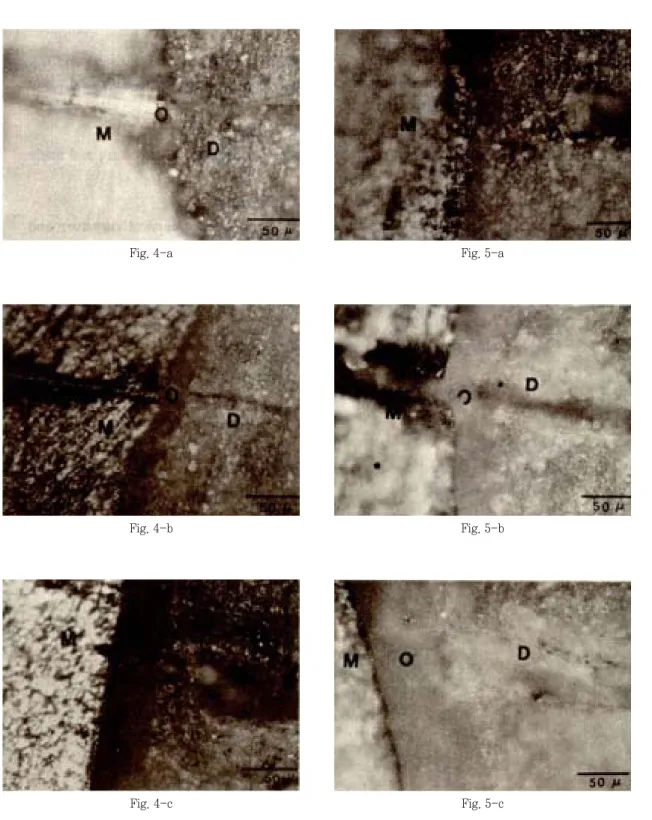
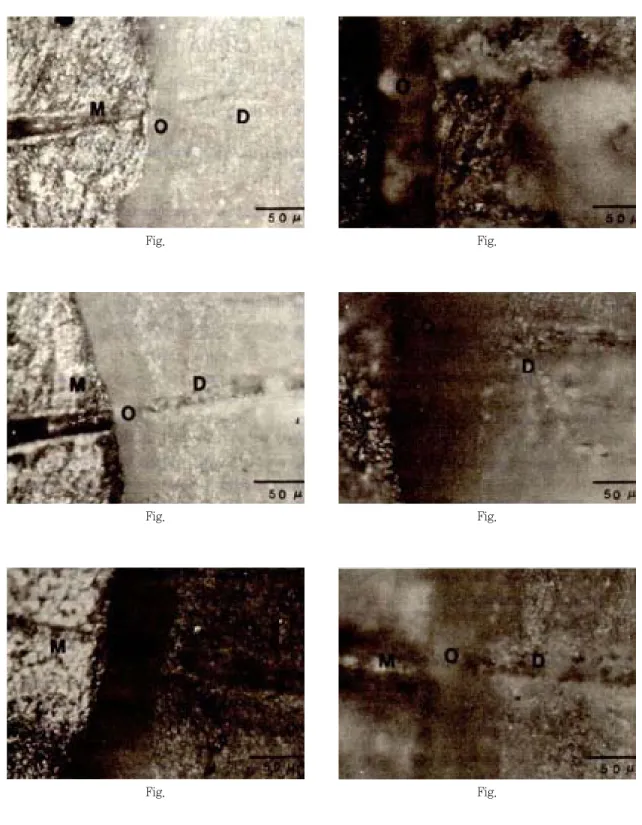
각 시편의 계측부위가 동일하도록 die 순측 변연부 에 임의의 세 지점(중아부, 근심부, 원심부)을 blade 로 표시하고 degassing전, degassing후, 그리고 glazing후에 현미경(×200, Optiphoto-M, Nikon, Japan)계측, 사진 촬영하였다.
Ⅲ. 연구성적
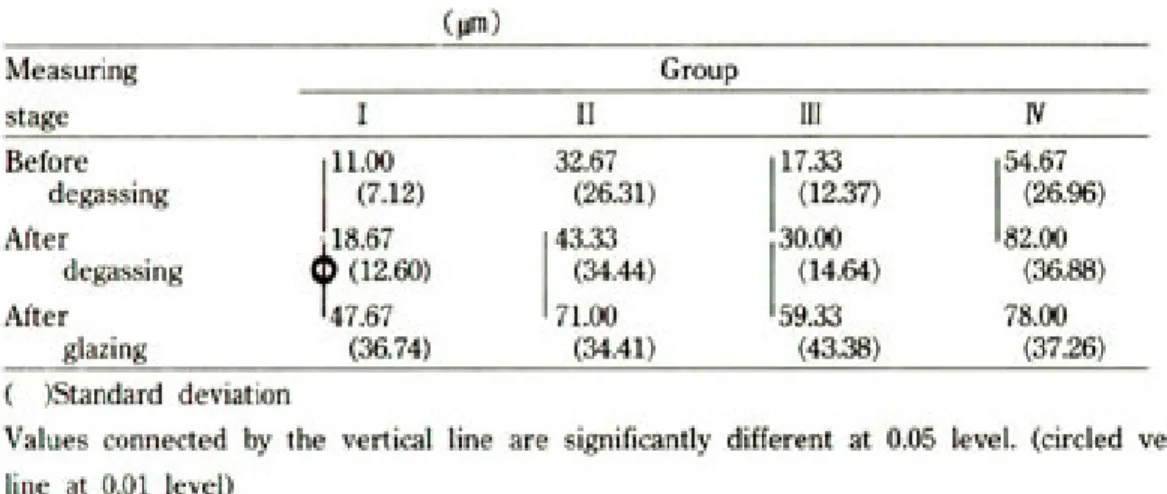
네 개의 군으로 분류된 20개의 시편에서 적합도 측정 결과 표 3과 같은 성적을 얻었다.
Degassing전 단계에서 Ⅰ군은 11.00±7.12㎛의 변연오차를 보여 적합도가 가장 우수하였고, 54.67
±26.96㎛의 변연오차를 보인 Ⅳ군이 적합도가 가장 불량하였다. Degassing과정에 의하여 Ⅰ, Ⅲ, Ⅳ군 에서, 도재소성과정에 의하여 Ⅰ, Ⅱ, Ⅲ군에서 변연 오차가 유의하게 증가되었으며, glazing 후 최종적 합도는 Ⅰ군(47.67±36.74㎛)이 가장 우수하였고 Ⅳ 군(78.00±37.26㎛)이 가장 불리하였다. 전과정을 통하여 적합도는 Ⅰ군, Ⅲ군, Ⅱ군, Ⅳ군의 순으로 우 수하였다.
각 제작단계의 변형량은 표 4와 같으며, degassing전의 변연오차값을 기준으로 degassing 처리 후 나타난 변연오차의 증, 감을 1차 변형량으로 정하고 도재소성과정에 의하여 발생한 변연오차의 증,감을 2차 변형량으로 정하였다. 1차 변형량은 Ⅳ 군이 27.33±22.51㎛로 가장 많았으며, 2차 변형량 은 Ⅰ, Ⅱ, Ⅲ군이 28~29㎛정도의 변형을 보인데 반 해 Ⅳ군은 -4.33±18.41㎛의 변형을 보여 오히려 적 합도가 나아지는 현상을 나타냈다.
표 5, 6은 제작단계별 각 군간 적합도 및 변형량 차 이에 대한 유의성을 Student’s t-test로 검정한 결 과이다. Ⅰ-Ⅱ과 Ⅲ-Ⅳ는 동일한 만곡형태에서 합금 의 종류에 따른 유의성을, Ⅰ-Ⅲ과 Ⅱ-Ⅳ는 같은 합 금을 사용한 경우에 대해 만곡형태에 따른 유의성을 검정한 것이다. 도재소성 전까지의 단계에서 적합도 는 만곡형태와 합금의 종류의 따라 유의성 있는 차이 를 보였으며, 일차 및 이차 변형에 있어서 Ⅳ군은 다 른 세 군과 유의성 있는 변형량을 보였다.
Table 2. Firing schedule of Duceram�porcelain powder.
Table 3. Mean marginal opening(㎛)
Table 4. Mean change in marginal opening after each firing pocedure(㎛).
Table 5. Significance of marginal fitness between each group.
Ⅳ. 총괄 및 고찰
인공치관의 변연적합도는 보철물의 성공 여부를 좌우하는 중요한 요소이다(7, 32~34). 변연적합도는 각 연구에 따라 정의되는 바가 다르지만, 일반적으로 주 조물 변연과 삭제된 치아의 변연간 거리인 변연오차
(20, 25)를 의미하며, 이는 다시 지대치의 장축을 기준
으로 수평성분과 수직성분으로 나눌 수 있다.
본 연구는 지대치 순측 치경부의 변연 마곡도의 차 이와 사용된 합금의 종류에 따른 도재소부전장관의 변연적합도의 수직적 변화를 측정, 비교하였다. 지대 치 형성은 순면 축벽의 길이를 3㎜차이나게 두 종류 의 삭제한 것 외에는 모두 동일하게 하였으며, 변연 의 형태는 Shillingburg등(2, 22), Belser등(17), Faucher등(18)과 Hamaguchi등(20)등의 연구를 근거 로 shoulder margin을 부여하였다.
한편, 시편제작과 계측을 위하여 사용한 die는 마 모 저항성과 크기 안정성이 좋은 epoxy resin die(36) 로 제작하였으며, cement 두께에 의한 변연적합오
차(37~40)를 배제하기 위하여 cementation을 하지않
은 상태에서 시편을 die에 압접시킨 후 die변연부에 표시된 세 곳의 계측 기준점 상방 수직오차값을 200 배율로 측정하였다.
도재소부전장관의 metal coping용 납형은 그 두
께가 얇으므로, 금합금관의 경우에 비하여 주조체 제 작에 따르는 변형가능성이 높아 특히 비귀금속계 합 금의 경우 주조시의 여퍼 조건들에 의해 많은 영향을 받는다고 보고(4, 29, 41~43)된 바 있다.
본 연구의 degassing전 주조체의 적합도는 Ⅰ군 의 경우 약 11㎛로 가장 우수하였고 Ⅲ, Ⅱ, Ⅳ군의 순으로 변연변위가 증가하였다. 귀금속합금군(Ⅰ, Ⅲ 군)에서 만곡도 차이에 의한 적합도의 차이는 유의성 이 없었으나(P>0.05), 비귀금속합금군(Ⅱ, Ⅳ군)에서 는 고도만곡군(55㎛)이 정상만곡군(33㎛)에 비해 유 의한 차이를 나타내었으며, 같은 변연형태에서는 귀 금속합금군이 보다 양호한 적합도를 보였다(P<0.01).
비귀금속합금은 주조수축이 크고 산화막이 과도하 게 형성되어 적합도가 떨어질 가능성이 높은 것으로
보고(12, 28, 42, 44)된 바 있으며, Vincent등(45)은 비중을
증가시키거나 과도한 가열에 의해, 한(46)은 Be원소 함유에 의해 주조성을 개선시킬 수 있다고 하였다.
Yamada(18)는 지대치 순측 축벽의 길이를 1㎜ 차이나 게 지대치를 형성한 후, 비귀금속합금(KIK�)으로 주 조하여 순측 변연만곡도의 차이에 의한 주조후 적합 도의 차이를 비교하였으나, 유의성 있는 차이가 없었 는데 이는 시편의 형태적 차이가 작았기 때문으로 여 겨진다.
Degassing에 의한 1차 변형량의 비교결과 비귀금
Table 6. Significance of change in margin opening between each group
속합금계인 Ⅱ, Ⅳ군이 많았고 특히 Ⅳ군의 경우 27.33±22.51㎛의 변연오차를 보여 나머지 세 군들 과 유의성있는 차이를 보였다(P<0.05). Buchman등
(30)은 degassing과 정에 의한 귀금속 및 비귀금속 합 금 도재소 부전장관의 변연변위량을 비교한 결과 비 귀금속 합금이 강도는 더 높지만 산화층릉 두껍게 형 성하여 동실험 귀금속합금 주조관의 변연오차 값의 8배나 되는 68㎛의 큰 변연오차를 나타냈다고 보고 하였고, Moffa등(9)과 Lubovich등(27)은 비귀금속계 합금이 높은 용융온도를 가지며, 강도, 탄성계수 및 항복강도가 높아서 귀금속계합금보다 적게 변형되어 우수한 적합도를 보인다고 하였다. Richter등(21)은 degassing에 의한 변연량은 alloy종류와 무관함을 보고하였는데, 이는 비귀금속합금은 고온강도가 높 고 비중이 낮기 때문에 degassing시 sag resisance 는 높지만, 주조온도가 높으므로 주조응력치가 귀금 속에 비해 컷 degassing시 응력해방으로 인한 주조 체의 변형이 많기 때문으로 사료된다.
또한 동일한 합금을 사용시 순설적 변연 만곡도가 큰 경우가 정상형태보다 24㎛정도 더 많이 변형된다 고 보고한 Yamada(15)는 만곡도가 큰 주조관은 수측 면의 삭성면적이 클뿐만 아니라 순측 변연부가 길어 서 인접부 주조체의 변형억제 효과를 받기 어렵고 응 력완화에 의한 영향을 받기 쉬워서 변연부는 크게 변 형된다고 하였다.
표 4에서 Ⅰ, Ⅱ, Ⅲ군은 도재소성과정에 의하여 degassing때 보다 28~29㎛정도의 변연오차가 증가 되었고, Ⅳ군은 오히려 -4.33±18.41㎛의 변형량으 로 변연적합도가 개선 된 양상을 보였지만, 제한된 시편수와 복잡한 도재소성과정으로 인한 큰 편차값 을 고려한 다면 이 수치들로 단정을 짓기는 어렵다고 여겨진다. 도재소성 후의 적합도 변화는 도재의 소성 수축으로 인한 metal coping의 변형때문이며(45), 도 재소성시 일어나는 변형의 대부분이 opaque도재 소 성과정에서 이루어 진다고 보고(47)된바 있다.
하 지 만 , 사 실 상 metal coping의 변 형 은 degassing단계(48)에서 주로 일어나며(12, 16, 22, 24, 25, 30,
48~51), 이러한 변형의 원인으로 Mumford(10)는 주조
체의 입자성장과 오염을 거론하였고, 그 외 다른 연 구들에서 주조응력의 해방(48, 52), 가열에 의한 금속조 직의 변화(12, 53, 54), 또한 비중이 크고 고온강도가 낮 은 금합금의 경우에서 가열에 의해 나타나는 sag resistance의 저하(53, 55), 반복적인 가열-냉각에 의 한 주조체의 팽창(26, 56), 특히 Pt. 성분에 의해 증가되 는 hysteresis드이 변형의 원인으로 보고되었다.
또한 degassing전 주조체의 기계가공(12)이나 표면
연마(15, 56)에 의해 변형량이 변화되는 것에 대하여
Andou(12), Yamada(16), 小池(56)등은 metal coping 의 두께와 형태를 조정하고 표면의 매몰제를 제거하 며, finishing line을 뚜렷하게 하기 위한 이런 일련 의 과정에 의하여 내부 응력의 균형이 소실되고, 열 흡수가 증가되어 더 큰 변형이 일어난다고 설명하였 고, 그 외에도 metal coping의 전열처리(11), degassing의 방식(16) 등도 변형량과 유관한 것으로 보고되었다.
한편, 官田(57)는 도재와 도재소부용 합금의 열팽창 차이로 인한 도재소부전장관의 변형을 연구하였고, Ishiguro(58)는 합금조직 변화의 영향을 연구하여 두 가지 모두 변형량과 무관하다는, 지금까지의 선학들 의 연구결과와 다른 주장을 하였다.
표 5를 보면 glazing후 적합도는 Ⅰ군이 Ⅳ군보다 유의성있게 우수하였으며, 변연만곡이 심한 군 중에 서는 비귀금속군이 귀금속군보다 18.67㎛정도 더 불 량함을 보이지만 유의성이 없었는데, 이는 비귀금속 합금의 열등한 주조성, 귀금속합금의 낮은 고온강도 로 인한 변형 민감성의 복합적 작용과 아울러 제한된 수의 시편으로 인한 큰 편차 때문으로 여겨진다.
네 군들에서 모두 40~80㎛의 적합도를 보여 Christensen(59), McLean과 Von Fraunhofer(60)의 임상적 허용한계 내에 있지만, Hung(35)에 의한 기준
으로 보면 Ⅳ군의 경우는 임상적으로 부적합하다고 여겨진다. 사실상 도재소부전장관의 순설적 직경은 degassing과 도재소성에 의하여 10~20㎛까지 변화 될 수 있으며(18-46), 또한 합금의 종류(41)와 열처리 단 계(19)에 따라서 달라진다고 보고되었다. 더우기 cementation에 의하여 변연오차가 40~200㎛정도 의 계측오차까지 고려하면 적합도는 다소 변화될 것 으로 여겨진다.
이상의 연구를 통하여 저자는 도재-합금상호 적합 성을 고려한 재료선택과 열처리에 의한 각종 합금의 미세조직 변화와 특성, 그리고 degassing전 열처리 효과 등에 관한 선학들의 연구결과를 도재소부전장 관 제작에 적용하면 변연적합도가 보다 향상될 것으 로 사료된다.
Ⅴ. 결 론
치경부 변연만곡도와 합금이 도재소부전 장관의 변연적합도에 미치는 옇양을 알아보기 위하여, 도재 소부전장관의 변연적합도를 제작과정별로 측저, 비 교하였으며, 변연만곡의 형태(정상만곡, 과도만곡)와 도재소부용 합금종류(귀금속합금, 비귀금속합금)에 따라 각 군별 5개씩 도합 20개의 시편을 제작하여 현 미경(×200) 계측한 결과 다음과 같은 결론을 얻었 다.
1. Degassing 전 변연적합도
귀금속 합금군은 비귀금속 합금군에 비하여 적합 도가 우수하였으며, 동일 합금군 내에서는 정상만곡 군의 적합도가 양호하였으나, 귀금속 합금군 내에서 는 유의성 있는 차이가 없었다.
2. Degassing후 변연적합도
Degassing에 의한 적합도의 변화는 과도만곡-비 귀금속합금군에서 가장 크게 나타났으며, 각 군간 적 합도의 우열은 degassing전과 동일한 경향을 보였 다.
3. 도재소성후 변연적합도
정상만곡-귀금속 합금군이 과도만곡-비귀금속 합 금군에 비해 우수하였으나, 그 외 정상만곡-비귀금 속 합금군, 과도만곡-귀금속 합금군, 과도만곡-비귀 금속 합금군들 간에는 유의성있는 차이는 없었고 각 군간 적합도의 우열은 degassing 전과 동일한 경향 을 보였다.
참고문헌
1. Fairhurst, C. W., Et al. : Porcelain-metal thermal compatibility, J. Dent. Res., 60 : 815, 1981.
2. Hobo. S., and Shillingburg, H.T. : Porcelain fused to metal : Tooth preparation and coping design, J.
Prosthet. Dent., 30 : 28, 1973.
3. Dykema, R. W., Goodagre, C. J., and Phillips, R. W. : Johnston’s modern practice in fixed prosthodontics, W. B.
Saunders Co., Philadelphia, 1986.
4. Zelster, C., Lewinstein, I., and Grajower, R. : Fit of crown was pattern after removal from the die, J. Prosthet. Dent., 53 : 344, 1985.
5. Silver, M., Klein, G., and Howard, M. C.
: An evaluation and comparison of porcelain fused to cast metals, J.
Prosthet. Dent., 10 : 1055, 1960.
6. Ramford, S. P. : Changing concepts in periodontics, J. Prosthet. Dent., 52 : 781, 1984.
7. Walton, J. N., Gardiner, F. M., and Agar, J. R. : A survey of crown and fixed partial denture failures : Length of service and reasons for replacement, J.
Prosthet. Dent., 56 : 416, 1986.
8. Johnston, J. F., Dykema, R. W., and Cunningham, D. M. : The use and construction of gold crowns with a fused porcelain veneer, J. Prosthet. Dent., 6 : 811, 1956.
9. Moffa, J. P., et al. : An evaluation of nonprecious alloys for use with porcelain
veneers. Part Ⅰ, J. Prosthet. Dent., 30 ; 424, 1973.
10. Mumford, G. : The porcelain fused to metal restoration, Dent. Clin. North.
Am., March : 241, 1965
11. Yamamoto, M. : Metal-Ceramics, pp.
206~218, Quintessence Pub.Co., Tokyo, 1985
12. Andou, N. : How to avoide deformation of Ceramo-meatl alloys, Hotesu Rinsho, 9 : 305, 1977.
13. 宮內修平 : �屬燒付 オ-セレン關の 適合性に 關する 硏究-齒經部 邊挻形態ならひに 陶材 被服形態につぃて, 補綴誌, 20(1. : 63, 1976
14. Mclean, J. W. : The sciance and art of dental ceramics. Vol I. pp245-247, Quintessence Pub. Co., Chicago, 1st ed., 1979
15. Yamada, T. : Accuracy of fitness in ceramo-metal crowns(part 5), Shika Giko, 7 : 349, 1979.
16. Yamada, T. : Accuracy of fitness in ceramo-metal crowns(part 2), Shika Giko, 4 : 69, 1976
17. Belser, V. C., MacEntee, M.I., and Richter, V.A. : Fit of three porcelain- fused-to-metal marginal design in vivo : A SEM study J. Prosthet. Dent., 53 : 24, 1985.
18. Faucher, R. R. and Nicholls, J. I. : Distortion related to margin design in porcelainfused-to-metal restorations, J.
Prosthet. Dent., 43 : 149, 1980.
19. Fisher, D. W., Hobo, S., and Righter, W.
R. : Behavior of the cast metal coping
during the porcelain firing cycle(Abstract), J. Dent. Res, 63, : 215, 1984
20. Hamaguchi, H., Cacciatore, A. and Tueller, V.M. : Marginal distortion of the porcelain-bonded-to-metal complete crown ; a SEM study, J. Prosthet. Dent., 47 : 146, 1982.
21. Richter-Snapp, K., et al. : Change in marginal fit as related to margin design, alloy type, and porcelain proximity in porcelain fused-to-metal restorations, J.
Prosthet. Dent., 60 : 436, 1988.
22. Shillingburg, H. T. and Hobo, S. : Preparation design and margin distortion in porcelain-fused-to-metal, J. Prosthet. Dent., 23 : 276, 1973.
23. Yamada, T. : Accuracy of fitness in ceramo-metal crowns(part 1), Shika Giko, 3 : 11, 1975.
24. Yamada, T. : Accuracy of fitness in ceramo-metal crowns(part 3), Shika Giko, 5 : 67, 1977
25. 安藤進夫 : 市販 オ-セレン燒府用 �合� の
*性時にわける 變形, 齒科 技工, 13 : 237, 1972
26. 白鳥孝之 : 市販 燒附用 �合�につぃて, 齒理 工誌, 16 : 226, 1975
27. Lubovich, P. P. and Gookind, R. J. : Semiprecious and nonprecious ceramic- metal alloys with two porcelains, J.
Prosthet. Dent., 37 : 288, 1977
28. 野村順雄 : 陶材燒附用 Ni-Cr 合�(3), 齒科 技工 : (別冊) 非貴�屬合�わ �用 する crownと bridgeの 技工, 1976
29. 이태호 : 도재소부전장주조관에 사용되는 각
종 합금의 주조성에 관한 비교연구, 대한치과 보철학회지, 18 : 87, 1980
30. Buchman, W. T., Savre, C. W., and Turner K. A. : The effect of repeated firings and strength on marginal distortion in two ceramo-metal systems, J. Prosthet. Dent., 45 : 502, 1981
31. 전영찬, 이호용 : 팔라듐-은 합금 도재 소부전 장 가공의치의 잔류응력과 변형에 관한 연구, 대한치과보철학회지, 27 : 53, 1989
32. Gardner, F. M. : Margins of complete crowns-Literature review, J. Prosthet.
Dent., 48 : 396, 1982.
33. Hunter, A. J. and Hunter, A. R : Gingival margins for crowns ; A review and discussion. PartⅡ : Discrepancies and configurations, J. Prosthet. Dent., 64 : 636, 1990
34. Morris, H. F. : Veterans Administration Cooperative Studies Project No. 147. Part
Ⅱ : A new assessment system for rating metal-ceramic crowns, J. Prosthet.
Dent., 56 : 546, 1986.
35. Hung, S.H., et al. : Marginal fit of porcelain-fused-to-metal and two types of ceramic crown, J. Prosthet. Dent., 63 : 26. 1990
36. Schartz, H. B., Leupold, R. J., and Thompson, V.P. : Linear dimentional accuracy of epoxy resin and stone dies, J. Prosthet. Dent., 45 : 621, 1981.
37. Assif, D., Rimer, Y., and Aviv, I. : The flow of ZPC under a fullcoverage restoration and its effect on marginal adaptation according to the location of cement application, Quintessence Int., 18
: 765, 1987
38. Fusayama, T., et al. : Cement thickness between case restorations and preparation wall, J. Prosthet. Dent., 13 : 354, 1963
39. Hoard, R.J., et al. : Intracoronal pressure during crown cementation, J.
Prosthet. Dent., 4 : 520, 1978.
40. Moore, J. A., et al. : Marginal distortion of cast restorations induced by cementation, J. Prosthet. Dent., 54 : 336, 1985.
41. Eden, G. T. et al. : Fit of porcelain- fused-to-metal crown and bridge casting, J. Dent. Res., 58, 2360, 1979 42. Nitkin, D. A. and Asgar, K. : Evaluation
of alternative alloys to type Ⅲgold for use in fixed prosthodontics, J. Am. Dent.
Asso., 93 : 622, 1976.
43. Strating, H., Pameijer, C. H., and Gildenhuys, R. R. : Evaluation of the marginal integrity of ceramo-metal restorations. PartⅠ, J. Prosthet. Dent., 46 : 59, 1981
44. 이선형 : Porcelain Fused to Metal Restoration에 대한 재료학적 고찰, 대한치과 보철학회지, 12 : 92, 1974
45. Vincent, R. F., Stevens, L., and Basford, B. S. : A comparison of the casting ability of precious and non-precious alloys for porcelain veneering, J.
Prosthet. Dent., 37 : 527, 1977
46. 한동후, 이호용 : 도재용착 주조금관에 사용되 는 각종 합금에 따르는 치경부 변연의 변형에 관찰 실험적 연구, 대한치과의사 협회지, 19 : 715, 1981
47. Yamada, T. : Accuracy of fitness in ceramo-metal crowns(part 4), Shika Giko, 6 : 344, 1978
48. Noguchi, Y. Concept of Degassing, Shika Giko, $ : 39, 1976
49. Dederic, D. N., et al. : The effect of repeated firings on the margins of non- precious ceramo-metals, J. Prosthet.
Dent., 51 : 628, 1984
50. Nakamura, K. : Deformation caused by firing porcelain, DE., 30 : 1, 1974
51. 宮內修平 : �屬燒付 オ-セレン冠の 適合性, Shikai Tenbo, 49 : 739, 1977
52. Phillips, R.W. : Skinner’s Science of Dental Matarials, pp 502-530, W.B.Saunders co., 8 th ed., 1982
53. Bertolotti, R. L. and Moffa, J. Prosthet.
Dent.,. ; Creeprate of porcelain-bonding alloy as a function of temperature, J.
Dent. Res., 59 : 2062, 1980
54. Leinfelder, K. F., et al. : Hardening of high-fusing gold alloy, J. Dent. Res., 45 : 392, 1986
55. Tuccillo. J. J. and Nielsen J. Prosthet.
Dent., : Creep and sag properties of a porcelain- gold alloy. J. Dent. Res., 46 : 579, 1967
56. 小池君司 : 適合性の よぃ �屬燒付 オ-セレ ン冠の 製作, 齒科技工, 5 : 31, 1977
57. 宮田修 : 陶材燒付用 貴�屬 合�に 關する 基 礎的 硏究(第 1報. : Au-PtPd 三元合�
の 燒成時 變形, 齒理工誌, 16 : 38, 1975 58. Ishiguro, M. : The relation between the
changes of microstructures of porcelain fused to precious alloys and the deformation fo porcelain fused to crown
in the firing process, Aichi-Gakuin J.
Dent. Sci.,19 : 256, 1981
59. Christensen, G. J. : Marginalfit of gold in lay casting, J. Prosthet. Dent., 16 : 297, 1966
60. Mclean, J. M. and von Fraunhofer, J. A : The estimation of the film thickness by an vivo technique, Brit. dent. J., 131 : 107, 1971
Legend for figures
Fig. 4. Photomicrographs of metal-ceramic crown with normal cervical curvature and made of DegudentG�(×200) a; before degassing, b; after degassing, c; after glazing
Fig. 5. Photomicrographs of metal-ceramic crown with normal cervical curvature and made of Verabond�(×200) a; before degassing, b; after degassing, c; after glazing.
Fig. 6. Photomicrographs of metal-ceramic crown with pronounced cervical curvature and made of DegudentG�(×200) a; before degassing, b; after degassing, c; after glazing.
Fig. 7. Photomicrographs of metal-ceramic crown with pronounced cervical curvature and made of Verabond�(×200) a; before degassing, b; after degassing, c; after glazing
Key to abbreviations
D : Epoxy die M : Metal
O : Marginal opening
Fig. 4-a Fig. 5-a
Fig. 4-b Fig. 5-b
Fig. 4-c Fig. 5-c
Fig. Fig.
Fig. Fig.
Fig. Fig.
=Abstract=
AN EXPERIMENTAL STUDY ON THE FITNESS OF THE CERVICAL MARGIN IN THE CERAMO-METAL CROWN ACCORDINGTO THE ALLOY
TYPES AND THE CURVATURE OF LABIO-CERVLCAL MARGIN
Young-Chan Jeon, D. D. S., M. S. D., Ph. D., Jung-Hwa Kim, D. D. S.
Department of prosthodontis, College of Dentistry, Pusan National University
The purpose of this study was to evaluate the marginal fit of ceramo-metal crown according o the different ceramo-metal alloy types and the curvature of labio-cervical margin. Degudent�as procious and Verabond� as non-precious ceramo-metal alloy were used. The abutment was preparaed with two different curvature types : a normal curvature type and a pronounced curvature type. 20 crowns were farbricated using four different combinations and their marginal fits were measured at 3 consecutive stages(before degassing, after degassing, after glazing) using microscope under 200 magnification.
The results were as follows :
1. Marginal fitness before degassing
The groups of precious ceramo-metal exhibite better marginal fit than the groups of non- precious ceramo-metal with significant difference(P<0.05). In the same ceramo-metal groups, the normal curvature group exhibited better marginal fit than the pronounced curvature group but without significant difference(P>0.05).
2. Marginal fitness after degassing
By degassing, the group of pronounced curvature and non-precious ceramo-metal was deformed the most, and the degree of margin fitness of each group was the same as before degassing.
3. Marginal fitness after glazing
The group of normal curvature and precious ceramo-metal exhibited better marginal fit than the group of pronounced curvature and non-precious ceramo-metal with significant difference(P<0.05), and the degree of margin fitness of each group was the same as before