* Corresponding author: In-Hee Lee
The Fore, 6 Ogeum-ro 19-gil, Songpa-gu, Seoul 06541, Korea E-mail: [email protected]
* ORCID: https://orcid.org/0000-0002-0733-990X
ORIGINAL ARTICLE
Anti-bacterial Activity and Standardization on Hwangryunhaedok–tang
Dae-Yeon Lee 1,2 , Young-Woo Yi 1 , Wan-Su Kim 2 , Sun-Hyung Sim 2 , Pil-Seung Kwon 3 , In-Hee Lee 1,3
1
The Fore, Seoul, Korea
2
Forest Hospital, Seoul, Korea
3
Department of Clinical Laboratory Science, Wonkwang Health Science University, Iksan, Korea
황련해독탕의 항균활성 및 표준화 연구
이대연 1,2 , 이영우 1 , 김완수 2 , 심선형 2 , 권필승 3 , 이인희 1,3
1
㈜더 포레,
2포레스트 요양병원,
3원광보건대학교 임상병리과
ARTICLE INFO ABSTRACT
Received April 26, 2019 Revised 1
stMay 17, 2019 Revised 2
ndMay 29, 2019 Accepted May 30, 2019
Hwangryunhaedok-tang (HT) is prescribed in oriental medicine to treat inflammation-related diseases. This study examined the anti-bacterial effect to select the index components of Traditional Chinese Medicine (TCM) HT. The disc diffusion method and minimum inhibition concentrations (MIC) tests were conducted to measure the antibacterial activity of HT. The strains were Staphylococcus aureus ATCC 25923 and Escherichia coli 23724. Berberine and geniposide were selected as the index components of HT and were analyzed quantitatively by high- performance liquid chromatography (HPLC). As a result, the inhibition ring was formed at 11.7±1.3 mm and 8.7±0.7 mm at HT 20 mg and 10 mg on S . aureus ATCC 25923, respectively; and 8.0±0.0 mm at HT 20 mg on E . coli ATCC 23724. The MIC were 31.25 mg/mL in S . aureus ATCC 25923 and 125.0 mg/mL in E . coli ATCC 23724. In quantitative analysis for standardization, HT contained 16.55 mg/g of berberine and 81.85 mg/g of geniposide. Overall, when antibiotics are developed using natural products, they may reduce the side effects and inhibit resistant bacteria. If research on HT continuously proceeds, positive developments are expected to be made in oriental medicine as well as in various other industries.
Copyright © 2019 The Korean Society for Clinical Laboratory Science. All rights reserved.
Key words Antibacterial activity Disc diffusion HPLC
Hwangryunhaedok-tang Minimum inhibition concentrations
서 론
세균에 의한 감염질환의 치료를 위해 화학적인 항생제를 사 용한다. 세균들은 다양한 경로를 통해 항생제와 접하는 기회가 많아지게 되어 내성을 가지게 된다[1-3]. 다양하게 발생되는 폐 수나 가정에서의 하수에 포함된 항생제는 분해되지 않은 상태 에서 자연계로 배출되면서 여러가지 항생제에 다중으로 내성을 갖는 다제 내성 세균도 나타나게 되었다[4]. 정상세균 역시도 항
생제에 노출되었을 때에는 항생제 내성을 획득할 수 있다[5, 6].
이들은 plasmid 또는 transposon 등의 이동성 유전자를 통해 다른 병원성 세균으로 내성 유전자를 전달하기도 한다[7-9]. 이 렇게 무분별한 항생제의 오남용으로 인한 항생제 내성 세균이 나타남에 따라 감염성 질환의 치료에 어려움이 많게 되었으며 그에 대처하기 위하여 많은 시간과 비용이 요구되는 새로운 항 생제들의 개발이 지속적으로 이루어지고 있다[10]. 이에 국제 적으로 천연물을 이용한 항생제에 대한 연구를 지속적으로 진 행해오고 있으며 이에 발맞춰 국내에서도 천연 항생물질에 대 한 연구가 적극적으로 이루어지고 있다[11, 12]. 황련해독탕은 Coptis japonica, Scutellaria baicalensis, Phellodendron amurense, Gardenia jasminoides의 한약재로 구성되어 있으
Korean Society for Clinical Laboratory Science
며[13] 중추 신경계와 교감신경의 흥분작용 억제, 항바이러스, 항고혈압, 항알레르기 등의 생리활성이 보고되어 있다[14-17].
황련해독탕은 한방산업에서 탕약 및 약침으로 보편적으로 사용 되고 있으며 약침의 경우 자율신경 조절[18], 기능성 두통[19], 흉부 상열감[20], 만성 결막염 또는 안구건조증[21], 지루성피 부염[22] 등의 효과가 있고 매선과 병행 사용할 때 두피 열감, 발 적, 상열감에 효능이 있다는 것이 임상적 보고되어 있다[23]. 최 근 연구동향으로 황련해독탕 약침이 iNOS 생성을 억제하여 알 레르기성 비염의 치료에 효능이 있다고 하였으며[24], 조 등은 심박변이에도 영향을 미친다고 하였다[25]. 급성 족관절 염에 봉약침과 더불어 황련해독탕 약침이 효과가 있다는 임상보고도 있었다[26]. 기존 천연물에 대한 항균효능 연구를 보면 대황과 견우를 주약재로 한 대황견우산으로 기존 항생제와 병행사용하 였을 때의 시너지 효능에 대한 연구가 있었으며[27], 황금, 천궁, 당귀, 작약, 지황을 주약재로 하여 Propionibacterium acnes 에 대한 항균 효과를 확인하는 보고도 있었다[28]. 황련해독탕 은 전통적으로 염증을 낮추는 효능을 가진 처방으로 알려져 있 기에 항균력에 대한 확인이 필요할 것이며, 추출하는 방식에 따 라 충분히 효능에 차이가 있을 수 있기에 본 연구의 주제로 선정 하였다. 또한 나아가 식품, 화장품, 제약 등 여러사업에서 활용 하기 위하여 유효성분 및 지표성분으로 이미 생리활성이 있다 고 알려져 있고 HPLC 분석이 용이한 berberine, geniposide를 선정하여[29] 지표성분에 대한 연구도 진행하여 품질관리의 기 틀을 마련하려 하였다.
재료 및 방법
1. 대상 균주
Staphylococcus aureus ATCC 25923, Escherichia coli ATCC 23724 균주는 tryptic soy agar (Becton Dickinson, NC, USA)에 계대 배양하여 35.5°C로 18∼24시간 동안 배양하 였다.
2. 황련해독탕의 조제
본 연구에서 사용한 황련, 황금, 황백, 치자의 약재(Green Pharm, Namyangju, Korea)는 자체적으로 검증 후 사용하였 다. 황련, 황백, 황금, 치자를 1:1:1:1의 비율로 총 300 g의 약재 를 10배수의 70% EtOH로 3시간 환류추출 하였다. 여과 후 에 탄올(EtOH)의 비율을 80%, 90%로 변경하면서 정제하였다. 최 종 여액은 동결건조 한 후 실험시까지 냉동보관 하였다. 동결건 조기(Ilshinbiobase, Yangju, Korea)는 Lyoph-Pride03 모델을
사용하였으며 감압농축기(Eyela, Tokyo, Japan)는 N-2110 모 델을 사용하였다.
3. 디스크 확산법
Clinical and Laboratory Standards Institute (CLSI) 가이드 라인 M07-A10에 따라 대상균주를 Mueller Hinton agar (Becton Dickinson, USA)로 계대 배양한 후 incubator (Jeio- tech, Daejeon, Korea)에서 18∼24시간 동안 35.5°C에서 배 양하였다. 배양된 각 균주의 집락을 얻어서 Mueller Hinton broth 2 mL에 현탁하여 1.5×10
8
cell/mL가 되는 0.5 McFatland 표준 값을 micro plate reader 625 nm로 측정 후 Mueller Hinton agar에 멸균 된 면봉으로 고르게 spreading 하였다. 실험에 사 용된 황련해독탕 원료는 동결건조를 통한 원료를 멸균수에 녹 여 사용하였다. 디스크 확산법 진행 시 황련해독탕의 최종 농도 는 20 mg/20 L, 10 mg/20 L 였다. 황련해독탕 분말은 멸균 수에 희석하여 1000 mg/mL, 500 mg/mL의 농도로 6 mm disk (Advantec, Tokyo, Japan)에 20 L (20 mg/10 mg)씩 분주하 여 건조 시켰다. Mueller Hinton agar에 멸균된 핀셋으로 해당 disk를 올려 놓고 살짝 눌러 붙인 후 35.5 °C로 18∼24시간 동 안 배양하였다. 대조를 위해 oxacillin (Sigma- Aldrich, MS, USA) 1 g과 ciprofloxacin (Sigma-Aldrich, MS, USA) 5 g 도 동일한 방법으로 디스크를 제작하였다. 배양 후 디스크 주변 의 억제환 직경(mm)을 측정하였다. 이와 같은 실험은 3회 반복 시행하였다.4. 최소억제농도(minimum inhibition concentration, MIC) CLSI 가이드라인 M07-A10에 따라 배양된 각 균주의 집락을 얻어서 Mueller Hinton broth 2 mL에 현탁 하여 1.5×10
8
cell/mL가 되는 0.5 McFatland 표준 값을 micro plate reader (Biotek, Vermont, USA) 625 nm로 측정한 후 대상 균주를 1.5×10⁷
cell/mL로 희석한 후 사용하였다. 96 well plate에 Mueller Hinton broth를 100 L씩 모두 분주하였고 각각의 용 액에서 두 번째 well부터 oxacillin은 128 g/mL부터 2 fold dilution으로 주입하였다. ciprofloxacin은 16 g/mL부터 2 fold dilution으로 주입하였다. 황련해독탕의 농도는 1000 mg/mL 부터 2 fold dilution으로 주입하였다. 각각의 용액을 모두 분주 후 대상 균주를 희석한 용액을 100 L씩 모두 분주한 후 18∼24시간 동안 배양시킨 후 육안으로 억제 농도를 측정하 였다.Table 1. Antimicrobial activity of Hwangryunhaedok-tang by disc diffusion method
Bacteria Inhibition Zone (mm)
HT* 20 mg HT* 10 mg Oxacillin Ciprofloxacin S.aureus 11.7±1.3 8.7±0.7 21.3±2.0 ND
†E.coli 8.0±0 ND
†ND
†46.0±1.0
Abbreviations: HT, Hwangryunhaedok–tang; ND, not defected.
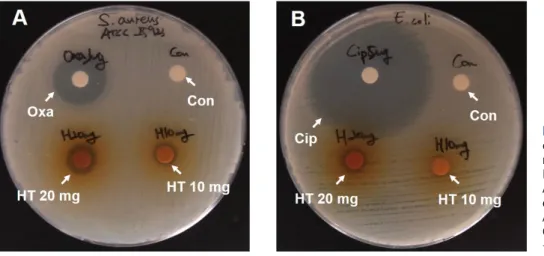
Figure 1. Antibacterial experiments on each bacteria by disk diffusion method. (A) Antibacterial activity of Hwangryunhaedok-tang on S . aureus ATCC 25923. (B) Antibacterial activity of Hwangryunhaedok-tang on E.coli ATCC 23724. Abbreviations: Oxa, oxacillin;
Cip, ciprofloxacin; HT, Hwangryunhaedok - tang; Con, control.
5. 지표성분 후보물질의 분석
황련해독탕은 berberine, geniposide를 지표성분으로 선정 하였다. 검액은 황련해독탕 분말 30.2 mg을 증류수 1 mL와 MeOH (Daejung Chemical, Siheung, Korea) 2 mL로 녹여 사 용하였다. Berberine 표준품(Sigma-Aldrich, MS, USA)은 1.4 mg을 칭량하여 10 mL의 증류수에 녹인 후 1 mL을 채취하여 MeOH로 희석하였다. Geniposide 표준품(Ministry of Food and Drug Safety, Cheongju, Korea)은 1.0 mg을 칭량하여 10 mL의 증류수에 녹인 후 1 mL을 채취하여 MeOH로 희석하였 다. Berberine은 50% ACN (Honeywell, NJ, USA) 1 L+인산이 수소칼륨(Samchun Chemicals, Pyeongtaek, Korea) 3.4 g+
라우릴황산나트륨(Samchun Chemicals, Pyeongtaek, Korea) 1.7 g을 이동상으로 하였으며 345 nm에서 검출하였다. Geni- poside는 (A) 1% acetic acid (Daejung Chemical, Siheung, Korea), (B) ACN+1% acetic acid를 이동상으로 하여 (A)/(B)=95/5 (0분)→ (A)/(B)=30/70 (40분) → (A)/(B)=0/100 (50분)→ (A)/(B)=95/5 (55분)와 같이 기울기 용매조건으로 하 였고 254 nm에서 검출하였다. 분석에 사용된 컬럼은 C
18
ODS (25 cm*I.D 50 m, Agilent, CA, USA)이었고, 컬럼오븐은 berberine 은 40°C, geniposide는 35°C로 하였다. 각 분석조건에서 이동상의 유속은 1 mL/min로 유지하였다. 이동상으로 사용된 Water (Honeywell, NJ, USA)는 HPLC Grade로 정량분 석을 위한 HPLC (Shimadzu, Kyoto, Japan)는 LC-20A, CBM-20A, LC-20AT, SIL-20AC, CTO-20ACM, DGU-20A5R, SPD-M20A, LC-PDA 모델을 사용하였다.
결 과
1. 디스크 확산법
황련해독탕의 항균력 억제대 측정 결과 Table 1에 따라 S.aureus ATCC 25923 균주에서 황련해독탕 20 mg은 11.7±1.3 mm의 억제대를 형성하였으며 10 mg은 8.7±0.7 mm의 억제대를 보였다. 그람양성알균에 사용되는 oxacillin 1
g의 억제환을 측정한 결과 S.aureus ATCC 25923 균주에서 21.3±2.0 mm가 나왔다(Figure 1A). E.coli ATCC 23724 균주 에서 황련해독탕 20 mg은 8.0±0.0 mm의 억제대를 형성하였 으며 10 mg에서는 억제대를 보이지 않았다. 그람음성막대균에 사용되는 ciprofloxacin 5 g의 억제대를 측정한 결과 E.coli ATCC 23724 균주에서 46.0±1.0 mm의 억제대가 형성되었다 (Figure 1B).
2. 최소억제농도(minimum inhibition concentration, MIC) 측정 결과
황련해독탕의 최소억제농도를 알아보기 위하여 황련해독탕 의 농도는 1 g/mL에서 2 fold dilution으로 계단 희석하였고, 대 조군으로는 oxacillin과 ciprofloxacin을 동시에 실험 진행하 였다. 황련해독탕의 MIC법 항균 실험 결과는 Table 2와 같이 S.aureus ATCC 25923, E.coli ATCC 23724 균주에서 각각 31.25 mg/mL, 125.0 mg/mL가 측정되었다. 그람양성알균에
Table 2. Antibacterial activity of Hwangryunhaedok-tang minimum inhibition concentration
Bacteria MIC
HT* (mg/mL) Oxacillin Ciprofloxacin
S.aureus 31.25 0.5 1.0
E.coli 125.0 128.0 0.5
Abbreviations: See Table 1.
Figure 2. Quantitative analysis chromatogram of Hwangryunhaedok- tang by HPLC. (A) Chromatograms of berberine standard and Hwangryun- haedok-tang. (B) Chromatograms of geniposide standard and Hwang- ryunhaedok-tang. The RT of berberine and geniposide is 15.727 min, 21.991 min. The sample matched the standard product.
사용되는 oxacillin 최소억제농도를 측정한 결과 S.aureus ATCC 25923 균주에서 0.5 g/mL가 형성되었고 그람음성막 대균에 사용되는 ciprofloxacin 최소억제농도를 측정한 결과 E.coli ATCC 23724 균주에서 0.5 g/mL가 형성되었다.
3. 지표성분 후보물질의 정량분석
황련해독탕 중 Berberine의 함량은 16.55 mg/g이었으며 retention time (RT)은 15.727분에 동일하게 나타났다(Figure 2A). Geniposide의 함량은 81.85 mg/g이었으며 retention time (RT)은 21.991분으로 동일하게 나타났다(Figure 2B). 지 표성분으로서 선정하기에 충분히 peak가 분리되었으며 적당 한 크기를 나타내었다.
고 찰
항생제를 대신하여 내성세균을 극복하기 위한 연구는 지속 적으로 활발히 진행되고 있으며[30, 31], 이에 따라 많은 연구자 들은 항균작용을 보이면서 인체에 부작용이 적은 것으로 알려 져 있는 천연물을 이용한 연구에 관심을 보이고 있다[32]. 최근 항균실험 연구 경향으로 봤을 때 주로 디스크 확산법과 최소억 제농도법으로 항균력 검사를 시행하고 있다[33]. 천연물을 이 용한 항균실험 연구는 해외에서도 진행되고 있는데 해외에서는 MIC 뿐만 아니라 기존 항생제들과의 시너지효과에 대한 연구
도 진행하고 있다[34]. 세균학적 조건으로 인하여 항생제가 잘 듣지 않는 Helicobacter pylori의 경우에도 천연물을 이용한 항 생제 개발이 연구되어 지고 있다[35].
본 연구에서는 한방산업에서 다빈도로 사용되는 천연 물질 인 황련해독탕을 기반으로 항균력을 알아보기 위한 실험을 진 행하였다. 황련해독탕의 항균효능에 대한 연구는 기존에 진행 된 바 있지만[36, 37], 황련해독탕의 70% EtOH 추출물에 대한 연구는 전무하였다. 또한 황련해독탕의 생리활성은 항균 이외 에도 아토피 질환에 대한 효능 보고도 있다[38]. 70% EtOH로 추출된 황련해독탕의 항균제로서의 가능성을 모니터링하고 차 후 제품화를 위한 지표성분을 설정하는 데에 본 연구의 목적이 있다.
디스크 확산법 실험의 경우 S.aureus ATCC 25923균주는 황 련해독탕 1 g/mL의 농도에서 11.7±1.3 mm의 억제대를 보였 고 0.5 g/mL의 농도에서 8.7±0.7 mm의 억제대를 보여 S.aureus ATCC 25923에 대한 농도 의존적인 항균력을 확인할 수 있었다. MIC법 실험은 S.aureus ATCC 25923균주의 경우 황련해독탕 31.25 mg/mL 농도에서 최소억제농도가 형성되었 으며 E.coli ATCC 23724 균주의 경우 황련해독탕 125.0 mg/mL 농도에서 최소억제농도가 형성되었다. 대조군인 ciprofloxacin는 CLSI 가이드라인의 범위에서 벗어났으나 그 오차가 크지는 않았으며 본 연구에 사용된 E.coli ATCC 23724 는 표준균주가 아니었기 때문에 내성에서 차이가 생긴 것으로 예측된다. 황련해독탕은 S.aureus ATCC 25923에서의 항균력 이 E.coli ATCC 23724보다 높게 나타나 추가적인 균주에 대한 항균 효능을 확인할 필요가 있을 것으로 사료된다. 천연 항생제 와 기존의 항생제를 병용 사용하여 시너지 효능을 기대하는 연 구에 oxacillin과 황흑산 에탄올 추출물을 사용한 보고가 있었 다. 연구에 따르면 methicillin-resistant Staphylococcus aureus infection (MRSA)에 oxacillin 을 단독으로 투여하였을 때는 항균활성이 보이지 않았다. 그러나 황흑산 에탄올 추출물
과 같이 병용처리 하였을 경우에는 낮은 농도에서도 유효한 항 균활성이 나타났다. 또한, 황흑산 에탄올 추출물과 다른 항생제 와의 병용처리에서도 단독으로 투여했을 경우와 비교하여 유효 한 생장억제효과가 나타났다[39]. 이처럼 항생제의 단독 치료 가 아니라 천연물과 기존의 항생제를 병용하여 치료하면 기대이 상의 효과가 나타나는 경우가 있다. 이처럼 황련해독탕에 대한 연구 중 기존 항생제들과 병용해서 치료하면 감염질환을 치료함 에 있어서 몸에 부작용이 줄어들거나 내성세균극복에 대한 효능 을 기대할 수도 있다. 아무리 생리활성이 뛰어나다고 하여도 품 질관리를 위한 표준화가 없다면 제품화는 쉽지 않다. 이에 본 연 구에서는 황련해독탕의 지표성분으로 berberine과 geniposide 를 선정하여 정량분석조건을 확립하였다. Berberine은 황련의 대표적인 지표 성분으로 황련은 강한 항균 작용이 있다고 여러 연구에서 보고되었다. 황련의 대표 구성성분 중 하나인 berberine은 장내 세균과 감염에 대해 강한 항균력이 있다고 알 려져 있기에[40] 황련해독탕의 유효성분이자 지표성분으로써 충분한 가치가 있다. Geniposide는 치자의 지표성분으로 일반 적으로는 소염, 이뇨, 항균작용이 있다고 알려져 있다[41].
Geniposide는 HPLC 분석 시 peak의 분리도가 좋으며 농도대 비 큰 peak area를 형성하여 황련해독탕의 지표성분으로 손색 이 없었다. 이 같은 천연 항생제는 단일물질로 이루어진 화학적 합성물이 아닌 여러가지 유효성분들의 조합에 의해 생리활성을 보이기 때문에 부작용이 적고 세균의 내성을 억제하는 데에 효 율적일 수밖에 없다. 이러한 점을 착안하여 지속적으로 연구를 진행한다면 한방산업과 더불어 여러 산업에서의 발전을 기대할 수 있을 것이다.
요 약
황련해독탕은 한방산업에서 염증관련 질환에 다빈도로 사용 되는 처방이다. 본 연구의 목적은 전통적 한약인 황련해독탕의 항균활성을 확인하고 지표성분을 선정하는 것이다. 황련해독 탕의 항균활성을 측정하기 위하여 디스크 확산법과 최소억제농 도법을 사용하였다. 사용균주는 Staphylococcus aureus ATCC 25923, Escherichia coli ATCC 23724였으며 대조군으 로 oxacillin과 ciprofloxacin을 이용하여 황련해독탕의 항균 활성을 확인하였다. 결과적으로 디스크 확산법에서는 S.aureus ATCC 25923에서 황련해독탕 20 mg과 10 mg은 11.7±1.3 mm, 8.7±0.7 mm의 억제환을 형성하였으며 E.coli ATCC 23724에서는 황련해독탕 20 mg이 8.0±0.0 mm의 억제환을 형성하였다. 최소억제농도는 S.aureus ATCC 25923가 31.25
mg/mL, E.coli ATCC 23724 에서는 125.0 mg/mL였다. 표준 화를 위한 HPLC 정량분석 결과, 황련해독탕은 berberine을 16.55 mg/g 함유하고 있었으며 geniposide를 81.85 mg/g 함 유하고 있었다. 천연물을 이용하여 항생제를 개발할 경우에는 내성세균을 억제하고 부작용을 줄일 수 있다는 장점이 있다. 이 러한 점을 착안하여 지속적으로 연구를 진행한다면 한방산업과 더불어 여러 산업에서의 발전을 기대할 수 있을 것이다.
Acknowledgements: None Conflict of interest: None
Author’s information (Position): Lee DY
1,2
, M.D.; Yi YW1
, Researcher; Kim WS2
, Researcher; Sim SH2
, Researcher;Kwon PS
3
, Professor; Lee IH1,3
, Professor.REFERENCES