<연구논문> Fashion & Text. Res. J.
Vol. 19, No. 3, pp.331-336(2017) https://doi.org/10.5805/SFTI.2017.19.3.331
331
편백나무 잎 추출액을 이용한 천연염색포의 항생제 내성균주에 대한 항균성
최나영†·김지희1) 원광대학교 가정교육과
1)원광대학교 식품산업융복합학과
Antibacterial Function of Fabrics Dyed with Extract from Chamaecyparis obtusa Leaves against Methicillin-resistant Staphylococcus aureus
Na Young Choi† and Ji-Hee Kim1)
Dept. of Home Economics Education of Wonkwang University; Iksan, Korea
1)Dept. of Food Industry Convergence of Wonkwang University; Iksan, Korea
Abstract : Bacteria exist everywhere and continuously come into contact with daily surroundings and humans. Super bacterium methicillin-resistant Staphylococcus aureus, resistant to methicillin, has recently appeared. The morbidity and rate of death associated with super bacteria infection has increased. This study investigated the antibacterial activity of fabrics naturally dyed with Chamaecyparis obtusa leaves extract against methicillin-resistant Staphylococcus aureus. Fab- rics were left for 15 min in a natural dyeing solution prepared by extraction from C. obtusa leaves using 11.3% (o.w.f) with a fixed liquor ratio of 1:22 at 40oC. The dyeing process was conducted using three different mordants; subsequently, the K/S value of the dyed fabrics increased in the order of None < Cu < Fe < Al. The color fastness property of the fabrics to washing, dry-cleaning, and rubbing was found to be excellent and ranked in the 4-5 grade. The color fastness to light of natural dyeing is low in most cases and has the problem that the dye color soon becomes bleached. Yet, in most cases cloth dyed with retinispora leaves, the color fastnezz to light was good with a third to fourth grade. Non-mordant fabrics, aluminum mordants, and copper mordants also showed better antibacterial properties (99.9% reduction) against meth- icillin-resistant Staphylococcus aureus, compared to the control fabrics. The dyed fabrics showed the same antibacterial activity even after three washes. The results highlight the strong potential of fabrics naturally dyed with C. obtusa-extract as a medicinal material with excellent antibacterial function against methicillin-resistant Staphylococcus aureus.
Key words : Chamaecyparis obtusa leaves (편백나무 잎), Methicillin-resistant Staphylococcus aureus (슈퍼박테리아), antibacterial activity (항균성)
1. 서 론
세균은 지구상의 어느 곳에나 존재하며 생활주변 및 인체와 항시 접하고 있다. 인체 피부를 예로 본다면 대략 105-106개/
cm2 혹은 그 이상의 세균이 부착되어 있다고 알려져 있다 (Johnson & Saravolatz, 2005; Scott et al., 2008, Yong et al., 1999). 일상생활 공간에 존재하는 미생물은 인간에게 큰 혜 택을 주는 균주도 있지만, 때로는 인체에 감염을 유발시켜 건
강장해를 일으키거나, 생명을 위협하는 균주도 있다(Dulon et al., 2011). 특히 항생제 내성균주인 슈퍼박테리아의 출현은 기 존의 항생제로 잘 치료되지 않아 감염성 질환으로 인한 사망률 을 증가시키고 있다. 페니실린이 세균감염에 사용되기 시작한 이래, 초기 슈퍼박테리아인 페니실린 내성균주가 출현하였고, 그 이후 페니실린 내성 균주에 대항할 수 있는 페니실린 계열 의 항생제인 메티실린과 그 유도체가 개발되었다(Morell &
Balkin, 2010). 그러나 최근에는 메티실린에도 내성을 보이는 슈퍼박테리아인 메티실린 내성 황색포도상구균(Methicillin- resistant Staphylococcus aureus; MRSA)이 출현함에 따라 슈 퍼박테리아 감염으로 인한 사망률이 증가하고 있다. 이러한 슈 퍼박테리아의 감염경로는 환자 간 감염뿐만 아니라 환경에 존 재하는 의류 및 침구류와 각종생활도구에 의해서도 이루어지고 있다(Scott et al., 2008). Wiener-Well 등이 보고한 최근 연구 결과에 따르면, 의사와 간호사들이 입고 근무하는 병원복을 검 사해 본 결과, 간호사 병원복의 65%와 의사의 병원복 60%에
†Corresponding author; Na Young Choi Tel. +82-63-850-6561, Fax. +82-63-850-6561 E-mail: [email protected]
© 2017 (by) the authors. This article is an open access article distributed under the terms and conditions of the Creative Commons Attribution license (http://creativecommons.org/licenses/by/3.0/), which permits unre- stricted use, distribution, and reproduction in any medium, provided the original work is properly cited.
서 병을 일으키는 세균이 발견되었다. 그리고 이중에서 간호사 병원복의 14%와 의사 병원복의 6%에서는 슈퍼박테리아가 존 재하는 것으로 확인되었다(Wiener-Well et al., 2011).섬유제품 은 병원균 감염의 매개체 또는 서식처가 되기도 한다(Scott et al., 2008; Wiener-Well et al., 2011). 그러므로 섬유제품에 세균 의 서식이나 증식을 억제하여 감염성 질환의 예방, 악취예방, 섬 유의 오염, 변색의 방지 등을 목적으로 하는 항균성 섬유가공을 시행할 필요가 있다. 항균, 방취 가공은 섬유제품의 물리화학적 성질을 가능한 변화시키지 않고, 섬유에서 세균, 곰팡이 등의 서식이나 번식을 억제함으로써, 인체보호와 위생적인 생활환경 을 제공하기 위한 섬유가공방법으로, 최근 건강과 환경을 생각 하는 소비자들이 친환경적인 소비패턴을 지향하여, 섬유산업에 서도 기능성을 가진 제품을 선호하는 경향이 커지고 있다. 그 러나, 항균, 방취 가공된 섬유제품이 직접 피부와 접촉하기 때 문에 땀에 의해서 항균제가 점차 빠져나와 피부장해를 유발할 수 있으므로 가공제의 안전성이 요구되는 동시에, 자연계에서 간단히 분해될 수 있는 환경친화성이 요구되며, 연소, 자외선 및 섬유표백제와 반응해서 유해물질을 생성하지 말아야 한다 (Choi & Jung, 1999; Yuge, 1990).
천연물속에 존재하는 항균성 물질은 위의 조건을 대체로 만 족시키므로 천연 항균성 물질의 이용에 관한 관심이 높아지고 있다. 특히 천연물에서 추출한 염료는 합성염료에 비하여 색상 이 자연스럽고, 환경친화성이 강하며, 인체에 위해성이 적고, 종 류에 따라서 항균작용을 나타내는 것으로 알려져 있다(Choi &
Jung, 1999).
천연물 중 편백은 겉씨식물 구과목 측백나무과의 상록교목 으로 습기가 적당하고 비옥한 사질양토인 산기슭 및 계곡에서 잘 자라며 높이 40m, 지름 2m에 달한다(Son et al., 2014).
최근 편백나무 추출액이 항균성, 소취성을 가지고 있는 것으로 알려지면서 아로마오일, 비누, 스킨로션 등 다양한 생활용품에 적용하려는 시도가 이루어지고 있다(Cho & Yi, 2011).
따라서 본 연구는 편백나무 잎으로부터 염료를 추출하여 레 이온에 염색한 후, 염색견뢰도와 항생제 내성균주에 대한 항균 성을 측정하기 위하여 시행되었다.
2. 재료 및 방법
2.1. 시료의 추출 및 계통적 분획 2.1.1. 시료의 추출
본 실험에 사용한 편백나무 잎은 전남 장성군 축령산에서 채 집하였다. 염액은 편백나무 잎을 편백 정유 추출기(Phytoncide extractor, 주)더블유원)로 추출한 염액을 사용하였다. 매염제로 사용한 황산 제1철(FeSO4·7H2O), 황산구리(CuSO4 5H2O), 황산 알루미늄(Al2(SO4)3)은 대정화금과 순정화학주식회사 제품을 사 용하였다. 항생제 내성균주는 Methicillin-resistant Staphylococcus aureus(MRSA) ATCC 33591를 사용하였다. 배지는 Oxacillin 2μg/ml, Fungizone 2.5μg/ml가 첨가된 Brain Heart Infusion
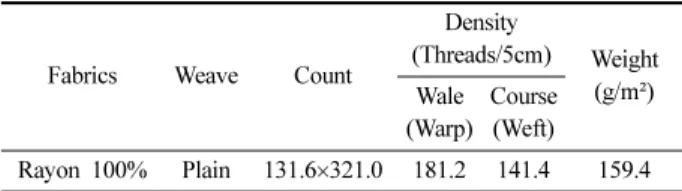
broth와 Brain Heart Infusion Agar(Detroit, MI, USA)를 사용 하였다. 시험포는 KS K 0210:2012에 준한 레이온을 정련하여 사용했으며 특성은 Table 1과 같다.
2.1.2. 시료의 계통적 분획 (1) 염료의 추출
편백나무 잎 60kg을 증류수 40L에 넣고 110oC를 유지하는 편백정유추출기(Phytoncide extractor, Korea)에 15시간 동안 가 열하여 20L의 편백수와 10L의 염료 추출액을 얻었다. 이 과정 을 반복하여 염료 추출액을 얻었다.
(2) 염색방법
① 염색
편백나무 잎 추출액의 농축염료 농도 11.3%(o.w.f), 욕비 1:22인 염욕에 시험포 885g을 40oC에서 15분간 염색하였다. 염 색된 시험포를 냉수에 3-4번 수세하고 자연건조하였다. 이 과 정을 2번 반복하였다.
② 매염
매염방법은 중매염법을 시행하였다. 매염조건은 황산알루미 늄 매염제의 농도 5%(o.w.f), 황산구리와 황산 제1철 매염제의 농도 3%(o.w.f), 욕비 1:17인 용액을 제조하여 염색된 시험포를 Table 1. Characteristics of fabrics
Fabrics Weave Count
Density
(Threads/5cm) Weight (g/m²) Wale
(Warp) Course (Weft) Rayon 100% Plain 131.6×321.0 181.2 141.4 159.4
Fig. 1. Surface color change to observe the color change of the dyed fabric. +a direction is a change in color to red, -a direction indicates a change in color to green. Yellow means +b direction, -b direction represents the change to the blue color.
40oC에서 15분 동안 매염 처리한 후 3번의 수세과정을 반복한 다음 자연 건조하였다.
(3) 색상분석(표면색 및 색차)
염색된 시료에 대한 색차는 Gretagmacbeth(Model: Color- Eye 7000A, U.S.A)를 사용하여 시료의 표면색을 광원 D65, 관측시야는 10o의 상태에서 X, Y, Z값 및 Lab값을 측정하고 Munsell 표색계 변환법에 따라 색의 3속성 H, V/C 및 Hunter 의 색차값 ΔΕ를 구하였다. 명도지수는 L, 색좌표 지수는 a와 b 값, 색상은 H(Hue), 채도는 C(chroma)로 표시했다. 다음의 Kubelka-Munk 식을 이용하여 계산된 K/S값을 염착량으로 사 용하였다. 본 연구의 편백잎 염색은 특정 파장에서 두드러진 Peak가 나타나지 않아 분광반사율(R) 400nm에서 측정된 값을 사용한(Jung & Lee, 2011)의 방법을 사용하여 염착량(K/S)을 표시하였다.
K/S=(1-R)2/2R
K: 염색포의 흡광계수, S: 염색포의 산란계수 R:염색포의 분 광반사율(0<R=1)
2.1.3. 염색견뢰도 측정
무매염포 및 3가지 매염제를 처리한 염색포에 대해 세탁견 뢰도, 마찰견뢰도, 땀견뢰도, 그리고 일광견뢰도를 측정하여 비 교, 검토하였다. 염색한 레이온의 세탁견뢰도는 Launder-o-meter (Koa Shokai Ltd, Kyoto, Japan)를 사용하여, KS K ISO 105-C06:2012에 준하여 측정하였다. 드라이클리닝견뢰도는 KS K 105-D01:2010에 준하여 측정하였다. 땀견뢰도는 Perspiration Tester(AATCC, Atlas Electric Device Co, U.S.A)를 사용하여 KS K ISO 105-E04:2010에 준하여 측정하였다. 마찰견뢰도는 Crock meter(Model CM-5, Atlas Eletninic Device Co.
U.S.A.)법을 사용하여 KS K 0650:2011에 준하여 측정하였다. 일 광견뢰도는 Xenon arc(Color & Color Difference Meter)법을 사용하여 KS K ISO 105-B02:2010에 준하여 측정하였다.
2.1.4. 염색 시험포의 항균성 측정
편백나무 잎 염색포의 항생제 내성균주에 대한 항균 효과를 알 아보기 위해서 항생제 내성균주(methicillin-resistant Staphylococcus aureus ATCC 33591)를 사용하였다. 0.05% 비이온 계면활성제 (TWEEN 80)를 첨가한 접종균액을 사용하였다.
항생제 내성균주의 세균증식 억제효능은 Choi and Kang (2015)의 Bioassay Test 방법을 변형하여 사용하였다. Clean bench(VS-1400LS-3N, Vision Scientific Co. Korea)내에서 레 이온포를 가로, 세로 각각 5cm로 준비한 후 petridish(SPL, Korea)에 위치시켰다. MRSA(ATCC 33591)를 BHI 배지에 24시 간 Incubator(SLI-400, EYELA, Japan)에서 배양한 후 petridish 에 위치해 있는 레이온 포에 접종하였다. 세균 접종 즉시(0시 간)와 24시간 배양 후에 각각 petridish에 phosphate buffered
saline(PBS)완충액을 넣어 레이온 포에 묻어있는 세균을 세척하 여 BHI Agar 배지에 도말하였다. 37oC Incubator(SLI-400, EYELA)에서 24시간 배양한 후 cfu 수를 측정하였다. 균감소 율은 아래와 같이 계산하였다.
균감소율(%)=(A-B)/A×100
(A: 원포의 균수, B: 무매염포 및 매염포의 균수)
2.1.5. 통계처리
각 데이터는 평균과 표준편차로 제시하였다. 평균치간의 유 의성은 통계프로그램인 SPSS(ver 10.0)를 사용하였다. α=0.05 수준에서 실험군과 대조군의 평균치를 independent sample t- test로 검증하였다.
3. 결과 및 논의
3.1. 염색된 시험포의 색상분석
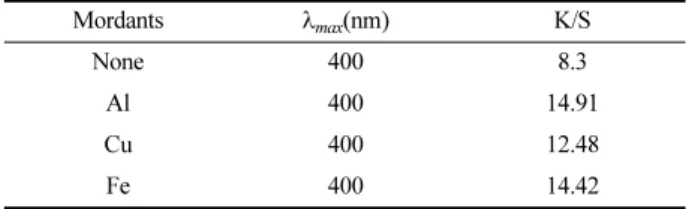
매염제별 염색포의 염착량 결과는 Table 2와 같다. Al 매염 염색포는 14.91로 가장 염착량이 높은 것으로 나타났다. 매염제 처리를 하지 않은 경우 염착량이 가장 낮은 것으로 나타났다.
이 결과 편백은 매염제를 사용할 경우 염착이 잘 되는 것을 알 수 있었다.
Table 3은 염색포의 색상변화를 살펴보기 위하여 표면색 변 화를 나타낸 것이다. L은 명도, H는 색상(Hue), V는 명도 (value), 그리고 C는 채도(chroma)를 나타낸다. +a방향은 red, -a 방향은 green색상으로의 변화를 나타낸다. +b방향은 yellow, -b방 향은 blue색상으로의 변화를 나타낸다. 매염 후 표면색 변화를 살펴보면, 표면색은 모두 a값 +, b값 +를 나타내 reddish하고 yellowish한 표면색을 나타냈다. 가장 높은 염착율 증가를 보인
Table 2. K/S value of fabrics dyed by C. obtusa extracts with different mordants
Mordants λmax(nm) K/S
None 400 8.3
Al 400 14.91
Cu 400 12.48
Fe 400 14.42
Table 3. L, a, b, H(V/C) and ΔΕab of fabric dyed with C. obtusa extracts H(V/C)&ΔΕab
Mordants ΔL(L*) Δa(a*) Δb(b*) ΔΕ H V/C Untreated 93.62 -0.31 4.19 5.1Y 9.3/0.5
None -64.45 2.52 21.15 30.25 3.1Y 7.1/3.6 Al -16.87 2.23 32.69 36.85 4.0Y 7.6/5.3 Cu -32.46 9.15 18.84 38.64 8.6YR 6.0/4.0 Fe -39.07 2.48 4.04 39.35 0.4Y 5.3/1.3
Al매염제 염색포는 무매염포에 비해 yellow 값이 증가하였다. Cu 매염제 염색포는 무매염포에 비해 red 값이 증가하고 yellow 값 은 감소하였다. Fe매염제 염색포는 무매염포에 비해 yellow 값 이 감소하여 색상이 어두워짐을 알 수 있다. 명도와 채도는 황 산알루미늄 매염포가 모두 높았으며, 철 매염포가 모두 낮았다.
3.2. 염색포의 견뢰도
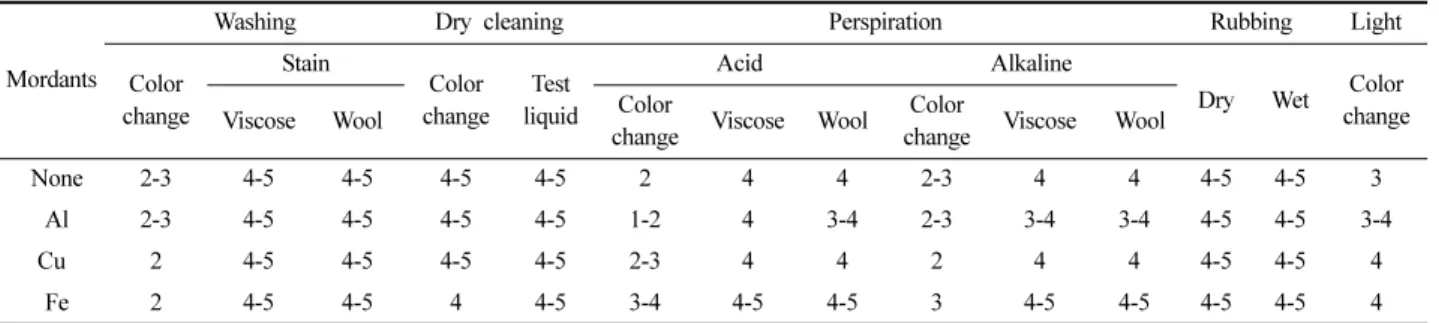
염색포의 견뢰도 결과는 Table 4와 같다. 변퇴색(F)에 대한 세탁견뢰도는 2 또는 2-3등급 정도로 낮았고, 오염 세탁견뢰도 에 있어서는 첨부백포가 비스코스인 경우와 모인 경우 모든 염 색포가 4-5등급으로 우수하였다. 드라이클리닝견뢰도는 매염포 와 무매염포의 변퇴색 정도는 4 또는 4-5등급으로 우수한 등급 을 나타냈다. 용제의 오염정도는 무매염포와 매염포 모두 4-5 등급으로 우수한 등급을 보여, 매염처리하지 않아도 용제의 오 염에 대한 견뢰도가 우수함을 알 수 있다. 땀 견뢰도는 산성(A)
땀인 경우 변퇴색 정도는 알루미늄 매염포인 경우 1-2등급으로 매우 열등하게 나타났다. 철매염포인 경우 3-4등급으로 보통-보 통 이상이었다. 오염 땀견뢰도에 있어서는 첨부 백포가 비스코 스인 경우와 모인 경우 땀견뢰도는 대부분의 염색포가 4-5등급 정도로 우수한 편이었다. 알칼리(AK) 땀인 경우 변퇴색 정도 는 전반적으로 2-3등급으로 보통 이하였다. 오염 땀견뢰도에 있 어서도 첨부 백포가 비스코스인 경우와 모인 경우 땀견뢰도는 알루미늄 매염포인 경우 3-4등급으로 보통-보통 이상이었다. 이 를 제외한 대부분의 염색포는 4-5등급으로 우수하였다. 땀견뢰 도의 변퇴색은 보통 이하였으나, 오염도는 전반적으로 우수하 였다. 마찰견뢰도는 무매염포와 매염포의 경우 건조 시와 습윤 시 모두 4-5등급으로 매우 우수하게 나타났다. 천연염색의 경 우 대부분 1-2등급으로 일광견뢰도가 낮아 염색색상이 빨리 탈 색되는 문제점이 있는데 편백나무잎으로 염색한 염색포의 일광 견뢰도는 대부분 3-4등급의 결과를 얻었다.
Table 4. Color fastness of fabrics dyed by C. obtusa extracts with different mordants
Mordants
Washing Dry cleaning Perspiration Rubbing Light
Color change
Stain
Color change
Test liquid
Acid Alkaline
Dry Wet Color change
Viscose Wool Color
change Viscose Wool Color
change Viscose Wool
None 2-3 4-5 4-5 4-5 4-5 2 4 4 2-3 4 4 4-5 4-5 3
Al 2-3 4-5 4-5 4-5 4-5 1-2 4 3-4 2-3 3-4 3-4 4-5 4-5 3-4
Cu 2 4-5 4-5 4-5 4-5 2-3 4 4 2 4 4 4-5 4-5 4
Fe 2 4-5 4-5 4 4-5 3-4 4-5 4-5 3 4-5 4-5 4-5 4-5 4
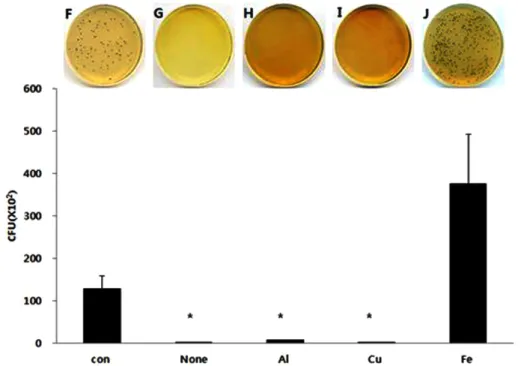
Fig. 2. Antibacterial abilities of Rayon dyed with C. obtusa extract. Con: Control, None: none-mordanted, Al: Al2(SO4)3 mordanted, Cu: CuSO4 5H2O mordanted, Fe: FeSO4 7H2O mordanted. Three replicates were made for each concentration of the test extract. *p<.05 was statistically significant as determined by independent sample t-test for the mean values different from the control group.
3.3. 염색포의 항생제 내성 균주에 대한 증식 억제효과 염색포에 세균을 접종하고 24시간 배양한 후, 염색포에 증식 한 세균을 취하여 고체배지에 도말한 후 cfu를 측정하여 다음 과 같은 결과를 얻었다(Fig. 2, Table 5). 원포에 세균을 접종 한 후 24시간 배양한 결과, 126±50.8×10² cfu/ml의 세균이 측 정되었으며, 염색만 시행하고 매염처리하지 않은 염색포에서는 0±0.0×10² cfu/ml의 세균이 측정되어 균 감소율은 99.9%였으 며, 황산알루미늄 매염을 실시한 경우 0±0.0×10² cfu/ml의 세 균이 측정되어 균 감소율은 99.9%였으며, 황산구리 매염을 실 시한 경우 0±0.0×10² cfu/ml의 세균이 측정되어 균 감소율은 99.9%였으며, 황산 제1철 매염을 실시한 경우 106±4.02×10² cfu/ml의 세균이 측정되어 균 감소율은 15.9%로 측정되었다.
무매염포, 황산알루미늄 매염포, 황산구리 매염포에서 원포와 비교하여 유의성(p<.05)있게 세균성장이 억제되었으며, 항균효 과가 높은 것으로 나타났다.
3차 세탁한 염색포에 세균을 접종하고 24시간 배양한 후, 염 색포에 증식한 세균을 취하여 고체배지에 도말한 후 cfu를 측정 하여 다음과 같은 결과를 얻었다(Fig. 3, Table 6). 원포에 세균
을 접종한 후 24시간 배양한 결과, 128±30.16×10² cfu/ml의 세 균이 측정되었으며, 염색만 시행하고 매염처리하지 않은 염색포 에서는 1±0.0×10² cfu/ml의 세균이 측정되어 균 감소율은 99.2%
였으며, 황산알루미늄 매염을 실시한 경우 7±0.0×10² cfu/ml의 세균이 측정되어 균 감소율은 94.5%였으며, 황산구리 매염을 실 시한 경우 1±0.0×10² cfu/ml의 세균이 측정되어 균 감소율은 99.2%였으며, 황산 제1철 매염을 실시한 경우 374±117.13×10² cfu/ml의 세균이 측정되어 균 감소율은 -192.2%로 측정되었다.
무매염포, 황산알루미늄 매염포, 황산구리 매염포에서 원포와 비 교하여 유의성(p<.05)있게 세균성장이 억제되었으나, 황산제1철 에서는 오히려 세균이 증식하는 결과를 나타내었다.
4. 결 론
본 연구에서는 편백나무 잎 추출물을 이용하여 직물에 염색 한 후, 매염제의 종류와 염색된 직물의 3차 세탁후의 항생제 내성균주에 대한 염색포의 염색견뢰도 및 항생제 내성균주의 항균성을 고찰한 결과, 다음과 같은 결론을 얻었다.
Table 5. Bacterial reduction rate of Rayon dyed with C. obtusa extract
Control None-mordanted Al Cu Fe
CFU(×102) 126±50.8 0±0.0 0±0.0 0±0.0 106±4.02
Reduction of bacterial (%) - 99.9 % 99.9 % 99.9 % 15.9 %
Fig. 3. Antibacterial abilities of Rayon dyed with C. obtusa extract after 3 times washing. The Rayon dyed with C. obtusa extracts and mordented.
Con: Control, None: none-mordanted, Al: Al2(SO4)3 mordanted, Cu: CuSO4 5H2O mordanted, Fe: FeSO4 7H2O mordanted. Three replicates were made for each concentration of the test extract. *p<.05 was statistically significant as determined by independent sample t-test for the mean values different from the control group.
1. 염색 직물의 K/S값은 None < Cu < Fe < Al 매염 염색포 순으로 증가했다. 편백은 알루미늄 매염제를 사용할 경우 염착 이 잘 되는 것으로 나타났다.
2. 무매염포와 매염포 모두 오염 세탁, 드라이클리닝, 마찰에 대한 염색견뢰도는 4-5등급으로 우수하였다. 일광견뢰도는 천 연염색의 경우 대부분 낮아 염색색상이 빨리 탈색되는 문제점 이 있는데 편백나무잎으로 염색한 염색포의 경우 대부분 3-4등 급의 우수한 견뢰도를 나타내었다.
3. 무매염포와 알루미늄 매염포, 구리 매염포는 대조군 직물 에 비해 항생제 내성균주에 뛰어난 항균성(99.9% 감소)을 나타 냈다. 염색포의 3차 세탁 후에도 항균성에 대해 같은 결과를 얻었다.
이러한 결과, 편백나무 잎 추출액으로 염색한 직물은 항생제 내성균주에 대한 높은 항균성을 나타내었고 3차 세탁 후에도 여전히 높은 항균활성을 나타냈었다. 따라서 편백나무잎은 항 균성을 가진 환경친화적인 천연염재임을 확인할 수 있었다. 이 와 같이 환경친화적인 항균성 천연염료의 개발로 향후 병원 의 료용 섬유제품으로의 응용 가능성이 매우 클 것으로 전망된다.
감사의 글
이 논문은 2015년도 정부(교육부)의 재원으로 한국연구재단의 지원을 받아 수행된 기초연구사업임(No. NRF-2015R1D1A3A 01016120).
References
Cho, S. E., & Yi, D. H. (2011). Antioxidant and anti-inflammatory activity of leaves extracts of Chamaecyparis Obtusa. Journal of the Korean Society of Cosmetology, 17(5), 970-975. doi:10.4314/
ahs.v15I2.39
Choi, N. Y., & Kang, S. Y. (2015). Effect of Ulmus Davidiana var.
Japonica Nakai extract on antibiotic resistant bacteria in dyed cotton. a Journal of the Korean Society of Clothing and Textiles, 39(2), 287-293. doi:10.5850/JKSCT.2015.39.2.287
Choi, S. C., & Jung, J. S. (1999). Study on the antimicrobial activity of Impatiens balsamina(III). Journal of the Korean Fiber Society, 36, 338-343.
Dulon, M., Haamann, F., Peters, C., Schablon, A., & Nienhaus, A.
(2011). MRSA prevalence in European healthcare settings: A review. BMC infectious diseases, 11(138), 1-13. doi: 10.1186/
1471-2334-11-138.
Johnson, L. B., & Saravolatz, L. D. (2005). Community-acquired MRSA: Current epidemiology and management issues. Infections in medicine, 22, 16-20. doi:10.1007/978-3-540-39026-8_211 Jung, G. E., & Lee, J. S. (2011). Transactions : Dyeability and
functionality of bamboo extracts (Part 2) - Characteristics of bamboo extracts and dyeing properties of cotton -. Journal of the Korean Society of Clothing and Textiles, 35(2), 206-217. doi:10.5850/
jksct.2011.35.2.206
Morell, E. A., & Balkin, D. M. (2010). Methicillin-resistant Staphylococcus aureus: A pervasive pathogen highlights the need for new antimicrobial development. Yale Journal of Biology and Medicine, 83(4), 223-233.
Scott, E., Duty, S., & Callahan, M. (2008). A pilot study to isolate Staphylococcus aureus and methicillin-resistant S. aureus from environmental surfaces in the home. American Journal of Infection Control, 36(6), 458-460. doi:10.1016/j.ajic.2007.10.012.
Son, H. J., Kim Y. S., Kim, N. Y., Lee, H. B., & Park, W. G. (2014).
A consideration of the possibility of panting Cryptomeria japonica and Chamaecyparis obtusa on the East sea area in Gangwon- province by tree ring dating and climatic factor analysis. Journal of Forest Science, 30(1), 36-44. doi:10.7747/jfs.2014.30.1.36 Wiener-Well, Y., Galuty, M., Rudensky, B., Schlesinger, Y., Attias, D.,
& Yinnon, A. M. (2011). Nursing and physician attire as possible source of nosocomial infections. American Journal of Infection Control, 39(7), 555-559. doi:10.1016/j.ajic.2010.12.016.
Yong, K. J., Kim, I. H., & Nam, S. W. (1999). Antibacterial and deodorization activities of cotton fabrics dyed with amur cork tree extracts. Journal of the Korea Society of Dyers and Finishers, 11, 9-15. doi:10.3390/ma2010010
Yuge, H. (1990). Koukinnboushywu. 44-48, 181-190, 205-340, Sen’i sya, Oska.
(Received 30 December 2016; 1st Revised 23 January 2017;
2nd Revised 25 April 2017; Accepted 1 May 2017) Table 6. Bacterial reduction rate of after third washing Rayon dyed with C. obtusa extracts(after third washing)
Control None-mordanted Al Cu Fe
CFU(×102) 128±30.16 1±0.0 7±0.0 1±0.0 374±117.13
Reduction of bacterial (%) - 99.2 % 94.5 % 99.2 % -192.2 %