Ⅰ. INTRODUCTION
Since the acid-etch technique was first intro- duced in dentistry by Buonocore1) in 1955, phos- phoric acid has been routinely used to etch the enamel surface in order to create micromechanical retention with resin composites. Formation of tag- like resin extensions into the enamel microporosi-
Influence of additional etching on shear bond strength of self-etching adhesive system to enamel
Sun-Jin Yoo, Young-Kyung Kim, Jeong-Won Park, Myoung-Uk Jin, Sung Kyo Kim* Department of Conservative Dentistry, School of Dentistry, Kyungpook National University, Daegu, Korea
Recently, self-etching adhesive system has been introduced to simplify the clinical bonding proce- dures. It is less acidic compared to the phosphoric acid, thus there is doubt whether this system has enough bond strength to enamel. The purpose of this study was to investigate the influence of addi- tional etching on the adhesion of resin composite to enamel.
Ninety extracted bovine permanent anterior teeth were used. The labial surfaces of the crown were ground with 600-grit abrasive paper under wet condition. The teeth were randomly divided into six groups of 15 teeth each. Clearfil SE Bond�, Adper™ Prompt L-Pop and Tyrian SPE™ were used as self-etching primers. Each self-etching primers were applied in both enamel specimens with and without additional etching. For additional etching groups, enamel surface was pretreated with 32%
phosphoric acid (UNI-ETCH, Bisco, Inc., Schaumburg, IL, USA). Hybrid resin composite Clearfil AP-X, (Kuraray Co., Ltd., Osaka, Japan) was packed into the mold and light-cured for 40 seconds.
Twenty-four hours after storage, the specimens were tested in shear bond strength. The data for each group were subjected to independent t - test at p < 0.01 to make comparisons among the groups.
In Clearfil SE Bond�, shear bond strength of additional etching group was higher than no addition- al etching group (p < 0.01). In Adper™Prompt L-Pop and Tyrian SPE, there were no significant dif- ference between additional etching and non-etching groups (p > 0.01).
In conclusion, self-etching adhesive system with weak acid seems to have higher bond strength to enamel with additional etching, while self-etching adhesive system with strong acid seems not. [J Kor Acad Cons Dent 31(4):263-268, 2006]
Key words : Self-etching adhesive, Phosphoric acid etching, Shear bond strength, Enamel
- Received 2005.10.6., revised 2006.3.18., accepted 2006.3.21.
ABSTRACT
* Corresponding Author: Sung Kyo Kim Department of Conservative Dentistry,
School of Dentistry, Kyungpook National University 188-1, Samdeok-Dong, 2-Ga, Jung-Gu,
Daegu, Korea, 700-412
Tel: 82-53-420-5935 Fax: 82-53-426-8958 E-mail: [email protected]
ties were considered the predominant bonding mechanism of resin to etched enamel2,3).
Recently, in an effort to simplify the dentin/
enamel bonding systems, a single procedure using self-etching adhesive system has been proposed.
These acidic primers include a phosphorated resin molecule that performs two functions simultane- ously that are conditioning and priming of tooth.
Several self-etching adhesive systems are on the market today, and the acidity of self-etching sys- tems allows mineralized tissue to be etched in a single treatment step. However, there are some controversies on the etching effect of the acid of the self etching adhesives. Some studies have reported that weaker acids etch enamel as effec- tively as 30% to 40% phosphoric acid4); but data from other studies indicate that weaker acids pro- vide significantly lower shear bond strengths when the manufacturers’recommended applica- tion times are used to etch enamel5). Self-etching primer may exhibit insufficient decalcification of enamel if it is a weak acid6) and the priming time may influence the morphologies of the tooth-resin interfaces or bond strength7,8).
Up to now, many self-etching adhesive systems vary in their acidity by differences in the compo- sition and concentration of polymerizable acids and/or acidic resin-monomers in these systems9,10). Therefore the purpose of this study was to evalu- ate the influence of additional etching on shear bond strength of self-etching adhesive systems to enamel.
Ⅱ. MATERIALS AND METHODS
Ninety extracted sound bovine permanent ante- rior teeth were chosen. They were sectioned at cemento-enamel junction and embedded in auto- polymerizing acrylic resin (Orthodontic Resin, Dentsply/Detrey, Konstanz, Germany) molds so that the prepared enamel surface was 2 ㎜ above acrylic resin cylinders. Specimens were placed in tap water to reduce the temperature rise from the exothermic polymerization reaction.
After the resin have completely polymerized, the
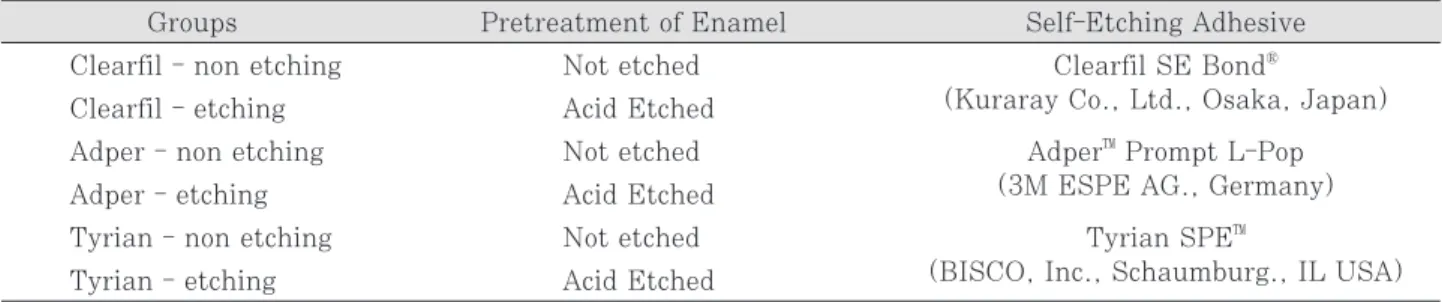
labial surfaces of the teeth were ground with model trimming wheel and 600-grit abrasive paper under wet conditions to expose enamel sur- faces. After ultrasonic cleaning with distilled water for 3 minutes to remove any surface debris, these surfaces were washed and dried with oil- free compressed air (Hotman, Dentro, Tokyo, Japan). The teeth were randomly divided into six groups of 15 teeth each and treated in the man- ner of Table 1. Composition of each system is shown in Table 2.
Each etching group was pretreated with 32%
phosphoric acid with benzalkonium chloride (UNI-ETCH, Bisco, Inc., Schaumburg, IL, USA) for 15 seconds while non-etching groups received no pretreatment. After the specimens were fully rinsed with running water for 10 seconds and dried in Clearfil groups, Clearfil SE Bond� (Kuraray Co., Ltd., Osaka, Japan) primer was applied to the tooth surface with Microbrush (Int’
l, Co., Ltd., Dungarvan, Waterford, Ireland). In Adper groups, after the two reservoirs were sequentially squeezed to mix the respective com- ponents, Adper™ Prompt L-Pop (3M ESPE AG., Germany) was applied and scrubbed on the bond- ing site of enamel for 15 seconds and then gently dried for 3 to 5 seconds with compress air. In Tyrian groups, Tyrian SPE™ (BISCO, Inc., Schaumburg., IL USA) primer were applied to the tooth surface with Microbrush.
After primed tooth surface was dried with oil- free compressed air for 5 seconds, the bonding agent was applied following the manufacturer’s instruction, and air-thinned, and irradiated using a curing light (Optilux 501) for 10 seconds with the intensity of 400 mW/cm2.
A mounting jig (Ultradent Product Inc., South Jordan, Utah, USA) with an internal ring of 2.38
㎜ in diameter and height of 2.0 ㎜ was placed against the tooth surface and stabilized with an alignment tube. Hybrid resin composite (Clearfil AP-X, Kuraray Co., Ltd., Osaka, Japan) was packed into the mold and light-cured for 40 sec- onds. After polymerization, the alignment tube and mold were removed and the specimens were
placed in 37�C, 100% humidity. Twenty-four hours after storage, the specimens were tested in shear mode using a chisel-shaped rod in an Instron testing machine (Type 4202, Instron Corp., Canton, Massachusettes, USA) at crosshead speed of 1 ㎜/minute.
The data for each group were subjected to inde- pendent t-test at p < 0.01 to make comparisons between the groups.
Ⅲ. RESULTS
The results of the shear bond strength tests to enamel were shown in Table 3.
In Clearfil SE Bond�, additional phosphoric acid etching group showed higher shear bond strength than priming only group (p < 0.01). However, there were no significant differences between additional etching group and non-etching groups in both Adper™ Prompt L-Pop and Tyrian SPE™ (p > 0.01).
Table 2.Composition of the self-etching adhesive systems tested
Adhesive System Composition*
Clearfil SE Bond� PRIMER MDP, HEMA, Hydrophilic dimethacrylate dl-Camphorquinone, aromatic tert-amine, Water
BOND MDP, Bis-GMA, HEMA, dl-Camphorquinone
Hydrophobic dimethacrylate
N,N-diethanol-p-toluidine, Silanated colloidal silica Adper™Prompt L-Pop Liquid 1 (red) Methacrylated phosphoric esters, Bis-GMA
Initiators based on camphorquinone, Stabilizers Liquid 2 (yellow) water, HEMA, Polyalkenoic acid, Stabilizers
Tyrian SPE™ Part A Ethanol
Part B 2-Acrylamido-2-methyl Propanesuflonic acid Bis(2-(methacryloyloxy)ethyl) phosphate, Ethanol One-Setp Plus Biphenyl Dimethacrylate,
Hydroxyethyl Methacrylate, Methacrylate, Acetone MDP : 10-methacryloyloxy methacrylate; HEMA : 2-hydroyxylethyl methacrylate;
Bis-GMA : bisphenol-A glycidylmethacrylate.
* According to manufacturer’s information.
Table 1.Experimental groups following surface treatment methods
Groups Pretreatment of Enamel Self-Etching Adhesive
Clearfil - non etching Not etched Clearfil SE Bond�
Clearfil - etching Acid Etched (Kuraray Co., Ltd., Osaka, Japan)
Adper - non etching Not etched Adper™Prompt L-Pop
Adper - etching Acid Etched (3M ESPE AG., Germany)
Tyrian - non etching Not etched Tyrian SPE™
Tyrian - etching Acid Etched (BISCO, Inc., Schaumburg., IL USA)
Ⅳ. DISCUSSION
Currently, clinical use of self-etching adhesive systems are increased because it is convenient and less technique sensitive. However, enamel bonding of self-etching adhesive systems is still a point of discussion. In the present study, addi- tional etching procedure improved the bond strength of Clearfil SE Bond�and did not improve in Adper™Prompt L-Pop and Tyrian SPE™.
Several studies have shown that self-etching adhesive with a resin composite did not provide as good bonding to the enamel surface as phos- phoric acid etching system11,12). However, several studies reported good bonding performances of self-etching adhesive system on enamel12). Etching of enamel with 30% to 40% phosphoric acid gives bond strength about 20 MPa13,14), and the results of this study showed good enamel bond strength comparable to these previous results.
In the present study, the shear bond strength of etching group was significantly higher than prim- ing only group in Clearfil SE Bond�. This can be explained by the acidity of each self-etching bond- ing systems. Clearfil SE Bond�had a pH value of 2.6, while Adper™Prompt L-Pop and Tyrian SPE™ had a pH value of 1.3 and 1.0 each15). According to Barkmeier et al.16), primer with a pH around 1.4 presumably allows mineralized tissues to be conditioned and primed in one treatment step.
In the self-etching primer adhesive system, the acidic part of the primer may be neutralized part- ly by calcium and phosphate ions released during
demineralization. Demineralization is therefore self-limiting, in that the high concentration of these ions tends to limit further dissolution of apatite. Thus the acidity of self-etching system is very important part of demineralizaiton of enam- el, and it is coincident with the result of this experiment.
Clearfil SE Bond� contains a functional monomer, 10-methacryloyloxydecyl dihydrogen phosphate (MDP) and it may also bind to calci- um. Recently, Yoshida et al.17)reported that MDP tightly adheres to hydroxyapatite and its calcium salt hardly dissolves in water. MDP is considered a more favorable adhesive monomer since it has two hydroxyl groups that chelate to calcium ions of enamel18). Acidic monomers in primer, such as 4-acryloxyethyl trimet (4-AET) and 2-hydrox- yethyl methacrylate (HEMA), may promote the penetration of bonding resin into dentin and enamel and/or may increase the wettability of bonding agent on tooth surface, resulting in an effective seal of flowable composite19). The differ- ence in bonding capacity to tooth substrates among MDP (Clearfil SE Bond�), Bis-GMA (Adper™ Prompt L-Pop) and Bis(2-(methacryloy- loxy)ethyl) phosphate (Tyrian SPE™) is unclear, but it is very interesting that these three adhe- sives show similar bonding performance for enam- el without pretreatment of 32% phosphoric aicd.
If the etching effect of Clearfil SE Bond� is less effective than other groups, this result may indi- cate that other factors - e.g., filled bonding layer - of the bonding system can affect the final bond Table 3.Shear bond strength of resin composite to enamel with self-etching adhesive (MPa)
Groups n Mean ± SD
Clearfil No etching 15 24.04 ± 4.6
Etching 15 34.14 ± 5.1
Adper No etching 15 23.36 ± 5.3
Etching 15 23.25 ± 4.9
Tyrian No etching 15 22.95 ± 5.2
Etching 15 22.15 ± 4.8
* Significantly different at p < 0.01.
*
strength.
In conclusion, additional phosphoric acid etching on the enamel surface can improve shear bond strength of mild acidic self-etching system.
However, it does not affect on the strong acidic self-etching system.
Further investigation is needed to evaluate the clinical significance of additional etching on the other self-etching systems which have different pH acidic primer.
REFERENCES
1. Buonocore MG. A simple method of increasing the adhesion of acrylic filling materials to enamel surfaces.
J Dent Res 34:849-853, 1955.
2. Gwinnett AJ, Matsui A. A study of enamel adhesives.
The physical relationship between enamel and adhe- sive. Arch Oral Biol 12:1615-1620, 1967.
3. Buonocore MG, Matsui A, Gwinnett AJ. Penetration of resin dental materials into enamel surfaces with refer- ence to bonding. Arch Oral Biol 13:61-70, 1968.
4. Uno S, Finger WJ. Phosphoric aid as a conditioning agent in the Gluma bonding system. Am J Dent 8:239- 241, 1995.
5. Triolo PT, Swift EJ, Mudgil A, Levine A. Effect of etching time on enamel bond strengths. Am J Dent 6:302-304, 1993.
6. Hara AT, Amaral CM, Pimenta LAF, Sinhoreti MAC.
Shear bond strength of hydrophilic adhesive systems to enamel. Am J Dent 12:181-184, 1999.
7. Kousuke I, Yasuhiro T, Takehiko T, Kana C, Kunio I, Kazuomi S. Effect of priming time on tensile bond strength to bovine teeth and morphologic structure of interfaces created by self-etching primers, Int J
Prostho 14:225-230, 2001.
8. Kang IJ, Park JW. Priming time and etching effect on shear bond strength of self-etching adhesive. J Kor Acad Cons Dent 29:185-190, 2004.
9. Van Meerbeek B, Vargas M, Inoue S, Yoshida Y, Peumans M, Lambrechts P, Vanherle G. Adhesives and cements to promote preservation dentistry. Oper Dent Suppl 6:119-144, 2001.
10. Tay FR, Pashley DH. Aggressiveness of contemporary self-etching systems. Ⅰ. Depth of penetration beyond dentin smear layers. Dent Mater 17:296-308, 2001.
11. Finger WJ, Fritz U. Laboratory evaluation of one-com- ponent enamel/dentin bonding agent. Am J Dent 9:206-210, 1996.
12. Shimada Y, Senawongse P, Harnirattisai C, Burrow MF, Nakaoki Y, Tagami J. Bond strength of two adhe- sive systems to primary and permanent enamel. Oper Dent 27:403-409, 2002.
13. Gwinett AJ, Garcia-Godoy F. Effect of etching time and acid concentration on resin shear bond strength to primary tooth enamel. Am J Dent 5:237-239, 1993.
14. Swift EJ, Cloe BC. Shear bond strengths of new enam- el etchant.Am J Dent 6:162-164, 1993.
15. Barkmeier WW, Los SA, Triolo PT. Bond strengths and SEM evaluation of Clearfil Liner Bond 2. Am J Dent 8:289-293, 1995.
16. Pashley DH, Tay FR. Aggressiveness of contemporary self-etching system. Part Ⅱ. Etching effects on unground enamel. Dent Mater 17:430-444, 2001.
17. Yoahida Y, Van Meerbeek B, Okazaki M, Shintani H, Suzuki K. Comparative study on adhesive performance of functional monomers.J Dent Res 82(Spec Iss B): B- 19 Abstr. 0051, 2003.
18. Yamada T, Sugizaki J. Basic properties and clinical applications of the Clearfil SE Bond. Proceedings of the International Kurary Symposium Osaka 1-6, 2000.
19. Nakabayashi N, Kojima K, Masuhara E. The promo- tion of adhesion by the infiltration of monomers into tooth substrates. J Biomed Mater Res 16:265-273, 1982.
부가적인 산부식이 자가산부식 접착제의 법랑질에 대한 전단결합강도에 미치는 영향
유선진∙김영경∙박정원∙진명욱∙김성교*
경북대학교 치의학전문대학원 치과보존학교실
최근 많이 소개되고 있는 자가산부식 접착제는 상아질에 대한 접착은 우수한 것으로 알려져 있지만 법랑질에 대 한 접착은 인산에 비해 낮은 산도로 인해 충분한 부식이 일어나는지에 대한 논란이 되고 있다.
본 연구에서는 서로 다른 산도를 가진 1단계 혹은 2단계의 자가산부식 접착제에서 부가적인 산부식이 법랑질과 복합 레진 사이의 전단결합강도에 미치는 영향을 평가하고자 하였다.
90개의 발거된 우치의 순면을 물기가 있는 상태에서 #600 사포로 표면을 연마하여 평활한 법랑질을 노출시킨 후, 임의로 6군으로 분류했다. 사용재료는 Clearfil SE Bond�, Adper™Prompt L-Pop, 그리고 Tyrian SPE™를 사용하였으며, 각 재료에 추가적인 산부식을 시행한 군과 그렇지 않은 군으로 나누어 표면 처리한 후, 제조사의 지 시대로 접착과정을 시행하였다. 각 시편에 복합레진을 2 ㎜ 두께로 충전하고, 40초간 광중합을 하였다. 그 후 시편 을 37℃, 100% 상대습도에서 24시간 보관 후 전단응력 접착강도를 측정하였다. 결과치는 independent t - test 를 이용하여 통계분석 하였으며 그 결과는 다음과 같이 나타났다.
Clearfil SE Bond�에서 부가적인 산부식을 시행한 군이 그렇지 않은 군보다 유의하게 높은 접착강도를 나타내 었다 (p < 0.01).
Adper™Prompt L-Pop과 Tyrian SPE™에서는 부가적인 산 부식이 결합강도에 통계적인 유의차를 나타내지 않 았다 (p > 0.01).
본 연구의 결과로 보아, 강산을 함유하고 있는 접착제를 사용할 경우에는 부가적인 부식 처치가 접착력을 증가시 키지 않으나, 약산을 함유하고 있는 접착제의 경우에는 부가적인 산부식이 접착력을 증진시키는 것으로 사료된다.
주요어: 자가산부식 접착제, 인산 산부식, 전단결합강도, 법랑질 국문초록