Background and Purpose Visual assessment of medial temporal-lobe atrophy (MTA) has been quick, reliable, and easy to apply in routine clinical practice. However, one of the limita- tions in visual assessments of MTA is the lack of widely accepted age-adjusted norms and cutoff scores for MTA for a diagnosis of Alzheimer’s disease (AD). This study aimed to deter- mine the optimal cutoff score on a T1-weighted axial MTA Visual Rating Scale (VRS) for dif- ferentiating patients with AD from cognitively normal elderly people.
Methods The 3,430 recruited subjects comprising 1,427 with no cognitive impairment (NC) and 2003 AD patients were divided into age ranges of 50–59, 60–69, 70–79, and 80–89 years.
Of these, 446 participants (218 in the NC group and 228 in the AD group) were chosen by random sampling for inclusion in this study. Each decade age group included 57 individuals, with the exception of 47 subjects being included in the 80- to 89-year NC group. The scores on the T1-weighted axial MTA VRS were graded by two neurologists. The cutoff values were evaluated from the area under the receiver operating characteristic curve.
Results The optimal axial MTA VRS cutoff score from discriminating AD from NC in- creased with age: it was ≥as ≥1, ≥2, and ≥3 in subjects aged 50–59, 60–69, 70–79, and 80–89 years, respectively (all p<0.001).
Conclusions These results show that the optimal cutoff score on the axial MTA VRS for diag- nosing of AD differed according to the decade age group. This information could be of practical usefulness in the clinical setting.
Key Words medial temporal-lobe atrophy, T1-weighted axial Visual Rating Scale, cutoff score, Alzheimer’s disease.
Age-Specific Cutoff Scores on a T1-Weighted Axial Medial Temporal-Lobe Atrophy Visual Rating Scale in Alzheimer’s Disease Using Clinical Research Center for Dementia
of South Korea Data
INTRODUCTION
The early and prompt diagnosis of Alzheimer’s disease (AD) crucially affects the clinical outcome.1,2 To improve the certainty of diagnosing early-stage AD, recently revised criteria incorporate atrophy of the medial temporal lobe (MTL) or hippocampus in magnetic reso- nance imaging (MRI) for neuronal injury and the presence of amyloid-deposition, based on the core AD symptom of progressively episodic memory impairment.3,4 Visually rat- ing medial temporal-lobe atrophy (MTA) is a useful method in the clinical setting.1,5,6 We have proposed a T1-weighted axial Visual Rating Scale (VRS) modified from Scheltens’ T1-weight- ed coronal VRS, and found it to be a quick, reliable, and easy-to-apply version of Scheltens’
scale through a validation study involving head-to head comparisons and 3D analyses of the hippocampal volume.7,8
Gyeong Seon Choia,b, Geon Ha Kima Ji-Hyun Choia, Jihye Hwanga Eunjin Kwona, Seung Ah Leea Kyoung Ae Kongc, Hee Jin Kangd Bora Yoone, Byeong C. Kimf Dong Won Yangg, Duk L. Nah Eun-Joo Kimi, Hae Ri Naj Hyun Jeong Hank, Jae-Hong Leel Jong Hun Kimm, Kang Youn Leen Kee Hyung Parko, Kyung Won Parkp SangYun Kimq, Seol-Heui Hanr Seong Yoon Kims, Soo Jin Yoont So Young Moonu, Young Chul Younv Seong Hye Choiw, Jee Hyang Jeonga
a Departments of Neurology, bCritical Care Medicine, and cPreventive Medicine, Ewha Womans University School of Medicine, Seoul, Korea
d Department of Neurology, Samsung Changwon Hospital, Sungkyunkwan University School of Medicine, Changwon, Korea
e Department of Neurology, Konyang University Hospital, College of Medicine, Konyang University, Daejeon, Korea
f Department of Neurology, Chonnam National University Medical School, Gwangju, Korea
g Department of Neurology, College of Medicine, The Catholic University of Korea, Seoul, Korea
h Department of Neurology, Sungkyunkwan University School of Medicine, Samsung Medical Center, Seoul, Korea
i Department of Neurology, Pusan National University Hospital, Pusan National University School of Medicine and Medical Research Institute, Busan, Korea
j Brain Fitness Center, Bobath Memorial Hospital, Seongnam, Korea
k Department of Neurology, Myongji Hospital, Goyang, Korea
l Department of Neurology, University of Ulsan College of Medicine, Asan Medical Center, Seoul, Korea
m Department of Neurology, Dementia Center, Ilsan Hospital, National Health Insurance Service, Goyang, Korea
n Department of Psychiatry, Pusan National University Hospital, Pusan National University School of Medicine and Medical Research Institute, Busan, Korea
o Department of Neurology, Gachon University School of Medicine, Incheon, Korea
p Department of Neurology, Dong-A University College of Medicine and Institute of Convergence Bio-Health, Busan, Korea
q Department of Neurology, Seoul National University College of Medicine and Clinical Neuroscience Center of Seoul National University Bundang Hospital, Seongnam, Korea
r Department of Neurology, Konkuk University Medical Center, Seoul, Korea
s Department of Psychiatry, Asan Medical Center, University of Ulsan College of Medicine, Seoul, Korea
t Department of Neurology, Eulji University College of Medicine, Daejeon, Korea
u Department of Neurology, Ajou University School of Medicine, Suwon, Korea
v Department of Neurology, Chung-Ang University College of Medicine, Seoul, Korea
w Department of Neurology, Inha University School of Medicine, Incheon, Korea
pISSN 1738-6586 / eISSN 2005-5013 / J Clin Neurol 2018;14(3):275-282 / https://doi.org/10.3988/jcn.2018.14.3.275
Received July 20, 2017 Revised November 7, 2017 Accepted November 9, 2017 Correspondence
Jee Hyang Jeong, MD, PhD
Department of Neurology, Ewha Womans University School of Medicine, Ewha Womans University Mokdong Hospital, 1071 Anyangcheon-ro, Yangcheon-gu, Seoul 07985, Korea Tel +82-2-2650-2776, Fax +82-2-2650-2652 E-mail [email protected]
cc This is an Open Access article distributed under the terms of the Creative Commons Attribution Non-Com- mercial License (http://creativecommons.org/licenses/by-nc/4.0) which permits unrestricted non-commercial use, distribution, and reproduction in any medium, provided the original work is properly cited.
JCN
Open Access ORIGINAL ARTICLECutoffs of T1-Axial Medial Temporal Atrophy Scale
JCN
While MTA is an earliest distinct pattern of brain atrophy in AD and is correlated with the disease severity,9 it has often also observed in the nondemented elderly population.10 More- over, MTA is a rare manifestation in young patients with cog- nitive disorder. Previous studies have shown that brain atro- phy that includes the MTL increases with age as a result of the normal aging process.10,11 Recent investigators suggested age- dependent cutoff scores on Scheltens’ MTA VRS of ≥2 for subjects <75 years old and ≥3 for subjects >75 years old.12 The present study aimed to generate practical cutoff scores on a T1-weighted axial MTA VRS for differentiating patients with AD from the cognitively normal population using data from a large cohort sample of the Clinical Research Center for Dementia of South Korea (CREDOS) study.
METHODS
Subjects
The study subjects comprised 1,427 controls with no cogni- tive impairment (NC) and 2003 AD patients from the CRE- DOS study.13 The CREDOS study was an observational, multidisciplinary dementia cohort from 31 centers in South Korea who participated from November 2005 until 2013. The 3,430 participants were categorized at their diagnostic visit into age groups of 50–59, 60–69, 70–79, and 80–89 years. The subjects underwent a standard assessment that included the clinical history, a neurological examination, detailed neuro- psychological tests, an MRI examination, and laboratory tests to exclude other causes of cognitive impairment. The maxi- mum interval between neuropsychological testing and the brain MRI examination was 3 months.
The inclusion criteria for NC were aged ≥50 years and nor- mal cognitive function on the Korean version of the Mini Mental State Examination (K-MMSE) and in all neuropsy- chological tests (as described in the next section).
The inclusion criteria for the AD group were as follows:
1) criteria for probable AD based on the National Institute of Neurological and Communicative Disorders and Stroke and the AD and Related Disorders Association, and the Di- agnostic and Statistical Manual of Mental Disorders (Fourth edition) criteria for probable AD, 2) age ≥50 years, and 3) total Clinical Dementia Rating (CDR) score of 0.5 or 1. The exclusion criteria for both the NC and AD groups were as follows: 1) significant neurological or psychiatric illness, 2) significant unstable systemic disease or organ failure, and 3) severe white-matter hyperintensities (>25 mm in deep white matter or a periventricular lesion >10 mm) in T2-weighted and FLAIR MRI images, which known to be related to brain atrophy and cerebrovascular events. No patients with a clini- cal diagnosis of mild cognitive impairment of any subtype
or a codiagnosis of AD were included in this study.
Each decade age group comprised 57 individuals (with the exception of 47 subjects being included in the 80- to 89-year NC group) chosen randomly using a list of random numbers generated in Microsoft Excel by decade age groups. In total, 446 subjects comprising 218 NC subjects and 228 of AD sub- jects were selected for inclusion in this study. We estimated that the sensitivity and specificity of the test would be 0.8 and 0.8, respectively. To conduct a one-sided test with the hy- pothesis that the sensitivity and specificity would each be 0.6 and with a significance level of 5% and a statistical power of 80%, the required number of the study subjects was 57 for each group. Since the 80- to 89-year NC group only had 47 subjects, all of them were included in the analysis.
The study was approved by the Institutional Review Board of Ewha Womans University Mokdong Hospital (IRB No. 2015- 12-023-002).
Neuropsychological tests
All participants underwent neuropsychological tests using a standardized neuropsychological battery, the Seoul Neu- ropsychological Screening Battery.15 This battery contains tests for attention, language, praxis, four elements of Gerst- mann syndrome, visuoconstructive function, verbal and visual memory, and frontal/executive function. The battery used in the present study included digit span (forward and backward), the Korean version of the Boston Naming Test,16 the Rey-Os- terrieth Complex Figure Test (copying, immediate and 20- minute delayed recall, and recognition), the Seoul Verbal Learning Test (3 learning-free recall trials of 12 words, a 20- minute delayed-recall trial for these 12 items, and a recognition test), the phonemic and semantic Controlled Oral Word As- sociation Test, and the Stroop Test (word and color reading of 112 items during a 2-minute period). We also applied the K-MMSE, the Clinical Dementia Rating Sum of Boxes, and the Geriatric Depression Scale.17
T1-weighted axial MTA VRS
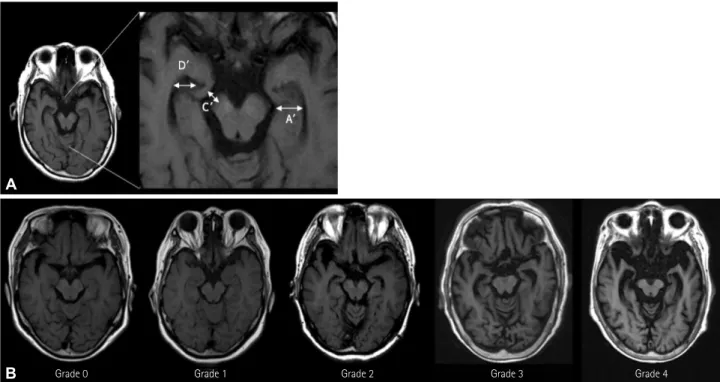
The T1-weighted axial scans were transcribed and assem- bled into a numbered series in order to conceal the clinical data of the subjects. Two neurologists (one experienced and one newly trained) who were blinded to the clinical informa- tion graded MTA on the T1-weighted axial VRS by assign- ing a 5-grade score ranging from 0 (no atrophy) to 4 (severe atrophy).7 Three widths of the MTL—the hippocampus and parahippocampal gyrus, the gap of the perimesencephalic cis- tern, and the width of the anterior temporal horn of the lateral ventricle (labeled as A’, C’, and D’, respectively, in Fig. 1A)—
were measured on both sides (Table 1).7 Right and left MTA were rated separately. If the degree of MTA was asymmetric in
Choi GS et al.
JCN
a participant, the side with greater atrophy was selected.
Magnetic resonance imaging
The MRI scans were obtained using a 1.5 Tesla (T) MRI ma- chine (AvantoSyngo, Siemens, Erlangen, Germany) with a 12-channel head, or a 3T MRI machine (Achieva TX, Philips, the Netherlands) with a 32-channel head. Brain T1-weighted axial MRI images were acquired parallel to the line from the anterior commissure to the posterior commissure. The 1.5T T1-weighted axial images were obtained with following pa- rameters: slice thickness, 5.0 mm; interslice thickness, 1.65 mm; repetition time, 430 ms; echo time, 8.70 ms; flip angle, 90°; matrix size, 320×182 pixels; and field of view, 145×220 mm2. The 3T T1-weighted axial images were obtained with the following parameters: slice thickness, 5.0 mm; interslice thickness, 1 mm; repetition time, 2,000 ms; echo time, 20 ms;
flip angle, 90°; matrix size, 324×244 pixels; and field of view, 183×220 mm2.
Statistical analyses
Intergroup comparisons of demographic characteristics were performed using Student’s t-test or the Mann-Whitney U test for continuous variables and the chi-square test for dichoto- mous variables. To determine an ideal cutoff value and to confirm the diagnostic performance of the cutoff scores on the axial MTA VRS in the different decade age groups, the area under the receiver operating characteristics curve (AUC) was analyzed.18 Statistical analyses were performed using the Statistical Package for the Social Sciences (version 19.0, IBM Corp., Armonk, NY, USA). The cutoff for statistical signifi- cance was defined as a probability value of p<0.05.
RESULTS
Demographic characteristics
The clinical characteristics of subjects are presented in Table 2. Age, gender, and education level did no differ significantly Table 1. Relationships between dimensions and scores on the T1-weighted axial medial temporal-lobe atrophy Visual Rating Scale
A' (medial temporal lobe*) C' (perimesencephalic cisternal gap*) D' (width of anterior temporal horn*)
Grade 0 (normal) Normal Normal Normal
Grade 1 (questionable) Normal ↑ Normal or slit-like change
Grade 2 (mild) ↓ ↑ ↑ ↑
Grade 3 (moderate) ↓ ↓ ↑ ↑ ↑ ↑ ↑
Grade 4 (severe) ↓ ↓ ↓ ↑ ↑ ↑ ↑ ↑ ↑
*These dimensions are shown in Fig. 1A.
↑ increase, ↓ decrease.
Fig. 1. A: Dimensions measured when scoring on the T1-weighted axial medial temporal-lobe atrophy VRS: width of the hippocampus (A'), width of the perimesencephalic cistern (C'), and width of the temporal horn (D'). B: Examples of grades 0 to 4 on the VRS. VRS: Visual Rating Scale.
Grade 0 Grade 1 Grade 2 Grade 3 Grade 4
A
B
Cutoffs of T1-Axial Medial Temporal Atrophy Scale
JCN
between the NC and AD groups. The K-MMSE scores were higher and the CDR and MTA VRS scores were lower in the NC group than in AD patients.
Decade-age-group-specific cutoff scores on the axial MTA VRS
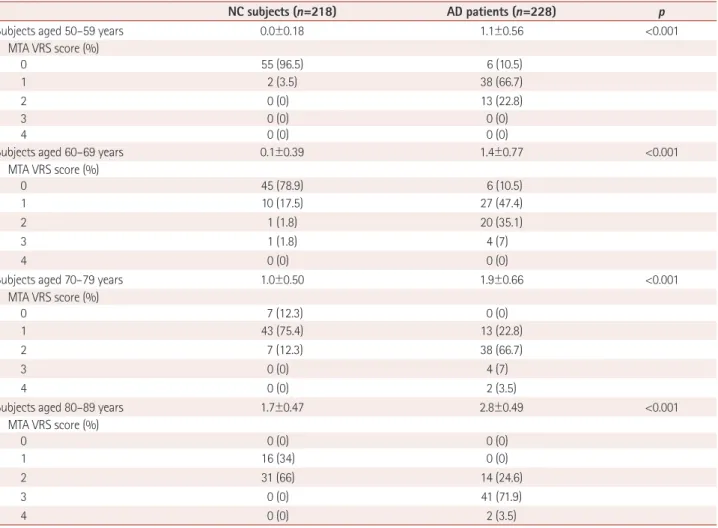
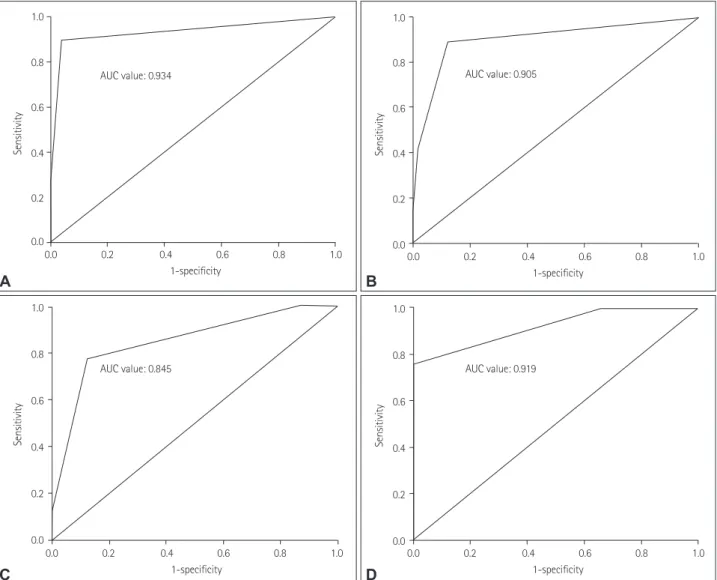
The mean and standard-deviation scores on the T1-weighted axial MTA VRS within each decade age group are listed in Table 3. The axial MTA VRS score increased with age in both the NC and AD groups. The cutoff score indicates the lower threshold for abnormality. The sensitivity and specificity ac- cording to different axial MTA VRS cutoff scores are listed in Table 4 for each age group. AUC analyses were performed for determining the optimal cutoff scores for best discrimi- nating between AD and NC. The results of the AUC analyses are shown in Fig. 2.
The optimal cutoff score for differentiating AD patients from the NC group was ≥1 (sensitivity, 89.5%; specificity, 96.5%; p<0.001; AUC, 0.934, 95% CI, 0.882–0.986) for subjects aged 50–59 years, ≥1 (sensitivity, 89.5%; specificity, 87.7%;
p<0.001; AUC, 0.868; 95% CI, 0.799–0.938) for subjects aged 60 to 69 years, ≥2 (sensitivity, 77.2%; specificity, 87.7%; p<
0.001; AUC, 0.845; 95% CI, 0.771–0.919) for subjects aged 70–79 years, and ≥3 (sensitivity, 75.4%; specificity, 100%;
p<0.001; AUC, 0.919; 95% CI, 0.868–0.970) for subjects aged 80–89 years. Kappa values of the T1-weighted axial VRS were also assessed. The intrarater and interrating reliabilities of the T1-weighted axial MTA VRS scores were 0.802 and 0.786, respectively (both p<0.001).
DISCUSSION
The aim of this study was to determine the optimal cutoff scores on the age-specific T1-weighted axial MTA VRS for practical use in the clinical decision tree. We found that the axial MTA VRS scores for a diagnosis of AD increased with the decade age group, as expected: the optimal score was ≥1 for diagnosing AD in patients aged 50–69 years, ≥2 for those aged 70–79 years, and ≥3 for those for those aged 80–
89 years. The cutoff values of the axial MTA VRS score for subjects aged 50–69 years achieved a high sensitivity and specificity, enabling a clinician to differentiate AD from NC correctly and thereby improving the diagnostic accuracy in this relatively young age range. The cutoff score for subjects Table 2. Demographic characteristics
NC subjects (n=218) AD patients (n=228) p
Subjects aged 50–59 years 57 57
Age (years) 59 54.9±2.56 0.296
Gender (male:female) 17:40 21:36 0.551
Education (years) 10.4±5.90 10.4±5.42 0.987
K-MMSE score 28.2±2.16 17.6±5.21 <0.001
CDR score 0.4±0.23 0.7±0.25 <0.001
Subjects aged 60–69 years 57 57
Age (years) 64.1±2.81 64.7±2.99 0.421
Gender (male:female) 15:42 25:32 0.077
Education (years) 10.2±5.35 8.4±4.70 0.195
K-MMSE score 27.6±2.50 18.8±5.62 <0.001
CDR score 0.4±0.23 0.7±0.24 <0.001
Subjects aged 70–79 years 57 57
Age (years) 74.3±2.81 74.7±2.83 0.408
Gender (male:female) 19:38 18:39 1.000
Education (years) 7.4±5.62 6.8±5.43 0.571
K-MMSE score 26.3±3.58 17.0±4.99 <0.001
CDR score 0.4±0.19 0.8±0.25 <0.001
Subjects aged 80–89 years 47 57
Age (years) 81.9±1.82 82.5±2.43 0.156
Gender (male:female) 19:28 23:34 1.000
Education (years) 6.7±5.89 6.9±5.28 0.868
K-MMSE 26.4±4.01 16.8±5.89 <0.001
CDR score 0.3±0.24 0.8±0.25 <0.001
Data are n:n, n, or mean±standard-deviation values.
AD: Alzheimer’s disease, CDR: Clinical Dementia Rating, K-MMSE: Korean version of the Mini Mental State Examination, NC: no cognitive impairment.
Choi GS et al.
JCN
aged 80–89 years showed a high specificity for detecting AD but a rather low sensitivity (75%) for differentiating between NC and AD. Therefore, in populations older than 80 years, the degree of MTA will have less effect on clinical manifesta- tion of dementia compared to in subjects aged 50–69 years.
Assessing MTA on MRI scans using a VRS is quick and readily available.5 The MTA coronal VRS was proposed by Scheltens et al.8 in 1992, since when it has been used in nu- merous studies and also been modified by several research-
ers. The present authors have also revised this coronal scale into an axial scale through a validation study for clinical us- age.7
The original paper of Scheltens et al.8 proposed cutoff scores on the MTA VRS using T1-weighted coronal images of ≥2 for those aged <75 years and ≥3 for those aged >75 years, which was defined as an indicator of the presence of MTA suggestive of AD. Our previous study also showed that a cut- off score on the axial MTA VRS of ≥2 was the standard cut- Table 3. Distribution of T1-weighted axial MTA VRS scores
NC subjects (n=218) AD patients (n=228) p
Subjects aged 50–59 years 0.0±0.18 1.1±0.56 <0.001
MTA VRS score (%)
0 55 (96.5) 6 (10.5)
1 2 (3.5) 38 (66.7)
2 0 (0) 13 (22.8)
3 0 (0) 0 (0)
4 0 (0) 0 (0)
Subjects aged 60–69 years 0.1±0.39 1.4±0.77 <0.001
MTA VRS score (%)
0 45 (78.9) 6 (10.5)
1 10 (17.5) 27 (47.4)
2 1 (1.8) 20 (35.1)
3 1 (1.8) 4 (7)
4 0 (0) 0 (0)
Subjects aged 70–79 years 1.0±0.50 1.9±0.66 <0.001
MTA VRS score (%)
0 7 (12.3) 0 (0)
1 43 (75.4) 13 (22.8)
2 7 (12.3) 38 (66.7)
3 0 (0) 4 (7)
4 0 (0) 2 (3.5)
Subjects aged 80–89 years 1.7±0.47 2.8±0.49 <0.001
MTA VRS score (%)
0 0 (0) 0 (0)
1 16 (34) 0 (0)
2 31 (66) 14 (24.6)
3 0 (0) 41 (71.9)
4 0 (0) 2 (3.5)
Data are n (%) or mean±standard-deviation values.
AD: Alzheimer’s disease, MTA: medial temporal-lobe atrophy, NC: no cognitive impairment, VRS: Visual Rating Scale.
Table 4. SN and SP values for T1-weighted axial MTA VRS cutoff scores according to four age groups for comparing AD patients and NC subjects MTA VRS
score
50–59 years (n=114) 60–69 years (n=114) 70–79 years (n=114) 80–89 years (n=104)
57 NC, 57 AD 57 NC, 57 AD 57 NC, 57 AD 47 NC, 57 AD
Cutoff SN SP SN SP SN SP SN SP
≥1 89.5* 96.5* 89.5* 87.7* 100 12.3 100 0
≥2 22.8 100 42.1 98.2 77.2* 87.7* 100 34
≥3 0 100 7 100 10.5 100 75.4* 100*
≥4 0 100 0 100 3.5 100 3.5 100
*Largest combined SN and SP values in each age range.
AD: Alzheimer’s disease, MTA: medial temporal-lobe atrophy, NC: no cognitive impairment, SN: sensitivity, SP: specificity, VRS: Visual Rating Scale.
Cutoffs of T1-Axial Medial Temporal Atrophy Scale
JCN
off for discriminating AD from NC.7
In a more-recent study that applied Scheltens’ scale to com- puted tomography (CT) images, the authors suggested using cutoff scores of >1.5 for those aged <75 years and ≥2 for those aged >75 years.19 In another study, Pereira et al.12 concluded that an MTA VRS score of ≥2 (in at least one hemisphere) was considered abnormal for subjects aged <75 years, whilst a score of ≥3 (in at least one hemisphere) should be consid- ered abnormal for subjects aged >75 years. Our study find- ings of cutoff scores of ≥2 for those aged 70–79 years and
≥3 for those aged 80–89 years are comparable to both of these previous studies. Our study population included AD pa- tients with an earlier onset (<65 years of age) but had fewer patients with a late onset (>85 years of age) compared to both the studies of Scheltens et al.8 and Pereira et al.12 We therefore suggest that early-onset dementia can be diagnosed in the absence of significant MTA. In addition, some elderly sub-
jects older than 80 years could have moderate MTA (Numeri- cal Rating Scale score of ≥3) without significant cognitive im- pairment or symptoms of dementia, thereby increasing the likelihood of a false-positive AD dementia diagnosis.
There are effects of expertise and practice on Scheltens’
MTA VRS scores when experts are compared to nonexpert MRI assessors.17 Our study showed a relatively high intrarater reliability and a good interrater reliability between experi- enced axial MTA raters and newly trained neurologists, sug- gesting that the axial MTA VRS is an easy-to-apply and use- ful tool for routine clinical practice.
Brain atrophy—especially atrophic changes in the MTL—
is a useful diagnostic tool for differentiating AD from NC, but this is due to structural neuronal degeneration possibly relat- ed to tau pathology, and not a result of amyloid pathology.20,21 Memory problems such as forgetting appointments and names, difficulty looking for things, and losing familiar ways
0.0 0.2 0.4 0.6 0.8 1.0 0.0 0.2 0.4 0.6 0.8 1.0 0.0 0.2 0.4 0.6 0.8 1.0 0.0 0.2 0.4 0.6 0.8 1.0
1-specificity 1-specificity
1-specificity 1-specificity
AUC value: 0.934
AUC value: 0.845
AUC value: 0.905
AUC value: 0.919 1.0
0.8
0.6
0.4
0.2
0.0 1.0
0.8
0.6
0.4
0.2
0.0
1.0
0.8
0.6
0.4
0.2
0.0 1.0
0.8
0.6
0.4
0.2
0.0
SensitivitySensitivity
SensitivitySensitivity
A B
D C
Fig. 2. AUC for optimal medial temporal-lobe atrophy Visual Rating Scale cutoff scores in subjects aged 50–59 years (A), 60–69 years (B), 70–79 years (C), and 80–89 years (D). AUC: area under the receiver operating characteristics curve.
Choi GS et al.
JCN
are an early sign of AD, but they are also common complaints in elderly individuals with normal cognition.22 Many previous studies showed the diagnostic certainty improved significant- ly—to a sensitivity and specificity of >90%—when using MTA grading on MRI scans combined with clinical mani- festations.23-25 It is clear that atrophy in the MTL is a landmark neuropathological change in AD, but brain atrophy is also well known to occur in the elderly population with normal cognition. Some previous studies suggested that age-related brain atrophy occurs in the MTL even in the presence of nor- mal cognitive function.10,26,27
Our results indicate that caution is necessary when diag- nosing AD in elderly patients with MTA. Although the MTA VRS score was a sensitive marker for distinguishing between AD and NC in previous studies,28 it might also lead to misdi- agnosis.12 In early-onset AD with proven amyloid pathology, the MTL structures do not seem to exhibit identifiable atro- phy.29 In addition, nondemented older adults with atrophy in the MTL are likely to be overdiagnosed as AD.12 In such cases the age-specific cutoff scores on the MTA VRS could be used as a secondary consideration that combines the degree of MTA and the clinical significance.
Our study was subject to several limitations. Firstly, the small number of normal controls older than 80 years and whole-brain atrophy involving the MTL at an advanced age, are likely to overestimate cutoff scores on the MTA VRS. This might have led to the low sensitivity in the oldest age group of our study. Therefore, considering the higher prevalence of AD in the elderly population, further studies involving larger numbers of normal controls older than 80 years or even 90 years are needed.
Secondly, it is possible for patients with AD-related pathol- ogy to be classified as cognitively normal when they have sufficient cognitive reserves that mitigate the development of cognitive impairment. In many such cases the cutoff scores on the MTA VRS may be increased, especially in older age groups. Thirdly, the NC group included individuals with sub- jective memory complaint as well as healthy normal controls without cognitive complaints, which possibly affected the VRS score and especially among those in the older age groups.
Fourthly, our study might have been more powerful if we could have performed a head-to-head comparison between the axial MTA VRS and the coronal MTA VRS in the large included cohort. Unfortunately, due to the low number of coronal MRI images in the CREDOS cohort, a head-to-head comparison could not be performed. Finally, we had no evi- dence of amyloid pathology such as cerebrospinal fluid as- says or in positron-emission tomography to support the de- termination of prodromal AD and dementia due to AD.32
We conclude that the optimal cutoff score on the T1-weight-
ed axial MTA VRS for diagnosing AD varies with the decade age range. The age-specific cutoff scores proposed herein could be useful in the practical clinical setting for the differential diagnosis of AD patients and cognitively normal elderly with age-related MTA. However, further studies are needed that include sufficient subjects older than 80 years for checking the test–retest reliability, the correlation with proof of amy- loid pathology, and the possible correlation with Scheltens’
coronal MTA rating in CT.
Conflicts of Interest
The authors have no financial conflicts of interest.
Acknowledgements
This study was supported by a research program to solve social issues of the National Research Foundation of Korea (NRF) funded by the Minis- try of Science, ICT & Future Planning (No. 2015M3C8A8076481) and by the Original Technology Research Program for Brain Science through the National Research Foundation of Korea (NRF) funded by the Korean government (MSIP) (No. 2014M3C7A1064752).
REFERENCES
1. Shen Q, Loewenstein DA, Potter E, Zhao W, Appel J, Greig MT, et al.
Volumetric and visual rating of magnetic resonance imaging scans in the diagnosis of amnestic mild cognitive impairment and Alzheimer’s disease. Alzheimers Dement 2011;7:e101-e108.
2. Golde TE. The therapeutic importance of understanding mechanisms of neuronal cell death in neurodegenerative disease. Mol Neurodegener 2009;4:8.
3. Jack CR Jr, Albert MS, Knopman DS, McKhann GM, Sperling RA, Carrillo MC, et al. Introduction to the recommendations from the Na- tional Institute on Aging-Alzheimer’s Association workgroups on di- agnostic guidelines for Alzheimer’s disease. Alzheimers Dement 2011;
7:257-262.
4. Ferreira D, Cavallin L, Larsson EM, Muehlboeck JS, Mecocci P, Vellas B, et al. Practical cut-offs for visual rating scales of medial temporal, frontal and posterior atrophy in Alzheimer’s disease and mild cogni- tive impairment. J Intern Med 2015;278:277-290.
5. Duara R, Loewenstein DA, Potter E, Appel J, Greig MT, Urs R, et al.
Medial temporal lobe atrophy on MRI scans and the diagnosis of Al- zheimer disease. Neurology 2008;71:1986-1992.
6. Harper L, Barkhof F, Fox NC, Schott JM. Using visual rating to diag- nose dementia: a critical evaluation of MRI atrophy scales. J Neurol Neurosurg Psychiatry 2015;86:1225-1233.
7. Kim GH, Kim JE, Choi KG, Lim SM, Lee JM, Na DL, et al. T1-weight- ed axial visual rating scale for an assessment of medial temporal atro- phy in Alzheimer’s disease. J Alzheimers Dis 2014;41:169-178.
8. Scheltens P, Leys D, Barkhof F, Huglo D, Weinstein HC, Vermersch P, et al. Atrophy of medial temporal lobes on MRI in “probable” Al- zheimer's disease and normal ageing: diagnostic value and neuropsy- chological correlates. J Neurol Neurosurg Psychiatry 1992;55:967-972.
9. Visser PJ, Verhey FR, Hofman PA, Scheltens P, Jolles J. Medial tempo- ral lobe atrophy predicts Alzheimer’s disease in patients with minor cognitive impairment. J Neurol Neurosurg Psychiatry 2002;72:491-497.
10. Zhang Y, Qiu C, Lindberg O, Bronge L, Aspelin P, Bäckman L, et al.
Acceleration of hippocampal atrophy in a non-demented elderly pop- ulation: the SNAC-K study. Int Psychogeriatr 2010;22:14-25.
11. Wu CC, Mungas D, Petkov CI, Eberling JL, Zrelak PA, Buonocore MH, et al. Brain structure and cognition in a community sample of el- derly Latinos. Neurology 2002;59:383-391.
12. Pereira JB, Cavallin L, Spulber G, Aguilar C, Mecocci P, Vellas B, et al.
Cutoffs of T1-Axial Medial Temporal Atrophy Scale
JCN
Influence of age, disease onset and ApoE4 on visual medial temporal lobe atrophy cut-offs. J Intern Med 2014;275:317-330.
13. Choi SH, Kim S, Han SH, Na DL, Kim DK, Cheong HK, et al. Neuro- logic signs in relation to cognitive function in subcortical ischemic vascular dementia: a CREDOS (Clinical Research Center for Demen- tia of South Korea) study. Neurol Sci 2012;33:839-846.
14. Barber R, Gholkar A, Scheltens P, Ballard C, McKeith IG, O'Brien JT.
MRI volumetric correlates of white matter lesions in dementia with Lewy bodies and Alzheimer’s disease. Int J Geriatr Psychiatry 2000;15:
911-916.
15. Ahn HJ, Chin J, Park A, Lee BH, Suh MK, Seo SW, et al. Seoul Neuro- psychological Screening Battery-dementia version (SNSB-D): a useful tool for assessing and monitoring cognitive impairments in dementia patients. J Korean Med Sci 2010;25:1071-1076.
16. Kim H, Na DL. Normative data on the Korean version of the Boston Naming Test. J Clin Exp Neuropsychol 1999;21:127-133.
17. Boutet C, Chupin M, Colliot O, Sarazin M, Mutlu G, Drier A, et al. Is radiological evaluation as good as computer-based volumetry to assess hippocampal atrophy in Alzheimer’s disease? Neuroradiology 2012;54:
1321-1330.
18. Mossman D, Somoza E. ROC curves, test accuracy, and the description of diagnostic tests. J Neuropsychiatry Clin Neurosci 1991;3:330-333.
19. Claus JJ, Staekenborg SS, Holl DC, Roorda JJ, Schuur J, Koster P, et al.
Practical use of visual medial temporal lobe atrophy cut-off scores in Alzheimer’s disease: validation in a large memory clinic population.
Eur Radiol 2017;27:3147-3155.
20. Frisoni GB, Fox NC, Jack CR Jr, Scheltens P, Thompson PM. The clini- cal use of structural MRI in Alzheimer disease. Nat Rev Neurol 2010;
6:67-77.
21. Wollman DE, Prohovnik I. Sensitivity and specificity of neuroimag- ing for the diagnosis of Alzheimer’s disease. Dialogues Clin Neurosci 2003;5:89-99.
22. Jonker C, Geerlings MI, Schmand B. Are memory complaints predic- tive for dementia? A review of clinical and population-based studies.
Int J Geriatr Psychiatry 2000;15:983-991.
23. Prestia A, Caroli A, Herholz K, Reiman E, Chen K, Jagust WJ, et al.
Diagnostic accuracy of markers for prodromal Alzheimer’s disease in independent clinical series. Alzheimers Dement 2013;9:677-686.
24. Golebiowski M, Barcikowska M, Pfeffer A. Magnetic resonance imag- ing-based hippocampal volumetry in patients with dementia of the Alzheimer type. Dement Geriatr Cogn Disord 1999;10:284-288.
25. Juottonen K, Laakso MP, Partanen K, Soininen H. Comparative MR analysis of the entorhinal cortex and hippocampus in diagnosing Al- zheimer disease. AJNR Am J Neuroradiol 1999;20:139-144.
26. Raz N, Rodrigue KM, Head D, Kennedy KM, Acker JD. Differential aging of the medial temporal lobe: a study of a five-year change. Neu- rology 2004;62:433-438.
27. Jack CR Jr, Petersen RC, Xu Y, O'Brien PC, Smith GE, Ivnik RJ, et al.
Rate of medial temporal lobe atrophy in typical aging and Alzheimer’s disease. Neurology 1998;51:993-999.
28. Westman E, Cavallin L, Muehlboeck JS, Zhang Y, Mecocci P, Vellas B, et al. Sensitivity and specificity of medial temporal lobe visual ratings and multivariate regional MRI classification in Alzheimer’s disease.
PLoS One 2011;6:e22506.
29. van der Flier WM, Pijnenburg YA, Fox NC, Scheltens P. Early-onset versus late-onset Alzheimer’s disease: the case of the missing APOE ε4 allele. Lancet Neurol 2011;10:280-288.
30. Fjell AM, Walhovd KB, Fennema-Notestine C, McEvoy LK, Hagler DJ, Holland D, et al. One-year brain atrophy evident in healthy aging. J Neurosci 2009;29:15223-15231.
31. Xu J, Kobayashi S, Yamaguchi S, Iijima K, Okada K, Yamashita K.
Gender effects on age-related changes in brain structure. AJNR Am J Neuroradiol 2000;21:112-118.
32. Schoonenboom NS, van der Flier WM, Blankenstein MA, Bouwman FH, Van Kamp GJ, Barkhof F, et al. CSF and MRI markers indepen- dently contribute to the diagnosis of Alzheimer’s disease. Neurobiol Aging 2008;29:669-675.