Copyrights © 2015 by The Korean Gastric Cancer Association www.jgc-online.org This is an open-access article distributed under the terms of the Creative Commons Attribution Non-Commercial License (http://creativecommons.org/
licenses/by-nc/4.0) which permits unrestricted noncommercial use, distribution, and reproduction in any medium, provided the original work is properly cited.
Introduction
Although the incidence of gastric (stomach) cancer is de- creasing wordwide, this is one of the most common cancers.
Gastric cancer is the third leading cause of death among various types of cancers. The incidence and death rates of this cancer are higher in men than in women.1 More than 70% of gastric cancer incidences occurred in developing countries. In addition, half of them are diagnosed in East Asians.2
Based on the latest report of the International Agency for Research on Cancer in 2012, the incidence and mortality rate of gastric cancer was estimated to be more than 951,000 cases (6.8%
of the total cases of cancer) and 123,000 cases (8.8% of the total cases of cancer cancer) respectively, during a year.1 In addition, the incidence of this cancer is estimated to increase to more than 1.5 million cases per year until 2030.1 The incidence and mortality rates of gastric cancer are nearly twice in men than in women.
Different studies indicate several risk factors for gastric can- cer, which includes Helicobacter pylori infection,3 consumption of red meat and processed meat,4 high consumption of salt,5 smoking,6 alcohol consumption,7 and family history of cancer.8 Of these, H. pylori infection is one of the most important risk factors for gastric cancer. Additionally, consumption of green tea,9 citrus products,10 dairy products,11 use of soy products,12 physical activity,13 and consumption of fruits and vegetables14 are the protective factors against gastric cancer. Various studies have Correspondence to: Ali Jalali
Department of Epidemiology, Faculty of Health, Shahid Sadoughi University of Medical Sciences, Yazd 8915173160, Iran
Tel: +98-3538209100, Fax: +98-3538209119 E-mail: [email protected]
Received December 1, 2015 Revised December 10, 2015 Accepted December 14, 2015
Effect of Carrot Intake in the Prevention of Gastric Cancer:
A Meta-Analysis
Hossein Fallahzadeh, Ali Jalali1, Mahdieh Momayyezi, and Soheila Bazm2
Research Center of Prevention and Epidemiology of Non-Communicable Disease, Shahid Sadoughi University of Medical Sciences, Departments of 1Epidemiology and 2Health Education, Faculty of Health, Shahid Sadoughi University of Medical Sciences, Yazd, Iran
Purpose: Gastric cancer is the third leading cause of cancer-related mortality, with the incidence and mortality being higher in men than in women. Various studies have shown that eating carrots may play a major role in the prevention of gastric cancer. We conducted a meta-analysis to determine the relationship between carrot consumption and gastric cancer.
Materials and Methods: We searched multiple databases including PubMed, Cochrane Library, Scopus, ScienceDirect, and Persian da- tabases like Scientific Information Database (SID) and IranMedx. The following search terms were used: stomach or gastric, neoplasm or cancer, carcinoma or tumor, and carrot. Statistical analyses were performed using Comprehensive Meta Analysis/2.0 software.
Results: We retrieved 81 articles by searching the databases. After considering the inclusion and exclusion criteria, 5 articles were in- cluded in this study. The odds ratio (OR) obtained by fixed effects model showed that a 26% reduction in the risk of gastric cancer has been associated with the consumption of carrots) OR=0.74; 95% confidence interval=0.68~0.81; P<0.0001). According to funnel graph, the results showed that the possibility of a publication bias does not exist in this study.
Conclusions: The findings of this study showed an inverse relationship between the consumption of carrots and the risk of gastric cancer.
Key Words: Stomach; Neoplasm; Carcinoma; Daucus carota
shown that eating vegetables like carrot may play a major role in the prevention of gastric cancer.15
Several studies have been conducted to examine the relation- ship between eating carrots and prevention of gastric cancer worldwide, but they have not been approved. Therefore, this meta-analysis aimed to investigate the relationship between car- rot consumption and prevention of gastric cancer.
Materials and Methods
1. Literature and search strategy
We searched published articles in some well known databases including PubMed, Cochrane Library, Scopus, and ScienceDirect as well as Persian databases like Scientific Information Database and IranMedx. Literature searches were conducted until 1 July 2014. The following search terms were used: stomach or gastric, neoplasm or cancer, carcinoma or tumor, and carrot.
2. Inclusion and exclusion criteria
We did not consider any limitation of time and language for selecting the articles. Studies that met the following criteria were included in the present analysis: 1) case-control or cohort stud- ies; 2) studies indicating a relationship between the consumption of vegetables (especially carrot) and gastric cancer; 3) providing odds ratios (ORs) and relative risk (RR) with 95% confidence intervals (CI); 4) providing incidence rates. The exclusion cri- teria included: 1) studies published more than once (researchers included more recent studies in this meta-analysis); 2) studies that reported mortality rates; 3) case reports, editorials, review articles, conference papers, and meta-analysis studies.
3. Data extraction and synthesis
Initially, we obtained a list of articles based on the inclusion and exclusion criteria and then considered them based on the researcher name, year of publication, number of samples, the country, the ORs, and CIs criteria.
4. Statistics and analysis
Considering that OR criteria is measurable in both case-con- trol studies and cohort studies, at first RR criteria is transformed to OR. Thereafter, all selected studies were analyzed by using the software. In addition, the studies were sub-grouped based on the type of study, sex of the subjects, anatomical view of the gastric (cardia, non-cardia), and a family history of gastric cancer.
I2 index and Q test were used to assess quantitative heteroge- neity of the results (P<0.1). I2 index describes the percentage of observed differences between indicators of studies based on the heterogeneity between them. The range of I2 index is 0%~100%, in which 0% indicates any heterogeneity between the studies and the largest values report the highest heterogeneity.16
We used two models to calculate the OR with 95% CI: ran- dom effects (DerSimonian and Laird)17 method and fixed ef- fects model. We used linear regression Egger’s and Begg’s rank correlation and funnel plot to assess publication bias (P<0.5).
Statistical analyses were performed using Comprehensive Meta Analysis/2.0 software (Biostat, Englewood, NJ, USA).
Results
1. Literature search
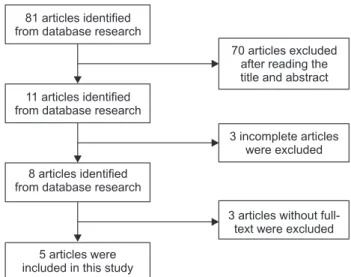
We found 81 articles by searching the databases and then we conducted a preliminary assessment of the articles based on the inclusion and exclusion criteria. Finally, a total of 5 published articles were chosen regarding the relationship between eating carrots and preventing gastric cancer (Fig. 1).
2. Study characteristics
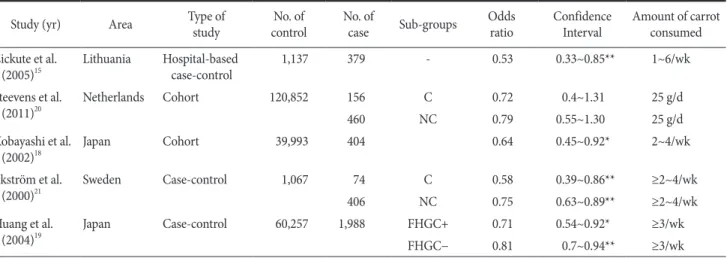
In Table 1, the main characteristics of the eligible studies have been summarized. One of the articles was written in Lithu- anian language15 and four in English. Of these 5 articles, two are published in Japan,18,19 whereas the other articles were from the Netherlands,20 Sweden,21 and Lithuania.15 Four studies have been conducted during 2000~2010 and one of them during 2010~2014.
81 articles identified from database research
11 articles identified from database research
8 articles identified from database research
5 articles were included in this study
70 articles excluded after reading the title and abstract
3 incomplete articles were excluded
3 articles without full- text were excluded
Fig. 1. Flow chart of study selection.
All articles were adjusted based on age, sex, and smoking criteria. Three articles were adjusted for body mass index,18,19,21 three articles for alcohol consumption,15,18,20 two articles for salt intake,18,21 two for eating fruits and raw vegetables19,20 and two for consuming vitamins.18,21 The other factors considered for ad- justing include affected area, urban environment, drinking hab- its, physical activity, educational level, family history of gastric cancer, and red meat and fish consumption.
3. Heterogeneity test results
The results of the heterogeneity test showed no significant heterogeneity among the five articles that were analyzed in this study (I2=0; P=0.576).22 The OR is calculated by fixed effects model, which showed that eating carrots decreased the risk of
Table 1. Characteristics of the studies correlating the effects of carrot consumption on gastric cancer risks
Study (yr) Area Type of
study No. of
control No. of
case Sub-groups Odds
ratio Confidence
Interval Amount of carrot consumed Zickute et al.
(2005)15 Lithuania Hospital-based
case-control 1,137 379 - 0.53 0.33~0.85** 1~6/wk
Steevens et al.
(2011)20 Netherlands Cohort 120,852 156 C 0.72 0.4~1.31 25 g/d
460 NC 0.79 0.55~1.30 25 g/d
Kobayashi et al.
(2002)18 Japan Cohort 39,993 404 0.64 0.45~0.92* 2~4/wk
Ekström et al.
(2000)21 Sweden Case-control 1,067 74 C 0.58 0.39~0.86** ≥2~4/wk
406 NC 0.75 0.63~0.89** ≥2~4/wk
Huang et al.
(2004)19 Japan Case-control 60,257 1,988 FHGC+ 0.71 0.54~0.92* ≥3/wk
FHGC− 0.81 0.7~0.94** ≥3/wk
C = cardia; NC = non-cardia; FHGC+ = family history of gastric cancer; FHGC− = No family history of gastric cancer. *P<0.05, **P <0.01.
Standarderror
2.0 1.5 1.0 0.5 0.0 0.5 1.0 1.5
0.0
0.1
0.2
0.3
2.0 Log odds ratio
0.4
Funnel plot of standard error by Log odds ratio
Fig. 3. Funnel plot of relationship between the consumption of carrots and gastric cancer.
Study name Subgroup within study Statistics for each study Odds ratio and 98% Cl
Steevens 2011 Steevens 2011 Zickute 2005 Huang 2004 Huang 2004 Kobayashi 2002 Ekstrom 2000 Ekstrom 2000
Odds ratio 0.720 0.790 0.530 0.810 0.710 0.640 0.580 0.750 0.742
Lower limit 0.398 0.551 0.330 0.699 0.544 0.448 0.391 0.631 0.678
Upper limit 1.303 1.132 0.851 0.939 0.927 0.915 0.861 0.891 0.812
P-value 0.278 0.199 0.009 0.005 0.012 0.014 0.007 0.001 0.000
Relative weight
2.31 6.28 3.64 37.46 11.47 6.37 5.21 27.27
0.01 0.1 1 10 100
Favours A Favours B
Cardia Non cardia Blank FHGC FHGC+
Blank Cardia Non cardia ..
..
Fig. 2. Forest plot of relationship between the consumption of carrots and gastric cancer. Blank = the absence of subgroups in the study; FHGC− = No family history of gastric cancer; FHGC+ = family history of gastric cancer; CI = confidence interval.
gastric cancer by 26% (OR=0.74; 95% CI=0.68~0.81; P<0.0001, Fig. 2).
4. Publication bias
Funnel plot is shown in Fig 3. Based on Begg’s test and Eg- ger’s test, the absence of a publication bias has been proven (P=0.04) (P=0.016).
Discussion
Results obtained from observational studies (case-control, cohort) showed that consumption of carrots is associated with a decrease in the risk of gastric cancer. In addition, the results of this study showed that carrot intake could reduce the risk of gastric cancer by up to 26% (OR=0.74; CI=0.68~0.81; P<0.0001).
The present study suggests an inverse relationship between eat- ing carrots and the risk of gastric cancer. Studies suggested that carrot is a vegetable rich in bioactive compounds such as carot- enoids (alpha, beta), vitamins (thiamine, riboflavin, niacin), and phenolic compounds.23 Probably, anticancer properties of carrots are due to the presence of carotenoids and phenolic compounds.
Carotenoids have antioxidant activity; thus, they are effective for maintaining health and preventing coronary heart disease and cancer by disabling free radicals.24,25 In addition, phenolic com- pounds have antioxidant, antimutagenic, and antitumor activities.26
Several studies have shown that the risk factors are differ- ent for various types of gastric cancer.27,28 Gastric cancer can be classified into two types, which includes classification based on the anatomical location of the stomach (cardia and non-cardia type) and Lauren classification for gastric cancer (diffuse and intestinal type).27 Some studies have reported that H. pylori in- fection is a risk factor for non-cardia gastric cancer, but it may be a protective factor for gastric cardia cancer. A meta-analysis showed that any single factor might increase or decrease the risk of different types of gastric cancer.29 Comparing the results of two studies suggested that carrot intake has a different effect in the prevention of gastric cancer.20,21 In addition, the pres- ent study indicates that the consumption of carrots has a strong impact on the prevention of gastric cardia cancer (OR=0.62;
CI=0.44~0.86; P<0.004) more than the non-cardia type (OR=0.75; CI=0.64~0.88; P<0.0001). In addition, an increase in carrot consumption may be related to healthy lifestyle and be- haviors such as physical activity,19 consumption of fruit and veg- etables,19-21 decreasing salt intake as well as stopping alcohol and
cigarette use.19 This shows that individuals who consume carrots pay more attention to their health.
The OR obtained from cohort studies (OR=0.71; 95%
CI=0.56~0.89; P<0.04) and case-control studies showed that the relationship between the consumption of carrots and the risk of gastric cancer are stronger in cohort studies than case-control studies. This may be due to characteristics of the cohort studies such as greater matching in confounding factors, larger sample size, and long time follow-up. However, one meta-analysis that examined the relationship between vegetable consumption and gastric cancer showed that this relationship was stronger in case-control studies than cohort studies.30 Moreover, the cohort and case control studies had 223,306 control and 3,867 cases, respectively, which were included in the present meta-analysis.
This sample size increased the power of the test for detecting an association between carrot consumption and gastric cancer.
It is essential to consider that the number of studies entered in a meta-analysis is effective in the statistical analysis.
One of the mentioned studies indicated that consumption of carrots is more effective for the prevention of gastric cancer in individuals who have a family history of gastric cancer than those who do not have a family history of gastric cancer. This shows that individuals who are at risk of gastric cancer can pre- vent it by selecting a suitable lifestyle.19
Like other observational studies, our study has limitations.
First, we cannot completely prove the absence of a publica- tion bias. It should be noted that a meta-analysis cannot address problems occurring due to confounding factors. It is noteworthy that the majority of studies included in this meta-analysis were adjusted for the main confounding factors. This issue reduced the publication bias in this study. Most of the articles had been published in English language, and some articles were likely to be in non-English languages. Another limitation of this study was the failure of reporting H. pylori infection. However, studies that classified the status of H. pylori infection in patients did not show any evidence of the effect of vegetable consumption on improving this infection.31-33 However, the consumption of veg- etables has been suggested to have a more protective effect on individuals infected with H. pylori than on those not infected.34
In conclusion, the findings of this study showed an inverse relationship between the consumption of carrots and the risk of gastric cancer. This property of carrots has a greater effect in gastric cardia cancer than in other types of cancer.
Acknowledgments
The researchers would wish to thank the Research Center of Prevention and Epidemiology of Non-Communicable Disease for research support.
Conflicts of Interest
No potential conflict of interest relevant to this article was reported.
References
1. Bray F, Ren JS, Masuyer E, Ferlay J. Global estimates of cancer prevalence for 27 sites in the adult population in 2008. Int J Cancer 2013;132:1133-1145.
2. Rahman R, Asombang AW, Ibdah JA. Characteristics of gastric cancer in Asia. World J Gastroenterol 2014;20:4483-4490.
3. Alexander GA, Brawley OW. Association of Helicobacter py- lori infection with gastric cancer. Mil Med 2000;165:21-27.
4. Zhu H, Yang X, Zhang C, Zhu C, Tao G, Zhao L, et al. Red and processed meat intake is associated with higher gastric cancer risk: a meta-analysis of epidemiological observational studies.
PLoS One 2013;8:e70955.
5. D'Elia L, Galletti F, Strazzullo P. Dietary salt intake and risk of gastric cancer. Cancer Treat Res 2014;159:83-95.
6. La Torre G, Chiaradia G, Gianfagna F, De Lauretis A, Boccia S, Mannocci A, et al. Smoking status and gastric cancer risk: an updated meta-analysis of case-control studies published in the past ten years. Tumori 2009;95:13-22.
7. de Menezes RF, Bergmann A, Thuler LC. Alcohol consump- tion and risk of cancer: a systematic literature review. Asian Pac J Cancer Prev 2013;14:4965-4972.
8. de Korwin JD. Epidemiology of Helicobacter pylori infection and gastric cancer. Rev Prat 2014;64:189-193.
9. Myung SK, Bae WK, Oh SM, Kim Y, Ju W, Sung J, et al. Green tea consumption and risk of stomach cancer: a meta-analysis of epidemiologic studies. Int J Cancer 2009;124:670-677.
10. Foschi R, Pelucchi C, Dal Maso L, Rossi M, Levi F, Talamini R, et al. Citrus fruit and cancer risk in a network of case-control studies. Cancer Causes Control 2010;21:237-242.
11. Huang YX, Qin LQ, Wang PY. Meta-analysis of the relation- ship between dairy product consumption and gastric cancer.
Zhonghua Yu Fang Yi Xue Za Zhi 2009;43:193-196.
12. Tong X, Li W, Qin LQ. Meta-analysis of the relationship between soybean product consumption and gastric cancer.
Zhonghua Yu Fang Yi Xue Za Zhi 2010;44:215-220.
13. Abioye AI, Odesanya MO, Abioye AI, Ibrahim NA. Physical activity and risk of gastric cancer: a meta-analysis of observa- tional studies. Br J Sports Med 2015;49:224-229.
14. Lunet N, Lacerda-Vieira A, Barros H. Fruit and vegetables consumption and gastric cancer: a systematic review and meta- analysis of cohort studies. Nutr Cancer 2005;53:1-10.
15. Zickute J, Strumylaite L, Dregval L, Petrauskiene J, Dudzevi- cius J, Stratilatovas E. Vegetables and fruits and risk of stomach cancer. Medicina (Kaunas) 2005;41:733-740.
16. Higgins JP, Thompson SG. Quantifying heterogeneity in a meta-analysis. Stat Med 2002;21:1539-1558.
17. DerSimonian R, Laird N. Meta-analysis in clinical trials. Con- trol Clin Trials 1986;7:177-188.
18. Kobayashi M, Tsubono Y, Sasazuki S, Sasaki S, Tsugane S;
JPHC Study Group. Vegetables, fruit and risk of gastric cancer in Japan: a 10-year follow-up of the JPHC Study Cohort I. Int J Cancer 2002;102:39-44.
19. Huang XE, Hirose K, Wakai K, Matsuo K, Ito H, Xiang J, et al.
Comparison of lifestyle risk factors by family history for gas- tric, breast, lung and colorectal cancer. Asian Pac J Cancer Prev 2004;5:419-427.
20. Steevens J, Schouten LJ, Goldbohm RA, van den Brandt PA.
Vegetables and fruits consumption and risk of esophageal and gastric cancer subtypes in the Netherlands Cohort Study. Int J Cancer 2011;129:2681-2693.
21. Ekström AM, Serafini M, Nyrén O, Hansson LE, Ye W, Wolk A. Dietary antioxidant intake and the risk of cardia cancer and noncardia cancer of the intestinal and diffuse types: a population-based case-control study in Sweden. Int J Cancer 2000;87:133-140.
22. Huedo-Medina TB, Sánchez-Meca J, Marín-Martínez F, Botel- la J. Assessing heterogeneity in meta-analysis: Q statistic or I2 index? Psychol Methods 2006;11:193-206.
23. Sharma KD, Karki S, Thakur NS, Attri S. Chemical composi- tion, functional properties and processing of carrot-a review. J Food Sci Technol 2012;49:22-32.
24. Krinsky NI. Antioxidant functions of carotenoids. Free Radic Biol Med 1989;7:617-635.
25. Palozza P, Krinsky NI. Antioxidant effects of carotenoids in vivo and in vitro: an overview. Methods Enzymol 1992;213:
403-420.
26. Nagai T, Inoue R, Inoue H, Suzuki N. Preparation and anti- oxidant properties of water extract of propolis. Food Chem 2003;80:29-33.
27. Lauren P. The two histological main types of gastric carcinoma:
diffuse and so-called intestinal-type carcinoma. An attempt at a histo-clinical classification. Acta Pathol Microbiol Scand 1965;64:31-49.
28. Forman D, Burley VJ. Gastric cancer: global pattern of the dis- ease and an overview of environmental risk factors. Best Pract Res Clin Gastroenterol 2006;20:633-649.
29. Helicobacter and Cancer Collaborative Group. Gastric cancer and Helicobacter pylori: a combined analysis of 12 case control studies nested within prospective cohorts. Gut 2001;49:347- 353.
30. Wu QJ, Yang Y, Wang J, Han LH, Xiang YB. Cruciferous veg- etable consumption and gastric cancer risk: a meta-analysis of epidemiological studies. Cancer Sci 2013;104:1067-1073.
31. Lee SA, Kang D, Shim KN, Choe JW, Hong WS, Choi H. Ef- fect of diet and Helicobacter pylori infection to the risk of early gastric cancer. J Epidemiol 2003;13:162-168.
32. Epplein M, Nomura AM, Hankin JH, Blaser MJ, Perez-Perez G, Stemmermann GN, et al. Association of Helicobacter pylori infection and diet on the risk of gastric cancer: a case-control study in Hawaii. Cancer Causes Control 2008;19:869-877.
33. Machida-Montani A, Sasazuki S, Inoue M, Natsukawa S, Shau- ra K, Koizumi Y, et al. Association of Helicobacter pylori infec- tion and environmental factors in non-cardia gastric cancer in Japan. Gastric Cancer 2004;7:46-53.
34. González CA, Pera G, Agudo A, Bueno-de-Mesquita HB, Ce- roti M, Boeing H, et al. Fruit and vegetable intake and the risk of stomach and oesophagus adenocarcinoma in the European Prospective Investigation into Cancer and Nutrition (EPIC- EURGAST). Int J Cancer 2006;118:2559-2566.