Journal of Bacteriology and Virology 2006. Vol. 36, No. 3 p.133 – 139
Antimicrobial Resistance and Integrons Found in Commensal Escherichia coli Isolates from Healthy Humans
Je Chul Lee, Hee Young Kang, Jae Young Oh, Jae Ho Jeong, Jungmin Kim, Sung Yong Seol, Dong Taek Cho and Yoo Chul Lee*
Department of Microbiology, Kyungpook National University School of Medicine, Daegu 700-422, Korea
Received : June 28, 2006 Accepted : July 26, 2006
The emergence and spread of antimicrobial resistance among the pathogenic and commensal Enterobacteriaceae are of great concern worldwide. We characterized the antimicrobial resistance and integrons found in commensal Escherichia coli from healthy humans in the community. Class 1 integrase (intl1) and class 2 integrase (intl2) genes were identified in 22 (13.3%) and 2 (1.2%) of 165 E. coli isolates, respectively. dfrA17-aadA5 and dfrA1-aadA2 were the most common class 1 integrons. The prevalence of each type of class 1 integron among commensal E. coli isolates during 2001~2003 was similar to that of clinical E. coli isolates from hospital-acquired infections during 1994~1999. The resistant rates of commensal E. coli isolates carrying intl1 to ampicillin, streptomycin, gentamicin, sulfamethoxazole, trimethoprim, chloramphenicol, and tetracycline were significantly higher than those of intl1-negative E. coli isolates (p<0.05).
Integrons were directly associated with multidrug resistance in commensal E. coli isolates. It is hypothesized that multidrug-resistant Enterobacteriaceae from hospital-acquired infections are a potential reservoir for integrons associated with resistance genes found in commensal E. coli isolates in the community.
Key Words: Integron, Commensal fecal flora, Multiresistance, Escherichia coli
INTRODUCTION
Multidrug resistance to antimicrobial agents among Enterobacteriaceae is of great concern in clinical settings and is a major public health issue. The use of antimicrobial agents is the main selective force in the emergence and maintenance of antimicrobial resistance (5,12,14). In addi- tion, the acquisition of resistance genes by horizontal trans- fer through plasmids and transposons plays an important role in the dissemination of resistance genes and in the de- velopment of multidrug resistance in bacterial populations (11).
A substantial portion of commensal fecal flora in humans
is resistant to antimicrobial agents commonly used to treat bacterial infections. Commensal fecal floras are considered to be a potential reservoir for antimicrobial resistance genes and play an important role in the ecology of antimicrobial resistance of bacterial populations (8,16). Commensal Esch- erichia coli have been exploited as sensitive indicators in the surveillance of antimicrobial resistance (17,19). How- ever, the acquisition of antimicrobial resistance in com- mensal fecal flora is still not fully understood.
Integrons are genetic elements capable of integrating or mobilizing gene cassettes by site-specific recombination.
Many resistance genes such as dfr genes, aad genes, and β-lactamase genes present as gene cassettes and, therefore, these resistance genes can be moved to other genetic sites or transferred horizontally to other bacteria (2,3,6,18). Of the three classes of integrons associated with antimicrobial resistance, class 1 integrons are the most commonly found in clinical isolates of Gram-negative bacteria (4,18). Among 133
*Corresponding author: Yoo Chul Lee. Department of Microbiology, Kyungpook National University School of Medicine, 101, Dongin-dong, Jung-gu, Daegu, 700-422, Korea.
Phone: +82-53-420-4843, Fax: +82-53-427-5664, e-mail: [email protected]
Enterobacteriaceae isolates obtained from hospitalized pati- ents in Korea, half of the clinical isolates carried integrons and 21 different gene cassettes including resistance genes were detected (10,22,23). Apart from being carried by clinical pathogens, few studies have reported integrons and gene cassettes in commensal fecal flora. The current study characterized the integrons found in commensal E. coli isolates from healthy humans in the community, and evalua- ted the association of integrons and multidrug resistance.
MATERIALS AND METHODS 1. Bacterial strains
A total of 165 E. coli strains were isolated from the stools of healthy students at Kyungpook National University, Daegu, Korea from 2001 to 2003 after written informed consent for study participation was obtained. Only students who were not admitted to any hospital during the previous year were included.
2. Antimicrobial susceptibility testing
The minimum inhibitory concentrations (MICs) were de- termined by the agar dilution method in Mueller-Hinton agar (Difco Laboratories, Detroit, MI, USA) with a Steer's multiple inoculator according to the National Committee for Clinical Laboratory Standards (15). E. coli ATCC 25922 and Pseudomonas aeruginosa ATCC 27853 were used as quality control strains. The antimicrobial agents included were β-lactams (ampicillin, piperacillin, cephalothin, cefamandole, and ceftazidime), aminoglycosides (streptomycin, kanamycin, gentamicin, and tobramycin), fluoroquinolone (ciprofloxacin and norprofloxacin), antifolates (sulfamethoxazole and trimethoprim), chloramphenicol, and tetracycline.
3. Conjugal transfer of plasmids
E. coli RG488 Rifr and RG176 Nalr were used as the recipients for the conjugation experiment (9). The donor and recipient strains in the logarithmic phase were grown in a trypticase soy broth (TSB, Difco Laboratories), mixed, and incubated at 37℃ for 20 h. The transconjugants were then selected on Mueller-Hinton agar supplemented with trimethoprim (50 µg/ml) or streptomycin (32 µg/ml) and rifampin (50 µg/ml) or nalidixic acid (50 µg/ml).
4. Plasmid DNA isolation and Southern hybridization Plasmid DNA was isolated using the alkaline extraction method (1). The extracted DNA was separated by electro- phoresis on 0.7% agarose gel. After agarose gel electropho- resis of plasmids, the denatured DNAs were transferred onto a positively charged nylon membrane (Boehringer Mann- heim, Manheim, Germany) using a capillary method (20).
For the hybridization assays, a DIG DNA labeling and de- tection kit (Roche, Manheim, Germany) was used according to the manufacturer's instructions. The purified integrase gene from the PCR products was used as the probe and was labeled with digoxigenin-11-dUTP according to random labeling methods.
5. PCR amplification of integrase genes
The conserved regions of integrase gene were amplified with the degenerate primer pair, hep35 and hep36, and the PCR products were further digested using either RsaI or HinfI to determine the class of integrons as previously de- scribed (21). The template was prepared by suspending a loopful of each isolate, which had been growing on a try- pticase soy agar (Difco Laboratories) plate, in 200 µL of sterile water, followed by boiling for 10 min and centrifu- ging for 5 min.
6. Amplification and sequencing of gene cassette re- gions
The gene cassette regions for the class 1 and class 2 in- tegrons were amplified using primer pairs hep58-hep59 and hep74-hep51, respectively, as previously described (21). To determine identical arrays of cassette genes, same-sized amplicons were restricted with RsaI and HinfI. Each PCR product of cassette regions that showed different restriction patterns were ligated with a pGEM T-easy vector (Promega, Madison, WI, USA) and transformed to E. coli DH5α cells.
Sequencing reactions were then performed with a double- stranded plasmid preparation using dideoxy chain termina- tion with T7 and Sp6 primers.
7. Statistical analyses
Statistical analyses were performed using the χ2 test or Fisher's exact test. A P value of <0.05 was considered to be statistically significant. Statistical analyses were performed
using SPSS, version 12 for Windows (SPSS Inc, Chicago, IL, USA).
RESULTS AND DISCUSSION
1. Prevalence of integrase genes among commensal E.
coli isolates
Integrase genes were amplified and PCR products were digested with either RsaI or HinfI to determine the classes of integrons. Integrase genes were detected in 14.5% (24/
165) of commensal E. coli isolates (Table 1). Of the com- mensal 24 E. coli isolates carrying integrase genes, intl1 and intl2 were amplified in 22 and 2 isolates, respectively.
No class 3 integrons were detected. Leverstein-van Hall et al (13) reported that 19% of commensal E. coli isolates in their community sample carried class 1 integrons. However, the prevalence of integrons was up to 59% in Enterobacte- riaceae isolated from clinical specimens (23). This suggests that integrons are more prevalent in Enterobacteriaceae iso- lated from hospital-acquired infections than from commen- sal fecal flora in the community.
2. Characterization of integrons among commensal E. coli isolates
To characterize the gene cassettes of integrons, the gene cassette regions were amplified and subsequently sequenced.
Of the 24 integrase-positive E. coli isolates, 19 (79.2%)
isolates carried the gene cassettes that encoded resistance to trimethoprim and aminoglycosides, whereas five E. coli isolates carried intl1 gene, but not carried gene cassettes in the class 1 integrons (Table 1). Eight different genes cas- settes encoding resistance to trimethoprim (dfrA1, dfrA5, dfrA7, dfrA12, and dfrA17), and aminoglycosides (aadA1, aadA2, and aadA5) were detected in the class 1 integrons.
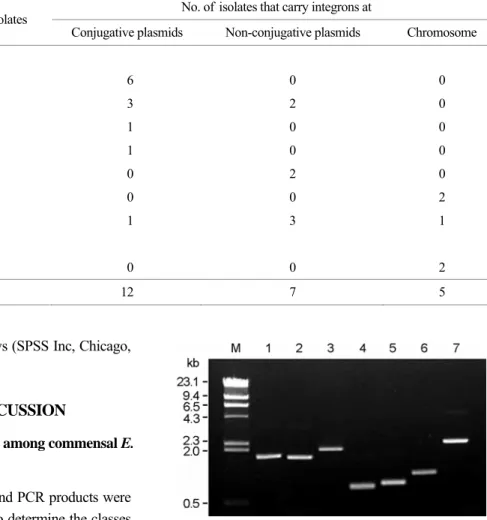
Six different cassette arrays of class 1 integrons were found in commensal E. coli isolates. dfrA17-aadA5 was the most prevalent, being found in six isolates, followed by dfrA1- aadA2 in five, dfrA7 in two, aadA1 in two, dfrA5 in one, and dfrA12-orfF-aadA2 in one (Table 1 and Fig. 1). Two intl2-positive E. coli isolates carried the dfrA1-sat-aadA1 Table 1. Characterization of integrons found in commensal E. coli isolates
No. of isolates that carry integrons at Cassette array No. of isolates
Conjugative plasmids Non-conjugative plasmids Chromosome Class 1 integrons
dfrA17-aadA5 6 6 0 0
dfrA1-aadA2 5 3 2 0
dfrA12-orfF-aadA2 1 1 0 0
dfrA5 1 1 0 0
dfrA7 2 0 2 0
aadA1 2 0 0 2
No cassettes 5 1 3 1
Class 2 integrons
dfrA1-sat-aadA1 2 0 0 2
Total 24 12 7 5
Figure 1. PCR amplification of gene cassette regions of class 1 and 2 integrons. Lane 1-6, class 1 integron carrying dfrA17-aadA5, dfrA1-aadA2, dfrA12-orfF-aadA2, dfrA5, dfrA7, and aadA1, resp- ectively. Lane 7, class 2 integron carrying dfrA1-sat-aadA1. Lane M, lambda DNA fragments digested with HindIII.
cassette array. All cassette arrays of class 1 integrons found in the current study were previously detected in Entero- bacteriaceae isolated from hospital-acquired infections in Korea (9,10,22,23).
The prevalence of each type of gene cassette found in commensal E. coli isolates in the current study was similar to that of the clinical E. coli isolates from Kyungpook National University Hospital, Daegu, Korea in the 1990s.
dfrA17-aadA5 and dfrA12-orfF-aadA2 were the most pre- valent in E. coli isolates from hospital-acquired infections since 1994 in Korea (23). dfrA1-aadA2 was the third most common in nosocomial E. coli isolates from the 1990s, but this type of class 1 integron was rarely detected in nosoco- mial E. coli isolates from the 2000s. aadA1 was the most common in nosocomial E. coli isolates from the 1980s, but the incidence of this type of class 1 integron sharply decre- ased in nosocomial E. coli isolates from the 1990s and finally was not detected in nosocomial E. coli isolates from the 2000s. dfrA7 was only detected in one clinical E. coli isolate from the 1990s.
Commensal fecal flora from humans can acquire resis- tance genes or integrons from food-producing animals.
However, the prevalence of class 1 integrons is totally diff- erent between commensal E. coli isolates from humans and food-producing animals (8). dfrA12-orfF-aadA2 and aadA1 were the most prevalent in commensal E. coli from poultry and swine in the 2000s, respectively. Furthermore, our pre- vious study demonstrated that pulsed-field gel electropho- resis patterns and restriction fragment length polymorphism patterns of the plasmids carrying identical cassette arrays were different between E. coli isolates from hospitalized patients and food-producing animals (8). This finding sug- gests that class 1 integrons found in commensal E. coli iso- lates from humans are not originated from food-producing animals.
3. Genetic localization of integrons among commensal E. coli isolates
To determine the transferability of integrons in E. coli isolates, a conjugation experiment was performed. Resis- tance to trimethoprim and/or streptomycin was conjugally transferred to a recipient E. coli strain in 12 (50.0%) of 24 isolates. The intl1 gene was detected in all transconjugants (Table 1). To differentiate the genetic location of integrons
in the 12 remaining E. coli isolates that did not transfer anti- microbial resistance, Southern hybridization with integrase gene probe was performed, which revealed that seven and three E. coli isolates carried class 1 integrons in the non- conjugative plasmids and chromosome, respectively. Class 2 integrons found in two commensal E. coli isolates were located in the chromosome (Table 1). R-plasmids from transconjugants carrying the identical cassette array showed the different RFLP patterns. The intl1 gene probe was hy- bridized with different fragments of DNA (data not shown).
These results suggest that R-plasmids carrying class 1 in- tegrons originate from different sources. Class 1 integrons harbored by commensal E. coli isolates may be acquired from other pathogenic or commensal bacteria by horizontal transfer. Although the present study did not directly characte- rize the transfer of class 1 integrons between commensal E.
coli isolates and Enterobacteriaceae from hospital-acquired infections, the influx of class 1 integrons from E. coli isolates from hospital-acquired infections was partly responsible for antimicrobial resistance in commensal E. coli isolates in the community. Our further investigations will examine whe- ther class 1 integrons are transferred horizontally between commensal E. coli isolates and Enterobacteriaceae from hospital-acquired infections.
4. Antimicrobial susceptibility of commensal E. coli isolates
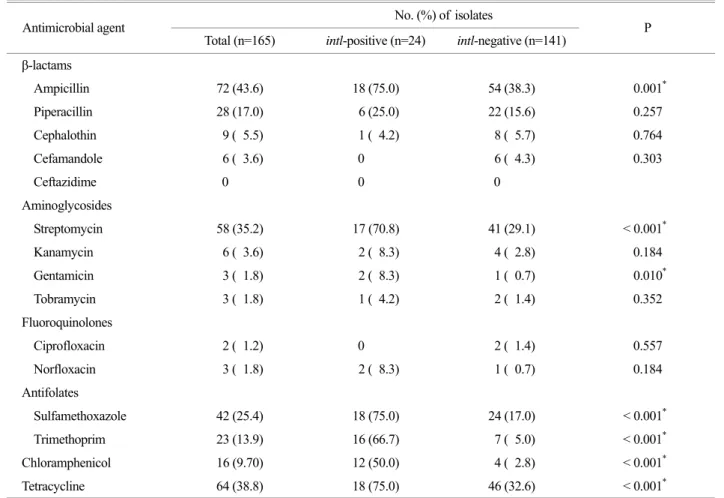
We examined the antimicrobial susceptibilities of com- mensal E. coli isolates to 15 antimicrobial agents. Resistance to ampicillin (43.6%) was the highest among the commensal E. coli isolates tested, whereas no isolates were resistant to third-generation cephalosporins such as ceftazidime (Table 2). Commensal E. coli isolates were moderately resistant to tetracycline (38.8%), streptomycin (35.2%), and sulfame- thoxazole (25.4%). Fifty-five (33.3%) commensal E. coli isolates were susceptible to the antimicrobial agents tested.
Our previous study investigated the differences in antimi- crobial susceptibility between commensal E. coli isolates and clinical E. coli isolates from hospital-acquired infections (8). The rates of resistance to antimicrobial agents were higher in clinical E. coli isolates from hospital-acquired in- fections than those of commensal E. coli isolates. Only 1.5%
of the clinical E. coli isolates from hospital-acquired infec- tions were susceptible to the antimicrobial agents tested.
These data suggest that the use of antimicrobial agents is an important selective force in the maintenance of antimicro- bial resistance in bacterial populations.
5. Multidrug resistance of integron-carrying com- mensal E. coli isolates
All commensal E. coli isolates carrying integrons were resistant to two or more antimicrobial agents, except for one isolate that was resistant to tetracycline (Fig. 2). This excep- tional tetracycline-resistant E. coli isolate carried the intl1 gene, but harbored empty gene cassettes. Integrons were not found in antimicrobial-susceptible E. coli isolates. The presence of an integron was significantly associated with multidrug resistance in commensal E. coli isolates (p<0.05), indicating that integrons are directly responsible for multi- drug resistance.
In conclusion, we suggest that class 1 integrons found in nosocomial pathogens can spread to and circulate in com- mensal fecal flora in the community. Integrons are directly responsible for resistance to trimethoprim and aminoglyco- sides and the presence of integrons is significantly associa- Table 2. Antimicrobial susceptibility of commensal E. coli isolates according to the presence of integrons
No. (%) of isolates Antimicrobial agent
Total (n=165) intl-positive (n=24) intl-negative (n=141) P
β-lactams
Ampicillin 72 (43.6) 18 (75.0) 54 (38.3) 0.001*
Piperacillin 28 (17.0) 6 (25.0) 22 (15.6) 0.257
Cephalothin 9 ( 5.5) 1 ( 4.2) 8 ( 5.7) 0.764
Cefamandole 6 ( 3.6) 0 6 ( 4.3) 0.303
Ceftazidime 0 0 0
Aminoglycosides
Streptomycin 58 (35.2) 17 (70.8) 41 (29.1) < 0.001*
Kanamycin 6 ( 3.6) 2 ( 8.3) 4 ( 2.8) 0.184
Gentamicin 3 ( 1.8) 2 ( 8.3) 1 ( 0.7) 0.010*
Tobramycin 3 ( 1.8) 1 ( 4.2) 2 ( 1.4) 0.352
Fluoroquinolones
Ciprofloxacin 2 ( 1.2) 0 2 ( 1.4) 0.557
Norfloxacin 3 ( 1.8) 2 ( 8.3) 1 ( 0.7) 0.184
Antifolates
Sulfamethoxazole 42 (25.4) 18 (75.0) 24 (17.0) < 0.001* Trimethoprim 23 (13.9) 16 (66.7) 7 ( 5.0) < 0.001* Chloramphenicol 16 (9.70) 12 (50.0) 4 ( 2.8) < 0.001* Tetracycline 64 (38.8) 18 (75.0) 46 (32.6) < 0.001*
* Asterisk indicates statistical significance
Figure 2. Multiplicity of antimicrobial resistance and its asso- ciation with the presence of integrons in commensal E. coli iso- lates. E. coli isolates were examined for antimicrobial suscepti- bility to 15 agents.
ted with multidrug resistance in commensal E. coli isolates.
Therefore, careful monitoring is necessary for the preven- tion of a wide dissemination of integrons and an increase of community-acquired infections by multidrug-resistant pathogens.
Acknowledgements
This study was supported by a grant from the Korea Health 21 R&D Project, Ministry of Health & Welfare, Republic of Korea (02-PJ1-PG3-20201-0005).
REFERENCES
1) Birnboim IC, Doly J: A rapid alkaline extraction proce- dure for screening recombinant plasmid DNA. Nucleic Acids Res 7: 1513-1523, 1979.
2) Collis CM, Grammaticopoulos G, Briton J, Stockes HW, Hall RM: Site-specific insertion of gene cassettes into integrons. Mol Microbiol 9: 41-52, 1993.
3) Fluit AC, Schmitz FJ: Class 1 integrons, gene cassettes, mobility, and epidemiology. Eur J Clin Microbiol Infect Dis 18: 761-770, 1999.
4) Goldstein C, Lee MD, Sanchez S, Hudson C, Phillips B, Register B, Grady M, Liebert C, Summers AO, White DG, Maurer JJ: Incidence of class 1 and 2 in- tegrase in clinical and commensal bacteria from lives- tock, companion, animals, and exotics. Antimicrob Agents Chemother 45: 723-726, 2001.
5) Guerra B, Junker E, Schroeter A, Malorny B, Leh- mann S, Helmuth R: Phenotypic and genotypic char- acterization of antimicrobial resistance in German Escherichia coli isolates from cattle, swine and poultry.
J Antimicrob Chemother 52: 489-492, 2003.
6) Hall RM, Collis CM: Mobile gene cassettes and in- tegrons: capture and spread of genes by site-specific recombination. Mol Microbiol 15: 593-600, 1995.
7) Hall RM, Collis CM: Antibiotic resistance in gram- negative bacteria: the role of gene cassettes and in- tegrons. Drug Resist. Updates 1: 109-119, 1998.
8) Kang HY, Jeong YS, Oh JY, Tae SH, Choi CH, Moon DC, Lee WK, Lee YC, Seol SY, Cho DT, Lee JC:
Characterization of antimicrobial resistance and class 1 integrons found in Escherichia coli isolates from humans and animals in Korea. J Antimicrob Chemother 55: 639
-644, 2005.
9) Kim KS, Oh JY, Jeong YW, Cho JW, Park JC, Cho DT, Lee JC: Epidemiological typing and characteri- zation of dfr genes of Shigella sonnei isolates in Korea during the last two decades. J Microbiol Biotechnol 12:
106-113, 2002.
10) Lee JC, Oh JY, Cho JW, Park JC, Kim JM, Seol SY, Cho DT: The prevalence of trimethoprim-resistance- conferring dihydrofolate reductase genes in urinary iso- lates of Escherichia coli in Korea. J Antimicrob Che- mother 47: 599-604, 2001.
11) Leverstein-van Hall MA, Box ATA, Blok HEM, Paauw A, Fluit AC, Verhoef J: Evidence of extensive interspecies transfer of integron-mediated antimicrobial resistance genes among multidrug-resistant Entero- bacteriaceae in a clinical setting. J Infect Dis 186: 49 -56, 2002.
12) Leverstein-van Hall MA, Fluit AC, Blok HE, Box AT, Peters ED, Weersink AJ, Verhoef J: Control of nosocomial multiresistant Enterobacteriaceae using a temporary restrictive antibiotic agent policy. Eur J Clin Microbiol Infect Dis 20: 785-791, 2001.
13) Leverstein-van Hall MA, Paauw A, Box ATA, Blok HEM, Verhoef J, Fluit AC: Presence of integrons- associated with resistance in the community is wide- spread and contributes to multidrug resistance in the hospital. J Clin Microbiol 40: 3038-3040, 2002.
14) Martinez-Freijo P, Fluit AC, Schmitz FJ, Grek VSC, Verhoef J, Jones ME: Class 1 integrons in Gram- negative isolates from different European hospitals and association with decreased susceptibility to multiple antibiotic compounds. J Antimicrob Chemother 42: 689 -696, 1998.
15) National Committee for Clinical Laboratory Stan- dards: Methods for Dilution Antimicrobial Suscepti- bility Tests for Bacteria that Grow Aerobically-Sixth Edition. Approved Standard M7-A6. National Commi- ttee for Clinical Laboratory Standards. Wayne, PA, USA.
2003.
16) Nield BS, Holmes AJ, Gillings MR, Recchia GD, Mabbutt BC, Nevalainen KM, Stokes HW: Recovery of new integron classes from environmental DNA.
FEMS Microbiol Lett 195: 59-65, 2001.
17) Poly MC, Denis F, Courvalin P, Lambert T: Mole-
cular characterization of integrons in Acinetobacter baumannii: description of a hybrid class 2 integron.
Antimicrob Agents Chemother 44: 2684-2688, 2000.
18) Recchia GD, Hall RM: Gene cassettes-a new class of mobile element. Microbiol 141: 3015-3027, 1995.
19) Rowe-Magnus DA, Guerout AM, Mazel D: Bacterial resistance evolution by recruitment of super-integron gene cassettes. Mol Microbiol 43: 1657-1669, 2002.
20) Sambrook J, Fritsch EF, Maniatis T: Molecular Clon- ing: a Laboratory Manual. pp 9.34-9.51, 2nd ed. Cold Spring Harbor Laboratory Press, Cold Spring Harbor, New York, 1989.
21) White PA, Mclver CJ, Rawlinson WD: Integrons and gene cassettes in the Enterobacteriaceae. Antimicrob
Agents Chemother 45: 2658-2661, 2001.
22) Yu HS, Lee JC, Kang HY, Jeong YS, Lee EY, Choi CH, Tae SH, Lee YC, Seol SY, Cho DT: Prevalence of dfr genes associated with integrons and dissemina- tion of dfrA17 among urinary isolates of Escherichia coli in Korea. J Antimicrob Chemother 53: 445-450, 2004.
23) Yu HS, Lee JC, Kang HY, Ro DW, Chung JY, Jeong YS, Tae SH, Choi CH, Lee EY, Seol SY, Lee YC, Cho DT: Changes in gene cassettes of class 1 integrons among Escherichia coli isolates from urine specimens collected in Korea during the last two decades. J Clin Microbiol 41: 5429-5433, 2003.