Printed in the Republic of Korea DOI 10.5012/jkcs.2010.54.02.198
요약. 독스핀 하이드로클로라이드 선택전극의 구조와 성능특징에 대하여 개발하였다. 전극의 3가지 형태가 있다. I. 플 라스틱 막 II. 코팅된 선형 III. 흑연으로 된 로드, 이것들은 암모늄 라이네케이트를 갖는 독스핀 하이드로클로라이드의 결합에 기초하여 구성되었다. 막의 조성, 가소제의 종류, 시험용액의 pH, 담궈 놓은 시간 그리고 전극에 있는 이질 이온 들의 영향을 조사했다. 25 oC에서 전극 I, II, III에 대해 각각 57.41 ± 0.5, 56.22 ± 0.2 and 52.88 ± 0.7 mV의 평균 보정 그래 프 기울기를 갖는 Nernst 반응을 보여준다. 그리고 전극 I, II, III에 대해 1 × 10⁻² -1 × 10⁻⁶ M, 5 × 10⁻² -1 × 10⁻⁶ M 그리고 1 × 10⁻³ -5 × 10⁻⁶ M의 독스핀 하이드로클로라이드 농도범위에 있고, 5.0 × 10⁻⁷M, 6.3 × 10⁻⁷ M 그리고 2.5 × 10⁻⁶ M의 검출한계 를 갖는다는 것을 보여준다. 만들어진 전극은 pH 3 - 7의 범위에서 선택적으로 정밀하고, 사용 가능한 평균을 보였다. 공 통양이온, 알칼로이드, 설탕 아미노산, 그리고 약품첨가제로부터의 방해가 기록되었다. 제안된 전극에 의해 얻어진 결 과는 약의 조세와 생물학적 유체에 있어서 약물의 확인에 성공적으로 적용되었다.
주제어: 플라스틱 막, 코팅된 선형 전극, 코팅된 흑연 로드, 이온선택전극, 독스핀 하이드로클로라이드
ABSTRACT. The construction and performance characteristics of doxepin hydrochloride selective electrodes were developed.
Three types of electrodes: plastic membrane I, coated wire II, and coated graphite rod III were constructed based on the incor- poration of doxepin hydrochloride with ammonium reineckate. The influence of membrane composition, kind of plasticizer, pH of the test solution, soaking time, and foreign ions on the electrodes was investigated. The electrodes showed a Nernstain response with a mean slope of 57.41 ± 0.5, 56.22 ± 0.2 and 52.88 ± 0.7 mV at 25 oC for electrode I, II and III respectively, over Doxepin hydrochloride concentration range from 1 × 10⁻² -1 × 10⁻⁶ M, 5 × 10⁻² -1 × 10⁻⁶ M and 1 × 10⁻³ -5 × 10⁻⁶ M, and with a detection limit 5.0 × 10⁻⁷ M, 6.3 × 10⁻⁷ M and 2.5 × 10⁻⁶ M for electrode I, II and III respectively. The constructed electrodes gave average selective precise and usable within the pH range 3 - 7. Interferences from common cations, alkaloids, sugars, amino acids and drug excipients were reported. The results obtained by the proposed electrodes were also applied successfully to the determination of the drug in pharmaceutical preparations and biological fluids.
Keywords: Plastic membrane, Coated wire electrode, Coated graphite rod, Ion-selective electrode, Doxepin hydrochloride
약의 조제와 생물학적 유체에서 독스핀 하이드로클로라이드의 확인을 위한 선택적 막 전극의 구성과 최적화
Maha El-Tohamy†, Sawsan Razeq†, Magda El-Maamly, and Abdalla Shalaby*
Analytical Chemistry Department, Faculty of Pharmacy, Zagazig University, Zagazig, Egypt
†Analytical Chemistry Department, Faculty of Pharmacy, Al-Azhar University, Cairo, Egypt (접수 2009. 12. 2; 수정 2010. 1. 29; 게재확정 2010. 2. 8)
Construction and Optimization of Selective Membrane Electrodes for Determination of Doxepin Hydrochloride in Pharmaceutical Preparations and Biological Fluids
Maha El-Tohamy†, Sawsan Razeq†, Magda El-Maamly, and Abdalla Shalaby*
Analytical Chemistry Department, Faculty of Pharmacy, Zagazig University, Zagazig, Egypt
*E-mail: [email protected]
†Analytical Chemistry Department, Faculty of Pharmacy, Al-Azhar University, Cairo, Egypt (Received December 2, 2009; Revised January 29, 2010; Accepted February 8, 2010)
INTRODUCTION
Doxepin hydrochloride, E-3-(dibenzo [b, e] oxepin-11 (6H)-ylidene)-N-N-dimethylpropan-1-amine hydrochloride (Fig. 1) is Doxepin is a psychotropic agent with antidepre- ssant and anxiolytic properties. It also has sedative and anti-
cholinergic effects, and, in the higher dosage range, it pro- duces peripheral adrenergic blocking effects.1
Several methods for its determination, both in body fluids and pharmaceuticals, including high performance liquid chro- matography,2-4 liquid chromatography coupled with mass spectrometry,5-7 gas chromatography,8 gas chromatography
HCl CH3
CH3
N
O
Fig. 1. Chemical Structure of Doxepin Hydrochloride.
coupled with mass spectrometry,9 Thin layer chromato- graphy,10 potentiometry.11 This work describes new selective membrane sensors, of three types: plastic membrane, coated wire and coated graphite electrodes for the determination of doxepin hydrochloride in pure solutions, pharmaceutical preparations and biological fluids.
EXPERIMENTAL Equipment
Jenway 3040 pH/mV meter (U. K.) with a doxepin-PVC membrane electrode type (I), doxepin-coated wire electrode type (II) or doxepin-coated graphite rod electrode type (III) in conjunction with double junction Ag/AgCl electrode (Orion 90-02) (Taiwan, R.O.C.) containing 10% w/v potassium nitrate in outer compartment. An Orion 91-02 glass-calomel combination electrode, (Taiwan, R.O.C.) was used for pH adjustment. All potentiometric measurements were carried out at 25 ± 1 oC with constant magnetic stirring.
Reagents
All chemicals used were analytical or pharmacopoeial grade. Doubly distilled water was used throughout the ex- periments. doxepin hydrochloride was provided by Pfizer Egypt, poly (vinyl chloride) PVC powder with high mole- cular weight was from Aldrich (Germany), di-butyl phthalate (DBP), di-octyl phthalate (DOP), di-butyl sebacate (DBS), o-nitrophenyl octyl ether (o-NPOE) were from Fluka (Buchs, Switzerland), ammonium reineckate, chloroform, acetone, hydrochloric acid and tetrahydrofuran (THF) were from Memphis-Delagrange (France), (Sinequan® capsules) were purchased from local drug stores. Stock doxepin hydrochlo- ride solution (1 × 10⁻¹ M) was prepared daily by dissolving an appropriate amount of the drug in double distilled water.
More dilute solutions were prepared by appropriate dilution.
Preparation of Doxepin-Reineckate Ion-pair
The ion-pair was prepared by mixing stoichiometric amo- unts of 1 × 10⁻² M ammonium reineckate with an equimolar solution of doxepin hydrochloride, stirred for 10 min. The resulting pink precipitate was filtered through G4 sintered
glass crucible and washed thoroughly with deionized water then dried at room temperature for 24 hours. The ion-pair should be stored in a desiccator.
Membrane Composition
The membrane composition was studied by varying the percentages (w/w) of the ion pair, poly (vinyl chloride) PVC and plasticizer (o-NPOE), until the optimum composition that exhibits the best performance characteristics was obtain- ed. The membranes were prepared by dissolving the required amount of the ion-pair, PVC and (o-NPOE), in 5 mL tetra- hydrofuran (THF). The solution mixture was poured into a petri dish (3 cm in diameter), covered with a filter paper and the solvent was allowed to evaporate slowly at room tem- perature. To obtain the uniform membrane thickness, the amount of (THF) was kept constant, and its evaporation was fixed for 24 h.
Electrode Construction
Plastic membrane electrode: A punched circular mem- brane was attached to a poly-ethylene tube (8 mm in dia- meter) in an electrode configuration by means of PVC-THF solution. A mixture containing equal volume of 1 × 10⁻³ M doxepin hydrochloride and potassium chloride was used as internal reference solution in which the Ag/AgCl reference electrode was dipped. The constructed electrode was pre- conditioned after preparation by soaking for at least 24 h in 1 × 10⁻³ M doxepin hydrochloride and stored in the same solution. All potentiometric measurements were performed using the following cell assembly: Ag/AgCl/Internal solution /membrane/test solution//KCl salt bridge//SCE.
Coated wire electrode: Pure aluminum wire of 4.0 cm length was tightly insulated by polyethylene tube leaving 1.0 cm at one end for the coating and 0.5 cm at the other end for connection. The coating solution was (described previ- ously under membrane composition). Prior to coating, the polished aluminum surface was washed with a detergent and water, thoroughly rinsed with water, and dried with acetone.
Then the wire was rinsed with chloroform and allowed to dry. Afterwards, the aluminum wire was coated by quickly dipping it into the coating solution several times, and allow- ing the film left on the wire to dry for about 3 min. The pro- cess was repeated several times until a plastic membrane of approximately 1.0 mm thickness was formed.12 The prepared electrode was conditioned by soaking for 3 h in 1.0 × 10⁻³ M doxepin hydrochloride solution. All potentiometric measure- ments were performed using the following cell assembly:
Al/membrane/test solution//KCl salt bridge//SCE.
Coated graphite electrode: A pure graphite rod of 4 mm
diameter was insulated by tight polyethylene tube, leaving 2 cm at one end for coating and 1 cm at the other end for co- nnection. The polished electrode surface was coated with the active membrane by dipping the exposed end into the coating solution was (described previously under membrane composition) ten times and allowing the film left on graphite rod to dry in air for 1 min each time. The process was repeat- ed until 1.0 mm thickness formed. The prepared electrode was preconditioned by soaking for 6 h in 1.0 × 10⁻³ M doxepin hydrochloride solution.13
Electrode Calibration
10 mL aliquots of 1 × 10⁻¹ -1 × 10⁻⁶ M standard doxepin hydrochloride solutions were transferred into 50 mL beaker and the sensor(s) in conjunction with double junction Ag/
AgCl reference electrode were immersed in the solution.
The measured potential was plotted against the logarithm of drug concentration. The electrode(s) was washed with deionized water and dried with tissue paper between mea- surements.
Effect of pH
The effect of pH on the potential of the electrode(s) was measured using two pH/mV meters. The combined glass calomel electrode was connected to one instrument and the doxepin-electrode(s) with the double junction Ag/AgCl re- ference electrode was connected to the second instrument.
Thirty mL aliquots of 1 × 10⁻³ M, drug solution were trans- ferred to a 100 mL beaker where the electrodes were immers- ed, the potential readings corresponding to different pH values were recorded. The pH was gradually increased or decreased by addition of small aliquots of dilute solutions of 0.1 N sodium hydroxide or 0.1 N hydrochloric acid res- pectively, and the pH-mV was measured and plotted.
Sensor Selectivity
Selectivity coefficients were determined by the separate solution method14 in which the following equation was applied.
Pot. 1/z
Log KDox. J z+ = (E2 – E1) / S + log [Dox ] – log [Jz+].
Where, E1 is the electrode potential in 1 × 10⁻³ M doxepin hydrochloride solution. E2 is the potential of the electrode in 1 × 10⁻³ M solution of the interferent ion Jz+ and S is the slope of the calibration plot. The selectivity of the electrode(s) towards sugars, amino acids, certain cations and alkaloids was studied.
Standard Addition Method
The fabricated electrode(s) was immersed into sample of 50 mL with unknown concentration (ca. 1 × 10⁻⁴ M) and the equilibrium potential of E1 was recorded. Then 0.1 mL of 1 × 10⁻¹ M of standard drug solution was added into the testing solution and the equilibrium potential of E2 was ob- tained, from the change of ∆E (E2-E1) one can determine the concentration of the testing sample. The standard addition technique was used for the analysis of doxepin hydrochlo- ride in capsules.15
Analytical Applications
Doxepin Hydrochloride Capsules: The content of ten cap- sules of doxepin hydrochloride were finely powdered and shaken with 100 mL distilled water to obtain different con- centrations in the range of 1 × 10⁻² -1 × 10⁻⁵ M. The prepared solutions were adjusted to pH 4 using 0.1 N dilute hydro- chloric acid. The doxepin-electrode(s) were immersed in the solution. The electrode(s) system was allowed to equilibrate with stirring and the e.m.f. was recorded and compared with the calibration graph.
Content Uniformity Assay of Doxepin Hydrochloride Capsules: Ten individual capsules of 75 mg/cap were placed in separate 100 mL beakers and dissolved in 90 - 100 mL of distilled water. The electrode(s) was directly immersed into 100 mL of each sample for five times and should be washed with deionized water to reach steady potential between the individual measurements. The mean potential was used to evaluate the content uniformity from the calibration graph.
Application to serum and urine:Adjust urine pH to 5 (using 0.1 N hydrochloric acid) and pH of serum to 6 (use phosphate buffer). Add hydrochloric acid to urine and phos- phate buffer to serum dropwise until the suitable pH obtained.
Transfer 5 mL previously adjusted urine or serum into small separatory funnels, and then separately add 5 mL, 10-3, 10-4 and 10-5,10-6 M standard drug solution, followed by the addi- tion of 20 mL toluene for urine or 20 mL diethyl ether for serum. Shake each funnel for 5 min, and transfer aqueous layer to centrifuge tube. Centrifuge for 2 min at 1500 rpm, transfer each solution to a 50 mL volumetric flask, and dilute to volume with deionized water. Apply above procedure as described under electrode calibration.16
RESULTS AND DISCUSSION Optimization of Membrane Composition
The effect of membrane composition on the potentiometric response of the electrodes was investigated by varying the proportion of the membrane active phase to the plasticizer
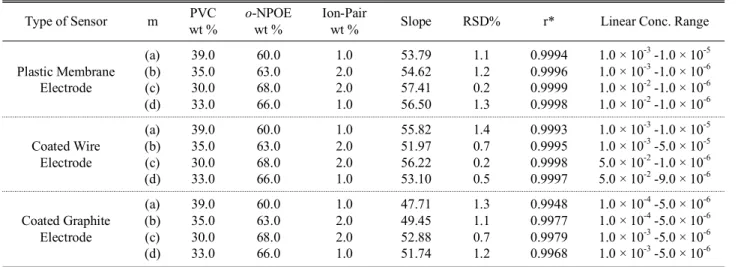
Table 1. Optimization of Membrane Composition (wt/wt %)
Type of Sensor m PVC
wt %
o-NPOE wt %
Ion-Pair
wt % Slope RSD% r* Linear Conc. Range
Plastic Membrane Electrode
(a) (b) (c) (d)
39.0 35.0 30.0 33.0
60.0 63.0 68.0 66.0
1.0 2.0 2.0 1.0
53.79 54.62 57.41 56.50
1.1 1.2 0.2 1.3
0.9994 0.9996 0.9999 0.9998
1.0 × 10⁻³ -1.0 × 10⁻⁵ 1.0 × 10⁻³ -1.0 × 10⁻⁶ 1.0 × 10⁻² -1.0 × 10⁻⁶ 1.0 × 10⁻² -1.0 × 10⁻⁶
Coated Wire Electrode
(a) (b) (c) (d)
39.0 35.0 30.0 33.0
60.0 63.0 68.0 66.0
1.0 2.0 2.0 1.0
55.82 51.97 56.22 53.10
1.4 0.7 0.2 0.5
0.9993 0.9995 0.9998 0.9997
1.0 × 10⁻³ -1.0 × 10⁻⁵ 1.0 × 10⁻³ -5.0 × 10⁻⁵ 5.0 × 10⁻² -1.0 × 10⁻⁶ 5.0 × 10⁻² -9.0 × 10⁻⁶
Coated Graphite Electrode
(a) (b) (c) (d)
39.0 35.0 30.0 33.0
60.0 63.0 68.0 66.0
1.0 2.0 2.0 1.0
47.71 49.45 52.88 51.74
1.3 1.1 0.7 1.2
0.9948 0.9977 0.9979 0.9968
1.0 × 10⁻⁴ -5.0 × 10⁻⁶ 1.0 × 10⁻⁴ -5.0 × 10⁻⁶ 1.0 × 10⁻³ -5.0 × 10⁻⁶ 1.0 × 10⁻³ -5.0 × 10⁻⁶
Table 2. Critical Response Characteristics of Sensors
Parametera Doxepin-RK plastic membrane electrode
Doxepin-RK coated wire electrode
Doxepin-RK coated graphite electrode
Slope (mV per decade) Intercept
Correlation coefficient r.
Linear range (M) Detection limit (M) Response timefor 10-3 M (s) Working pH range
Lifetime/day Accuracy (%) Standard deviation (%) Repeatability (CVw %)
Between day variability (CVb %) Robustnessb
Ruggednessc
57.41 ± 0.5 474.23 0.9998 1.0 × 10⁻² -1.0 × 10⁻⁶
5.0 × 10⁻⁷ 30 3 ~ 7
25 99.42
0.6 0.7 0.9 99.75 ± 0.2 99.89 ± 0.4
56.22 ± 0.2 413.87 0.9998 5.0 × 10⁻² -1.0 × 10⁻⁶
6.3 × 10⁻⁷ 20 3 ~ 7
30 99.56
0.5 0.6 0.8 99.96 ± 0.4 99.91 ± 0.1
52.88 ± 0.7 527.49 0.9979 1.0 × 10⁻³ -5.0 × 10⁻⁶
2.5 × 10⁻⁶ 45 3 ~ 7
15 99.37
0.4 0.5 0.7 99.84 ± 0.9 99.77 ± 0.8
aMean of six measurements. bA small variation in method parameters were as pH of buffer. cComparing the results by those obtained by different sensors assemblies using (Orion 420A).
and PVC ratio. It is obvious that both kind of plasticizer selected and the membrane composition used can influence the response performances (such as the sensitivity, linear concentration range, the detection limit, the response time etc.) of PVC membrane sensors, if other properties of the sensor, e.g. selectivity or pH response, are omitted. In this study four membrane compositions were investigated, the results were summarized in Table 1. The results showed that the electrode(s) made by membrane of type (c) with 2.0 wt % doxepin-reineckate ion pair, 30.0 wt % PVC and 68.0 wt % plasticizer o-NPOE exhibits the best performance characteristics (slope 57.41 ± 0.5, 56.22 ± 0.2 and 52.88 ± 0.7 mV decade-1 at 25 oC for electrode I, II and III respecti- vely, over doxepin concentration range from 1 × 10⁻² -1 ×
10-6 M, 5 × 10⁻² -1 × 10⁻⁶ M and 1 × 10⁻³ -5 × 10⁻⁶ M, for electrode I, II and III respectively.
Nature and Response Characteristics of the Sensors Doxepin reacts with ammonium reineckate to form a stable doxepin-reineckate ion-pair complex which is water insoluble but readily soluble in an organic solvent such as tetrahydrofuran. The complex was prepared and tested as active material with o-nitrophenyl octyl ether as a solvent mediator in a poly (vinyl chloride) membrane response for doxepin. The critical response characteristics of plastic membrane, coated wire, and coated graphite electrodes were determined and results are summarized in Table 2. The elec- trode(s) exhibits a Nernstain response over the concentration
1 2 3 4 5 6 7 8
-log conc. of doxepin hydrochloride (M)
500
400
300
200
100
0
Electrode potential/mV
Fig. 2. Typical calibration graph of doxepin sensors: (●) Doxepin- plastic membrane, (■) Doxepin-coated wire, (○) Doxepin-coated graphite sensors.
0 1 2 3 4 5 6 7
-log conc. of doxepin hydrochloride (M)
400
300
200
100
0
Electrode potential/mV
Fig. 3. Optimization of plasticizers. DBP (●) (PVC membrane composition: DBP 63.0 wt %, PVC 35.0 wt %, ion-pair, 2.0 wt %) DOP (○) (PVC membrane composition: DOP 66.0 wt %, PVC 33.0 wt %, ion pair, 1.0 wt %) DBS (▼) (PVC membrane Composition:
DBS 60.0 wt %, PVC 39.0 wt %, ion-pair, 1.0 wt %) o-NPOE () (PVC membrane composition: o-NPOE 68.0 wt %, PVC 30.0 wt
%, ion-pair 2.0%).
range from 1 × 10⁻² -1 × 10⁻⁶ M, 5 × 10⁻² -1 × 10⁻⁶ M and 1 × 10⁻³ -5 × 10⁻⁶ M doxepin for electrode I, II and III respec- tively, with a cationic slope of 57.41 ± 0.5, 56.22 ± 0.2 and 52.88 ± 0.7 mV decade-1 change in concentration for elect- rode I, II and III respectively as in Fig. 1. The choice of membrane solvent to achieve the required selectivity is based on its electric permittivity and its immiscibility with aqueous phase, high viscosity, low solubility of the matrix in the membrane and ability to dissolve ion-pair complex.
Effect of Plasticizer
In this study, four plasticizers. di-butylphthalate (DBP),
di-octylphthalate (DOP), di-butyl sebacate (DBS) and o- nitrophenyl octyl ether (o-NPOE), were used to examine the optimization of the membrane with plasticizer entailed the use of plasticizer content ratio, 63.0, 66.0, 60.0 and 68.0 wt
%, and the use of PVC contents of 35.0, 33.0, 39.0 and 30.0 wt %. The electroactive compound (doxepin-reineckate) contents of 2.0, 1.0, 1.0 and 2.0 wt %. The results obtained showed that the response performances of the prepared membranes were rather different depending on the use of plasticizer, the proportion of the plasticizer toward PVC and of the electroactive compound. The typical potential res- ponses of the electrodes constructed with four plasticizers were given in Fig. 3. As shown in Fig. 3, the o-NPOE-PVC electrodes were superior to DBP- , DOP and DBS-PVC electrodes in both the response slope and linear concent- ration range. So o-NPOE was selected as the plasticizer of the membranes. The best membrane composition of the o-NPOE-PVC electrode(s) was 30.0 wt % PVC, 68.0 wt % o-NPOE and 2.0 wt % ion-pair.
Effect of Soaking
The performance characteristics of doxepin-reineckate electrode(s) was studied as a function of soaking time. For this purpose the electrode(s) was soaked in 1 × 10⁻³ M solu- tion of doxepin hydrochloride and the calibration graphs were plotted after 6, 3, and 8 h. the optimum soaking time was found to be 6, 3 and 8 h at which the slope of the cali- bration curve was 57.41 ± 0.5, 56.22 ± 0.2 and 52.88 ± 0.7 mV decade-1, at 25 oC for electrode I, II and III, respectively.
The influence of prolonged soaking on the lifetime of doxe- pin-reineckate electrode(s) was followed by constructing calibration plots. The electrode(s) was soaked continuously on 1 × 10⁻³ M solution of doxepin hydrochloride for 24 h, 7, 15, 18, 25 and 30 days. The calibration plot slopes decreased slightly to 54.10, 53.86 and 48.55 mV decade-1 after 18 days for electrode I, II and III respectively, and continued to de- crease reaching 50.49, 51.90 mV decade-1 after 25 days for electrode I and II respectively. The slope of the electrode(s) was dropped to 47.37 and 49.54 mV decade-1 after 30 days for electrode I and II respectively. Fig. 4, showing the effect of prolonged soaking time and the life span of the doxepin- reineckate electrodes.
Regeneration of the Electrode
The above discussion reveals that soaking of the elect- rode(s) in the drug solution for a long time has a negative effect on the response of the membrane. The same effect appears after working with the electrode(s) for a long time.
The regeneration of the electrode(s) was tried simply by reformation of the ion-exchange on the external gel layer
1 2 3 4 5 6 7
-log conc. of doxepin hydrochloride (M)
400
300
200
100
0
Electrode potential/mV
Fig. 4. Calibration graphs obtained at 25 ± 1 oC after soaking the doxepin-reineckate plastic membrane electrode for (●) 6 h, () 24 h, (▼) 7 days, (○) 15 days, (■) 18 days, (∆) 25 days, (+) 30 days.
1 2 3 4 5 6 7
-log conc. of doxepin hydrochloride (M)
500
400
300
200
100
Electrode potential/mV
Fig. 5. Regeneration of doxepin-reineckate plastic membrane sensor (●) exhausted electrode (▼) regenerated electrode.
1 2 3 4 5 6 7
-log conc. of doxepin hydrochloride (M)
500
400
300
200
100
Electrode potential/mV
Fig. 6. Regeneration of doxepin-reineckate coated wire sensor (●) exhausted electrode (○) regenerated electrode.
2.5 3.0 3.5 4.0 4.5 5.0 5.5
-log conc. of doxepin hydrochloride (M)
400 380 360 340 320 300 280 260
Electrode potential/mV
Fig. 7. Regeneration of doxepin-reineckate coated graphite sensor (●) exhausted electrode (▼) regenerated electrode.
of membrane.17 The regeneration of the doxepin membrane was successfully achieved by soaking the exhausted elect- rode(s) for 24 h in a solution that was 1 × 10⁻² M ammonium reineckate, followed by soaking for 3 h in 1 × 10⁻² M doxepin hydrochloride solution. Fig. 5-7, showing the calibration graphs for an exhausted electrode(s) (slopes 47.37, 49.54 and 48.55 mV decade-1) for electrode I, II and III respectively, and for the same electrode(s) after regeneration (slopes 55.20, 54.90 and 50.28 mV decade-1) for electrode I, II and III res- pectively. It was found that the lifespan of the regenerated electrode(s) is limited to 6 h due to the ease of leaching of the lipophilic salts from the gel layer at the electrode(s) surface compared with those that are attached homogeneously to the PVC network through the solvent mediator.
Effect of pH
The effect of pH of the doxepin hydrochloride solutions using 1 × 10⁻³ M doxepin on the electrode(s) potential was investigated. The solutions were acidified by the addition of very small volumes of hydrochloric acid 0.1 N then the pH value was increased gradually using sodium hydroxide 0.1 N for each pH value, the potential was recorded and thus the potential-pH curves for doxepin concentration was con- structed as in Fig. 8. As is obvious, within the pH range 3 - 7 for all electrodes. The electrode(s) potential is practically independent of pH, and in this range the electrode(s) can be safely used for doxepin hydrochloride determination. The potential decrease at higher pH values is most probably attri- buted to the formation of the ionization of the hydroxyl group,
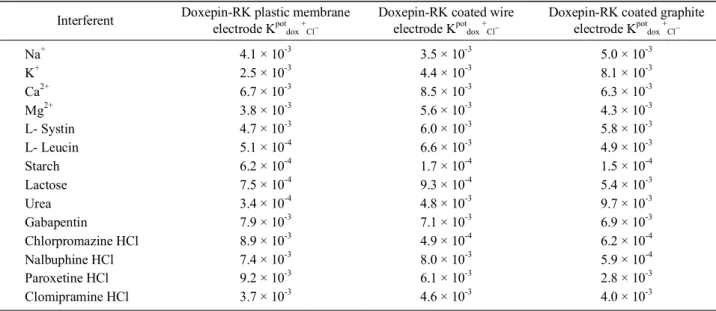
Table 3. Selectivity coefficients of the doxepin-RK sensors calculated by the separate solution method (1.0 × 10⁻³ M of both doxepin hydrochloride and interferent) at 25 oC
Interferent Doxepin-RK plastic membrane electrode Kpotdox +
Cl_ Doxepin-RK coated wire electrode Kpotdox +
Cl_ Doxepin-RK coated graphite electrode Kpotdox +
Cl_
Na+ K+ Ca2+
Mg2+
L- Systin L- Leucin Starch Lactose Urea Gabapentin
Chlorpromazine HCl Nalbuphine HCl Paroxetine HCl Clomipramine HCl
4.1 × 10⁻³ 2.5 × 10⁻³ 6.7 × 10⁻³ 3.8 × 10⁻³ 4.7 × 10⁻³ 5.1 × 10⁻⁴ 6.2 × 10⁻⁴ 7.5 × 10⁻⁴ 3.4 × 10⁻⁴ 7.9 × 10⁻³ 8.9 × 10⁻³ 7.4 × 10⁻³ 9.2 × 10⁻³ 3.7 × 10⁻³
3.5 × 10⁻³ 4.4 × 10⁻³ 8.5 × 10⁻³ 5.6 × 10⁻³ 6.0 × 10⁻³ 6.6 × 10⁻³ 1.7 × 10⁻⁴ 9.3 × 10⁻⁴ 4.8 × 10⁻³ 7.1 × 10⁻³ 4.9 × 10⁻⁴ 8.0 × 10⁻³ 6.1 × 10⁻³ 4.6 × 10⁻³
5.0 × 10⁻³ 8.1 × 10⁻³ 6.3 × 10⁻³ 4.3 × 10⁻³ 5.8 × 10⁻³ 4.9 × 10⁻³ 1.5 × 10⁻⁴ 5.4 × 10⁻³ 9.7 × 10⁻³ 6.9 × 10⁻³ 6.2 × 10⁻⁴ 5.9 × 10⁻⁴ 2.8 × 10⁻³ 4.0 × 10⁻³
0 2 4 6 8 10
pH
400
300
200
Electrode potential/mV
Fig. 8. Effect of pH on potential/mV of Doxepin-reineckate sen- sors using 1 × 10⁻³ M (○) Electrode potential/mV for plastic membrane electrode, (●) Electrode potential/mV for coated wire electrode, (■) Electrode potential/mV for coated graphite electrode.
leading to a decrease in the concentration of the doxepin ion.
Selectivity of the electrode
Potentiometric selectivity coefficients were evaluated by the separate solution method. Table 3, showed that the pro- posed doxepin-reineckate membrane electrode(s) is highly selective toward doxepin. The electrode(s) showed no res- ponse to a number of potentially interfering ionic excipients usually used in the manufacturing of the pharmaceutical pre- parations, such as starch and lactose. In the case of amino acids, the high selectivity is mainly attributed to the diffe-
rence in polarity and lipophilic character of their molecules relative to doxepin.
Quantification, of the Doxepin Hydrochloride
Direct potentiometric determination of doxepin hydro- chloride using doxepin-reineckate electrode(s) type I, II and III, was performed and calculated from the calibration curve.
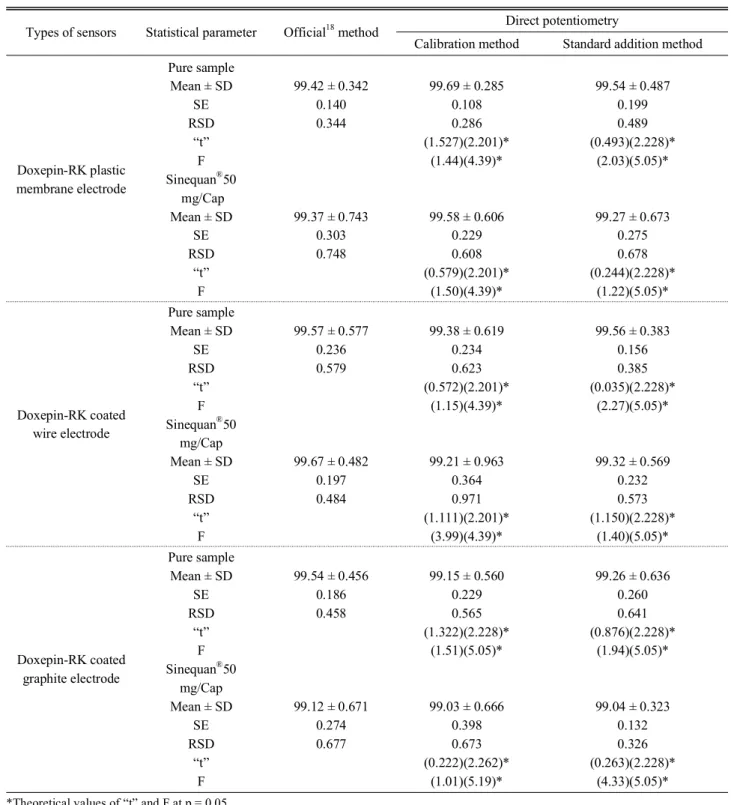
The direct potentiometric determination of doxepin hydro- chloride in pure form using the proposed electrodes gave average recovery % of 99.54 ± 0.5, 99.56 ± 0.3 and 99.26 ± 0.6 for electrode I, II and III respectively. Furthermore, the results obtained were compared with the official method,18 (potentiometric titration using 0.1 M sodium perchloric acid, until the colour change from blue to green using 0.2 mL of crystal violet solution as indicator), and the results are listed in Table 5.
The Validation of the Proposed Method
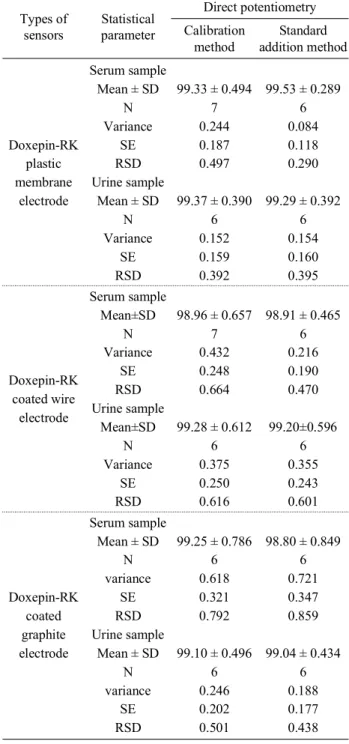
The accuracy of the proposed method was investigated by the determination of doxepin hydrochloride in spiked placebo samples prepared from serial concentrations of doxepin re- ference standards. The results summarized in Table 6, show that the proposed method is an accurate one for the deter- mination of doxepin hydrochloride in their pharmaceutical preparations without interfering from the coformulated adju- vants as indicated by the percentage recovery values.
The linearity, under the optimal experimental conditions, linear relationships exist between the electrode potential/mV and the logarithm of corresponding concentration of the in- vestigated drug. The regression data, correlation coefficients
Table 4. Determination of doxepin hydrochloride in pure form and pharmaceutical formulations in comparison with official method Types of sensors Statistical parameter Official18 method Direct potentiometry
Calibration method Standard addition method
Doxepin-RK plastic membrane electrode
Pure sample Mean ± SD
SE RSD
“t”
F Sinequan®50
mg/Cap Mean ± SD
SE RSD
“t”
F
1 99.42 ± 0.342
0.140 0.344 1 1 1 1 99.37 ± 0.743
0.303 0.748
1 99.69 ± 0.285
0.108 0.286 (1.527)(2.201)*
(1.44)(4.39)*
1 1 99.58 ± 0.606
0.229 0.608 (0.579)(2.201)*
(1.50)(4.39)*
1 99.54 ± 0.487
0.199 0.489 (0.493)(2.228)*
(2.03)(5.05)*
1 1 99.27 ± 0.673
0.275 0.678 (0.244)(2.228)*
(1.22)(5.05)*
Doxepin-RK coated wire electrode
Pure sample Mean ± SD
SE RSD
“t”
F Sinequan®50
mg/Cap Mean ± SD
SE RSD
“t”
F
1 99.57 ± 0.577
0.236 0.579 1 1 1 1 99.67 ± 0.482
0.197 0.484
1 99.38 ± 0.619
0.234 0.623 (0.572)(2.201)*
(1.15)(4.39)*
1 1 99.21 ± 0.963
0.364 0.971 (1.111)(2.201)*
(3.99)(4.39)*
1 99.56 ± 0.383
0.156 0.385 (0.035)(2.228)*
(2.27)(5.05)*
1 1 99.32 ± 0.569
0.232 0.573 (1.150)(2.228)*
(1.40)(5.05)*
Doxepin-RK coated graphite electrode
Pure sample Mean ± SD
SE RSD
“t”
F Sinequan®50
mg/Cap Mean ± SD
SE RSD
“t”
F
1 99.54 ± 0.456
0.186 0.458 1 1 1 1 99.12 ± 0.671
0.274 0.677
1 99.15 ± 0.560
0.229 0.565 (1.322)(2.228)*
(1.51)(5.05)*
1 1 99.03 ± 0.666
0.398 0.673 (0.222)(2.262)*
(1.01)(5.19)*
1 99.26 ± 0.636
0.260 0.641 (0.876)(2.228)*
(1.94)(5.05)*
1 1 99.04 ± 0.323
0.132 0.326 (0.263)(2.228)*
(4.33)(5.05)*
*Theoretical values of “t” and F at p = 0.05
(r) and other statistical parameter are previously listed in Table 2.
The precision of the proposed ISE method, measured as percentage relative standard deviation (RDS %) was tested by repeating the proposed method for determination of the
investigated drug in its pharmaceutical preparations to nine replicates. The RSD% values for the repeated determinations were 0.341%, 0.598% and 0.455% for determination of doxepin hydrochloride in Sinequan® 50 mg/capsule using electrode I, II and III respectively, and 0.838 %, 0.985 %
Table 5. Determination of doxepin hydrochloride in human serum and urine
Types of sensors
Statistical parameter
Direct potentiometry Calibration
method
Standard addition method
Doxepin-RK plastic membrane
electrode
Serum sample Mean ± SD
N Variance
SE RSD Urine sample
Mean ± SD N Variance
SE RSD
1 99.33 ± 0.494
7 0.244 0.187 0.497 1 99.37 ± 0.390
6 0.152 0.159 0.392
1 99.53 ± 0.289
6 0.084 0.118 0.290 1 99.29 ± 0.392
6 0.154 0.160 0.395
Doxepin-RK coated wire
electrode
Serum sample Mean±SD
N Variance
SE RSD Urine sample
Mean±SD N Variance
SE RSD
1 98.96 ± 0.657
7 0.432 0.248 0.664 1 99.28 ± 0.612
6 0.375 0.250 0.616
1 98.91 ± 0.465
6 0.216 0.190 0.470 1 99.20±0.596
6 0.355 0.243 0.601
Doxepin-RK coated graphite electrode
Serum sample Mean ± SD
N variance
SE RSD Urine sample
Mean ± SD N variance
SE RSD
1 99.25 ± 0.786
6 0.618 0.321 0.792 1 99.10 ± 0.496
6 0.246 0.202 0.501
1 98.80 ± 0.849
6 0.721 0.347 0.859 1 99.04 ± 0.434
6 0.188 0.177 0.438
and 0.486% in Sinequan® 75 mg/Capsule using electrode I, II and III respectively. The above RSD% values are less than 2% indicating good precision.
The robustness of the proposed method was tested by investigating the capacity of the method to remain unaffected by a small but a deliberate variation in method parameters and provide an indication of its reliability during normal usage. While the ruggedness of the proposed method was
investigating the degree of reproducibility at test results ob- tained by the analysis of the same samples under a variety of conditions such as different laboratories, analysts and instruments. The results obtained by using another model of pH-meter (Orion 420 A) were compared with those obtained using model of pH-meter (Jenway 3040). The obtained re- sults are close and also reveal validity of the method. The results previously listed in Table 2.
The detection limit of the investigated drug was calculated according to IUPAC recommendation which stated that the detection limit is the concentration at which the measured potential differs from that predicted by the linear regression by more than 18 mV. The values were previously reported in Table 2; indicate that the proposed ISE method is sensitive for detection of very small concentrations of doxepin hydro- chloride.
The Electrode Response in Pharmaceuticals and Biological Fluids
The use of doxepin hydrochloride drug in various clinical fields has necessitated an accurate and rapid, quantitative analysis in various matrices (dosage forms and biological fluids). This work proposed a fast, simple, easy, sensitive and straightforward potentiometric method to determine doxepin hydrochloride in dosage forms without the need for prior separation and preconcentration or derivatization procedures.
The potential of the doxepin-reineckate sensors showed no significant difference of response time between aqueous solution of pure drug and its solutions from pharmaceutical preparations and biological fluids. The proposed method described good accuracy and precise for the quality control tests, the content uniformity assay showed that the (R.S.D <
1%), with mean standard deviation 99.59 ± 0.6, 99.72 ± 0.6 and 99.45 ± 0.8 for electrode I, II and III respectively.
CONCLUSION
The described potentiometric methods have simple work- up procedures and require no sophisticated instrumentation.
The results obtained also show that the constructed elect- rodes provide response suitable for analytical use in the de- termination of doxepin hydrochloride in drug bulk powder, dosage forms and biological fluids. Apart from showing linear response within wide pH and concentration ranges with high accuracy and sensitivity, they also have high selectivity, reproducibility, simplicity and rapidity. This conclusion is justified by the results obtained from the analysis of phar- maceutical preparations, for which precise and accurate re- coveries were obtained.
Table 6. Determination of doxepin hydrochloride in doxepin-spiked placebo samples using doxepin-reineckate sensors
Statistical Parameter
Sample of capsules placebo Doxepin-RK plastic membrane
electrode
Doxepin-RK coated wire
electrode Doxepin-RK coated graphite electrode
Added (M) Found -log conc. (M)
Recovery
%
Added (M)
Found -log conc. (M)
Recovery
%
Added (M)
Found -log conc. (M)
Recovery
% 1 × 10⁻⁶
3 × 10⁻⁶ 5 × 10⁻⁶ 1 × 10⁻⁵ 3 × 10⁻⁵ 5 × 10⁻⁵ 1 × 10⁻⁴ 3 × 10⁻⁴ 5 × 10⁻⁴
5.99 5.49 4.93 4.28 4.48 4.27 3.98 3.47 3.27
99.83 99.82 98.60 99.51 99.56 99.28 99.50 99.14 99.06
1 × 10⁻⁶ 3 × 10⁻⁶ 5 × 10⁻⁶ 1 × 10⁻⁵ 3 × 10⁻⁵ 5 × 10⁻⁵ 1 × 10⁻⁴ 3 × 10⁻⁴ 5 × 10⁻⁴
6.0 5.48 5.27 4.98 4.47 4.29 4.0 3.46 3.24
100.00 99.64 99.42 99.60 99.33 99.74 100.00 98.86 98.15
1 × 10⁻⁶ 3 × 10⁻⁶ 5 × 10⁻⁶ 1 × 10⁻⁵ 3 × 10⁻⁵ 5 × 10⁻⁵ 1 × 10⁻⁴ 3 × 10⁻⁴ 5 × 10⁻⁴
6.01 5.46 5.29 4.96 4.49 4.26 4.01 3.48 3.27
100.17 99.27 99.79 99.20 99.78 99.05 100.25 99.43 99.06 N
Mean SD RSD
9 99.37 0.393 0.395
9 99.42 0.591 0.594
9 99.56 0.460 0.462
REFERENCES
1. Hajak, G.; Rodenbeck, A.; Voderholzer, U. J. Clin. Psychiatry 2001, 62(6), 453.
2. Han Park, Y.; Goshorn, C.; Hinsvark, O. N. J. Chromatogr., B 1986, 375, 202.
3. Emm, T.; Lesko, L. J.; Perkal, M. B. J. Chromatogr. B 1987, 419, p 441.
4. Dilger, C.; Salama, Z.; Jaeger, H. Arzneimittel-Forschung 1988, 38(10), 1525.
5. Hummel, D.; Löffler, D.; Fink, G.; Ternes, T. A. Environ. Sci., Techno 2006, 40(23), 7321.
6. Kirchherr, H.; Kühn-Velten, W. N. J. Chromatogr., B 2006, 843(1), 100.
7. Titier, K.; Castaing, N.; Le-Déodic, M.; Le-Bars, D.; Moore, N.; Molimard, M. J. Anal. Toxico. 2007, 31(4), 200.
8. Tammilehto, S.; Heikkinen, L.; Jarvela, P. J. Chromatogr. A
1982, 246(2), 308.
9. Rana, S.; Uralets, V. P.; Ross, W. J. Analytical Toxico. 2008, 32(5), 355.
10. Misztal, G.; Hopkata, H.; Stawik, T. Acta Pol., Pharm. 1997, 54(4), 257, 259.
11. Valsami, G. N.; Koupparis, M. A.; Macheras, P. E. Pharm. Res.
1992, 9(1), 94.
12. Arvand, M.; Mousavi, M. F.; Zanjanchi, M. A.; Shamsipur, M.
J. Pharm. Biomed., Anal. 2003, 33, 975.
13. Zayed, S. I. M. Japan Soci., Anal., Chem. 2004, 20, 1043.
14. Badawy, S. S.; Shoukry, Y. M. Analyst 1986, 111, 1363.
15. Buck, R. P.; Lindner, E. Pur. Appl. Chem. 1994, 66, 2527.
16. Khadiga, M. K. J. AOAC 2004, 87(6), 1309.
17. Linder, E.; Toth, K.; Pungor, E. Dynamic characteristics of Ion-selective electrodes. Chemical Rubber Company (CRC) Press, 1988, Boca Raton, FL.
18. British Pharmacopoeia, electronic edition, 2007.