Development and Implementation of Clinical Practice Guidelines: Current Status in Korea
Documentation of unexplained geographic variations in medical practices and use of inappropriate interventions has led to the proliferation of clinical practice guidelines. With increased enthusiasm for guidelines, evidence exists that clinical practice guidelines often influence clinical practices or health outcomes. Their successful implementation may improve the quality of care by decreasing in appropriate variation and expediting the application of effective advances to healthcare practices. In Korea, physicians and healthcare professionals have begun to take interests in clinical practice guidelines.
Currently, over 50 practice guidelines have been developed through professional academic organizations or via other routes; however, the quality of the guidelines is unsatisfactory, implementation in clinical settings is incomplete, and there is insufficient infrastructure to develop clinical practice guidelines. Korea must develop policies and invest resources to enhance the development and implementation of clinical practice guidelines.
Key Words: Clinical Practice Guidelines; Evidence-Based Medicine; Healthcare Quality;
Health Policy; Clinical Practice Guideline Development; Korea Hyeong Sik Ahn and Hyun Jung Kim
Department of Preventive Medicine, Korea University College of Medicine, Seoul, Korea
Received: 7 June 2011 Accepted: 28 March 2012 Address for Correspondence:
Hyun Jung Kim, MD
Department of Preventive Medicine, Korea University College of Medicine, 73 Inchon-ro, Seongbuk-gu, Seoul 136-705, Korea Tel: +82.2-920-6406, Fax: +82.2-927-7220
E-mail: [email protected]
http://dx.doi.org/10.3346/jkms.2012.27.S.S55 • J Korean Med Sci 2012; 27: S55-60
INTRODUCTION
Clinical practice guidelines can be defined as, “systematically developed statements to assist practitioners and patient deci- sions about appropriate healthcare for specific circumstances”
(1). The purpose of clinical practice guidelines is to provide as- sistance for decision-making between practitioners and patients under healthcare (2). Clinical practice guidelines are developed to improve the quality of care by providing scientific informa- tion for decision-making and by providing a description of de- tails for appropriate practices.
The backgrounds from which clinical practice guidelines are emerging are as follows:
1) There is increasing uncertainty about the effectiveness of new medical technologies that are rapidly implemented in clinical practice.
2) Variations in the medical practices such as surgery rate, admission rate, and medication dosage rate are unex- plained; however, there is insufficient scientific evidence to reconcile these variations.
3) Regarding healthcare spending, the need to induce proper behavior by healthcare providers is emerging because decisions by physicians have considerable discretion.
Clinical practice guidelines inform physicians on beneficial types of intervention and effective treatment methods versus those that are dangerous or ineffective treatments. In addition,
by presenting various alternatives in patient management, they summarize the pros and cons, offer possible consequences in an objective manner, and provide physicians with the latest in- formation through clearly stated recommendations. This can help prompt confidence in physicians and their choice of treat- ment. Furthermore, clinical practice guidelines can assist phy- sicians as well as patients by providing information on the best treatments that enables them to make informed decisions and improve treatment compliance.
Clinical practice guidelines are considered effective tools to shorten the gap between practitioners’ medical care and scien- tific evidence. During the past several decades, the global de- velopment and implementation of clinical practice guidelines to improve the quality of medical care has increased (3).
The purpose this article was to investigate current status of development and implementation of clinical practice guideline in Korea.
CLINICAL PRACTICE GUIDELINES IN GENERAL Effects on healthcare practice
Though some studies do not show the positive relationships, many previous studies on clinical practice guidelines show that clinical practice guidelines can provide effective methods to change the process of healthcare services and contribute to im- proving healthcare outcomes (4). Existing study results of the
cases in which clinical practice guidelines was effective in the healthcare process and treatment results are as follows:
1) Many previous studies examined whether clinical practice guidelines contribute to promoting appropriate medical care. The majority of studies suggest clinical practice guide- lines have a positive effect. A survey by the American Col- lege of Physicians (ACP) showed that 60% of the members felt that clinical practice guidelines had positive effects on decisions by physicians (5). In another example, the study on the effectiveness of guidelines for upper respiratory in- fection treatments showed that clinical practice guideline- driven treatment reduced the dosage of antibiotics, while the symptom reduction times of the test and control groups were similar (6).
The results of evaluation of the effectiveness of clinical prac- tice guidelines for treating cystitis have shown that the uri- nalysis rate, urine culture rate, number of hospital visits of the patients subjected to clinical practice guidelines were reduced, and the dosage rate of antibiotics recommended by clinical practice guidelines were increased (7).
2) The effects of clinical practice guidelines differ with the par- ticipation level of physicians and the contents of clinical practice guidelines (8).
a. The physicians who participated in developing clinical practice guidelines tend to abide by clinical practice guidelines more than colleagues who did not partici- pate.
b. Specific clinical practice guidelines influence the be- havior of physicians more than non-specific clinical practice guidelines.
3) The effectiveness of clinical practice guidelines can differ by the policies and environment of the hospitals at which the physicians work. When an institution initiates a hospi- tal-wide program that evaluates physician performance based on guidelines and recommends the use of clinical practice, physicians often resorted to the use of clinical prac- tice guidelines in actual practice.
4) Implementation of clinical practice guidelines resulted in reduced medical care costs as well as improved health out- comes. Based on a study on the economic benefits of clini- cal practice guidelines for stroke patients, patients who were treated according to clinical practice guidelines incurred lower treatment costs than others and a tangible reduction in the use of hospital resources. The patients treated with the clinical practice guidelines had improved life expectan- cy and the degree of disability was less severe.
5) The result is that clinical practice guidelines benefit doctors, patients, and clinical researchers. Clinical practice guide- lines improve the quality of medical decisions during treat- ment and, clinical practice guidelines facilitate the improve- ment of health outcomes through the promotion of proven
and effective treatments and the avoidance of ineffective treatments.
Methods of development
Clinical practice guidelines emerged about one hundred years ago and were first based on the personal testimonies and opin- ions of at individual hospitals. The documentation of these tes- timonies and opinions formed the prototypes of the current guidelines. The two main approaches to creating Clinical Prac- tice Guidelines are the consensus-based approach and the evi- dence-based approach. Until the 1980s, the consensus-based approach was used more often and was based on experts dis- cussing and debating particular topics, through which treat- ment recommendations would be derived. However, this ap- proach often included recommendations with unproven effec- tiveness because the experts included the preferred treatment methods they were personally accustomed to. Accordingly, there are weaknesses stemming from the arbitrary recommendations, difficulty in propagation and potential controversial topics with questionable validity.
The evidence-based approach developed parallel to evidence- based medicine and was highly endorsed since it addressed the weaknesses of the consensus-based approach (9). With the evi- dence based approach, literature could be systematically searched through literature-search software that helped to eliminate the flaws of evidence selection (10). In addition, with meta-analyses becoming more common, the methods for grading evidence becoming formalized and influential archives such as the Co- chrane database being established, the evidence-based approach gained more credibility and its recommendations became more convincing. Currently, the evidence-based approach is domi- nant because the advantages of a comprehensive literature se- lection, evaluation, and recommendation derivation (11).
Activities in developed countries
In Europe and North America, the development and implemen- tation of clinical practice guidelines were initiated two decades ago and are still actively pursued. Thus, the experience of these regions provide valuable lessons. The important elements that appear in the policies of the European and North American coun- tries regarding clinical practice guidelines are as follows (12):
• The development of clinical practice guidelines are connect- ed to policies of that improve the quality of healthcare.
• An evidence based approach is used to develop most clini- cal practice guidelines.
• Development of clinical practice guidelines is tightly linked to implementation and dissemination strategies.
In these nations, significant effort is put into the development of clinical practice guidelines as well as implementation and dissemination (13). These implementation and dissemination strategies include publishing educational literature, conducting
conferences, holding discussions among clinical opinion lead- ers, and developing reminder systems (14). Audits and finan- cial incentives are also included.
In order to do this, developed nations have set up national or- ganizations or programs for clinical practice guidelines (Table 1).
These clinical practice guideline programs have standards for the quality of clinical practice guidelines; in addition, guide- line clearing houses have been built for the purpose of their dis- semination (15).
CURRENT STATUS OF CLINICAL PRACTICE GUIDELINES IN KOREA
In Korea, physicians, healthcare professionals, and policy mak- ers have had recent and increased interest in clinical practice guidelines and have initiated discussions within the healthcare community. Currently, about 70 clinical practice guidelines have been developed through professional academic organizations (Table 2) (16).
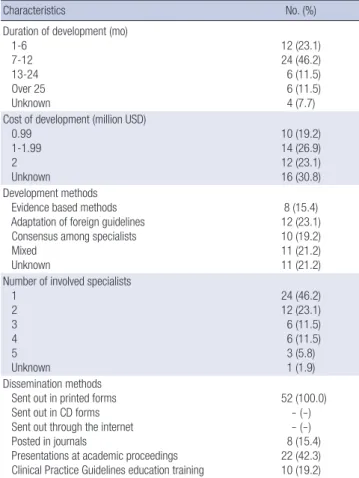
Characteristics of Korean clinical practice guidelines We have analyzed 52 guidelines included in the clinical practice information system. The average development time for a clini- cal practice guideline is 7-12 months and the professionals in- volved in clinical practice guideline development were mostly physicians of one specialty within the same medical field. Multi- disciplinary groups of practitioners involved in clinical practice guideline development are relatively rare. Of the development methods, the adaptation of foreign guidelines were the most common (23.1%), followed by consensus among specialists (19.2), and then by evidence based methods (15.4%); in addition, the combination of these methods was also common (21.2%). The cost of developing clinical practice guidelines came from the internal budgets of academic organizations, with development amounts ranging from $10,000 and $30,000. Over 50% of aca- demic organizations either plan to or have gone through revi- sions (17) (Table 3).
Through assessing the quality of guidelines using the AGREE
method, the average score of the six domains were between 50 to 70 points and was relatively low compared to other nations.
Dissemination and implementation of clinical practice guidelines
The dissemination methods for clinical practice guidelines are mainly in forms of printed material (28.0%) or presentations at academic proceedings (22.7%), and other methods of dissemi- nation include dissemination at academic proceedings. A total of 32.7% of academic associations claimed to have a planned budget to disseminate clinical practice guidelines; however, over 67% did not have a separate budget for dissemination.
The awareness and implementation of guidelines among physicians was not high (18). In regards to the clinical practice guidelines for the treatment of childhood asthma, less than 20%
attended the educational course for clinical practice guidelines and about 20% examined the use of clinical practice guidelines.
A total of 70% of the pediatricians were aware of the clinical prac- tice guidelines; however, only a small portion of them actually used the guidelines. Conducting educational training for guide- lines was infrequent. In a survey of pediatricians, the lack of pro- motion and training on clinical practice guidelines were point- ed out as necessary.
Problems in developing clinical practice guidelines in Korea The problems in developing clinical practice guidelines are as follows:
• There is a lack of interdisciplinary approaches to develop clinical practice guidelines.
• There is an intention to use and evidence based approach;
however, guidelines that detail rigorous evidence based approaches are scarce.
• They want reflect the situations in Korea; however, it is not possible due to insufficient domestic research.
• Recommendations are made through a consensus of experts with an unclear connection between recommendations and evidence.
• Within development groups, there were limited methodol- Table 1. Guideline agencies in several countries
Country Name of organization Type of organization Web site
Australia National Health and Medical Research Council (NHMRC) National government www.health.gov.ac./hfs/nhmrc Canada Canadian Medical Association (CMA Infobase)
Centres for Health Evidence (CHE) Professional www.cche.net
Scotland Scottish Intercollegiate Guidelines Network (SIGN) Professional www.sign.ac.uk
England National Institute for Health and Clinical Excellence (NICE) Professional www.nice.org.uk
France HAS (Haute Autoroite De Sante) National government www.has-sonte.fr
Germany AEZQ/AQuMed Guideline Link Collection (AGLC) National government www.leitlinien.de
Netherlands Dutch Institute for Healthcare Improvement (CBO) Professional www.cbo.nl
New Zealand New Zealand Guideline Group (NZGG) National but not government www.nzgg.org.nz
United States US Preventive Services Task Force (USPSTF) National government www.uspreventiveservicestaskforce.org
Singapore Singapore Clinical Practice Guidelines National government www.moh.gov.sg
Japan Japan Council for Quality Healthcare (JCQHC) National semi government http://minds.jcqhc.or.jp
ogists with detailed techniques (19).
ISSUES RELATED TO CLINICAL PRACTICE GUIDELINES IN KOREA
Issues regarding the development of implementation of guide- lines in Korea can be summed up as:
Concerns among the healthcare providers
Many physicians in Korea are critical of clinical practice guide- lines. According to a survey more than 70% of physicians agreed
that CPG’s intended to improve quality of healthcare and were helpful in making good clinical decisions and improving good educational tools. However, over 50% of physicians said that it decreased healthcare costs, lowered reimbursements to physi- cians, challenged the autonomy of physicians, and was too rigid to apply to individual patients (Table 4).
Their concerns can be summarized as guidelines that could possibly impede the creativity and diversity of practice, be used as an external evaluation and assessment tool, and be used against doctors as a basis for legal action.
Clinical practice guidelines will improve the quality of medi- Table 2. Korean clinical practice guideline by subjects
Category Guideline subjects Academic societies who published guideline
Gastroinstestinal system Diagnostic endoscopy Therapeutic endoscopy Intestinal tuberculosis Behcet’s enteritis Ulcerative colitis Crohn’s disease
The Korean Society of Gastrointestinal Endoscopy The Korean Society of Gastroenterology
Liver Chronic hepatitis B
Chronic hepatitis C Liver cirrhosis Hepatocellular carcinoma
The Korean Association for the Study of the Liver
The Korean Liver Cancer Study
Respiratory system Asthma
Tuberculosis Pneumonia COPD Lung cancer
The Korean Academic of Tuberculosis and Respiratory Diseases
Korean Association for the study of Lung Cancer Neurology & psychiatry Alzheimer’s disease
Bipolar disorder Schizophrenia Depressive disorder Post traumatic stress syndrome Stroke
Stroke rehabilitation Facial nerve palsy
Korean Association for Geriatric Psychiatry Korean Neuropsychiatric Association
Korean Academy of Anxiety Disorder, Korean college of Neuropsychopharmacology Korean Stroke Society
The Korean Otologic Society
Cardiovascular system Hypertension The Korean Society of Hypertension
Musculoskeletal system Osteoporosis
Nerve block The Korea Society of Bone Metabolism
The Korea Pain Society Genitourinary system Impotence
Bladder tumor Gynecologic cancer Urinary tract infection Dyslipidemia and impotence Benign prostate hyperplasia Kidney disease
Korean Society for Sexual Medicine and Andrology The Korean Urological Association
The Korean Society of Gynecologic Oncology and Colposcopy Korean Society of Pediatric Nephrology
The Korean Urological Association The Korean Urological Association The Korean Society of Nephrology
Endocrine system Diabetes
Hormonal replacement therapy Korean Diabetes Association
Korean Society of Obestetrics and Gymecology
Infection Vaccination
Nosocomial infection Meningococcal meningitis
The Korean Pediatric Society
Korean Society for Nosocomial Infection Control The Korean Society of Menopause
Oncology Bladder tumor
Gynecologic cancer Cancer screening Malignant pain control Breast cancer
The Korean Urological Association
The Korean Society of Gynecologic Oncology and Colposcopy Korean Medical Association
Ministry of Health & Wellfare Korean Breast Cancer Society
Nephrology Kidney disease The Korean Society of Nephrology
Otolaryngology Allergic
Sinusitis Chronic otitis media
The Korean Academy of Asthma, Allergy and Clinical Immunology The Korean Rhinologic Society
The Korean Otologic Society Characteristics of Korean Clinical Practice Guidelines.
cal care and are critical tools to implement evidence-based med- icine that can only be achieved through the active participation of the practitioners to develop and utilize clinical practice guide- lines. In Korea, it is necessary for providers to properly recognize guidelines in order to further expand clinical practice guidelines (20). To stimulate the proper recognition of guidelines, there needs to be a mechanism to include the providers in the devel- opment of clinical practice guidelines and logistical support.
Reflection of the situation in Korea and proliferation of domestic research
One of the missions in the development of clinical practice guide- lines is to properly represent the Korean context. Reflecting the domestic situation includes understanding the epidemiological characteristics of a disease and properly assessing the effective- ness of interventions in Korea. However, we cannot represent
the situation in Korea because of insufficient clinical research and have to resort to data from other nations. Therefore, we need to proliferate domestic research to eliminate this problem.
While it is possible to conduct comprehensive literature search- es for international literature using PubMed, Embase, and Co- chrane Library databases, the search for domestic literature is difficult with an electronic database and in most cases physi- cians have to resort to a manual paper search. It is necessary to build a searchable database that effectively aids in a compre- hensive search of the domestic literature.
De novo development or adaptation of international guidelines
Since most data for guidelines are from international research, a question is raised on whether it is necessary to create de novo development or if we can adapt international guidelines that cost less time and money. It would make strategic sense to de- velop guidelines based on increased domestic research. How- ever, there is a school of thought that makes a strong and valid argument on the effectiveness of the evaluation of the quality of internationally developed guidelines and the adaptation of good quality guidelines. When adapting international guidelines, it would be necessary to establish acceptance criteria on the re- quired information and processes. It would also be necessary to define standards to establish priorities to determine whether to develop de novo or adapt international clinical practice guide- lines (18).
Government’s policies and support
The investment of significant human and financial resources is required for the development of sound quality clinical practice guidelines. Currently, there exists insufficient infrastructure to develop clinical practice guidelines and investments are required to develop sound quality clinical practice guidelines. For this, the government must be instrumental and provide support for professional staff that can allocate an adequate budget to estab- lish systematic clinical practice guideline programs. Korea needs to establish policies on how to develop, expand, and implement clinical practice guidelines. These policies require priorities to develop clinical practice guidelines (determined in concert by the medical community, insurance industry, and consumer groups), a system to evaluate the quality and effect of clinical practice guidelines, and support functions for the evaluation, Table 3. General characteristics of clinical practice guidelines in Korea
Characteristics No. (%)
Duration of development (mo) 1-6
7-12 13-24 Over 25 Unknown
12 (23.1) 24 (46.2) 6 (11.5) 6 (11.5) 4 (7.7) Cost of development (million USD)
0.99 1-1.99 2 Unknown
10 (19.2) 14 (26.9) 12 (23.1) 16 (30.8) Development methods
Evidence based methods Adaptation of foreign guidelines Consensus among specialists Mixed
Unknown
8 (15.4) 12 (23.1) 10 (19.2) 11 (21.2) 11 (21.2) Number of involved specialists
1 2 3 4 5 Unknown
24 (46.2) 12 (23.1) 6 (11.5) 6 (11.5) 3 (5.8) 1 (1.9) Dissemination methods
Sent out in printed forms Sent out in CD forms Sent out through the internet Posted in journals
Presentations at academic proceedings Clinical Practice Guidelines education training
52 (100.0) - (-) - (-) 8 (15.4) 22 (42.3) 10 (19.2)
Table 4. Korean physician’s attitude for clinical practice guidelines
Characteristic Agree Disagree Do not know
Intended to improve the quality of care 561 (78.8) 105 (14.8) 46 (6.5)
Helpful in making good clinical decisions 617 (86.7) 76 (10.7) 19 (2.7)
Helpful to improve good educational tools 615 (86.4) 83 (11.7) 14 (2.0)
Intended to decrease healthcare costs and lower reimbursements to physicians 418 (58.7) 207 (29.0) 87 (12.3)
A challenge to the autonomy of physicians 446 (62.6) 212 (29.8) 54 (7.6)
Too rigid to apply to individual patients and oversimplified 422 (59.2) 216 (30.4) 74 (10.4)
management, and propagation of diverse guidelines by a Guide- line Clearing House. Clinical practice guidelines are an effective means to change the process of healthcare services; however, they could adversely affect the quality of medical care and the effectiveness of the healthcare system that result in the waste of resources if quality clinical practice guidelines are not developed.
Therefore, a careful, prudent decision-making is required.
Human resources for evidence-based medicine methods Methods for Evidence-based medicine are key for development of clinical practice guidelines; however, there are an insufficient number of professionals with relevant experience. It is neces- sary to secure and nurture qualified personnel with pertinent experience for evidence-based medicine and systematic reviews are required in the development of clinical practice guidelines.
It is also necessary to develop domestically feasible evidence- based methods adapted from researched developed by inter- national guideline agencies or associations that can be distrib- uted nationally.
CONCLUSION
Clinical practice guidelines must be developed by reasonable and well-planned methods to provide required support in the fields where actual treatments are provided. Therefore, clinical practice guidelines must provide broad, critical, and unbiased information in regards to the benefits and limitations of diverse diagnoses and treatment methods. This way, doctors who pro- vide treatments can effectively utilize clinical practice guide- lines in individual decision-making for patient treatment. In all previous research, clinical practice guidelines are presented as capable to modify the behaviors of practitioners and improve treatment results. In Korea, while the activities of developing clinical practice guidelines are vitalized, we must develop and find execution ideas that are appropriate for the current condi- tions of the nation by fully considering research results. For this, a policy-backed support by the government is required; it is now time for the medical community and government to cooperate towards an important endeavor.
REFERENCES
1. Field MJ, Lohr KN, editors. Clinical practice guidelines: directions for a new program. Washington, DC: National Academy Press, 1990.
2. Field MJ. Overview: prospects and options for local and national guide- lines in the courts. Jt Comm J Qual Improv 1993; 19: 313-8.
3. Field MJ, Lohr KN, editors. Institute of medicine. Guidelines for clinical practice: from development to use. Washington, DC: National Academy
Press, 1992.
4. Schoenbaum SC, Sundwall DN. Agency for healthcare policy and re- search. Using clinical practice guidelines to evaluate quality of care. Agen- cy for Healthcare Policy and Research Publication, 1995.
5. Tunis SR, Hayward RS, Wilson MC, Rubin HR, Bass EB, Mary J, Stein- berg EP. Internists’ attitudes about clinical practice guideline. Ann Intern Med 1994; 120: 956-63.
6. Coenen S, Van Royen P, Michiels B, Denekens J. Optimizing antibiotic prescribing for acute cough in general practice: a cluster-randomized controlled trial. J Antimicrob Chemother 2004; 54: 661-72.
7. Saint S, Scholes D, Fihn SD, Farrell RG, Stamm WE. The effectiveness of a clinical practice guideline for the management of presumed uncompli- cated urinary tract infection in women. Am J Med 1999; 106: 636-41.
8. Grimshaw JM, Russel IT. Achieving health gain through clinical guide- lines. II: Ensuring guidelines change medical practice. Qual Health Care 1994; 3: 45-52.
9. National Institute for Clinical Excellence (NICE). The guideline develop- ment process-information for national collaborating centres and guide- line development groups. London: NICE, 2001.
10. Bowker R, Lakhanpaul M. How to write a guideline. Handbook for health- care professionals. Philadelphia, USA: Churchill Liningstone Elsevier, 2008.
11. New Zealand Guidelines Group (NZGG). Handbook for the prepara- tion of explicit evidence-based clinical practice guidelines. The Terrace, New Zealand Guidelines Group, 2003.
12. Burgers JS, Grol R, Klazinga NS, Mäkelä M, Zaat J; AGREE Collabora- tion. Towards evidence-based clinical practice: an international survey of 18 clinical guideline programs. Int J Qual Health Care 2003; 15: 31-45.
13. Burgers JS, Cluzeau FA, Hanna SE, Hunt C, Grol R. Characteristics of high quality guidelines: evaluation of 86 clinical guidelines developed in ten European countries and Canada. Int J Technol Assess Health Care 2003; 19: 148-57.
14. Grol R, Thomas S, Roverts R. Development and implementation of guide- lines for family practice: lessons from the Netherlands. J Fam Pract 1995;
40: 435-9.
15. National Guideline Clearinghouse. Available at http://www.guideline.
gov [accessed on 10 January 2012].
16. Korean Medical Guideline Information Center. Available at http://www.
guideline.or.kr [accessed on 10 January 2012].
17. Ahn HS, Lee HY, Lee SY, Kim NS, Kim SY, Park EJ. Manual for clinical practice guideline development and implementation. Seoul: Korea Insti- tute for Health and Social Affairs Press, 2004.
18. Ahn HS. Clinical practice guideline. In: Park BJ, editor. Evidence-based Healthcare. Seoul: Korea Medical Book Publisher Press, 2009, p243-71.
19. Kim NS, Kim SY, Park EJ. Handbook for promoting the quality of medi- cine: based on clinical practice guidelines. Seoul: Korea Institute for Health and Social Affairs Press, 2004.
20. Appraisal of Guidelines, Research, and Evaluation in Europe (AGREE) Collaborative Group. Guideline development in Europe. An internation- al comparison. Int J Technol Assess Health Care 2000; 16: 1039-49.