Mid-term Outcomes of Total Arterial Revascularization Versus Conventional Coronary Surgery in Isolated Three-Vessel
Coronary Disease
Whether arterial conduits are superior to venous grafts in coronary artery bypassing has been debated. The aim of this study was to investigate clinical outcomes after total arterial revascularization versus conventional coronary bypassing using both arterial and venous conduits in isolated three-vessel coronary disease. Between 2003 and 2005, 503 patients who underwent isolated coronary artery bypass grafting for three-vessel coronary disease were enrolled. A total of 117 patients underwent total arterial revascularization (Artery group) whereas 386 patients were treated with arterial and venous conduits (Vein group).
Major adverse outcomes (death, myocardial infarction, stroke and repeat revascularization) were compared. Clinical follow-up was complete in all patients with a mean duration of 6.1 ± 0.9 yr. After adjustment for differences in baseline risk factors, risks of death (hazard ratio [HR] 0.96; 95% confidence interval [CI] 0.51-1.82, P = 0.90), myocardial infarction (HR 0.20, 95% CI 0.02-2.63, P = 0.22), stroke (HR 1.29, 95% CI 0.35-4.72, P = 0.70), repeat revascularization (HR 0.64, 95% CI 0.26-1.55, P = 0.32) and the composite outcomes (HR 0.83, 95% CI 0.50-1.36, P = 0.45) were similar between two groups. Since the use of veins does not increase the risks of adverse outcomes compared with total arterial revascularization, a selection of the conduit should be more liberal.
Key Words: Coronary Artery Bypass Grafting; Arteries; Veins Jin Woo Chung1, Joon Bum Kim2,
Sung Ho Jung2, Suk Jung Choo2, Hyun Song3, Cheol Hyun Chung2, and Jae Won Lee2
1Department of Thoracic and Cardiovascular Surgery, Konkuk University Medical Center, Konkuk University School of Medicine, Seoul; 2Department of Thoracic and Cardiovascular Surgery, Asan Medical Center, University of Ulsan College of Medicine, Seoul; 3Department of Thoracic and Cardiovascular Surgery, Seoul St. Mary’s Hospital, College of Medicine, The Catholic University of Korea, Seoul, Korea
Received: 8 March 2012 Accepted: 8 June 2012 Address for Correspondence:
Jae Won Lee, MD
Department of Thoracic and Cardiovascular Surgery, Asan Medical Center, University of Ulsan College of Medicine, 86 Asanbyeongwon-gil, Songpa-gu, Seoul 138-736, Korea Tel: +82.2-3010-3584, Fax: +82.2-3010-6966 E-mail: [email protected]
http://dx.doi.org/10.3346/jkms.2012.27.9.1051 • J Korean Med Sci 2012; 27: 1051-1056
INTRODUCTION
Although the internal thoracic artery (ITA) has been regarded as the graft of choice for left anterior descending artery (LAD) bypass during coronary artery bypass grafting (CABG) (1), there have been debates over which conduits are best fitted as second and third grafts for non-LAD bypass. Unlike several reports sup- porting the superior patency of arterial grafts over venous grafts (2-4), a recent prospective randomized study showed that the selection of arterial or venous graft for the second graft has not affected patency beyond 5 yr (5). In a clinical perspective that the purpose of CABG is to relieve ischemic symptoms and to improve survival, evidences are poor with regard to the selec- tion of optimal second and third grafts for non-LAD bypass re- lating to clinical outcomes (6).
Therefore, the aim of the study was to investigate mid-term clinical outcomes after total arterial revascularization versus conventional coronary bypassing using both arterial and venous conduits in three-vessel coronary disease.
MATERIALS AND METHODS Patients
All patients undergoing CABG are prospectively registered in the Asan Medical Center database (Seoul, Korea). This registry prospectively contains patient baseline characteristics, results of cardiac evaluations, detailed information on surgery, and peri- operative complications. Between January 2003 and December 2005, 1,495 patients underwent CABG. Of them, 503 patients who underwent primary isolated CABG for three-vessel coro- nary disease were enrolled in the study. A total of 117 patients underwent total arterial revascularization strategy (Artery group) whereas 386 patients were treated with conventional strategy using both arterial and venous conduits (Vein group). The end- points of the study were defined as death, myocardial infarction, stroke and repeat revascularization.
Surgery
All CABGs were performed by experienced cardiac surgeons, each of whom performs 100 CABGs annually. Off-pump or con-
ventional on pump CABG was performed at the discretion of the attending surgeon, with off-pump CABG usually performed when severe atherosclerosis was suspected along the ascend- ing aorta and the aortic arch. Off-pump CABG was performed using one of several commercially available, suction-based, car- diac positioning and coronary artery-stabilizing devices. Con- ventional on pump CABG was performed using standard tech- niques that used roller-head pumps, membrane oxygenators, cardiotomy suction, arterial filters, cold antegrade blood cardio- plegia, and moderate systemic hypothermia.
The use of total arterial grafting or conventional strategies depended on the number of distal targets requiring grafting and degree of proximal stenosis of target coronary arteries, but ulti- mately it was finally decided at the attending surgeon’s prefer- ence. For the revascularization of the right coronary artery terri- tory, the saphenous was proximally anastomosed to the ascend- ing aorta in the vein group. In the artery group, the right coronary artery territory was revascularized with the radial artery which was anastomosed to left ITA or the aorta, if the length was long enough. If the length of the radial artery graft was not enough to reach the right coronary system, right ITA or gastroepiploic artery was used. Diltiazem was used routinely to avoid arterial graft spasm intraoperatively and postoperatively. The radial ar- tery was preferentially used to target vessels with proximal ste- nosis of 80% or greater.
Statistics
Categorical variables are presented as frequencies and percent- ages, and were compared using the chi-square test or Fisher’s exact test. Continuous variables are expressed as mean ± SD or medians with ranges, and compared using the Student’s unpaired t-test.
Kaplan-Meier curves were employed to delineate time relat- ed mortality, freedom from reintervention or major cerebro- vascular events. Stratified survival curves were plotted to ex- plore unadjusted differences for variables of interest (log-rank test).
To reduce the effect of treatment selection bias and potential confounding, we performed adjustment for the differences in the baseline characteristics by use of propensity score analysis (7). The propensity scores were estimated without regard to out- come variables, with multiple logistic regression analysis. Pre- specified covariates listed in Table 1 were included in the full non- parsimonious models for total arterial revascularization versus conventional coronary bypass surgery. The discrimination and calibration abilities of the propensity score model were assessed by means of C statistics and the Hosmer-Lemeshow test. The model had C statistic of 0.722 and a Hosmer-Lemeshow good- ness-of-fit P value of 0.121, indicating the model was well cali- brated with strong discrimination.
Cox regression or multiple logistic regression models were
used to compare time related outcomes (survival, freedom from reintervention, freedom from major cerebrovascular event) or binary outcomes (early complications), respectively, with the inclusion of the treatment option (total arterial revasculariza- tion versus conventional coronary bypass surgery) and the pro- pensity score as potential predictors of outcomes.
All reported P values were two-sided, and a value of P < 0.05 was considered statistically significant. SAS software, version 9.1 (SAS Institute, Cary, NC, USA) and SPSS version 12 were used for the statistical analysis.
Ethics statement
This study was approved by our institutional review board (No.:
Table 1. Baseline characteristics of entire cohort
Parameters Artery group Vein group P value
Number of patients 117 386
Age (yr) 61.7 ± 8.9 62.6 ± 8.1 0.34
Female gender, No. (%) 27 (23.1) 105 (27.2) 0.37 Body mass index (kg/m2) 24.8 ± 3.1 24.9 ± 3.3 0.80 Diabetes mellitus, No. (%) 56 (47.9) 168 (43.5) 0.41 Hypertension, No. (%) 59 (50.4) 241 (62.4) 0.020*
Dyslipidemia, No. (%) 65 (55.6) 180 (46.6) 0.091
Current smoker, No. (%) 32 (27.4) 77 (19.9) 0.089 History of MI, No. (%) 26 (22.2) 88 (22.8) 0.89 Chronic renal failure, No. (%) 2 (1.7) 33 (8.5) 0.011*
Peripheral arteriopathy, No. (%) 3 (2.6) 4 (1.0) 0.21 History of CVA or TIA, No. (%) 5 (4.3) 35 (9.1) 0.12
Acute MI < 7 days 1 (0.9) 1 (0.3) 0.41
Unstable angina 28 (23.9) 99 (25.6) 0.71
LV ejection fraction (%) 56.0 ± 10.6 56.1 ± 11.5 0.93 Coronary lesion category
Left main disease, No. (%) 46 (39.3) 109 (28.2) Chronic total occlusion ≥ 1, No. (%) 64 (54.7) 191 (49.5) 0.32
Off pump/on pump, No. 46/71 86/299 < 0.001*
Grafting strategy
Number of distal anastomosis No use of ITA
Bilateral ITA usage
3.4 ± 0.8 1 (0.9)
22
3.8 ± 1.0 9 (2.3)
21
< 0.001*
0.47
< 0.001*
Number of bypassing at each territory Ramus intermedius
0 1 Left circumflex 0 1 2 3 Right coronary 0 1 2 3 Diagonal 0 1 2
102 (87.2) 15 (12.8) 20 (17.1) 84 (71.8) 12 (10.3) 1 (0.9) 21 (17.9) 79 (67.5) 17 (14.5)
0 75 (64.1) 41 (35.0) 1 (0.9)
318 (82.4) 68 (17.6) 47 (12.2) 249 (64.5) 88 (22.8) 2 (0.5) 59 (15.3) 279 (72.3) 47 (12.2) 1 (0.3) 196 (50.8) 176 (45.6) 14 (3.6)
0.22
0.022*
0.71
0.022*
*Significant difference. CVA, cerebrovascular accident; ITA, Internal thoracic artery; LV, left ventricle; MI, myocardial infarction; TIA, transient ischemic attack.
2012-1302), and the requirement for informed consent was waived by the board owing to the retrospective nature of the current study.
RESULTS Baseline profiles
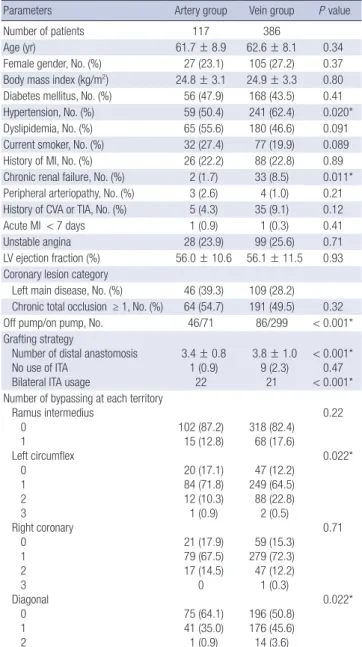
Baseline characteristics of the entire cohort are shown in Table 1.
Patients in the Artery group were less likely to have hypertension and chronic renal failure, and were more likely to undergo off- pump surgery. Mean numbers of distal anastomoses were 3.4 ± 0.8 in the Artery group and 3.8 ± 1.0 in the Vein group (P < 0.001).
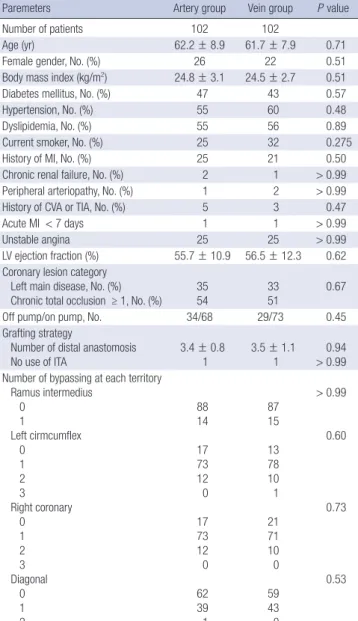
In the Vein group, mean number of distal anastomoses using vein graft was 1.3 ± 0.6 (Median 1, range 1-4). The numbers of distal anastomses using vein grafts were one in 289 (74.9%), two in 82 (21.2%), three in 9 (2.3%) and four in 5 (1.3%). The vein grafts were used for right coronary artery territory bypassing in 351, and for left circumflex or ramus intermedius territories in 53. Propensity score matching yielded 102 pairs of patients in which there were no significant differences in baseline charac- teristics between the two groups including the mean number of distal anastomoses (Table 2 and 3).
Unadjusted clinical outcomes
Clinical follow-up was complete in all patients (100%) with a mean follow-up duration of 6.1 ± 0.9 yr, during which there were 60 deaths, 25 reinterventions, 3 non-fatal myocardial infarctions, 18 strokes. Ninety patients experienced at least one of the major adverse events during follow-up (Table 4). There were no sig- nificant differences in the rates of death, reintervention, myo- cardial infarction, stroke and the composite outcomes between the Artery and the Vein groups in crude and propensity score Table 2. Baseline characteristics of propensity score matched population
Paremeters Artery group Vein group P value
Number of patients 102 102
Age (yr) 62.2 ± 8.9 61.7 ± 7.9 0.71
Female gender, No. (%) 26 22 0.51
Body mass index (kg/m2) 24.8 ± 3.1 24.5 ± 2.7 0.51
Diabetes mellitus, No. (%) 47 43 0.57
Hypertension, No. (%) 55 60 0.48
Dyslipidemia, No. (%) 55 56 0.89
Current smoker, No. (%) 25 32 0.275
History of MI, No. (%) 25 21 0.50
Chronic renal failure, No. (%) 2 1 > 0.99 Peripheral arteriopathy, No. (%) 1 2 > 0.99
History of CVA or TIA, No. (%) 5 3 0.47
Acute MI < 7 days 1 1 > 0.99
Unstable angina 25 25 > 0.99
LV ejection fraction (%) 55.7 ± 10.9 56.5 ± 12.3 0.62 Coronary lesion category
Left main disease, No. (%)
Chronic total occlusion ≥ 1, No. (%) 35
54 33
51 0.67
Off pump/on pump, No. 34/68 29/73 0.45
Grafting strategy
Number of distal anastomosis
No use of ITA 3.4 ± 0.8
1 3.5 ± 1.1
1 0.94
> 0.99 Number of bypassing at each territory
Ramus intermedius 0
1
Left cirmcumflex 0
1 2 3 Right coronary 0 1 2 3 Diagonal 0 1 2
88 14 17 73 12 0 17 73 12 0 62 39 1
87 15 13 78 10 1 21 71 10 0 59 43 0
> 0.99
0.60
0.73
0.53
CVA, cerebrovascular accident; ITA, Internal thoracic artery; LV, left ventricle; MI, myo- cardial infarction; TIA, transient ischemic attack.
Table 3. Number of distal anastomoses using each graft conduit
Sites of anastmoses
No. of anastomoses Artery group
(n = 117)
Vein group (n = 386)
Total (n = 503) ITA
ITA to LAD ITA to other territory
139 (1.2) 115 24
422 (1.1) 375 47
561 (1.1) 490 71
RA 246 (2.1) 528 (1.4) 774 (1.5)
GEA 13 (0.1) 0 13
SVG 0 498 (1.3) 498
Total 398 (3.4) 1,448 (3.8) 1,846 (3.7)
ITA, internal thoracic artery; LAD, left anterior descending artery; GEA, gastroepiploic artery; RA, radial artery; SVG, saphenous vein graft.
Table 4. Complications and mortality
Complications
No. (%) of patients
Entire cohort Propensity score matched cohort
Artery group Vein group P value Artery group Vein group P value
Death 14 (12.0) 46 (11.9) 0.99 12 (11.8) 11 (10.8) 0.83
Non-fatal MI 2 (1.7) 1 (0.3) 0.074 2 (2.0) 0 0.16
Stroke 3 (2.6) 15 (3.9) 0.50 2 (2.0) 3 (2.9) 0.65
Reintervention 9 (7.7) 16 (4.1) 0.12 9 (8.8) 5 (4.9) 0.27
Composite outcomes 24 (20.5) 66 (17.1) 0.40 21 (20.6) 17 (16.7) 0.47
MI, myocardial infarction.
matched comparisons (Table 4).
Twenty-five repeat-revascularizations included one case of redo-CABG (saphenous vein graft revision immediately after the operation) and 24 cases of percutaneous coronary interven- tion. When the myocardial ischemic events (reintervention and myocardial infarction, n = 26; two patients had both events) were analyzed according to the conduits used for bypassing, they were left ITA problem in 6 (out of 561 left ITA grafts, 1.1%), radial artery problems in 11 (out of 774 radial arteries, 1.4%), saphenous vein grafts problems in 5 (out of 498, 1.0%) and non- target territory problems in 4 (right coronary artery in 3, obtuse marginal artery in 1).
Adjusted hazard
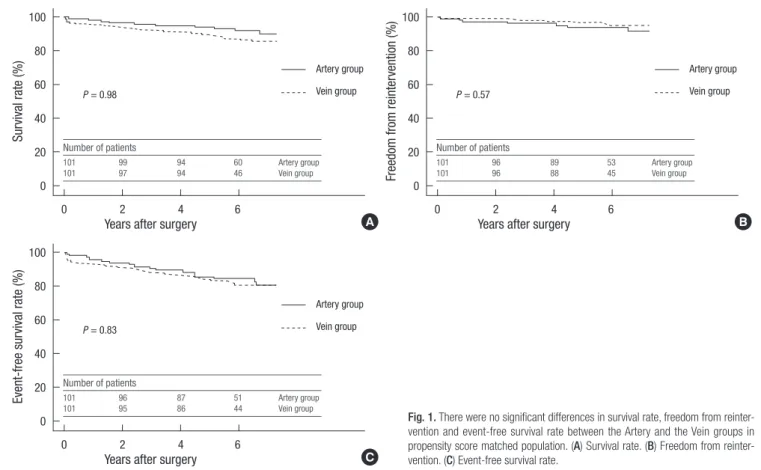
Kaplan-Meier curves for overall survival, freedom from reinter- vention and event-free survival in propensity score matched pa- tients are shown in Fig. 1, and there were no significant differ- ences in the rates of events between the two groups.
After adjustment, risks of death (hazard ratio [HR] 0.96; 95%
confidence interval [CI] 0.51-1.82, P = 0.90), myocardial infarc- tion (HR 0.20, 95% CI 0.02-2.63, P = 0.22), stroke (HR 1.29, 95%
CI 0.35-4.72, P = 0.70), repeat revascularization (HR 0.64, 95%
CI 0.26-1.55, P = 0.32) and the combined risk of death, myocar- dial infarction, stroke or repeat revascularization (HR 0.83, 95%
CI 0.50-1.36, P = 0.45) were similar between the Artery group and the Vein group. For the 102 propensity score-matched pairs,
similar results were obtained for all clinical endpoints (Table 5).
DISCUSSION
The present study showed that conventional coronary artery
Fig. 1. There were no significant differences in survival rate, freedom from reinter- vention and event-free survival rate between the Artery and the Vein groups in propensity score matched population. (A) Survival rate. (B) Freedom from reinter- vention. (C) Event-free survival rate.
Survival rate (%) Freedom from reintervention (%)
Years after surgery Years after surgery
0 2 4 6 0 2 4 6
100 80 60 40 20 0
100 80 60 40 20 0
A B
Artery group Artery group
Vein group Vein group
P = 0.98 P = 0.57
Number of patients
101 99 94 60 Artery group
101 97 94 46 Vein group
Number of patients
101 96 89 53 Artery group
101 96 88 45 Vein group
Event-free survival rate (%)
Years after surgery
0 2 4 6
100 80 60 40 20 0
C Artery group Vein group P = 0.83
Number of patients
101 96 87 51 Artery group
101 95 86 44 Vein group
Table 5. Hazard ratios for clinical outcomes of the Vein group compared with the Artery group
Outcomes HR 95% CI P value
Death Crude
Propensity score matching Propensity score adjusted
1.05 0.98 0.96
0.58-1.92 0.43-2.22 0.51-1.82
0.87 0.96 0.90 Myocardial infarction
Crude
Propensity score matching Propensity score adjusted
0.17 0.22 0.20
0.02-1.94 0.02-2.43 0.02-2.63
0.16 0.20 0.22 Stroke
Crude
Propensity score matching Propensity score adjusted
1.57 1.54 1.29
0.45-5.42 0.26-9.21 0.35-4.72
0.48 0.64 0.70 Reintervention
Crude
Propensity score matching Propensity score adjusted
0.56 0.57 0.64
0.25-1.26 0.19-1.70 0.26-1.55
0.16 0.32 0.32 Death, stroke, myocardial infarction
and reintervention Crude
Propensity score matching Propensity score adjusted
0.86 0.83 0.83
0.54-1.37 0.44-1.57 0.50-1.36
0.51 0.56 0.45 CI, confidential interval; HR, hazard ratio.
surgery in three-vessel coronary disease, compared with total arterial revascularization, demonstrated similar risks of death, myocardial infarction, stroke, reintervention and composite outcomes. In this study, we included three-vessel disease only because the importance of second and third grafts can be mag- nified in this subset of coronary diseases. In order to obtain mid- term clinical outcomes over 5 yr, patients enrollments were con- fined to those who underwent surgery before the end of 2005.
The goals of coronary artery bypass graft surgery are relief of ischemic symptoms, prevention of myocardial pumping failure and prolongation of the patient’s survival. For decades, arterial grafts have been reported to have better patency rate and supe- rior clinical results compared to venous conduits (8-10). Since the long-term survival depends on the patency of graft vessel after CABG, the excellent long-term patency and survival of left ITA (11) arguably encouraged the use of arterial graft such as radial artery, gastroepiploic artery and right ITA rather than vein graft and led to the enthusiasm to achieve total arterial revascu- larization. Radial artery graft shows more than 90% patency rate at 1 yr and 5 yr compared to about 85% of vein graft for left cir- cumflex coronary artery (2, 3). It also demonstrated about 85%
of patency rate at 5 yr for left circumflex coronary artery and right coronary artery (8-10). On the other hand, Hayward et al. showed that there was no difference in 5 yr patency rates between radial artery graft and saphenous vein graft (90.0% vs 87.0%) (5). Khot and co-workers reported that radial artery graft revealed lower patency rate than saphenous vein graft for left circumflex coro- nary artery and right coronary artery (12). Furthermore, in a study evaluating post-CABG symptomatic patients with con- ventional angiography, about 75% patency rate of radial artery graft was reported at mean follow-up of 27.1 months (4). Anoth- er study also demonstrated that the patency rate of radial artery graft in symptomatic patient was as low as 60% (13).
The use of bilateral ITA showed superior patency rate and survival rate than the use of radial artery graft and saphenous vein graft in triple vessel disease (14, 15). However, harvesting of bilateral ITA is technically demanding, time consuming and may cause sternal wound infection. And recent multi-center randomized trial revealed that the use of bilateral ITA were as- sociated sternal wound reconstruction, but did not have advan- tages compared to the use of single ITA, in terms of myocardial infarction (2.0% vs 2.0%), cerebrovascular accident (1.5% vs 1.8%), and revascularization at 1 yr (1.8% vs 1.3%) (16). Since this report is limited by only 1-yr follow-up results, long-term follow-up data are expected to be reported.
Unlike previous studies demonstrated that superior patency rate and clinical outcomes of arterial graft (2-4), our study showed that conventional strategy using both arterial and venous con- duits showed similar risks of death and major adverse outcomes on mid-term follow-up compared with total arterial revascular- ization for isolated three-vessel disease. We thought that many
factors contributed to this result. Although radial artery graft shows superior patency rate to saphenous vein graft (2, 3, 8-10), if angiographic string sign was included in patency rate, saphe- nous vein graft was not inferior to radial artery graft (3).
Compromising patency rate of vein graft is due to high rate of intermediate and late graft failure, which comes from intimal and medial hyperplasia, particularly at the proximal and distal anastomosis site (17, 18). There have been advances in drug ther- apy, such as the use of statin medications, which may decrease the vein graft failure (19-21). Procedural factors such as less ma- nipulation, no pressure dilatation of vein graft or no tough tech- nique also improved a quality of vein graft, which may result in similar clinical outcomes compared with artery graft in this study.
This study is subject to the limitations inherent in retrospec- tive work with observational data. The non-randomized design may have affected the results because of unmeasured confound- ers, procedure bias or detection bias, even with the use of pro- pensity score matching. This study is not an ‘intention-to-treat’
based comparison and graft patency was not considered.
The concept of total arterial revascularization has been based on superior graft patency rate of arterial graft rather than venous graft on angiographic data ground. However, in clinical perspec- tive, our results showed similar risks of death and major adverse outcomes on mid-term follow-up between two groups. Since the use of veins does not increase the risks of adverse outcomes compared with total arterial revascularization, a selection of the conduit should be more liberal.
REFERENCES
1. Cameron A, Davis KB, Green G, Schaff HV. Coronary bypass surgery with internal-thoracic-artery grafts--effects on survival over a 15-year period. N Engl J Med 1996; 334: 216-9.
2. Collins P, Webb CM, Chong CF, Moat NE. Radial artery versus saphe- nous vein patency randomized trial: five-year angiographic follow-up.
Circulation 2008; 117: 2859-64.
3. Desai ND, Cohen EA, Naylor CD, Fremes SE. A randomized compari- son of radial-artery and saphenous-vein coronary bypass grafts. N Engl J Med 2004; 351: 2302-9.
4. Maniar HS, Sundt TM, Barner HB, Prasad SM, Peterson L, Absi T, Moustakidis P. Effect of target stenosis and location on radial artery graft patency. J Thorac Cardiovasc Surg 2002; 123: 45-52.
5. Hayward PA, Gordon IR, Hare DL, Matalanis G, Horrigan ML, Rosalion A, Buxton BF. Comparable patencies of the radial artery and right inter- nal thoracic artery or saphenous vein beyond 5 years: results from the Radial Artery Patency and Clinical Outcomes trial. J Thorac Cardiovasc Surg 2010; 139: 60-5.
6. Eagle KA, Guyton RA, Davidoff R, Edwards FH, Ewy GA, Gardner TJ, Hart JC, Herrmann HC, Hillis LD, Hutter AM Jr, et al. ACC/AHA 2004 guideline update for coronary artery bypass graft surgery: a report of the American College of Cardiology/American Heart Association Task Force
on Practice Guidelines (Committee to Update the 1999 Guidelines for Coronary Artery Bypass Graft Surgery). Circulation 2004; 110: e340-437.
7. D’Agostino RB Jr. Propensity score methods for bias reduction in the com- parison of a treatment to a non-randomized control group. Stat Med 1998;
17: 2265-81.
8. Acar C, Ramsheyi A, Pagny JY, Jebara V, Barrier P, Fabiani JN, Deloche A, Guermonprez JL, Carpentier A. The radial artery for coronary artery bypass grafting: clinical and angiographic results at five years. J Thorac Cardiovasc Surg 1998; 116: 981-9.
9. Possati G, Gaudino M, Alessandrini F, Luciani N, Trani C, Cellini C, Canosa C, Di Sciascio G. Midterm clinical and angiographic results of radial artery grafts used for myocardial revascularization. J Thorac Car- diovasc Surg 1998; 116: 1015-21.
10. Taggart DP, D’Amico R, Altman DG. Effect of arterial revascularisation on survival: a systematic review of studies comparing bilateral and sin- gle internal mammary arteries. Lancet 2001; 358: 870-5.
11. Loop FD, Lytle BW, Cosgrove DM, Stewar RW, Goormastic M, Williams GW, Golding LA, Gill CC, Taylor PC, Sheldon WC, et al. Influence of the internal-mammary-artery graft on 10-year survival and other cardiac events. N Engl J Med 1986; 314: 1-6.
12. Khot UN, Friedman DT, Pettersson G, Smedira NG, Li J, Ellis SG. Radial artery bypass grafts have an increased occurrence of angiographically severe stenosis and occlusion compared with left internal mammary ar- teries and saphenous Vein Grafts. Circulation 2004; 109: 2086-91.
13. Weinschelbaum EE, Macchia A, Caramutti VM, Machain HA, Raffaelli HA, Favaloro MR, Favaloro RR, Dulbecco EA, Abud JA, Laurentiis MD, et al. Myocardial revascularization with radial and mammary arteries:
initial and mid-term results. Ann Thorac Surg 2000; 70: 1378-83.
14. Tatoulis J, Buxton BF, Fuller JA. The right internal thoracic artery: the forgotten conduit--5,766 patients and 991 angiograms. Ann Thorac Surg 2011; 92: 9-17.
15. Navia D, Vrancic M, Vaccarino G, Piccinini F, Raich H, Florit S, Thierer J.
Total arterial off-pump coronary revascularization using bilateral inter- nal thoracic arteries in triple-vessel disease: Surgical technique and clini- cal outcomes. Ann Thorac Surg 2008; 86: 524-30.
16. Taggart DP, Altman DG, Gray AM, Lees B, Nuqara F, Yu LM, Campbell H, Flather M. Randomized trial to compare bilateral vs. single internal mam- mary coronary artery bypass grafting: 1-year results of the Arterial Revas- cularisation Trial (ART). Eur Heart J 2010; 31: 2470-81.
17. Motwani JG, Topol EJ. Aortocoronary saphenous vein graft disease. Patho- genesis, predisposition and prevention. Circulation 1998; 97: 916-31.
18. Campeau L. Lipid lowering and coronary bypass graft surgery. Curr Opin Cardiol 2000; 15: 395-9.
19. Kulik A, Ruel M. Statins and coronary artery bypass graft surgery: pre- operative and postoperative efficacy and safety. Expert Opin Drug Sa 2009; 8: 559-71.
20. Shukla N, Angelini GD, Wan I, Jeremy JY. Potential role of nitroaspirins in the treatment of vein graft failure. Ann Thorac Surg 2003; 75: 1437-42.
21. Wan S, Yim A, Shukla N, Johnson JL, Angelini GD, Jeremy JY. Nitric ox- ide donating aspirin (NCX 4016) inhibits neointimal thickening in a pig model of saphenous vein into carotid artery interposition grafting: a com- parison with aspirin and morpholinosydnonimine. J Thorac Cardiovasc Surg 2007; 134: 1033-39.