Chang Gun Cho, Seok Ki Lee*, Soon-Yhul Nam�, Moo-Song Lee�, Sang-Wook Lee�, Eun Kyung Choi�, Heon Joo Park‖, Sang Yoon Kim�
Department of Otorhinolaryngology-Head and Neck Surgery, Dongguk University International Hospital, Goyang; Depatment of Otolaryngology*, Kangwon National University Hospital, Chunchon; Department of Otolaryngology�, Department of Preventive Medicine� and Department of Radiation Oncology�, University of Ulsan College of Medicine, Asan Medical Center, Seoul; Department of Microbiology‖, College of Medicine, Inha University Hospital, Incheon, Korea
Address for correspondence Sang Yoon Kim, M.D.
Department of Otolaryngology, University of Ulsan College of Medicine, Asan Medical Center, 388-1 Poongnap-dong, Songpa-gu, Seoul 138-736, Korea Tel : +82.2-3010-3710, Fax : +82.2-489-2773 E-mail : [email protected]
*This study was supported by a grant from the National R&D Program for the Cancer Control Program (Grant No. 0320320-2), Ministry of Health & Welfare, Republic of Korea.
1075
Association of the GSTP1 and NQO1 Polymorphisms and Head and Neck Squamous Cell Carcinoma Risk
Received : 13 February 2006 Accepted : 24 April 2006 The GSTP1 and NQO1 have been reported to be associated with an increased risk
for smoking related head and neck squamous cell carcinoma (HNSCC). The pur- pose of this study was to determine the effect of these metabolic gene polymorphisms on the risk of HNSCC. The study population included 294 histologically confirmed HNSCC cases and 333 controls without cancer. Genotyping analysis of the GSTP1 Ile105Val and NQO1 Trp139Arg genes was performed by polymerase chain reac- tion-based techniques on DNA prepared from peripheral blood. The Mantel-Haen- szel 2test was used for statistical analysis. The allele frequencies of the GSTP1 and NQO1 polymorphisms were not statistically significant between cases and con- trols. In analyzing the association between smoking amounts and genetic polymor- phisms, GSTP1 and NQO1 polymorphisms were associated with cigarette smoking amounts in cases. G allele containing genotypes in GSTP1 and T allele containing genotypes in NQO1 were associated with a tobacco dose-dependent increase in risk of HNSCC and these genotype distributions were statistically significant (p<
0.05). We found that the GSTP1 105Val allele and NQO1 139Arg allele were asso- ciated with tobacco dose-dependent increase in risk of HNSCC. GSTP1 and NQO1 genotype polymorphisms may play an important role in the development of smok- ing related HNSCC.
Key Words : Glutathione S-Transferase pi; NADH dehydrogenase (quinone); Head and Neck Neoplasms;
Carcinoma, Squamous Cell; Smoking
INTRODUCTION
Head and neck squamous cell carcinoma (HNSCC) which includes cancers of the larynx, pharynx, and oral cavity, show a wide range of geographical variations in incidence. Although tobacco and alcohol consumption are recognized as the major causes of HNSCC, geographic distribution of cancer incidence is not strongly correlated with areas of high tobacco and alco- hol consumption. Also, only a small number of smokers actu- ally develop HNSCC (1). This suggests a gene-environmen- tal interaction where host components, likely genetics, have an influential role in the susceptibility to HNSCC (2). The presence of polymorphisms in genes coding for enzymes in- volved in tobacco-related carcinogen metabolism, such as the glutathione S-transferase (GST) and NAD(P)H:quinone oxi- doreductase (NQO) enzymes, could explain this difference in susceptibility. It has recently been suggested that these inherited differences, in the capacity to metabolize such che- micals, are the modifiers of individual susceptibility to envi- ronmentally induced HNSCC (3).
Human GST enzymes can be subdivided into five main classes, alpha (A), mu (M), pi (P), theta (T), and zeta (Z). Each class includes one or more isoenzymes with different, but some- times overlapping, substrate specificity (4, 5). As a result of conjugation with glutathione, the potential carcinogens are eliminated and DNA, or other important biomolecules, are protected against damage or adduct formation. The GSTP1 gene encodes for the isoenzyme GSTP1-1. GSTP1-1 is a major enzyme in the detoxification of tobacco-related metabolic products and, quantitatively, the most abundant GST enzyme in the human head and neck area (6). The GSTP1-1 enzyme level has been extensively studied in relation to tobacco-relat- ed malignancies. Elevated tissue levels of GSTP1-1 enzyme have been found in stomach, colorectal, bladder, oral, phar- ynx, larynx, lung, skin, and breast tumors compared with normal tissues of matched controls (7). Ali-Osman et al. have described a polymorphism of GSTP1, resulting from a sin- gle base change at codon 105, that produces an enzyme with reduced capacity for detoxifying a number of carcinogens (8).
Recently, there have been several reports describing a higher
risk of developing HNSCC at pharyngeal locations in patients who are Val homozygous for the GSTP1 Ile105Val variant (9).
NQO1 is also a detoxification enzyme that plays a critical role in protecting cells against chemically induced oxidative stress, cytotoxicity, mutagenicity, and carcinogenicity (10).
NQO1 protects cells from oxidative damage by preventing the generation of reactive oxygen species through the reduc- tion of endogenous quinines, and by reducing certain envi- ronmental carcinogens, such as nitroaromatic compounds, heterocyclic amines, and possibly cigarette smoke condensate.
Furthermore, NQO1 reduces the formation of DNA adducts induced by benzo[a]pyrene 3,6-quinone, one of the impor- tant carcinogenic polycyclic aromatic hydrocarbons identi- fied in cigarette smoke (11). However, under specific circum- stances, metabolism by NQO1 yields more active products that can actually produce reactive oxygen species or undergo rearrangement to generate alkylating species (12). Therefore, NQO1 exerts both beneficial and harmful effects, which vary depending on the substrate. Many epidemiological studies have been performed to examine NQO1 polymorphism in tobacco-related cancers. These have shown that the NQO1 variant allele can modify the risk of colorectal cancer, lung can- cer, renal cell carcinoma, and basal cell carcinoma (13-16).
In the present study, we investigated GSTP1 and NQO1 polymorphisms, in a large series of Korean patients with HN- SCC and in matched controls, to determine the association between genetic polymorphisms and HNSCC risk. We also assessed the association between the tobacco exposure of all patients and GSTP1 and NQO1 polymorphisms.
MATERIALS AND METHODS Study subjects
The study population consisted of 294 HNSCC cases and
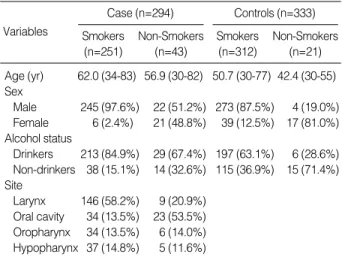
333 cancer-free controls, recruited from the Department of Otolaryngology, at Asan Medical Center, from April 1994 to January 2004. All study participants were Korean. The case group consisted of 267 male patients (90.8%) and 27 female patients (9.2%); 251 cases were smokers with a mean age of 62 yr, and 43 were non-smokers with a mean age of 57 yr. Pathology reports were used to confirm the diagnosis of HNSCC for all cases. The control group consisted of 277 male patients (83.2%) and 56 female patients (16.8%); 312 were smokers with a mean age of 51 yr, and 21 were non- smokers with a mean age of 42 yr (Table 1). Controls were randomly selected from inpatients and outpatients with no history of cancer and were diagnosed with benign head and neck lesions. The distribution of primary cancer sites, among cases, is shown in Table 1.
For study purposes, subjects were divided into non-smok- ers and ever-smokers. Ever-smokers were defined as anyone who had smoked at least one pack-year; a pack-year was de- fined as the product of [{number of cigarettes consumed per day}×{duration of smoking (years)}]. Ever smokers were grouped as mild (≤30 pack-years) and heavy (>30 pack- years) smokers. Non-smokers were defined as individuals who had smoked less than one pack-year. Informed consent was obtained from all study subjects prior to participation.
Genotyping methods
After informed consent was obtained, each subject donat- ed ten milliliters of blood. A B lymphocyte pellet, obtained from the buffy coat by centrifuging the whole blood, was used for DNA extraction using a DNA purification kit (GEN- TRA, Minneapolis, MN, U.S.A.). SNP genotyping was per- formed by SNP-ITTMassays using the SNPstream 25KTM System (Orchid Biosciences, NJ, U.S.A.). The genomic DNA region spanning the polymorphic site was PCR amplified using one phosphothiolated primer and one regular PCR pri- mer (Table 2). The amplified PCR products were digested with exonuclease. The 5′phosphothiolates protected one strand of the PCR product from exonuclease digestion, result- ing in the generation of a single-stranded PCR template. The single-stranded PCR template was then overlaid onto a 384 well plate that contained covalently attached SNP-ITTMpri- mer extension, designed to hybridize immediately adjacent to the polymorphic site. Primer extension reaction was per-
Variables
Case (n=294) Smokers (n=251)
Non-Smokers (n=43)
Controls (n=333) Smokers
(n=312)
Non-Smokers (n=21) Age (yr) 62.0 (34-83) 56.9 (30-82) 50.7 (30-77) 42.4 (30-55) Sex
Male 245 (97.6%) 22 (51.2%) 273 (87.5%) 4 (19.0%) Female 6 (2.4%) 21 (48.8%) 39 (12.5%) 17 (81.0%) Alcohol status
Drinkers 213 (84.9%) 29 (67.4%) 197 (63.1%) 6 (28.6%) Non-drinkers 38 (15.1%) 14 (32.6%) 115 (36.9%) 15 (71.4%) Site
Larynx 146 (58.2%) 9 (20.9%) Oral cavity 34 (13.5%) 23 (53.5%) Oropharynx 34 (13.5%) 6 (14.0%) Hypopharynx 37 (14.8%) 5 (11.6%)
Table 1.Frequency distribution analysis of demographic and risk factors
Gene-SNP Primer Sequence (5′-3′) Table 2.Primers for amplification and sequencing of genes
GSTP1 PCR Forward TGGTGGACATGGTGAATG Ile105Val PCR Reverse AACCCTGGTGCAGATGCT
Genotyping CGTGGAGGACCTCCGCTGCAAATAC NQO1 PCR Forward ATTCTGAAAGGCTGGTTTGAG
Trp139Arg PCR Reverse CCAGAAGCTGGCTGTCAG Genotyping AGCATTCAGAACCATCCACCTACCC
formed with the SNaPshot ddNTP Primer Extension Kit (Applied Biosystems, Foster City, CA, U.S.A.). To purify the product of the primer extension reaction, one unit of SAP (shrimp alkaline phosphatase) was added to the reaction mix- ture and was incubated at 37℃for one hour, followed by fifteen minutes at 72℃for enzyme inactivation. The DNA samples, containing the extension products and Genescan 120 Liz size standard solution, were added to Hi-Di forma- mide (Applied Biosystems). The mixture was incubated at 95℃for five minutes, then placed on ice for another five minutes. It was then analyzed by electrophoresis in an ABI Prism 3700 Genetic analyzer. The results were analyzed using GeneScan and Genotyper software (Applied Biosystems).
Statistical analysis
The distributions of the GSTP1 and NQO1 genotypes between patients and controls were compared using the Man- tel-Haenszel 2test. The frequencies of genotypes were ana- lyzed between the cases and the controls within three sub- groups of wild type, heterozygote, and homozygote mutant.
Throughout this study, a p-value of <0.05 was considered sta- tistically significant. Mantel-Haenszel 2test was also used to evaluate the association between the GSTP1 and NQO1 genotypes and smoking status in HNSCC risk. The associa- tion between genotypes and smoking status was evaluated within subgroups of the GSTP1 and NQO1 genotypes, the wild type group and the combined heterozygote/homozygote mutant group.
RESULTS
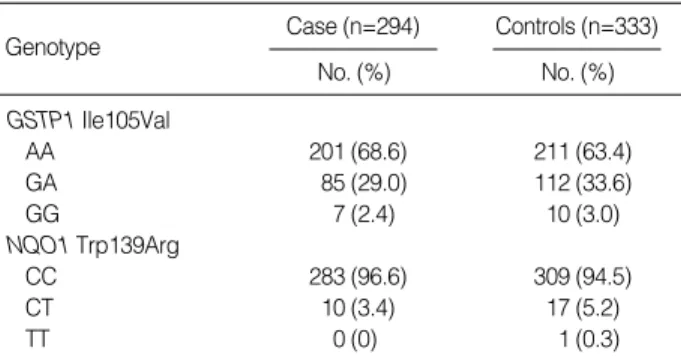
Table 3 shows the GSTP1 and NQO1 genotype distribu- tions among cases and controls. The distribution of the GS- TP1 and NQO1 genotypes among controls were in agree- ment with the Hardy-Weinberg equilibrium. The frequen- cies of GSTP1 and NQO1 genotypes in controls were simi- lar to those previously observed in Koreans (17). When com- paring the genotype distribution between control individu- als and HNSCC patients, we observed that the frequency of
the wild type GSTP1 and NQO1 genotype was slightly ele- vated in HNSCC patients, but the difference was not statis- tically significant (Table 3).
GSTP1 and NQO1 polymorphisms were associated with cigarette smoking and the risk of HNSCC in the case group (p<0.05). The frequency of genotype AA in GSTP1 Ile105Val was 83.7% in non-smokers, 70.1% in mild smokers, and 66.7% in heavy smokers; the frequency of the G allele conta- ining genotypes (genotypes GA and GG) was 16.3%, 29.9%, and 33.3%, respectively. Genotype distributions were statisti- cally significant (p=0.0114), and we observed that the GSTP1 105Val allele was associated with a tobacco dose-dependent increase in risk of HNSCC (Table 4). The frequency of geno- type CC in NQO1 Trp139Arg was 100% in non-smokers, 98.7% in mild smokers, and 94.8% in heavy smokers, and the frequency of T allele containing genotypes (genotype TC and TT) was 0%, 1.3%, and 5.2%, respectively (Table 5). The NQO1 139Arg allele was associated with a tobacco dose-de- pendent increase in risk of HNSCC and these genotype distri- butions were statistically significant (p=0.0454). In the con- trol groups, no significant difference of genotype distribution was found between wild type and mutant genotypes (Table 4, 5).
DISCUSSION
In this hospital-based, case-control study of 627 Korean patients, polymorphisms in two of the genes involved with metabolism of tobacco-induced carcinogens, GSTP1 Ile105Val and NQO1 Trp139Arg, were examined for association with
0 PY 1-29 PY >30 PY p-value Cases
AA 36 (83.7%) 54 (70.1%) 110 (66.7%) 0.0114 GA+GG 7 (16.3%) 23 (29.9%) 55 (33.3%)
Controls
AA 11 (52.4%) 109 (63.0%) 91 (65.5%) 0.5737 GA+GG 10 (47.6%) 64 (37.0%) 48 (34.5%)
PY, pack year.
0 PY 1-29 PY >30 PY p-value Cases
CC 43 (100%) 76 (98.7%) 163 (94.8%) 0.0454
CT+TT 0 (0%) 1 (1.3%) 9 (5.2%)
Controls
CC 19 (90.5%) 164 (96.5%) 126 (92.6%) 0.3946 CT+TT 2 (9.5%) 6 (3.5%) 10 (7.4%)
PY, pack year.
Genotype
No. (%) Controls (n=333) No. (%)
Case (n=294)
Table 3.Genotype distribution of GST1 and NQO1 polymorphi- sms in squamous cell carcinoma patients and controls
Table 4.Association between GSTP1 Ile105Val genotypes and smoking amounts
Table 5.Association between NQO1 Trp139Arg genotypes and smoking amounts
GSTP1 Ile105Val
AA 201 (68.6) 211 (63.4)
GA 85 (29.0) 112 (33.6)
GG 7 (2.4) 10 (3.0)
NQO1 Trp139Arg
CC 283 (96.6) 309 (94.5)
CT 10 (3.4) 17 (5.2)
TT 0 (0) 1 (0.3)
HNSCC risk. We found no significant difference among the genotype distribution of polymorphic GSTP1 and NQO1 genes between HNSCC cases and controls. Although there are a large number of reports which suggest that polymor- phisms of GSTP1 and NQO1 genes influence the suscepti- bility to cancer, the results of this present study suggest that the polymorphisms of the genes alone have only minor im- portance in the susceptibility to HNSCC. However, this find- ing is likely not due to the lack of a relationship between ge- netic polymorphisms and risk of HNSCC, but rather because biomolecular studies for genetic polymorphisms are still in the early phases of development.
To date, the role of several different DNA polymorphisms in detoxification genes have been examined in numerous case- control HNSCC studies. Results have often been conflicting, and some report weak-to-moderate associations, while others show no elevation of risk. These conflicting results may be due to relatively small samples sizes, or the lack of proper controls for other environmental exposures that are also risk factors for HNSCC. This study is also limited by the relatively small number of cases and controls. And the control popu- lation in this study was a convenience sample, and cases and controls were not balanced for confounding factors, age and sex. Therefore further studies with a larger number of subjects and well controlled risk factors such as age, sex, smoking, and alcohol exposures are needed.
In addition, the concept of genetic susceptibility is extre- mely complex and involves multiple cellular systems regu- lated by hundreds of genes (18), therefore, it is difficult to explain the association between genetic polymorphisms and risk of HNSCC by analyzing only one or two genes. In con- clusion, a variety of analysis is needed, including a combined analysis of multiple polymorphic genotypes in detoxification enzymes, and of haplotypes to multiple enzymes associated with metabolisms of tobacco-induced carcinogens.
In our analysis, GSTP1 and NQO1 polymorphisms were associated with the status of cigarette smoking and, there- fore an increased risk of HNSCC in the case group (p<0.05).
For evaluation of smoking and genetic polymorphisms, we divide the subjects into three subgroups: non-smokers, mild smokers, and heavy smokers. Frequencies of the wild type GSTP1 and NQO1 genotypes were high in all three sub- groups compared to frequencies of the mutant allele contain- ing genotypes. Both GSTP1 and NQO1 genotype distribu- tions in all three subgroups of the cases were statistically sig- nificant, and the GSTP1 105Val allele and NQO1 139Arg allele were associated with a tobacco dose-dependent increase in risk of HNSCC. It is likely that because GSTP1 and NQO1 are involved in the metabolism of specific tobacco smoke intermediates, ever smokers with the variant alleles, which are associated with reduced enzymatic activities, experience deleterious effects from reduced carcinogen detoxification.
Therefore, there is a greater impact on HNSCC risk in smokers based on pack-years of smoking. This suggests that a predis-
position to genetic factors, such as GSTP1 and NQO1 vari- ants, plays a role in the development of HNSCC in smokers.
However, there were no significant differences in the distri- bution of genetic variants among the smoking status in con- trols. There was also no significant difference in the genotype distribution of polymorphic GSTP1 and NQO1 genes bet- ween HNSCC cases and controls. From this point of view, environmental effects such as cigarette smoking are likely to dominate over genetic effects.
Several studies have examined the relationship between the GSTP1 polymorphisms and smoking status in HNSCC, and the results are not consistent. Ophuis et al. (19) found that HNSCC patients with the GSTP1 G allele containing genotypes (GA and GG) showed increased odds ratios for smoking compared with the wild type GSTP1 genotype.
However, McWilliams et al. (20) found no association between the GSTP1 genotypes and smoking status in HNSCC risk.
There are no studies performed to determine the relationship between the NQO1 polymorphisms and smoking in HNSCC.
However, in bladder cancer, which is similar to HNSCC epi- demiology in that it is strongly related to tobacco exposure, there are several studies that suggest the association between NQO1 genetic polymorphisms and the development of smok- ing related bladder cancer (21, 22).
Assessment of smoking or alcohol consumption is difficult, especially for the total accumulative exposure. Exposure usu- ally takes place over many years and is not always consistent.
In addition, different cigarette brands may yield completely different nicotine and tar exposures. Therefore, development of biomarkers, that could indicate the level of exposure and the period of consumption, would be more helpful.
In summary, to study the effect of different genotypes on the risk of developing HNSCC, we conducted a case-control study of two genetic polymorphisms in HNSCC. We were unable to demonstrate a significant association between gene- tic polymorphisms and risk of HNSCC. However, in analy- sis of the association between smoking and genetic polymor- phisms, GSTP1 105Val allele and NQO1 139Arg allele were associated with tobacco dose-dependent increase in risk of HNSCC in the case group. Our findings suggest that the GSTP1 and NQO1 genotype polymorphisms may play an important role in the development of HNSCC, and that the association between cigarette smoking and HNSCC may be modulated by these genetic polymorphisms.
REFERENCECS
1. Landis SH, Murray T, Bolden S, Wingo PA. Cancer statistics 1998.
CA Cancer J Clin 1999; 48: 6-29.
2. de Andrade M, Amos CI, Foulkes WD. Segregation analysis of squa- mous cell carcinoma of head and neck: evidence for a major gene determining risk. Ann Hum Genet 1998; 62: 505-10.
3. Raunio H, Husgafvel-Pursiainen K, Anttila S, Hietanen E, Hirvonen
A, Pelkonen O. Diagnosis of polymorphisms in carcinogen activating and inactivating enzymes and cancer susceptibility-a review. Gene 1995; 159: 113-21.
4. Beckett GJ, Hayes JD. Glutathione S-transferases; biomedical appli- cations. Adv Clin Chem 1993; 30: 281-380.
5. Hayes JD, Pulford DJ. The glutathione S-transferase supergene fam- ily: regulation of GST and the contribution of the isoenzymes to can- cer chemoprotection and drug resistance. Crit Rev Biochem Mol Biol 1995; 30: 445-600.
6. Mulder TP, Manni JJ, Roelofs HM, Peters WH, Wiersma A. Glu- tathione S-transferases and glutathione in human head and neck cancer. Carcinogenesis 1995; 16: 619-24.
7. Tsuchida S, Sato K. Glutathione transferases and cancer. Crit Rev Biochem Mol Biol 1992; 27: 337-84.
8. Ali-Osman F, Akande O, Antoun G, Mao JX, Buolamwini J. Molec- ular cloning, characterization, and expression in Escherichia coli of full-length cDNAs of three human glutathione S-transferase Pi gene variants. Evidence for differential catalytic activity of the encoded proteins. J Biol Chem 1997; 272: 10004-12.
9. Matthias C, Bockmuhl U, Jahnke V, Harries LW, Wolf CR, Jones PW, Alldersea J, Worrall SF, Hand P, Fryer AA, Strange RC. The glutathione S-transferase GSTP1 polymorphism: effects on suscep- tibility to oral/pharyngeal and laryngeal carcinomas. Pharmacoge- netics 1998; 8: 1-6.
10. Ernster L. DT-diaphorase. Meth Enzymol 1967; 11: 309-17.
11. Joseph P, Jaiswal AK. NAD(P)H:quinone oxidoreductase 1 specifi- cally prevents the formation of benzo[a]pyrene quinine-DNA adducts generated by cytochrome P450 1A1 and P450 reductase. Proc Natl Acad Sci USA 1994; 91: 8413-7.
12. Hajos AK, Winston GW. Purified NAD(P)H:quinone oxidoreduc- tase 1 enhances the mutagenicity of dinitropyrenes in vitro. J Biochem Toxicol 1991; 6: 277-82.
13. Xu LL, Wain JC, Miller DP, Thurston SW, Su L, Lynch TJ, Chris- tiani DC. The NAD(P)H:quinone oxidoreductase 1 gene polymor- phism and lung cancer: differential susceptibility based on smoking behavior. Cancer Epidemiol Biomarkers Prev 2001; 10: 303-9.
14. Longuemaux S, Delomenie C, Gallou C, Mejean A, Vincent-Viry M, Bouvier R, Droz D, Krishnamoorthy R, Galteau MM, Junien C, Beroud C, Dupret JM. Candidate genetic modifiers of individual sus- ceptibility to renal cell carcinoma: a study of polymorphic human xenobiotic-metabolizing enzymes. Cancer Res 1999; 59: 2903-8.
15. Clairmont A, Sies H, Ramachandran S, Lear JT, Smith AG, Bowers B, Jones PW, Fryer AA, Strange RC. Association of NAD(P)H: qui- none oxidoreductase (NQO1) null with numbers of basal cell carci- nomas: use of a multivariate model to rank the relative importance of this polymorphism and those at other relevant loci. Carcinogene- sis 1999; 20: 1235-40.
16. Lafuente MJ, Casterad X, Trias M, Ascaso C, Molina R, Ballesta A, Zheng S, Wiencke JK, Lafuente A. NAD(P)H:quinone oxidoreduc- tase-dependent risk for colorectal cancer and its association with the presence of K-ras mutations in tumors. Carcinogenesis 2000; 21:
1813-9.
17. Jeong HS, Kim KW, Lee JE, Lee WT, Park KA, Chang SK. Influence of GST subfamily & NQO1 gene polymorphism on the metabolism of benzene. Korean J Anat 2003; 36: 291-9.
18. Sturgis EM, Dahlstrom KR, Spitz MR, Wei Q. DNA repair gene ER- CC1 and ERCC2/XPD polymorphisms and risk of squamous cell carcinoma of the head and neck. Arch Otolaryngol Head Neck Surg 2002; 128: 1084-8.
19. Oude Ophuis MB, Roelofs HM, var den Brandt PA, Peters WH, Ma- nni JJ. Polymorphisms of the glutathione S-transferase P1 gene and head and neck cancer susceptibility. Head Neck 2003; 25: 37-43.
20. McWilliams JE, Evans AJ, Beer TM, Anderson PE, Cohen JI, Everts EC, Henner WD. Genetic polymorphisms in head and neck cancer risk. Head Neck 2000; 22: 609-17.
21. Park SJ, Zhao H, Spitz MR, Grossman HB, Wu X. An association between NQO1 genetic polymorphism and risk of bladder cancer.
Mutat Res 2003; 536: 131-7.
22. Choi JY, Lee KM, Cho SH, Kim SW, Choi HY, Lee SY, Im HJ, Yoon KJ, Choi H, Choi I, Hirvonen A, Hayes RB, Kang D. CYP2E1 and NQO1 genotypes, smoking and bladder cancer. Pharmacoge- netics 2003; 13: 349-55.