• 검색 결과가 없습니다.

Design and comparative study of various Two-Dimensional Grain Configurations based on Optimization Method

N/A
N/A
Protected

Academic year: 2021

Share "Design and comparative study of various Two-Dimensional Grain Configurations based on Optimization Method"

Copied!
9
0
0

로드 중.... (전체 텍스트 보기)

전체 글

(1)

Design and comparative study of various Two-Dimensional Grain Configurations based on Optimization Method

Khurram Nisar 1 Liang Guozhu 2

1 PhD candidate at Beijing University of Aeronautics & Astronautics, (BUAA), China

2 Deputy Dean, Professor at Beijing University of Aeronautics & Astronautics (BUAA), China School of Astronautics, BUAA, 37 Xue Yuan Road, Beijing 100083, China

[email protected]

Keywords: Solid Rocket Motor, Star Grain, Wagon Wheel Grain, Slotted Tube Grain, Internal Ballistics, Optimization

Abstract

Grain design has always been a vital and integral part of Solid Rocket Motor (SRM) design. Basing on the design objectives set by the system designer, the SRM designer has many options available for selecting the Grain configuration. Many of the available configurations may fulfill the required parameters of volumetric loading fraction, web fraction & Length to diameter ratios and produce internal ballistic results that may be in accordance to the design objectives.

However, for any given set of design objectives, it is deemed necessary that best possible configuration be selected, designed and optimized. Hence optimal results of all applicable configurations are vital to be attained in order to compare and finalize the design that will produce most efficient performance.

Generally the engineers pay attention and have skills on a specific grain configuration. The designing methodologies and computer codes available usually focus on single grain configuration may it be Star, Wagon Wheel or slotted tube. Hardly one can find a software or a design methodology where all such configurations can be worked on jointly and not only adequate designs be found but optimal solutions reached by applying an optimization method to find final design best suited for any design objective.

In the present work design requirements have been set, grain configurations have been selected and their designing has been conducted. The internal ballistic parameters have been calculated and after finding the preliminary design solutions, the optimal solutions have been found.

In doing so, software has been developed comprising of computer programs for designing the 2D grains including Star, Wagon Wheel and Slotted Tube configurations.

The optimization toolbox of Matlab Fmincon has been used for getting optimal solutions. The affects of all the independent geometric design variables on the optimized solutions have been analyzed.

Based on results attained from Optimization Method, an in depth comparison of Grain Configurations and analysis of performance prediction outputs have been conducted to come to conclusion as to which grain configuration is ideal for the current design requirement under study.

Introduction

Grain design is essentially a geometrical constraint depending upon the Thrust~Time & Pressure ~ Time laws 1) . It is most imperative in completing the design of any Solid Rocket Motor. The essence is to evolve the burning surface and develop relation between web burnt and the burning surface 2) . Design analysis of these grain configurations involving various independent geometric variables that define the different geometries has been conducted in detail.

Considering large and limitless number of combinations of these variables that satisfy the vital requirements of thrust, pressure, mass of propellant and burning time in addition to basic needs of volumetric loading fraction and web fraction, sound approach has been found to ensure that the final design of each type of grain configuration is the optimal one based on performance.

Optimization of the same has been conducted by keeping thrust as the Objective function, burning time and propellant mass as major constraints and by defining upper and lower bounds for the independent design variables. Programs written during the course of studies are modifiable, user friendly and all the calculations have been carried out logically and sequentially.

The analysis applied in this paper identifies, for a given fixed length and outer diameter of the grain while remaining within constraints of burning time and mass of a particular propellant, the most efficient grain geometric configuration amongst those mentioned that delivers best possible internal ballistic design parameters.

This has been achieved by analyzing the effects of all the independent variables on the port area, burning surface, perimeter, sliver area, web fraction, volumetric loading fraction, neutrality, burning rate, thrust coefficient that in turn have been used to find chamber pressure and thrust for each grain configuration.

The various steps incorporated for completing the study are enumerated below:

a. Evaluation of system requirements and design objectives.

b. Geometric parameters of Star Grain 3) , Wagon Wheel Grain and Slotted Tube Grain.

c. Performance prediction.

(2)

d. Design analysis of these grain configurations involving various independent geometric variables.

e. Comparison of all optimal designs, analysis of performance prediction outputs and evaluation of best suited grain configuration for the current design requirements.

System requirements and design objectives Requirements have been given for a given fixed length and outer diameter of the grain while remaining within constraints of burning time t b and mass of propellant m p . Maximum average thrust F av has to be calculated fulfilling below mentioned design objectives. Moreover the propellant and nozzle parameters have also been dictated and have to be adhered.

Design objective

a. Grain Length : 3700 mm

b. Mass of Propellant : 350± 10 kg c. Burning time : 4.5 ± 1 sec.

d. Average Thrust : >240 kN e. Total Impulse : > 800 kNs f. Grain Outer Radius : 147 mm Propellant parameters

Considering, the mechanical properties and internal ballistics required, the following propellant parameters have been selected:

a. Propellant : HTPB/AP/AL

b. Density : 1.74 g/cm 3

c. C * : 1554

Nozzle parameters

a. Exit diameter: 280mm

Geometric Parameters Star Grain

Star grain being well known for its simplicity, reliability, neutral burning and efficiency has been graded amongst the best and widely used grain configurations 2) . Certain disadvantages like higher sliver ratios and undesirable tail offs are objectionable and disadvantageous but affects of the same can be reduced by tapering and filleting the star points 3) .A star perforated grain has been defined in Fig 1.

a. Number of star points N b. Web thickness e c. Grain outer radius

2 D d. Fillet radius r

e. Cusp Radius r 1

f. Star angle coefficient ζ = n

επ

g. Valley angle θ / 2

Fig 1. Star Perforated Grain Wagon Wheel Grain

This configuration is best suited for motors requiring large burning surface areas. Wagon wheel design encompasses different webs along spokes that can be useful for dual thrust considerations. Likewise low volumetric loading fractions and web fractions are achievable with this configuration. Ballistic design analysis of the wagon wheel grain configuration involves parametric evaluation of the six independent geometric variables that defines the wagon wheel 4),5) . A Wagon Wheel perforated grain has been defined in Fig 2.

a. Number of spokes N

b. Web thickness e

c. Grain outer radius D/2 d. Fillet radius r

e. Ray Side h

f. Wagon Wheel angle ζ = n επ g. Valley angle

2 θ /

Fig. 2 Wagon Wheel perforated grain Slotted Tube Grain

The Slotted Tube configuration consists of a cylindrical tube of propellant into which a number of slots have been cast. In tubular grain, to make A b

constant, the grain must be slotted 4) . In case of tube or

cylindrical grains, for adjusting large values of

burning area, long lengths of the grain may have to be

incorporated that may not be feasible, hence slots can

be put across the grain or in cross sections 5) . These

slots connect the inner and outer surfaces of the tube

and extend part of its length.

(3)

The configuration offers some significant advantages for the designers, the most obvious is its inherent lack of sliver in a non erosive situation since basically it is an internal burning cylinder. Being a very simple configuration, it remains free of stress concentration which is not so in case of Star and Wagon Wheel designs being more complicated 6),7) . Another feature of Slotted Tube grain designs is that they can contain thick webs, in some propellants the stresses arising from casting and curing of such webs are relieved by cracking although there are no stress concentration points. Moreover Slotted Tube grains, being relatively simple in design, require mandrels for casting propellant which are less costly and easy to be machined.

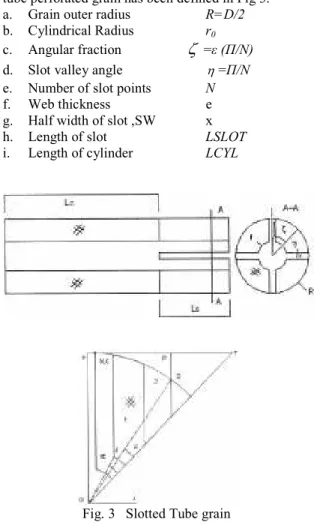
A discrete disadvantage of Slotted Tube grain design is in the exposure of the motor case in the slot region to hot, high velocity combustion gases that calls for an efficient insulation and liner. A slotted tube perforated grain has been defined in Fig 3.

a. Grain outer radius R=D/2 b. Cylindrical Radius r 0

c. Angular fraction ζ =ε (Π/N) d. Slot valley angle η =Π/N e. Number of slot points N f. Web thickness e g. Half width of slot ,SW x

h. Length of slot LSLOT

i. Length of cylinder LCYL

Fig. 3 Slotted Tube grain Performance prediction

The ability to accurately predict the performance of SRMs has obvious importance in their designing. The main outputs of the performance predictions are the P av and P max . Performance requirements that satisfy the mission objectives are given in terms of impulse and time or thrust level. Therefore typical specification will include I t , I s , F av , F max and t b .

Definition of the ballistic performance parameters is related to thrust - time and pressure - time curves for the motor. Other important parameters that influence the performance and have been calculated in this study are A pi , A bi , A p /A t , m p , BR, n, Cf, C*, d t , A t , d e , A e , V p , V c 8)

.

Optimization

The optimization toolbox of Matlab Fmincon for local optimization utilizing exact analysis has been used in which Fmincon attempts to find a constrained minimum of a scalar function of several variables starting at an initial estimate. This is generally referred to as constrained nonlinear optimization or nonlinear programming. Medium-Scale Optimization has been used in which Fmincon uses a sequential quadratic programming (SQP) method. In this method, the function solves a quadratic programming (QP) subproblem at each iteration. An estimate of the Hessian of the Lagrangian is updated at each iteration so a positive definite quasi-Newton approximation of the Hessian of the Lagrangian function, is calculated.

After choosing the direction of the search, the optimization function uses a line search procedure to determine how far to move.

Thurst has been computed as the objective function with constraints of burning time and mass of propellant. This has been done by keeping the diameter and length of grain fixed. Upper and lower limits have been defined for independent geometric variables and an initial guess provided.

Hence all the Burning Zones for Star Grain, Wagon Wheel Grain and Slotted Tube Grain have been calculated and then optimized. Value of Maximum attainable F av has been calculated through this optimization method. m p and t b have been kept within given design ranges. Parametric study of all the independent design variables has also been conducted to analyze their affects of performance parameters during designing and optimization.

Results and Analysis Results of Star Grain 3)

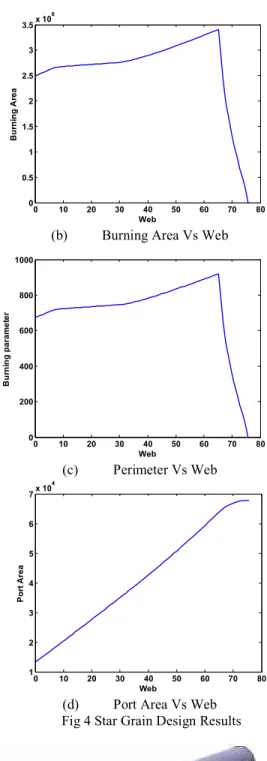
Preliminary and optimal results of Star grain design are depicted in table 1, table 2 and Fig. 4.

Table 1 Preliminary Design Results

N 6 7 7

e(mm) 70 63.21 63.21

ε 0.8 0.99 0.9

2 θ /

(deg) 30 35.56 40

r(mm) 10.29 11.76 11.76 r 1 ( mm) 13.32 11.76 11.76 F av (KN) 241.9 255.4 251.3 m p (kg) 351.7 346 340

t b (sec) 3.99 3.79 3.68

(4)

S f 3.48 4.6 3.35 S(m) 0.685 0.707 0.7 Burn rate

mm/sec 20.28 20.57 20.48

d t (mm) 101 101 101

I t (kNsec) 966 968 926.7 P av

(MPa) 18.26 19.24 18.9

w f 0.47 0.43 0.43

V l 0.8 0.79 0.76

d e (m) 0.28 0.28 0.28 A e ( m 2 ) 0.06 0.06 0.06

Table 2 Optimal Design Results

N 8 d t (mm) 101

e(mm) 65.76 A t ( m 2 ) 0.006 ε 0.99 I (kNsec) t 971.9

2 θ /

(deg) 39.87 av

P

(MPa) 19.44

r(mm) 7.35 w f 0.447

r 1 (mm) 7.35 V l 0.8

F av (KN) 258 d e (m) 0.28 m p (kg) 351.2 A e ( m 2 ) 0.06 t b (sec) 5.76 Burn rate

mm/sec 20.72 S f 3.55 V p ( m 3 ) 0.2

C f 1.63 n 0.35

Neutrality 1.429 V c ( m 3 ) 0.251

0 0.5 1 1.5 2 2.5 3 3.5 4

0 200 400

P re s s u re

Time (Sec)

0 0.5 1 1.5 2 2.5 3 3.5 4 0

200 400

T h ru s t

(a) Pressure & Thrust Vs Time

0 10 20 30 40 50 60 70 80

0 0.5 1 1.5 2 2.5 3 3.5 x 10

6

Web

B u rn in g A re a

(b) Burning Area Vs Web

0 10 20 30 40 50 60 70 80

0 200 400 600 800 1000

Web

B u rn in g p a ra m e te r

(c) Perimeter Vs Web

0 10 20 30 40 50 60 70 80

1 2 3 4 5 6 7 x 10

4

Web

P o rt A re a

(d) Port Area Vs Web Fig 4 Star Grain Design Results

Fig 5 Optimized Star Grain

(5)

Analysis of Star Grain Results

With the diameter of the motor fixed, the star grain geometry is totally dependent upon six independent variables i.e. ε, N, θ, e, r and r 1 . Each of these variables has a bearing on explicit characteristic of star optimization. Effects of these six variables have also to be visualized while considering V l ,w f ,

neutrality and S f . r and r 1 are required to be kept as low as possible. F av , V l , neutrality and S f are not as sensitive to changes in r 1 as to changes in r. By increasing N, the perimeter and thereafter the burning surface area also increase and also F av . Considering values of ε and θ / 2 , the effects of N on neutrality and S f are prominent. θ / 2 also affects the neutrality, S f , m p

and F av . By increasing the value of ε , the V l and m p

can be increased and similarly F av can be increased but with it S f will also increase. The grain designer always prefers more e while remaining within desired limits of w f and V l . By increasing e the w f and V l will increase but this will also increase the m p that may go out of the constrained range.

An analysis of a suitable range of ε, N, θ, e, r, r 1

satisfying the requirements of maximum F av and ensuring sound values of w f , V l , . S f & neutrality while remaining within the design constraints of m p & t b has ensured an overall optimal design and value of optimized objective function F av has been increased to maximum compared to the values attained during preliminary designs.

Results of Wagon Wheel grain

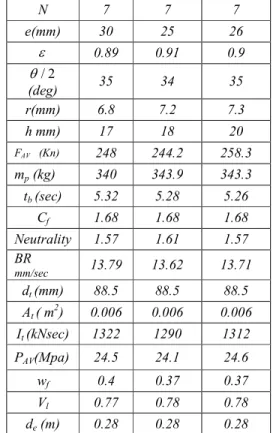
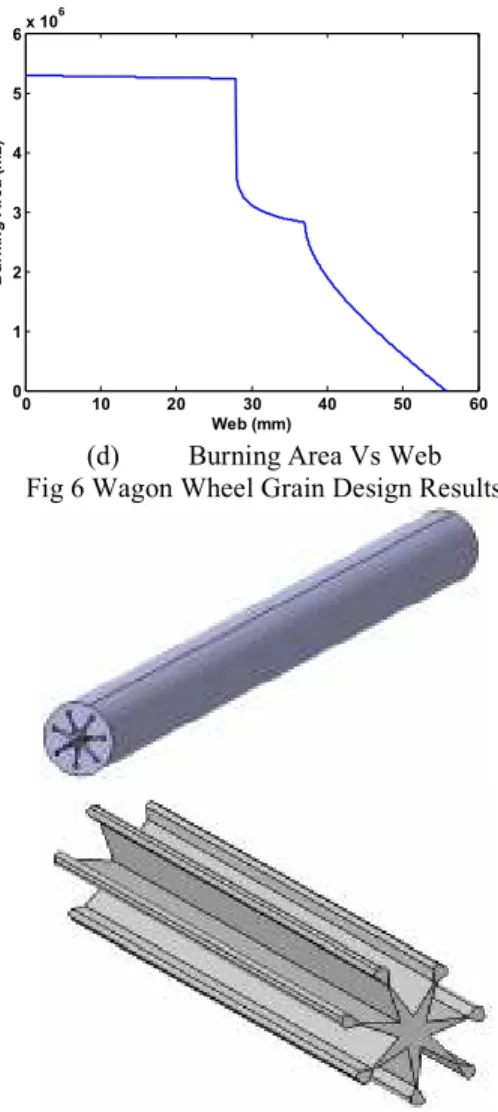
Preliminary and optimal results of Wagon Wheel grain design are depicted in table 3, table 4 and Fig. 6.

Table 3 Preliminary Design Results- Wagon Wheel

N 7 7 7

e(mm) 30 25 26

ε 0.89 0.91 0.9

2 θ /

(deg) 35 34 35

r(mm) 6.8 7.2 7.3

h mm) 17 18 20

F AV (Kn) 248 244.2 258.3

m p (kg) 340 343.9 343.3 t b (sec) 5.32 5.28 5.26

C f 1.68 1.68 1.68

Neutrality 1.57 1.61 1.57 BR

mm/sec 13.79 13.62 13.71 d t (mm) 88.5 88.5 88.5 A t ( m 2 ) 0.006 0.006 0.006 I t (kNsec) 1322 1290 1312 P AV (Mpa) 24.5 24.1 24.6

w f 0.4 0.37 0.37

V l 0.77 0.78 0.78

d e (m) 0.28 0.28 0.28

Table 4 Optimized Design Results- Wagon Wheel

N 7 d t (mm) 88.5

e(mm) 28 A t ( m 2 ) .0056 ε 0.917 I t (kNsec) 1367 2

θ / (deg) 35.13 P AV (Mpa) 25.3

r(mm) 7.54 w f 0.37

h mm) 20.72 V l 0.8

F AV (Kn) 256.6 d e (m) 0.28

m p (kg) 354 A e ( m 2 ) 0.06 t b (sec) 5.33 A b (m 2 ) 5.28

S f 1.76 R (mm) 147

C F 1.68 n 0.325

Neutrality 1.64 BRmm/sec 13.88

0 1 2 3 4 5 6

0 50 100 150 200 250 300 350 400 450

P re s s u re ( M P a )

Time (Sec)

0 1 2 3 4 5 6 -100

0 100 200 300 400 500

T h ru s t (k N )

(a) Pressure & Thrust Vs Time

0 10 20 30 40 50 60

0 500 1000 1500

Web (mm)

B u rn in g p a ra m e te r (m m )

(b) Perimeter Vs Web

0 10 20 30 40 50 60

1 2 3 4 5 6 7 8 x 10

4

Web (mm)

P o rt A re a ( m 2 )

(c) Port Area Vs Web

(6)

0 10 20 30 40 50 60

0 1 2 3 4 5 6 x 10

6

Web (mm)

B u rn in g A re a ( m 2 )

(d) Burning Area Vs Web Fig 6 Wagon Wheel Grain Design Results

Fig 7 Optimized Wagon wheel Grain Analysis of Wagon Wheel Grain Results

The wagon wheel grain geometry is dependent upon six independent variables i.e. ε, N, θ, e, r and h

By increasing N, the perimeter and thereafter the burning surface area also increase and also F av . By decreasing θ / 2 , the F av , A b , m p and V l increase correspondingly while S f decreases. By increasing the value of ε , the V l and m p can be increased and similarly F av can be increased but with it S f will also increase. . r is required to be kept low. The grain designer always prefers more e while remaining within desired limits of w f and V l . By increasing e the w f and V l will increase but this will also increase the m p that may go out of the constrained range. By increasing h, value of F av , m p & V l increases and S f

decreases while neutrality is negatively affected.

Due to these attributes of wagon wheel, compromises will result.

An analysis of a suitable range of ε, N, θ, e, r, h satisfying the requirements of maximum F av and ensuring sound values of w f , V l , S f & neutrality while remaining within the design constraints of m p & t b has ensured an overall optimal design and value of optimized objective function F av has been increased to maximum compared to the values attained during

preliminary designs. This has been attained while remaining within the set design constraints.

Results of Slotted Tube grain

Preliminary and optimal results of Slotted Tube grain design are depicted in table 5 and Fig. 8. Preliminary results for three different slotted tube configurations have been listed for analysis and comparison. Thrust and Pressure time histories have been shown along with burning parameters, propellant volume decay and web being burnt.

Table 5 Design Results – Slotted Tube PRELIMINARY

RESULTS

OPTIMIZED RESULTS

N 4 4 4 4

r (mm) 65 70 69 69.97

ε .8 .95 .89 0.99

X (mm) 50 50 51 50.7

LSLOT(mm) 450 925 875 925

LCYL( mm) 3250 2775 2825 2775

F av (KN) 242 246 247 251.8

m P (kg) 349 348 348 359

t b (sec) 4.03 3.74 3.79 3.72 BR(mm/sec) 19.85 19.96 20 20

d t (mm) 85 85 85 85

I t (kNsec) 980 922 937 937

P av (MPa) 26 26.2 26 26.8

w f .55 .52 .53 0.52

V L .80 .79 .79 0.80

d e (m) .28 .28 .28 .28

A e ( m 2 ) .0057 .0057 .0057 .0056

N .34 .34 .34 .34

0 0.5 1 1.5 2 2.5 3 3.5 4

0 100 200 300 400 500 600 700 800 900

Time (Sec)

P re s s u re ( B a r)

(a) Pressure VS Time

0 0.5 1 1.5 2 2.5 3 3.5 4

0 100 200 300 400 500 600 700 800

Time (Sec)

T h ru s t (K N )

(b) Thrust VS Time

(7)

0 10 20 30 40 50 60 70 80 0

1 2 3 4 5 6 7 8 9

x 10

6

Web

Bu rn in g p a ra m e te r

(c) Burning Parameter VS Web

0 10 20 30 40 50 60 70 80

0 0.5 1 1.5 2 2.5 x 10

8

Web

P ro p e ll a n t V o lu m e

(d) Propellant Vol VS Web Fig. 8 Slotted Tube Grain Design Results

Fig 9 Optimized Slotted Tube Grain Analysis of Slotted Tube Grain Results

The Slotted Tube grain geometry is dependent upon six independent variables i.e. ε, N, r, LSLOT,LCYL, X .

Effects of these variables have been visualized while considering V l , w f and neutrality. By increasing the value of ε , the V l and m p has been increased and with it F av has increased. By increasing N, the perimeter and thereafter the burning surface area also increases and also F av but value of m p gets out of the design constraint. Considering values of ε , the effects of N on neutrality are prominent. An increase in value of r increases F av and decreases m p that may get out of the constrained limits. Better neutrality is attainable at higher values of r but a compromise is required to be made between better neutrality and m p while trying to achieve maximum F av . Usually L S < 1/3 L CYL , F av

increases slightly by increasing the LSLOT but with it m p also increases while better neutrality is attained

likewise by increasing value of X, F av decreases slightly and neutrality improves.

An analysis of a suitable range of ε, N, r, LSLOT,LCYL, X satisfying the requirements of maximum F av and ensuring sound values of w f , V l &

neutrality while remaining within the design constraints of m p & t b has ensured overall optimal design and value of optimized objective function F av

has been increased to maximum compared to the values attained during preliminary designs. Like Star and Wagon Wheel designs, this has also been achieved while adhering to all the set constraints.

Comparison and Analysis of Optimal Designs Comparison

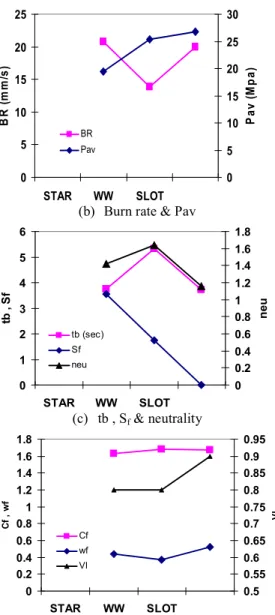
Based on results attained from Optimization Method, an in depth comparison of Grain Configurations and analysis of performance prediction outputs has been conducted to come to conclusion as to which grain configuration is ideal for the current design requirement under study. Hence for a given fixed length and outer diameter of the grain while remaining within constraints of t b and m p , the most efficient grain geometric configuration that delivers best internal ballistic parameters has been identified.

Table 6 Comparison of optimal designs STAR WAGON

WHEEL

SLOTTED TUBE F av (KN) 258 256.6 251.8

m p (kg) 351.2 354 359

t b (sec) 3.76 5.33 3.72

S f 3.55 1.76 0

BRmm/sec 20.72 13.88 20

C f 1.63 1.68 1.67

P av (MPa) 19.44 25.3 26.8

w f 0.44 0.37 0.52

V l 0.8 0.8 0.9

neu 1.42 1.64 1.16

248 249 250 251 252 253 254 255 256 257 258 259

STAR WW SLOT

F a v

346 348 350 352 354 356 358 360

m p

Fav (KN) mp (kg)

(a) Fav & mp

(8)

0 5 10 15 20 25

STAR WW SLOT

B R ( m m /s )

0 5 10 15 20 25 30

P a v ( M p a )

BR Pav

(b) Burn rate & Pav

0 1 2 3 4 5 6

STAR WW SLOT

tb , S f

0 0.2 0.4 0.6 0.8 1 1.2 1.4 1.6 1.8

n e u

tb (sec) Sf neu

(c) tb , S f & neutrality

0 0.2 0.4 0.6 0.8 1 1.2 1.4 1.6 1.8

STAR WW SLOT

C f , w f

0.5 0.55 0.6 0.65 0.7 0.75 0.8 0.85 0.9 0.95

V l

Cf wf Vl

(d) C f , W f & V l

Fig 10 Comparison of optimal designs Analysis

With the Grain length and diameter fixed, required F av

is >240 KN, m p is 350± 10 kg & the desired limit of t b

is 4.5 ± 1 sec. All the above three grain configurations are fulfilling requirements of F av , I t , P av , S f , V l , w f ,

neutrality & BR while remaining within the required limits of t b and m p ..

F av , m p and t b It is always desirable to attain required thrust in least t b as practically it gives leverage to the system designer to adjust separation timings and thrust termination if required but typically from SRM design point of view, it is just important that this parameter be kept within the desired design limits. Least possible m p is also appreciated as it reduces the overall system weight and size. From table 6 and figure 10(a) and (c), it is evident that max F av is being achieved by Star configuration where average thrust of 258 kN is being attained in 3.76 sec and by utilizing 351.2 kg propellant, wagon wheel geometry

also delivers 256.6 kN but in 5.33 sec and by using 354 kg whereas slotted tube configuration can give 251.8 kN in least time of 3.72 sec but requires maximum m p i.e. 359 kg. So for the current objective requirements, Star geometry is delivering maximum thrust utilizing least m p in relatively fine t b . Hence considering F av , m p and t b the Star grain geometry is finest of all the three configurations under study.

Sliver While designing any SRM grain, it is deemed necessary that the sliver should be kept low, because useful energy cannot be attained by the left over propellant at the end of burning. Considering the above three grain configurations from figure 10 (c), Slotted Tube geometrical grain operates with no sliver as it’s slotted portion diminishes earlier and at the last zone of burning only tubular grain is left that is fully consumed during combustion. Maximum sliver is left in the star configuration and slightly lesser amount is left in wagon wheel grain. So comparing the sliver fraction, Slotted tube proves to be better between the three grain configurations under current situation.

Neutrality The neutrality usually refers to flatness of the thrust-time curve and can also be defined as ratio of maximum pressure and the average pressure.

The value of neutrality is desirable to remain near 1 thus a flat Thrust-time trace is desired. Considering the high F av required in such short t b , this motor has to act as a Booster Motor through out its burning time phase so totally flat thrust-time curve may not be possible to be attained. From table 6 and figure 10 (c), it is clear that slotted tube grain configuration is producing a more neutral behaviour compared to Star and Wagon Wheel configurations.

w f and V l SRM grains are designed to satisfy w f

and V l . Hence the two dependent parameters are of considerable importance in a grain design analysis.

Usually the SRM design requires a highly loaded configuration. The impact of remaining sliver content on the design depends on the specific ballistic requirements, however in virtually all cases the sliver fraction will have a bearing on the required volumetric loading. If burning neutrality is not important, high V l

can be attained with small sliver fractions by increasing web fraction. Table 6 and figure 10 (d) indicates values of V l , Slotted tube grain has highest loaded configuration.

P av In addition to the above referred design parameters, it is very important that P av be kept as low as possible. P av is mainly dependent upon grain burning surface areas A b , propellant burning rate BR and throat diameter d t . Normally with the d t fixed, A b

and BR become crucial. BR dependents upon the

propellant formulation and it is desired to be kept as

low as possible. From figure 10 (b) it can be seen that

Star grain is delivering the required thrust in P av is

19.44 MPa whereas Wagon wheel and Slotted tube

are operating at 25.3 MPa & 26.8 MPa respectively.

(9)

Hence Star grain is fulfilling the design requirements at lowest pressure.

Conclusion

While designing any solid rocket motor grain, it is imperative that maximum F av be attained within least allowable t b and m p . It is deemed necessary that the sliver should be kept low and a flat Thrust-time trace is desired. Usually the SRM design requires a highly loaded configuration and it is important that P av be kept as low as possible.

For the current design objectives, while remaining within the essential constraints, the optimal designs of star, wagon wheel and slotted tube grain configurations are fulfilling all the design requirements.

Star grain is delivering the maximum F av using least m p while operating at lowest P av but at relatively higher BR and S f , the wagon wheel is delivering lower F av at slightly higher m p and relatively higher P av but in least t b and lowest required BR. Slotted tube is delivering lowest F av by utilizing maximum m p and at highest P av but at lowest value of neutrality with no sliver.

It can be deduced that all the configurations are delivering the required design objectives but with certain compromises in different design parameters as compared with each other.

Considering the most vital design parameters of F av , m p and P av and considering the current design requirements, the Star Grain design is the most viable and best suited option to be selected as final design amongst the three optimal grain design configurations mentioned in table 6.

By applying this method of design and optimization, various Two Dimensional Grains for SRM can be designed and optimized considering different design objectives like F av , m p & t b and best possible configuration of all the available geometries can be finalized that will produce most efficient performance.

References

1) W.T. Brooks “Solid Propellant Grain Design and Internal ballistics” NASA SP-8076-1972 2) W.T. Brooks. “Application of an analysis of the

two dimensional internal burning Star grain configurations”. AIAA 80-1136.

3) Khurram Nisar, Xu Peng, Liang Guozhu. “Grain Design, Performance Prediction and Optimization of Star configuration for SRM”, 11 th International Space Conference of Pacific Basin Societies, May 16~18, 2007, Beijing, China.

4) Wang guanglin, Cai e., “The design of Solid rocket motor”. Publish by Northwestern Polytechnical Univ. Press. 1994. (In Chinese).

5) Wang guanglin, Cai e., “The design of Solid rocket motor”. Publish by Northwestern Polytechnical Univ. Press. 1985.(In Chinese).

6) Stone, M.W. “Slotted Tube grain design”. ARSJ Vol 31, February 1961.

7) Stone, M.W. “The Slotted Tube grain design”.

AD 248599.

8) Li yimin, Zhang Zhongqin, “The principles of solid rocket motor”. Published by Beihang University Press.1999. (In Chinese).

Appendix Nomenclature

Burning area = A b

Initial burning area = A bi Nozzle exit diameter = A e

Initial port area = A pi

Area of throat = A t

Burning rate = BR

Characteristic velocity = C*

Thrust coefficient = C f

Nozzle exit diameter = d e

Average thrust = F av

Max thrust = F max

Specific impulse = I s

Total impulse = I t

Grain outer radius = R

Mass of propellant = m p

Burning Duration = t b

Pressure exponent = n

Vol. chamber case = V c

Avg. chamber pr = P av

Vol. of propellant = V p

Maximum pressure = P max

Volumetric Loading = V l

Web Fraction = w f

수치

Fig. 2   Wagon Wheel perforated grain  Slotted Tube Grain
Fig. 3   Slotted Tube grain  Performance prediction
Fig 5 Optimized Star Grain
Table 4 Optimized Design Results- Wagon Wheel
+4

참조

관련 문서

§ Due to the late start of construction and frequent design changes during construction, the completion of the project has been one year delayed. of the project has been

- Divertor: 중성자와 각종의 하전입자 충돌로 방사화됨. Divertor plate도 교환할 필요가 있음. 예) ITER: cassette 모양의 설계.. 중성자 조사량이 매우 높고,

Edit the layout in the design magazine, the nature of the design, the designers are trying to convey the power of the message depends on the magazine

The purpose of this study is to establish and design the characteristics of summer resorts according to the design manual, develop cultural products using

Design consulting service focusing on design development is dominant in Korean design industry. There has been design consulting service supported by

In terms of the mould design, the effects of runner system design and the mould temperature on filling characteristics, the weldline formation, the

선박기본설계개론, 2006.3 Computer Aided Ship Design 2008 Computer Aided Ship Design 2008 –– PART III: Optimization Methods , 2006.3 PART III:

Appendix C. Solution of Systems of equation by optimization method.. 2009 Fall, Computer Aided Ship Design – Part1 Optimal Ship Design.. @ SDAL Advanced Ship