www.earticle.net
Ⅰ. Introduction
Soyabean meal (SBM) is one of the most important sources of protein used in the diets of farm animals although it has antigenic activity and antinutritional factors that affect the young animals. Moreover the cost of typical protein sources used in the diets of young pigs like dried skim milk, dried whey, spray-dried plasma proteins and dried porcine soluble are expensive compared to plant protein sources. Thus specially processed soy products such as soya protein concentrate (SPC), HP300 and soya protein isolate (SPI) are used in the starter diets.
Refined soya proteins sources like fermented soya protein (FSP), are specially designed protein sources prepared by fermentation and enzymatic degradation of dehulled soyabean meal. The fermentation is carried out by using Aspergillus oryzae and Bacillus subtilis. Microbes utilize carbohydrates and thereby proteins are concentrated due to microbial growth ultimately increasing the protein content of the product after fermentation. Hong et al.
(2004) concluded that fermentation with Aspergillus oryzae could improve nutritional quality of soybeans and soybean meals. Fermented soybean meal has low trypsin inhibitor content and high amount of small-size peptide and thus can be a promising alternative to animal-origin protein
Effects of Feeding Fungal and Bacterial Fermented Soya Proteins on Blood Hematology, Enzymes and Immune Cell Populations in Weaned Pigs
Young Gwon Kim, Prashant Shinde, Jae Yong Choi, Myung Sang Kwon
1)and Byung Jo Chae * College of Animal Life Sciences, Kangwon National University
School of Veterinary Medicine
1), Kangwon National University
ABSTRACT
In this study 300 weaned pigs (Landrace × Yorkshire × Duroc, 23±3 d of age, 5.56±1.21 kg initial body weight) were used to study the effect of fungal (Aspergillus oryzae, FSP-A) and fungal + bacteria (Aspergillus oryzae + Bacillus subtilis, FSP-B) fermented soya proteins on their blood hematology, enzymes and immune cell populations. Pigs were allotted to 5 treatments, each comprising of 4 pens with 15 pigs. Basal diets consisted of 15% soyabean meal (Control diet) while for treatment diets SBM was replaced with 3 and 6% of each FSP-A and FSP-B, respectively. The experimental diets were fed from 0 to 14 day after weaning and then a common commercial diet was fed from 15 to 35 day. Blood was collected on 14 and 35 day of experiment and analyzed for hematology, aspartate transaminase (AST), alanine transaminase (ALT) and immune cell populations. At d 14, lower RBC count, Hb and HCT values and higher AST values were noted in pigs fed FSP-A diets when compared with Control and FSP-B fed pigs.Also at d 14 pigs fed 6% FSP-A had lower NE (P<0.05) when compared with those fed 6% FSP-B. The level of FSP influenced the RDW on d 14 and MCHC, MO and MPV on d 35. In addition on d 35, pigs fed 3% FSP-A had lesser NE than those fed 6% FSP-A and Control diet, while pigs fed 6% FSP-B had the highest number of MO compared to other treatments. But there were no differences in the plasma AST and ALT values on d 35. Thus it may be concluded that the FSP either by fungal or fungal + bacterial sources had an influence on the blood hematological status and the populations of immune cells.
Keywords: fermented soya protein, weanling pigs, hematology, plasma enzymes, immune cell population
* Corresponding author: Byung Jo Chae, Tel: 82-33-250-8616, Fax: 82-33-244-4946, E-mail: [email protected]
[Provider:earticle] Download by IP 118.70.52.165 at Monday, December 20, 2021 8:12 PM
www.earticle.net
ingredients in diets of young animal.
The process of fermentation leads to removal of trypsin inhibitors and oligosaccharides from SBM by the bacterial and fungal protease and glucoamylase causing hydrolysis and forms processed soya protein (Kim, 2006).
Feeding of processed soya protein to weanling pigs that has high proportion of small peptides improved their performance and nutrient digestibilities (Min et al., 2004).
Thus we hypothesized that these small peptides present in the processed soyaprotein may have an influence on the hematological status, plasma enzymes and blood immune cell populations. Hence, the present study was conducted in weaned pigs to compare the effects of fermented soya protein sources on the blood hematological status, immune populations and plasma enzyme activities.
Ⅱ. Materials and Methods
1. Experimental animals and diets
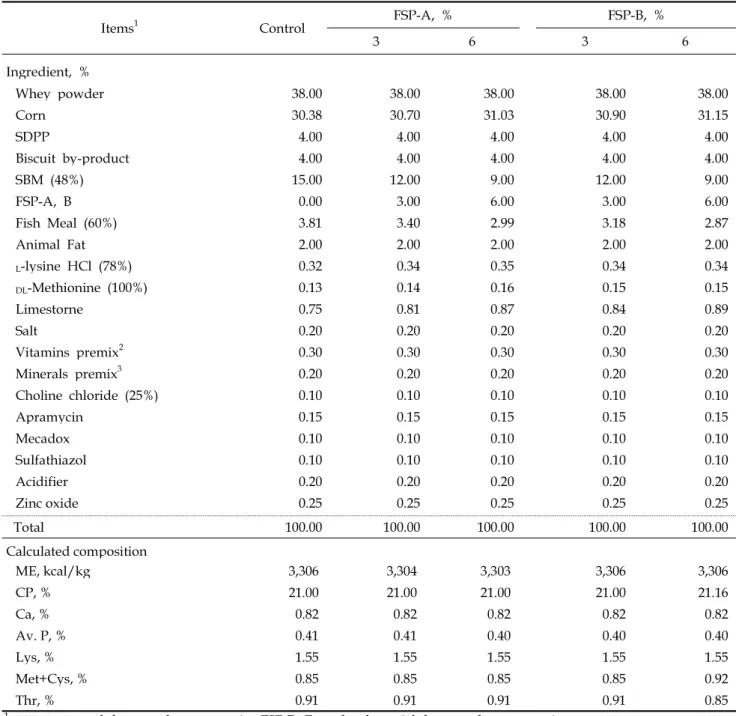
Three hundred weaned pigs (Landrace × Yorkshire × Duroc, 23±3 d of age, 5.56±1.21 kg initial body weight) from the same ancestry but mixed sex were allotted to 5 treatments with 4 replicates in each, comprising 15 pigs per pen. The pigs were housed in partially slotted and concrete floor pens with a pen size of 1.90 × 2.54 m, with a self feeder and nipple waterer to allow ad libitum access to feed and water. The main objective of this study was to compare different sources and levels of fermented soya protein used in weaned pig’s diet. The soya protein sources used soyabean meal (SBM) in control diet, while fungal fermented soya protein (FSP-A) and fungal + bacterial fermented soya protein (FSP-B) were used at 3 and 6% each in treatment diets. The FSP-A and FSP-B were obtain from Genebiotech Co. Ltd., (Seoul, Korea).
Iso-energitic (3,300 kcal/kg) and iso-proteinous (21% CP) diets in mash form were formulated and these treatments diets were fed from 0 to 14 day (phase I) postweaning.
From d 15 to 35 (phase II) of experiment a common commercial diet as crumbs was fed to all the pigs. The composition of phase I diets is presented in Table 1. All the diets met or exceeded the nutrient requirements as
suggested by NRC (1998).
2. Analytical methods
The experiment was conducted for 35 days during which blood was collected on 14 and 35 day postweaning.
Blood was collected by jugular venipuncture from 2 pigs of each pen into disposable Vacutainer tubes containing sodium heparin as anticoagulant (Becton Dickenson, Franklin, NJ) and analysed for hematological indices and immune cell populations. The hematological indices like red blood cell (RBC), hemoglobin (Hb), hematocrit (HCT), mean corpuscular volume (MCV), mean corpuscular hemoglobin (MCH), mean corpuscular hemoglobin concentration (MCHC), red blood cell distribution (RDW), platelets (PLT), mean platelet volume (MPV), white blood cell (WBC), neutrophil (NE), lymphocyte (LY), monocyte (MO), eosinophil (EO), and basophil (BA) were analysed using HematocyteTM (Oxford science, Inc., USA). Blood was centrifuged at 3000 × g for 15 min and plasma samples obtained were used for the analysis of aspartate acid transaminase (AST) and alanine transaminase (ALT) by an automated chemistry analyzer (Fuji Dri-chem 3500i, Japan).
Collected data were subjected for statistical analysis using GLM procedure of SAS (1985) by using statistical software package. The effect of source (FSP-A or FSP-B) and level (0, 3 and 6%) were tested. When significant differences were noted means were separated using LSD’s multiple range test. The treatments were the main effects, while pens formed the experimental units for all analysis.
The level of significance was accepted at P<0.05.
Ⅲ. Results and Discussion
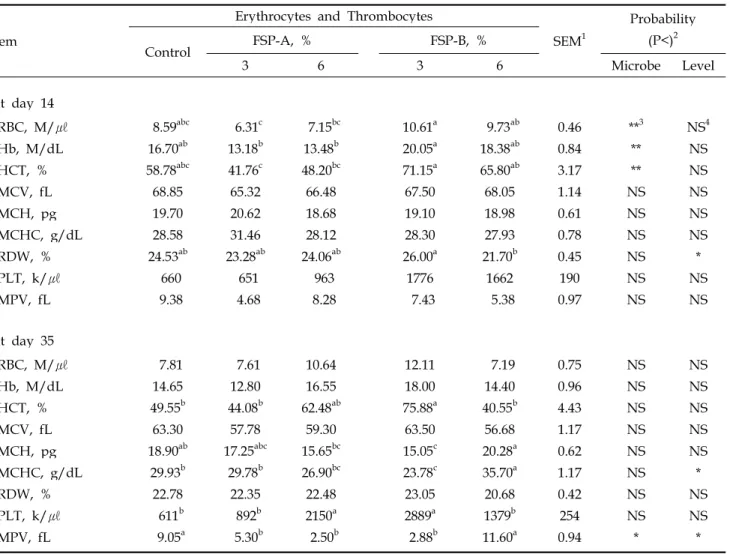
The source of fermented soya protein influenced (P<0.01) the values of RBC, Hb and HCT, while the levels of FSP affected the RDW values (P<0.05) on d 14 (Table 2).
Pigs fed FSP-A had lower RBC, Hb and HCT. Among dietary treatments pigs fed 3% FSP-B had the highest RBC, Hb and HCT while pigs fed 3% FSP-A had the lowest values. The distribution of red blood cells was highest in
[Provider:earticle] Download by IP 118.70.52.165 at Monday, December 20, 2021 8:12 PM
www.earticle.net
Table 1. Ingredient and chemical composition of the experimental diets used during phase I (d 0 to 14).
Items
1Control FSP-A, % FSP-B, %
3 6 3 6
Ingredient, % Whey powder Corn
SDPP
Biscuit by-product SBM (48%) FSP-A, B Fish Meal (60%) Animal Fat
L
-lysine HCl (78%)
DL
-Methionine (100%) Limestorne
Salt
Vitamins premix
2Minerals premix
3Choline chloride (25%) Apramycin
Mecadox Sulfathiazol Acidifier Zinc oxide
38.00 30.38 4.00 4.00 15.00 0.00 3.81 2.00 0.32 0.13 0.75 0.20 0.30 0.20 0.10 0.15 0.10 0.10 0.20 0.25
38.00 30.70 4.00 4.00 12.00 3.00 3.40 2.00 0.34 0.14 0.81 0.20 0.30 0.20 0.10 0.15 0.10 0.10 0.20 0.25
38.00 31.03 4.00 4.00 9.00 6.00 2.99 2.00 0.35 0.16 0.87 0.20 0.30 0.20 0.10 0.15 0.10 0.10 0.20 0.25
38.00 30.90 4.00 4.00 12.00 3.00 3.18 2.00 0.34 0.15 0.84 0.20 0.30 0.20 0.10 0.15 0.10 0.10 0.20 0.25
38.00 31.15 4.00 4.00 9.00 6.00 2.87 2.00 0.34 0.15 0.89 0.20 0.30 0.20 0.10 0.15 0.10 0.10 0.20 0.25
Total 100.00 100.00 100.00 100.00 100.00
Calculated composition ME, kcal/kg
CP, % Ca, % Av. P, % Lys, % Met+Cys, % Thr, %
3,306 21.00 0.82 0.41 1.55 0.85 0.91
3,304 21.00 0.82 0.41 1.55 0.85 0.91
3,303 21.00 0.82 0.40 1.55 0.85 0.91
3,306 21.00 0.82 0.40 1.55 0.85 0.91
3,306 21.16 0.82 0.40 1.55 0.92 0.85
1
FSP-A: F ungal fermented soya protein, FSP-B: Fungal + bacterial fermented soya protein
2
Supplied per kg diet: 9,600IU vitamin A, 1,800IU vitamin D
3, 24mg vitamin E, 1.5mg vitamin B
1, 12mg vitamin B
2, 2.4mg vitamin B
6, 0.045mg vitamin B
12, 1.5mg vitamin K
3, 24mg pantothenic acid, 45 mg niacin, 0.09mg biotin, 0.75mg folic acid, 18mg ethoxyquin.
3
Supplied per kg diet: 162mg Fe, 96mg Cu, 72mg Zn, 46.49mg Mn, 0.9mg I, 0.9mg Co, 0.3mg Se.
3% FSP-B and lowest in 6% FSP-B. At day 35, the level of FSP affected MCHC (P<0.05) and both level and source of FSP influenced the MPV values (P<0.05) but the other hematological indices remained unaffected. When
compared among the different treatments pigs fed with 3%
FSP-B diet had greater (P<0.05) HCT and PLT and the lowest (P<0.05) MCH, MCHC and MPV values, while pigs fed with 6% FSP-B had the highest (P<0.05) MCH, MCHC
[Provider:earticle] Download by IP 118.70.52.165 at Monday, December 20, 2021 8:12 PM
www.earticle.net
and MPV values. These results suggest that FSP do affect the hematological indices, and differences in the source of fermentation may have affected the composition of FSP and the amount of antinutritional factors present in comparison to SBM.
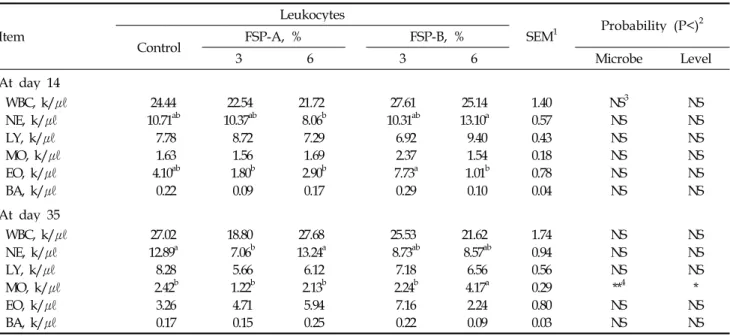
Neither the level nor the source of FSP had any affect on the immune cell population on d 14 and 35, except for the MO on d 35 which were affected by both level (P<0.05) and source (P<0.01, Table 3). Pigs fed 6% FSP-A had significantly lesser NE than those fed 6% FSP-B, while pigs fed 3% FSP-B had more EO levels than other FSP treatments on d 14. Also on d 35, pigs fed 3% FSP-A diet
had lesser NE than pigs fed control and 6% FSP-A, while pigs fed 6% FSP-B had the highest number of MO (P<0.05).
Wang et al. (2003) concluded that adding 3 g small peptides/kg basal diets of piglets increased the immune cell populations. Fermentation affected the characteristics of proteins in soybean meal. Hong et al. (2004) reported that A. oryzae fermented soybean meal did not contain large-size peptides (>60 kDa) and fermentation increased the amount of small-size peptides (<20 kDa). These small peptides might have improved the level of serum IgA and IgM in broilers fed fermented soybean meal (Feng et al., 2007).
Table 2. Effects of different sources and levels of fermented soya protein on the hematological indices in weaned pigs.
Item
Erythrocytes and Thrombocytes
SEM
1Probability (P<)
2Control FSP-A, % FSP-B, %
3 6 3 6 Microbe Level
At day 14 RBC, M/㎕
Hb, M/dL HCT, % MCV, fL MCH, pg MCHC, g/dL RDW, % PLT, k/㎕
MPV, fL
8.59
abc16.70
ab58.78
abc68.85 19.70 28.58 24.53
ab660 9.38
6.31
c13.18
b41.76
c65.32 20.62 31.46 23.28
ab651 4.68
7.15
bc13.48
b48.20
bc66.48 18.68 28.12 24.06
ab963 8.28
10.61
a20.05
a71.15
a67.50 19.10 28.30 26.00
a1776
7.43
9.73
ab18.38
ab65.80
ab68.05 18.98 27.93 21.70
b1662 5.38
0.46 0.84 3.17 1.14 0.61 0.78 0.45 190 0.97
**
3**
**
NS NS NS NS NS NS
NS
4NS NS NS NS NS
* NS NS
At day 35 RBC, M/㎕
Hb, M/dL HCT, % MCV, fL MCH, pg MCHC, g/dL RDW, % PLT, k/㎕
MPV, fL
7.81 14.65 49.55
b63.30 18.90
ab29.93
b22.78 611
b9.05
a7.61 12.80 44.08
b57.78 17.25
abc29.78
b22.35
892
b5.30
b10.64 16.55 62.48
ab59.30 15.65
bc26.90
bc22.48 2150
a2.50
b12.11 18.00 75.88
a63.50 15.05
c23.78
c23.05 2889
a2.88
b7.19 14.40 40.55
b56.68 20.28
a35.70
a20.68 1379
b11.60
a0.75 0.96 4.43 1.17 0.62 1.17 0.42 254 0.94
NS NS NS NS NS NS NS NS
*
NS NS NS NS NS
* NS NS
*
abc
Values with different superscripts of the same row are significantly differ (p<0.05).
1
Pooled standard error means.
2
Microbe : A. oryzae vs A. oryzae + B. subtilis ; Level : 3% vs 6%.
3
* p<0.05; ** p<0.01.
4
Not significant (p>0.05).
[Provider:earticle] Download by IP 118.70.52.165 at Monday, December 20, 2021 8:12 PM
www.earticle.net
Table 3. Effects of different sources and levels of fermented soya protein on the immune cell populations in weaned pigs.
Item
Leukocytes
SEM
1Probability (P<)
2Control FSP-A, % FSP-B, %
3 6 3 6 Microbe Level
At day 14 WBC, k/㎕
NE, k/㎕
LY, k/㎕
MO, k/㎕
EO, k/㎕
BA, k/㎕
24.44 10.71
ab7.78 1.63 4.10
ab0.22
22.54 10.37
ab8.72 1.56 1.80
b0.09
21.72 8.06
b7.29 1.69 2.90
b0.17
27.61 10.31
ab6.92 2.37 7.73
a0.29
25.14 13.10
a9.40 1.54 1.01
b0.10
1.40 0.57 0.43 0.18 0.78 0.04
NS
3NS NS NS NS NS
NS NS NS NS NS NS
At day 35 WBC, k/㎕
NE, k/㎕
LY, k/㎕
MO, k/㎕
EO, k/㎕
BA, k/㎕
27.02 12.89
a8.28 2.42
b3.26 0.17
18.80 7.06
b5.66 1.22
b4.71 0.15
27.68 13.24
a6.12 2.13
b5.94 0.25
25.53 8.73
ab7.18 2.24
b7.16 0.22
21.62 8.57
ab6.56 4.17
a2.24 0.09
1.74 0.94 0.56 0.29 0.80 0.03
NS NS NS
**
4NS NS
NS NS NS
* NS NS
ab
Values with different superscripts of the same row are significantly differ (p<0.05).
1
Pooled standard error means.
2Microbe : A. oryzae vs A. oryzae + B. subtilis ; Level : 3% vs 6%.
3
Not significant (p>0.05).
4* p<0.05; ** p<0.01.
a a a
b b
a
a
a
b
a
0 10 20 30 40 50 60 70 80
AST ( μ / ℓ) AL T ( μ / ℓ)
a a
a a
a a
a a
a a
0 10 20 30 40 50 60 70 80
AST (μ/ℓ) ALT (μ/ℓ)
Fig. 1. Effects of using different sources and levels of fermented soya protein on the plasma ALT and AST values in weaned pigs.
a, bMeans with different superscript are significantly differ (p<0.05). Mean ± standard error is shown.
At day 14
At day 35
[Provider:earticle] Download by IP 118.70.52.165 at Monday, December 20, 2021 8:12 PM
www.earticle.net
At d 14 pigs fed with control and 3% FSP-B diet had lower AST values than other FSP treatments, while the ALT values were highest in pigs fed with 3% FSP-A (Fig.
1). But at d 35 the levels of both enzymes AST and ALT were neither affected by the level and source of FSP.
Alanine aminotransferase (ALT) is an enzyme that is markedly elevated during liver damage while aspartate aminotransferase is not only found in the liver but also in other tissues like heart and kidney. The elevated values of AST in pigs fed FSP may be due to the higher activity of the liver in processing the smaller peptides present in FSP.
Thus from the above results it may be concluded that the source and level of fermented soya protein affect the blood hematological, immune cell populations and enzymes and these reflect the changes in the amount of different peptides and antinutritional factors present in the FSP than the SBM.
Acknowledgement
The authors sincerely acknowledge for the financial support provided by the Institute of Animal Resources, Kangwon National University, & Agricultural Research &
Development Promotion Center (ARPC), Korea.
Ⅳ. References
1. Feng, J., X. Liu, Z. R. Xu, Y. P. Lu and Y. Y. Liu. 2007.
Effect of fermented soybean meal on intestinal morphology and digestive enzyme activities in weaned piglets. Dig. Dis. Sci. 52:1845-1850.
2. Kim, Y. G., J. D. Lohakare and B. J. Chae. 2006. Growth performance, nutrients digestibility and intestinal morphology in weaned pigs fed fungal and bacterial fermented soya proteins. J. Anim. Feed. Sci. 15:213-224.
3. Hong, K. J., C. H. Lee and S. W. Kim. 2004. Aspergillus oryzae GB-107 fermentation improves nutritional quality of food soybeans and feed soybean meals. J. Med.
Food. 7:430-435.
4. Min, B. J., J. W. Hong, O. S. Kwon, W. B. Lee, Y. C.
Kim, I. H. Kim, W. T. Cho and J. H. Kim. 2004. The effect of feeding processed soy protein of growth performance and apparent ileal digestibility in weanling pigs. Asian-Austr. J. Anim. Sci. 17:1271-1276.
5. NRC. 1998. Nutrient requirements of swine (10th Ed).
National Academy Press, Washington, DC.
6. SAS, 1985. SAS User’s Guide: Statistics. SAS Inst. Inc., Cary, NC.
7. Wang, T., F. U. Yong-Ming and Lv. Jun-Long. 2003.
Effects of mini-peptides on the growth performance and the development of small intestines in weaning piglets. Anim. Husband. Vet. Med. pp. 4-8.
(Received: 2007.11.19, Accepted: 2007.12.21)
[Provider:earticle] Download by IP 118.70.52.165 at Monday, December 20, 2021 8:12 PM