Print ISSN: 2288-4637 / Online ISSN 2288-4645 doi:10.13106/jafeb.2021.vol8.no3.0885
The Effects of Profitability and Solvability on Stock Prices:
Empirical Evidence from Indonesia
Fatmawati SHOLICHAH
1, Nurul ASFIAH
2, Titiek AMBARWATI
3, Bambang WIDAGDO
4, Mutia ULFA
5, M. JIHADI
6Received: November 30, 2020 Revised: February 01, 2021 Accepted: February 16, 2021
Abstract
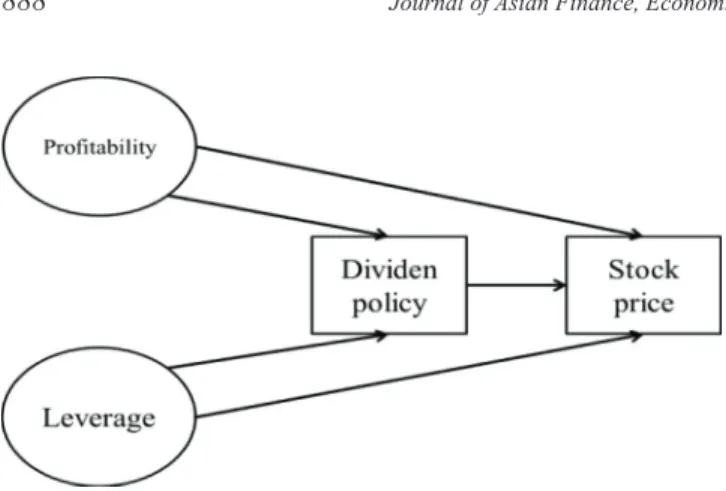
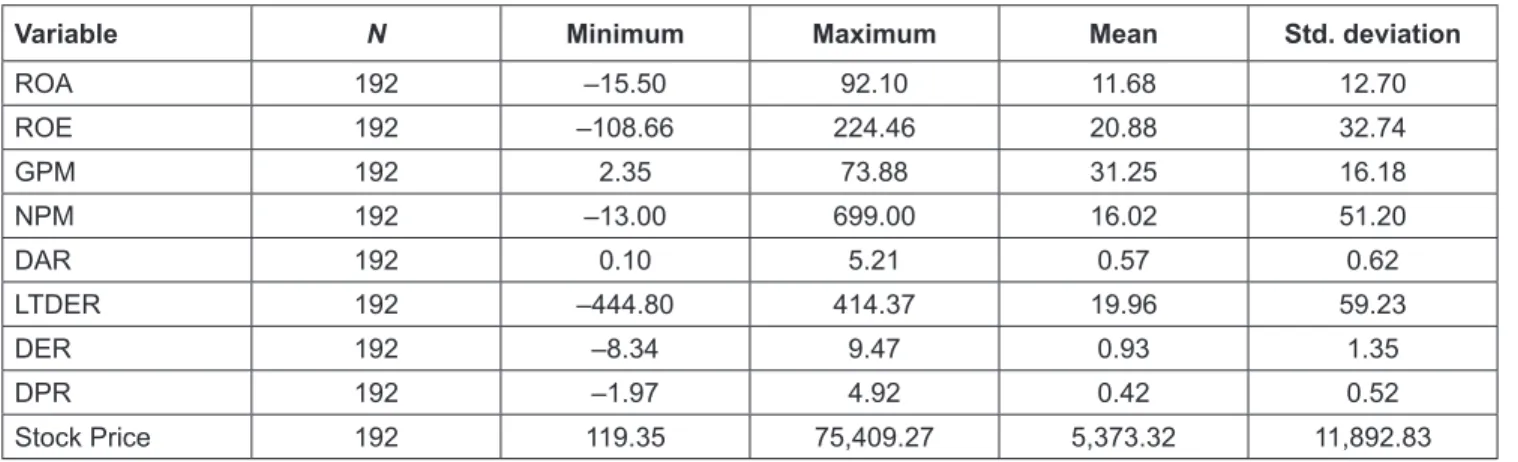
This study aims to analyze the effect of the ratio of profitability and solvability (leverage) on the variable stock price, which is mediated (intervening) by the variable dividend policy. Using the financial reports of manufacturing companies in the consumer goods sector, we take profitability data (ROA, ROE, GPM, and NPM), solvability data (DAR, LTDER, and DER), dividend policy (DPR), and stock price (closing price) from 24 companies, which were selected as samples, from 2011 to 2018. Data was analyzed using the Structural Equation Modeling (SEM) method. The results show that profitability, solvability, and dividend policy affect changes in stock prices, respectively. On the other hand, profitability and solvability do not affect dividend policy. The indirect relationship (intervening) is assessed using a single test, resulting in a dividend policy that can intervene in the relationship between profitability and stock prices but cannot mediate the relationship between solvability and stock prices. The implication of this research is to provide knowledge to investors about the importance of knowing the company’s financial performance. Companies with good financial performance will easily develop because there are sufficient funds for company operations. By analyzing financial ratios, investors can get signals to decide whether to invest in the company they want.
Keywords: Profitability, Leverage, Dividend Policy, Stock Prices JEL Classsification Code : G10, G35, G12
et al., 2017). Investment means investing in a business and as proof of ownership of company assets. In addition to profit, investors are also faced with uncertainty or risk, that is, when stock price fluctuations occur, the company may suffer losses if the stock price falls. Investors need to consider the feasibility of a company to buy its shares so that the profit can be maximized. The stock price is defined as the closing price of each type of share in the stock market during an observation period whose movements are continuously observed by investors, besides that, the stock price is an indicator that is widely used by investors to find out about changing trends in the capital market (Simbolon, 2018).
There are two forms of stock prices, namely the market price or the opening price and the closing price. Investors know the changes in stock prices in general by looking at the movement of the Jakarta Composite Index (JCI); when the index rises, the price of some shares is high and vice versa.
Stock prices change very quickly, they can even change in a matter of seconds. Stock price fluctuations, both joint- stock and individual stock prices, are influenced by macro and micro factors of the company (Rohmawati, 2017).
1
First Author. Lecturer, Faculty of Economics and Business, STIKES Bhakti Al-Qodiri, Jember, Indonesia. Email: [email protected]
2
Lecturer, Faculty of Economics and Business, Universitas Muhammadiyah Malang, Indonesia. Email: [email protected]
3
Associate Professor, Faculty of Economics and Business, Universitas Muhammadiyah Malang, Indonesia.
Email: [email protected]
4
Professor. Faculty of Economics and Business, Universitas Muhammadiyah Malang, Indonesia. Email: [email protected]
5
Directorate of Postgraduate Programs, Universitas Muhammadiyah Malang, Indonesia. Email: [email protected]
6
Corresponding Author. Lecturer, Faculty of Economics and Business, Universitas Muhammadiyah Malang, Indonesia [Postal Address: Jl.
Bandung 1, Malang, Jawa Timur, Indonesia]
Email: [email protected]
© Copyright: The Author(s)
This is an Open Access article distributed under the terms of the Creative Commons Attribution Non-Commercial License (https://creativecommons.org/licenses/by-nc/4.0/) which permits unrestricted non-commercial use, distribution, and reproduction in any medium, provided the original work is properly cited.