• 검색 결과가 없습니다.

Rapid and Simultaneous Determination of Volatile Fatty Acids and Indoles in Pig Slurry and Dog Excrement by Solid-Phase Micro-Extraction Method with Gas Chromatography

N/A
N/A
Protected

Academic year: 2021

Share "Rapid and Simultaneous Determination of Volatile Fatty Acids and Indoles in Pig Slurry and Dog Excrement by Solid-Phase Micro-Extraction Method with Gas Chromatography"

Copied!
9
0
0

로드 중.... (전체 텍스트 보기)

전체 글

(1)

ORIGINAL ARTICLE

Rapid and Simultaneous Determination of Volatile Fatty Acids and Indoles in Pig Slurry and Dog Excrement by Solid-Phase

Micro-Extraction Method with Gas Chromatography

Hyun-Jung Kim, Mee-Seon Yu, Sung-Bong Yang

*

Department of Chemistry, University of Ulsan, Ulsan 680-749, Korea

Abstract

A rapid and simple method for the quantitative determination of volatile fatty acids (VFAs; propionic acid, n-butyric acid, i-valeric acid and n-valeric acid) and indoles (phenol, p-cresol, 4-ethyl phenol, indole and skatole) in pig slurry and dog excrement using solid-phase micro-extraction (SPME) coupled to gas chromatography was evaluated. 50/30 ㎛ DVB/CAR/PDMS (Divinylbenzene/Carboxen/Polydimethylsiloxane) fiber was used to extract the target compounds in aqueous media. Sample amount and adsorption time was standardized for the routine analysis. Detection limits were from 0.11 to 0.15 ㎍/L for VFAs and from 0.12 to 0.28 ㎍/L for indoles and the correlations observed (R

2

) were 0.975~1.000. This method was applied to the pig slurry, fertilizer, compost and dog excrement. In nearly all cases, the indoles were detected in concentrations of higher than their limits of detection (DOLs). But the VFAs in swine manure were below their DOLs.

Key words : SPME, Pig slurry, Dog excrement, Odor, Volatile fatty acids, Indoles 1) 1. Introduction

The scale-up of intensive swine production in the countryside and the raised level of local communities’ awareness of environment problems were resulted in a rapid increase of civil complaints about malodor (Yang et al., 2014) and these had serious effects on the livestock management (Heber and Bogan, 2006). In addition, as the raising of pets indoors have increased with the gentrification of apartments, the deterioration of indoor air quality from animal excrement is enhancing the concern of offensive odors.

Most frequent complaints related to animal production are the odor annoyance from neighbors

near swine facility and a lot of research have been carried out actively on the compounds causing the odor complaints (Ni et al., 2012) and odor emission rates of the swine housing (Schauberger et al., 2013).

On the other hand, few cases of clarification on the odorants from pets raised indoor are published in literatures (Mitsuda et al., 2012). More than 136 compounds including nitrogen compounds, volatile organic acids (VFAs) and reduced sulfur compounds (Hydrogen sulfide, mercaptans and sulfides) were found in the odors produced by livestock (Hartung and Phillips, 1994). Each compound has different physicochemical property and control method.

Currently, Korean government regulates 22 odorous compounds with the Offensive Odor Control Law.

Received 10 September, 2014; Revised 16 October, 2014;

Accepted 20 October, 2014

*

Corresponding author : Sung-Bong Yang, Department of Chemistry, University of Ulsan, Ulsan 680-749, Korea

Phone: +82-52-259-2340 E-mail: [email protected]

ⓒ The Korean Environmental Sciences Society. All rights reserved.

This is an Open-Access article distributed under the terms of the Creative Commons Attribution Non-Commercial License (http://

creativecommons.org/licenses/by-nc/3.0) which permits unrestricted

non-commercial use, distribution, and reproduction in any medium,

provided the original work is properly cited.

(2)

Compound Formula MW Density

(g/cm

3

) m.p. b.p. Solubility in water(g/100g)

Propionic acid C

3

H

6

O

2

74.08 0.999 -22.0 141.0

n-Butyric acid C

4

H

8

O

2

88.11 0.959 -5.7 163.5

n-Valeric acid C

5

H

10

O

2

102.14 0.939 -34.5 187.0 3.7 g

i-Valeric acid C

5

H

10

O

2

102.14 0.928 -37.6 176.5 4.2 g

Phenol C

6

H

6

O 94.11 1.070 40.5 181.7 8.3 g

p-Cresol C

7

H

8

O 108.13 1.045 35.5 201.8 2.4 g

4-Ethyl phenol C

8

H

10

O 122.16 - 41.0 218 Sparingly soluble

Indole C

8

H

7

N 117.15 1.175 53 254 0.19 g

Skatole C

9

H

9

N 131.7 - 95 265 Sparingly soluble

Table 1. Physical properties of lower fatty acids and indoles Among these, ammonia, four sulfur compounds, four volatile organic acids and trimethyl amine are those related to the livestock production facilities (Lee et al., 2013), mostly contained in the animals’ excrement odor. And in case of swine excretion, indoles are also included (Hobbs et al., 1998; Willig et al., 2004).

Recently, as a method to reduce the malodor in the swine housings, subsidiary ingredients such as microorganisms are added to the feed in some cases (Hobbs et al., 1996; Leong et al., 2011; Ábalos et al., 2000). To confirm the effect of deodorant, the importance of measurement method for indoles and organic acids, which are the key odorants in swine excretion, has been emphasized (Yu et al., 2013;

Rahman and Kim, 2013). Until now, the analysis of VFAs and indoles in the aqueous solution has been conducted either through liquid-liquid extraction or using GC or HPLC after the concentration by distillation (Jensen and Jensen, 1994). However, there is no case that the fixed quantity of VFAs and indoles in animal excrement was determined simultaneously and rapidly.

Meanwhile, SPME (solid-phase microextraction) technique was developed as a simple and cheap method to analyze various compounds and cases applying this technique in the various fields have been introduced in the literatures (Lambropoulou et

al., 2007). Some case studies on the malodor chemical analysis of the dust in hog barns were also published (Cai et al., 2006). Generally, VFAs or indoles analysis with SPME has a problem of having two different methods which target either VFAs (Cruwys et al., 2002) or indoles. In other words, there is no case study that determined the concentrations of VFAs and indoles in the animal excrement simultaneously by SPME.

In this study, a method that can analyze both volatile organic acids and indoles in aqueous solution quickly and simultaneously using SPME technique was developed. And determination of key odorants in the swine slurry, liquefied fertilizer, compost and the dog feces was carried out.

2. Materials and methods

2.1. Reagents and SPME

The volatile fatty acids employed in this study

were propionic acid, n-butyric acid, n-valeric acid

and i-valeric acid, and in addition, 5 indoles (phenol,

p-cresol, 4-ethyl phenol, indole and skatole) were

studied. These compounds were purchased from

Sigma-Aldrich (Seoul, Korea) at the highest purity

available. Physical information of these odorants are

shown in Table 1.

(3)

Description Condition

Column HP-FFAP (50 m × 0.32 mm × 0.52 )

Column condition 120 (1 min) 8 /min 250 (12 min) Temperature Injector Temp. : 230 . Detector temp : 250

SPME Concentration time : 15 min

Desoption time : 7 min Table 2. Experimental condition for GC/FID

SPME used in this study was a manual type (gray color) of 50/30 DVB/CAR/PDMS fiber which was purchased from Supelco (Sigma Aldrich, Korea). The SPME fiber was inserted in the inlet port of a gas chromatograph (HP 5890, USA) before use to clean contaminated materials in the fiber according to user manual of SPME.

2.2. Preparation of standard solution and calibration line

For the preparation of calibration line, about 0.09 g of each of 5 indoles was weighed exactly and then taken in a 100 mL of mass flask. As shown in Table 1, the standard stock solutions of 4-ethyl phenol and indole which are insoluble in water were made by dissolving them in 1.0 mL of ethanol and subsequently adding distilled water to make total 100 mL. And other indoles that are water soluble were diluted with pure water to make 100 mL standard stock solutions. For 4 VFAs, 50.0 of each VFA was weighed and taken in a 100 mL mass flask and the water was added to make 100 mL. The standard working solution was prepared by diluting the standard stock solution step-by-step for each step.

Adequate amounts of the diluted standard working solutions were mixed to make standard mixed solutions. And 5.0 mL of each mixed solution was taken in a 40 mL vial for the standard solution for preparation of a calibration line. After addition of 1.5 g of NaCl in each vial, the vial was put on a hot plate set at 50 . And then, the SPME fiber was injected in the vial to concentrate VFAs and indoles for 15

min. The fiber concentrated with VFAs and indoles was inserted into the GC inlet port for 7 min, and subsequently the target compounds were desorbed into the gas chromatograph column and analyzed.

The analytical condition of GC is shown in Table 2.

2.3. Analysis of field samples

It was tried to apply this rapid and simultaneous analytical method of VFAs and indoles to measure the odorants in pig slurries, liquid fertilizer and compost which are the cause of malodors from composting facilities of swine manure. Each 5.0 mL of the liquid phase samples obtained from swine slurry and fertilizer was taken into the 40 mL vial. In case of the solid phase samples, the composts, which were taken at 3 points of the swine compost facility, about 1.3 g of the sample was weighed accurately and added into the vial. According to the same method described previously in 2.2 for the preparation of calibration line, VFAs and indoles in these liquid samples were analyzed quantitatively. After desorption of odorants, the SPME fiber was taken out from the GC inlet port.

The VFAs and indoles in excrement of 6 Beagle

dogs, which are a common type of pet raised indoor

in Korea, were measured. The samples from dog

excrements were taken right after, 3 days after and 7

days after feeding the feed added with deodorizing

agent. Because dog excrement is in solid phase with

very low water content, 1.3 g of it was collected and

weighed precisely before putting it in a 40 mL vial

and then 5.0 mL of distilled water was added to it.

(4)

Compounds Calibration line R

2

LOD(ug/mL) LOQ(ug/mL)

VFA

Propionic acid y = 485 x + 57600 0.995 0.13 0.42

n-Butyric acid y = 257 x + 10300 0.994 0.13 0.44

i-Valeric acid y = 790 x - 8200 0.996 0.11 0.35

n-Valeric acid y = 595 x + 87300 0.983 0.15 0.49

Indoles

Phenol y = 1717 x + 86600 0.975 0.28 0.93

p-Cresol y = 3665 x + 135000 0.983 0.23 0.76

4-Ethyl phenol y = 16505 x + 898000 0.982 0.23 0.77

Indole y = 17787 x + 604000 0.994 0.13 0.45

Skatole y = 49060 x + 467000 1.000 0.12 0.41

R

2

= correlation coefficient. LOD = limit of detection. LOQ = limit of quantitation.

Table 3. Calibration equations of standard volatile fatty acids and indoles

Fig. 1. Calibration lines of volatile fatty acids by SPME and GC/FID.

The vial was shaken thoroughly to make it into complete slurry and analyzed by using the same method as swine slurry.

3. Result and discussion

3.1. Preparation of calibration lines

Correlation coefficient R

2

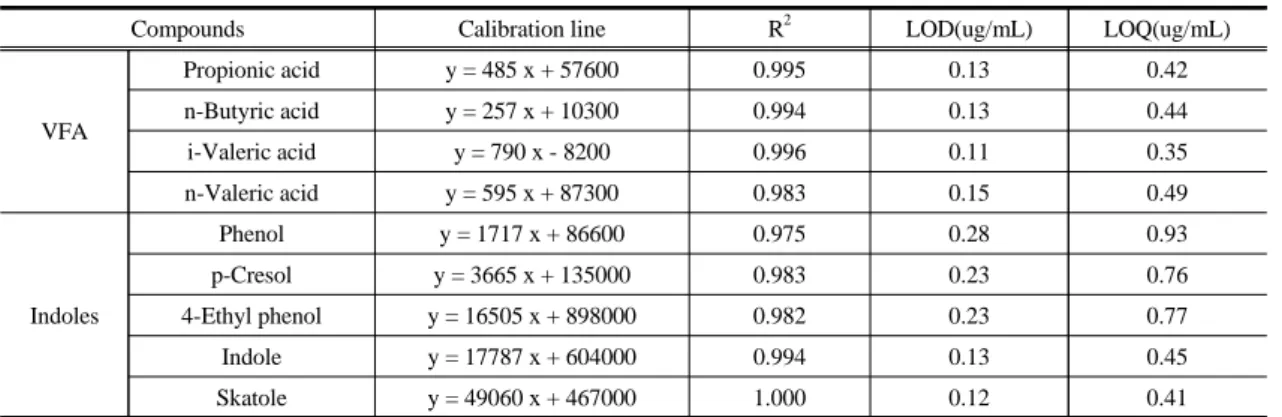
, which was obtained from analysis of four types of volatile fatty acids and five types of indoles showed excellent linearity of

0.975 1.000, which is presented in Table 3. To calculate limit of detection of each volatile fatty acid and indole, standard deviation (Sb) of linear regression obtained from each standard solution was calculated.

Limit of detection (LOD) of each compound was obtained by multiplying 3 to each standard deviation (3×Sb) and limit of quantification (LOQ) was from 10 times of each Sb (10×Sb) (Yu et al., 2010;

Godayol et al., 2011).

(5)

Fig. 3. Chromatogram of VFAs and indoles in one of standard working solutions by SPME and GC/FID analysis.

Fig. 2. Calibration lines of indoles by SPME and GC/FID.

(6)

Compounds Amount of VFAs or indoles ( /mL)

Average( /mL) RSD(%)

1st 2nd 3th 4th 5th

Propionic acid 256.2 272.7 227.6 248.4 244.6 249.9 ± 3.8 1.5

n-Butyric acid 229.7 228.5 224.4 225.8 224.0 226.5 ± 1.6 0.7

i-Valeric acid 255.6 244.1 232.0 239.4 236.8 241.6 ± 2.9 1.2

n-Valeric acid 284.4 290.1 255.5 260.8 257.2 269.6 ± 4.2 1.6

Phenol 99.1 99.7 103.8 100.9 101.6 101.0 ± 1.3 1.3

p-Cresol 80.7 81.3 77.0 70.4 66.6 75.2 ± 2.6 3.5

4-Ethyl phenol 71.4 64.5 58.9 47.7 44.3 57.4 ± 3.4 5.9

Indole 75.4 58.2 60.0 44.0 40.0 55.5 ± 3.7 6.6

Skatole 73.2 60.2 56.1 46.0 44.1 55.9 ± 3.3 5.9

RSE: Relative standard deviation

Table 4. Relative standard deviations of volatile fatty acids and indoles

Sample Concentrations of Indoles(mg/L)*

Phenol p-Cresol 4-Ethyl phenol Indole Skatole

Swine slurry #1 2.5 12.5 1.0 n.d. 0.2

Swine slurry #2 0.7 0.4 n.d. n.d. n.d.

Liquid fertilizer #1 8.1 13.9 4.2 1.1 1.2

Liquid fertilizer #2 10.3 35.2 5.8 n.d. 1.5

Swine compost #1 0.9 6.8 1.9 0.3 0.2

Swine compost #2 2.5 2.2 n.d. 0.2 0.5

Swine compost #3 0.6 0.4 n.d. n.d. n.d.

*n.d means below LOD

Table 5. Concentrations of indoles in pig slurry, liquid fertilizer and compost LODs based on measurements of each VFA were

0.13 for propionic acid; 0.13 for n-butyric acid;

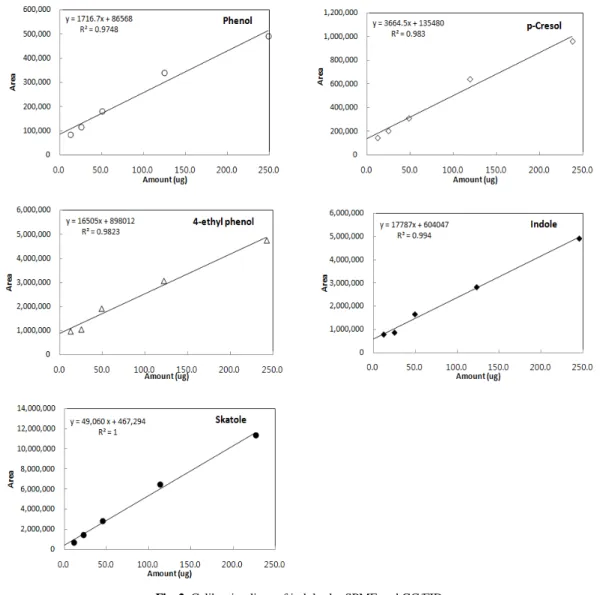
0.11 for i-valeric acid; and 0.15 for n-valeric acid, which are higher than double of the LODs reported by Ábalos et al. (2000), and indoles were, phenol 0.28 ; p-cresol 0.23 ; 4-ethyl phenol 0.23

; indole 0.13 ; and skatole 0.12 , respectively.

Volatile fatty acids and indoles showed very close LODs in this experiment. The calibration lines of each VFA and indole are shown in Fig. 1 and Fig. 2, and the typical example of gas chromatogram obtained to make the line is presented in Fig. 3.

3.2. Reproducibility

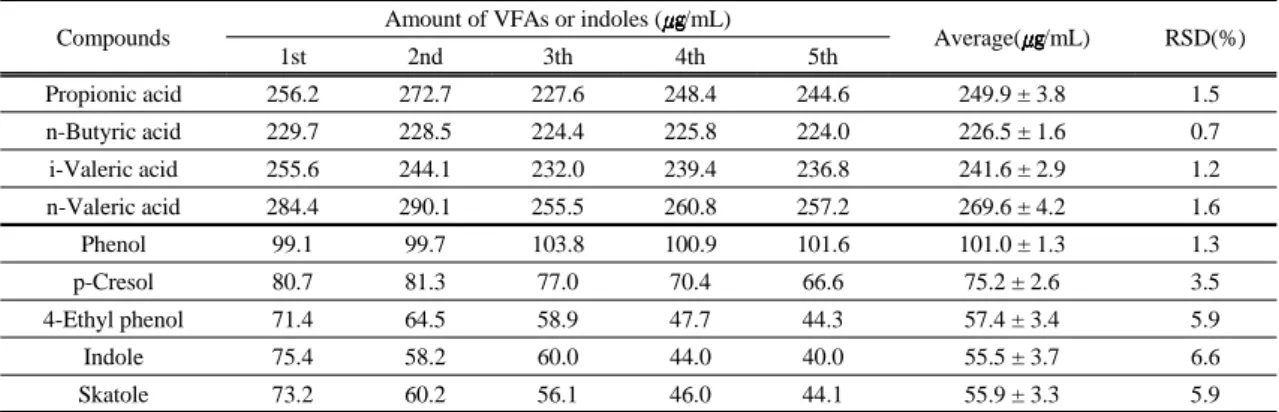
The reproducibility of this method was studied by performing the solid-phase microextraction of five standard solutions spiked at concentrations within the

range of each calibration line. Standard deviations were between ±1.3 /mL and ±4.2 /mL from average values, and relative standard deviations ranged from 0.7% to 1.6% for VFAs and from 1.3% to 6.6%

for indoles as shown in Table 4.

Although VAFs showed slightly lower RSD than indoles, it is generally known that their concentrations in manure range from several ppm to hundreds ppm (Jensen and Jensen, 1994; Hobbs and Pain, 1996).

Therefore, SPME method appears to be useful for determining the concentrations of VFAs and indoles in odors from dog excrement and pig slurry.

3.3. Analysis of field sample

3.3.1. Pig slurry, liquid fertilizer and compost

VFAs in pig slurry, liquid fertilizer and manure

compost were measured to be below the LODs.

(7)

Fig. 4. Chromatogram of VFAs and indoles in dog excrement.

Sample VFAs( /g)

*

Indoles( /g)

PA n-BA i-VA n-VA Phenol Indole

0 day

#1 29.2 317.5 48.9 n.d. 5.0 3.8

#2 n.d. 87.5 27.7 n.d. 1.9 2.0

#3 n.d. 1380.6 47.5 n.d. 11.9 8.6

#4 n.d. 136.1 32.2 n.d. 6.4 3.1

#5 14.5 243.0 64.5 n.d. 5.4 6.1

#6 1.6 49.1 60.6 100.3 2.3 3.3

3 day

#1 67.4 257.5 88.5 n.d. 1.1 1.4

#2 235.6 904.0 147.5 n.d. 3.1 1.5

#3 234.8 830.2 117.9 n.d. 3.4 3.4

#4 264.5 750.7 145.6 n.d. 5.5 2.9

#5 360.4 1261.6 167.8 n.d. 2.4 2.5

#6 241.2 847.0 247.6 185.0 4.4 6.4

7 day

#1 391.1 964.0 226.3 129.2 13.3 2.3

#2 92.2 966.1 207.8 88.1 6.2 2.0

#3 218.5 997.6 215.4 n.d. 12.4 6.9

#4 208.0 493.5 155.1 n.d. 3.1 4.8

#5 516.9 1118.3 244.5 n.d. 2.4 1.3

#6 59.6 707.6 135.5 n.d. 5.6 1.5

*n.d. means below LOD

Table 6. Concentration of VFAs and indoles in dog excrement

However, as for indoles, all of the five types of indoles were found as shown in Table 5, and these all showed slightly higher concentrations in liquid fertilizer than in slurry or compost. As similar to the report of Hwang et al. (2013 a), p-cresol showed higher concentration than other four indoles. The reason that VFAs were not detected in swine slurry, fertilizer and compost is supposed that VFAs, which

are highly volatile, were volatilized during the fertilization process of swine manure.

3.3.2. Analysis of VFAs and indoles in dog excrement

Table 6 shows the measured concentrations of

VFAs and indoles contained in dog excrement. And

Fig. 4 includes an example of gas chromatogram

obtained during the measurement. As shown in this

(8)

figure, the peaks of VFAs, p-cresol and skatole were observed.

It can be found that concentration of n-butyric acid is higher than other VFAs in dog excrement, and that concentrations of VFAs were higher in the manures collected 3 or 7 days later than in one collected immediately after feeding the feed added with deodorizing agent. The odor caused by fatty acids seems to have increased with passage of time after consuming the feed added with deodorizing agent. In general, with comparison to concentrations of VFAs in swine slurry reported by Hwang et al. (2013 b), the concentrations of n-butyric acid in dog excrement were more than those of propionic acid. For indoles, unlike swine manures, only phenol and indole were detected. It is expected that the reason of concentrations of VFAs in fresh dog excrement were higher than those of indoles is that VFAs are more volatile than indoles and therefore, were more concentrated in fresh manure.

3. Conclusions

The quantitative analysis of VFAs and indoles in swine slurry, liquid fertilizer and manure compost, and dog excrement by SPME has the advantages that;

1) result can be obtained in a simple and faster way, in comparison to concentration by conventional extraction or distillation; and 2) VFAs and indoles, which are the key odorants in animal excrement, can be analyzed simultaneously. 3) As pointed out by Kim and Szulejko (2013), this method has poor detection limits of VFAs because of lower recovery yields than extraction method, due to high solubilities of VFAs, and is not suitable for VFAs sample with low concentrations. However, for indoles, the concentrations were higher than LODs in swine manure and dog excrement, which proved its utility as fast simultaneous analysis method. It seems necessary to conduct close examination in order to

find out why VFAs were not detected in the samples obtained from process of fermentation of swine slurry.

Acknowledgements

This work was supported by the project of the National Institute of Animal Science (grant PJ009 235042014), Rural Development Administration, Korea.

References

Ábalos, M., Bayona, J.M., Pawliszyn, J., 2000, Development of a headspace solid-phase microextraction procedure for the determination of free volatile fatty acids in waste waters, J. Chromatography A, 873, 107-115.

Cai, L., Koziel, J.A., Lo, Y.C., Hoff, S.J., 2006, Characterization of volatile organic compounds and odorants associated with swine barn particulate matter using solid-phase microextraction and gas chromatography-mass spectrometry-olfactometry, J. Chromatography A, 1102, 60-72.

Cruwys, J.A., Dinsdale, R.M., Hawkes, F.R., Hawkes, D.L., 2002, Development of a static headspace gas chromatographic procedure for the routine analysis of volatile fatty acids in wastewaters, J. Chromato -graphy A, 945, 195-209.

Godayol, A., Alonso, M., Besalú, Sanchez, J.M., Anticó, E., 2011, Odour-causing organic compounds in wastewater treatment plants: Evaluation of headspace solid-phase microextraction as a concentration technique, J. Chromatography A, 1218, 4863-4868.

Hartung, J., Phillips, V.R., 1994, Control of gaseous emissions from livestock buildings and manure stores, J. Agric. Engng Res. 57, 173-189.

Herber, A.J., Bogan, B.W., 2006. The study and regulation of agricultural air quality in the US. In:

Aneja, V.P., et al. (Eds.), Proceedings: Workshop on Agricultural Air Quality: State of the Science.

Potomac, MD, 32-35.

Hobbs, P.J., Misselbrook, T.H., Pain, B.F., 1998, Emission rates of odorous compounds from pig slurries, J. Sci.

Food Agric., 77, 341-348.

(9)

Hobbs, P.J., Pain, B.F., 1996, Reduction of odorous compounds in fresh pig slurry by dietry control of crude protein, J. Sci. Food Agric., 71, 508-514.

Hwang, O.H., Yang, S.H., Jeon, J.H., Kim, J.K., Choi, D.Y., Cho, S.B., 2013b, The effect of the addition levels of odor reducing contents on the concentration of volatile fatty acid and volatile organic compound in pig slurry, J. Anim. Environ.

Sc. 19(2), 101-108 (Korean).

Hwang, O.H., Yang, S.H., Jeon, J.H., Kwag, J.H., Choi, D.Y., Yang, S.B., Kim, D.H., Cho, S.B., 2013a, The effect of the addition of carbohydrate on the concentration of odorous compounds in pig slurry, J. Anim. Environ. Sc. 19(1), 1-8 (Korean).

Jensen, M.T., Jensen, B.B., 1994, Gas chromatographic determination of indole and 3-methylindole (skatole) in bacterial culture media, intestinal contents and faeces, J. Chromatography B, 655, 275-280.

Kim, K.H., Szulejko, J.E., 2013, A theoretical consideration on the unfeasibilty of an analytical method reco- mmended for volatile fatty acids (VFA) by the offensive odor prevention law, J. Korean Soc. Odor Res. Eng., 12(1), 1-7.

Lambropoulou, D.A., Konstantinou, I.K., Albanis, T.A., 2007, Recent developments in headspace micro -extraction techniques for the analysis of environmental contaminants in different matrices, J. Chromatography A, 1152, 70-96.

Leong, J., Morel, P.C.H., Purchas, R.W., Wilkinson, B.H.P., 2011, Effects of dietary components including garlic on concentrations of skatole and indole in subcutaneous fat of female pigs, Meat Sciences, 88, 45-50.

Lee, H.D., Jeon, S.B., Choi, W.J., Lee, S.S., Lee, M.H., Oh, K.J., 2013, A novel assessment of odor sources using instrumental analysis combined with resident

monitoring records for an industrial area in Korea, Atmospheric Environment, 74, 277-290.

Mitsuda, M., Tanamura, T., Asano, Y., Fujii, Y., Kubo, Y., 2012, Measurement survey on pet odor - odor emission rate and odor control, Jap. Soc. Human -Environment System, 36th Symposium, 37-40.

Ni, J.-Q., Robarge, W., Xiao, C., Herber, A., 2012, Volatile organic compounds at swine facilities: A critical review, Chemosphere, 89, 769-788.

Rahman, M.M., Kim, K.H., 2013, Parallel analysis of volatile fatty acids, indole, skatole, phenol and trimethylamine from waste-related source environments, J. Chromatography A, 1314, 241-248.

Schauberger, G., Lim, T.T., Ni, J.Q., Bundy, D.S., Haymore, B.L., Diehl, C.A., Duggirala, R.K., Herber, A.J., 2013, Empirical model of odor emission from deep-pit swine finishing barns to derive a standarized odor emission factor, Atmospheric Envirnment, 66, 84-90.

Willig, S., Lacorn, M., Claus, R., 2004, Development of a rapid and accurate method for the determination of key compounds of pig odor, J. Chromatography A, 1038, 11-18.

Yang, X., Lorjaroenphon, Y., Cadwallader, K., Wang, X., Zhang, Y., Lee, J., 2014, Analysis of particulate -borne odorants emitted from concentrated animal feeding operations, Science of the Total Environment, 490, 322-333.

Yu, M.S., Lee, J.C., Yang, S.B., Kim, D.H., Cho, S.B., Whang, O.W., 2013, Comparison on usefulness of sampling methods of indoles, in airs from swine facility by Tenax-TA and SPME, J. Env. Sc. Int., 22(12), 1539-1549.

Yu, M.S., Yang, S.B., Ha, N., 2010, Analysis of volatile fatty acids in air by dynamic SPME., J. Environ.

Sci. Int., 19(12), 1447-2010.

수치

Table 1. Physical properties of lower fatty acids and indoles Among these, ammonia, four sulfur compounds, four  volatile organic acids and trimethyl amine are those  related to the livestock production facilities (Lee et al., 2013), mostly contained in th
Table 3.  Calibration equations of standard volatile fatty acids and indoles
Fig. 3. Chromatogram of VFAs and indoles in one of standard working solutions by SPME and GC/FID analysis.
Table 4. Relative standard deviations of volatile fatty acids and indoles
+2

참조

관련 문서

- A novel lactic acid bacterium for the production of high purity l-lactic acid, Lactobacillus paracasei subspL. helveticus - Production of Lactic Acid from Water Hyacinth

In this study, a titanium surface was modified with acrylic acid (AA) using a plasma treatment and immobilized with bioactive arginine- glycine-aspartic acid (RGD) peptide,

Currently, the method of radioactive strontium( 90 Sr) analysis uses the nitric acid method and resin method.. The act of nitric acid method and

phenylalanine, carnosine, ornitine contents were significantly higher in carrot than in parsnip, while α-aminoadipic acid, leucine, tyrosine, γ-amino-n-butyric

The cell growth rate, biomass productivity, oil content and fatty acid composition of T.. oculata, candidates for biodiesel production were measured using

Growth and rosmarinic acid accumulation in callus, cell suspension, and root cultures of wild Salvia fruticosa.. Plant Cell Tissue

Effect of amino acid addition in culture media on the mycelial growth and g-aminobutyric acid (GABA) production of Sparassis latifolia..

Degradation of PE and PP into fuel oil by using solid acid and non-acid catalyst (Sakata et.. of liquid products from thermal and catalytic degradation of (a) HDPE at 430 °C