Print ISSN: 2288-4637 / Online ISSN 2288-4645 doi:10.13106/jafeb.2021.vol8.no1.971
An Empirical Study of Customers’ Satisfaction and Repurchase Intention on Online Shopping in Vietnam
Lan NGUYEN
1, Thu Ha NGUYEN
2, Thi Khanh Phuong TAN
3Received: October 01, 2020 Revised: December 06, 2020 Accepted: December 14, 2020
Abstract
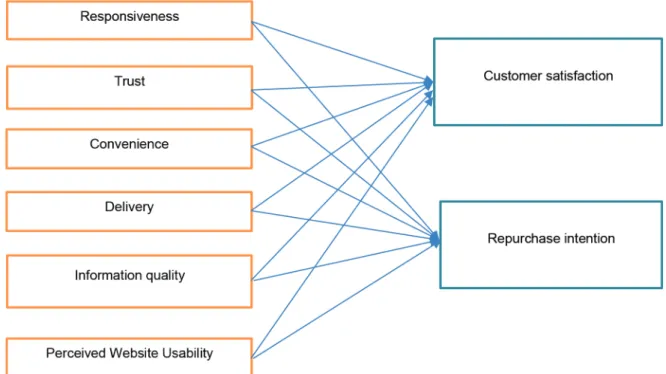
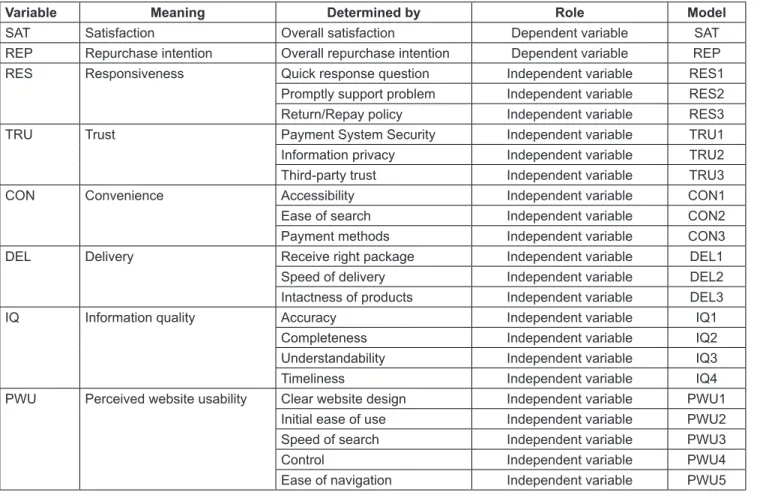
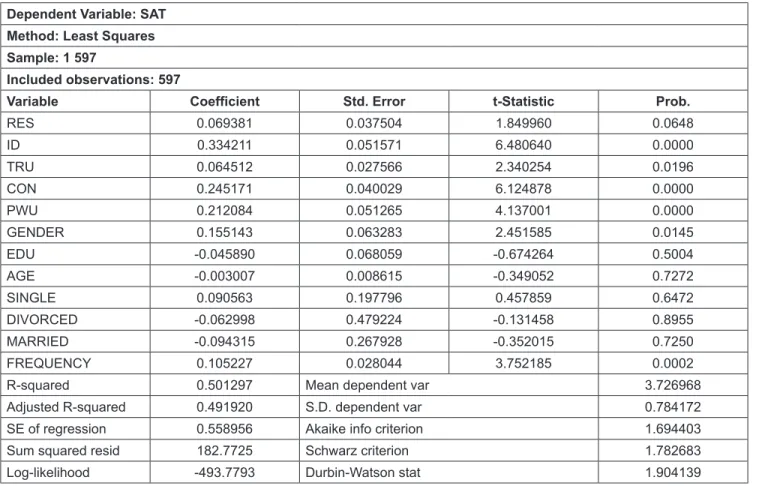
This study aims to examine the factors that affect customer satisfaction and repurchase intention of online shoppers in Vietnam. We used the anklet method to collect information by sending the online questionnaire to Vietnamese people via social media like Facebook, Zalo, and instructed participants to fill out the survey. This study collected data randomly from 597 Vietnamese individuals who have experienced online shopping. Applying both qualitative and quantitative methods, we investigated the impacts of factors (responsiveness, trust, convenience, delivery, information quality and perceived website usability) on customer satisfaction and repurchase intention. The results revealed that: (1) Information quality, delivery, convenience, and perceived website usability have the most significant impacts on customer satisfaction and intention, (2) Trust moderately affects satisfaction and repurchase intention, (3) Responsiveness has no significant influence on repurchase intention and (4) Control variables, included gender and marital status also impacted satisfaction and repurchase intention because the study found that male customers are more satisfied than female customers and single people tend to repurchase at familiar websites more than the other people. The findings suggested that six mentioned factors have different levels of impacts on customer satisfaction and repurchase intention; moreover, the demographic factors also affect satisfaction and intention to repurchase.
Keywords: Customer Satisfaction, Repurchase Intention, Online Shopping JEL Classification Code: C12, C83, L83, Z32
accounting for 12 percent of global sales in 2016 (Kinda, 2019). Developing in line with Asia, Vietnam online shopping market has become more vibrant. The growth rate of national e-commerce was higher than 32 percent in 2019 and predicted to be over 30 percent this year (Vietnam E-Commerce Association, 2020). Vietnam E-Commerce Association (VECOM) also predicted that our e-commerce sales in 2019 will increase to more than US$15 trillion, up 10 percent in total GDP in 2020 (Vietnam E-Commerce Association, 2020). Obviously, online shopping is becoming more important in the economy. Hence, it is crucial for companies to know how to satisfy the customers to gain market shares and improve performance.
Prior studies have revealed that customer satisfaction is critical to business performance (Anderson & Sullivan, 1993;
Loveman, 1998; Reichheld & Teal, 1996) and customer loyalty leads to better firms’ performance (Reichheld &
Teal, 1996). Regarding satisfaction, it is directly associated with firm’s financial performance (Williams & Naumann, 2011), profits (Hallowell, 1996), and decreased operating costs (Reichheld & Sasser, 1990). Satisfaction is also one of the primary marketing goals that the enterprise wants to
1
First Author and Corresponding Author. International Cooperation and Scientific Research Department, Van Lang University, Ho Chi Minh City, Vietnam [Postal Address: 45 Nguyen Khac Nhu Street, Co Giang Ward, District 1, Ho Chi Minh City, 700000, Vietnam]
Email: [email protected]
2
Faculty of Planning and Development, National Economics University, Hanoi, Viet Nam
3
Faculty of Finance, University of Economics, The University of Danang, Danang, Vietnam
© Copyright: The Author(s)
This is an Open Access article distributed under the terms of the Creative Commons Attribution Non-Commercial License (https://creativecommons.org/licenses/by-nc/4.0/) which permits unrestricted non-commercial use, distribution, and reproduction in any medium, provided the original work is properly cited.