Print ISSN: 2288-4637 / Online ISSN 2288-4645 doi:10.13106/jafeb.2021.vol8.no8.0387
Intention to Use Digital Banking Services of Young Retail Customers in Vietnam*
Ngoc Anh TRAN
1Received: April 20, 2021 Revised: July 04, 2021 Accepted: July 15, 2021
Abstract
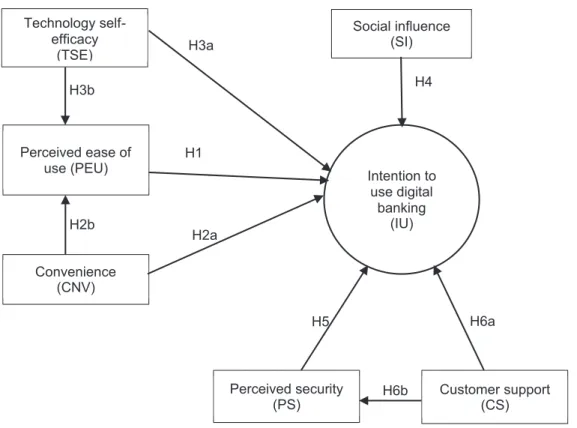
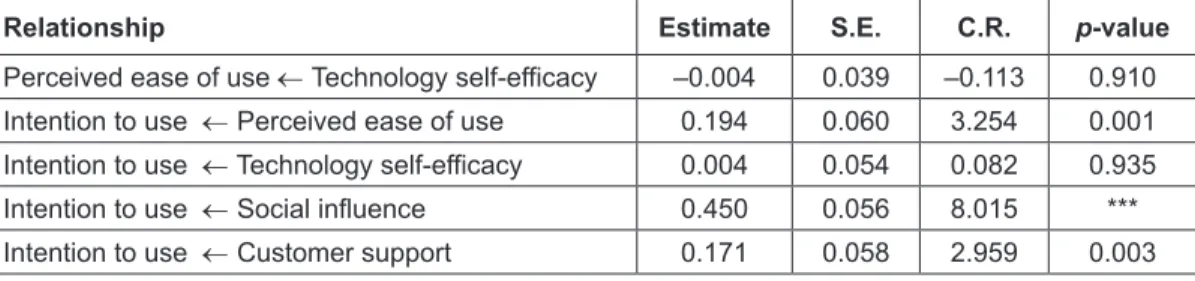
The object of this article is to assess the factors affecting the behavioral intention of young retail customers to use digital banking services in Vietnam. In this article, multivariate data analysis techniques including Cronbach’s Alpha, Exploratory factor analysis (EFA), Confirmatory factor analysis (CFA), Structure equation model (SEM), and Bootstrapping are used to analyze the data collected from 525 young respondents under the age of 35 who are using or having opportunities to experience digital banking services. The people taking part in the survey were mainly University students with incomes of most of them under VND 5 million. The result from the analysis illustrates that (1) perceived ease of use positively affects intention to use, (2) social influence positively impacts intention to use, and (3) customer support has a positive impact on the intention of young people to use digital banking services. While technology self-efficacy, convenience, and perceived security were found to have an impact on intention to use services in former studies, the influences of these factors on intention to use digital banking services are found insignificant in this research. From these results, the author provides implications for commercial banks to increase the intention to use digital banking of young people in Vietnam.
Keywords: Digital Banking, Structural Equation Model, Vietnam, Young Customers JEL Classification Code: C38, D70, G20, M21
digital technologies in the banking industry also come with many challenges such as institutional change requirements, large investment capital, and human resources equipped with knowledge and capacity to master new technologies.
New technology also affects the behavior of customers (Leung, 2009). Customers would be willing to choose another bank if their bank did not provide services via an online channel. Therefore, it is necessary for banks to utilize digital technologies to accelerate their competencies and activities in an increasingly competitive market (Nguyen &
Dang, 2018).
Digital banking services will help the banks increase their competitiveness, maintain current, and attract new customers (Nguyen, 2020). The Vietnamese government is in the process of promoting the digital economy. Lately, the digital economy has had a high rate of growth; hence, it requires all sectors of the economy to undergo digital transformation, especially in the context of the outbreak of the Covid-19 pandemic (Ha, 2020). Especially in the banking and finance sector, the Vietnamese government has always shown support for digital transformation and cashless payments. Therefore, it is necessary to conduct research on the intention of customers to use digital banking services
*Acknowledgements:
I would like to thank all of the respondents who participated in the survey and my colleagues who supported me during the process of data collection. I am also grateful for the support of Hanoi Open University, Vietnam.
1
First Author and Corresponding Author. Lecturer, Faculty of Finance and Banking, Hanoi Open University, Vietnam [Postal Address:
B101 Nguyen Hien Street, Hai Ba Trung District, Hanoi, 100000, Vietnam] Email: [email protected]
© Copyright: The Author(s)
This is an Open Access article distributed under the terms of the Creative Commons Attribution Non-Commercial License (https://creativecommons.org/licenses/by-nc/4.0/) which permits unrestricted non-commercial use, distribution, and reproduction in any medium, provided the original work is properly cited.