Journal of the Korean Society of Marine Environment & Safety Research Paper Vol. 20, No. 2, pp. 121-129, April 30, 2014, ISSN 1229-3431(Print) / ISSN 2287-3341(Online) http://dx.doi.org/10.7837/kosomes.2014.20.2.121
부산 이기대 지역의 해조상 및 군집구조
신봉균 권천중 이석모 최창근
* 부경대학교 환경공학과, ** 부경대학교 해양과학공동연구소, *** 부경대학교 생태공학과
Marine Algal Flora and Community Structure of Igidea Area in Busan, Korea
Bong-Kyun Shin
*
Chun-Jung Kwon**
Suk-Mo Lee***
Chang-Geun Choi****
* Department of Environmental Engineering, Pukyung National University, Namgu, Busan, 608-737, Korea
** Korea Inter-University Institute of Ocean Science, Pukyung National University, Namgu, Busan, 608-737, Korea
*** Department of Ecological Engineering, Pukyung National University, Namgu, Busan, 608-737, Korea
요 약 : 우리나라 동남해 연안 해역에 위치한 이기대 지역에서 2010년 5월부터 2011년 2월까지 계절별로 해조상 및 군집구조에 관 한 연구를 수행하였다. 조사기간 동안 녹조류 9종, 갈조류 14종, 홍조류 43을 포함한 총 66종이 동정되었으며, 16종의 해조류는 조사지 역에서 연중 출현하였다. 계절별 평균 현존량은 봄 123.6 g·m
–2, 여름 2,061.6 g·m
–2, 가을 412.0 g·m
–2, 겨울 678.9 g·m
–2로 나타났다. 종조성의 차이는 주변의 오염원이 존재하지 않는 정점 3과 4에 비하여 주변 하천의 영향을 받는 정점 1로 갈수록 종조성이 상대적으로 낮은 경 향을 보였는데 이는 주변의 용호천, 대연천, 남부하수처리장 방류수에 의한 영향으로 판단되었다. 해조군집의 생태적 특성을 판단할 수 있는 R/P, C/P, (R+C)/P 값은 각각 3.07, 0.64, 3.71로 나타났으며, 해조류의 외부형태와 내부구조 등에 따라 구분되는 6가지 기능형군에 따른 분류결과는 성긴분기형 39.39 %, 엽상형 30.30 %, 다육질형 13.64 %, 사상형 12.12 %, 각상형 3.03 %, 유절산호말형 1.52 %으로 나타났 다. 한편, 이기대 지역의 해조류 개체수는 1996년부터 1997년에 96종, 2010년부터 2011년에 66종으로 감소된 것을 확인하였다. 이는 주 변하천과 하수처리장의 방류수 등에 의한 영향으로 판단된다. 결론적으로 대도시 인근 연안의 해조군락 보호 및 육성을 위하여 연안역 에 유입되는 오하수의 처리 및 해조장 복원과 같은 적극적인 해양환경 유지관리방법이 체계적으로 추진되어야 할 것이다.
핵심용어 : 해조상, 군집구조, 이기대, 현존량, 기능형군
Abstract : Marine algal flora and community structure were seasonally investigated at four sites in the vicinity of the Igidae on the southern east coast of Korea from May 2010 to February 2011. A total of 66 species including 9 of Chlorophyta, 14 of Phaeophyta, 43 of Rhodophyta were found during the survey period. Among these species, 16 species were found throughout the year. Seasonal mean biomass in wet weight was 123.6 (spring), 2,061.6 (summer), 412.0 (autumn), 678.9 (winter) g·m
–2. Maximum biomass was recorded in summer(2,061.6 g·m
–2), and minimum was recorded in spring(123.6 g·m
–2). Spatial maximum and minimum species number were recorded at station 3 and 4(50 species) and at station 1(47 species). At station 1, 2 directly exposure on Yongho and Daeyeon cheon (stream) run off, and discharge from Nambu sewage treatment plants near coastal area, species diversity was relatively low and dominant species were similar throughout four seasons. The R/P, C/P and (R+C)/P value reflecting flora characteristics were 3.07, 0.64 and 3.71, respectively. The flora investigated could be classified into six functional groups such as coarsely branch form 39.39 %, sheet form 30.30 %, thick leather form 13.64 %, filamentous form 12.12 %, crustose form 3.03% and jointed calcareous form 1.52 % during survey period. The number of marine algae species in Igidea were 96 species at 1996 to 1997 and 66 species at 2010 to 2011, respectively.
The change of seaweed species is due to the pollution loaded from sewage treatment plant and stream. We thus recommend that the positive maintenance control method like sewage treatment, for the protection of seaweed bed should be proceeded to near coastal area.
Key Words : Algal flora, Community structure, Igidea area, Biomass, Functional group 1)
First Author : [email protected], 051-629-6546
Corresponding Author : [email protected], 051-629-6546
1. 서 론
우리나라 연안지역은 도시화와 산업화로 인하여 생활오 수 및 산업폐수 등의 발생량이 증가함에 따라 연안지역의
오염부하량이 지속적으로 증가하고 있다.
부산광역시의 경우에도 지리적 특성상 하수처리장이 연 안역에 위치하고 있어 하수처리수가 연안으로 직접 유입됨
에 따라 주변 해역에 서식하는 해양생물에 직 간접적으로
영향을 미치고 있는 실정이다(Hong et al., 1994; Nam and Kim, 1999).
부산의 연안역을 대상으로 수행된 해조군집에 대한 연구 는 Kang(1966)에 의한 한국산 해조류의 지리적 분포에 관한 연구를 시작으로 영도(Choi, 2007), 용호동(Nam and Kim, 1999), 해운대 동백섬(Lee, 1972; Lee, 1973; Choi et al., 2002;
Yoo, 2003a), 기장(Lee et al., 1984; Choi et al., 2010a; Choi et al., 2010b; Yoo, 2003b), 일광만(Kang et al., 2008)에서 계절변 화 및 수직분포에 따른 출현종 변화 등에 대하여 다양하게 수행되었다.
해양생태계의 일차생산자인 해조류는 서식지의 생물학적,
무생물학적 환경의 변화에 따라 출현종, 종다양성 및 생물 량 등이 변화하는 특징 때문에 환경변화를 분석할 수 있는 생물지표종으로 사용될 수 있다(Orfanidis et al., 2001; Arévalo et al., 2007; Choi, 2008). 또한, 해조류의 출현종, 종다양성 및 생물량은 환경적 스트레스에 따라 변화하게 되며 연안역에 위치한 하수처리장이나 발전소로부터 배출되는 하수처리수 및 온배수 등의 환경적 스트레스에 의해서 해조류의 출현 종, 종다양성 및 생물량이 변화하는 것으로 알려져 있다 (Langford, 1990; Díez et al., 1999; Arévalo et al., 2007).
따라서 본 연구에서는 부산광역시 남구 이기대 해안의 남 부하수처리장 해양방류수역에 서식하는 해조상 및 군집구 조를 파악하고 대상지역의 과거 해조상과 주변해역의 해조 상 및 군집구조를 비교 분석한 후 연안의 저층에서 방류된 하수처리수가 해조류 군집구조와 특성변화에 미치는 영향 을 확인하여 향후 자연 생태계에서 해조 생물량의 연간변동 및 연안역 biofilter로의 해조류 이용에 관한 연구의 기초자료 로 활용하고자 시도되었다.
2. 재료 및 방법
본 연구는 부산광역시 남구 용호동 이기대 인근에 위치한 남부하수처리장 방류수역으로써 수영만에 속해있는 지역에 서 수행되었다. 수영만은 해운대 동백섬과 이기대 사이 반
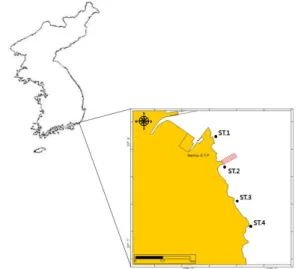
원형의 개방적인 만으로 남부하수처리장을 비롯한 도시하 천인 용호천, 대연천 등의 영향을 직·간접적으로 받는 지역 이다(Park, 2001). 대상해역의 해조류 출현현황을 분석하기 위하여 주요 오염 발생원인 용호천과 대연천이 인접한 정점 1과 해양방류관이 위치한 정점 2, 이기대 해안전망대가 위치 하여 인위적 간섭이 예상되는 정점 3 그리고 주변 오염원의 영향을 직접적으로 받지 않을 것으로 판단되는 정점 4를 조 사지점을 선정하여 2010년 5월부터 2011년 2월까지 계절별 로 현장조사를 실시하였다(Fig. 1).
Fig. 1. Sampling sites of marine algal species in the study area.
해조군락의 분석을 위한 정량조사는 조간대와 조하대에 위치한 각 조사지점에서 0.5 m × 0.5 m 방형구를 설치하고 방 형구 내의 출현해조를 끌칼 등으로 전량을 채집하였으며, 조사정점의 주변해역에 서식하는 해조류를 정성적으로 채 집하였다. 채집된 해조류는 5~10 % 포르말린-해수용액으로
고정하여 실험실로 운반하여 분석하였다. 현존량은 채집된
해조류를 담수로 수차례 세척하여 모래 등의 이물질들을 제 거한 후 페이퍼 타월 등을 이용하여 습기를 제거한 후 측정 하였으며, 단위면적당( ) 습중량으로 생물량을 환산하였다.
현장에서 채집하여 실험실로 운반한 해조류의 동정은 Kang(1968), Yoshida(1998)과 Lee(2008)의 도감을 이용하였 으며, 출현종의 목록은 Lee and Kang(2001)의 분류체계에 따라 작성하였다. 명명규약상 이미 변경된 학명은 Algaebase (http://www.algaebase.org, Guiry and Guiry, 2012)를 이용하거나 최근 논문을 추적하여 종 목록을 작성하였다.
조사지역에서의 우점종을 나타내는 중요도를 파악하기 위 하여 피도는 현장에서 Saito and Atobe(1970)의 피도 등급에 의 해 단위면적당 피복 백분율, 빈도는 전체 조사 방형구 수에
대한 대상종의 출현 방형구 수의 비로 구하였다. 상대피도는 방형구 내의 전 출현종의 피도 합에 대한 대상종의 피도 백 분율, 상대빈도는 방형구 내의 출현종의 빈도 합에 대한 대상 종의 빈도 백분율로 구하였고, 조사지역에서 중요도는 상대 피도와 상대빈도의 산술평균으로 계산하였다(Mueller-Dombois and Ellenberg, 1974; Sohn et al., 2007).
조사지역에서 출현하는 해조류의 분포 특성 및 해조상을 해석하는 지표로는 수온의 변동과 밀접한 연관이 있어서 해 조상의 지리적 분포한계와 수평분포 지수 특성을 확인해주 는 것으로 이용되는 C/P(Segawa, 1956), R/P(Feldmann, 1937)와 (R+C)/P(Cheney, 1977) 값을 이용하여 분석하였다.
해조류의 기능형군 분석은 해조류의 출현종 형태와 내부 구조 등의 차이에 따른 Littler and Littler(1984)의 분류기준에 의하여 다육질형(thick leathery form), 유절산호말형(jointed calcareous form), 각상형(crustose form), 엽상형(sheet form), 사 상형(filamentous form), 성긴분기형(coarsely branched form)의 6 가지 기능형군으로 구분하였다.
이를 근거로 생태학적 특성에 따라 느린 생장을 나타내는 다년생 해조류인 다육질형(thick leathery form), 유절산호말형 (jointed calcareous form), 각상형(crustose form) 해조류를 생태 학적 상태그룹 I (Ecological State Group I, EGS I), 상대적으로 빠른 생장을 보이는 엽상형(sheet form), 사상형(filamentous form), 성긴분기형(coarsely branched form)의 해조류를 생태학 적 상태그룹 II(ESG II)로 구분하였다(Orfanidis et al., 2001). 또 한 조사지역에서 채집된 해조류는 Algaebase에 등록된 지리 적 분포정보를 참고로 온대~한대(Cold, TePo), 온대(Temperate, TeTe), 온대~열대(Warm, TrTe) 및 열대~한대(Broad, TrPo)의 생육 기후대(habitat climate zone)로 구분하여 구성비를 산출 하였다.
3. 결 과
3.1 종조성
본 연구기간 동안 총 66종의 해조류가 출현하였으며, 분 류군 별 출현종수 및 구성비는 녹조류 9종(13.6 %), 갈조류 14종(21.2 %), 홍조류 43종(65.2 %)로 나타났다(Tables 1~2). 조 사시기별로는 33 42종의 범위로 해조류가 출현하였고, 계 절별로는 겨울에 42종으로 최대로 나타났으며, 봄(40종), 여름 (38종), 가을(33종) 순으로 나타났다. 정점별로는 정점 1에서 47종, 정점 2에서 48종, 정점 3에서 50종, 정점 4에서 50종으 로 나타나 정점 3과 4에 비하여 방류관에 인접한 정점 1에서 가장 빈약하게 나타났다. 연구기간 동안 모든 정점에서 구멍 갈파래(Ulva pertusa)와 참보라색우무(Symphyocladia latiuscula) 가 출현하는 것으로 나타났다.
Species
Habitat climate zone
F-form
May August November February 1 2 3 4 1 2 3 4 1 2 3 4 1 2 3 4
ChlorophytaUlva compressa TrTe S + + + + + + + + +
Ulva intestinalis TrPo S + +
Ulva linza TrPo S + +
Ulva prolifera TrPo S + + +
Ulva conglobata TrTe S + + +
Ulva fasciata TrPo S + +
Ulva pertusa TrTe S + + + + + + + + + + + + + + + +
Bryopsis plumosa TrPo F +
Derbesia marina TrPo F + + + +
Phaeophyta
Dictyota dichotoma TrPo S + + + + + +
Rugulopteryx okamurae TrTe S + + + + + +
Dictyopteris pacifica TrTe S +
Colpomenia bullosa TrPo TL + + +
Petalonia fascia TrPo S +
Scytosiphon lomentaria TrPo CB + +
Undaria pinnatifida TePo TL + + + + +
Hizikia fusiformis TeTe CB + + + + + + + +
Sargassum fulvellum TrTe CB + + + +
Sargassum hemiphyllum TrTe CB + +
Sargassum horneri TrTe CB + + + + + + + + + + +
Sargassum micracanthum TeTe CB +
Sargassum thunbergii TeTe CB + + + + + + +
Sargassum sp. CB +
Rhodophyta
Pyropia suborbiculata TePo S +
Pyropia yezoensis TePo S + + +
Porphyra sp. S + +
Dichotomaria falcata TeTe CB +
Corallina pilulifera TrPo JC + + + + + + + + + + + + + + +
Lithophyllum okamurae TrTe C +
Gelidium amansii TrPo CB + + + + + +
Gelidium divaricatum TrTe CB + + + + + + +
Pterocladiella capillacea TrTe CB + +
Hildenbrandia rubra TrPo C + + + + + + + +
Chondrus crispus TrPo TL + +
Chondrus ocellatus TrTe TL + + + + + + + + + + +
Chondracanthus intermedius TrTe CB + + + + + + + + + + +
Chondracanthus tenellus TrTe CB + +
Callophyllis adnata TeTe S +
Callophyllis crispata TeTe S + + +
Peyssonnelia caulifera TeTe TL + +
Phacelocarpus japonicus TeTe CB +
Ahnfeltiopsis flabelliformis TrPo CB + + + + + + + + + + + + + +
Grateloupia elliptica TeTe TL + + + + + + +
Grateloupia filicina TrPo CB + + +
Grateloupia lanceolata TeTe TL + + + + + + +
Grateloupia cornea TrPo CB + + + + + + + + + + + + +
Grateloupia sparsa TrTe CB + + +
Grateloupia turuturu TrPo TL + + +
Gracilaria textorii TrTe TL + + + + + + + + + + +
Plocamium telfairiae TrTe CB + + + + + + + + + + + +
Champia parvula TrTe F + + + + +
Lomentaria catenata TeTe CB + + + + + + + +
Lomentaria hakodatensis TrPo CB + + + +
Rhodymenia intricata TrTe S + + + + + + + + + + +
Antithamnion sp. F +
Ceramium japonicum TePo F + + + + + + +
Ceramium kondoi TrPo F + +
Heterosiphonia japonica TePo F +
Acrosorium polyneurum TeTe S + + + + + + + + + + + + + + +
Acrosorium uncinatum TrTe S + + + +
Phycodrys fimbriata TePo CB + + + +
Polyneura japonica TeTe S + + + + + + + +
Chondria crassicaulis TrTe CB + + + + + + + + + + + + +
Laurencia pinnata TrTe CB +
Polysiphonia morrowii TePo F + + + + +
Symphyocladia latiuscula TePo CB + + + + + + + + + + + + + + + +
Table 1. A list of marine algal species investigated at Igidae of Busan, including functional(F) form, habitat climate zone
TePo, Temperate~Polar zone; TeTe, only Temperate zone; TrTe, Tropical~Temperate
zone; TrPo, Tropical~Polar zone; S, sheet form; CB, coarsely branched form; F,
filamentous form; TL, thick leathery form; JC, jointed calcareous form; C, crustose
form
Species
May August November February
1 2 3 4 1 2 3 4 1 2 3 4 1 2 3 4
A B A B A B A B A B A B A B A B A B A B A B A B A B A B A B A B
Chlorophyta
Ulva compressa 19.3 + 77.1
Ulva linza + 17.3
Ulva fasciata + 13.7 30.3
Ulva pertusa 28.6 + + + + 19.8 11.6 + + 32.9 36.9 + + + 17.3
Phaeophyta
Dictyota dichotoma 35.7 10.4 +
Rugulopteryx okamurae 13.9 + 21.1 +
Dictyopteris pacifica 16.7
Colpomenia bullosa + 25.0
Undaria pinnatifida 33.7
Sargassum fulvellum 24.3
Sargassum horneri 48.3 + 14.2 26.4 +
Sargassum micracanthum 66.8
Sargassum thunbergii 36.4 39.1
Rhodophyta
Porphyra suborbiculata 88.4
Porphyra sp. 25.9 12.5
Corallina pilulifera 34.9 15.7 22.6 + 21.7 13.4 70.0 11.7 11.5 + 36.7 17.9 10.9
Gelidium amansii + 15.4 22.3 +
Chondrus crispus 17.2 23.8 +
Chondrus ocellatus + + + 13.5 + + + 13.6 +
Chondracanthus intermedius + + + 10.1
Peyssonnelia caulifera 28.9
Ahnfeltiopsis flabelliformis + + + 14.5 13.2 + + 41.8 + + +
Grateloupia elliptica 18.3 46.9 15.4 +
Grateloupia lanceolata + + 13.8 21.2
Grateloupia cornea + + 19.4 + 12.3 45.5 61.5 15.2 + +
Gracilaria textorii 16.2 11.2 + 29.2 20.8 14.3 27.2 35.4
Plocamium telfairiae 16.1 15.9 + 15.9 5.3 10.5 + + +
Lomentaria catenata 19.0 + + 19.5 11.3 +
Rhodymenia intricata 17.1 + + + + 26.0 + +
Acrosorium polyneurum 24.2 + 35.6 + 15.4 26.7 30.0 17.4 16.3 + + + + 16.8 + 21.1 + + +
Acrosorium uncinatum 20.2 11.0 + +
Phycodrys fimbriata + 35.9 + 57.9
Polyneurua japonica 22.1 23.8 14.8 37.2 31.1 13.2 35.5 45.7
Chondria crassicaulis 15.2 15.9 29.8 + 18.0
Symphyocladia latiuscula + 21.1 + + + + 29.8
IV < 10, + ; A, intertidal zone; B, subtidal zone
Table 3. The importance value(IV) of marine algal species at Igidae of Busan
Division Spring Summer Autumn Winter
Chlorophyta 3 7 4 4
Phaeophyta 7 9 6 9
Rhodophyta 30 22 23 29
R, Rhodophyta; P, Phaeophyta; C, Chlorophyta
Table 2. Seasonal change in marine algal species and floristic composition at Igidae in Busan
3.2 중요도
본 연구기간 동안 조사정점 해역에서 출현한 해조류의 중요도는 Table 3과 같으며, 이 중 중요도가 높게 나타난 종 은 녹조류인 구멍갈파래(Ulva pertusa), 갈조류인 괭생이모 자반(Sargassum horneri), 홍조류인 작은구슬산호말(Corallina
pilulifera)로 나타났다.
중요도로 분석한 계절별, 정점별 우점종은 봄의 경우, 정점 1에서 작은구슬산호말(C. pilulifera), 구멍갈파래(U. pertusa), 정 점 2에서 괭생이모자반(S. horneri), 바다참나무잎(Phycodrys fimbriata), 정점 3에서 잔금분홍잎(Acrosorium polyneurum), 작은구슬산호말(C. pilulifera), 정점 4에서 바다참나무잎(P.
fimbriata), 지충이(S. thunbergii)로 나타났다. 여름에는 정점 1에서 참도박(Grateloupia elliptica), 바다참나무잎아재비(P.
japonica), 정점 2에서 잔금분홍잎(A. polyneurum), 참그물바탕말 (Dictyota dichotoma), 정점 3에서 붉은까막살(G. cornea), 미역 (Undaria pinnatifida), 정점 4에서 작은구슬산호말(C. pilulifera), 개그물바탕말(Rugulopteryx okamurae)의 순으로 중요도가 높았
Species May August November February
1 2 3 4 1 2 3 4 1 2 3 4 1 2 3 4
Chlorophyta
Ulva compressa * * 65.1 * 17.3 375.8
Ulva intestinalis * *
Ulva linza 24.9 102.1
Ulva prolifera * * *
Ulva conglobata * * *
Ulva fasciata 35.7 229.8
Ulva pertusa 66.7 27.2 52.0 54.3 16.1 11.7 72.7 3.3 0.1 15.2 148.1 0.2 24.0 96.3
Bryopsis plumosa 0.1
Derbesia marina 1.1 81.3 6.2
Phaeophyta
Dictyota dichotoma 373.9 8.1 * 1.1 3.7
Rugulopteryx okamurae * 126.0 * 5.5 9.0 13.3
Dictyopteris pacifica 164.8
Colpomenia bullosa 12.0 134.2
Petalonia fascia 23.8
Scytosiphon lomentaria * 13.2
Undaria pinnatifida * * 1160.1 48.4
Hizikia fusiformis * * * * * * * 2.1
Sargassum fulvellum 120.5
Sargassum hemiphyllum * *
Sargassum horneri * 503.8 * * 44.2 28.4 0.4 226.4 39.3
Sargassum micracanthum 205.4
Sargassum thunbergii * * 488.4 * 347.6
Sargassum sp. *
Rhodophyta
Pyropia suborbiculata 33.6
Pyropia yezoensis 2.8 * 3.2
Porphyra sp. 95.8
Dichotomaria falcata 2.0
Corallina pilulifera 261.0 169.4 183.4 329.2 14.0 156.7 45.7 222.7 43.0 97.4 2.1 173.1 100.9 82.8
Lithophyllum okamurae *
Gelidium amansii 25.0 13.3 * 6.2 11.8
Gelidium divaricatum * * * * * * 29.8
Pterocladiella capillacea * 0.9
Hildenbrandia rubra * * * * * * * *
Chondrus crispus 4.7 4.7
Chondrus ocellatus * 12.0 122.2 51.9 34.6 * 0.1 1.4 6.7 0.3
Chondracanthus intermedius 45.4 9.7 12.0 * 87.1 1.9 8.3 7.6 0.4 0.1
Chondracanthus tenellus * 0.5
Callophyllis adnata *
Callophyllis crispata 0.2 0.8 1.7
Peyssonnelia caulifera 5.9
Phacelocarpus japonicus 11.4
Ahnfeltiopsis flabelliformis 36.6 25.4 27.1 132.0 0.8 9.8 2.0 14.2 5.4 2.2 1.3
Grateloupia elliptica * 1242.0 197.3 * 0.3
Grateloupia filicina 3.8 * 2.8
Grateloupia lanceolata 22.4 * * 18.1 384.5
Grateloupia cornea 19.7 4.7 129.1 60.7 44.2 97.8 1123.6 9.0 1.1 0.8 1.4
Grateloupia sparsa 16.2 * 81.3
Grateloupia turuturu * * *
Gracilaria textorii 118.5 24.4 * * * 3.6 15.1 6.5 8.7 25.5 37.1
Plocamium telfairiae 81.5 84.9 * 3.4 121.2 0.1 6.2 0.1 9.1 1.7 0.1 *
Champia parvula 37.8 3.1 * 0.7 9.8
Lomentaria catenata 174.2 28.8 10.2 * 368.5 28.9 * 0.7
Lomentaria hakodatensis * 1.8
Rhodymenia intricata 120.9 20.4 * 279.8 21.2 0.7 * 0.6 4.8 9.9 2.1
Antithamnion sp. *
Ceramium japonicum 7.8 5.0 * * 1.5 28.2
Ceramium kondoi *
Heterosiphonia japonica 3.5
Acrosorium polyneurum 210.9 30.3 208.4 447.2 665.9 * 7.4 15.6 5.4 1.4 0.1 11.8 31.4 6.9 0.4
Acrosorium uncinatum 13.6 4.0 1.8 2.5
Phycodrys fimbriata 23.1 290.2 29.0 145.8
Polyneura japonica 635.8 13.1 59.1 4.7 48.0 6.9 72.9 43.7
Chondria crassicaulis * 94.7 183.8 2.7 0.2 74.6 6.7 * 104.4 *
Laurencia pinnata 0.5
Polysiphonia morrowii 9.2 0.2 49.7
Symphyocladia latiuscula * 38.8 21.3 * * 37.3 * * 0.03 73.4 0.1 12.3 203.2
Total biomass = Biomass in intertidal zone and subtidal zone; *, biomass<0.1g m
-2Table 4. Change of total biomass (fresh wet g m
-2
) of marine algal species according to the survey period다. 가을에는 정점 1에서 둥근돌길(Porphyra suborbiculata), 참 보라색우무(Symphyocladia latiuscula), 정점 2에서 잔가시모자 반(S. micracanthum), 바다참나무잎아재비(Polyneura japonica), 정점 3에서 지충이(S. thunbergii), 구멍갈파래(U. pertusa), 정점 4에서 부챗살(Ahnfeltiopsis flabelliformis), 구멍갈파래(U. pertusa) 의 순으로 중요도가 높게 나타났으며, 겨울에는 정점 1에서 납 작파래(U. compressa), 바다참나무잎아재비(P. japonica), 정점 2 에서 작은구슬산호말(C. pilulifera), 잔금분홍잎(A. polyneurum), 정점 3과 정점 4에서 바다참나무잎아재비(P. japonica), 잎꼬 시래기(Gracilaria textorii)의 순으로 중요도가 높았다.
3.3 현존량
본 연구기간 동안 수행된 연구결과 지점별, 계절별 출현 종의 현존량은 Table 4와 같다.
봄에는 정점 1에서 작은구슬산호말(C. pilulifera, 261.0 g·m
-2
), 정점 2에서 괭생이모자반(S. horneri, 503.8 g·m-2
), 정점 3에서 잔금분홍잎(A. polyneurum, 208.4 g·m-2
), 정점 4에서 지충이(S.thunbergii, 488.4 g·m
-2)
, 여름에는 정점 1에서 참도박(G. elliptica, 1242.0 g·m-2
), 정점 2에서 잔금분홍잎(A. polyneurum, 665.9 g·m-2
), 정점 3에서 미역(U. pinnatifida, 1160.1 g·m-2
), 정점 4에 서는 작은구슬산호말(C. pilulifera, 222.7 g·m-2
)이 높은 현존량을 나타냈다. 가을에는 정점 1에서 둥근돌김(Porphyra suborbiculata, 33.6 g·m-2
), 정점 2에서 잔가시모자반(S. micracanthum, 205.4 g·m-2
), 정점 3에서는 지충이(S. thunbergii, 347.6 g·m-2
), 정점 4 에서 띠갈파래(U. fasciata, 229.8 g·m-2
), 겨울에는 정점 1에서는 납작파래(U. compressa, 375.8 g·m-2
), 정점 2에서는 괭생이모자 반(S. horneri, 226.4 g·m-2
), 정점 3에서는 긴불레이말(Colpomenia bullosa, 134.2 g·m-2
), 정점 4에서는 개도박(G. lanceolata, 384.5 g·m-2
)가 높은 현존량을 나타냈다.전 조사기간 동안 정점별 출현종의 현존량은 미역(U.
pinnatifida), 괭생이모자반(S. horneri), 지충이(S. thunbergii) 등 의 갈조류와 작은구슬산호말(C. pilulifera), 참도박(G. elliptica), 붉은까막살(G. cornea) 등의 홍조류가 대부분을 차지하였다.
또한, 단위면적당 생물량의 계절평균은 여름(2,061.6 g·m
-2
)에 가 장 높았고 겨울(678.9 g·m-2
), 가을(412.0 g·m-2
), 봄(123.62 g·m-2
) 순으로 감소하였다.3.4 생태지수(R/P, C/P, (R+C)/P)
서식지 기후에 따른 해조상의 특징을 나타내는 방법으로 제시된 R/P, C/P, (R+C)/P값을 활용하여 해조상을 분석해보면, 본 연구대상지역에 생육하는 해조류의 생태지수는 Table 5와 같이 R/P, C/P, (R+C)/P는 각각 3.07, 0.64, 3.71로 분석되었다.
Site Ratio Number of
species References
R/P C/P (R+C)/P Dongbaek
seom 2.47 0.74 3.21 181 Lee and Kang(1971)
2.35 0.55 2.90 82 Yoo(2003a)
Kijang 3.75 0.54 4.29 127 Lee et al.(1984) 5.17 1.00 6.17 59 Choi et al.(2010b)
Seoam 2.76 0.35 3.12 75 Yoo(2003b)
Youngdo 2.33 0.48 2.81 69 Choi(2007) Ilkwang 4.47 0.59 5.06 103 Kang et al.(2008) Yongho-
dong 2.19 0.50 2.69 96 Nam and Kim(1999) Igidae 3.07 0.64 3.71 66 This study
Table 5. The comparison of R/P, C/P, (R+C)/P ratio at Igidea andit’s vicinity
3.5 기능형 및 생태학적 상태그룹
본 연구기간 동안 지점별, 계절별 출현종의 기능형 및 생 태학적 상태그룹의 분석결과는 Table 6과 같다. 출현한 해조 류의 기능형군 별 비율은 성긴분기형 39.39 %, 엽상형 30.30
%, 다육질형 13.64 %, 사상형 12.12 %, 각상형 3.03 %, 유절산 호말형 1.52 %순으로 나타났으며, 생태학적 상태그룹 별 비 율은 ESG 81.82 %, ESG 18.18 %으로 나타났다. 각 정점별 기능형의 구성종을 살펴보면, 성긴분기형과 엽상형의 출현 종수가 다른 기능형 해조에 비하여 상대적으로 높게 나타났 으며, 조사정점과 시기에 따라서는 다육질형과 사상형 해조 류도 다수 출현하는 것으로 나타났다.
Functional form
Thick leathery
Jointed
calcareous Crustose Sheet Filamentous Coarsely branched This study 13.64 1.52 3.03 30.30 12.12 39.39
Table 6. Composition ratio(%) of marine algal species functionalform group investigated at Igidae according to the survey period
3.6 기후대별 서식분포
해조류의 기후대별 서식분포에 따른 해조상의 분석 결과, Table 7과 같이 온대~한대(Cold), 온대(Temperate), 온대~열대 (Warm), 열대~한대(Broad)에 분포하는 해조류는 각각 12.7%, 20.6 %, 34.9 %, 31.7 %으로 나타났다.
Climate affinity Cold Temperate Warm Broad Nam and Kim, 1999 6.1 14.6 41.5 37.8
This study, 2010 12.7 20.6 34.9 31.7
Table 7. Comparisons of species composition(%) based on thehabitat climate zone at Igidae in Busan
4. 고 찰
본 조사기간 동안 나타난 해조류의 총 출현종수는 66종
(녹조류 9종, 갈조류 14종, 홍조류 43종)의 해조류가 채집되 었으며 봄에 40종, 여름에 38종, 가을에 33종 및 겨울에 42종 을 확인하였다. 연구대상지역을 포함한 부산 용호동(이기대) 지역(Nam and Kim, 1999)에서 출현한 99종에 비하여 약 30 % 이상 감소된 것으로 나타났다. 또한 이를 부산지역의 해조 류 출현종수와 비교하였을 때 2000년 이전에 수행된 연구결 과에 비하여 현저하게 감소된 것을 알 수 있으나 2000년 이 후에 수행된 연구결과와 비교하였을 때는 인접 지역과 큰 차이를 나타나지 않음을 알 수 있었다. 분류군 별 출현비율 의 경우 Nam and Kim(1999)은 녹조류 15.6 %, 갈조류 23.4 %, 홍조류 56.3 %로 나타나 이번 연구결과인 녹조류 13.6 %, 갈 조류 21.2 %, 홍조류 65.2 %의 출현비율과 비교하였을 때 녹 조류와 갈조류의 출현비율이 감소한 반면 홍조류의 출현비 율이 증가한 것으로 나타났다. 조사정점 별 출현비율의 경 우 하수처리장 방류관이 위치한 지역으로부터 인접한 지점 (정점 1)에서 해조류의 출현종수가 상대적으로 빈약하게 나 타났으나, 각 조사정점 별 해조류 출현종수에 관한 변화는 크지 않는 것으로 나타났다. 이는 남부하수처리장 하수처리 수 최종배출방식이 기존의 표층방류가 아닌 저층방류를 채 택함으로써 저층에서 방류된 하수처리수가 밀도 차에 의하 여 주변해수와 급격하게 혼합되어 희석 확산이 원활하게 진행됨으로써 연안생태계의 피해를 최소화한 것으로 판단 된다.
하지만 여전히 수온 상승 등의 자연적 변화와 개발사업 등으로 발생되는 부유사, 육상 및 주변하천에서 유입되는 비점오염원, 지속적으로 유입되는 하수처리장 배출수 등의 점오염원에 의한 오염부하량 증가 등은 장기적으로 해조류 생육에 불리한 환경요인으로 사료되므로 지속적인 모니터 링이 필요할 것으로 판단된다.
생태지수 분석결과 이기대 지역의 R/P값은 3.07, C/P값은 0.64, (R+C)/P값은 3.71로 나타나 Kang(1966)이 지적한 바와 같이 온대성 혼합 해조상의 특징을 나타내었다. 이번 조사 지역인 이기대 인근의 동해남부해역에서 보고된 선행 연구 들(Lee and Kang, 1971; Lee et al., 1984; Nam and Kim, 1999;
Choi, 2007; Kang et al., 2008; Yoo, 2003b; Choi et al., 2010b)과 생태지수를 비교해 보면, 조사시기별, 조사지점별로 다소 차 이는 있으나 과거 동백섬(Lee and Kang, 1971; Yoo, 2003a), 기 장(Lee et al., 1984), 서암(Yoo, 2003b), 영도(Choi, 2007), 용호 동(Nam and Kim, 1999)의 해조상과 유사한 것으로 나타나 전 반적으로 온대성 혼합해조상의 특성을 나타내고 있음을 알 수 있다. 하지만 2000년대 후반에 기장(Choi et al., 2010b)과
일광(Kang et al., 2008)에서 수행된 연구결과는 (C+R)/P와 R/P 값이 열대성 해조상의 특징을 가지는 것으로 나타나, 1970년 대부터 2000년대 초반까지 주변해역에서 수행된 조사결과에 비하여 생태지수 값이 열대성 해조상에 가깝게 나타나는 것 으로 확인되었다.
또한, 출현 해조류의 기후대별 서식분포 분석결과, 본 연 구지역이 포함되어 있는 Nam and Kim(1999)의 연구에 비해 온대와 온대~한대에 분포하는 해조류의 비율이 다소 증가하 는 경향이 나타났다. 이와 연관하여 Kim and Lee(2010)는 지 난 10년간 남해안의 표층수온이 약 0.2~1.7 상승한 것으로 보고하였으나 본 연구결과 이기대 해역은 수온 상승으로 인 한 해조상의 변화는 크지 않음을 알 수 있었다.
하지만 지구온난화로 인하여 우리나라 연안에서의 수온 이 지속적으로 상승되고 있는 것으로 고려하였을 때 장기적 인 모니터링을 통하여 수온변화에 따른 해조상 변화에 관한 지속적인 연구가 필요할 것으로 판단된다.
해조류의 전체 출현종에 대한 기능형군별 구성 분석결과, 성긴분기형-엽상형-다육질형-사상형-각상형-유절산호말형의 순으로 높았으며, 성긴분기형, 엽상형, 사상형 해조류의 출 현 비율이 전체 출현 해조류의 80 %를 차지하였다. Lee et al.(2007)과 Orfandis et al.(2001)의 연구에서는 인위적인 활동 에 의하여 발생되는 하천수의 유입으로 인한 염분 저하 및 다량의 오염물질유입, 열오염 등 환경적인 스트레스로 인한 교란이 나타나는 지역에서 성긴분기형, 사상형, 엽상형 해조 류의 출현비율이 높게 나타난다고 보고하였다. 해조류의 기 능형군 별 구성비와 해조류의 서식환경이 언급된 이전의 연 구들(Song et al., 2011; Yoo et al., 2007; Wells et al., 2007; Kim et al., 2010)에서는 환경적인 스트레스의 정도에 따라 오염도 가 높은 지역에서는 엽상형, 사상형의 해조류가 우세하며, 오염도가 중간인 지역에서는 성긴분기형이 우세한 것으로 분석하였다. 이를 바탕으로 본 연구 대상지역은 환경적 스 트레스가 중간 정도에 속하는 것으로 판단되며 본 연구 대 상지역이 주변 하천의 유입과 하수처리장 처리수에 의해 환 경적 스트레스를 받을 가능성이 높으나 하수처리수의 해양 방류를 통하여 초기희석 및 확산이 원활하게 일어나 장기간 동안 고농도의 오염물질에 대한 직접적인 영향을 받지 않았 던 것으로 해석되었다.
결론적으로, 본 연구대상지역은 기존 하수처리장 배출수
의 영향과 주변하천의 영향을 직·간접적으로 받는 지역으로
써 향후 하수처리장 증설이나 인위적인 개발 등으로 연안생 태계 교란이 지속적으로 발생될 수 있는 지역이다. 따라서 하수처리장 해양방류수역에서 연안생태계의 변화를 최소화 시키기 위해서는 하수처리방법의 개선 및 해양방류관 길이 의 확장 등으로 유입되는 오염물질 부하량 감소와 하수처리
장 배출수의 영향을 최소화시킬 수 있는 개선방안이 마련되 어야 한다. 또한, 상대적으로 높은 탁도와 영양염이 존재하 는 대상지역에 생육이 가능한 해조를 선정하여 생태공학적 기법을 고려한 생태복원 등과 같은 적극적인 해양환경 유지 관리 방법도 체계적으로 추진해야할 것으로 판단된다.
사 사
이 논문은 2010년도 부산지역환경기술개발센터의 연구사 업비 지원을 받아 연구되었음(10-2-70-76-3).
References
[1] Arévalo, R., S. Pinedo and E. Ballesteros(2007), Changes in the composition and structure of Mediterranean rocky-shore communities following a gradient of nutrient enrichment:
descriptive study and test of proposed methods to assess water quality regarding macroalgae, Marine Pollution Bulletin, Vol. 55, Issues 1-6, pp. 104-113.
[2] Cheney, D. P.(1977), R&C/P - A new and improved ratio for comparing seaweed floras, Journal of Phycology, No. 13, p.
129.
[3] Choi, C. G.(2007), Algal flora and Ecklonia stolonifera Okamura (Laminariaceae) population of Youngdo in Busan, Korea, Algae, Vol. 22, No. 4, pp. 313-318.
[4] Choi, C. G., H. G. Kim and C. H. Sohn(2002), Effect of transplantation of Ecklonia stolonifera Okamura with adhesive glue, Journal of the Korean fisheries society, Vol. 35, No. 6, pp. 608-613.
[5] Choi, C. G., M. T. H. Chowdhury, I. Y. Choi and Y. K.
Hong(2010a), Marine algal flora and community structure on the southern east coast of Korea, The sea, Vol. 15, pp.
133-139.
[6] Choi, C. G., S. J. Oh and I. J. Kang(2010b), A study on the community structure of subtidal marine algae in Kijang, Korea, Faculty of agriculture, Kyushu university, Vol. 55, No.
1, pp. 39-46.
[7] Choi, H. G.(2008), Effects of thermal effluents from Wolseong nuclear power plant on macroalgal composition and community structure, Algae, Vol. 23, pp. 151-162.
[8] Díez, I., A. Secilla, A. Santolaria and J. M. Gorostiaga (1999), Phytobenthic intertidal community structure along an environmental pollution gradient, Marine Pollution Bulletin, Vol. 38, pp. 463-472.
[9] Feldmann, J.(1937), Recherches sur la vegetation marine de la Miditerranee, La cote des Alberes, Revue Algologique, Vol.
10, pp. 1-339.
[10] Guiry, M. D. and G. M. Guiry(2012), Algaebase. World-wide electronic publication, National University of Ireland, Galway, Retrieved from "http://www.algaebase.org" on December 12.
[11] Hong, S. Y., C. W. Ma and Y. S. Kang(1994), Distribution of copepod indicator species and zooplankton communities in Pusan Harbor, Korea, The Sea Journal of the Korean Society of Oceanography, Vol. 29, No. 2, pp. 132-144.
[12] Kang, J. W.(1966), On the geographical distribution of marine algae in Korea, Bulletin of Pusan Fisheries College, Vol. 7, pp. 1-125.
[13] Kang, J. W.(1968), Illustrated encyclopedia of fauna & flora of Korea, Vol. 8, Marine algae. Samhwa Press, Seoul, Korea, pp. 1-465.
[14] Kang, P. J., Y. S. Kim and K. W. Nam(2008), Flora and community structure of benthic marine algae in Ilkwang Bay, Korea, Algae, Vol. 23, No. 4, pp. 317-326.
[15] Kim, B. Y., W. S. Kim and H. G. Choi(2010), Seasonal variability of seaweed biomass along the vertical shore gradients of Nachido and Odo islands, the Yellow Sea, Korea, Journal of the Korean fisheries society, Vol. 13, No. 4, pp 324-332.
[16] Kim, Y. T. and H. J. Lee(2010), Positive correlation water temperature increase with thermal front retrogression in the southern sea of Korea, Proceedings of spring conference of the Korean earth science society, pp. 122-123.
[17] Langford, T. E. L.(1990), Ecological Effects of Thermal Discharges. Elsevier Applied Science Publishers Ltd. London and New York, p. 468.
[18] Lee, I. K., H. S. Kim., C. H. Koh, J. W. Kang, S. Y. Hong, S. M. Boo, I. H. Kim and Y. C. Kang(1984), Studies on the marine benthic communities in inter- and subtidal zone II.
Qualitative and quantitative analysis of the community structure in south-eastern coast of Korea. Proceedings of College of Natural Sciences Seoul National University, Vol.
9, pp. 71-126.
[19] Lee, K. H., H. I. Yoo and H. G. Choi(2007), Seasonal community structure and vertical distribution of medicinal seaweeds at Kkotji in Taean Peninsula, Korea, Algae, Vol.
22, No. 3, pp. 209-219.
[20] Lee, K. W. and J. W. Kang(1971), A preliminary survey of the algal flora and communities of Dongbaiksum, Pusan,
Publications of Marine Laboratory Pusan Fisheries College, Vol. 4, pp. 29-37.
[21] Lee, K. W.(1972), Annual variation of marine algae flora at Dongbaeksum, Bulletin of Fishery, Cheju University, Vol. 1, pp. 8-16.
[22] Lee, K. W.(1973), Observation of algal community near Dongbaeksum, Haeundae, Bulletin of Fishery, Cheju University, Vol. 5, pp. 319-331.
[23] Lee, Y. P.(2008), Marine algae of Jeju, Academy Publisher, Seoul, Korea, pp. 1-477.
[24] Lee, Y. P and S. Y. Kang(2001), A Catalogue of the Seaweeds in Korea, Cheju National University Press, Cheju, Korea, p. 662.
[25] Littler, M. M. and D. S. Littler(1984), Relationships between macroalgal functional form groups and substrata stability in a subtropical rocky-intertidal system, Journal of Experimental Marine Biology and Ecology, Vol. 74, pp. 13-34.
[26] Mueller-Dombois, D. and H. Ellenberg(1974), Aims and Methods of Vegetation Ecology, John Wiley and Sons, New York, U.S.A., pp. 1-547.
[27] Nam, K. W. and Y. S. Kim(1999), Benthic marine algal flora and community structure of Yongho-dong area in Pusan Korea, Korean Journal of Fisheries and Aquatic Sciences, Vol. 32, pp. 374-384.
[28] Orfanidis, S., P. Panayotidis and N. Stamatis(2001), Ecological evaluation of transitional and coastal and water; A marine benthic macrophytes-based model, Mediterranean Marine Science, Vol. 2, pp. 45-65.
[29] Park, H. S.(2001), Numerical simulation for the optimum design factor for the construction of ocean outfall system, Ph.D. Thesis, Pukyong National University, Busan, Korea, p.
16
[30] Saito, Y. and S. Atobe(1970), Phytosociological study of intertidal marine algae I. Usujiri Benten-Jima, Hokkaido, Faculty of Fisheries Hokkaido University, Vol. 21, No. 2, pp.
37-69.
[31] Segawa, S.(1956), Coloured illustration of the seaweeds of Japan, Hoikusha Publishing Co, Ltd., Osaka, Japan, pp.
1-195.
[32] Sohn, C. H., C. G. Choi and H. G. Kim(2007), Algal Communities and Useful Seaweed Distribution at Gangnung and Its Vicinity in East Coast of Korea, Algae, Vol. 22, No.
1, pp. 45-52.
[33] Song, J. N., S. K. Park, J. S. Heo, B. Y. Kim, H. I. Yoo and
H. G. Choi(2011), Summer Seaweed Flora and Community Structure of Uninhabited Islands in Goheung, Korea, Korean Journal of Fisheries and Aquatic Sciences, Vol. 44, No. 5, pp.
524-532.
[34] Wells, E., M. Wilkionson, P. Wood and C. Scanlan(2007), The use of macroalgal species richness and composition on intertidal rocky seashores in the assessment of ecological quality under the European water framework directive, Marine Pollution Bulletin, Vol. 55, pp. 151-161.
[35] Yoo, H. I., J. H. Lee, K. H. Lee, S. H. Beak, Y. B. Heo, H.
S. Noh and H. G. Choi(2007), Summer marine algal floras and community structures in Taean Peninsula, Korea, Journal of the Korean fisheries society, Vol. 40, No. 4, pp. 210-219.
[36] Yoo, J. S.(2003a), Biodiversity and community structure of marine benthic community in the rocky shore of Dongbaekseom, Busan, Algae, Vol. 18, pp. 225-232.
[37] Yoo, J. S.(2003b), Dynamics of marine benthic community in intertidal zone of Seoam, Busan. The Sea Journal of the Korean Society of Oceanography, Vol. 8, No. 4, pp. 420-425.
[38] Yoshida, T.(1998), Marine algae of Japan, Uchida Rokakuho Publishing Company, Tokyo, Japan, pp. 1-1222.
원고접수일 : 2013년 10월 16일
원고수정일 : 2013년 12월 12일 (1차) 2014년 01월 15일 (2차) 게재확정일 : 2014년 04월 25일