• 검색 결과가 없습니다.

Ecological Status Evaluation using Seaweed Community Structures of Taean Coastal Areas in Korea

N/A
N/A
Protected

Academic year: 2021

Share "Ecological Status Evaluation using Seaweed Community Structures of Taean Coastal Areas in Korea"

Copied!
9
0
0

로드 중.... (전체 텍스트 보기)

전체 글

(1)

Article

http://dx.doi.org/10.4217/OPR.2015.37.4.317 Ocean and Polar Research December 2015

Ecological Status Evaluation using Seaweed Community Structures of Taean Coastal Areas in Korea

Yeon Ju Na

1

, Ju-Hee Kim

2

, Chun Jung Kwon

2

, Han Gil Choi

1*

, and Ki Wan Nam

3

1

Faculty of Biological Science and Institute for Basic Science, Wonkwang University Iksan 54538, Korea

2

Marine Biodiversity Institute of Korea Seocheon 33662, Korea

3

Department of Marine Biology, College of Fisheries Sciences, Pukyong National University Busan 48513, Korea

Abstract : To evaluate the relative ecological quality of Taean coastal areas in terms of various seaweed community indices, seasonal samplings were taken at the Hakampo, Padori, Chaeseokpo, Mongsanpo and Bangpo shores from March 2006 to January 2007. A total of 105 species were identified; species richness ranged from 37 ~ 72 species spatially and from 65 ~ 75 species seasonally over the study period. Coarsely- branched seaweeds were dominant in functional group and ESG I (ecological state group I) made up 61 species (58.10%) of the identified macroalgae. The average seaweed biomass at the five study sites was 56.63 g dry wt./m

2

(range, 36.66 at Hakampo −73.89 g/m

2

at Mongsanpo). Seaweeds were generally abun- dant in mid and low intertidal zone. Corallina pilulifera, Ulva australis, Sargassum thunbergii, Neor- hodomela aculeata, and Symphyocladia latiuscula were the dominant species across all five study sites.

Species diversity was between 1.24 ~ 2.30, while species evenness was between 0.40 and 0.61. The dom- inance index ranged from 0.43 at Padori to 0.64 at Mongsanpo. Given the community indices and shore descriptions, the five study sites were divided into two groups based on ecological quality: moderate (Chaeseokpo and Mongsanpo) and good (Hakampo, Padori and Bangpo).

Key words : community index, ecological quality, species diversity, species richness

1. Introduction

Macroalgae dominate on the intertidal and subtidal rocky shores of temperate seas, where they have a fundamental role in determining the production of organic matter and biodiversity of coastal ecosystems (Tribollet and Vroom 2007; Lindstrom 2009; Böhnke-Henrichs et al. 2013). Biotic and environmental factors influence seaweed community components such as species richness (number) and biomass (Andrew and Viejo 1998; Piazzi and Cinelli 2001). Species richness and biomass are altered by habitat modification, eutrophication and pollution linked to human activities (Orfanidis et al. 2001; Panayotidis

et al. 2004; Arévalo et al. 2007; Juanes et al. 2007; Pinedo et al. 2007; Wells et al. 2007; Böhnke-Henrichs et al.

2013). Thus, seaweed community structure was utilized to evaluate and monitor coastal ecosystem stability.

Seaweed community structures are generally analyzed by species richness, species composition, biomass, coverage and proportion of functional form algae that respond to environmental conditions (Panayotidis et al. 2004; Juanes et al. 2007; Wells et al. 2007). Many human induced environmental stresses (sedimentation, eutrophication etc.) reduce seaweed biodiversity as measured by species richness and biomass or coverage (Gorostiaga and Díez 1996; Wells et al. 2007). An increase in species richness of filamentous and/or delicate red algae occurred under good environmental condition (Wells et al. 2007), whereas

*Corresponding author. E-mail : [email protected]

(2)

green algae with small, filamentous morphology are readily observed in degraded environments (Díez et al. 2003). In seaweed functional form models, filamentous and sheet form algae have greater species richness and biomass in unstable habitats, whereas coarsely-branched, thick- leathery, articulated, crustose seaweeds are more abundant in stable environments (Littler and Littler 1984; Steneck and Dethier 1994). Also, dominant seaweeds change from large, perennial, coarsely-branched algae to small, turf- forming, filamentous algae and opportunists grow rapidly in polluted or eutrophicated coastal areas (Díez et al.

1998; Piazzi and Cinelli 2001).

Various ecological indices using macroalgal community structure have been developed to evaluate the ecological status of a body of water, some of which are currently being used as official methods in Greece, Spain and Catalonia in the western Mediterranean (Orfanidis et al.

2003; Arévalo et al. 2007; Ballesteros et al. 2007).

Arévalo et al. (2007) introduced the Ecological Evaluation Index (EEI) to evaluate shifts from pristine to degraded states in coastal ecosystems by using the ecological state groups (ESG I and II) based on functional groups. Wells et al. (2007) classified the ecological quality of coastal ecosystems into five levels ranging from “Bad” to “High”

by using species richness and shore description (substrate type). Species diversity and dominance index have been used to assess habitat conditions (McNaughton 1967;

Lambshead et al. 1983; Ludwing and Reynolds 1988).

In Korea, ecological evaluation of coastal areas via analysis of seaweed community structures has not been carried out. Lee et al. (2007a) tried to assess ecological quality with species composition and proportion of functional group algae, but their classification of functional-form algae was not clear. Furthermore, they did not examine seasonal and regional variations in various ecological indices. Thus, the aim of the present study was to evaluate the relative ecological quality of Taean coastal areas, which include parts of the national park using various macroalgal community indices.

2. Materials and Methods

Sea condition

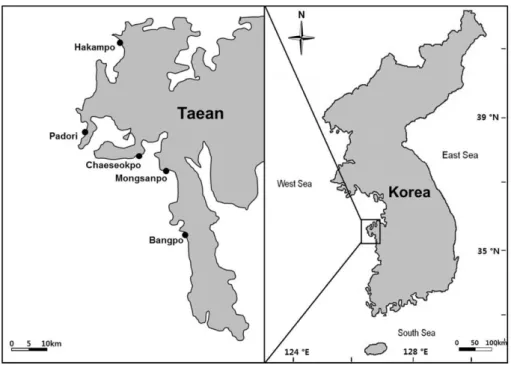
The five study sites were located along the coast of the Taean Peninsula, Korea (Fig. 1), which is directly under the influence of the Yellow Sea warm current year-round.

Average seawater temperature was 6.11

o

C ± 1.97 (mean ± SD) in winter and 16.2

o

C ± 3.24 in summer. Overall, the average seawater temperature was 11.12

o

C ± 5.75. Overall salinity was 29.61‰ ± 1.72. Tidal ranges of the study sites were 5 ~ 6 m. Measurements of daily surface seawater temperatures and salinities over the monitoring period were obtained from the Anheung branch (36

o

40'N, 126

o

08'E) of the National Oceanographic Research Institute (NORI), which is situated near Chaeseokpo, Taean, Korea.

Fig. 1. Sampling area of five study sites (•) on the coast of Taean Peninsula, Korea

(3)

Sampling

Collections were carried out seasonally from March 2006 to January 2007. Three replicated quadrats (50 cm × 50 cm) were randomly placed at three levels (high, middle and low) in the intertidal zone. On the rocky shores, the coverage of seaweeds was recorded using the methods of Saito and Atobe (1970), and then all seaweeds within the quadrats were collected using a scraper. The seaweeds were preserved in formaline-seawater solution (5 ~ 10%), transported to the laboratory, and classified according to Lee and Kang (2002). To estimate biomass, the samples found in each quadrat were dried at 60

o

C for seven days after being identified.

Macroalgal species were divided into six functional forms (sheet, filamentous, coarsely-branched, thick-leathery, jointed-calcareous and crustose) using the methods of Littler and Littler (1984). Ecological State Group I (ESG I) consists of late successional or perennial seaweeds including coarsely-branched, thick-leathery, jointed- calcareous and crustose forms, while ESG II is made up of opportunistic or annual seaweeds including sheet and filamentous forms (Steneck and Dethier 1994; Wells et al.

2007; Lee et al. 2007a).

Data analyses

Macroalgal community structures were compared with respect to diversity, similarity, dominance index, and species richness. The Shannon-Wiener diversity index (H’) and evenness (J’) were calculated with coverage data. The dominance index (DI) was calculated from biomass data of the two most dominant species. The equation for the dominance index is as follows: D

I

= (n

1

+ n

2

)/N, where n

1

= first dominant species, n

2

= second dominant species, and N = total biomass in each quadrat.

Community index and similarity between study sites were analyzed using PRIMER version 6.0 (Clarke and Gorley 2006). The similarity profile test (SIMPROF) was used to test the differences within each of the groups identified from the cluster analysis.

Evaluation of ecological quality

Ecological quality of each of the study sites was determined by various macroalgal community indices including species richness, diversity index, dominance index, biomass, EEI and shore description. EEI was based on Orfanidis et al. (2001) and shore descriptions of sampling sites including dominant shore type and sub-habitats were scored using methods modified from those of Wells et al.

(2007) as described in Table 1. All community indices

were integrated to evaluate the overall coastal ecosystem quality of the study areas. We divided the status of ecological quality into five levels from “Bad” to “High”

using species richness and biomass which have been reported in previous studies performed on the western coast of Korea.

The EEI is an original biotic index based on the concept

Table 1. The shore descriptions of study sites and their scores used in assessment of ecological quality that modified that of Wells et al. (2007)

Rock shore descriptions Score Shore description

Presence of turbidity

(known to be non-anthropogenic)

Yes 0, No 2

Sand scour Yes 0, No 2

Dominant shore type

Rock ridges/outcrops/platforms 4 Irregular rock or, Boulders (large, medium and

small)

3 Steep/vertical rock or, Non-specific hard substrate 2

Pebbles/stones/small rocks 1

Shingle/gravel 0 Subhabitat

Wide shallow rock pools (> 3 m wide and < 50 cm deep)

4 Large rock pools (> 6 m long) or

Deep rock pools (50% >100 cm deep)

4 Basic rock pools or Large crevices 3 Large overhangs and vertical rock 2

Caves Yes 1, No 0

Total number of subhabitats > 4 3 2 1 0

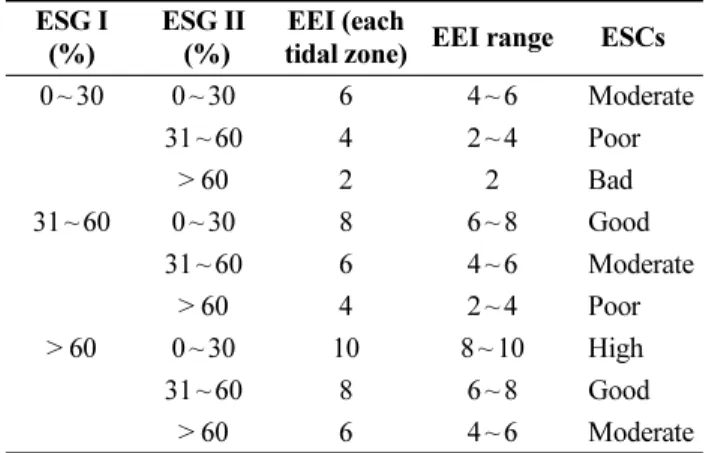
Table 2. Estimation of Ecological Evaluations Index (EEI) using seaweed coverage of Ecological State Groups (ESG) and Ecological Status Class (ESC, Orfan- idis et al. 2003)

ESG I (%)

ESG II (%)

EEI (each

tidal zone) EEI range ESCs

0 ~ 30 0 ~ 30 6 4 ~ 6 Moderate

31 ~ 60 4 2 ~ 4 Poor

> 60 2 2 Bad

31 ~ 60 0 ~ 30 8 6 ~ 8 Good

31 ~ 60 6 4 ~ 6 Moderate

> 60 4 2 ~ 4 Poor

> 60 0 ~ 30 10 8 ~ 10 High

31 ~ 60 8 6 ~ 8 Good

> 60 6 4 ~ 6 Moderate

(4)

of morphological and functional groups (Orfanidis et al.

2001, 2003). All species found at the five sites were divided into two Ecological State Groups, ESG I and ESG II (see above). Each sampling site was classified as one of the five ecological status classes (ESC; bad, poor, moderate, good, and high) after a cross-comparison of the coverage values of ESG I and II (Table 2). The mean seaweed coverage of the three replicated quadrats in each intertidal zone was multiplied by the applicable EEI and then summed to estimate the spatial scale weighted EEI and the equivalent ESC (bad = 2, low = 4, moderate = 6, good = 8, high = 10) (Table 2).

Diversity index, dominance index, EEI, species richness, and substratum type can be used to evaluate overall coastal water quality. All community measurements showed a distinct trend of either increasing or decreasing in quality and rank. The ecological quality of the examined shores could be classified into five classes (bad, low, moderate, good, and high) by their final scores (Table 3).

3. Results

Species richness

A total of 105 seaweeds (16 green, 25 brown and 64 red) were identified at the five study sites, from samples collected seasonally from March 2006 to January

2007. The number of species at each site ranged from 37 species at Mongsanpo to 72 species at Bangpo over the study period (Table 4). Seasonal variations were also found from 65 species in autumn to 75 species in winter, over the study period. At Hakampo, species number increased from spring to autumn and declined in winter.

Species richness reached a peak in spring and a minimum in summer at Padori; species richness increased from spring to summer and decreased from summer to autumn, peaking in winter, at Chaeseokpo.

At all study sites, twenty-three species including three ulvacean species (Ulva compressa, U. linza and U.

australis), two brown algae (Ralfsia verrucosa and Sargassum thunbergii) and 15 red algae (including Corallina pilulifera, Polyopes affinis, Ceramium kondoi, Neorhodomela aculeata etc.) were commonly found. In particular, Corallina pilulifera and Polyopes affinis appeared throughout the study period.

Differences between the five study sites were explored using similarity cluster analysis based on species number (Fig. 2) and the study sites were divided into three groups:

Group A (Mongsanpo), Group B (Hakampo), and Group C (Chaeseokpo, Padori, Bangpo). The calculated similarity between Groups A and B in species number was 60.78%, while that between Groups B and C was 67.96%.

Differences were statistically significant between groups (SIMPROF; p < 0.05).

Table 3. The scoring system with classification status ranges for macroalgal species richness, diversity index (H’), Dom- inance Index (DI), Ecological Evaluation Index (EEI) and shore descriptions as described and calculated from the field sampling sheet

Quality (Score) Bad (1) Poor (2) Moderate (3) Good (4) Excellent (5)

Species richness ≤ 20 21 ~ 35 36 ~ 50 51 ~ 65 > 65

Diversity (H’) 0 ~ 1 1 ~ 2 2 ~ 3 3 ~ 4 > 4

Dominance (DI) 0.9 ~ 1 0.7 ~ 0.9 0.5 ~ 0.7 0.25 ~ 0.5 < 0.25

EEI < 2 2 ~ 4 4 ~ 6 6 ~ 8 8 ~ 10

Biomass < 30 30 ~ 60 61 ~ 80 81 ~ 250 > 250

Shore descriptions N/A 1 ~ 7 8 ~ 11 12 ~ 14 15 ~ 18

Final score 0 ~ 6 7 ~ 12 13 ~ 18 19 ~ 24 25 ~ 30

Table 4. The number of marine algal species occurred at five study sites in Taean, Korea during the study period (Sp, spring; Su, summer; Au, autumn; Wi, winter; To, total)

Taxon Hakampo Padori Chaeseokpo Mongsanpo Bangpo

Total Sp Su Au Wi To Sp Su Au Wi To Sp Su Au Wi To Sp Su Au Wi To Sp Su Au Wi To

Green 2 6 6 3 8 8 4 6 4 11 4 3 3 5 8 3 3 1 3 6 6 5 3 4 12 16

Brown 4 1 3 3 7 7 8 7 9 16 9 8 6 8 16 6 5 2 7 11 12 8 8 10 18 25

Red 26 27 28 26 42 32 25 27 29 44 19 24 18 24 41 11 14 11 15 20 29 25 28 26 42 64

Total 32 34 37 32 57 47 37 40 42 71 32 35 27 37 65 20 22 14 25 37 47 38 39 40 72 105

(5)

Species composition

The proportion of green algae ranged from 12.31 ~ 16.67% of total species number. Brown algae made up 12.28 ~29.73%, with the most at Mongsanpo and the least at Hakampo (Table 4). Red algae dominated at all study sites, ranging from 54.05% at Mongsanpo to 73.68% at Hakampo.

In terms of seaweed functional group, coarsely-branched form (CB) was dominant at all study sites, ranging from 17 species (45.95%) to 35 species (48.61%). The percentage of sheet form algae ranged from 19.30 ~ 27.78%, even though the species number was very different between study sites. Filamentous form seaweeds made up between 10.77% and 21.62% of the total found per site (Table 5).

ESG I seaweeds were dominant and greater in number (61 species, 58.10%) than ESG II seaweeds (44 species, 41.90%) during the study period. At the five study sites, the annual prevalence of ESG I species ranged from 56.77% at Mongsanpo to 64.92% at Hakampo (Table 5).

Biomass

Average seaweed biomass was 56.63 g dry wt./m

2

and

ranged from 36.66 to 73.89 g dry wt./m

2

over the study period. Biomass was greatest at Mongsanpo and least at Hakampo. Seasonal variations in total seaweed biomass were also found, from 47.22 g/m

2

in spring to 68.35 g/m

2

in winter (Fig. 3). The vertical distribution of seaweed biomass fluctuated from 53.49 g/m

2

on high shore to 60.24 g/m

2

in low intertidal zones (Fig. 4).

At Hakampo, seaweed biomass ranged from 17.92 g in spring to 53.63 g/ m

2

in summer (Fig. 3). Seaweed biomass changed seasonally: from 18.09 g/m

2

to 52.61 g/m

2

at Padori, from 54.68 g/m

2

to 81.06 g/m

2

at Chaeseokpo, from 59.70 g/m

2

to 103.06 g/m

2

(mean, 73.89 g/m

2

) at Mongsanpo, and from 36.47 g/m

2

to 117.30 g/m

2

(mean, 69.76 g/m

2

) at Bangpo (Fig. 3).

Seaweed biomass at Hakampo was maximal on the mid shore (52.20 g/m

2

). Biomass was at a minium in the low intertidal zone of Padori (51.25 g/m

2

, Fig. 4). The vertical distribution of seaweed biomass was greater on the mid shore with 71.91 g/m

2

than at higher (58.57 g/m

2

) or lower (66.86 g/m

2

) locations at Chaeseokpo. Mongsanpo seaweeds on the upper shore had the greatest biomass

Table 5. The number of species (percentage, %) in functional form group and ecological state group (ESG) and of sea- weeds occurred at the five study sites of Taean Peninsula, Korea during the study period

Sites ESG I ESG II

Coarsely-branched Thick-leathery Jointed-calcareous Crustose Sheet Filamentous

Hakampo 25 (43.86) 4 (7.02) 4 (7.02) 4 (7.02) 11 (19.30) 9 (15.79)

Padori 31 (43.66) 6 (8.45) 4 (5.63) 3 (4.23) 14 (19.72) 13 (18.31)

Chaeseokpo 33 (50.77) 3 (4.62) 4 (6.15) 2 (3.08) 16 (24.62) 7 (10.77)

Mongsanpo 17 (45.95) 0 2 (5.41) 2 (5.41) 8 (21.62) 8 (21.62)

Bangpo 35 (48.61) 3 (4.17) 2 (2.78) 2 (2.78) 20 (27.78) 10 (13.89)

Total 44 ( 41.90) 6 (5.71) 6 (5.71) 5 (4.76) 26 (24.76) 18 (17.14)

Fig. 2. The Bray Curtis similarity based on species number of seaweeds between five study sites of Taean Peninsula,

Korea during the study period

(6)

(91.51 g/m

2

), whereas the mid shore had the least (63.19 g/m

2

) (Fig. 4). At Bangpo, the vertical biomass distribution ranged from 34.50 g/m

2

at mid shore to 96.85 g/m

2

at high shore.

Such seasonal and vertical variations in seaweed biomass were reflected in the dominant seaweeds. The dominant seaweeds on the Hakampo rocky shore were Corallina pilulifera, Polyopes affinis, Symphyocladia latiuscula and Ulva australis, and two species (C.

pilulifera and U. australis) in the mid to low intertidal zones. At Padori, the biomasses of Sargassum thunbergii, C. pilulifera and U. australis fluctuated and the dominant species were Neorhodomela aculeata on the high shore and, S. latiuscula and Acrosorium yendoi on the low shore. Four species, S. thunbergii, C. pilulifera, U. australis and Gelidium elegans were dominant at Chaeseokpo. S.

thunbergii and C. pilulifera were found on all shore levels at Mongsanpo. At Bangpo, seaweeds such as S. thunbergii and P. affinis dominated on the upper shore, N. aculeata and S. latiuscula dominated on the mid shore, and C.

pilulifera, U. australis and Sargassum fulvellum were most

abundant on the lower shore.

Community structure indices

On the rocky shores of the five study sites, species diversity based on seaweed coverage showed seasonal variation. Average diversity was from 1.24 ~ 2.30 with a maximum at Padori and a minimum at Mongsanpo over the study period (Table 6). Species evenness was greatest at Padori (0.61) and least at Mongsanpo (0.40). The dominance index calculated from biomass data ranged from 0.43 at Padori to 0.64 at Mongsanpo (Table 6).

There were no overall seasonal patterns in dominance index, and it differed from site to site.

Evaluation of ecological status

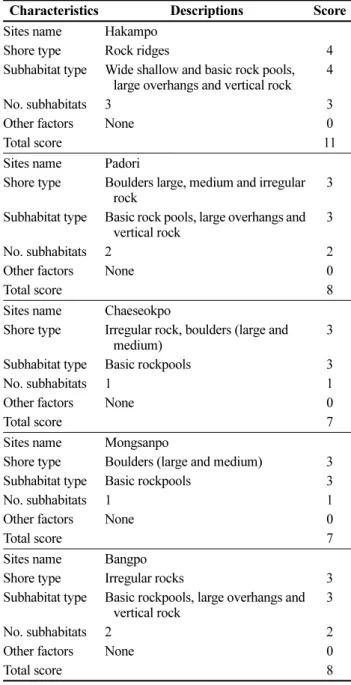
Rocky shore descriptions and various community indices were used to evaluate the ecological quality of the five study sites. Rocky shore description scores based on shore descriptions, dominant shore type and sub-habitats are described in Table 2. Shore description scores were least at Chaeseokpo (7) and Mongsanpo (7) and most at Hakampo (11) (Table 7). Differences in the shore description scores were largely attributable to the number of subhabitats.

To compare the ecological quality of the five study Fig. 3. Seasonal variations in average biomass at the five

study sites of Taean, Korea during the study period. Bars showed standard errors

Fig. 4. Vertical variations in average biomass at the five study sites of Taean, Korea during the study period. Bars showed standard errors

Table 6. The seasonal diversity, evenness and dominance index for the five study sites, Taean, Korea during the study period

Indices Hakampo Padori Chaeseokpo Mong-

sanpo Bangpo Diversity

Spring 1.89 2.34 1.98 1.42 2.43

Summer 2.33 2.31 1.37 1.26 1.48

Autumn 2.19 2.53 1.85 0.89 2.17

Winter 1.76 2.04 1.56 1.39 2.34

Mean 2.04 2.30 1.69 1.24 2.11

Evenness

Spring 0.54 0.60 0.56 0.47 0.62

Summer 0.65 0.64 0.38 0.40 0.40

Autumn 0.59 0.67 0.54 0.32 0.58

Winter 0.51 0.53 0.42 0.42 0.63

Mean 0.57 0.61 0.48 0.40 0.56

Dominance

Spring 0.65 0.45 0.39 0.63 0.43

Summer 0.57 0.40 0.53 0.57 0.50

Autumn 0.55 0.36 0.49 0.74 0.49

Winter 0.45 0.51 0.56 0.63 0.36

Mean 0.56 0.43 0.49 0.64 0.45

(7)

sites, six indices of seaweed community health were examined. Over the study period, the scores of species richness ranged from 3 to 5 (Table 8). Diversity index values were greater (> 2.0) at Hakampo, Padori and Bangpo than at Chaeseokpo (1.69) and Mongsanpo (1.24).

The dominant index was greatest at Mongsanpo. The lowest biomass was found at Hakampo and Padori (Table 8). On the basis of the six community indices, the ecological quality of the five study sites was divided into two groups: moderate (Chaeseokpo and Mongsanpo) and good (Hakampo, Padori and Bangpo).

4. Discussion

Species richness of seaweeds may seem like a very basic tool, but it represents the ecological quality of a coastal area because it responds sensitively to environmental changes (Wells et al. 2007). On the western coast of Korea, annual macroalgal species richness varied widely:

27 species at Gyounggi Bay (Lee et al. 2007b), 36 species on Deojeog Island (Koh and Lee 1982), 61 species in the vicinity of Yonggwang (Hwang et al. 1996; Kim and Huh 1998), 81 species at Garolim Bay (Lee and Lee 1982), and 94 species at Padori (Lee and Chang 1989; Lee et al.

1997; Lee et al. 2000). On the intertidal rocky shores of the Taean Peninsula, 105 seaweed species were identified in the present study. This indicates that the ecological quality of the intertidal rocky shores at the Taean Peninsula is greater than that of many other coastal areas in terms of species richness. However, species richness even at these five sites on one peninsula differed; there were, for example, only 37 species at Mongsanpo but 72 at Bangpo.

Macroalgal species composition is also indicative of ecological health because the number and/or proportion of green seaweeds are high in disturbed areas with sewage runoff whereas those of red algae are high at sites with Table 7. Basic shore descriptions and scores for five

study sites of Taean, Korea (see Table 2)

Characteristics Descriptions Score

Sites name Hakampo

Shore type Rock ridges 4

Subhabitat type Wide shallow and basic rock pools, large overhangs and vertical rock

4

No. subhabitats 3 3

Other factors None 0

Total score 11

Sites name Padori

Shore type Boulders large, medium and irregular rock

3

Subhabitat type Basic rock pools, large overhangs and vertical rock

3

No. subhabitats 2 2

Other factors None 0

Total score 8

Sites name Chaeseokpo

Shore type Irregular rock, boulders (large and medium)

3

Subhabitat type Basic rockpools 3

No. subhabitats 1 1

Other factors None 0

Total score 7

Sites name Mongsanpo

Shore type Boulders (large and medium) 3

Subhabitat type Basic rockpools 3

No. subhabitats 1 1

Other factors None 0

Total score 7

Sites name Bangpo

Shore type Irregular rocks 3

Subhabitat type Basic rockpools, large overhangs and vertical rock

3

No. subhabitats 2 2

Other factors None 0

Total score 8

Table 8. Final scores for five study sites of the characteristics in macroalgal species richness, diversity index (H’), Dom- inance Index (DI), Ecological Evaluation Index (EEI), biomass and shore description during the study period

Characteristics Hakampo Padori Chaeseokpo Mongsanpo Bangpo

Species richness 4 (57) 5 (71) 4 (65) 3 (37) 5 (72)

Diversity index 3 (2.04) 3 (2.30) 2 (1.69) 2 (1.24) 3 (2.11)

Dominance index 3 (0.56) 4 (0.43) 4 (0.49) 3 (0.64) 4 (0.45)

EEI 4 (6.02) 3 (6) 3 (5.32) 3 (4.61) 3 (5.56)

Biomass 2 (36.66) 2 (37.07) 3 (65.78) 3 (73.89) 3 (69.76)

Shore descriptions 3 (11) 3 (8) 2 (7) 2 (7) 3 (8)

Final score 19 20 18 16 21

Quality status Good Good Moderate Moderate Good

(8)

better environmental quality (Díez et al. 2003; Arévalo et al. 2007; Wells et al. 2007). The major taxon group, red algae ranged from 20 to 44 species (from 54.05% to 73.68%) at the five study sites over the study period. Red algal dominance is a general phenomenon on the western coasts of Korea (Hwang et al. 1996; Yoo et al. 1999), even though environmental conditions are very poor because of high turbidity and dominant oyster beds. Seaweeds can be classified by their morphology and texture into six functional groups and two ecological state groups (ESG I and ESG II) based on six functional forms (Littler and Littler 1984; Orfanidis et al. 2001; Wells et al. 2007).

Previous authors reported that ESG II seaweeds (filamentous and sheet groups) were abundant in disturbed or eutrophicated coastal areas and ESG I seaweeds (coarsely-branched, thick-leathery, articulated, and crustose seaweeds) were dominant in stable environmental conditions. In the present study, coarsely-branched seaweeds predominated at all study sites and ESG I seaweeds were more abundant than ESG II species (61 species, 58.10% vs. 44 species, 41.90%), respectively. Thus, the five study sites are stable environ- mentally, and serious human activity-driven changes have not occurred.

It is well known that seaweed biomass determines the amount of primary production in coastal areas because many marine animals use seaweeds as food sources (Parker et al. 2001). Thus, seaweed biomass is a commonly used indicator representing the health of coastal ecosystems (Liu et al. 2007; Arévalo et al. 2007). On the western coasts of Korea, seaweed biomass ranged from 34.01 g dry wt./m

2

at Inchon dock to 276.25 g dry wt./m

2

at Padori (Lee and Chang 1989; Yoo et al. 1999). In previous reports, the biomass of seaweeds in the Taean area was 123.23- 276.25 g dry wt./m

2

(Lee and Chang 1989; Lee et al.

1997; Lee et al. 2000). At the five study sites, macroalgal biomass ranged from 36.66 g dry wt./m

2

to 73.89 g dry wt./m

2

over the study period and it was maximal at Mongsanpo and minimal at Hakampo. Thus, the study areas of the Taean Peninsula were in moderate condition in terms of seaweed biomass relative to other coasts.

The ecological quality of the five study sites was assessed by scoring species richness, biomass, diversity index, dominance index, and shore descriptions. The ecological quality of the five study sites was divided into two groups, moderate (Chaeseokpo and Mongsanpo) and good (Hakampo, Padori and Bangpo). The final relative shore quality score was the greatest at Bangpo and the least at Mongsanpo. The important parameters determining the ecological quality of the study sites were species richness,

diversity index, dominance index, and shore descriptions.

Acknowledgements

This work was supported by National Marine Biodiversity Institute Research Program (2015M00400). This research was financially supported by a grant from the Marine Biotechnology Program Funded by the Ministry of Ocean and Fisheries of the Korean Government.

References

Andrew NL, Viejo RM (1998) Effects of wave exposure and intraspecific density on the growth and survivorship of Sargassum muticum (Sargassaceae: Phaeophyta). Eur J Phycol 33:251−258

Arévalo R, Pinedo S, Ballesteros E (2007) Changes in the composition and structure of Mediterranean rocky-shore communities following a gradient of nutrient enrichment:

descriptive study and test of proposed methods to assess water quality regarding macroalgae. Mar Pollut Bull 55:104 −113

Ballesteros E, Torras X, Pinedo S, García M, Mangialajo L, Torres M (2007) A new methodology based on littoral community cartography dominated by macroalgae for the implementation of the European water framework directive. Mar Pollut Bull 55:172−180

Böhnke-Henrichs A, Baulcomb C, Koss R, Hussain SS, de Groot RS (2013) Typology and indicators of ecosystem services for marine spatial planning and management. J Environ Manage 130:135−145

Clarke KR, Gorley RN (2006) Primer V6: user manual/

tutorial. PRIMER-E Ltd, Plymouth, UK

Díez I, Secilla A, Santolaria A, Gorostiaga JM (1998) Phytobenthic intertidal community structure along an environmental pollution gradient. Mar Pollut Bull 38:463 −472

Díez I, Santolaria A, Gorostiaga JM (2003) The relationship of environmental factors to the structure and distribution of subtidal seaweed vegetation of the western Basque coast (N Spain). Estuar Coast Shelf Sci 56:1041−1054 Gorostiaga JM, Díez I (1996) Changes in the sublittoral

benthic marine macroalgae in the polluted area of Abra de Bilbao and proximal coast (northern Spain). Mar Ecol Prog Ser 130:157 −167

Hwang EK, Park CS, Sohn CH, Koh NP (1996) Analysis of

functional form groups in macroalgal community of

Yonggwang vicinity, western coast of Korea. J Kor Fish

Soc 29:97 −106

(9)

Juanes JA, Guinda X, Puente A, Revilla JA (2007) Macroalgae, a suitable indicator of the ecological status of coastal rocky communities in the NE Atlantic. Ecol Indicators 10:10 −16

Kim YH, Huh SH (1998) Species composition and biomass of marine algal community in the vicinity of Yonggwang nuclear power plant on the west coast of Korea. J Kor Fish Soc 31:186−194

Koh CH, Lee HB (1982) Distributional pattern of macroalgae in coast of Deogjeog Islands. Rep Surv Nat Environ Korea 1:229 −249

Lambshead PJD, Platt HM, Shaw KM (1983) The detection of differences among assemblages of marine benthic species based on an assessment of dominance and diversity.

Nat Hist 17:859−874

Lee HB, Chang RH (1989) A qualitative and quantitative analysis of seasonal change of an algal community at Padori of Taean peninsula, west coast of Korea. Kor J Bot 4:19−40

Lee IK, Lee HB (1982) A study on the algal vegetation in Garolim Bay, western coast of Korea. Rep KACN 4:

325 −337

Lee JW, Oh BG, Lee HB (1997) Marine algal flora and community of Padori area in Taean peninsula, the west coast of Korea. Algae 12:131−138

Lee JW, Oh BG, Lee HB (2000) Marine benthic algal community at Padori, west coast of Korea. Algae 15:111 −117

Lee KH, Yoo HL, Choi HG (2007a) Seasonal community structure and vertical distribution of medicinal seaweeds at Kkotji in Taean peninsula, Korea. Algae 22:209 −219 Lee YP, Kang SY (2002) A Catalogue of the Seaweeds in

Korea. Cheju National University Press, Jeju, 662p Lee WJ, Hwang MS, Beak JM, Lee JW, Kim JI (2007b)

Primary survey on algal community of Gyounggi Bay for restoration. Algae 22:201 −207

Lindstrom SC (2009) The biogeography of seaweeds in southeast Alaska. J Biogeogr 36:401−409

Littler MM, Littler DS (1984) Relationships between macroalgal functional form groups and substrata stability in a sub-tropical rocky-intertidal system. J Exp Mar Biol Ecol 74:13 −34

Liu D, Bai J, Song S, Zhang J, Sun P, Li Y, Han G (2007) The impact of sewage discharge on the macroalgae community in the Yellow Sea coastal area around Qingdao, China. Water Air Soil Pollut 7:683 −692 Ludwing JA, Reynolds JF (1988) Statistical ecology: a

primer on methods and computing. John Wiley & Sons,

New York, 329 p

McNaughton SJ (1967) Relationship among functional properties of California Grassland. Nature 216:168−169 Orfanidis S, Panayotidis P, Stamatis N (2001) Ecological

evaluation of transitional and coastal water: a marine benthic macrophytes-based model. Medit Mar Sci 2:45 −65 Orfanidis S, Panayotidis P, Stamatis N (2003) An insight to

the ecological evaluation index (EEI). Ecol Indicators 3:27 −33

Panayotidis P, Montesanto B, Orfanidis S (2004) Use of low-budget monitoring of macroalgae to implement the European Water Framework Directive. J Appl Phycol 16:49 −59

Parker JD, Duffy JE, Orth RJ (2001) Plant species diversity and composition: experimental effects on marine epifaunal assemblages. Mar Ecol Prog Ser 224:55 −67

Piazzi L, Cinelli F (2001) Distribution and dominance of two introduced turf-forming macroalgae on the coast of Tuscany, Italy, northwestern Mediterranean Sea in relation to different habitats and sedimentation. Bot Mar 44:509−

520

Pinedo S, García M, Satta MP, Torres M, Ballesteros E (2007) Rocky-shore communities as indicators of water quality: a case study in the Northwestern Mediterranean.

Mar Pollut Bull 55:126−135

Saito Y, Atobe S (1970) Phytosociological study of intertidal marine algae. 1. Usujiri Benten-Jima, Hokkaido. Bull Fac Fish Hokkaido Univ 21:37−69

Steneck RS, Dethier MN (1994) A functional group approach to the structure of algal-dominated communities. Oikos 69:476 −498

Tribollet AD, Vroom PS (2007) Temporal and spatial comparison of the relative abundance of macroalgae across the Mariana Archipelago between 2003 and 2005.

Phycologia 46:187−197

Wells E, Wilkinson M, Wood P, Scanlan C (2007) The use of macroalgal species richness and composition on intertidal rocky seashore in the assessment of ecological quality under the European water framework directive.

Mar Pollut Bull 55:151−161

Yoo JS, Kim YH, Lee IK (1999) Succession of benthic algal community in Dock marine ecosystem perturbated by red tide. Algae 14:181−187

Received Nov. 11, 2015

Revised Nov. 27, 2015

Accepted Dec. 10, 2015

수치

Fig. 1. Sampling area of five study sites (•) on the coast of Taean Peninsula, Korea
Table 2. Estimation of Ecological Evaluations Index (EEI) using seaweed coverage of Ecological State Groups (ESG) and Ecological Status Class (ESC,  Orfan-idis et al
Table 4. The number of marine algal species occurred at five study sites in Taean, Korea during the study period (Sp, spring; Su, summer; Au, autumn; Wi, winter; To, total)
Fig. 2. The Bray Curtis similarity based on species number of seaweeds between five study sites of Taean Peninsula, Korea during the study period
+3

참조

관련 문서

A Systematics and Ecological Notes on Marine Polychaetes (Annelida, Polychaeta) from Korea, with the Secondary Production of Hediste japonica Population in Suncheon

So, this research was done for evaluating the usefulness of Periodontal age 「 index 」 by using 「 Periodontal age index 」 to examine subjective consciousness on

Objective: This study examined the current status of depression and related factors affecting children's depression among children using Community child center.. Methods:

Mudeung and Naejang, located on the southwestern part of Korea, were studied in terms of the benthic macroinvertebrate community with selecting eight study stations over

Objectives: The purpose of this study was to investigate the relationship between mental health and experience of falling in some local elderly people using the 2013

A summer marine benthic algal flora and community of uninhabited islands in Haenamgun, southern coast of Korea. Seasonal Variations in the Macroalgal Flora and

In the present study, 10 study stations were established, and seasonal changes for various ecological aspects of the community such as species composition, number of

This study reconstructed variations in the SST during the Holocene by using the alkenone unsaturation index of marine sediments of two deep-drilled cores (HMB-102 and