서 론
최근 우리나라의 많은 하천 및 강은 다양한 수자원의 이용 및 건설로 인해 수환경의 서식지가 변해가고 있으
며, 각종 산업폐수와 생활하수의 증가는 유수생태계의 부영양화를 가속화 시키고 있다 (Shin and Cho 1999). 이 러한 상황에서 하천 생태계의 생물 서식지 교란, 물질순 환 및 에너지 흐름의 급격한 변화는 변화에 적응하지 못하는 수생생물, 특히 어류의 종 조성을 변화시켜 이에 대한 생태계의 종합적 건강도 평가 및 모니터링 평가가 시급한 실정이다.
Korean J. Environ. Biol. 31(4) : 440~447 (2013) http://dx.doi.org/10.11626/KJEB.2013.31.4.440
남한강 수계에서 하천차수에 따른 생태건강도 평가 및 지점별 물리적 서식지 평가
최 지 웅∙안 광 국*
충남대학교 생명과학과
Ecological Health Assessments on Stream Order in Southern Han River Watershed and Physical Habitat Assessments
Ji-Woong Choi and Kwang-Guk An*
Department of Biological Science, College of Biological Sciences and Biotechnology, Chungnam National University, Daejeon 305-764, Korea
Abstract -- The ecological health, based on the Index of Biological Integrity (IBI) and Qualitative Habitat Evaluation Index (QHEI) was evaluated in 10 stream sites of Southern Han River. Eleven parameters of 12 parameters (Karr 1981) were modified for the application of regional Korean circumstance. The ecological health, based on IBI grade, was in “good condition” and the IBI score ranged from 33 to 47. Nine parameters of the original 12-parameter metrics in QHEI model (Plafkin et al. 1989) were applied in the habitat assessment. The mean QHEI model values were judged as “partially supporting” and ranged from 75 (non-supporting) to 109 (supporting). Com- parative analyses revealed that values of IBI and QHEI models were greater in Gj stream than Ig- and Dn streams. The analysis of fish compositions showed that the proportions of insectivore, omnivore, and carnivore were 61.9%, 19%, and 9.5%, respectively. According to tolerance guild analysis, sensitive species and tolerant species were 76.1% and 4.7%, respectively, indicating a healthy trophic state in terms of food chain. The analysis by habitat guild type indicated that riffle benthic species dominated (57.1%) when compared to water column species (28.5%). The intro- duced species and individuals with diseases or external abnormality were not observed. Overall, the model values of IBI and QHEI suggested that the ecological health was maintained well in this upstream region.
Key words : ecological health, physical habitat, stream order, Southern Han River
* Corresponding author: Kwang-Guk An, Tel. 042-821-6408, Fax. 042-822-9690, E-mail. [email protected]
<Note>
ⓒ2013. Korean Society of Environmental Biology.
환경 평가자들은 급속도로 악화되어 가는 수중 생태계 오염을 파악하기 위한 방법으로 화학적 모니터링 방식을 가장 빈번하게 이용해 왔다(Karr 1981; US EPA 1991). 그 러나 화학적 모니터링은 생태계의 변화에 대한 총체적 특성을 잘 반영하지 못하는 것으로 나타났다. 예를 들면, 수체의 흐름 변화, 서식지 면적의 감소 및 수체내의 생물 먹이연쇄 등에 대한 특성은 화학적 평가로는 전체를 탐 지할 수 없어 종합적인 평가가 되지 못하는 것으로 분석 되었다(Karr 1981). 우리나라의 경우 수질평가를 위해 어 류, 수서곤충 및 조류와 같은 생물종을 이용하였다. 어류 의 경우 군집 분석 평가 (Yang and Chae 1994; Choi et al.
1997; Choi and Byeon 1999) 및 어류 지표종 (Song et al.
1995; Byeon et al. 1996)을 이용하여 수질을 평가하였으 나, 대부분의 자료가 어류의 분포나 군집에 대한 조사만 을 했을 뿐 어류를 이용한 수질평가는 보고된 바가 거의 없었다. 또한, Bae (1993), Kim et al. (1995)은 수서곤충을 이용하였고, Kim et al. (1996)과 Cho et al. (1998)은 조류 를 이용하여 수질을 평가하였으나 수서곤충이나 조류를 이용한 생물학적 모니터링은 수환경을 평가함에 있어 수 체를 총체적으로 반영하기에는 그 자료가 충분하지 못하 였다(Karr 1981; Hay et al. 1995).
미국 환경부 (US EPA) 및 유럽연합 (EU)의 연구들에서 는 이러한 문제점을 보완하기 위한 방법으로 어류를 이 용한 생물기준 (biological criteria)을 도입하였다 (Van Put- ten 1989; US EPA 1993). Karr (1981)에 의해 연구된 어류 를 이용한 생물보전지수(Index of Biological Integrity, IBI) 모델의 개념은 1981년 미국에 도입되었고, 미국의 각 지 역에서는 그 지역의 생태학적 특성을 고려하여 다변수 모델에 대한 수정 보완작업이 이루어졌다. 1991년 이후 에는 35개 주 정부에서 하천 평가를 하는데 이용되었고 1990년 이후로는 다변수 모델에 대한 적용이 미국뿐만 아니라 나미비아 (Hocutt et al. 1994), 베네수엘라 (Gutierrez 1994), 프랑스 (Oberdorff and Hughes 1992; Oberdorff and Porcher 1994), 호주 (Harris 1995)에도 도입이 되어 많이 이용되어지고 있다. Karr (1981)가 어류를 이용하여 수 환 경을 평가한 근거로는 1) 대부분 어류에 대한 생활사가 널리 알려져 있고, 2) 다양한 영양 단계를 나타내며, 3) 어 류는 야외에서 분류 및 동정이 용이하고, 4) 일반인들이 어류군집 상태를 쉽게 이해할 수 있으며, 5) 스트레스 요 소들(성장과 생식)을 잘 반영하며, 6) 물속에 어류는 광범 위하게 분포하여 지역적 평가가 가능한 장점을 가지고 있다. 이런 어류 생물체의 장점을 이용하여 US EPA (1993) 에서는 어종 풍부도 및 구성도, 영양단계구조, 개체 풍부 도 및 개체건강도의 3가지 특성을 정량화하여 하천의 생
태학적 건강도를 평가하였고, 과거의 생물학적 모니터링 을 보완하여 수중 생태계의 변화를 파악하고 있다. 남한 강 상류수계에서는 Lee et al. (2007)이 Karr (1981)의 기법 을 적용하여 다변수 모델 지수를 보고한 바 있다.
본 연구에서는 남한강의 상류수계 하천을 대상으로 하 천차수별 생물보전지수 (Index of Biological Integrity, IBI) 의 메트릭 분석 및 서식지 평가 지수 (Qualitative Habitat Evaluation Index, QHEI)를 적용하여 생태건강도 특성을 평가하였고, 이에 대한 모델 값들의 상호 비교분석을 통 해 생태건강도의 양호 혹은 악화상태 등을 평가하였다.
본 자료는 향후 이지역의 생태계의 건강성 특성 변화에 대한 기초자료로 활용될 것으로 사료된다.
재료 및 방법
1. 대상 지역
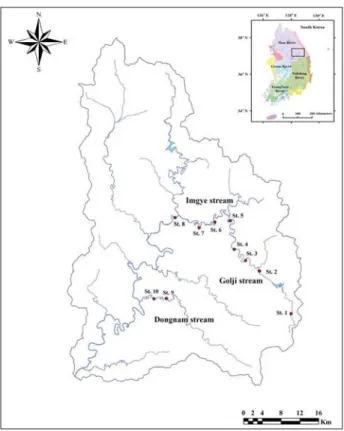
본 조사는 강원도 남한강 상류인 골지천 (Gj), 임계천 (Ig) 및 동남천 (Dn)을 대상으로 1999년 9월부터 2000년 8월까지 조사하였으며, 조사지점의 선정은 하천 서식지 평가법(US EPA 1983; Bartholow 1989; Plafkin et al. 1989)
Fig. 1. Map showing all sampling sites of the upstream watershed in Southern Han River.
에 의거하여 10개의 조사지점을 선정하였다(Fig. 1).
[조사지점]
St. 1. 강원도 삼척시 하장면 상사미리 상사미교(골지천) St. 2. 강원도 삼척시 하장면 장전리 장전교(골지천) St. 3. 강원도 삼척시 하장면 갈전리(골지천) St. 4. 강원도 삼척시 하장면 토산리 은토교(골지천) St. 5. 강원도 정선군 임계면 낙천리 혈천교(골지천) St. 6. 강원도 정선군 임계면 반천리(임계천) St. 7. 강원도 정선군 임계면 봉정리 옛골(임계천) St. 8. 강원도 정선군 북면 여량리 아우라지교(임계천) St. 9. 강원도 정선군 남면 낙동리 음지교(동남천) St. 10. 강원도 정선군 남면 낙동리(동남천)
2. 조사 방법
생물보전지수 (Index of Biological Integrity, IBI) 산정을 위한 어류의 채집은 Ohio EPA (1989)의 Wading method 에 의거하여 실시하였다. 북미의 경우 배터리를 사용하 여 어류를 채집하나 국내의 경우 생태계 보호를 위한 규 약에 의거하여 투망(망목 5×5 mm), 족대(망목 3×3 mm) 를 사용하였다. 또한, 정량적 조사를 수행하기 위해 투망 은 소(pool)와 여울(riffle)을 고려하여 각각 5회씩 총 10 회 투척하였고, 특정 구조물들에 의하여 투망을 사용하 기 어려운 곳에서는 족대를 사용하였다. 각 지점의 조사 범위는 Ohio EPA (1989)에 의거하여 정점으로부터 상∙
하류의 150~200 m로 설정하였고, 조사시간은 지점별 비 교∙분석을 위해 60분으로 한정하였다. 채집된 어류는 야 외에서 즉시 동정, 분류한 후 하천에 방류하였고, 분류가 모호한 어류는 10%의 포르말린에 고정하여 실험실로 운 반하여 Choi et al. (1990), Kim and Kang (1993)의 검색표 에 의거하여 종 분류를 실시하였다.
3. 물리적 서식지 평가
한강 상류역의 하천인 골지천 (Gj), 임계천 (Ig), 동남천 (Dn)의 서식지 분석은 Plafkin et al. (1989)에 의해 도입 된 물리적 서식지 평가지수 (Qualitative Habitat Evalua- tion Index, QHEI)를 이용하였다. 물리적 서식지 평가지수 (QHEI)의 전체 12개 항목 중 국내하천의 환경에 적용 가능한 9개 항목 (Metric, M)을 선택하여 적용하였고, 각 변수는 최적상태 (Optimal), 양호상태 (Sub-optimal), 일부 미진한 상태 (Marginal) 및 악화상태 (Poor)로 구분하였으 며 각 등급에 대한 기준은 US EPA (1993)에 의거하였다.
물리적 서식지 평가 지수(QHEI)는 9개 변수로부터 얻어
진 합을 이용하여, 최적상태 (Fully supporting, ¤90%;
QHEI 값: ¤121), 적정상태 (Supporting, 75~89%; QHEI 값: 101~120), 부분 지지상태(Partially supporting, 60~74
%; QHEI 값: 81~100) 및 악화상태 (Non supporting, ⁄59
%; QHEI 값: ⁄80)로 대별하였다.
4. 생물보전지수(IBI) 분석
본 조사에 이용된 생물보전지수(IBI)의 변수들은 각 나 라의 지역적, 생태적 특성을 반영하는 모델 설정 작업이 선행되어야 하는 점을 감안하여 (Karr et al. 1986; Ober- dorff and Hughes 1992; Barbour et al. 1999), 한국의 지역 적 특성에 맞게 총 메트릭 (Metric, M) 수를 조정하여 본 연구대상 수계를 분석하였다. 본 기법의 창시자인 Karr
(1981)는 북미하천의 어류군을 이용한 12개 메트릭을 제
시하였으나, 본 연구에서는 An et al. (2001a, 2001b)에 의 해 장수하는 어류항목을 반영한 흡반류 항목 (Species of long-lived fish)을 제외한 11개 메트릭을 이용하였다. 생 물보전지수(IBI)산정을 위한 각 어류의 서식지 분류(Ha- bitat guild)는 US EPA (1993)의 기법을 이용하여 여울성 저서종(Riffle benthic species), 소에 거주하는 저서종(Pool benthic species) 및 소에 거주하는 수층종 (Water column species in pool)으로 구분하였으며, 영양구조 구분 (Trophic guild) 및 서식지 특성(Habitat guild)은 생물보전지수(IBI) 를 이용한 An et al. (2001a, 2001b) 및 Yeom et al. (2000) 의 문헌에 의거하여 실시되었다. 각 조사 메트릭에 대한
“5”, “3”, “1”의 점수분류 (Scoring category) 및 기준 선정 은 US EPA (1993)의 방법에 의거하였고, 최상(Excellent), 양호 (Good), 보통 (Fair), 악화 (Poor) 및 최악상태 (Very poor)의 5개 등급으로 구분하여 평가하였다.
결과 및 고찰
1. 물리적 서식지 평가지수(QHEI)에 의한 서식지 상태
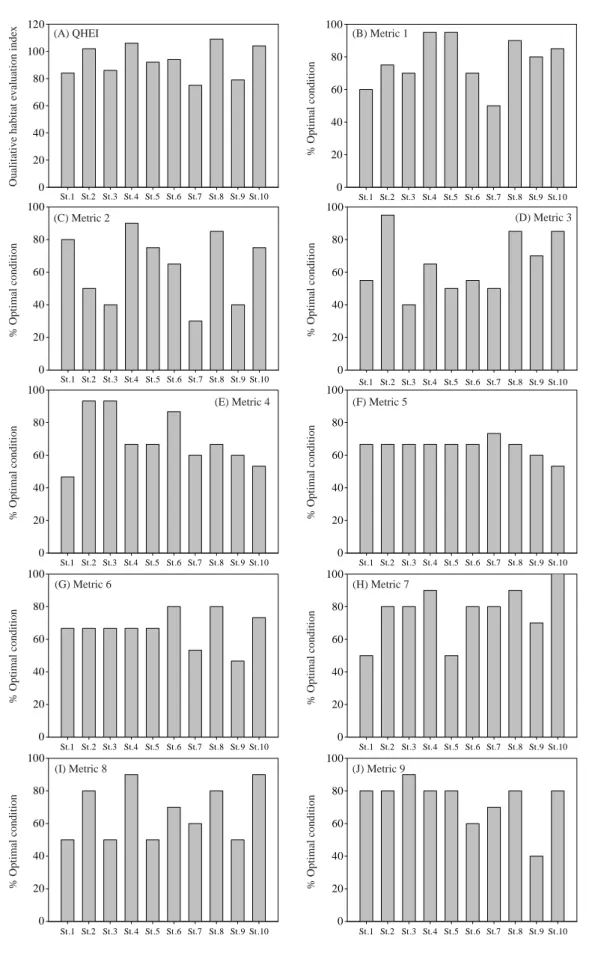
남한강 상류하천의 10개 지점을 대상으로 물리적 서식 지 평가지수(QHEI)를 산정한 결과에 따르면 골지천(Gj), 임계천 (Ig) 및 동남천 (Dn)의 물리적 서식지 평가지수 (QHEI)는 평균 93.6 (범위 : 75~109)로 생물서식지 측면 에서 부분 지지상태 (Partially supporting)인 것으로 나타 났다 (Fig. 2A). 또한, 10개 지점 중 적정상태 (Supporting) 로 평가된 지점이 4개, 부분 지지상태(Partially supporting) 로 평가된 지점이 4개, 악화상태 (Non-supporting)로 평가 된 지점이 2개인 것으로 분석되었다. 하천별 물리적 서식
St.1 St.2 St.3 St.4 St.5 St.6 St.7 St.8 St.9 St.10 St.1 St.2 St.3 St.4 St.5 St.6 St.7 St.8 St.9 St.10
St.1 St.2 St.3 St.4 St.5 St.6 St.7 St.8 St.9 St.10 St.1 St.2 St.3 St.4 St.5 St.6 St.7 St.8 St.9 St.10
St.1 St.2 St.3 St.4 St.5 St.6 St.7 St.8 St.9 St.10 St.1 St.2 St.3 St.4 St.5 St.6 St.7 St.8 St.9 St.10
St.1 St.2 St.3 St.4 St.5 St.6 St.7 St.8 St.9 St.10 St.1 St.2 St.3 St.4 St.5 St.6 St.7 St.8 St.9 St.10
0 20 40 60 80 100
0 20 40 60 80 100
0 20 40 60 80 100
0 20 40 60 80 100
0 20 40 60 80 100
0 20 40 60 80 100
0 20 40 60 80 100
0 20 40 60 80 100
St.1 St.2 St.3 St.4 St.5 St.6 St.7 St.8 St.9 St.10
0 20 40 60 80 100
St.1 St.2 St.3 St.4 St.5 St.6 St.7 St.8 St.9 St.10
0 20 40 60 80 100 120
Oualitative habitat evaluation index% Optimal condition % Optimal condition% Optimal condition% Optimal condition% Optimal condition% Optimal condition
% Optimal condition% Optimal condition% Optimal condition
(A) QHEI
(C) Metric 2
(E) Metric 4
(G) Metric 6
(I) Metric 8 (J) Metric 9
(H) Metric 7 (F) Metric 5
(D) Metric 3 (B) Metric 1
Fig. 2. Qualitative Habitat Evaluation Index (QHEI) in sampling sites.
지 평가지수 (QHEI)를 살펴보면, 골지천 (Gj)은 평균 94, 임계천(Ig)은 평균 92.6, 동남천 (Dn)은 평균 91.5로 나타 나 큰 차이를 보이지 않았으나 골지천(Gj)의 QHEI 모델 값이 타 하천들 (임계천, 동남천)에 비해 높게 나타나 물 리적 서식지 상태가 상대적으로 양호한 것으로 평가되었 다.
각 평가 항목에 대하여 지점별로 살펴보면, 하상기질 및 하천 피도 (M1, bottom substrate / instream cover; Fig.
2B), 수목 피도 (M2, canopy cover; Fig. 2C), 하상 침적도 (M3, embeddedness; Fig. 2D), 수로 변경도 (M4, channel alteration; Fig. 2E), 제방 식생 보호도 (M7, bank vegetative protection; Fig. 2H)는 각 지점에서 최적상태 (Optimal)에 서 일부미진한 상태 (Marginal)의 범위를 나타냈다. 식생 폭 (M9, riparian vegetative zone width; Fig. 2J)은 최적상 태 (Optimal)에서 악화상태 (Poor)의 범위를 나타냈고, 퇴 적도 (M5, deposition; Fig. 2F)는 지점10이 일부미진한 상 태 (Marginal)인 것을 제외하고 모두 양호상태 (Sub-opti- mal)인 것으로 나타났다. 소와 여울의 분포비 및 유로 직 선도와 굴곡비 (M6, pool/riffle, run/bend ratio; Fig. 2G)는 지점6과 지점8이 최적상태 (Optimal), 지점7이 일부미진 한 상태 (Marginal)인 것을 제외하고는 다른 지점 모두 양호상태 (Sub-optimal)로 나타났다. 천변 피도 (M8, strea- mside cover; Fig. 2I)는 최적상태 (Optimal)에서 양호상태 (Sub-optimal)의 범위를 나타냈다.
2. 하천차수에 따른 생물보전지수(IBI) 메트릭별 평가
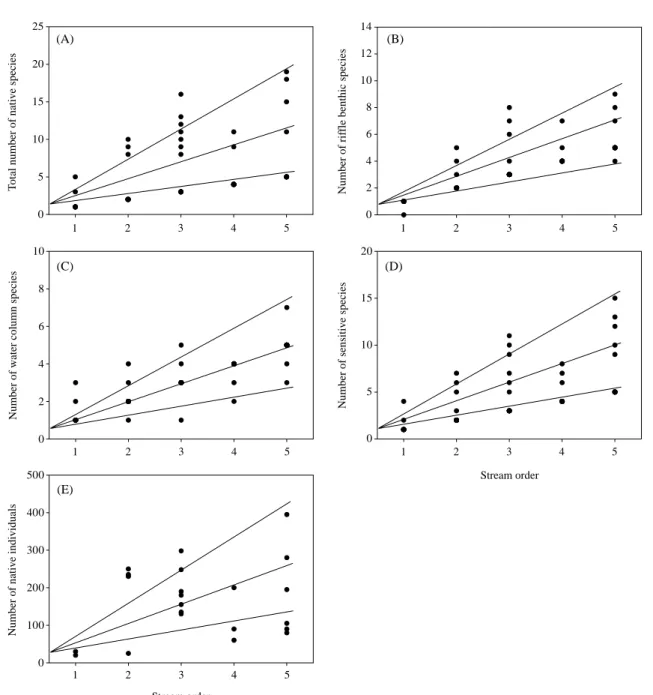
생물보전지수 (IBI)를 산정하기 위하여 하천차수에 따 라 대조하천 (Reference stream)을 조사하고 이를 통하여 최대종풍부도곡선 (Maximum species richness line, MSRL) 을 산정하고 각 메트릭의 점수분류 (Scoring category)를 위한 기준을 설정하였다. 이러한 과정을 통하여 산출된 최대종풍부도곡선과 하천차수에 따른 메트릭별 결과는 다음과 같다.
첫 번째 메트릭(M1)은 토착어종의 총 종수(Total num- ber of native species)로 본 항목의 최대종풍부도곡선은 Fig. 3A와 같으며, 점수분류는 5차 하천을 기준으로 각각 12~19, 6~11, 0~5종으로 구분되었다. 최대종풍부도곡 선을 통하여 설정된 점수분류를 기준으로 조사지점의 총 종수를 그래프에 표시한 결과, 하천차수가 증가할수록 채집되는 어종의 수는 증가하는 경향을 보였다. 그러나 4차 하천에 해당하는 지점들에서는 상대적으로 적은 종 이 채집되어 낮은 메트릭 값을 보였고, 최대종풍부도곡선 과 유사한 경향을 보이지 않는 것으로 나타났다. 5차 하
천에서는 11~19종이 채집되어 최대종풍부도 곡선의 점 수분류 기준에 의거하여 대부분의 지점에서 메트릭 값이
5점으로 산정되었다. 두 번째 메트릭 (M2)은 여울성 저
서종수 (Number of riffle benthic species)로 본 항목의 최 대종풍부도곡선은 Fig. 3B와 같으며, 점수분류는 5차 하 천을 기준으로 각각 7~10, 4~6, 0~3종으로 구분되었 다. 또한, 세 번째 메트릭 (M3)은 소의 수층에 서식하는 어종 수 (Number of water column species)로 점수분류는 Fig. 3C와 같이 5차 하천을 기준으로 5~7, 3~6, 0~2종 으로 구분되었다. 조사지점의 조사 결과를 그래프에 표 시한 결과, M2와 M3모두 4차 하천에서 상대적으로 적은 여울성 저서종과 수층종이 채집되었고, 4차 하천을 제외 하고 하천차수가 증가할수록 더 많은 종이 채집되는 것 으로 나타났다. 네 번째 메트릭(M4)은 민감종수(Number of sensitive species)로 높은 부유물질로 인한 서식지의 하 상구조 변경, 낮은 용존산소량, 수온 상승 및 독성 물질 로 인해 종의 감소가 기대되는 특성을 살린 항목이다 (Karr 1981). 점수분류는 Fig. 3D의 최대종풍부도 곡선에 의하여 5차 하천을 기준으로 10~16, 4~9, 0~3종으로 구분되었다. 조사지점 중 5차 하천에 속하는 지점에서 가장 많은 민감종이 채집되었고, 하천차수가 4차인 하천 에서 상대적으로 적은 종이 확인되어 다른 메트릭들과 유사한 경향을 보였다. 즉, 대부분의 지점에서 수질오염 에 쉽게 사라지는 민감종이 다수 출현함으로서 오염이 적은 산간계류형 하천 (An et al. 2001b)과 유사한 특성을 보였고, 내성종이 우점하는 도심형 하천 (Yeom et al.
2000)의 연구결과와 분명한 차이를 보였다.
메트릭 5~8 (M5~M8)은 내성단계 특성 (Tolerance guild)과 영양단계 구조 (Trophic composition)에 대한 메 트릭으로 내성 및 영양단계의 개체수 빈도에 따라 메트 릭 값이 다르게 산정되었다. 아홉 번째 메트릭(M9)은 개 체 풍부도를 평가하는 토착어종의 총 개체수 (Number of native individuals) 항목으로 최대종풍부도곡선은 Fig. 3E 와 같으며, 5차 하천을 기준으로 261~420, 161~260, 0
~160개체로 구분되었다. 조사지점 중 1차 하천과 4차 하천에 해당하는 지점들의 경우, 최대종푸도곡선의 기준 에 크게 못 미치는 수치를 보여 메트릭 값이 3으로 나 타났다. 이와 달리 2차 하천의 일부 지점들은 하천차수 에 비하여 다수의 개체가 채집되어 높은 메트릭 값을 보 였다. 연구기간 동안, 메트릭 10~11 (M10~M11)에 해당 하는 외래종과 질병에 걸리거나 비정상적인 증상을 보 이는 개체는 채집되지 않았다.
각 메트릭 분석에 따른 결과를 종합하면, 남한강 상류 수계 10개 지점의 생물보전지수 (IBI) 등급은 US EPA
(1993)의 기준에 의거하여 “양호상태”, 지점별 생물보전 지수 (IBI) 값의 범위는 33 (악화상태)~47 (양호상태)로 나타났다. 골지천 (Gj)의 경우, 민감종의 평균 상대빈도가 76.1%로 내성종 (4.7%)보다 우점하였고, 충식종, 잡식종, 육식종의 평균 상대빈도가 각각 61.9%, 19.0%, 9.5%로 나타나 내성단계 특성 (Tolerance guild)과 영양단계 구조 (Trophic composition)에 대한 메트릭 5~8 (M5~M8)에서 높은 메트릭 값을 보여 생물보전지수 (IBI)가 높게 나타
나 타 하천들(임계천, 동남천)에 비하여 생태건강도가 잘 유지되고 있는 것으로 판단되었다(Lee et al. 2007).
적 요
본 연구에서는 남한강 상류수계의 10개 지점에서 생 물보전지수 (Index of Biological Integrity, IBI) 및 물리적
0 5 10 15 20 25
0 2 4 6 8 10 12 14
0 2 4 6 8 10
0 5 10 15 20
0 100 200 300 400 500
Stream order
Stream order
Total number of native species Number of riffle benthic speciesNumber of sensitive species
Number of water column speciesNumber of native individuals
(A)
(C)
(E)
(D) (B)
Fig. 3. The maximum species richness lines for a IBI in reference streams. Total number of native species (A), number of riffle benthic species (B), number of water column species (C), number of sensitive species (D) and total number of native individuals (E) in samples against stream orders in 10 sampling sites.
서식지 평가 지수 (Qualitative Habitat Evaluation Index, QHEI)를 이용하여 생태건강도 특성을 평가하였다. 생물 보전지수 조사는 Karr (1981)가 제시한 12개 항목 중 11 개 메트릭에 대하여 평가하였다. 생물보전지수 등급은
“양호상태”였고, 지점별 IBI 값의 범위는 33 (악화상태)~
47 (양호상태)로 나타났다. 물리적 서식지측면에서는 Plaf- kin et al. (1989)에 의해 도입된 서식지 평가 지수 (QHEI) 의 12항목 중 9개 항목에 대해 평가를 실시했으며, QHEI 값의 범위는 75~109로 나타났으며, 전체 서식지 건강도 평균치는 부분 지지상태(Partially supporting)로 나타났다.
연구지점내의 하천 비교평가에 따르면, Gj 하천의 IBI 모 델 값 및 QHEI 모델 값은 타 하천들 (Ig, Dn 하천)에 비 해 양호한 상태로 평가되었다. 어류의 영양단계 종 성분 분석에 따르면, 식충종, 잡식종 및 육식종은 61.9%, 19.0%
및 9.5%를 차지하는 것으로 나타났다. 어류의 내성도 길 드분석에 따르면, 민감종 (76.1%)은 내성종 (4.7%)보다 우점하여 생태계가 건전한 것으로 평가되었다. 서식지 길 드 분석에 따르면, 여울성 저서종 (57.1%)은 수층종 (28.5
%)보다 우점하는 것으로 나타났다. 연구기간 동안, 외래 종 및 질병에 걸리거나 비정상적인 증상을 나타내는 개 체는 관측되지 않았다. 전체적으로 생태건강도 모델값 (IBI) 및 서식지평가지수 모델값의 분석에 따르면 본 상 류 하천지역은 생태학적으로 양호한 상태로 잘 유지되 는 것으로 평가되었다.
사 사
본 연구는 대전녹생환경지원센터의 2009년도 연구개발 사업 지원에 의해 이루어진 것이며, 이에 감사드립니다.
REFERENCES
An KG, DH Yeom and SK Lee. 2001a. Rapid bioassessments of Kap stream using the index of biological integrity. Korean J. Environ. Biol. 19:261-269.
An KG, SH Jung and SS Choi. 2001b. An evaluation on health conditions of Pyong-Chang River suing the index of biologi- cal integrity (IBI) and qualitative habitat evaluation index (QHEI). Korean J. Limnol. 34:153-165.
Bae KS. 1993. Community structure and ecological dynamics of benthic macroinvertebrates according to the micro-habi- tats in Gokneung Stream. Korean J. Limnol. 26:263-280.
Barbour MT, J Gerritsen, BD Snyder and JB Stribling. 1999.
Rapid bioassessment protocols for use in streams and wade- able rivers: Periphyton, benthic macroinvertebrates and fish.
EPA 841-B-99-002 (2nd ed.). Office of Water, US EPA, Washington, DC, USA.
Bartholow JM. 1989. Stream temperature investigations: field and analytical methods. Instream flow information pater 13.
Biological Report 89 (17). Fish and Wildlife Service, US Department of the Interior, Washington, DC, USA.
Byeon HK, JS Choi and JK Choi. 1996. Fish fauna and distribu- tion characteristic of anadromous type fish in Yangyang- namdae Stream. Korean J. Limnol. 29:159-166.
Cho KJ, JK Shin, SK Kwak and OH Lee. 1998. Diatom genus Stephanodiscus as eutrophication indicator for water quality assessment. Korean J. Limnol. 31:204-210.
Choi JK and HK Byeon. 1999. Fish community in the lower course of Han River. Korean J. Limnol. 32:49-57.
Choi KC, SR Jeon, IS Kim and YM Son. 1990. Coloured illus- trations of the freshwater fishes of Korea. Hyang-Moon Publishing Co., Korea.
Choi SS, HB Song and SO Hwang. 1997. Study on the fish com- munity in the Daechong Reservoir. Korean J. Limnol. 30:
155-166.
Gutierrez MAR. 1994. Utilizacion de la ictiofauna como indi- cadora de la integridad biotica de los Rios Guachey Guanare, Estado Portuguesa, Venezuela, pp. 1-40. M.Sc. thesis, Uni- versidad Nacional Experimental de los Llanos Occidentales
“Ezequiel Zamora”, Guanare, Venezuela.
Harris JH. 1995. The use of fish in ecological assessments. Aust.
J. Ecol. 20:65-80.
Hay CJ, BJ Van Zyl and GJ Steyn. 1995. A quantitative assess- ment of the biotic integrity of the Okavango River, Namibia, based on fish. Water SA 22:263-284.
Hocutt CH, PN Johnson, CJ Hay and BJ Van Zyl. 1994. Biolo- gical basis of water quality assessment: the Kavango River, Namibia. Rev. Hydrobiol. Trop. 27:361-384.
Karr JR. 1981. Assessment of biotic integrity using fish com- munities. Fishieries 6:21-27.
Karr JR, KD Fausch, PL Angermeier, PR Yant and IJ Schlosser.
1986. Assessing biological integrity in running waters: A method and its rationale. Illinois Natural History Survey, Special Publication 5, pp 28.
Kim IS and EJ Kang. 1993. Colored illustrations of the fishes in Korea. Academy Press, Korea.
Kim JS, SA Ham and CH Ra. 1995. Water quality evaluation by the aquatic insects in Tamjin river system. Korean J. Envi- ron. Biol. 3:225-230.
Kim JT, ER Park, HS Cho and SM Boo. 1996. The phytoplank- ton community structure in the main stream of the Kumgang River, Korea. Korean J. Limnol. 29:187-195.
Lee JH, YP Hong and KG An. 2007. Multi-metric index assess- ments of fish model and comparative analysis of community index with the health index in the upstream watershed of Southern Han River. Korean J. Limnol. 40:327-336.
Oberdorff T and JP Porcher. 1994. An index of biotic integrity to assess biological impacts of salmonid farm effluents on receiving waters. Aquaculture 119:219-235.
Oberdorff T and RM Hughes. 1992. Modification of an index of biotic integrity based on fish assemblages to characterize rivers of the Seine Basin, France. Hydrobiologia 228:117- 130.
Ohio EPA. 1989. Biological criteria for the protection of aquatic life. Vol. III, standardized biological field assessment of Ohio surface waters. Division of Water Quality Monitoring and Assessment, Surface Water Section, Columbus. OH.
Plafkin JL, MT Barbour, KD Porter, SK Gross and RM Hughes.
1989. Rapid assessment protocols for use in streams and rivers: benthic macroinvertebrates and fish, EPA/444/4-89- 001, Office of Water, US EPA, Washington, DC, USA.
Shin JK and KJ Cho. 1999. Diurnal variation of environmental factors and freshwater algae in the Naktong River estuary.
Korean J. Limnol. 32:341-348.
Song HB, OK Kwon, SH Jeon, HJ Kim and KS Cho. 1995. Fish fauna of the upper Sum River in Hoengsong. Korean J. Lim- nol. 28:225-232.
US EPA. 1983. Technical support manual: waterbody surveys
and assessment for conducting use attainability analyses.
Office of Water, US EPA, Washington, DC, USA.
US EPA. 1991. Technical support document for water quality- based toxic control. EPA 505-2-90-001. Office of Water, US EPA, Washington, DC, USA.
US EPA. 1993. Fish field and laboratory methods for evaluation the biological integrity f surface waters. EPA 600-R-92-111.
Environmental Monitoring systems Laboratory-cincinnati office of Modeling, Monitoring systems and quality assurance Office of Research Development, US EPA, Cincinnati, Ohio 45268.
Van Putten M. 1989. Issues in applying water quality criteria.
Water quality standards for the 21st century. Office of Water, US EPA, Washington, DC, USA. pp. 175-177.
Yang HJ and BS Chae. 1994. The water environment and lim- nological study of the river system around the megalopolis - The ichthyofauna and structure of fish community in the Kumho River (II) -. Korean J. Limnol. 27:177-188.
Yeom DH, KG An, YP Hong and SK Lee. 2000. Assessment of an index of biological integrity (IBI) using fish assem- blages in Keum-Ho River, Korea. Korean J. Environ. Biol.
18:215-226.
Received: 30 October 2013 Revised: 21 November 2013 Revision accepted: 22 November 2013