INTRODUCTION
Behavioral adaptations promoting retention within geo- graphical areas seem to be important in marine zooplankton (Kaartvedt 1993; Schlacher and Wooldrige 1995), and such behavior may decrease the actual influence of advection on population dynamics. In particular, migration pattern and retention strategy in tidal estuaries are closely related to the ecological processes of that estuary. Tides determine habitat accessibility for tidal migrating species while the semi-diel cycle actively controls visual conditions and diel changes in organisms. These ecological processes, such as instantaneous variations in salinity caused by tides, increase the mortality
rate of early copepod stages. Although copepod position in the water column is greatly affected by water movements such as tides and currents, they are not totally at the mercy of these influences and have been known to migrate verti- cally and horizontally (Morgan et al. 1997; Kimmerer et al.
1998). However, it is still not fully clear how much of cope- pod movement is caused by tides and how much is in res- ponse to the surrounding physical environment. Although vertical migration has been observed to occur at specific tidal periods (Wooldridge and Erasmus 1980), varying mig- ration patterns are exhibited by different copepod species and even intra-species in different environmental settings, which is more complicated by their species-specific life strategies (Head et al. 1985; Hays et al. 2001). However, tides have often been regarded as playing a constraining role on migration.
Several reports have indicated that, despite their weak Korean J. Environ. Biol. 31(2) : 165~171 (2013) http://dx.doi.org/10.11626/KJEB.2013.31.2.165
─
─ 165 ─ ─
Distribution Patterns of Calanoid Copepods along the Seomjin River Estuary in Southern Korea during Summer
Eun-Ok Park
1,§, Muhammad Shafiqur Rahman
§, Min Ho Seo
2, Jong Jyu Kim and Ho Young Soh*
Faculty of Marine Technology, Chonnam National University, Yeosu 550-749, Korea
1
Department of Life Science, Hanyang University, Seoul 133-791, Korea
2
Korea Institute of Ocean Science and Technology/South Sea Institute, Geoje 656-830, Korea
Abstract -- The distribution patterns of estuarine copepods were investigated in the Seomjin River estuary of southern Korea after heavy rains in August 2006. Tidal influence extended 16 km from the estuary mouth. Each estuary zone (Oligohaline salinity ⁄ ⁄5, mesohaline salinity 5~ ~18, polyha- line salinity ¤ ¤18) changed within a range of about 5~ ~6 km between low and high tides. A total of ten species were recorded, of which Pseudodiaptomus koreanus, Sinocalanus tenellus, and Tortanus dextrilobatus were predominant in the oligohaline zone; Acartia ohtsukai and Acartia forticrusa in the mesohaline zone; and A. erythraea, Calanus sinicus, Centropages dorsispinatus, Labidocera rotunda and Paracalanus parvus s. l. in the polyhaline zone. Their density was fastly reduced in the other zones. In particular, the oligohaline species migrated and aggregated into deeper water during ebb tides in order to retain their populations, while the same tendency was weaker for polyhaline species, suggesting that evolutionary traits primarily control population retention behaviors in estuarine environments.
Key words : estuarine copepods, Korean estuary, heavy rains, salinity gradients, tides
§
These authors contributed equally to the work.
* Corresponding author: Ho Young Soh Ph.D., Tel. 061-659-7147, Fax. 061-659-7149, E-mail. [email protected]
< Review paper >
power of locomotion, some species of zooplankton occurr- ing in estuaries can actively cope with tidal transportation and remain at their preferred salinity concentrations (Cronin et al. 1962; Wooldridge and Erasmus 1980; Collins and Williams 1981; Hough and Naylor 1991; Kimmerer et al.
1998; Ueda et al. 2004; Park et al. 2005). Moreover, other reports have indicated that the pattern of species appearance in estuaries is related not only to salinity but also to tempera- ture, food, turbidity, tides and other factors (Castel and Veiga 1990; Jerling and Wooldridge 1991; Laprise and Dodson 1994).
In this study we aim to highlight the effect of tide control- ling horizontal distribution of some calanoid copepods along the Seomjin River estuary, Korea during the rainy season of August.
MATERIALS AND METHODS
1. Study area
The Seomjin River is 226 km long, making it the ninth-
longest river in Korea. The basin area is 4,897 km
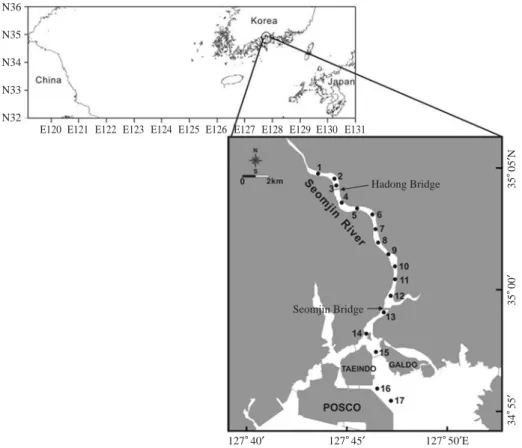
2, covering southeastern Jeollabuk-do as well as eastern Jeollanam-do and western Gyeongsangnam-do provinces. Water depth in the estuary averages at 7~8 m. Average annual rainfall is 1,253 mm, with over 70% falling in summer. Tides affects to about 18 km in the upper stream from the mouth of the Seomjin River estuary. The sampling stations are showed in Fig. 1.
2. Sampling methods
The field survey was conducted August 9
th2006. All copepods were deep horizontally towed near bottom at the speed of 2 knots from 17 stations during flood and ebb tides along a gradient salinity using a NORPAC net (mesh size 200 μm; mouth diameter 45 cm) during 5 minutes. Distance between each station was about 1 km. Sampling was over within 3 hours starting at each high and low tide using a high speed boat. Water temperature and salinity were measured by 600 MKIII CTD (UK, Valeport) and ACL 1150- DK (Japan, Alec co.).
Fig. 1. Map of the sampling stations in the Seomjin River estuary, Korea.
N36 N35 N34 N33 N32
E120 E121 E122 E123 E124 E125 E126 E127 E128 E129 E130 E131
Hadong Bridge
Seomjin Bridge
127�40′ 127�45′ 127�50′E
35 � 05 ′N 35 � 00 ′ 34 � 55 ′
Abundance of copepods were estimated from rotations of a flow meter (General Oceanics co.) attached to the net mouth. After samples were immediately preserved in a 5%
neutralized formalin and estuarine water solution, copepods were identified at a species level and counted using light stereomicroscopes (Nikon) according to their identification characteristics. According to Ekman’s classification system (Day et al. 1989), there are three salinity divisions in the estuarine zone; oligohaline salinity (0~5.0), mesohaline salinity (¤5.0~18.0), and polyhaline salinity (¤18.0).
Rainfall data from the study area were provided by the meteorological agency (http://www.kma.go.kr/).
3. Statistical analysis
For correlation to detect any significant density differences among the stations at specific tides, and between high tide and low tides, ANOVA and student’s t-test analysis were carried out using SPSS (Version 12). Data were log (X + + 1)- transformed for the statistical analyses. The density of cope- pods was calculated by ind.m
-3.
RESULTS
1. Tides and salinity
Salinity was in the range of 0.1 to 29.3 for the 17 stations.
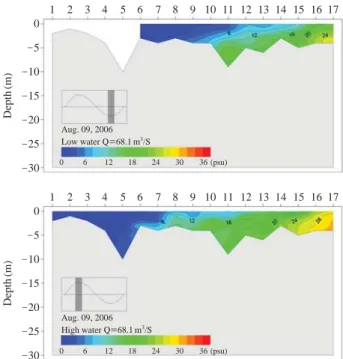
Salinity of less than 1.0 was found in the upper stream beyond station 5 in high tide, while being noted as far back as station 9 in low tide. Salinity of more than 18.0 was found down- stream of station 11 in high tide, reducing to 16.0 in low tide (Fig. 2). In particular, salinity fluctuated strongly during high tide and followed the same pattern in low tide.
At both high and low tides, copepod abundance was high at salinity of 20.0~23.0 and low at salinity of ⁄2.0.
2. Copepod populations and their density
In total, ten copepods were recorded from the Seomjin River estuary. Among them the major copepods were Tor- tanus dextrilobatus, Pseudodiaptomus koreanus, Acartia ohtsukai, Sinocalanus tenellus and Paracalanus parvus s.
l., while other minor copepods taxa were Calanus sinicus, Acartia forticrusa, Centropages dorsispinatus, and Labi-
docera rotunda.
Copepod movement patterns were affected by salinity ranges in estuary zones and their highest density was shown to be polyhaline, which migrated gradually from mesohaline to oligohaline zones. The highest density was observed in mesohaline zone at high tide, while in contrast the lowest density was observed in mesohaline zone at low tide (Fig. 3).
The density of oligohaline species (Pseudodiaptomus koreanus, Tortanus dextrilobatus, and Sinocalanus tenellus) was high in the low salinity estuarine zone during flood/low tides. However, the density of Tortanus dextrilobatus was Fig. 2. Salinity ranges of in (a) low tide (upper) and (b) high tide
(lower) of the Seomjin River estuary.
Fig. 3. Abundance of copepods (ind.m
-3) in high and low tides according to salinity divisions; e.g. Oligohaline (⁄5), Meso- haline (5~18) and Polyhaline (¤18).
Depth (m) Depth (m)
0 -5 -10 -15 -20 -25 -30
0 -5 -10 -15 -20 -25 -30
1 2 3 4 5 6 7 8 9 10 11 12 13 14 15 16 17
1 2 3 4 5 6 7 8 9 10 11 12 13 14 15 16 17
Aug. 09, 2006Low water Q==68.1 m3/S
Aug. 09, 2006 High water Q==68.1 m3/S
0 6 12 18 24 30 36 (psu)
0 6 12 18 24 30 36 (psu)
Abundance (ind.m
-3) 12000 10000 8000 6000 4000 2000
0 Oligohaline Mesohaline Polyhaline
High tideLow tide
high at ebb/high tides in the mesohaline zone. Although oli- gohaline copepods varied highly in density within different salinity zones and sampling locations, their density was widely distributed during ebb tides. During both tides, the densities of Pseudodiaptomus koreanus, Tortanus dextri- lobatus, and Sinocalanus tenellus were highest in low salinity areas, followed by high salinity areas. However, the density of a few Pseudodiaptomus koreanus was somewhat higher in polyhaline zones which indicated that it is a highly diver- sified and retentive species. Tortanus dextrilobatus and Sino- calanus tenellus density was highest in oligohaline and meso- haline areas. Low density was also estimated in polyhaline zones (Figs. 4 and 5). The density of mesohaline species (Acartia ohtsukai and Acartia forticrusa) was usually high at the mesohaline zones. The density of Acartia ohtsukai was also found to be highest in the polyhaline and mesohaline areas, but the density of Acartia forticrusa was zero at poly- haline while few copepods were found in the oligohaline zone. They are widely distributed in the mesohaline zone (Figs. 4 and 5).
The densities of polyhaline species (Calanus sinicus, Para- calanus parvus s. l., Labidocera rotunda and Centropages dorsipinatus) were high in polyhaline areas while low in oligohaline areas during low tide (Fig. 4). During high tide, the density of Calanus sinicus, Paracalanus parvus s. l and Labidocera rotunda were highest in the polyhaline region, but the density of Centropages dorsispinatus was highest in the mesohaline region. This group of copepods were not observed in the oligohaline division but occasionally a few of them were found in this salinity range because of environ- mental factors (Figs. 4 and 5).
Overall copepod density varied between low and high tides with salinity; in high tide, the highest density was observed at mesohaline station 13 (5,113 ind.m
-3) and the lowest was observed at oligohaline station 3 (56 ind.m
-3) (Fig. 4a). On the other hand, at low tide the highest density of copepods was at polyhaline station 16 (2,457 ind.m
-3) and the lowest was at oligohaline station 8 (85 ind.m
-3) (Fig.
4b). The present result showed significant difference in den- sity with different tides (p⁄0.05).
On the other hand, in high tide Pseudodiaptomus koreanus, Tortanus dextrilobatus, Paracalanus parvus s. l. showed significant difference in their densities between stations (p⁄
0.05), while Acartia ohtsukai was insignificant (p¤0.05).
In low tide, Pseudodiaptomus koreanus, Tortanus dextri- lobatus, Acartia ohtsukai, Paracalanus parvus s. l. were gradually dominant along high salinity gradient, but only Pseudodiaptomus koreanus and Tortanus dextrilobatus showed significant difference in their densities among stations (p⁄0.05).
DISCUSSION
Estuarine copepods were well distributed and migrated from changing salinities in different stations. In the Seomjin River estuary, copepods display species-specific responses during high and low tides and copepods change in a parti- cular habitat salinity zone caused by tide and salinity. Gene- rally, estuarine copepods were dominant in their most favo- rable salinity zone, but they had to move to other salinity zones because of changing ecological processes. Despite of this fact, they are able to retain their density through hori- zontal or vertical migration strategies. Copepod populations Fig. 4. Variation of copepods abundance (ind.m
-3) at difference
sampling stations in, (a) high tide/flood and (b) low tide/ebb of the Seomjin River estuary.
Abundance (1000 ind.m
-3) Abundance (1000 ind.m
-3) 6
4
2
0
3
2
1
0
1 3 5 7 9 11 13 15 16 17
6 7 8 9 10 11 12 13 14 15 16 17
Stations
OligohalineOligohaline
Mesohaline
Mesohaline
Polyhaline
Polyhaline