ABSTRACT
Technology transfer from a multinational company to a local subsidiary is essential for successful local market operations. This study aims to analyze the impact of market, cultural and institutional environmental factors on international technology transfer and innovation performance based on the S-C-P paradigm. We collected data from one hundred ninety-five subsidiaries of Korean parent firms located in seventeen countries and used structural equation modeling to test hypotheses. The analysis findings are as follow; First, both market and cultural environment directly affect international technology transfer. However, institutional environment such as protection of intellectual property does not affect international technology transfer. Due to the less risk of technology disclosure involved in technology transfer within the MNE organization can be not relationship between protection of intellectual property in the host country and the foreign subsidiary’s transfer of technology. The risk of infringement of intellectual property is relatively low in intra-firm transfer of technology. Second, the technology introduced from the parent company has a positive effect on the innovation performance of local subsidiaries. This implies that multinational companies that have entered unfamiliar overseas markets should be able to effectively transfer the inherent advantages of the parent company to their overseas subsidiaries, and that their ability to adapt to the local environment is important.
Keywords: S-C-P paradigm, International technology transfer, External environmental factors, Innovation performance, Knowledge management
The Influence of External Environmental Factors on Technology Transfer between Foreign MNCs and
Local Subsidiaries: Based on SCP Paradigm
1해외자회사 환경요인이 국제기술이전 및 혁신성과에 미치는 영향 : S-C-P 패러다임 관점에서
1) 이 논문은 2015학년도 대구대학교 학술연구비 지원에 의한 논문임.
논문접수일: 2019년 2월 26일; 1차 수정: 2019년 3월 15일; 게재확정일: 2019년 3월 18일 2) 제 1저자 ([email protected])
대구대학교 경상대학 무역학과2
정 재 휘 (Jaehwi Jeong)
1. Introduction
Firms entering international markets should not only overcome but also adapt to the changes in global market environment to compete successfully in their global markets. Particularly, by transferring firm-specific technology to their foreign subsidiaries, they can gain competitive advantages in their foreign markets. They have to enable their subsidiaries to stabilize and make effective use of production systems, develop new products, and obtain quality standard in their local markets. However, transferring technology from the parent to the subsidiary is not easy and automatic process, faced with various barriers even in intra-organizational transfer. Parent firms should be involved in the transfer process actively and assist the subsidiaries to learn from them effectively. A successful technology transfer within organizational units of multinational enterprises (MNEs) has become a central issue to maintaining sustainable competitive advantages (Bartlett and Goshal 1989). Thus, the study of international technology transfer have been considered to be one of the key areas of academic research in international business. Previous studies have classified international technology transfer as inter-firm and intra-firm technology transfer. Inter-firm technology transfer refers to cases in which technologies are transferred to
international joint ventures or strategic alliance partner, while intra-firm technology transfer means that technology is transferred internally within their organization, for example, from the parent to the subsidiary. Most previous studies on international technology transfer have attempted to identify factors affecting technology transfer performance. They have relied on a particular theoretical paradigm and a certain group of variables associated with the paradigm.
There are very few, if any, studies focusing on process of international technology transfer and using theoretical paradigm integrating existing theories. Recently, Parent et al. (2007) and Wang et al. (2004) attempted to show the process of international technology transfer by developing conceptual frameworks; however, they did not test the process empirically.
In order to overcome the research gap of previous research, our study set two research objectives. First, Most of previous researches tends to concentrate on knowledge transfer among companies such as IJV (Inter-firm transfer).
based on these research gap, Our study focus on the technology transfer between the headquarters of multinational corporations and overseas subsidiaries (Intra firm transfer). Second, we examine the effects of environmental factors on international technology transfer and innovation performance based on the S-C-P paradigm of
industrial organization theory.
2. Literature Review
2.1 Industrial Organizational Theory: S-C-P Paradigm
The studies based on industrial organizational theory have focused on characteristics of host country or environment as variables to affect international technology transfer; market potential (Grosse 1996; Cui et al. 2006), protection of intellectual property (Tsang 2002; McCalman 2004), cultural distance (Davidson and McFetridge 1985; Cui et al. 2006). Cui et al. (2006) examined the environmental factors affecting international technology transfer based on the S-C-P paradigm.
According to these studies, the dynamics of local markets increase the technology adoption of foreign subsidiaries. In addition, organizational culture similarity between parent company and subsidiary serves as a factor to promote technology transfer. The organizational culture difference between parent company and overseas subsidiaries hinders mutual reciprocal cooperation among the organization members. Fabry and Zeghni (2003) argue that the differences in organizational culture lead to inter-organizational conflicts and misunderstandings. These conflicts and misunderstandings hinder the exchange of
information, making it difficult to communicate internally to new information. In order to secure a sustainable competitive advantage, it is necessary for competitors to acquire and retain irreplaceable resources and capabilities (Barney 1991). Therefore, in terms of protecting these core competencies, the degree of intellectual property rights in the local market is a very important environmental factor. In order to reduce the risk of technology imitation and leakage, technology providers should internalize the market through foreign direct investment rather than technology transfer of market trading method (Tsang 2002).
Some studies (Davidson and McFetridge 1985;
Simonin 1999a) have examined the determinants of technology transfer, paying attention to national characteristics and explaining the relationship between market uncertainty and international technology transfer. In these studies, the differences in geographical distance and culture, language, laws, and institutions between home and host countries increase uncertainty about the local market. This uncertainty is a factor that inhibits the entry of MNCs into overseas markets and technology transfer.
2.2 International Technology Transfer International technology transfer has been classified into two types, namely inter-firm and intra-firm transfer on the basis of characteristics
of technology receivers. Inter-firm technology transfer refers to cases in which technologies are transferred to international joint ventures or strategic alliance partner, while intra-firm technology transfer means that technology is transferred internally within their organization, for example, from the parent to the subsidiary. This study focuses on intra-firm technology transfer.
Through literature review shown in <Table 1>, this research can identify some trends in the past research on international technology transfer.
First, most research on international technology transfer has discussed two types of knowledge,
technological knowledge as well as non- technological knowledge such as management practices, marketing or innovation know- hows. The research focusing on technological knowledge transfer has dealt with the technology of products development skill, manufacturing process and production technology (e.g., Lin 2003; Park and Ghauri 2011; Simonin 2004). On the other hand, more literature has focused on the issue of knowledge transfer that includes both technological knowledge and non-technological knowledge such as marketing, business administration and advice about quality control.
<Table 1> Classification of literature by knowledge type and unit of analysis
Study Knowledge type
Unit of analysis Sample
Technology Knowledge
Bresman et al. (1999) ■ Sweden
(entered) MNE’s subsidiaries 42
Cui et al. (2006) ■ Croatian
(entered) MNE’s subsidiaries 131
Gupta & Govindarajan (2000) ■ U.S. Europe,
Japan (HQ) MNE’s subsidiaries 374
Minbaeva et al. (2003) ■ U.S. Europe,
Japan (HQ) MNE’s subsidiaries 169
Minbaeva and Michailova (2004) ■ Denmark
(HQ) MNE’s subsidiaries 92
Noorderhaven and Harzing (2009) ■ U.S. Europe,
Japan (HQ) MNE’s subsidiaries 169
Park (2011) ■ Korea
(entered) IJV 127
Park and Ghauri (2011) ■ Korea
(entered) IJV 106
Grosse (1996) ■ South America
(entered) IJV 73
Lyles and Salk (1996) ■ Hungary
(entered) IJV 78
Lane et al. (2001) ■ Hungary
(entered) IJV 201
Tsang (2002) ■
Singapore, HongKong
(entered)
IJV 162
Dhanaraj et al. (2004) ■ Hungary
(entered) IJV 140
Thuc Anh et al. (2006) ■ Vietnam
(entered) IJV 173
Perez-Nordtvedt et al.
(2008) ■ U.S
(entered) IJV 102
Park et al. (2012) ■ Korea
(entered) IJV 326
Minbaeva et al. (2013) ■ Korea
(entered) IJV 199
Simonin (1999a) ■ U.S Strategic alliance firms 147
Simonin (2004) ■ U.S Strategic alliance firms 147
Lin (2003) ■ Taiwan Strategic alliance firms 84
Lin (2007) ■ Taiwan Strategic alliance firms 109
Kotabe et al. (2003) ■ U.S, Japan Strategic alliance firms 202
Kotabe et al. (2007) ■ U.S Strategic alliance firms Secondary Data
Simonin (1999b) ■ U.S Strategic alliance firms 151
Second, previous studies that have focused on technology transfer between parent firms and subsidiaries (Gupta and Govindarajan 20 0 0; M i nbaeva a nd M icha i lova 20 0 4;
Noorderhaven and Harzing 2009) were mainly based on developed countries such as U.S, Japan, Europe and studied the topic in the view of technology outflow. On the other hand, some research studying technology transfer between international joint venture partners (e.g., Dhanaraj et al. 2004; Lane et al. 2001; Park and Ghauri 2011) was based on emerging markets, China, Korea, Vietnam etc., and approached the issue in the view of technology inflow. Third, past studies have used two types of measures of technology
transfer performance. The first type measures quantitative performance by using amount of technology acquired from supplier (e.g., Gupta and Govindarajan 2000; Minbaeva 2007). For example, Gupta and Govindarajan (2000) used seven items such as marketing know-how, distribution know-how, packaging and design technology, product design, process design, purchasing know-how, management control to measure the performance of technology transfer.
Second type focuses on qualitative performance such as understanding transferred knowledge and information or contribution to improvement of performance (Lin 2003; Szulanski 1996;
Zahra et al. 2000). For example, Szulanski
(1996) measured the performance of technology transfer by the speed of technology transfer and degree of satisfaction of the recipient. Zahra et al. (2000) measured the performance of learning by the amount of technology transfer, degree of understanding about transferred technology, and speed of technology transfer.
3. Research Model and Hypothesis
3.1 Research Model
The purpose of this study is to propose a process-oriented research model that can comprehensively explain how the environmental factors (market, culture, institution) affecting
the international technology transfer affect the innovation performance of MNCs. The external environmental factors are not controllable by the enterprises, and from the viewpoint of industrial organization, they provide a policy environment that determines the competitiveness of the enterprises (Hsu and Fang 2009).The investment of multinational corporations makes the transfer of technical knowledge essential. Environmental factors such as market potential and intensity of competition affect the investment and technology transfer of multinational corporations. <Fig.
1> presents the proposed research model. The research model depicts the influence of three factors of environmental factors. (1) market potential, and (2) compatible organizational
<Figure 1> Research Model
culture, and (3) protection of intellectual properties on international technology transfer and innovation performance under the structure- conduct-performance framework advanced by Cui et al. (2006). In the S-C-P framework, conduct refers to the strategy undertaken by companies in the industry. Technology transfer is a fundamental strategic option employed by MNCs and technology transfer to successful foreign subsidiaries has a direct impact on the innovation performance of MNCs. Figure 1 shows the research model of the above discussion.
3.2 Hypothesis 3.2.1. Market Potential
market potential of foreign market can generally achieve high profitability and economies of scale, so it is important to secure first mover status in foreign markets through rapid entry into markets with high market potentials (Caves and Mehra 1986; Sabi 1988). In addition, the overseas market, which has a high market potential, has a high strategic importance for the parent company.
Therefore, it will actively transfer the technology to the subsidiary so that overseas subsidiaries can quickly secure competitiveness. In other words, the high potential of the local market provides the motivation to transfer technology quickly and effectively from the perspective of the parent company. If the potential of the local
market is high, the local subsidiaries will also need to introduce new technologies from their parent companies in order to secure a competitive position in the market as soon as possible. Market potential of host country was found to motivate parent firm and foreign subsidiaries in technology transfer (Grosse 1996). Technology transfer is more important in a highly growth market, where increasing customer demands require firms to continuously modify products and adjust operation (Wang et al. 2006). Thus, I can develop the following hypothesis:
Hypothesis 1: Market potential in the market environment is positively related to technology transfer between foreign MNC and local subsidiaries.
3.2.2. Compatible organizational culture Differences in organizational culture between parent company and local subsidiaries can cause conflicts and misunderstandings, and these conflicts and misunderstandings are important factors that interfere with information exchange and communication. In addition, if there are procedures and norms similar to those of local subsidiaries, the parent company can transfer the technology more effectively based on this reciprocal learning environment. Cui et al.
(2006) suggested that the greater the cultural distance between the parent company and the local subsidiaries, the less the introduction of
internal technology. Difference of organizational culture between parent firm and its foreign subsidiaries becomes the cause of conflict and misunderstanding. It can cause interruption of information exchange and communication.
Simonin (1999a) argued that organizational dissimilarities increased ambiguity and decreased transferability of knowledge. Also, Lane and Lubatkin (1998) suggested that a successful knowledge transfer be derived from the compatibility of organizational culture between organizational units. So, I can assume that similarity in organizational culture positively affects both parent firm’s disseminative capacity and absorptive capacity of its foreign subsidiary.
Based on this discussion, we can hypothesize:
Hypothesis 2: Compatible organizational culture in the cultural environment is positively related to technology transfer between foreign MNC and local subsidiaries.
3.2.3. Institutional Environment
Market uncertainty stems from country risk, demand variation in market, government regulation, frequent policy changes, and infringement of intellectual property rights.
Particularly, protection of intellectual property rights is very important factor in technology transfer (McCalman 2004). In the case of critical technologies that play a key role in the operation
of the company, there is a stronger tendency to choose the way of transferring internal technology (Davidson and McFetridge 1985). The results of this study show that in a well-established market, the introduction of new technologies and the motivation for learning will have a positive impact on the transfer of technology from the parent company. This research assume that the protection of intellectual property rights of host country will increase foreign subsidiary’s motivation of learning external new technology and adapting it to local environment. Based on this discussion, I can hypothesize
Hypothesis 3: Protection of intellectual properties in the institutional environment is positively related to technology transfer between foreign MNC and local subsidiaries.
3.2.4. International Technology Transfer Technology transfer performance depends on local adaptation and availability of technology at the head office (Van Wijk et al. 2008). The technological innovation of a local subsidiary is to utilize the technical knowledge transferred from the MNCs HQ in accordance with local characteristics, thereby enhancing the quality competitiveness or improving existing products (Guan et al. 2006). Strengthening the competitive environment of products requires creation of new customer value. The production and supply
of competitive products ultimately depends on the technological innovation of the multinational company (Garcia-Morales et al. 2007). However, technological innovation is difficult because the technology knowledge from the MNCs HQ is distributed in various structural elements (Van Wijk et al. 2008).For example, they are located within a mix of human resources or the tangible knowledge they possess or the specificity of their technical equipment, and the various elements of these various factors. Moreover, if the implicit form of knowledge is customary in ordinary job, transferring to a local subsidiary is more difficult.
In the process of transferring technology from the MNC HQ, absorbing the technical knowledge inherent in various factors and leaving it as an achievement can enhance the capability of developing new products (Kim and Inkpen 2005).
Based on this discussion, I can hypothesize
Hypothesis 4: International technology transfer between foreign MNC and local subsidiaries is positively related to innovation performance of local subsidiaries.
4. Research Method
4.1 Sample and Data Collection
The purpose of this study is to identify determinants of technology transfer performance from the parent firm to its subsidiaries in a Korean case. Thus, this study used Korean MNEs having headquarters in Korea and established subsidiaries in overseas. The sample frame consisted of firms listed in the Directory of Korean Firms Going International published
<Table 2> Sample characteristics
Country Number (%) Country Number (%)
Host country
China 93 47.7%
Industry
Textile 46 23.6%
Vietnam 60 30.8% Electricity and electronics 46 23.6%
Indonesia 12 6.2% Parts of automobile 27 13.8%
U.S 6 3.1% Machine and equipment 26 13.3%
Mexico 4 2.1% Chemicals 20 10.3%
India 3 1.5% Groceries 6 3.1%
Slovakia 3 1.5% Paper manufactures 6 3.1%
Russia 2 1.0% Household products 5 2.6%
Thailand 2 1.0% Furniture manufactures 4 2.1%
Turkey 2 1.0% Shipbuilding 1 0.5%
Poland 2 1.0% Steel and metal 1 0.5%
Malaysia 2 1.0% Etc 7 3.6%
Etc 5 2.6% Total 195 100%
Total 195 100%
by the Korean Trade Investment Promotion Agency (KOTRA). The study used a survey which focused on managers of foreign subsidiaries of Korean manufacturing MNEs. Our final sampling population contained 1,121 foreign subsidiaries.
I received 210 responses as a response rate of 17.3 percent. 15 responses were unusable due to missing data. After removing unusable responses, 195 questionnaires were retained for our analysis.
Table 3 presents profiles of foreign subsidiaries in our sample.
4.2 Measures
This paper classifies international technology transfer into two categories: quantitative and qualitative transfer. Quantitative transfer measures the extent to which foreign subsidiary acquire technology from its parent firm (Kotabe et al. 2007; Park and Ghauri 2011). Technology included product and manufacturing technologies.
Qualitative transfer measures the degree of successful transfer of technology from the parent firm, which includes the degree of understand and utilization of transferred technology, and the extent of its contribution to performance (i.e.
improvement of productivity, quality, and new product development) (Szulanski 1996; Perez- Nordtvedt et al. 2008). Innovation performance though the international technology transfers were measured as the degree to which the received
technology (1) contributed to the productivity improvement, (2) the contribution to the quality improvement, and (3) the contribution to the product development and improvements (Guan et al. 2006; Garcia-Morales et al. 2007; Hsu and Fang 2009). Market potential of host country was measured by two items indicating (1) market size (potential) and (2) potential of growth (Agarwal and Ramaswami 1992). Protection of intellectual proper ties was measured by three item indicating the degree of (1) institutional policy, (2) government restriction against infringement of intellectual properties, (3)protection of intellectual properties in market (Reddy and Zhao 1990).
Compatible organizational culture was measured by three items indicating the degree of similarity in (1) organizational culture, (2) management style, (3) process of decision-making (Simonin 1999b; Katsikeas et al. 2009).
5. Results
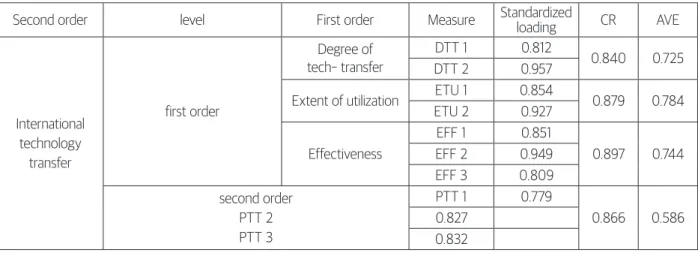
5.1 Reliability and validity of Measures This research ran a confirmatory factor analysis (CFA) to assess reliability and validity of measures and the final results after a measurement purification process are shown in Table 3 and 4.
Five measures were dropped because of their low standardized loading on the constructs. The
CFA results for the first-order factors indicate an acceptable fit (χ2(21)=27.584(p=0.152), GFI=0.970, NFI=0.979, TLI=0.991, CFI=0.995, RMSEA=0.040).
Also, the CFA results for second-order factors indicate that the measurement model shows a good fit ((χ2(11)=34.082(p<0.001), GFI=0.957, NFI=0.966, TLI=0.954, CFI=0.976).
The most of fitness indexes such as GFI, NFI, CFI, and RMSEA show the indexes have a good fit to the model. The results in Table 3 and 4 show that all standardized loading are significant (p<0.001) and greater than 0.7, which indicates the measures achieve adequate levels of convergent validities (Bagozzi and Yi 1988). This research calculated composite reliabilities (CR) to assess the reliability of each construct. All CR values presented in Table 3 and 4 are greater than 0.7,
and AVE exceed 0.5 which means all measures achieve reliabilities.
5.2 Non-response and common method bias check
This research compared early and late respondents in ter ms of orga nizat iona l characteristics (subsidiary’s size and age, parent firm’s degree of internationalization, and etc.) to test non-response bias and observed no significant differences. This suggests that non-response bias does not exist. A risk of common method variance may exist because this research asked respondents to subjectively assess variables by their perceptual judgments (Chang et al. 2010). To address this issue, This research, first, conducted a Harman’s Sing-factor analysis, where common
<Table 3> CFA results of the first-order factors
Construct Measure Standardized loading CR AVE
Market potential MKP 1 0.988
0.828 0.662
MKP 2 0.722
Compatible organizational culture COC 1 0.919
0.914 0.752
COC 2 0.947
Protection of intellectual properties PIP 1 0.963
0.951 0.807
PIP 2 0.945
Innovation performance
IPF 1 0.892
0.851 0.671
IPF 2 0.850
IPF 4 0.813
χ2(21)=27.584(p=0.152), GFI=0.970, AGFI=0.936, NFI=0.979, TLI=0.991, CFI=0.995, RMSEA=0.040 All standardized loadings are significant at p<0.001
method variance was indicated by the emergence of a single factor that accounts for a large portion of the variance in factor analysis. However, no such single factor emerged. The first factor accounted for 34.4 percent of total variances.
Second, I followed a procedure recommended by Cote and Buckley (1987). Thus, I can conclude that the common method variance is not a significant problem in our analysis.
5.3 Results of structural equation modeling
Table 5 shows the standardized estimates of coefficients of hypothesized paths as a result of the structural equation modeling. The model’s goodness of fit indices are χ2(50)=87.144(p=0.001), χ2/DF=1.743, GFI=0.928, NFI=0.946, IFI=0.976,
TLI=0.968, CFI=0.976, RMSEA=0.062, which indicate the model achieve a good fit.
As shown in Table 5, Hypothesis 1 was supported (0.234, p <0.05) as market potential positively affected international technology transfer. And compatible organizational culture (0.256, p <0.005) positively affects international technology transfer. However, protection intellectual properties and international technology transfer is found not to be significant (0.031, p>0.05). Thus, hypothesis 1 and 2 is supported, but hypothesis 3 is not supported.
Finally, International technology transfer positively affects innovation performance of local subsidiaries (0.522, p <0.001), suggesting hypothesis 4 was supported.
<Table 4> CFA results of the second-order factors
Second order level First order Measure Standardized
loading CR AVE
International technology
transfer
first order
Degree of tech- transfer
DTT 1 0.812
0.840 0.725
DTT 2 0.957
Extent of utilization ETU 1 0.854
0.879 0.784
ETU 2 0.927
Effectiveness
EFF 1 0.851
0.897 0.744
EFF 2 0.949
EFF 3 0.809
second order PTT 2 PTT 3
PTT 1 0.779
0.866 0.586 0.827
0.832 χ2(11)=34.082(p=0.001), GFI=0.957, AGFI=0.889, NFI=0.966, TLI=0.954, CFI=0.976
All standardized loadings are significant at p<0.001
6. Discussion and conclusion
This research aims to identify factors that influence performance of international technology transfer under the S-C-P paradigm advanced by Cui et al. (2006). This study explains the process of technology transfer between the parent firm and local subsidiaries. This research tested the hypotheses by using 195 foreign subsidiaries of Korean MNEs as a sample and obtained the following results. First, Market potential, Compatible organizational and protection of intellectual properties of the host country positively influences international technology transfer.
First, Market potential of the host country and compatible organizational between HQ and local subsidiaries positively influences international technology transfer. However, protection of intellectual property does not affect international technology transfer. Due to the less risk of technology disclosure involved in technology
transfer within the MNE organization there can be no relationship between protection of intellectual property in the host country and the foreign subsidiary’s transfer of technology. The risk of infringement of intellectual property is relatively low in intra-firm transfer of technology.
Second, International technology transfer positively affects innovation performance of local subsidiaries. This study contributes to the existing literature on international technology transfer on the following grounds. First, this research provides a theoretical framework which can explain a whole process of international technology transfer from the parent firm to its foreign subsidiary based on environmental factors under the advanced S-C-P paradigm by Cui et al.
(2006). Second, this study attempts to identify the determinants of technology transfer in the view of technology outflow in Korea MNEs, which are a successful example of emerging market MNEs.
Most previous studies have focused on technology transfer between IJVs or strategic alliance partners
<Table 5>. Results of structural equation modeling
Hypothesis Path Standardized
Path coefficient p
H 1 Market potential → International technology transfer 0.234* 0.050 Supported H 2 Compatible organizational culture → International technology transfer 0.256** 0.005 Supported H 3 Protection intellectual properties → International technology transfer 0.031 0.841 Not Supported H 4 International technology transfer → Innovation performance 0.522*** 0.001 Supported χ2(50)=87.144(p=0.001), χ2/DF=1.743, GFI=0.928, NFI=0.946, IFI=0.976, TLI=0.968, CFI=0.976, RMSEA=0.062
***p<0.001, **p<0.01, *p<0.05, †p<0.1, two tailed-test
or in developed countries such as USA, Japan, or European countries.
There are some limitations in this study.
First, the data are collected from the foreign subsidiaries. Because the performance of international technology transfer is also affected by characteristics of parent firms and relationship between the two entities, the data should be also gathered from the parent firm to draw the whole picture of technology transfer process more accurately. However, it is very hard in reality to gather all the data from both parent firm and its subsidiaries. So, I did a survey to expatriate managers who have previous experience of working in the parent firm before dispatching to the foreign subsidiaries. Second, this study used Korean MNEs in various industries as a sample.
This research attempted to control industry characteristics by including industry type (capital- intensive versus labor-intensive industry) as a controlling variable. However, I cannot make sure full reflection of differences among industries in the analysis. I hope to all these limitations will be overcome in the future research on this topic.
Reference
[국내 문헌]
1. 이지원, 강인원, 박경신 2013, “다국적기업 네트워 크내 관계활동이 지식이전 및 자회사 성과에 미치 는 영향,” 지식경영연구 (14:3), pp. 1-13.
2. 신건철, 이지원, 강인원 2011. “다국적기업 R&D
센터의 지식이전과 혁신성과에 관한 연구,” 지식
경영연구 (12:1), pp. 111-121.
[국외 문헌]
1. Agarwal, S., and Ramaswami, S. N. 1992.
“Choice of foreign market entry mode: Impact of ownership, location and internalization factors,” Journal of International business studies (23:1), pp. 1-27.
2. Bagozzi, R., and Yi, Y. 1998. “On the evaluation of structural equation models,”
Journal of the Academy of Marketing Science (16:1), pp. 74-94.
3. Bartlett, C., and Ghoshal, S. 1986. “Tap your subsidiaries for global reach,” Harvard business review (64:6), pp. 87-94.
4. Björkman, I., Barner-Rasmussen, W., and Li, L. 2004. “Managing knowledge transfer in MNCs: the impact of headquarters control mechanisms,” Journal of International Business Studies (35:5), pp. 443-455.
5. Bresman, H., Birkinshaw, J., and Nobel, R.
1999. “Knowledge transfer in international
acquisitions,” Journal of international business studies (30:3), pp. 439-462.
6. Chang, S. J., van Witteloostujin, A., and Eden, L. 2010. “From the Editors: Common method variance in international business research,”
Journal of International Business Studies (41:2), pp. 178-184.
7. Cote, J. A., and Buckley, M. R . 1987.
“Estimating trait, method, and error variance:
Generalizing across 70 construct validation studies,” Journal of Marketing Research (24:3), pp. 315-318.
8. Cui, A. S., Griffith, D. A., Cavusgil, S. T., and Dabic, M. 2006. “The influence of market and cultural environmental factors on technology transfer between foreign MNCs and local subsidiaries: a Croatian illustration,” Journal of World Business (41:2), pp. 100-111.
9. Dhanaraj, C., Lyles, M. A., Steensma, H. K., and Tihanyi, L. 2004. “Managing tacit and explicit knowledge transfer in IJVs: the role of relational embeddedness and the impact on performance,” Journal of International Business Studies (35:5), pp. 428-442.
10. Frost, T. S., Birkinshaw, J. M., and Ensign, P. C.
2002. “Centers of excellence in multinational corporations,” Strategic Management Journal (23:11), pp. 997-1018.
11. Flatten, T. C., Engelen, A., Zahra, S. A., and Brettel, M. 2011. “A measure of absorptive
capacity: Scale development and validation,”
European Management Journal (29:2), pp.
98-116.
12. Govindarajan, V. 1988. “A contingency approach to strategy implementation at the business-unit level: integrating administrative mechanisms with strategy,” Academy of Management Journal (31:4), pp. 828-853.
13. Grosse, R. 1996. “International technology transfer in services,” Journal of International Business Studies (27:4), pp. 781-800.
14. Gupta, A. K., and Govindarajan, V. 2000.
“Knowledge f lows within multinational corporations,” Strategic Management Journal (21:4), pp. 473-496.
15. Hair, J. F., Anderson, R. E., Tahtam, R. L., and Black, W. C. 1998. Multivariate Data Analysis (5th ed.), Prentice-Hall, pp. 654-667.
16. H a m e l , G . 1 9 9 1 . “ C o m p e t i t i o n fo r competence and inter partner learning within international strategic alliances,” Strategic Management Journal (12:S1), pp. 83-103.
17. Inkpen, A. C., and Dinur, A. 1998. “Knowledge management processes and international joint ventures,” Organization Science (9:4), pp. 454-468.
18. Kale, P., Singh, H., and Perlmutter, H. 2000.
“Learning and protection of proprietary assets in strategic alliances: building relational capital,” Strategic Management
Journal (21:1), pp. 83-103.
19. Katsikeas, C. S., Skarmeas, D., and Bello, D.
C. 2009. “Developing successful trust-based international exchange relationship,” Journal of International Business Studies (40:2), pp.
132-208.
20. Kogut, B., and Zander, U. 1995. “Knowledge, market failure and the multinational enterprise: A reply,” Journal of International Business Studies (26:2), pp. 417-426.
21. Kotabe, M., Martin, X., and Domoto, H.
2003. “Gaining from vertical partnerships:
knowledge transfer, relationship duration, and supplier performance improvement in the US and Japanese automotive industries,”
Strategic Management Journal (24:4), pp.
293-316.
22. Kotabe, M., Dunlap-Hinkler, D., Parente, R., and Mishra, H. A. 2007. “Determinants of cross-national knowledge transfer and its effect on firm innovation,” Journal of International Business Studies (38:2), pp.
259-282.
23. Lane, P. J., Salk, J. E., and Lyles, M. A.
2001. “Absorptive capacity, learning, and performance in international joint ventures,”
Strategic Management Journal (22:12), pp.
1139-1161.
24. Lane, P. J., Koka, B. R., and Pathak, S. 2006.
“The reification of absorptive capacity:
a critical review and rejuvenation of the construct,” Academy of Management Review (31:4), pp. 833-863.
25. Lin, B. W. 2003. “Technology transfer as technological learning: a source of competitive advantage for firms with limited R&D resources,” R&D Management (33:3), pp. 327-341.
26. Lin, W. B. 2007. “Factors affecting the correlation between interactive mechanism of strategic alliance and technological knowledge transfer performance,” The Journal of High Technology Management Research (17:2), pp. 139-155.
27. Lyles, M. A., and Salk, J. E. 1996. “Knowledge acqu isit ion f rom foreig n pa rents in international joint ventures: An empirical examination in the Hungarian context,”
Journal of International Business Studies (27:5), pp. 877-903.
28. Ma r t i n , X . , a nd Sa lomon , R . 2 0 03 .
“ K n ow le d ge t r a n s fe r c a p a c it y a n d its implications for the theory of the multinational corporation,” Journal of International Business Studies (34:4), pp.
356-373.
29. McCalman, P. 2004. “Foreign direct investment and intellectual property rights: evidence from Hollywood’s global distribution of movies and videos,” Journal
of International Economics (62:1), pp. 107- 123.
30. Noorderhaven, N., and Harzing, A. W. 2009.
“Knowledge-sharing and social interaction within MNEs,” Journal of International Business Studies (40:5), pp. 719-741.
31. Parent, R., Roy, M., and St-Jacques, D. 2007. “A systems-based dynamic knowledge transfer capacity model,” Journal of Knowledge Management (11:6), pp. 81-93.
32. Pérez-Nordtvedt, L., Kedia, B. L., Datta, D.
K., and Rasheed, A. A. 2008. “Effectiveness and efficiency of Cross‐Border knowledge transfer: An empirical examination,” Journal of Management Studies (45:4), pp. 714-744.
33. Podsakoff, P. M., MacKenzie, S. B., Lee, J. Y., and Podsakoff, N. P. 2003. “Common method biases in behavioral research: a critical review of the literature and recommended remedies,” Journal of applied psychology (88:5), pp. 879.
34. Romijn, H., and Albaladejo, M. 2002.
“Determinants of innovation capability in small electronics and software firms in southeast England,” Research Policy (31:7), pp. 1053-1067.
35. Sarkar, M. B., Echambadi, R., Cavusgil, S.
T., and Aulakh, P. S. 2001. “The influence of complementarity, compatibility, and relationship capital on alliance performance,”
Journal of the Academy of Marketing Science (29:4), pp. 358-373.
36. Simonin, B. L. 1999a. “Ambiguity and the process of knowledge transfer in strategic alliances,” Strategic Management Journal (20:7), pp. 595-623.
37. Simonin, B. L. 1999b. “Transfer of marketing know-how in international strategic alliances:
an empirical investigation of the role and antecedents of knowledge ambiguity,”
Journal of International Business Studies (30:3), pp. 463-490.
38. Simon in, B. L . 20 04. “A n empir ica l investigation of the process of knowledge transfer in international strategic alliances,”
Journal of International Business Studies (35:5), pp. 407-427.
39. Szulanski, G. 1996. “Exploring internal stickiness: Impediments to the transfer of best practice within the firm,” Strategic Management Journal (17:1), pp. 27-43.
40. Thuc Anh, P. T., Christopher Baughn, C., Minh Hang, N. T., and Neupert, K. E. 2006.
“Knowledge acquisition from foreign parents in international joint ventures: An empirical study in Vietnam,” International Business Review (15:5), pp. 463-487.
41. Tsai, W. 2001. “Knowledge transfer in intra organizational networks: effects of network position and absorptive capacity on business
unit innovation and performance,” Academy of Management Journal (44:5), pp. 996-1004.
42. Tsang, E. W. 2002. “Acquiring knowledge by foreign partners from international joint ventures in a transition economy: learning
‐by‐doing and learning myopia,” Strategic Management Journal (23:9), pp. 835-854.
43. Wang, P., Tong, T. W., and Koh, C. P. 2004. “An integrated model of knowledge transfer from MNC parent to China subsidiary,” Journal of World Business (39:2), pp. 168-182.
44. Zander, U., and Kogut, B. 1995. “Knowledge and the speed of the transfer and imitation of organizational capabilities: An empirical test,” Organization Science (6:1), pp. 76-92.
45. Zahra, S. A., Ireland, R. D., and Hitt, M. A.
2000. “International expansion by new venture firms: International diversity, mode of market entry, technological learning, and performance,” Academy of Management Journal (43:5), pp. 925-950.
46. Zahra, S. A., and George, G. 2002. “Absorptive capacity: A review, reconceptualization, and extension,” Academy of Management Review (27:2), pp. 185-203.
저 자 소 개
정 재 휘 (Jaehwi Jeong)
현재 대구대학교 경상대학 무역학과 조교수로 재직 중이다. 서강대학교에서 국제경영 전공으로 경영학 박사 학위를 취득하였고 (사)한중기업연합회 상임이사로 활동 중이다.
주요 관심분야는 국제기술이전, 국제노무관리, 신흥시장 진출전략 등이다. 지금까지 경 영학연구, 경영연구, 국제경영연구, 국제경영리뷰, 무역학회지, 무역연구, 유라시아연구, 중 소기업연구, 전문경영인연구, 경영컨설팅연구 등 KCI 학술지에 논문을 발표하였다.