RBF
커널과 다중 클래스 SVM을 이용한 생리적 반응 기반 감정 인식 기술Physiological Responses-Based Emotion Recognition Using Multi-Class SVM with RBF Kernel
마카라 완니, 고 광 은, 박 승 민, 심 귀 보
*
(Makara Vanny
1, Kwang-Eun Ko
1, Seung-Min Park
1, and Kwee-Bo Sim
1)
1
Chung-Ang University
Abstract: Emotion Recognition is one of the important part to develop in human-human and human computer interaction. In this paper, we have focused on the performance of multi-class SVM (Support Vector Machine) with Gaussian RFB (Radial Basis function) kernel, which has been used to solve the problem of emotion recognition from physiological signals and to improve the accuracy of emotion recognition. The experimental paradigm for data acquisition, visual-stimuli of IAPS (International Affective Picture System) are used to induce emotional states, such as fear, disgust, joy, and neutral for each subject. The raw signals of acquisited data are splitted in the trial from each session to pre-process the data. The mean value and standard deviation are employed to extract the data for feature extraction and preparing in the next step of classification.
The experimental results are proving that the proposed approach of multi-class SVM with Gaussian RBF kernel with OVO (One-Versus-One) method provided the successful performance, accuracies of classification, which has been performed over these four emotions.
Keywords: emotion recognition, biofeedback system, physiological signals, visual-stimuli, multi-class SVM with Gaussian RBF
Copyright© ICROS 2013
I. INTRODUCTION
The concept of emotion involves three major components, such as experience, expressions, and biological arousal. The emotion is treated as psycho-physiological process that produced by the limbic system activity in response to a formal stimulus [3]. Various researches have tried to measure the psycho-physiological signals and used to them as novel source for HCI (Human-Computer Interaction) system. This system provided interactive services for human and has been proved to be a particularly successful in recent and future industry [11]. Especially, the automatic emotion recognition system in the HCI fields can be increasingly playing a significant role in practical applications, such as affective computing, smart phone application, assistance robot in household, and so on.
So far, there have been some kind of problems that the researchers have occurred and solved in the study of emotion recognition such as the experimental paradigm for acquisition data, means that the methods of induced
* 책임저자(Corresponding Author)
논문접수: 2013. 1. 30., 수정: 2013. 2. 16., 채택확정: 2013. 2. 18.
마카라 완니, 고광은, 박승민, 심귀보: 중앙대학교 전자전기공학부 ([email protected]/[email protected]/[email protected]/kbsim@
cau.ac.kr)
※ 본 논문은 한국연구재단 중견연구자지원사업(No. 2012-0008726) 에서 지원하여 연구하였음.
emotion in which have proved receiving low level of acquired data, the method for designing filter for noisy reduction and translating the meaningful data into the feature vector, and the method with algorithm for classifying data.
There were many previous methods that various
researchers have employed to express and elicit emotions
through visualization, audition, gesture with tone of voice,
body movement, facial expressions, and other elicitation
methods in order to detect which respond to the effective
state [3]. In this paper, visual-stimuli of IAPS was used to
elicit emotions in the experimental paradigm and it was an
effective picture standard to induce emotions for each
subject [1]. And some emotions were difficult to induce
and recognize by human, and inner states of emotion was
not expressed outwardly. The physiological patterns might
be used to recognize distinct emotions through the remained
questions [2]. And the importance of physiological
responses-based emotion recognition proved the evidence to
express some gestural activities such as shaking, leg
movement, facial impression (lips, nose, cheek, eyebrows,
and chin) would be preferable, as well as other
behavior-based models, such as gestural activity or time to
complete a test. However, it is a mistake to think of
physiology as something that people do not naturally
recognize. As the real example, a stranger shaking your
hand can feel its clamminess (related to skin conductivity) and a friend learning next to you might sense your heart pounding.
In this paper, multi-class SVM with Gaussian RBF (Radial Basis Function) kernel was proposed to solve the problem for classifying data and improving accuracy in the study of automatic emotion recognition. The goal of this paper is to show and improve the efficiency of emotional detection system in the real time with the knowledge of the current advancement in this technology through the methods and algorithms as we mention above. The remained sections show the next step respectively, such as related works in section II, meaningful feature selection from physiological responses in section III, Physiological response-based automatic emotion recognition in section IV, and the last section is conclusion.
II. RELATED WORKS
In this paper, the emotion recognition procedure was performed by using the physiological responses through the different ways, which the responses were composed of SC (Skin Conductance), SKT (Skin Temperature), and BVP (Blood Volume Pulse). Skin conductance changing was related to the activity of sweat gland which was controlled by the sympathetic nervous system and skin conductance was used as an indication of psychological or physiological arousal. SKT might be taken as a representative sample of bodily activity correlated with changes in affective states. A fall in the skin temperature of the extremities in response to mental work had like so stress, fear, and pain.
Conversely, a rise in the skin temperature showed about the relaxation and sleep state. BVP changed in the blood flow causes fluctuations in the brightness of the reflected or transmitted light. These fluctuations were filtered out, amplified, and displayed as the BVP parameter relative change in blood flow.
The physiological signals are varied depending of the range of the number of emotional categories and whether the systems were user-dependent or user-independent as followings: the emotion recognition system was developed by Picard et al. [3] was able to recognize eight different emotions and performed with the accuracy of 81.25% for a single subject. Four biometric sensors of physiological signals were collected over a period of 20 days. The statistical features were then calculated over a period of one-day, and the hybrid of SFFS (Sequential Forward Feature Selection) and FP (Fisher Projection) were used to select and classify emotions respectively. Posner et al. was proved an analog, continuous mapping of emotions based on a weighted combination of arousal intensity and emotional valence in which was represented by two-dimensional space [4].
In the case of user-independent emotion recognition system performed the emotion detection procedure by utilizing three physiological signals that the acquisition data was collected from 50 children aged from 5 to 8 years old to recognize 4 emotions of sadness, anger, stress, and surprise. The accuracy of 78.43% and 61.76% were achieved from three and four emotions respectively [5]. In pattern classification, SVM was employed to classify emotion recognition. This system had been developed by Kim et al. [5].
The emotion recognition system used five types of bio- sensors to attach on the subjects in order to make the experiment [6]. The IAPS was employed to elicit emotion for subjects and feature extraction utilized six statistical features of physiological signals. In order to optimize the work procedure, genetic algorithm was used in feature selection.
The classification of emotional recognition was an important step to classify emotion for getting the result of the accuracy that it was focused and attracted by many researchers. Many researchers have used the different classification technique by trying the best as possible in order to solve the emotional recognition problem and improve the accuracy result. four types of classification methods were employed to classify emotions after comparing the accuracy of these methods such as kNN (k-Nearest Neighbor), fuzzy-kNN, discriminant function analysis with linear (LDF), quadratic (QDF) kernels, and support vector machine (SVM) and so on [6]. Especially, SVMs are widely used for many purpose in various field [12]. The introductions of techniques among the above ones which are applied in this work are described as bellow.
1. Binary class support vector machine
Generally, binary SVM algorithm has shown a good performance in classification that it has received input data during a training phase, build model of the input and output a hypothesis function that could have been used to predict the future data [8,9].
Given the training samples
,
∈
(
: feature vector, m: dimensionality of input space) with two-classes and ∈ denotes the class label of
. In the training of SVM has been to find the optimal hyperplane, one should have maximized the margin which separates two-class samples. Gaussian optimization can be applied to solve the non linear margin separation [13]. In order to minimize the problem, we have used a convex QP (Quadratic Program) as follows:
Find the Lagrange multipliers
that maximize the objective function:
(1)
≤
≤
, (2)
where
is a kernel function and is a positive constant specified by user.
In our experiment, we applied Gaussian kernel function:
exp
∥
∥
, (3)
where is a constant specified by user.
From Eq. (1), we could see the size of the QP problem is equal to the number of training samples. Therefore, usually SVM is slow, especially for large size problem.
Solving the Lagrange multiplier above, we could get a decision function:
, (4)
where is a bias.
From Eq. (2), we know ≤
≤
holds for
All training samples corresponding to
≻ are called SVs (Support Vectors). Let
≻ for
so Eq. (4), could be written as:
(5)
In general, [10] the distance between two points x and y in a Euclidean space
, we then could have calculated the distance by using the formula below:
, (6)
where
and
2. OVO (One-Versus-One) method
After we have already extracted the features, we have to calculate the distance between each feature vector of emotion for dividing the emotions into two classes, because the multi-class SVM could not have been directly solved and applied to the multi-class problems, and then it has to design the multi-class problems into the binary problems by using binary class SVM for solving it [8]. After that, we have trained a statistical classifier with the goal of learning the corresponding emotion by making the binary classification decision function for a set of features with which it has been shown. In order to address this problem, the OVO method has been used to solve this emotion recognition and the feature vectors that have extracted from the multiple subjects under the same emotional stimulus form a distribution in high dimensional space.
We have employed OVO method to solve the multi-class
our emotion recognition problems [7-9]. Given k-class training samples
where
∈
∈
An algorithm for realizing OVO method is described as follows: Given training samples
, a kernel
and a constant C, execute the following steps.
Step 1: Divide
into k subsets as
where
includes the samples
with
Set
and
Step 2: Get a two-class training set
Solve Lagrange multiplier on by using SMO (Sequential Minimal Optimization) algorithm and get a classifier.
Step 3: Add 1 to
. If
≤ go to step 2; if not, go to step 4.
Step 4: Add 1 to
. If
≤ set
and go to Step 2; if not, stop.
From the above algorithm, we can see the final obtained classification model includes classifiers. For unknown sample decision functions should be calculated and
, are obtained. The unknown sample would be determined to belong to class whose frequency of appearing in the results is highest.
In this work, according to the previous works of the other researchers and our researches, we proposed the classification algorithm of multi-class SVM with Gaussian RBF kernel in order to improve the accuracy of emotion recognition. We have also proposed our interested classification technique, multi-class SVM with Gaussian RBF kernel, by combining with OVO method in order to solve the emotional recognition problem and improve the accuracy result.
III. MEANINGFUL FEATURE SELECTION FROM PHYSIOLOGICAL RESPONSES
1. Preprocessing data
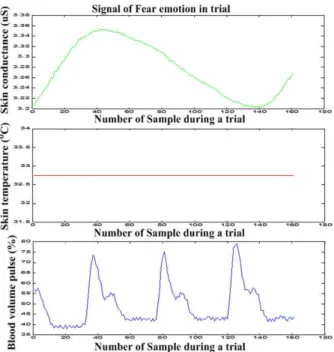
We first have verified that the recorded data properly during the experimental session by generating and examining plots of each channels over time as the following Fig. 1.
In order to preprocess the meaningful data in feature
extraction step, the raw data has considered as the
meaningful data and has applied directly for proceeding to
the next step due to the data acquisition of each
physiological signal has been the low level of the noise
artifact and environment. In this paper, any kinds of noisy
reduction approaches are not employed in the feature
extraction step. The reason of we do not consider about
noisy reduction in feature extraction is the physiological
responses (SC, ST, BVP) what we have an interest in are
그림 1. 생리적 신호들에서 분포된 공포 감정 관련 실험측정치.
Fig. 1. An experimental measurements of fear emotion signal plotted in physiological signals.
already simply noisy-canceled by the data-acquisition device module with its sensing interface S/W (biofeedback 2000 x-pert). And the major contribution of this paper is that figure out the experimental paradigms for artificially inducing the responses correspond to emotional states and acquire the validated physiological responses instead of focusing on the optimal feature extraction or optimization of class labeling process in the field of emotion recognition.
Also, we try to design of automatic emotion recognition framework using the validated responses. Therefore, the additional noisy filtering methods are unnecessary in the feature extraction step. The data acquisition of each physiological signal was segmented according to the time duration of the stimulating effects sections as you could see in the Fig. 4. And then these segments were prepared to process to the next step, means that we cut the meaningful signal as the trial from the session of the experiment procedure.
2. Feature selection
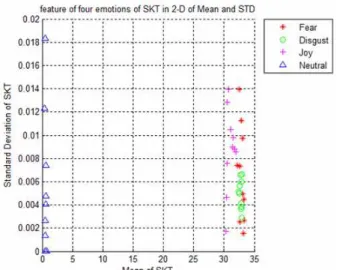
Feature selection has been necessary to define a methodology in order to enable the system to translate the signals coming from the physiological signals into the specific emotions. For this study, emotion recognition training or testing, the features of physiological signals have been extracted using two parameters. Mean and standard deviation are used to extract the features from the data of each trial after the preprocessing step, so we have received 160 features from four subjects, four emotions (four sessions) and one trial equals to 10 trials.
,