접수일자: 2013년 3월 10일 심사(수정)일자: 2013년 4월 7일 게재확정일자 : 2013년 5월 2일
†Corresponding author
본 논문은 본 학회 2013 춘계학술대회에서 선정된 우 수논문입니다.
본 논문은 한국연구재단 중견연구자지원사업(No. 2012- 0008726)에서 지원하여 연구하였습니다. 연구비 지원에 감사드립니다.
This is an Open-Access article distributed under the terms of the Creative Commons Attribution Non-Commercial License (http://creativecommons.org/licenses/by-nc/3.0) which permits unrestricted non-commercial use, distribution, and reproduction in any medium, provided the original work is properly cited.
Half-Against-Half Multi-class SVM Classify Physiological Response-based Emotion Recognition
Makara Vanny, Kwang-Eun Ko, Seung-Min Park, and Kwee-Bo Sim†
†School of Electrical and Electronics Engineering, Chung-Ang University E-mail : [email protected]
Abstract
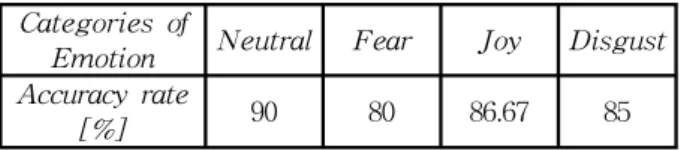
The recognition of human emotional state is one of the most important components for efficient human-human and hu- man-computer interaction. In this paper, four emotions such as fear, disgust, joy, and neutral was a main problem of classi- fying emotion recognition and an approach of visual-stimuli for eliciting emotion based on physiological signals of skin con- ductance (SC), skin temperature (SKT), and blood volume pulse (BVP) was used to design the experiment. In order to reach the goal of solving this problem, half-against-half (HAH) multi-class support vector machine (SVM) with Gaussian radial basis function (RBF) kernel was proposed showing the effective techniques to improve the accuracy rate of emotion classification. The experimental results proved that the proposed was an efficient method for solving the emotion recognition problems with the accuracy rate of 90% of neutral, 86.67% of joy, 85% of disgust, and 80% of fear.
Key Words : Visual-stimuli, Emotion Recognition, Physiological Signals, HAH Multi-class SVM Classification.
1. Introduction
Interactive emotion have been significantly improved the usage of an affective system and provided user with all the benefits of natural interaction as well as, the performance of emotional recognition rate was highly dependent on the quality of emotional data [1].
Emotion was treated as a psycho-physiological process that produced by the limbic system activity in response to a formal stimulus, whereas the physiological signals were varied depending on the range of the number of emotional categories and whether the system were user-dependent or user-independent that the emotion recognition system was developed by Picard et al. [2].
Emotion recognition system obviously was emerged in the Human-Computer Interaction (HCI) research area that could be essentially playing a significant role more and more in practical applications like assistance robot
in household with the user, smart phone, affective com- puting, and so on. Moreover, some emotions also have been the difficulty in order to induce and recognize by human that the inner states of emotion have not been expressed outwardly. As the real example, when some images were looked at by a subject, certain feelings and emotions might be experienced by that subject [3]. And the visual-stimuli of International Affective Picture System (IAPS) have been an affective picture standard for inducing emotions, and have been the most aspect of the experiment protocol. For instance, when the hu- man looked at some objects or pictures, the eyes trans- formed visual-stimuli into the neural signals. Therefore, in this paper, Radio MULTI module of biofeedback 2000 x-pert with visual information of IAPS were used to make the experiment in order to design the meaningful data for achieving higher recognition rate.
So far, Support Vector Machine (SVM) still has been one of the most popular classification algorithm, and has been used in numerous practical applications that performed a higher accuracy with good generalization capability because of its robust classification tool has effectively overcome many traditional classification problems such as local optimum and curse of dimensionality. Furthermore, it based on the principle of the Structural Risk Minimization (SRM) and employed the convex optimization with unique optimum solution [4], [5], [6], [7]. In addition, two kinds of SVM such as binary and multi-class SVM were presented in the var- ious problems of classifying data that each technique was employed in the other different conditions. For in- stance, multi-class SVM was used to solve multi-class classification problem in many areas such as pattern
recognition, computer vision, data mining and bio-informatics. Likewise, most of these problems in classification study also have been tackled by the other methods of SVM classifier like One-Against-One (OAO), One-Against-All (OAA), Directed Acyclic Graph (DAG), and Binary-Tree (BT).
On the other hand, the goal of this paper, we pro- posed the Hafl-Against-Half (HAH) multi-class SVM with Gaussian Radial Basis Function (RBF) in order to optimize and solve the multi-class problems for im- proving overall emotion recognition accuracy. For HAH multi-class SVM construction was combined by the other methods such as (OAO), (OAA), and (DDAG) [8-9], and it existed the same as a decision tree which contained the binary SVM classifier in each node. It meant that the classification procedure was run at the beginning of the root node to the leaf led by the binary SVM classifier. Especially, HAH SVM existed the greatest problem which was to find the optimal way in order to distinguish classes in each node as well as the speed of the computational time of this method gave better performance compare to other methods.
For the remainders of this paper, were organized as the following sections: section 2 demonstrated the re- lated works, section 3 presented the meaning feature extraction from physiological responses, For the physio- logical response-based emotion recognition was proved in section 4, and conclusion was expressed in the last section.
2. Related Works
2.1 Binary Support Vector Machine
Support vector machine (SVM) is a statistical classi- fication system proposed by Cortes and Vapnik in 1995 [15]. In general, SVM algorithm has been designed and proposed for binary classification which has been shown a good performance in classification for receiv- ing the input data during a training phase, build model of the input and output a hypothesis function that could have been used to predict the future data [7, 11].
Given the training data sets
,∈ ,where represented as a feature vector, m represented the dimensionality of input space, and
∈ denoted the class label of with two classes. SVM classification was to construct a hy- per-plane to classify patterns into two classes. In the case, the linear classifier could be inseparable data and then the nonlinear classifier (kernel function) was ap- peared to create the separable classifier by mapping da- ta into the high-dimensional space [12]
→ → where H was called feature space.
And herein the inner product similarity was calculated
through
〈
〉
for pattern and . So, SVM was realized through the kernel function as shown in Eq. (1).
〈
〉
(1) In the training of SVM was to discover the optimal hyper-plane, one should be maximized the margin which separates two-class samples. In order to mini- mize the problem, we employed a convex Quadratic Program (QP) as follows:Find the Lagrange multipliers
that maximize the objective function:
(2)
≤ ≤ (3) where is a kernel function and is a positive con- stant specified by user.
From Eq. (2), we could see the size of the QP prob- lem is equal to the number of training samples.
Therefore, usually SVM is slow, especially for large size problem. By solving the Lagrange multiplier above, we could get a decision function:
∗
(4) where is a bias.From Eq. (3), we know ≤ ≤ holds for
All training samples corresponding to
≻ are called support vectors (SVs). Let ≻ for
so Eq. (4), could be written as:
∗
(5)
2.2 Multi-class Support Vector Machine
Support vector machine was originally designed for binary classification, and it could not be directly ex- tended to multi-class problem. Basically, there were two types of approached for multi-class SVM problem.
One was constituting all data into the formula opti- mization [13], and the other was distinguishing the multi-class problem by designing into the series stand- ard techniques of binary SVMs, namely OAO, OAA, and DAG. All of these methods were considered as the efficient and suitable methods to realize the practical multi-class problem in the real world that their struc- ture was constructed briefly by the form of binary SVM as shown below [16], [17], [18], [19].
The OAO method has built the M(M-1)/2 binary SVM classifiers in order to solve the M-class problem, and it was created by training binary SVM between pair-wise classes, (where M >2).
Whereas, the OAA technique has designed the M bi-
nary classifiers for replying with M-class problem, and herein the patterns of a class were trained against the patterns of rest classes, (where M >2).
For the DAG has created M(M-1)/2 binary classifiers which have been organized in a tree structure with M layers for dealing with M-class problem. This method has operated in a kernel induced feature space and has utilized binary class at each node of a tree structure (where M >2).
In this section, as we have mentioned above, HAH multi-class SVM algorithm has constructed
log binary classifiers in order to tackle M-class problem, (where M >2). The N binary SVM classifiers have been resulted from each node of a deci- sion tree that the level of decision tree was defined by
log
, and the M classes were bifurcated randomly into two groups. And the similar or close classes could have been grouped together. The problem was happened due to the separability between the arbitrary two groups was not high that made the accuracy to be unreliable. For reaching problem, the most desirable way was to find the optimum two groups to reduce the expected error. And the hierarchy clustering of classes was selected to progress the optimal division. The first group consisted of a half of the classes with perform- ance of the better separation. After that, the distance between two classes was considered as the mean dis- tance between the training data of both two classes, and likewise each node was repeated. The hierarchy clustering structure for the M classes could be built, and herein the HAH model could be trained accordingly.Therefore, this method was demonstrated sequentially [9-10], as the following steps:
Step 1 : Adopt Gaussian kernel function in Eq. (6), and calculate the Euclidean distances between one class and the others in Eq. (7),
exp
∥
∥
(6)
∥
∥
(7)
Step 2 : Calculate the distance between the two nearest samples which respectively belong to class A and class B as the distance of class A and class B, indicated by , in Eq.
(8).
min
∥
∥
∈ ∈
(8) So that, and are the sample of class A respectively, and B, and k is the number of classes.Step 3 : Arrange the distances between each class and the other k-1 classes from small to large order
and then renumber. Take class i for example,
we the new order of
≠ ≤ ≤ ≤ . Step 4 : First, arrange the corresponding classes ac-
cording to . Compare their
when two classes have the same
. If class i and j own the same , let’s put the smaller label in front of the others. Finally, we get the new arrangement of all types:
Step 5 : Built a binary tree according to the arrange- ment of all types: .
Step 6 : According to the binary tree at step 5, con- struct the optimal hyper-plane of every node using binary SVM formulation. Therefore, we could get the multi-class SVM classification model based a binary tree, and each category could be divided completely.
In the Gaussian kernel function, the output of the kernel was dependent on the Euclidean distance of
from that one of these would be the support vector and the other would be the testing data point. The sup- port vector would be the center of the Gaussian kernel function and would determine the area of influence this support vector that existed over the data space [14]. In order to select the value , it was depended on the condition of each data set (over-fitting or un- der-fitting). For instance, if was defined by a larger value, and then the area of the data would be a smoother decision area and provide more regular deci- sion boundary. Thereby, the Gaussian kernel function with large would permit the support vector to have a strong influence over a larger area. On the other hand, the large value of would reduce the number of sup- port vectors, thus, it must be adapted to some extent of the feature space distribution.
3. Meaning feature extraction from physiological responses
3.1 Preprocessing data
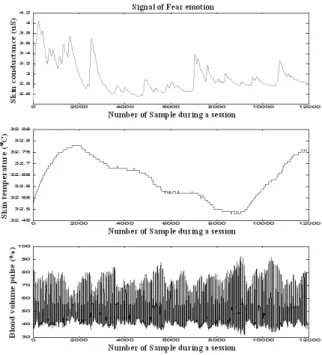
The raw data was really important in the pre- processing step before it was carried out in the feature extraction step. In this work, the raw data in figure 1, was considered as the meaningful data in figure 2, due to the artifacts and the environmental noise of each physiological signal were the low level compared to the meaningful data so the noisy reduction were not used in
the preprocessing data. The reason is that the noisy re- duction of each channel was already simply-canceled by the data acquisition device module with its sensing in- terface S/W (biofeedback 2000 x-pert). The acquisition data were segmented depending on duration time of (4 seconds) for stimulating emotions of each trial in the session.
Fig. 1. The raw data of fear emotion recorded by each physiological signal in a session
3.2 Feature extraction
To define the methodology for recognizing emotion, it was essential to translate the meaningful data of the physiological signals into the feature vector that was received from the device sensors. In order to overcome that problem, mean and standard deviation were utilized extracting the features from each trial as shown in the following equations (9) and (10). In this work, we have 160 features from four emotions, four subjects, and 40 trials (1 session has 10 trials). Thus, for deriving a set of features, each physiological signal was combined in order to train in the classification step through the fea- ture vector which expressed in Eq. (11).
(9)
(10)
(11) where i is the number of trial and n is the total number of trial.
Fig. 2. The meaningful dat of fear emotion in a trial for processing in the feature extraction
4. Physiological response-based emotion recognition
4.1 Equipment and experimental induction method In this experiment was carried out in a quiet room (temperature: 22-26⁰C, 4 subjects, sex: male, age:
25-30)) that each subject was seated on the chair with a comfortable state, and at the approximate distance of 70cm in front of a computer monitor. Moreover, the subjects were requested to have enough relaxation and have not take any medicine before running the experiment. For the specific emotional statuses were necessary to represent the databases of physiological signals. Furthermore, each subject was introduced how to induce emotions before the experiment and ask after finish the experiment, whereas the device sensors of Biofeedback 2000 x-pert were attached on the finger tip of non-dominant hand to record physiological signals as shown in the figure 3.
Fig. 3. The attachment and experiment procedure of equipment (Biofeedback 2000 x-pert)
In order to progress the protocols for emotion in- duction, IAPS material was designed to elicit emotions which would be reflected by the subject’s stimuli in the
figure 4.
Fig. 4. The process of eliciting emotions for the subject (R=rest and S=stimulus)
In figure 3 illustrated the collecting data of each ses- sion of experiments that were taken approximately 5 minutes 40 seconds of the time length, and displayed 10 images, an image was displayed 4 seconds to induce emotion. The experiment was begun showing the black-screen which represents the rest time during 30 seconds. Next, the image stimulus was shown to elicit the target emotion that this model was operated 10 times until finish the session.
4.2 Experimental results
In our work, we had four emotions that would be represented by four different classes such as fear (F), disgust (D), joy (J), and neutral (N). Throughout, the proposed HAH algorithm, we could construct the struc- ture of those emotions in the following figure (5).
Fig. 5. The corresponding decision tree of HAH algo- rithm division of the four classes
In the figure 5, illustrated that the similarity of class J and F was grouped together, and the similarity of class D and N was also created into one group. After that, each group was tackled by binary SVM classifier.
Categories of
Emotion Neutral Fear Joy Disgust
Accuracy rate
[%] 90 80 86.67 85
Table 1. The accuracy of each emotion for multiple subjects using HAH multi-class SVM
In Table 1, the experimental result of HAH algorithm proved that the highest accuracy of 90% for classifying the neutral, 86.67% for joy, 85% for disgust, and the low accuracy of 80% for fear for recognizing emotions in our work.
5. Conclusion
In this paper proved that HAH multi-class SVM with Gaussian RBF kernel is an efficient algorithm for solving the multi-class problem in order to improve the high accuracy of emotion recognition, and it existed the greatest problem which was to find the optimal way in order to bifurcate the classes in each node as well as it proved the better performance of the training speed, testing speed, and the size of model compare to other methods. As the real example, it proved that achieving the higher recognition rate like neutral of 90%, joy of 86.67%, disgust of 85%, and fear of 80% in this work.
Although, it had a bit complexity than the others.
In the future work, we will study the efficient opti- mization methods and algorithms to propose the new ideas for making the experimental paradigm as well as improving the accuracy of emotion recognition in order to develop human-computer and human-machine interaction.
References
[1] D. E. Kim, J. Kim, E. C. Lee, M. Whang and Y.
Cho, “Interactive Emotional Content Communication System using Portable Wireless Biofeedback Device,” IEEE Trans. on Consumer Electronics, vol. 54, no. 4, pp. 1929-1936, 2011.
[2] E. Vyzas, W. Picard and J. Healey, “Toward Machine Emotional Intelligence,” Analysis of Affective Physiological State, IEEE Trans. on Pattern Analysis and Machine Intelligence, vol. 23, no. 10, pp. 1175-1191, Oct. 2001.
[3] J. Lang, M. Bradley and N. Cuthbert, “International Affective Picture System (IAPS),” Center for Research in Psychophysiology, University of Florida, 1999.
[4] J. Platt. How to Implement SVMs, IEEE Intelligent System, vol. 13, no. 4, pp. 26-28D, 1998.
[5] Vladimir N. Vapnik, “Statistical Learning Theory,”
New York, Wiley, 1998.
[6] Vladimir N. Vapnik, “The Nature of Statistical Learning Theory,” Springer-Verlag, New York, 1995.
[7] R. Sangeetha and B. Kalpana, “Performance Evaluation of Kernels in Multiclass Support Vector Machines,” Int. Journal of Soft Computing and Engineeing, vol. 1, no. 5, pp. 2231-2307, 2011.
[8] H. Lei and V. Govindaraju, “Half-against-half Multi-classs Support Vector Machines,” Lecture Notes in Computer Science, 3541, Springer-Verlag, pp. 156-164, 2005.
[9] J. Henry, “Half-against-half multi-class support vector machines in classification of benthic macro- invertebrate images,” IEEE Int. Conference on (ICCIS), 2012.
[10] L. Lei and Z. H. Zhu, “ On-line static security as- sessment of power system based on a new half-Against-half multi-class support vector Machine,” IEEE Int. Workshop on (ISA), pp. 1-5, 2011.
[11] A. Hassan and I. Damper, “Classification of Emotional Speech using 3DEC Hierarchical Classification,” Elsevier Speech Communication, vol. 54, pp. 903-916, 2012.
[12] Bernhard Scholkopf and Alex Smola, “Learning with kernels.” MIT Press, Cambridge, MA, 2002.
[13] K. Crammer and Y. Singer, “On the algorithmic implementation of multi-class kernel-based vector machines,” Journal of Machine Learning Research, vol. 2, pp. 265-292, 2001.
[14] Q. Chang, Q. Chen and X. Wang, “Scaling Gaussian RBF kernel width to improve SVM clas- sification,” IEEE Int. Conference on Neural Networks and Brain, vol. 1, pp. 19-22, Oct. 2005.
[15] C. Cortes and V. Vapnik, “Support vector net- works,” Machine Learning, vol. 20, no. 3, pp.
273-297, 1995.
[16] B. Liu, Z. Hao and E. C. C. Tsang, “Nesting One-Against-One Algorithm Based on SVMs for Pattern Classification,” IEEE. Trans. on Neural Network, vol. 19, no. 12, pp. 2044-2052, Dec. 2008.
[17] Y. Liu and Y. F. Zheng, “One-Against-All Multi-Class SVM Classification Using Reliability Measures,” IEEE. Int. Joint Conf. on Neural Networks, vol. 2, pp. 849-854, 2005.
[18] P. Ranganathan, A. Ramanan and M. Niranjan,
“An Efficient and Speed-Up Tree for Multi-class Classification,” IEEE. 6th Int. Conf. on (ICIAfS), pp. 190-193, 2012.
[19] H. Yi, X. Song and B. Hiang, “Structure Selection for DAG-SVM based on Misclassification Cost Minimization,” Int. Journal of (ICIC), vol. 7, no. 9, pp. 5133-5143, Sept. 2011.
저 자 소 개
Vanny Makara
2011년 : B.S. in Electronic, Automatic, and Telecommunication from Institut of Technology of Cambodia
2011년~현재 : 중앙대학교 대학원 전자전기공학부 석사과정 관심분야 : Biofeedback system, brain-computer interface,
machine learning, and multi agency, etc.
Phone : +82-2-820-5319
Email : [email protected]
박승민(Seung-Min Park)
2010년 : 중앙대학교 전자전기공학부 공학사 2010년 ~ 현재 : 중앙대학교 대학원 전자전기공학부 석박사통합과정
관심분야 : Brain-Computer Interface, Intention Recognition Soft Computing 등.
Phone : +82-2-820-5319 E-mail : [email protected]
고광은(Kwang-Eun Ko)
2007년 : 중앙대학교 전자전기공학부 공학사 2007년 ~ 현재 : 중앙대학교 대학원 전자전기공학부 석박사통합과정
관심분야 : Multi-Agent Robotic Systems (MARS), Machine Learning, Context Awareness, Emotion Recognition Systems 등.
Phone : +82-2-820-5319 E-mail : [email protected]
심귀보(Kwee-Bo Sim)
1990년 : The University of Tokyo 전자공학과 공학박사
1991년~현재 : 중앙대학교 전자전기공학부 교수 2006년~2007년 : 한국지능시스템학회 회장
관심분야 : 인공생명, 뇌-컴퓨터 인터페이스, 의도인식, 감성인 식, 유비쿼터스 지능형로봇, 지능시스템, 컴퓨테이 셔널 인텔리젼스, 지능형 홈 및 홈 네트워크, 유비쿼 터스 컴퓨팅 및 센서 네트워크, 소프트 컴퓨팅(신경 망, 퍼지, 진화연산), 다개체 및 자율분산로봇시스템, 인공면역시스템, 지능형 감시시스템 등.
Phone : +82-2-820-5319 E-mail : [email protected]
Homepage URL : http://alife.cau.ac.kr