* Dept. of Electronics Engineering, Incheon National University
★ Corresponding author
032-835-8447, [email protected]
※Acknowledgement
-This work was supported by Incheon National University Research Grant in 2014.
Manuscript received Mar. 20, 2015; revised May. 10, 2015;
accepted May. 11. 2015.
This is an Open-Access article distributed under the terms of the Creative Commons Attribution Non-Commercial License(http://creativecommons.org/licenses/by-nc/3.0) which permits unrestricted non-commercial use, distribution, and reproduction in any medium, provided the original work is properly cited.
Design and Implementation of Multiband Internal Antenna for LTE Mobile Handset
Young Min Cho
*, Pil Hyun Jung
*, Woon Geun Yang
*★Abstract
In this paper, we proposed a multiband internal antenna for LTE mobile handset that could be used for mobile devices. The proposed antenna has a volume of 50 mm(W) × 21 mm(L) × 5 mm(H), ground plane size is 60 mm(W) × 100 mm(L), and covers 9 service frequency bands including LTE(Long Term Evolution) band with VSWR(Vlotage Standing Wave Ratio) less than 3. With rapid change of technologies, people wants to include more function into one device. In addition, each country uses different frequency band for traffic service, it is necessary to design multiband antenna for mobile phone since traveling foreign country needs roaming. And if we can cover several services with one antenna, cost and volume needed for antennas are minimized. A HFSS (High Frequency Structure Simulator) of the Ansoft Corporation based on a finite element method is employed to analyze the proposed antenna in the design process and to compare the simulation and experimental results.
Key words: LTE, Multiband, Internal, Antenna, Mobile Handset
I. Introduction
With the rapid development of wireless communication systems, multiband antenna has become one of the most important issues and attracted much interest[1].
Most of the modern wireless enabled devices require low cost, lightweight, dual or multiband antennas which are easy to fabricate and integrate with RF (Radio Frequency) devices, and so forth[2].
For mobile phones, planar antennas are very
attractive, because these antennas have low profile and also can be simply fabricated on the system circuit board of the mobile phone for practical applications. In recent years, many planar antennas with multiband capability are suggested, including multiband PIFA (Planar Inverted-F) antennas[3-4]
and planar monopole antennas[5-8].
The planar antennas are very easy to manufacture, low-cost, and can be easily integrated within the PCBs (Printed Circuit Boards) of notebook computers, mobile terminals, and other wireless networking equipment. The planar monopole antenna has attracted the most attention even in UWB (Ultra-Wide-Band) [9-10].
It is well known that the resonance frequency band of the antenna shifts as environmental condition is changing. So sufficient margin for resonance bandwidth is always required, and most multiband antenna show a narrow bandwidth for a lowest frequency band. And lowest frequency band is very hard to widen bandwidth. One method to design a multiband antenna is designing with several branches, each for corresponding frequency
bands. Longest branch covers lowest frequency band[11-12].
For mobile phones or devices, in designing antenna, getting suitable performance in lowest frequency band is most hard job. As service frequency is getting lower and lower, designing antenna in limited volume needs more hard work. Obtaining suitable performance in high frequency bands is relatively easy to achieve. And getting more service bands with single antenna is another challenging job. And if we can cover several services with one antenna, cost and volume needed for antennas are minimized. Our design starts lowest frequency band at LTE 700 (Long Term Evolution : 699-798 MHz) and covers 9 service frequency bands which are lower starting frequency and equal to maximum number of service bands compared to ref.[1-12].
In this paper, we propose a multiband internal antenna for multiband operation covering the LTE700, PCS/K-PCS (Personal Communications Service / Korea-Personal Communications Service : 1750-1870 MHz), US-PCS (US Personal Communications Service : 1850-1990 MHz),
UMTS/WCDMA (Universal Mobile
Telecommunications System /Wideband Code Division Multiple Access : 1920-2170 MHz), Wibro (2300-2390 MHz), LTE2300 (2300-2400 MHz), Bluetooth (2400-2483 MHz) and WLAN (Wireless Local Area Network : 2400-2483.5 MHz), US-WiMAX (US Worldwide Interoperability for Microwave Access : 2400-2590 MHz), LTE2500 (2496-2690 MHz) bands with VSWR(Voltage Standing Wave Ratio) less than 3 [13-15]. The measured results of the fabricated antenna are validated by the simulated ones, which obtained using a HFSS (High Frequency Structure Simulator) from Ansoft.
II. Proposed Antenna
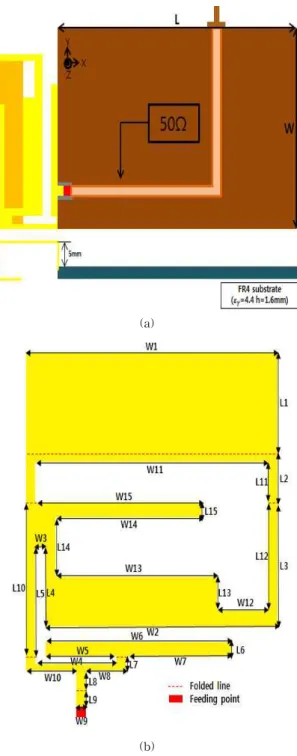
Fig. 1 shows the geometry of the proposed multiband internal monopole antenna. The antenna size is 50 mm(W) × 21 mm(L) × 5 mm(H). Ground plane size is 60 mm(W) × 100 mm(L). Ground plane is a copper sheet above an inexpensive FR4 substrate with a dielectric constant of 4.4 and a
antenna is consist of a slotted patch, and a branch.
(a)
(b)
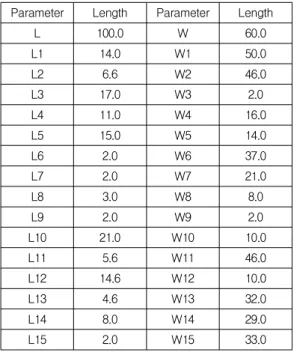
Table 1. Design parameters of the proposed antenna (unit : mm) Parameter Length Parameter Length
L 100.0 W 60.0
L1 14.0 W1 50.0
L2 6.6 W2 46.0
L3 17.0 W3 2.0
L4 11.0 W4 16.0
L5 15.0 W5 14.0
L6 2.0 W6 37.0
L7 2.0 W7 21.0
L8 3.0 W8 8.0
L9 2.0 W9 2.0
L10 21.0 W10 10.0
L11 5.6 W11 46.0
L12 14.6 W12 10.0
L13 4.6 W13 32.0
L14 8.0 W14 29.0
L15 2.0 W15 33.0
Table 1 shows values of the design parameters which were derived through the simulation.
Ⅲ. Simulation and Measurement
The commercial program HFSS based on the FEM (Finite Element Method) is used to obtain suitable values of parameters and analyze the behavior of the proposed antenna.
(a)
(b)
(c)
(d)
(e)
(f)
(g)
(h)
(i)
Fig. 2. Current distributions of the proposed antenna.
(a) at 748 MHz, (b) at 1810 MHz, (c) at 1920 MHz, (d) at 2045 MHz, (e) at 2345 MHz, (f) at 2350 MHz, (g) at 2442 MHz, (h) at 2495 MHz, (i) at 2595 MHz
Fig. 2 shows the excited surface current distributions obtained from the HFSS simulation in the radiation element of the proposed antenna at each frequencies. According to (a) in Fig. 2, the leftpath and patch of the proposed antenna is the major radiation element at 748 MHz. Fig. 2 (d) shows the major radiation element at 2045 MHz.
Also (i) in Fig. 2 shows that the branch from right path play a major role for 2595 MHz.
Fig. 3 shows simulated 3D radiation patterns at
(a) (b)
(c) (d)
(e) (f)
(g) (h)
(i)
Fig. 3 Simulated 3D radiation patterns of the proposed antenna. (a) at 748 MHz, (b) at 1810 MHz, (c) at 1920 MHz, (d) at 2045 MHz, (e) at 2345 MHz, (f) at
Fig. 4 shows the implemented antenna. Fig. 5 shows measurement and simulation results on the S11 of the proposed antenna. The results show a good agreement between measurement and simulation.
Fig. 4. Photograph of the implemented antenna
Fig. 5. Simulated and measured S11
The implemented antenna satisfied multiple operating bands including LTE700 (699-798 MHz), PCS/K-PCS (1750-1870 MHz), US-PCS (1850-1990 MHz), UMTS/WCDMA (1920-2170 MHz), Wibro (2300-2390 MHz), LTE2300 (2300-2400 MHz), Bluetooth (2400-2483 MHz), WLAN (2400-2483.5 z), US-WIMAX (2400-2590 MHz) and LTE2500 (2496-2690 MHz).
Table 2 shows measurement and simulation results on the VSWR of the proposed antenna.
Table 2. Simulation and measuremnet VSWR at center frequencies for each services Frequency Band
(MHz) simulated
VSWR measured
VSWR LTE700
(at 748) 2.210 1.766
PCS/K-PCS
(at 1810) 1.866 1.771
US-PCS
(at 1920) 1.917 1.378
UMTS/WCDMA
(at 2045) 1.398 1.616
Wibro
(at 2345) 2.447 2.090
LTE2300
(at 2350) 2.375 2.077
Bluetooth/WLAN
(at 2442) 1.841 1.856
US-WiMAX
(at 2495) 1.500 1.627
LTE2500
(at 2595) 1.204 1.446
From Table 2, we can find simulated and measured VSWR at each frequency bands. The maximum and minimum simulated VSWR value are 2.447 at Wibro and 1.204 at LTE2500 bands. Also, the maximum and minimum measured VSWR value are 2.090 at LTE2300 and 1.378 at US-PCS bands, respectively.
(a)
(b)
(c)
(d)
(e)
(f)
(g)
(h)
(i)
Fig. 6. Normalized measured radiation patterns of the implemented antenna. (a) at 748 MHz, (b) at 1810 MHz, (c) at 1920 MHz, (d) at 2045 MHz, (e) at 2345 MHz, (f) at 2350 MHz, (g) at 2442 MHz, (h) at 2495 MHz, (i) at 2595 MHz
Fig. 6 shows the normalized measured co-polarization and cross-polarization radiation patterns of the implemented antenna in the x-y, z-y and z-x planes at center frequencies of each services. The radiation patterns of the implemented antenna were measured in an anechoic chamber equipped with HP 8510C network analyzer and a far field measurement system. Antenna should not have sharp deeps in radiation patterns since it is thought that the sharp deeps in radiation patterns cause call drop. It was found that the proposed antenna has proper radiation patterns at all center frequencies.
Table 3. Measured antenna gains Frequency Band Peak
Gain(dBi) Average Gain(dBi)
LTE700 1.30 -1.01
PCS/K-PCS 2.16 -1.36
US-PCS 2.90 -2.31
WCDMA 2.56 -2.09
Wibro 2.21 -2.14
LTE2500 2.44 -2.20
Bluetooth/WLAN 3.35 -2.58
US-WiMAX 3.05 -2.79
LTE2500 2.38 -3.03
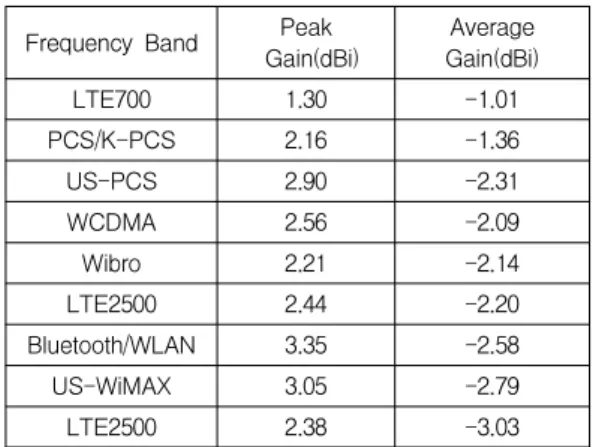
Table 3 shows the measurement results of maximum peak gain and average gain of the implemented antenna.
From Table 3, we can see that the maximum and minimum peak gain and average gain at each service. The maximum and minimum peak gain are
3.35dBi at Bluetooth/WLAN and 1.30dBi at LTE700 service bands respectively. The maximum and minimum average gain are –1.01dBi at LTE700 and –3.03dBi at LTE2500, respectively.
Most of typical monopole antennas for mobile handset should have VSWR performance less than 3 and should not have sharp deeps in radiation patterns since it is thought that the sharp deeps in radiation patterns cause call drop. Therefore, the result for the proposed antenna shows proper performance characteristics.
Ⅳ. Conclusion
We proposed a multiband internal antenna for LTE mobile handset. We designed and fabricated the multiband monopole for LTE700, PCS/K-PCS, US-PCS, UMTS/WCDMA, Wibro, LTE2300, Bluetooth, WLAN, US-WIMAX and LTE2500 bands.
The antenna has a volume of 50 mm(W) × 21 mm(L) × 5 mm(H), and ground plane size is 60(W) mm × 100(L) mm..
The maximum and minimum simulated VSWR value are 2.447 at Wibro and 1.204 at LTE2500 band respectively. Also, the maximum and minimum measured VSWR value are 2.090 at Wibro and 1.378 at US-PCS band, respectively. The maximum and minimum peak gain are 3.35dBi at Bluetooth/WLAN and 1.30dBi at LTE700, respectively. The maximum and minimum average gain are –1.01dBi at LTE700, –3.03dBi at LTE2500, respectively. The proposed antenna has VSWR performance less than 3 in all service bands and does not have sharp deeps in radiation patterns. And measured antenna gain is practically applicable. Therefore, the result for the proposed antenna shows proper performance characteristics.
We expect that the proposed monopole is applicable for multiband mobile device.
References
independent frequency tuning capability for compact wireless usb dongles”, Microwave and Optical Technology Letters, vol.54, no. 11, pp. 2548-2552, Nov. 2012
[2] Ritesh Kumar Badhai, and Nisha Gupta “Compact dual sinc-shaped monopole antennna for dual band wireless applications”, Microwave and Optical Technology Letters, vol. 55, no. 12, pp. 2883-2888 Dec. 2013
[3] Chien-Wen Chiu and Yu-Jen Chi, “Planar hexa-band inverted-F antenna for portable device applications”, IEEE Antenna and Wireless Propagation Letters, vol. 8, pp. 1099-1102, 2009
[4] Chuan-Ling Hu, De-Lun Huang, Huang-Lin Kuo, Chang-Fa Yang, Chang-Lun Liao, and Shun-Tain Lin, “Compact multibranch inverted-F antenna to be embedded in a laptop computer for LTE/WWAN/IMT-E applications”, IEEE Antenna and Wireless Propagation Letters, vol. 8, pp. 838-884, 2010 [5] P. Misra, A. Tripathy, and N. Singhdeo, “A Planar Monopole Antenna for Dual band Appication”, International Journal of Scientific & Technology Research, vol. 1, Issue 2, Mar. 2012
[6] Jui-Han Lu and Wen-Chieh Chou, “Planar dual U-shaped monopole antenna with multiband operation for IEEE 802.16e”, IEEE Antenna Wireless Propagation Letters, vol. 9, pp. 1006-1009, 2010 [7] Kin-Lu Wong and Shu-Chuan Chen, “Printed single-strip monopole using a chip inductor for penta-band WWAN operation in the mobile phone”, IEEE Transacations on Antennas Propagagation, vol.
58, pp. 1011-1014, Mar. 2010
[8] Seyed Ehsan Hosseini, Amir Reza Attari, and Mohammad Saeed Majedi, “Planar monopole antenna for multiband wireless applications”, Microwave and Optical Technology Letters, vol. 55, no. 5, pp.
966-970, May. 2013
[9] Y. Lu, Y. Huang, Y. C. Shen, and H. T. Chattha,
“A further study of planar UWB monopole antennas”, in Proc. Loughbrough Antennas Propag.
Conf. 2007, pp. 353-356, Sep. 2009
[10] J. X. Liang, C. C. Chian, X. D. Chen, and C. G.
Parini, “Study of a printed circular disc monopole antenna for UWB systems”, IEEE Transacations on
Woon Geun Yang (Member)
1983 : BS degree in Electronics Engineering, Seoul National University.
1985 : MS degree in Electronics Engineering, Seoul National University.
1994 : Ph.D in Electronics Engineering, Seoul National University.
1988∼ : Faculty of Dept. of Electronics Engineering, Incheon National University.
2015∼ : Dean of academic affairs, Incheon National University
2013∼2014 : Head of job career development center in Incheon National University.
2013∼ : An outside director of ISC Co., Ltd.
2004∼2005 : Consulting Professor, LG Electronics Inc.
1997∼2001 : Consulting Professor, LG Electronics Inc Listed in the Marquis Who’s Who in the World from 2003 edition. And also listed in well-known international biographical dictionaries, ABI (American Biographical Institute) in USA and IBC (International Biographical Centre) in England. Research interests include antenna, mobile phone, wireless communication especially digital modulation and demodulation, RFID.
[11] Woon-Geun Yang, Ling-Zhi Cai, and Cheol-Yong Yang, “Design and implementation of internal multiband monopole antenna for mobile phones”, Journal of IKEEE, Volume: 15, No. 4, pp.
339-344, Dec, 2011
[12] Pil Hyun Jung, Cheol Yong Yang, Seong Ha Lee, Woon Geun Yang, “Design and Implementation of Internal Multiband Loop Embedded Monopole Antenna for Mobile Handset”, Journal of IKEEE, vol. 17, no. 4 pp. 484-491, Dec. 2013
[13] HongKoo Lee, Jaesuk Lee, Sungjin Moon, Mingi Kim and Hyeongdong Kim “Multiband Planar Monopole Antenna Using Coupling Control Feed Structure for Mobile Handsets”, Microwave and Optical Technology Letters, vol.57, no, 4, pp.823-826, Apr. 2015
[14] M.Amin Honarvar, Naeemehsadat Hamidi, and Bal S. Virdee “Multiband Antenna for Portalbe Device Applications”, Microwave and Optical Technology Letters, vol.57, no. 4, pp. 956-959, Apr.
2015
[15] Pradutt Kumar Bharti, Gaurav Kumar Pandey, Hari Shankar Singh, and Manoj Kumar Meshram,
“Multiband Shorted Monopole Antenna for Handset Applications”, Microwave and Optical Technology Letters, vol.57, pp. 1459-1466, no. 6, Jun. 2015
BIOGRAPHY
Young Min Cho (Student Member)
2014 : BS degree in Electronics Engineering, Incheon National University.
2014∼ : MS course in Electronics Engineering, Incheon National University.
Pil Hyun Jung (Student Member)
2013 : BS degree in Electronics Engineering, Incheon National University.
2015 : MS degree in Electronics Engineering, Incheon National University.
2015∼ : Engineer, Seetron Inc.