• 검색 결과가 없습니다.

Design and Implementation of Internal Multiband Loop Embedded Monopole Antenna for Mobile Handset

N/A
N/A
Protected

Academic year: 2021

Share "Design and Implementation of Internal Multiband Loop Embedded Monopole Antenna for Mobile Handset"

Copied!
8
0
0

로드 중.... (전체 텍스트 보기)

전체 글

(1)

Design and Implementation of Internal Multiband Loop Embedded Monopole Antenna for Mobile Handset

Pil Hyun Jung

*

, Cheol Yong Yang

*

, Seong Ha Lee

*

, Woon Geun Yang

*

Abstract

In this paper, we proposed an internal multiband loop embedded monopole antenna for mobile handset that could be used for smart phones. The proposed antenna has a volume of 40 mm(W) × 15 mm(L) × 5 mm(H), ground plane size is 40 mm(W) × 80 mm(L), and covers the GSM900 (Global System for Mobile communications : 880-960 MHz), K-PCS (Korea-Personal Communications Service : 1750-1870 MHz), US-PCS (US Personal Communications Service : 1850-1990 MHz), WCDMA (Wideband Code Division Multiple Access : 1920-2170 MHz), Wibro (2300-2390 MHz), Bluetooth (2400-2483 MHz) and WLAN (Wireless Local Area Network : 2400-2483.5 MHz) bands for VSWR (voltage standing wave ration) less than 3. The proposed loop adding design at middle section of longest branch showed wide impedance bandwidth for the lowest resonance frequency band. The proposed antenna have a lowest resonance frequency band from 738 MHz to 1075 MHz for S

11

value of –6dB. A HFSS (High Frequency Structure Simulator) of the Ansys Corporation based on a finite element method is employed to analyze the proposed antenna in the design process and to compare the simulation and experimental results.

Key words: Monopole, Multiband, Internal antenna, Mobile handset, Loop adding

*Dept. of Electronics Engineering, Incheon National University,

Cheol Yong Yang is now with EMW Co., Ltd.

and Seong Ha Lee is now with KMW Inc.

★Corresponding author

032-835-8447 [email protected]

※Acknowledgement

-This work was supported by Incheon National University Research Grant in 2012.

Manuscript received Nov. 14, 2013; revised Dec.

01, 2013 ; accepted Dec. 02. 2013

I. Introduction

With the development of the mobile communication technology, the function of the mobile phone has changed more and more diverse. The essentially required characteristic is supporting multiple frequency bands for the mobile system[1-4]. In addition to multiband capability, there are strong demands for small-sized, light weight, and compact mobile stations[1].

Various multiband planar inverted-F antennas

(PIFAs), monopoles, and slot antennas have been reported in the literature for mobile phone applications[1-7]. Monopole antennas have been employed widely in various mobile and ground-based communication systems due to its simple topology, omnidirectional radiation pattern and moderate efficiency[8-10].

In wireless communication, most mobile phone networks operate at various radio frequency bands.

A multiband phone is a phone which is designed to work on more than one radio frequency band.

Multiband phones have been valuable to enable

roaming. Roaming is a general term referring to the

extension of connectivity service in a location that

is different from the home location where the

service was registered. One of roaming is

international roaming. This type of roaming refers

to the ability to move to a foreign service

provider's network. For a phone to work with

different frequency allocations, it must support both

of frequencies. Eventually, it is necessary to design

multiband phones or antennas. And if we can cover

(2)

several services with one antenna, we can save cost and volume needed for antennas for each services.

In this paper, we propose an internal loop embedded monopole antenna for multiband operation covering the GSM900 (Global System for Mobile communications : 880-960 MHz), K-PCS (Korea-Personal Communications Service : 1750-1870 MHz), US-PCS (US Personal Communications Service : 1850-1990 MHz), WCDMA (Wideband Code Division Multiple Access : 1920-2170 MHz), Wibro (2300-2390 MHz), Bluetooth (2400-2483 MHz) and WLAN (Wireless Local Area Network : 2400-2483.5 MHz) bands. The measured results of the fabricated antenna are validated by the simulated ones, which obtained using a HFSS (High Frequency Structure Simulator).

It is well known that the resonance frequency band of the antenna shifts as environmental condition is changing. So a margin for resonance bandwidth is always required. [1] and most multiband antenna show a narrow bandwidth for a lowest frequency band. And lowest frequency band is very hard to widen bandwidth. One method to design a multiband antenna is designing with several branches, each for corresponding frequency bands. Longest branch covers lowest frequency band.

In this paper, the proposed antenna has a slot at the longest branch’s middle section which results a loop at longest branch. And widened bandwidth is obtained for the lowest frequency band. [1] shows a lowest resonance frequency band from 880 MHz to 960 MHz for –6dB of S

11

value. And [1] shows S

11

of -12dB at 920MHz. In comparison with [1], the proposed antenna have a lowest resonance frequency band from 738 MHz to 1075 MHz for the same S

11

value of –6dB. And the proposed antenna shows S

11

of -31dB at 920MHz. So, the proposed antenna shows better impedance bandwidth performance.

II. Proposed Antenna

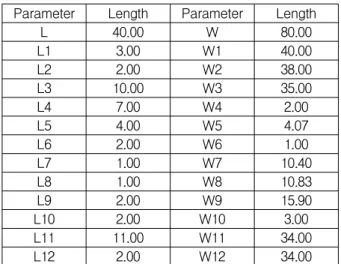
Fig. 1 depicts the geometry of the proposed internal multiband monopole antenna having one top branch with a loop and two side branch lines. Also, the parameters of the proposed antenna are

presented in Table 1. The antenna size is 40 mm(W) × 15 mm(L) × 5 mm(H). Ground plane size is 40 mm(W) × 80 mm(L). Ground plane is an inexpensive FR4 substrate with a dielectric constant of 4.4 and a thickness of 1.60 mm. A microstrip transmission line, with dimensions of 2.00 mm(W) x 2.00 mm(L), was used to feed the antenna.

(a)

(b)

Fig. 1. Geometry of the proposed antenna. (a) Top and side view, (b) Parameters of the proposed antenna.

Table 1. Design parameters of the proposed antenna (unit : mm) Parameter Length Parameter Length

L 40.00 W 80.00

L1 3.00 W1 40.00

L2 2.00 W2 38.00

L3 10.00 W3 35.00

L4 7.00 W4 2.00

L5 4.00 W5 4.07

L6 2.00 W6 1.00

L7 1.00 W7 10.40

L8 1.00 W8 10.83

L9 2.00 W9 15.90

L10 2.00 W10 3.00

L11 11.00 W11 34.00

L12 2.00 W12 34.00

(3)

Table 1 shows values of the design parameters which were derived through the simulation.

Ⅲ. Simulation and Measurement

The commercial program HFSS based on the FEM (Finite Element Method) is used to obtain suitable values of parameters and analyze the behavior of the proposed antenna.

(a) (b)

(c)

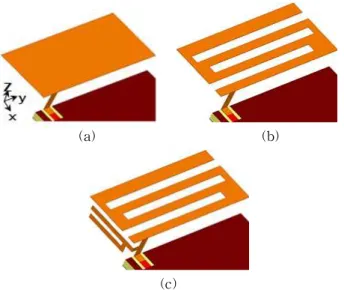
Fig. 2. Design process of the proposed antenna. (a) a top patch, (b) a branch with a loop, (c) a branch with a loop and two side branch lines.

Fig. 3. Simulated S

11

in Fig. 2 (a) a top patch, (b) a branch with a loop, (c) a branch with a loop and two side branch lines.

The proposed antenna consists of two major resonant geometries relative to its inherent functionality. Fig. 2 shows the design process of the

proposed antenna stepwise: (a) a top patch with 40mm(W) x 15mm(L); (b) a branch with a loop; (c) a branch with a loop and two side branch lines.

Fig.3 shows simulated S

11

for the three different types of Fig. 2. The basic radiator (a) has the center frequency at 1500 MHz and a single resonance band from 1041 MHz to 1940MHz for VSWR (Voltage Standing Wave Ration) < 3. A branch with a loop used in (b) is based on (a) patch size. The main radiator (b) resulted in the production of a low

(a)

(b)

(c)

Fig. 4 Current distributions of the proposed antenna.

(a) at 920 MHz, (b) at 1810 MHz, (c) at 2442 MHz.

(4)

resonance band from 738MHz to 1075MHz. The final design (c) is used to obtain an additional high resonance band from 1760 MHz to 2604 MHz.

Fig. 4 shows the excited surface current distributions obtained from the HFSS simulation in the radiation element of the proposed antenna at 920 MHz, 1810 MHz, 2442 MHz. According to (a) in Fig. 4, the top branch of the proposed antenna is the major radiation element at 920 MHz. Also (b) and (c) in Fig. 4 shows that the top branch and side branch lines play a major role for 1810 MHz and 2442 MHz.

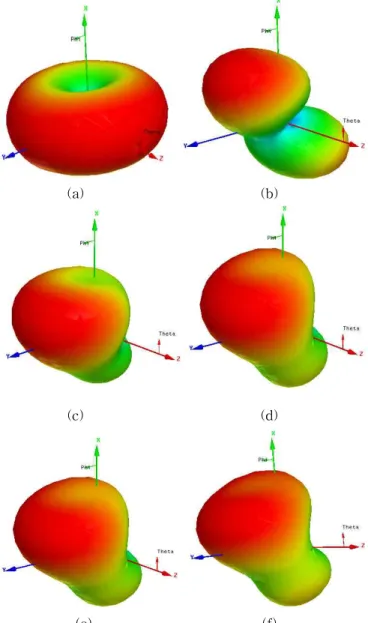
Fig. 5 shows simulated 3D radiation patterns at

(a) (b)

(c) (d)

(e) (f)

Fig. 5 Simulated 3D radiation patterns of the proposed antenna. ⒜ at 920 MHz, ⒝ at 1810 MHz, ⒞ at 1920 MHz,

⒟ at 2045 MHz, ⒠ at 2345 MHz, ⒡ at 2442 MHz.

920 MHz,1810 MHz, 1920 MHz, 2045 MHz 2345 MHz, 2442 MHz.

Fig. 6 shows the implemented antenna. Fig. 7 shows measurement and simulation results on the S

11

of the proposed antenna. The results show a good agreement between measurement and simulation.

Fig. 6. Photograph of the implemented antenna.

Fig. 7. Simulated and measured S

11

.

The implemented antenna satisfied multiple

operating bands including GSM900 (880-960 MHz),

K-PCS (1750-1870 MHz), US-PCS (1850-1990

MHz), WCDMA (1920-2170 MHz), Wibro (2300-2390

MHz), Bluetooth (2400-2483 MHz) and WLAN

(2400-2483.5 MHz) bands. The proposed loop adding

at middle section of longest branch showed wide

impedance bandwidth for the lowest resonance

frequency band. The proposed antenna have a

lowest resonance frequency band from 738 MHz to

1075 MHz for S

11

value of –6dB. And the proposed

antenna shows S

11

of -31dB at 920MHz which is

center frequency of GSM900.

(5)

Table 2 Simulated and measured VSWR at center frequencies for each services.

Frequency Band

(MHz) simulated

VSWR measured

VSWR GSM900

(at 920) 1.502 1.437

K-PCS

(at 1810) 1.951 2.194

US-PCS

(at 1920) 2.744 1.932

WCDMA

(at 2045) 1.923 1.566

Wibro

(at 2345) 1.820 1.439

Bluetooth/WLAN

(at 2442) 2.378 1.542

Table 2 shows measurement and simulation results on the VSWR of the proposed antenna. Through Table 2, we can find that the simulated and measured VSWR of GSM900 band at 920 MHz are 1.502, 1.437, respectively. For the K-PCS band at 1810 MHz, the simulated and measured VSWR are 1.951, 2.194, respectively. For the US-PCS at 1920 MHz, the simulated and measured VSWR are 2.744, 1.932, respectively. For the WCDMA band at 2045 MHz, the simulated and measured VSWR are 1.923, 1.566, respectively. For the Wibro band at 2345 MHz, the simulated and measured VSWR are 1.820, 1.439, respectively. For the Bluetooth and WLAN bands at 2442 MHz, the simulated and measured VSWR are 2.378, 1.542, respectively.

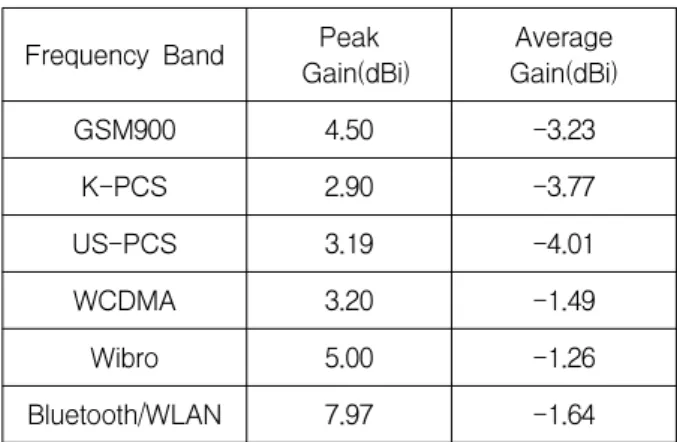
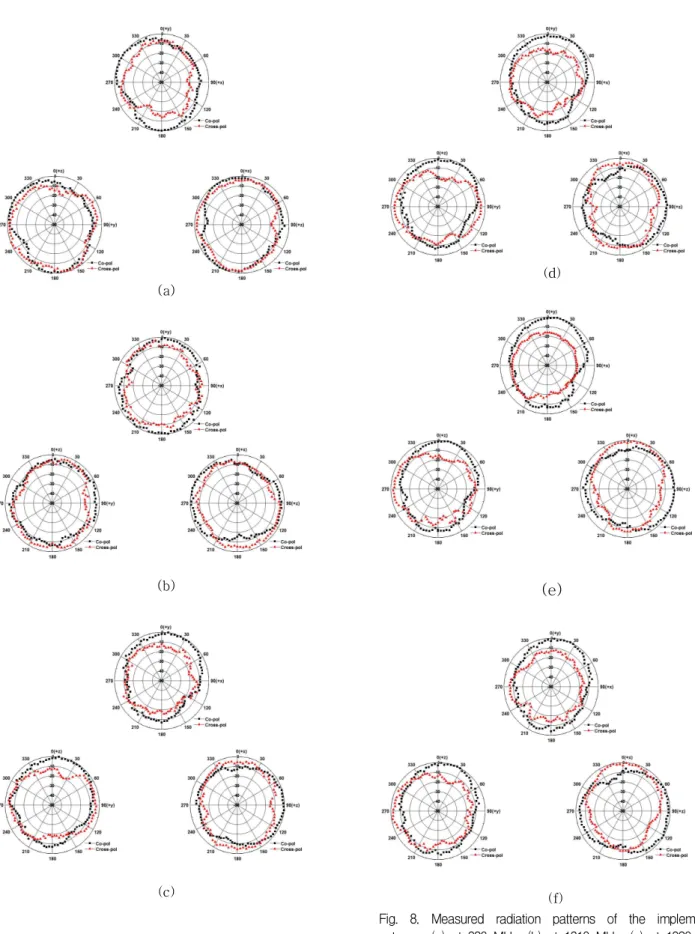
Fig. 8 shows the normalized measured co-polarization and cross-polarization radiation patterns of the implemented antenna in the x-y, z-y and z-x planes at center frequencies of each services. The radiation patterns of the implemented antenna were measured in an anechoic chamber equipped with HP 8510C network analyzer and a far field measurement system. It was found that the proposed antenna has proper radiation patterns at all center frequencies. Table 3 shows the results of maximum peak gain and average gain measurement of the implemented the antenna.

Through this Table 3, we can see that the maximum peak gain and average gain of GSM900

Table 3. Measured antenna gains Frequency Band Peak

Gain(dBi) Average Gain(dBi)

GSM900 4.50 -3.23

K-PCS 2.90 -3.77

US-PCS 3.19 -4.01

WCDMA 3.20 -1.49

Wibro 5.00 -1.26

Bluetooth/WLAN 7.97 -1.64

band are 4.50dBi, -3.23dBi, respectively. For the K-PCS band, the maximum peak gain and average gain are 2.90dBi, -3.77dBi, respectively. For the US-PCS band, the maximum peak gain and average gain are 3.19dBi, -4.01dBi, respectively. For the WCDMA band, the maximum peak gain and average gain are 3.20dBi, -1.49dBi, respectively. For the Wibro band, the maximum peak gain and average gain are 5.00dBi, -1.26dBi, respectively. For the Bluetooth and WLAN bands, the maximum peak gain and average gain are 7.97dBi, -1.64dBi, respectively.

Ⅳ. Conclusion

We proposed an internal multiband loop embedded monopole antenna for mobile handset. We designed and fabricated the multiband monopole for GSM900, K-PCS, US-PCS, WCDMA, Wibro, Bluetooth, WLAN bands with one top branch with a loop and two side branch lines and measurement showed suitable performance. The antenna has a small volume of 40 mm(W) × 15 mm(L) × 5 mm(H), and ground plane size is 40(W) mm × 80(L) mm.

The proposed loop adding design at middle section of longest branch showed wide impedance bandwidth for the lowest resonance frequency band.

The proposed antenna have a lowest resonance frequency band from 738 MHz to 1075 MHz for S

11

value of –6dB. Good radiation characteristics for frequencies over the mobile application bands have been observed.

We expect that the proposed monopole is applicable

for multiband mobile phone.

(6)

(a)

(b)

(c)

(d)

(e)

(f)

Fig. 8. Measured radiation patterns of the implemented

antenna. (a) at 920 MHz, (b) at 1810 MHz, (c) at 1920 MHz,

(d) at 2045 MHz, (e) at 2345 MHz, (f) at 2442 MHz.

(7)

References

[1] Woon-Geun Yang, Ling-Zhi Cai, and Cheol-Yong Yang, “Design and implementation of internal multiband monopole antenna for mobile phones” , Journal of IKEEE, Volume: 15, No. 4, pp. 339-344, Dec, 2011 [2] Yeon-Chan Hong, Seong-Ha Lee, and Woon-Geun Yang, “ Design and implementation of a MIMO antenna for LTE700/2300/2500/PCS/Wibro/Bluetooth/Wimax mobile handset ”, Journal of IKEEE, Volume: 16, No.

3, pp. 159-166, Sept, 2012

[3] Sung-Min Kim, Ki-Suk Yoon, Su-Bin Park, Woon-Geun Yang, Nam-Ki Kim, and Jong-Hyuk Lee, " Multiband internal monopole antenna for mobile station ", Microwave and Optical Technology Letters, Volume: 50, No. 1, pp. 241-244, Jan, 2008 [4] Hong, S., Kim, W., Kahng, S., and Choi, J.,

" Design of an internal multiresonant monopole antenna for GSM900/DCS1800/US-PCS/SDMB operation ", IEEE Trans. Antennas Propag, Volume:

56, No. 5, pp. 1437-1443, May, 2008

[5] R. A. Bhatti and S. O. Park, " Octa-band internal monopole antenna for mobile phone applications ", Electron. Lett., Volume: 44, No. 25, pp. 1447–1448, Dec, 2008

[6] Chia-Ling Liu, Yi-Fang Lin, Chia-Ming Liang, Shan-Cheng Pan, and Hua-Ming Chen, " Miniature internal penta-band monopole antenna for mobile phones ", IEEE Trans. Antenna and Propag., Volume:

58, No. 3, pp. 1008-1011, March, 2010

[7] J.B.Yu and W.G. Yang, " Design and implementation of internal multiband folded monopole antenna for mobile handset applications ", KIMICS, Volume: 8, No. 6, pp. 630-634, Dec, 2010 [8] Marek Kitli_ski and Tomasz Borodo, " Improved compact low-profile quadband planar monopole antenna for mobile handsets ", 2006 International Conference on Microwaves, Radar & Wireless Communications, (MIKON 2006), pp. 736-739, May, 2006

[9] Jihui Gu, Xiaomin Zhou, Yifei Yang, and Jianmin Fang, " A multiband compact monopole antenna for mobile handsets ", Microwave and Millimeter Wave Technology, ICMMT 2008, International Conference on, Volume: 3, pp. 1092-1094, April, 2008

[10] K.-L. Wong, G.-Y. Lee, and T.-W. Chiou,

" Monopole antenna for multiband operation of

mobile handsets ", IEEE Trans. Antennas Propag., Volume: 51, No. 1, pp. 121-125, Jan, 2003

BIOGRAPHY

Pil Hyun Jung (Member)

2013 : BS degree in Electronics Engineering, Incheon National University.

2013~ : MS course in Electronics Engineering, Incheon National University.

Cheol Yong Yang (Member)

2011 : BS degree in Electronics Engineering, Hoseo University.

2013 : MS degree in Electronics Engineering, Incheon National University.

2012~ : Research Engineer, EMW Co., Ltd.

Seong Ha Lee (Member)

2011 : BS degree in Electronics Engineering, Incheon National University.

2013 : MS degree in Electronics Engineering, Incheon National University.

2012~ : Engineer, KMW Inc.

(8)

Woon Geun Yang (Member)

1983 : BS degree in Electronics Engineering, Seoul National University.

1985 : MS degree in Electronics Engineering, Seoul National University.

1994 : Ph.D in Electronics Engineering, Seoul National

University.

1988~ : Faculty of Dept. of Electronics Engineering, Incheon National University.

1997~2001 : Consulting Professor, LG Electronics Inc.

2001~2002 : Researcher, ETRI (Electronics and Telecommunications Research Institute)

2004~2005 : Consulting Professor, LG Electronics Inc.

수치

Fig. 1. Geometry of the proposed antenna. (a) Top and side view, (b) Parameters of the proposed antenna.
Table 1 shows values of the design parameters which were derived through the simulation.
Fig. 5 Simulated 3D radiation patterns of the proposed antenna. ⒜ at 920 MHz, ⒝ at 1810 MHz, ⒞ at 1920 MHz,
Table 2 Simulated and measured VSWR at center frequencies for each services.
+2

참조

관련 문서

 Startup condition: a unity loop gain at the desired oscillation frequency, ω 1..  The loop gain is usually quite larger than unity to leave margin for process,

Resonance for multiple degree of freedom systems can occur at each of the systems natural frequencies. • Note that the frequency response of the previous example

A positive-feedback loop is formed by an amplifier and a frequency-selective network Figure 13.1 The basic structure of a sinusoidal oscillator.. A positive feedback loop is

This section describes the overall structure of the diagnostic algorithm for abnormal situations using ANN. 6 illustrates the functional architecture of the diagnostic

In this thesis, P controller for pitch controller of outer loop control system and PD controller for fin controller of inner loop control system are

The measured results for the fabricated dual-band pass filters agreed well with the simulated ones, and hence, it was confirmed that the proposed design method

• What are the distinctive physical and mechanical properties of nonferrous alloys?.. Materials Design‐for‐Properties : “Alloyed Pleasure”..

The hardware/firmware division implementation method proposed in this thesis can elicit methods to design little more efficient system by choosing