토양 내의 Atrazine의 생물학적 분해 촉진을 위한 활성토의 이용
김 상 준*
해군사관학교이학과
Use of Activated Soil to Bioaugment Degradation of Atrazine in Soils
Kim Sang-Jun
*Dept. of Natural Sciences, Republic of Korea Naval Academy
ABSTRACT
Effectiveness of activated soil containing directly enriched atrazine-degrading soil microorganisms as an inoculant to bioaugment degradation of atrazine in soils was investigated. A Wooster silt loam (Typic Fragiudalf) was spiked with atrazine at a rate of 4 mg/kg soil three successive times to create activated soil. Atrazine degradation was significantly enhanced (p < 0.05) after the first treatment. After the second treatment, there was an increase in the number, based on MPN, of microorganisms utilizing atrazine as a C- and N-source by 3 logs and 1 log of magnitude, respectively.
Inoculation of typical agricultural soils collected from Ohio with activated soil at a rate as low as 0.5% reduced the extractable atrazine remaining in soils to the level below 2% of that initially recovered (initially added at a rate of 4 mg/kg soil) after 4 days. Inoculation at a higher rate was required to achieve the same result in soils with non-typical properties (pH of 4.5 or organic matter of 43% w/w). Activated soil was stable, in terms of atrazine degradation activity, at least up to 6 months when it was kept at low temperature (< 10
oC) and moistened (water content above 15%). The results of this study indicate that microorganisms capable of degrading atrazine are relatively easily enriched in soil to create activated soil. Use of activated soil can be a practical option for bioremediation of contaminated soils.
Key words : Atrazine, Bioaugmentation, Bioremediation, Activated soil, Pesticide
요 약 문
토양내
atrazine
분해촉진을 위한생물적 증진제로서의토양내에서직접증식된Atrazine
분해 미생물을 함유하는활성토의 효용성을 조사하였다
. Atrazine
분해미생물을 증식시키기 위하여Wooster silt loam
을4 mg/kg
농도의atrazine
으로3
회연속처리하며atrazine
분해 미생물수와atrazine
분해속도를관찰한결과, 1
회처리 후atrazine
분 해속도가 현저하게증가하였고, 2
회처리 후atrazine
을탄소원과질소원으로이용하는미생물의수가 각각10
3, 10
1배 증가하였다
.
증식된미생물을 함유하는 이 활성토를atrazine
에 오염(
초기농도4 mg/kg)
된Ohio
의 전형적인 농지 토양에0.5%
비율로접종하였을 때,
토양내atrazine
농도가4
일만에초기농도의2%
이하로 감소하였다.
비전형적인토양
(pH 4.5
또는 유기물함량43%)
에서 같은 효과를얻기 위해서는 더 높은 비율의 접종이필요하였다.
활성토는저온
(10
oC
이하)
습윤(
수분함량15%)
한 상태에서최소한6
개월간안정하였다.
본 연구결과는atrazine
분해미생물이토양내에서비교적 쉽게증식되며
,
이를 함유하는 활성토가토양내에서의atrazine
분해촉진을 위한접종제로 유용 하게 이용될수있음을보여준다.
주제어
: Atrazine, Bioaugmentation,
생물학적복원,
활성토,
농약*Corresponding author : [email protected]
원고접수일
: 2006. 8. 1
게재승인일: 2006. 9. 21
질의및토의
: 2007. 2. 28
까지1. Introduction
The herbicide, atrazine (2-chloro-4-ethylamino-6-iso- propylamino-1,3,5-triazine), is used in many parts of the world to control broadleaf and grassy weeds.
Half-life of atrazine in natural soils ranges from a few days to a few months. Atrazine is frequently detected at trace levels in surface and groundwater samples (Goodrich et al., 1991; Thurman et al., 1992) and has been found in water samples at levels exceeding 3 µ g/L of the health advisory level set by the U.S. EPA (Gannon, 1992; Koelliker et al., 1986). Therefore, there have been considerable interests in developing management practices that minimize the potential for atrazine pollution of surface water and groundwater resources.
Both aerobic and anaerobic microbial degradation (Chung et al., 1996), as well as sorption, are the key processes governing the persistence of atrazine in the environment. A variety of bacteria (Behki and Khan, 1986; Behki et al., 1993; Bouquard et al., 1997) and fungi (Donnelly et al., 1993; Mougin et al., 1997) capable of degrading atrazine have been isolated.
A number of microbial strains, either as single strain or consortium, have been tested for their ability to bioaugment the remediation of atrazine-contaminated soils and waters. Either specific strains or microbial consortia capable of atrazine degradation resulted in improved atrazine degradation in both laboratory and natural environments (Barriuso and Houot, 1996; New- combe and Crowley, 1999; Runes et al., 2001;
Struthers et al., 1998). In most previous studies on bioremediation of atrazine-contaminated soils and waters using bioaugmentation with atrazine degraders, however,
pure cultures of microorganisms have been used as inocula (Grigg et al., 1997; Newcombe and Crowley, 1999) although the majority of species present in an ecosystem are non-culturable (Torsvik et al., 1990).
In this study, the possibility of direct enrichment of atrazine-degrading microbial populations in soil and its effectiveness as inocula to bioaugment the degradation of atrazine-contaminated soil were tested.
2. Materials and Methods 2.1. Chemicals and soils
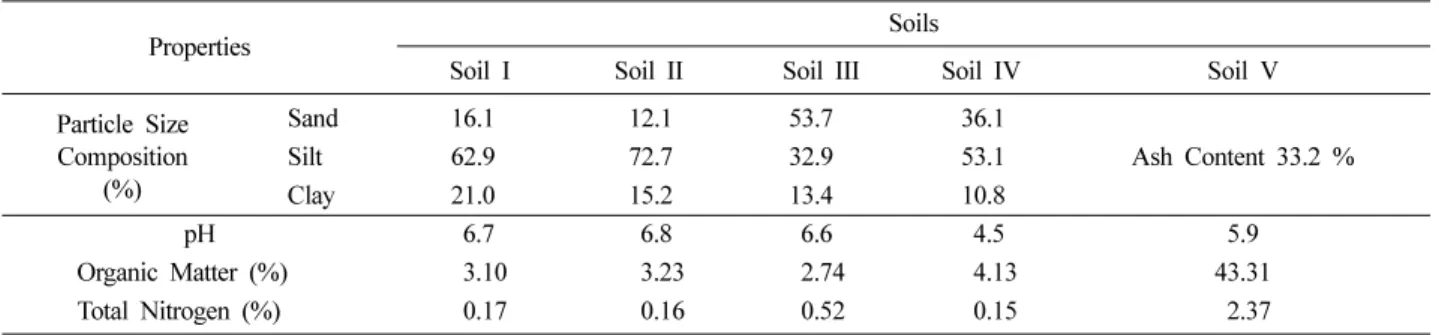
Standard-grade atrazine was purchased from Chem Service, Inc. (West Chester, PA), and pesticide grade toluene was obtained from Sigma Aldrich (St. Louis, MO). Soils used were collected from various areas inclu- ding agricultural and forest areas. Surface (0-20 cm depth) soils with different textures, pH values, organic matter content and land use were obtained. Soils I and II (Wooster silt loam soils) and Soil III (a Fremont sandy loam soil) were collected from an agricultural area in Ohio. Soil IV (a forest soil) was collected from Mohican State Park, Ohio, and had no known history of pesticide application. Soil V (a Muck soil) was obtained from the MUCK branch of OARDC at Celeryville, Ohio, and stored at green- house without further treatment.
Soil texture was analyzed by the hydrometer method (Buoyoucos, 1962). Total organic matter was analyzed using the method described by Combs and Nathan (1998), and total nitrogen was determined using a Carbon/Nitrogen Analyzer (Model MAX-CN, Elementar Americas, Inc., Mt. Laurel, NJ). Soil pH
Table 1. Selected properties of soils used for atrazine degradation study
Properties Soils
Soil I Soil II Soil III Soil IV Soil V
Particle Size Composition
(%)
Sand 16.1 12.1 53.7 36.1
Ash Content 33.2 %
Silt 62.9 72.7 32.9 53.1
Clay 21.0 15.2 13.4 10.8
pH 6.7 6.8 6.6 4.5 5.9
Organic Matter (%) 3.10 3.23 2.74 4.13 43.31
Total Nitrogen (%) 0.17 0.16 0.52 0.15 2.37
was measured by the glass electrode method (McKea- gue, 1978) in a ratio of 1 : 1 (w/v, soil/water suspen- sion). The properties of the soils used are summarized in Table 1.
2.2. Application, extraction, and determination of atrazine
Atrazine stock solution was prepared by dissolving 20 mg of atrazine in 1 mL of methanol. All experi- ments in which soils were treated with atrazine at various rates (4, 40 and 400 mg/kg soil) were prepared by applying the atrazine stock solution diluted in sterilized water. Soils were thoroughly mixed with added atrazine using a spatula to achieve uniform distribution of atrazine. The water content of soil reaction mixture was then adjusted to 25% (w/w) with sterilized water.
Atrazine was extracted from soil as follows. Eight mL of distilled water was added to 10 g soil in a 125-mL high-density polyethylene (HDPE) bottle, and was vortexed to disperse soil particles. Ten mL of pesticide-grade toluene was added, and the soil-water- toluene mixture was shaken on a horizontal shaker at 120 strokes per min for 1 hr. The mixture was then centrifuged at 8,000 × g for 10 min, and a 2-mL aliquot of the toluene layer was transferred to a 5-mL glass vial and stored at 4
oC until analyzed. Tests indicated that samples could be stored for several months in the glass vials without changes in atrazine concentration.
To extract atrazine from microbial cultures used for Most Probable Number (MPN) determination, 0.8 mL aliquot of the culture was transferred to Eppendorf tube, and the equal volume of pesticide-grade toluene was added. After mixing on a vortex shaker for 1 min, the mixture was centrifuged at 15,000 rpm ( 10,000 × g) in a microcentrifuge for 10 min, and 0.5 mL of the toluene layer was transferred to a 5-mL glass vial and was stored at 4
oC until analyzed. As for the atrazine extracted from soil, these samples could be stored for several months without changes in atrazine concentration.
Atrazine concentration in the extracts was determined with a Varian 3700 gas chromatograph equipped with a 3% OV-1 on 100/200 Supelcoport packed column
(3 m in length) and a nitrogen-specific thermionic detector. Helium was used as a carrier gas at a flow rate of 28 mL/min. Temperatures were set to 210
oC for the injector, 250
oC for the column, and 310
oC for the detector. The retention time for atrazine was 2.10 min. The average recovery rate of atrazine from soils, when atrazine-treated sterile soils were left at room temperature for 24 hours, was between 82 and 95%
at low atrazine treatment rate (4 mg/kg), and above 95% at higher treatment rates (40 mg/kg or higher).
The average recovery rate of atrazine under the condition used for MPN was 95%.
2.3. Monitoring the rate of atrazine degradation Atrazine degradation in this study was monitored by disappearance of parent material during incubation.
Disappearance of atrazine was measured based on the amount of extractable atrazine remaining in soils. The amount of atrazine degraded by microorganisms was calculated by subtracting the amount of extractable atrazine remaining in non-sterile soil from that of sterile soil at certain time of incubation. The rate of degradation was primarily expressed by plotting per- centage of atrazine remaining at various incubation times compared to the amount of atrazine extracted at time zero immediately after the treatment. The soil reaction mixture was divided into 10 g (as dry weight) subsamples and the subsamples were placed into 125- mL HDPE bottles. Bottles were loosely capped and incubated at 25 ± 2
oC. The averaged amount of atrazine initially recovered from triplicate samples at the beginning of the incubation was counted as 100%.
For the test of significant statistical difference in atrazine degradations (as measured by percent recovery of atrazine), Analysis of Variance (ANOVA) was con- ducted for each incubation time.
2.4. Creation, evaluation, and preservation of enhanced or activated soil
Soils I-V (Table 1) were treated with atrazine at a rate of 4 mg/kg to check the ease of enhancement in a range of soils. Additional treatment of atrazine was applied by two more times only when the extractable
≈
atrazine remaining in soil dropped to the levels less than 20% of the initially recovered amount. Therefore, there was only one treatment of atrazine at a rate of 4 mg/kg for Soil IV and V. These soils treated with atrazine were referred to as “enhanced soil.”
Soil activation was achieved by direct enrichment, or acclimation, of atrazine-degrading microorganisms. Soil I was treated three times with atrazine at a rate of 4 mg/kg soil. Atrazine dissipation rate was monitored by the method previously described in section 2.3, and additional atrazine was applied when there was no apparent change for 6 days. During activation total microbes utilizing atrazine as carbon source, and those utilizing atrazine as nitrogen source were counted (see section 2.5). This “activated soil” hereafter, unless otherwise specified, is the soil used as an inoculant for the subsequent experiments.
The activated soil was moisturized to obtain a water content of 25% (w/w) and placed in a plastic container with lid in a cold room (10
oC) for storage.
2.5. Enumeration of soil microorganisms
Total microorganisms capable of utilizing atrazine as a carbon or nitrogen source in soil were counted based on MPN method (Alexander, 1982) with a slight modification. TGYe (0.5% tryptone, 0.1% glucose, and 0.25% yeast extract, w/v) was used as a medium for culturing total bacteria. The basal minimal salts nitrogen medium(BMN, described in Behki and Khan, 1986) was supplemented with atrazine (4 mg atrazine/L) and used for microorganisms utilizing atrazine as carbon source. The modified atrazine medium, described by Mandelbaum et al. (1993), containing 4 mg atrazine/L was used for bacteria that can utilize atrazine as a sole nitrogen source. Five replicates of MPN tubes were incubated at 25 ± 2
oC for 7 days. Positive tubes for total bacteria were identified by visual turbidity.
Those for atrazine utilizing bacteria were determined based on the amount of atrazine remaining in tubes and extracted by the method described in the previous section, after 7 days of incubation. Tubes containing atrazine less than 20% of the initial concentration were considered positive.
2.6. Inoculation of contaminated soil with activated soil
Inoculation of contaminated soils with activated soil and evaluation of its effect on degradation of atrazine were performed as follows. The artificially atrazine- contaminated soils were prepared by applying atrazine to target soils (Soil II, III, IV, and V) at a rate of 4 mg/kg soil. Then the atrazine-contaminated soil was inoculated with activated soil at different rates (0.05, 0.5, and 5%, w/w), and the mixture was divided into 10-g (as dry weight) subsamples and placed into 125- mL HDPE bottles and loosely capped. These bottles were incubated in a temperature-controlled incubator (25 ± 2
oC). Triplicate samples were selected at each time of incubation, and the atrazine remaining in soil was extracted and analyzed as described in section 2.2. Atrazine remaining (calculated as a percentage of atrazine initially added and recovered) vs. incubation time was plotted.
For test of significant statistical difference among atrazine degradations (as measured by percent recovery of atrazine) in soils non-inoculated and inoculated with activated soil at different rates, ANOVA was conducted for each individual incubation time for each contaminated soil.
2.7. Stability of activated soil
Stability of activated soil, in terms of atrazine- degrading activity, was investigated by first adjusting water content of activated soil to 25 (w/w), and then storing it at different conditions. Four different storage conditions were imposed as follows: (1) at room tem- perature without soil water content adjustment; (2) at room temperature and with soil water content maintained between 15 and 25 %; (3) at low temperature (10 or 4
oC), and (4) at frozen state ( − 20
oC). Results observed at 10 and 4
oC were found to be almost identical, and thus these two conditions were combined and regarded as one condition.
2.8. Statistical analysis
All statistical analyses were done using MINITAB
(ver. 13.1, MINITAB Inc., State College, PA). AVOVA
was done using the General Linear Model menu of MINITAB, and the least significant difference (LSD) was calculated at 5% level.
3. Results and Discussion
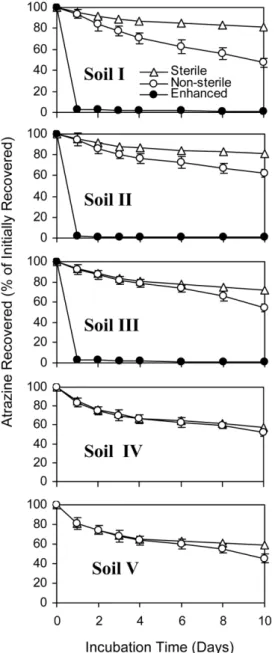
3.1. Rates of atrazine degradation in various soils Dissipation of atrazine in natural (non-sterile) soils, presumably disappearance due to biological and/or
nonbiological processes (such as adsorption, volatili- zation, etc.), was relatively slow (Fig. 1). After 10 days of incubation, about 50 to 70 % of the atrazine initially recovered (added initially at 4 mg/kg soil rate) still remained in the soils tested. Atrazine biodegradation seemed to be relatively high in typical agricultural soils (e.g., Soil I, II and III) that may have received previous application of s-triazine herbi- cide, and atrazine degradation was easily enhanced by repetitive applications of atrazine.
In non-agricultural soil (Soil IV and V), however, both atrazine degradation and enhancement were not observed (Fig. 1). This might be due to the soil pH (a low pH of 4.5 in Soil IV) and organic content (as high as 43% in Soil V).
3.2. Creation of atrazine-activated soil
Atrazine-degrading microorganisms were enriched in soil by applying atrazine (4 mg/kg soil) for three consecutive treatment cycles. The soil used was a Wooster silt loam (Soil I) found to have a higher atrazine degrading activity than the other soils tested.
The changes during enrichment process are shown in Fig. 2. The extractable atrazine concentration was reduced much faster during the second atrazine treat- ment cycle, compared to the first atrazine treatment at a rate of 4 mg/kg soil. The extent of atrazine degradation also increased with each successive treatment cycle; the amount of extractable atrazine remaining in soil was less with each successive treatment.
The number of total bacteria remained almost constant during all three treatments. However, the number of microorganisms utilizing atrazine as a carbon source and a nitrogen source increased by about 3 logs and 1 log of magnitude, respectively, after three treatments. In this study, the population changes during enrichment were not monitored after the third treatment cycle of atrazine. However, further enrichment of atrazine-degrading microorganisms might be possible with additional cycles of atrazine application at the same rate, or by a single treatment at a higher atrazine application rate. The rate of atrazine degradation seemed to be relatively easily enhanced, which is in
Fig. 1. Degradation and disappearance of atrazine in various soils.
Soils treated with atrazine at a rate of 4 mg/kg soil were incubated at 25±2oC. Error bars represent Least Significant Difference (LSD) between treatment means at given incubation time.
contrast to the fact that enhanced atrazine biodegra- dation by repetitive application has rarely been reported.
The soil prepared by the process described above, which contained an enriched number of atrazine- degraders, is defined as activated soil.
3.3. Atrazine degradation in activated soil
Many chemicals, not toxic at low concentrations and easily biodegraded, are known to become toxic when concentrations exceed their threshold levels. For example, among various factors investigated (e.g., soil type, pH, moisture content, organic matter content, microbial activity, and pesticide concentration), pesticide concentration was found to be the most important factor affecting degradation rate of pesticide mixture of atrazine, captan, carbaryl, 2,4-D, diazinon, fenitro- thion, and triflurarin when treatments of 100 and 1,000 mg pesticide/kg soil were compared (Schoen and Winterlin, 1987). Degradation rates in soils treated with pesticide at a rate of 1,000 mg/kg soil were much lower than in soil treated at a rate of 100 mg/kg soil.
In this study, the degradation rates were compared when atrazine was applied at different concentra- tions(4, 40, and 400 mg/kg soil). A short acclimation or lag period (<1 day) seemed to exist in the activated soil treated with atrazine at a rate of 400 mg/kg soil,
whereas degradation began immediately in the activated soil treated with atrazine at a rate of 4 mg/kg soil (Fig. 3). The overall degradation pattern observed was similar to the results reported by Gan et al. (1996), who found that the amount of atrazine degraded in soil under laboratory conditions also increased propor- tionally with the increase of concentration of atrazine over the range of 5, 50, 500, and 5000 mg/kg. On the other hand, Grigg et al. (1997) reported incom- plete and lower extent of atrazine degradation at a very high initial concentration of atrazine (0.046 mole/
Fig. 2. Atrazine degradation and enrichment of atrazine-degrading microorganisms in soil. Application rate of atrazine at the beginning of each treatment cycle was 4 mg/kg soil.
Fig. 3. Degradation of atrazine as a function of atrazine concen- tration in activated soil. Error bars represent Least Significant Difference (LSD) among treatment means at given incubation time.
kg 10,000 mg/kg, and 0.23 mole/kg 50,000 mg/kg) by a mixed microbial population. According to the authors, the decreased and the incomplete degradation resulted from decreasing atrazine bioavailability and phosphorous depletion, respectively, rather than the inhibitory effect of high concentration.
Based on the earlier studies (Gan et al. 1996; Grigg et al. 1997) and this report, atrazine degradation by soil microorganisms does not seem to be inhibited even at quite high concentration of atrazine.
3.4. Effect of inoculation of activated soil on atrazine degradation
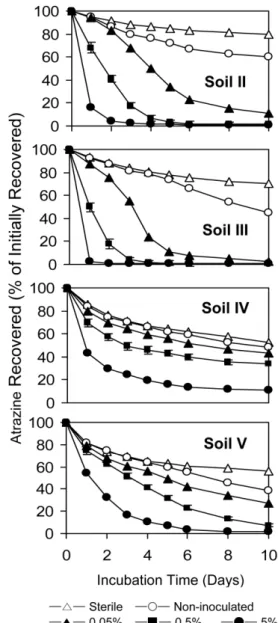
Inoculation of natural soils with activated soil significantly increased the degradation of atrazine, and the effects of inoculation rates on atrazine degradation in various soils are shown in Fig. 4. Atrazine degradation rates and extents increased with increased inoculation rates ranging from 0.05 to 5% (w/w) on dry weight basis. In all soils inoculated with activated soil at 5% rate, atrazine concentrations were reduced very rapidly from the beginning of incubation.
Previously, several studies have shown the accelerated degradation of atrazine in soils augmented with cultured cells (Assaf and Turco, 1994; Yanze Kontchou and Gschwind, 1995) or non-sterile poultry litter (Gupta and Baummer, 1996). Lower degradation in the high organic soil or low pH soil is in agreement with the results given by Yanze Kontchou and Gschwind (1995), who have shown that inoculation of soil with a Pseudomonas strain was less efficient at reduced water contents, limited oxygen supply, low pH, and high organic content of soil.
Similar to degradation patterns observed in the non- activated soils (refer to Fig. 1), inoculation effects were greater in soils with neutral pH and low organic matter content (< 10%). A pH value of 4.5 in Soil IV may have inhibited microbial growth or inactivated enzyme function. Lower degradation rate in the Soil V may have been attributed to either lower bioa- vailability of atrazine because of sorption to organic matter or presence of other substrates that are preferred over atrazine as a carbon source for the microbial population.
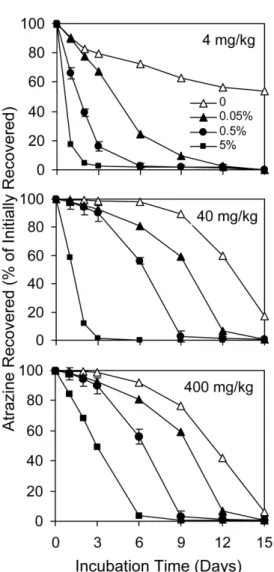
The relationship between inoculation rate and atrazine concentration on atrazine degradation in Soil II (Fig. 5) revealed that degradation of atrazine started with a short lag when atrazine was applied at a higher rate (40 or 400 mg/kg). Once started, however, degradation was rapid, even in the non-inoculated soils. It seemed that when atrazine was applied at a higher rate (40 or 400 mg/kg soil), it quickly stimulated atrazine degrading activity. This lag in the development of degradation was not evident at application rate of
Fig. 4. Effect of inoculation rate of activated-soil on degradation of atrazine in soils treated with atrazine. The rate of atrazine applied to soil was 4 mg/kg soil. Error bars represent Least Significant Difference (LSD) among treatment means, excluding that of sterile soil, at given incubation time.
4 mg/kg soil, and stimulation of atrazine degradation was not observed during 15 days of incubation. The extent of degradation in non-inoculated soil treated with atrazine at a rate of 4 mg/kg soil was low and almost completely stopped after only 50% of the initially applied atrazine was degraded. The reason for this might be low concentration of atrazine to support increase in atrazine-degrading microbial population. The results also show that a higher rate of inoculation reduced the lag period even at high atrazine concen- trations. The microbial population required for rapid degradation was delayed at the lowest inoculation rate (0.05%) but developed rapidly over just a few days
of time to achieve rapid atrazine degradation.
Grigg et al. (1997) suggested that a mixed culture could be used for bioremediation of atrazine at concentrations up to and exceeding those reported for agrochemical mixing-loading facilities; atrazine at agro- chemical mixing-loading sites in Illinois occurred at levels up to 1.9 mmole/kg soil ( 413 mg/kg soil).
On the other hand, this report suggests that activated soil containing directly enriched atrazine degrading microbial consortia is also an effective bioaugmen- tation option.
3.5. Effect of storage condition on stability of activated soil
Readily usable inoculum is required for immediate availability of inoculant for bioaugmentation and thus successful bioremediation. For practical use of inoculum for bioaugmentation, the inoculum must be stable during long periods of storage. Activated soil, in terms of atrazine degrading activity during storage under various conditions tested, was found to be very stable at least up to 6 months (data not shown).
4. Summary and Conclusion
The rates of atrazine degradation (defined as disap- pearance of parent atrazine) in natural soils were found to be relatively slow. Depending on soil type and properties, only about 30 to 50% of atrazine added to and initially recovered from non-activated natural soils (4 mg/kg) was degraded after 10 days of incubation at 25 ± 2
oC.
It was found that atrazine degrading microorganisms in Soil I (a Wooster silt loam) are readily enriched during repetitive application of atrazine at a rate of 4 mg/kg soil. After three treatments, the number based on MPN, of atrazine-utilizing bacteria as C- or N- source, increased by about 3 logs or 1 log of magnitude, respectively. Atrazine degradation was acco- rdingly accelerated. Increased levels of atrazine degradation were observed in other soils when they were treated with atrazine three times at a rate of 4 mg/kg soil. Exceptions were observed in Soil IV (a
≈
Fig. 5. Effect of inoculation rate on atrazine degradation when atrazine was applied at different concentrations. Artificially atrazine-contaminated Soil II was inoculated with different rates of activated soil. Error bars represent Least Significant Difference (LSD) among treatment means at given incubation time.
forest soil) and Soil V (a Muck soil), which might not be favorable for microbial growth and/or activity.
Inoculation of atrazine-contaminated soil with activated soil, resulted in significant increase in degradation of atrazine in contaminated soil. This result implies that the activated soil is an effective inoculant to stimulate atrazine degradation in the environments. The activated soil was stable at temperatures below 10
oC and moisture content above 15% further suggesting the potential usefulness of these materials to bioaugment the remediation of atrazine-contaminated environments.
References
Alexander, M., 1982, Most probable number method for micro- bial populations, In: Page, A.L., Miller, R.H., and Keeney, D.R.
(eds.),
Methods of Soil Analysis, 2nd ed., Part 2, American Soci- ety of Agronomy, Madison, WI, p. 815-820
Assaf, N.A. and Turco, R.F., 1994, Accelerated biodegradation of atrazine by a microbial consortium is possible in culture and soil,
Biodegradation,
5, 29-35.
Barriuso, E. and Houot, S., 1996, Rapid mineralization of the s- triazine ring of atrazine in soils in relation to soil management,
Soil. Biol. Biochem,
28, 1341-1348.
Behki, R.M. and Khan, S.U., 1986, Degradation of Atrazine by Pseudomonas: N-dealkylation and dehalogenation of atrazine and its metabolites,
J. Agric. Food. Chem,
34, 746-749.
Behki, R.M., Topp, E., Dick, W., and Germon, P., 1993, Metab- olism of the herbicide atrazine by Rhodococcus strains,
Appl.Environ. Microbiol
,
59, 1955-1959.
Bouquard, C., Ouazzani, J., Prome, J.-C., Michel-Briand, Y., and Plesiat, P., 1997, Dechlorination of atrazine by a
Rhizobiumsp.
Isolate,
Appl. Environ. Microbiol,
63, 862-866.
Buoyoucos, G.J., 1962, Hydrometer method improved for mak- ing particle-size analysis of soils,
Agron. J.,
53, 464-465.
Chung, K.M., Ro, K.S., and Roy, D., 1996, Fate and enhance- ment of atrazine biotransformation in anaerobic wetland sedi- ment,
Wat. Res.,
30, 341-346.
Combs, S.M. and Nathan, M.V., 1998, Recommended Chemi- cal Soil Test Procedures for the North Central Region, NCR Publication No. 221, Missouri Agricultural Experiment Station, Columbia, MO, p. 53-58
Donneley, P.K., Entry, J.A., and Crawford, D.L., 1993, Degrada- tion of atrazine and 2,4-dichlorophenoxyacetic acid by mycor- rhizal fungi at three nitrogen concentrations in vitro,
Appl.Environ. Microbiol
.,
59, 2642-2647.
Gan, J., Becker, R.L., Koskinen, W.C., and Buhler, D.D., 1996, Degradation of atrazine in two soils as a function of concentra- tion,
J. Environ. Qual.,
25, 1064-1072.
Gannon, E., 1992, Site remediation: environmental clean-up of fertilizer and agri-chemical dealer sites, 28 Iowa case studies, Iowa Natural Heritage Foundation, Des Moines, Iowa.
Goodrich, J.A., Lykins, Jr., B.W., and Clark, R.M., 1991, Drink- ing water from agriculturally contaminated groundwater,
J.Environ. Qual