
IEG 환경지질연구정보센터
6
0
0
전체 글
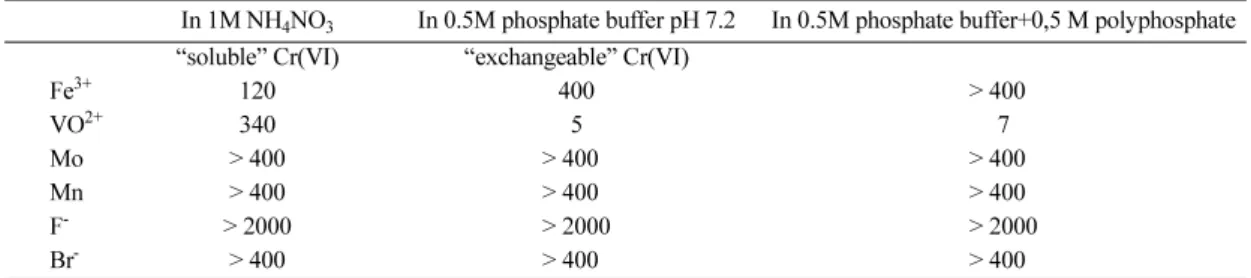
(2) Manfred Sager. 658. ulatory limit for chromate contents for waste deposits of 2 mg/kg, as well as chromate in effluents of 0.1 mg/L in Austria. Cr(VI) is stable in mineral nitrate and phosphate fertilizers as well as toxic to plant roots, and hazardous to ground water. In order to avoid abuse, the same limit of 2 mg/kg has been set for the use of mineral fertilizers used in agriculture. 2. MATERIAL AND METHODS. Fertilizer samples were crushed and homogenized in a rotating agate or a corundum mortar mill. Soil samples were air dried, and sieved minor 2 mm. The samples were weighed into glass Erlenmeyer flasks, 50 ml of various kinds of extractant solution was added, and shaken for 2 hours at ambient temperature. Occasionally, pH during extraction was determined with a glass electrode. After filtration, for spectrophotometric determination of hexavalent chromium, suitable aliquots of the extractant solution were pipetted into 50 ml volumetric flasks, some water was added to fill the vessel about ¾, then the samples were acidified with 5 ml 0.75 M H2SO4 (42 ml H2SO4 conc made up to 1 liter with H2O) and immediately 1 ml of diphenylcarbazide reagent (0, 5% solution in 1:1 acetone/water) was added, mixed, and made up to the mark. After 1-2 hours, the absorbance of the resulting violet color was measured at 542 nm. Calibrations were done with 2/4/8/10 (microliters) in 50 ml; however, the curve would be linear up to 50/60 µg for a 1cm cuvette. Oven dried K2CrO4 (Merck pro analysi) was weighed for the primary 1000 mg/liter calibration solution, which was diluted to 20 mg/liter for working purposes. The stability of Cr(VI) in the extractant solutions was frequently tested by adding K2CrO4-solution, solid CaCrO4, and solid PbCrO4 · PbSO4 pigment. (“Siccomin-yellow L 1523”, Reichhold Chemie AG, 1120 Wien, containing 9% Cr and 63% Pb) to the samples prior to wetting with the extractant solution. The recovery of hexavalent chromium in the color reaction was tested by addition of chromate solution prior to acidification. CaCrO4 was synthesized by heating stoichiometric amounts of dry CaCl2 (2.22 g) and K2CrO4 (3.92 g) in a porcellain crucible, and subsequently leached with 9 ml hot water. The structure of the product was checked by X-ray diffraction. 3. RESULTS. 3.1. Spectrophotometric determination. The final spectrophotometric determination of chromate with diphenyl carbazide in aqueous samples has been issued as an Austrian Standard Method (OENORM M) 6288 in 1991, and can be done easily (see also Oelschlaeger 1955, Froehlich 1959, Pilz 1966). During the color reaction time, improvement of the stability of the color was obtained by the use of acetone:water mixture 1:1 for the dye instead of ethanol. In the absorption spectrum, the maximum of extinction was very flat, and 542 nm, 544 nm, and 546 nm yielded equal sensitivity. In case of colored sample solutions (like alkaline soil extracts), the same amount of sample solution was acidified and diluted to 50 ml, but without dye, and taken as the sample blank. Chromate addition revealed, however, that Cr(VI) significantly reacted with the dissolved organics during the color reaction (see below). Interferences from inorganics were investigated in 1 M NH4NO3 and in 0.5 M phosphate buffer pH 7.2 (see Table 1), because these solutions yield the operationally defined fractions “soluble “chromate (German Standard DIN 19730), and “exchangeable” chromate (Kozuh ., 1994, Milacic and Stupar, et al. Interferences in the final spectrophotometric determination (µg in 50 ml). In 1M NH4NO3 In 0.5M phosphate buffer pH 7.2 In 0.5M phosphate buffer+0,5 M polyphosphate “soluble” Cr(VI) “exchangeable” Cr(VI) Fe3+ 120 400 > 4000 VO2+ 340 5 7 Mo > 400 > 4000 > 4000 Mn > 400 > 4000 > 4000 > 2000 > 2000 > 2000 FBr> 400 > 4000 > 4000. Table 1..
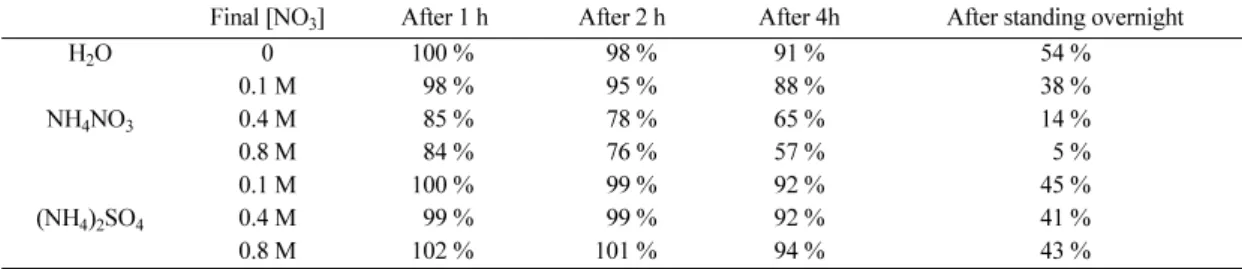
(3) About Chromium (VI) extraction from fertilizers and soils Stability of the color in nitrate and sulfate solutions in closed vessels. Final [NO3] After 1 h After 2 h After 4h 0 100 % 98 % 91 % H2O 0.1 M 98 % 95 % 88 % NH4NO3 0.4 M 85 % 78 % 65 % 0.8 M 84 % 76 % 57 % 0.1 M 100 % 99 % 92 % (NH4)2SO4 0.4 M 99 % 99 % 92 % 0.8 M 102 % 101 % 94 %. 659. Table 2.. Effect of humics on the recovery of Cr(VI). Color of soil extract Cr(VI)- addition at 542 nm before the extraction E=0.000 100% E=0.036 86% E=0.079 68% E=0.090 0 E=0.217 0. After standing overnight 54 % 38 % 14 % 05 % 45 % 41 % 43 %. Table 3.. 1995), respectively. Some of the P-fertilizer samples can strongly buffer themselves, thus the P-buffer concentration had to be increased from originally 0.1 M to 0.5 M, to maintain the pH within reasonable limits. Iodide is strongly interfering as well, but it cannot occur simultaneously with hexavalent chromium because of immediate redox reaction. High amounts of trivalent Fe could be masked in polyphosphate solution (Graham’s salt). Usually, the solubility of Fe and V at circumneutral pH is much lower than the limits found here. If the nitrate is the main component of the fertilizer investigated, nitric acid can be formed in the acidification step, which may fade away the dye (see Table 2). Fading in ammonium nitrate is not due to the oxidation of ammonium ions, as can be shown from stable colours in equivalent ammonium sulfate solutions. However, determinations are still possible, if the nitrate matrix is matched in the calibration curve. Staying overnight resulted in substantial color fadings.. 3.2. Effect of organics. For soils yielding appreciably colored soil extracts in phosphate buffer, addition of chromate before the extraction and immediately before the addition of the reagent showed that incomplete recovery derived mainly from the color reaction period (Table 3). The spike added at the start of the extraction could be recovered by standard addition to the coloured extract prior to the reagent, within certain limits.. Cr(VI)- addition before the determination 100% 081% 075% 038% -. Cr(VI) determination in the extract by standard addition 096% 105% No slope. In order to demonstrate the effect of co-extracted humics on Cr(VI) determination, a chernozem soil was extracted with 0.4 M NaOH to yield a brown organic rich solution. For this soil, adsorption of hexavalent chromium from phosphate buffer was just 5%, and from 0.4 M NaOH just 11%. When a substrate for growing bacteria (AgroBiosol) was extracted with 1 M NH4NO3, the recovery of 200 µg Cr(VI) added to 5 g sample was about zero. After membrane filtration of the extract through 0.450 µm, the slope of chromate determination in the extract was 92%, 61%, and 63% (3 replicates), but useless, as chromate was not stable in this sample.. 3.3. Addition of solid chromates. The extraction of minor amounts of K2CrO4 and CaCrO4 was not limited by their solubility. On or within clay minerals, adsorbed chromate anion is exchangeable. The recovery of chromate from PbSO4 · PbCrO4 (pigment “Siccomin Yellow”) added to the fertilizer samples was significantly lower for phosphate fertilizers, but variable, and seemed to have a maximum at pH 7.5-8.. 3.4. Effect of solid : liquid ratio during extraction. In order to test matrix and dilution effects, the solid : liquid ratio was varied widely (see Table 4), which significantly influenced the results, if aliquots were taken to reach the optimum determi-.
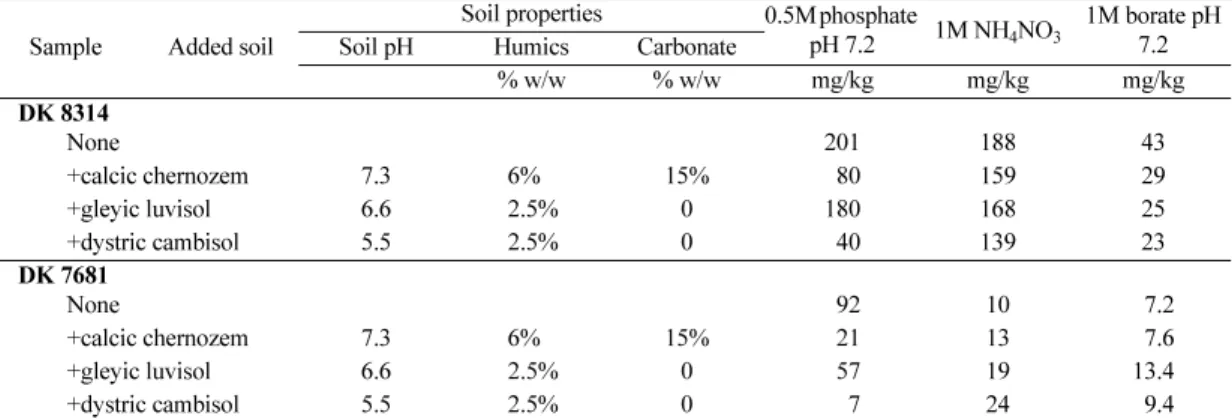
(4) Manfred Sager. 660. nation range. The validity of the calibrations was checked by standard additions.. 3.5. Effect of extractant pH. Slag and ash samples may contain appreciable amounts of alkaline compounds (see table 5). In case of significantly high extractant pH, recoveries are lowered because of hydroxide precipitation. The extracts were controlled for total chromium with flame atomic absorption (AAS). In order to maintain a more constant pH during extraction, therefore the concentration of the phosphate buffer extractant had been finally increased from 0.1 M to 0.5 M.. 3.6. Choice of various extractants. The extractant anion may effect the extraction efficiency by precipitation and ion exchange effects.. Extraction with borates was the lowest (see Table 6). From 0.1 M and 0.5 M phosphate buffer solutions, Ca-phosphates like CaHPO4 or Ca5(PO4)3OH should precipitate, but basic slags are usually low in Ca. pH shift due to sample dissolution and its effect upon the analytical result (1 g basic slag+50 ml 0.1 M phosphate buffer). pH before pH after Cr(VI) Total extraction extraction mg/kg Cr mg/kg 06.3 8.0 221 232 06.5 8.1 199 222 06.8 8.7 232 250 07.5 10.1 178 200 08.6 10.9 140 150 10.8 11.2 127 131 Table 5.. Effect of solid: liquid ratio upon Cr(VI) concentrations (mg/kg) found in basic slags. 1 M NH4NO3 0.5 M phosphate pH 7.2 Sample DK 10228 DK 8314 DK 7443 DK 10228 DK 8314 DK 7443 0.5 g /50 ml 14.0 200 1.0 g /50 ml 180 12.5 190 3.6 2.0 g /50 ml 1.9 118 0.8 9.1 143 2.9 5.0 g /50 ml 0.7 73 0.5 3.5 108 1.0 20 g / 50 ml 0.5 0.1 The experimental results indicate that the basic slag samples were surely the worst case of incomplete dissolution and re/adsorption in 1M NH4NO3 and 0.5M phosphate buffer oH 7.2. However, in order to achieve compatible results between various laboratories, the solid:liquid ration of the extractions should be standardized. Table 4.. Effect of various extraction solutions upon the Cr(VI) concentrations (mg/kg) found in basic slag. 1M 1M 0.5 M phosphate 0.5 M phosphate/ 0.5 M borate Saturated borax 2 g/50 ml ammonium nitrate ammonium sulfate buffer pH 7.2 polyphosphate pH 7.2 pH 9.6 DK 8314 118 132 144 59 54 DK 7681 00.7 4 95 72 2.3 17.5 DK10228 02.6 3 11 21 -. Table 6.. The effect of the interaction of soils with a basic slag on the recovery of Cr(VI). Soil properties 0.5M phosphate 1M NH NO 1M borate pH 4 3 pH 7.2 7.2 Sample Added soil Soil pH Humics Carbonate % w/w % w/w mg/kg mg/kg mg/kg. Table 7.. DK 8314. None +calcic chernozem +gleyic luvisol +dystric cambisol. 7.3 6.6 5.5. 6% 2.5% 2.5%. 15% 0 0. 201 080 180 040. 188 159 168 139. 43 29 25 23. 7.3 6.6 5.5. 6% 2.5% 2.5%. 15% 0 0. 092 021 057 007. 10 13 19 24. 07.2 07.6 13.4 09.4. DK 7681. None +calcic chernozem +gleyic luvisol +dystric cambisol.
(5) About Chromium (VI) extraction from fertilizers and soils. 661. Interlaboratory comparison of results for soil samples from a chromate - contaminated site in Nyiregyhaza/Hungary. Environmental Lab. Nyiregyhaza mg/kg This study Agric. University Debrecen Technical College Lab. Debrecen July 98 Oct. 97 March 98 Oct. 98 1997 March 98 Oct. 97 March 98 Extract → 1M NH4NO3 0.01M CaCl2 0.01M CaCl2 0.01M CaCl2 Sample I 18.2 ± 0.9 pH=4.5 24.0 ± 2.30 Sample II < 0.1 pH=3.9 0.22 ± 0.02 Sample III 02.1 ± 0.1 pH=3.9 2.24 ± 0.15 Sample IV 10.9 ± 0,4 pH=6.4 13.2 ± 1.0 11.5 ± 0.9 11.4 ± 0.40 11.4 ± 0.1 7.8 ± 0.4 15.0 ± 0.5 12.7 ± 0.1 Sample V 08.9 ± 0.3 pH=6.6 11.4 ± 0.6 08.5 ± 0.5 08.4 ± 0.50 08.8 ± 0.1 5.3 ± 0.1 11.1 ± 0.8 009.3 ± 0.03 Table 8.. 3.7. Recovery from mixtures of basic slags with soils. In a mixture of a basic slag and a soil (1 g+5 g), extracted chromate may react with other components from the soil or the basic slag, in particular with divalent Fe and humics. Table 7 shows the results obtained from extractions with phosphate and borate buffers of pH 7.2, as well as with unbuffered ammonium nitrate. If ion exchange is the main mechanism of Cr(VI) release, the affinity of phosphate to the solid is expected to be higher than of divalent chromate, tetraborate or monovalent nitrate, resulting in higher release into phosphate than into nitrate media. If the released Cr(VI), however, gets readily consumed by divalent Fe, nitrate may oxidize the divalent Fe more quickly than the chromate, and thus result in higher recovery.. 3.8. Interlaboratory comparison. For determination of hexavalent chromium in soils, no certified reference material has been available yet, because of the lack of long-term stability. Thus, an interlaboratory exchange of samples was arranged by the Central Laboratory of Debrecen Agricultural University, Hungary, which provided some alkaline and low organic carbon soils sampled at a contaminated site in Nyiregyhaza (Table 8). No additional information about the samples were given. In spite of the large scatter of results from the basic slags presented in this study, the results obtained for soil samples from different laboratories were satisfactory. The time scale of analysis indicates a gradual decline of the obtained concentrations of hexavalent chromium in the solid samples IV and V.. 4. CONCLUSIONS. Basic slags may contain appreciable amounts of hexavalent chromium. The recovery from circumneutral soutions for subsequent spectrophotometric determination with diphenylcarbazide may depend on the extractant pH, the anion of the extractant electrolyte and the solid: liquid ratio. In admixtures with soils, degradation of chromate may take place during the extraction step also. In order to achieve comparable results, there is a need to standardize the procedure. Results for samples from a chromate contaminated site, however, agreed satisfactorily within different labs, because soil organics and soil Fe may have already completely reacted during the contamination period. REFERENCES Barcelo J., Poschenrieder Ch., Vazquez M.D. and Gunse B. (1993) Beneficial and toxic effects of chromium in plants: solution culture, pot and field studies. In: Environmental contamination, pp. 147-171, J.P. Vernet ed., Elsevier Amsterdam. Bartlett R.J. and Kimble J.M. (1976) Behavior of chromium in soils: II. Hexavalent forms. J. Environ. Qual., 5, 383. Carey P.L., McLaren R.G., Cameron K.C. and Sedcole J.R. (1996) Leaching of copper, chromium and arsenic through some free draining New Zealand soils. Austr. J. Soil Res., 34, 583-597. Carey, P.L., Bidwell, V.J. and McLaren, R.G. (2002) Chromium (VI) leaching from large undisturbed soil lysimeters following application of a simulated copperchromium-arsenic (CCA) timber preservative. Austr. J. Soil Res., 40, 351-365. Farmer, J.G., Thomas, R.P., Graham, M.C., Geelhoed, J.S., Lumsdon, D.G. and Paterson, E. (2002) Chromium speciation and fractionation in ground and surface waters in the vicinity of chromite ore processing residue disposal.
(6) 662. Manfred Sager. sites. J. Environ. Monitor., 4, 235-243. Froehlich, F. (1959) Bestimmung kleiner Chromgehalte in Mineralen und Gesteinen mit Diphenylcarbazid. Fres. Z. Anal. Chem., 170, 383-387. Kozuh, N., Stupar, J., Milacic, R. and Gorenc, B. (1994) Optimization of extraction procedure for determination of total water soluble chromium and chromium (VI) in various soils. Int. J. Environ. Anal. Chem., 56, 207-217. Loyaux-Lawniczak, St., Lecomte, P., and Ehrhardt, J.J. (2001) Behavior of hexavalent chromium in a polluted groundwater: redox processes and immobilization in soils. Environ. Sci. Technol., 35, 1350-1357. Milacic, R. and Stupar, J (1995) Fractionation and oxidation of chromium in tannery waste- and sewage sludge amended soils. Environ. Sci. Technol., 29, 506-514. Neidhard, B., Herwald, S., Lippmann, Ch., and StrakaEmden B. (1990) Biosampling for metal speciation. I. Determination of chromate in the presence of Cr(III) by separation with cell membranes and GFAAS. Fres. J. Anal. Chem., 337, 853-859.. OENORM M 6288 (=Austrian standard method), issued Oct. 1st 1991: Wasseruntersuchung, Bestimmung voin Chrom(VI), spektrophotometrische Methode mit 1,5 Diphenylcarbazsid. Pilz, W. (1966) Die photometrische Mikrobestimmung kleinster Mengen Chromverbindungen in Luft. Fres. Z. Anal. Chem., 219, 350-359. Puls, R.W., Clark, D.A., Paul, C.J. and Vardy, J. (1994) Transport and transformation of hexavalent chromium through soils and into ground water. J. Soil Contam., 3(2), 203-224. Sager, M. (1996) Discrimination between Cr(VI) and Cr(III) load by sequential leaching methods. Die Bodenkultur, 47, 213-222. Zachara, J.M., Ainsworth, C.C., Cowan, C.E. and Resch, C.T. (1989) Adsorption of chromate by subsurface soil horizons. Soil Sci. Soc. Am. J., 53, 418-428.. 년 월 일 원고접수. 2004. 10. 18. 년 월 일 게재승인. , 2005. 12. 20. ..
(7)
수치

관련 문서
In conclusion, the growth and yield of potato was not different between mixed fertilizer(chemical fertilizer : liquid pig manure = 1:1) and the
The metal biopsy test of both specimens did not show any microscopic cracks in the heat affected zone and the base metal, and both samples were free from
A laboratory experiment was performed to investigate the removal of nitrogen and phosphorus from plating factory effluent using the soil column.. Soil,
Therefore, in this study, genetic tests were performed to investigate and identify the infections of Orientia tsutsugamushi, Ricekttsia genus, Anaplasma phagocytophilum ,
In this context, this study compared and analyzed a variety of soil decontamination methods used to evaluate the wide-area soil contaminated with Cs:
Fresh samples were immediately tested for antioxidant activity, and antioxidant activity was compared according to gestational age and measured the difference
Statistical analyses were performed using SPSS software (version 12.0, SPSS Inc, Chicago, IL, USA). Measurements of the alveolar bone thickness from the root
Fig. 34 The consist of magnetic and non-magnetic fractions of the 60min precipitate.. 자착물의 함량은 Fig. 35 The distribution of magnetic and non-magnetic fractions of
