• 검색 결과가 없습니다.

Effect of the Earth Pressure Coefficient on the Support System in Jointed Rock Mass

N/A
N/A
Protected

Academic year: 2021

Share "Effect of the Earth Pressure Coefficient on the Support System in Jointed Rock Mass"

Copied!
11
0
0

로드 중.... (전체 텍스트 보기)

전체 글

(1)

† Department of Civil Engineering, Daegu University (Corresponding Author : [email protected])

Effect of the Earth Pressure Coefficient on the Support System in Jointed Rock Mass

Moorak Son

・ Solomon Adedokun

1)

・ Youngcheol Hwang

2)

Received: October 31

st

, 2014; Revised: December 2

nd

, 2014; Accepted: January 9

th

, 2015

ABSTRACT : This paper investigated the magnitude and distribution of earth pressure on the support system in jointed rock mass by considering different earth pressure coefficients, rock types and joint inclination angles. The study mainly focused on the effect of the earth pressure coefficients on the earth pressure. Based on a physical model test (Son & Park, 2014), extended studies were conducted considering rock-structure interactions based on the discrete element method, which can consider the joints characteristics of rock mass. The results showed that the earth pressure was highly influenced by the earth pressure coefficients as well as the rock type and joint inclination angles. The effects of the earth pressure coefficients increased when the rock suffered more weathering and has no joint slide. The test results were also compared with Peck’s earth pressure for soil ground, and clearly showed that the earth pressure in jointed rock mass can be greatly different from that in soil ground. This study indicated the earth pressure coefficients considering the rock types and joint inclination angles are important parameters influencing the magnitude and distribution of earth pressure, which should be considered when designing the support systems in jointed rock mass.

Keywords : Rock excavation, Support system, Earth pressure, Earth pressure coefficient, Rock type, Joint inclination angle, Rock-structure interaction

Journal of the Korean Geo-Environmental Society 16(2): 33~43. (February, 2015) http://www.kges.or.kr

ISSN 1598-0820 DOI http://dx.doi.org/10.14481/jkges.2015.16.2.33

1. Introduction

Braced and underground excavations are extensively being utilized in congested urban areas for the construction of high- rise structures and underground facilities. However, the impact of these excavation works on the surrounding environment has become a major concern. Particularly, the miscalculation of earth pressure on excavation walls may cause the collapse of support systems in open cuts and eventually lead to the substantial time loss, financial damage, work stoppages, legal action, and compensation. Therefore, it is highly important to ensure the safety of support systems installed in underground structures and to minimize related problems (both social and economic ones). It is also necessary to clearly understand the behavioral characteristics of the ground and excavation walls and to have a clear understanding of ground-wall interactions.

The magnitude and distribution of earth pressure on the support walls caused by ground excavation works have been examined by several researchers through field measurements and physical model tests (Peck, 1969; Tschebotarioff, 1973;

Laio & Neff, 1990; Thompson & Miller, 1990; Lings et al.,

1991; Tanaka, 1994; Wong et al., 1997; Hashash & Whittle, 2002). Among them, Fig. 1 shows apparent earth pressure envelopes suggested by Peck (1969) and Tschebotarioff (1973), which are frequently used in practice for designing excavation support systems in soil ground. Numerical analyses have also been effectively utilized in many ways to predict the behavior of the of the excavation wall and the surrounding soil (Clough

& Hansen, 1981; Potts & Fourie, 1986; Clough et al., 1989;

Finno et al., 1991; Richards & Powrie, 1994; Goh et al., 1995; Hashash & Whittle, 1996; Ou et al., 1996; Lee et al., 1998; Hashash et al., 2003; Lawler et al., 2011; Worden &

Achmus, 2013). However, these existing studies were mainly

carried out on sandy and clayey soils but ground is made

up of not only soils but also rocks. There are also some

studies which measured the earth pressure on the retention

walls in multi-layered ground, including rocks (Chae & Moon,

1994; Jeong & Kim, 1997; Yoo & Kim, 2000). But these

studies only compare the earth pressure measured in multi-

layered soils with Peck’s earth pressure and the effects of the

earth pressure coefficients and joint conditions (joint inclination

angle and joint shear strength) were not considered. It is

(2)

Sand Soft to medium clay Stiff fissured clay (a) Apparent earth pressure (Peck, 1969)

Sand Temporary support in stiff clay Permanent support in medium clay (b) Apparent earth pressure (Tschebotarioff, 1973)

Fig. 1. Apparent earth pressure for soils very hard to find studies that have investigated the earth

pressure on support systems in rock strata containing systematic joints.

Few studies have examined the earth pressure in rock strata by considering ground-wall interactions and joint characteristics, which are important factors influencing the magnitude and distribution of the earth pressure. This might be due to the general misunderstanding that rock strata represent a better condition than soil ground. Recently, Son (2013), and Son

& Park (2014) presented the results of the earth pressures in jointed rock mass. Their results clearly showed that the earth pressure can be higher for rock strata than soil ground when the rock and joint characteristics are under unfavorable conditions, such as a joint condition that induces sliding and a weathered joint and rock condition. On the other hand, the earth pressure might be much lower than the soil ground when the rock conditions are favorable.

This study extended the previous studies, focusing on the effects of earth pressure coefficients for different rock types and joint inclination angles. Extended numerical parametric

studies were conducted by varying the earth pressure coefficient together with the rock types and joint inclination angles. The advantage of numerical analysis is not only various conditions can be considered easily with limited time, cost, and space, but also reproducible analyses are possible. This characteristic allows the effects of the earth pressure coefficients on the earth pressure to be investigated in various rock and joint conditions. The results from this study are expected to provide a better understanding of the earth pressure on the support system in a jointed rock mass that can experience different earth pressure coefficients.

2. Numerical approach and extended parametric study

The applied numerical approach in this study is similar to

the previous studies (Son, 2013; Son & Park, 2014), and the

following gives a brief description. The approach was verified

by the numerical simulation of a physical model test (Figs. 2

(3)

Fig. 2. Test preparation for physical model (Son & Park, 2014)

Fig. 3. Comparison between physical model test and numerical simulation (Son & Park, 2014) and 3) and the details of the verification are reported elsewhere

(Son & Park, 2014). The numerical approach was extended to this parametric study, which considered the effects of different earth pressure coefficients as well as rock types and joint inclination angles on the magnitude and distribution of earth pressure against the support in jointed rock masses.

To assess the characteristics of rock masses governed by joints, this study adopted 2-D Universal Distinct Element

Code (UDEC, 2004), which allows for large displacements between blocks. The rock blocks, wall and struts were simulated as separate elastic elements. The joints between the rock blocks and the interfaces between walls and rocks were modeled using the Coulomb slip model in which when the contact shear stress exceeds the contact shear strength the contact loses strength and sliding occurred.

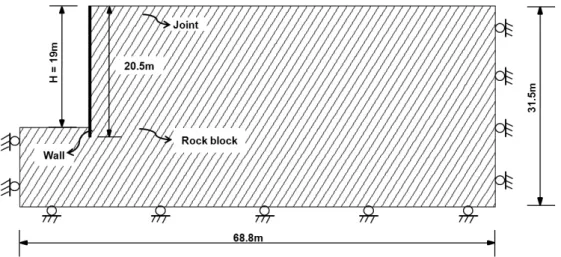
The analysis model was 68.8 m × 31.5 m and the excavation

(4)

Fig. 4. Numerical modeling (a case of joint inclination angle of 60°)

Table 1. Controlled parameters for numerical analyses Joint

Rock type Joint inclination angle (°) Joint shear condition Earth pressure coefficient

Hard 30, 60 Good 0.5, 1, 2, 3

Slightly weathered 30, 60 Fair 0.5, 1, 2, 3

Moderately weathered 30, 60 Poor 0.5, 1, 2, 3

wall was installed at the depth of 20.5 m (Fig. 4). The excavation width was assumed to be 20 m and the final excavation depth was 19 m. A strut-supported system was used because the apparent earth pressure (Peck, 1969), which was compared with this paper’s results, was obtained from many sets of comprehensive measurements of the strut load in strut-supported excavation walls for soil ground.

The study considered the different earth pressure coefficients and various arrangements of rock type and joint condition (Table 1). The joint inclination angle was measured in the anticlockwise direction from the horizontal plane, and the joint spacing was assumed to be 1 m to minimize the analysis time but to consider the effect of joints in the condition of the strut spacing of 3 m. For each of the cases, the analysis was carried out using soldier pile and timber lagging wall.

In order to reflect the general excavation procedures in the field, eight excavation stages were conducted to obtain the distribution and magnitude of earth pressure. Before the first excavation was carried out, the initial equilibrium was obtained with the at-rest earth pressure coefficient. At this stage, the boundary condition was a roller at each end of the two vertical boundaries and at the bottom boundary. After ensuring the initial equilibrium condition, all displacements were reset to zero and the wall was installed at a depth of 20.5 m. The

first excavation was conducted up to 1.0 m, followed by the installation of the first strut at 0.5 m over the excavation line. After the first excavation, there was additional excavation work every 3 m, which was followed by the strut installation at every 3 m interval (which is 0.5 m above each excavation line). Wall stabilization was ensured after each excavation stage. The final excavation was conducted up to 19.0 m, and no strut was installed in the final stage (see Fig. 5). Other analyses were also carried out for different earth pressure coefficients using the same procedures discussed above, whereas the earth pressure coefficients of 1.0, 2.0 and 3.0 were used to attain the initial equilibrium.

The shape of typical excavation wall (i.e. soldier pile and timber lagging wall) might have little effect on the earth pressure and wall displacement in the field as long as the flexural stiffness of the wall is equivalent. However, in a numerical analysis the shape may have a considerable influence on the results because of a stress concentration in modeling.

To address this issue, this study transformed the excavation

wall into a simple section to represent the equivalent flexural

stiffness of the wall (see Fig. 6). Table 2 shows the properties

of the wall, rocks, joints, and interfaces used in numerical

analysis. The assessment of the properties was discussed in

detail by Son & Yoon (2011).

(5)

Fig. 5. Excavation stages in numerical modeling (a case of joint inclination angle of 60°)

Table 2. Properties of wall, rock, joints and interfaces used in the numerical analysis

Rock type

Wall Rock and joint

Rock-Wall interface

Rock Joint

EI (MPa.m

4

)

Er

(MPa) υ γ

t

(MN/m

3

) Joint condition

c, σ

t

(MPa)

(°)

r

(°) k

n

(MPa/m) k

s

(MPa/m) c, σ

t

(MPa) δ (°)

k

s

(MPa/m) k

s

(MPa/m) Hard

23.20

1.0×10

5

0.2 2.7×10

-2

Good 0 50 35 2.33×10

5

0.96×10

5

0 33 2.33×10

5

0.96×10

5

Slightly weathered 1.0×10

4

0.22 2.6×10

-2

Fair 0 40 32 2.33×10

4

0.96×10

4

0 27 2.33×10

4

0.96×10

4

Moderately weathered 1.0×10

3

0.25 2.5×10

-2

Poor 0 35 31.5 2.33×10

3

0.96×10

3

0 23 2.33×10

3

0.96×10

3

EI = Wall bending stiffness, E

r

= Intact rock elastic modulus, υ = Poisson’s ratio, γ

t

= Unit weight of intact rock, c = Joint or interface cohesion, σ

t

= Joint or interface tensile strength,

= Joint friction angle,

r

= Joint residual friction angle, δ = Interface friction angle, k

n

= Joint or interface normal stiffness, k

s

= Joint or interface shear stiffness.

Fig. 6. Transformed section in numerical modeling

3. Effect of the earth pressure coefficient

The effect of the earth pressure coefficient on the magnitude

and distribution of the earth pressure in jointed rock masses

was investigated. The results of the investigation are discussed

(6)

Fig. 7. Comparison of the apparent earth pressure for hard rock

Fig. 8. Comparison of the total earth pressure between the numerical tests for hard rock and Peck’s empirical earth pressure below.

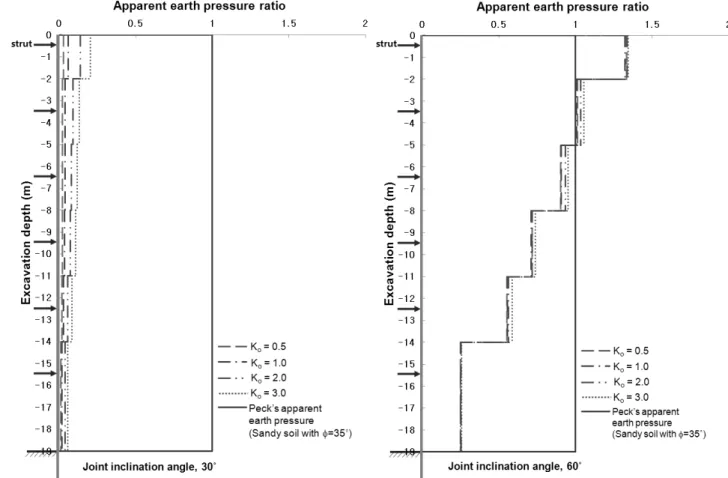
Fig. 7 compares the apparent earth pressure for hard rock with varying earth pressure coefficients and joint inclination angles with Peck’s empirical earth pressure based on the sand ground with friction angle of  = 35°. The apparent earth pressure ratio in the figure represents the ratio of the induced earth pressure from the numerical analysis to Peck’s

empirical earth pressure. Fig. 8 compares the total earth pressure ratios between the induced earth pressure from the numerical analysis for a jointed rock mass and Peck’s empirical earth pressure for the sand ground.

For a joint inclination angle of 30°, the apparent earth

pressures for all the earth pressure coefficients were very

small and showed slight differences between them. The earth

(7)

Fig. 9. Comparison of the apparent earth pressure for slightly weathered rock pressures were far lower than Peck’s soil earth pressure, and

the total earth pressure ratios increased from 0.02 for the earth pressure coefficient of 0.5 to 0.11 for the earth pressure coefficient of 3.0 (see Fig. 8). This result indicated that the earth pressure increased linearly with increasing earth pressure coefficient.

For a joint inclination angle of 60° where joint sliding was induced at the joint, the apparent earth pressures were similar regardless of the earth pressure coefficient, even though the higher earth pressure coefficient induced a slightly higher earth pressure. The induced earth pressures were significantly higher when compared with the results of a joint inclination angle of 30°. The apparent earth pressures were higher at the upper part of the excavation wall but decreased down the depth due to the increase of confining pressure with depth.

The total earth pressure ratios were approximately 0.72 for all the earth pressure coefficients. This result indicates that the effect of earth pressure coefficient for hard rock is insignificant when a rock mass is under the condition of joint sliding.

Fig. 9 compares the apparent earth pressure for slightly

weathered rock due to varying earth pressure coefficients and joint inclination angles with Peck’s empirical earth pressure based on a sand ground with friction angle of  = 35°. Fig.

10 compares the total earth pressure ratios between the induced earth pressure from the numerical analysis for a jointed rock mass and Peck’s empirical earth pressure for the sand ground.

For a joint inclination angle of 30°, the apparent earth pressures for all the earth pressure coefficients were significantly higher when compared to those of hard rock with a joint inclination angle of 30°, even though the induced earth pressures were lower than Peck’s earth pressure for soil ground. The results showed the earth pressure increased proportionally with the increase of earth pressure coefficient.

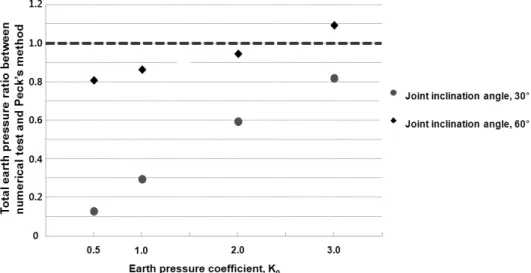
The total earth pressure ratios ranged from 0.13 for the earth pressure coefficient of 0.5 to 0.82 for the earth pressure coefficient of 3.0 (see Fig. 10).

For a joint inclination angle of 60° where a joint sliding

was induced, the apparent earth pressures were similar in

distribution to those of hard rock but were fairly higher in

magnitudes. The induced earth pressures showed the increase

in magnitudes as the earth pressure coefficients increased,

(8)

Fig. 10. Comparison of the total earth pressure between the numerical tests for slightly weathered rock and Peck’s empirical earth pressure

Fig. 11. Comparison of the apparent earth pressure for moderately weathered rock but the increasing rate was much smaller than that in the

joint inclination angle of 30°. The total earth pressure ratios ranged from 0.81 for the earth pressure coefficient of 0.5 to 1.10 for the earth pressure coefficient of 3.0. These results indicate that the effect of earth pressure coefficient increases as the rock condition becomes weathered more.

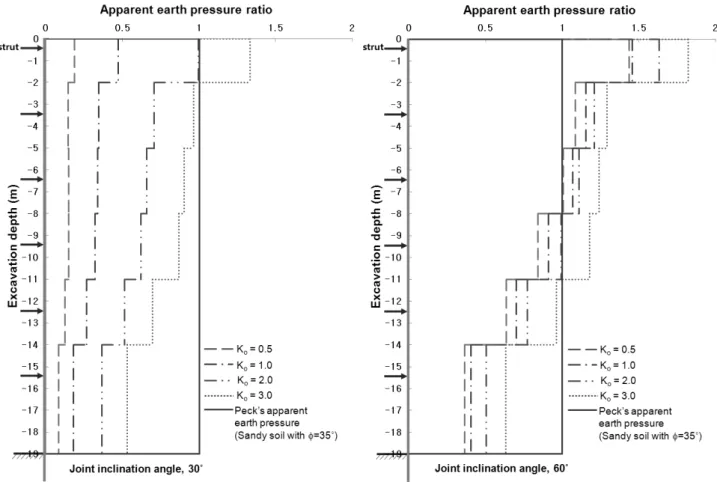
Fig. 11 compares the apparent earth pressure for moderately weathered rock due to varying earth pressure coefficients and joint inclination angles with Peck’s empirical earth pressure based on a sand ground with friction angle of = 35°. Fig.

12 compares the total earth pressure ratios between the induced

earth pressure from the numerical analysis for a jointed rock

(9)

Fig. 12. Comparison of the total earth pressure between the numerical tests for moderately weathered rock and Peck’s empirical earth pressure

mass and Peck’s empirical earth pressure for the sand ground.

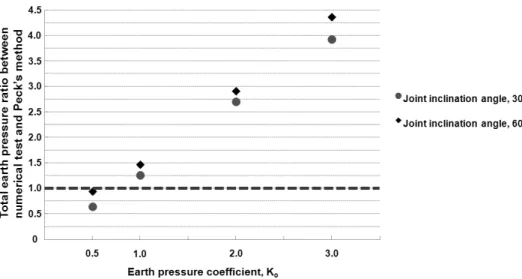
For a joint inclination angle of 30°, the induced earth pressures for all the earth pressure coefficients were significantly higher than those of hard and slightly weathered rocks due to the higher tendency of block displacement in moderately weathered rock. The results showed that earth pressures increased constantly with the increase of the earth pressure coefficient and the increase rate was much higher than that in slightly weathered rock. The apparent earth pressures were generally higher than Peck’s earth pressure for the sand ground of  = 35°, except for the earth pressure coefficient of 0.5. The total earth pressure ratios between the induced earth pressure and Peck’s earth pressure ranged from 0.65 for the earth pressure coefficient of 0.5 to 3.9 for the earth pressure coefficient of 3.0 (see Fig. 12).

For a joint inclination angle of 60°, the apparent earth pressures were fairly higher than the results of a joint inclination angle of 30°, and this indicates that a joint inclination angle has little effect on the earth pressure in moderately weathered rock when compared with those of hard and slightly weathered rock. The apparent earth pressures had a similar pattern to those of the joint inclination angle of 30° even though the earth pressures were a little higher.

The increase in the earth pressure with increasing earth pressure coefficient was significantly higher than those of hard and slightly weathered rocks. The total earth pressure ratios ranged from 0.95 for the earth pressure coefficient of 0.5 to 4.35 for the earth pressure coefficient of 3.0.

These results indicated that the effect of earth pressure

coefficient on the joint inclination angle was not that important for moderately weathered rock. However, the induced earth pressure increased significantly regardless of the joint inclination angle when compared with those of hard and slightly weathered rocks.

4. Conclusions

The magnitude and distribution of the earth pressure on a support system in jointed rock mass were investigated with controlled parameters including different earth pressure coeffi- cients, joint inclination angles, and rock types. The following conclusions were deduced from the results of this study:

(1) This study clearly indicated that the earth pressure coefficient

had significant effects on the magnitude and distribution

of the earth pressure against the support systems in

jointed rock mass. For hard and slightly weathered rocks,

the effect of earth pressure coefficient was more significant

in no joint sliding condition than the condition of joint

sliding condition. In addition, the effect of the joint

inclination angle decreased with increasing earth pressure

coefficient. For moderately weathered rock, the effect of

earth pressure coefficient was less important of the joint

inclination angle. As the rock type became weathered

more, the induced earth pressure became much higher

for a same earth pressure coefficient because of the higher

tendency of block displacement in more weathered rock.

(10)

(2) For hard rock, the induced earth pressure was relatively small for no joint sliding, even though the earth pressure increased linearly with increasing earth pressure coefficient.

The earth pressures were far lower than Peck’s soil earth pressure, and the total earth pressure ratios (induced earth pressure / Peck’s earth pressure) increased from 0.02 for the earth pressure coefficient of 0.5 to 0.11 for the earth pressure coefficient of 3.0. When a joint slid, the induced earth pressure increased significantly, but the effect of earth pressure coefficient was small. The total earth pressure ratios were approximately 0.72 for all the earth pressure coefficients.

(3) For slightly weathered rock, the effect of earth pressure coefficient on earth pressure was more apparent than in hard rock. The apparent earth pressure at a joint inclination angle of 30° were generally smaller than that of a joint inclination angle of 60°, but the difference was decreased with the increase of earth pressure coefficient. The total earth pressure ratios at the joint inclination angle of 30°

ranged from 0.13 for the earth pressure coefficient of 0.5 to 0.82 for the earth pressure coefficient of 3.0. When a joint slid, the total earth pressure ratios increased and ranged from 0.81 for the earth pressure coefficient of 0.5 to 1.10 for the earth pressure coefficient of 3.0.

(4) For moderately weathered rock, the induced earth pressures for all the earth pressure coefficients were significantly higher than those of hard and slightly weathered rocks due to the higher tendency of block displacement in moderately weathered rock. The earth pressures increased constantly with the increase of the earth pressure coefficient.

The total earth pressure ratios at the joint inclination of 30° ranged from 0.65 for the earth pressure coefficient of 0.5 to 3.9 for the earth pressure coefficient of 3.0.

When a joint slid, the total earth pressure ratios ranged from 0.95 for the earth pressure coefficient of 0.5 to 4.35 for the earth pressure coefficient of 3.0. This result indicated that the effect of earth pressure coefficient on the joint inclination angle was not that important for moderately weathered rock.

(5) The magnitude and distribution of the earth pressure on a retaining wall in a jointed rock mass are strongly affected by the earth pressure coefficient, together with the joint inclination angle and rock type. The study results were compared with Peck’s earth pressure for a

soil ground. The comparison indicated that the induced earth pressure in a jointed rock mass can be significantly different from that in soil ground, and therefore a careful consideration of rock and joint conditions should be given for estimating earth pressure in a jointed rock mass.

References

1. Chae, Y. S. and Moon, I. (1994), Earth pressure on retaining wall by considering local soil condition. Korean Geotechnical Society ’94 fall conference paper, pp. 129~138.

2. Clough, G. W. and Hansen, L. (1981), Clay anisotropy and braced wall behavior, Journal of Geotech. Eng., ASCE, Vol.

107, No. 7, pp. 893~913.

3. Clough, G. W., Smith, E. M. and Sweeney, B. P. (1989), Movement control of excavation support systems by iterative design, Foundation Engineering: Current Principles and Practices, ASCE Geotechnical Special Publication, Vol. 22, pp. 869~884.

4. Finno, R. J., Harahap, I. S. and Sabatini, P. J. (1991), Analysis of braced excavations with coupled finite element, formulations, Computers and Geotechnics, Vol. 12, No. 2, pp. 119~143.

5. Goh, A. T. C., Wong, K. S. and Broms, B. B. (1995), Estimation of the lateral wall movements in braced excavations using neural networks, Canadian Geotech. Journal, Vol. 32, No. 6, pp. 1059~1064.

6. Hashash, Y. M. A., Marulanda, C., Ghaboussi, J. and Jung, S.

(2003), Systematic update of a deep excavation model using field performance data. Computers and Geotechnics, Vol. 30, pp. 477~488.

7. Hashash, Y. M. A. and Whittle, A. J. (1996), Ground movement prediction for deep excavations in soft clay, Journal of Geotech.

Eng., ASCE, Vol. 122, No. 6, pp. 474~487.

8. Hashash, Y. M. A. and Whittle, A. J. (2002), Mechanism of load transfer and arching for braced excavations in clay. Journal of Geotech. and Geoenviron. Eng., Vol. 128, No. 3.pp. 187~197.

9. Jeong, E. T. and Kim, S. G. (1997), Case study of earth pressure distribution on excavation wall of multi-layered soil.

Korean Geotechnical Society ’97 spring conference paper, pp.

78~80.

10. Laio, S. S. C. and Neff, T. L. (1990), Estimating lateral earth pressure for design of excavation support, Proceedings, Design and Performance of earth retaining structures, ASCE special conference, Ithaca, New York, pp. 489~509.

11. Lawler, M., Farrell, E. R. and Lochaden, L. E. (2011), Comparison of the measured and finite element-predicted ground deformations of a stiff lodgement till, Canadian Geotech. Journal, Vol. 48, No. 1, pp. 98~116.

12. Lee, F. H., Yong, K. W., Quan, K. C. N. and Chee, K. T.

(1998), Effect of corners in strutted excavations: field monitoring and case histories, Journal of Geotech. and Geoenv., ASCE, Vol. 124, No. 4, pp. 339~349.

13. Lings, M. L., Nash, D. F. T., Ng, C. W. W. and Boyce, M.

D. (1991), Observed behavior of a deep excavation in Gault

clay. A preliminary appraisal, Proceedings of the Tenth European

(11)

Conference on Soil Mechanics and Foundation Engineering, Vol. 10, No. 3, pp. 467~470.

14. Ou, C. Y., Chiou, D. C. and Wu, T. S. (1996), Three-dimentional finite element analysis of deep excavations, Journal of Geotech.

Eng., ASCE, Vol. 105, Vol. 4, pp. 481~498.

15. Peck, R. B. (1969), Deep excavations and tunneling in soft fround.

State-of-the-Art report, Proceedings of the 7th International Conference on Soil Mechanics and Foundation Engineering, Mexico City, State-of-the Art Volume, pp. 225~290.

16. Potts, D. M. and Fourie, A. B. (1986), A numerical study of the effect of wall deformation on earth pressures. Intern. Journal of Numerical Ana. Methods in Geomech. Vol. 10, No. 4, pp.

383~405.

17. Richards, D. J. and Powrie, W. (1994), Finite element analysis of construction sequences for propped retaining walls, Geotechnical Engineering, ICE, Vol. 107, No. 4, pp. 207~216.

18. Son, M. (2013), Earth pressure on the support system in jointed rock mass, Canadian Geotech. Journal, Vol. 50, No. 5, pp. 493~502.

19. Son, M. and Park, J. (2014), Physical model test and numerical simulation of excavation wall in jointed rock mass, Canadian Geotech. Journal, Vol. 51, No. 5, pp. 554~569.

20. Son, M. and Yoon, C. (2011), Characteristics of the earth pressure magnitude and distribution in a jointed rockmass,

Journal of Korean Society of Civil Engineers, Vol. 31(6), pp.

203~212.

21. Tanaka, H. (1994), Behaviour of a braced excavation in soft clay and the undrained shear strength for passive earth pressure, Soil and Foundations, Vol. 34, No. 1, pp. 53~64.

22. Thompson, S.R. and Miller, I.R. (1990), Design, construction and performance of a soil nailed wall in Seattle, Washington, Design and Performance of Earth Retaining Structures, ASCE, Geotechnical Special Publication, Vol. 25, pp. 629~643.

23. Tschebotarioff, G. P. (1973), Foundations, Retaining and Earth Structures. 2nd Ed., MGH

24. Universal Distinct Element Code, UDEC (2004), User's Manual, Itasca Consulting Group, Inc., Minneapolis, Minnesota, U.S.A 25. Worden, F. T. and Achmus, M. (2013), Numerical modeling

of three-dimensional active earth pressure acting on rigid walls, Computer and Geotechnics, Vol. 51, pp. 83~90.

26. Wong, I. H., Poh, T. Y. and Chuah, H. L. (1997), Performance of excavations for depressed expressway in Singapore, Journal of Geoteh. and Geoenviron. Eng., Vol. 123, No. 7, pp. 617~625.

27. Yoo, C. S. and Kim, Y. J. (2000), Deep excavation in soil,

including rock with layers on retaining wall and apparent

horizontal displacement of earth pressure, Journal of Korean

Geotechnical Society, Vol. 16, No. 4, pp. 43~50.

수치

Fig. 1. Apparent earth pressure for soilsvery hard to find studies that have investigated the earth
Fig. 3. Comparison between physical model test and numerical simulation (Son & Park, 2014)and 3) and the details of the verification are reported elsewhere
Fig. 4. Numerical modeling (a case of joint inclination angle of 60°)
Table 2. Properties of wall, rock, joints and interfaces used in the numerical analysis
+5

참조

관련 문서

Although the coastal area of Jeju has already been developed, it has high pressure and demands for development continually increasing due to the increase

The purpose of this study to investigate the background of revision, educational objectives, organization, contents of the high school earth science curriculum

• When top earth condition is weak and the large cross section does not have bearing capacity, Temporary supports like rock bolts or shotcrete, 1D~2D. – Side Pilot

– Directly support earth until the shotcrete reach the required bearing capacity, distribute loads to shotcrete, and shape the tunnel cross section.

(Saturated zone is the zone in which the voids in the soil and rocks are filled with water at a pressure greater than atmospheric pressure).. (Unsaturated zone is the zone

‹ The science of Geophysics is the application of physics to investigations of the Earth, Moon and Planets3. × In

The 4-digit display shows the pump’s maximum flow rate (mL/min), pressure setting (PSI), the set upper or lower pressure limit (PSI), the actual pressure (PSI), or actual

“Characteristics of Meteorological Variables in the Leeward Side associated with the Downslope Windstorm over the Yeongdong Region.” Journal of the Korean