• 검색 결과가 없습니다.

Wind Vector Retrieval from SIR-C SAR Data off the East Coast of Korea

N/A
N/A
Protected

Academic year: 2021

Share "Wind Vector Retrieval from SIR-C SAR Data off the East Coast of Korea"

Copied!
13
0
0

로드 중.... (전체 텍스트 보기)

전체 글

(1)

Wind Vector Retrieval from SIR-C SAR Data off the East Coast of Korea

Tai-Sung Kim

1

, Kyung-Ae Park

2,

*, and Woo-Il Moon

3

1

Department of Science Education, Seoul National University, Seoul 151-748, Korea

2

Department of Earth Science Education/Research Institute of Oceanography, Seoul National University, Seoul 151-748, Korea

3

Research Institute of Oceanography/Department of Geophysics, University of Manitoba, Winnipeg MB R3T 2N2, Canada

Abstract: Sea surface wind field was retrieved from high-resolution SIR-C SAR data by using CMOD algorithms off the east coast of Korea. In order to extract wind direction information from SAR data, a two-dimensional spectral analysis method was applied to the normalized radar cross section of the image. An 180

o

-ambiguity problem in the determination of wind direction was solved by selecting a direction nearest to the wind vector of the ECMWF reanalysis data.

Comparison of the wind retrieval patterns with the ECMWF and NCEP/NCAR dataset showed RMS errors in the range of 1.30 to 1.72 ms

−1

. In contrast, comparison of wind directions revealed large errors of greater than 60

o

, which is enormously higher than the permitted limit of about 20

o

for satellite scatterometer winds. Compared with wind speed results from different algorithms, wind vectors based on commonly-used CMOD4 algorithm showed good agreement with those derived by other algorithms such as CMOD_IFR2 and CMOD5, particularly at medium winds from 4 to 8 ms

−1

. However, apparent discrepancy appeared at low winds (<4 ms

−1

). This study also addressed an importance of accurate wind direction data to improve the accuracy of wind speed retrieval and discussed potential causes of wind retrieval errors from SAR data.

Keywords: sea surface wind, SIR-C, SAR, CMOD, wind direction

Introduction

Sea surface wind has major effects on the heat flux variations of the upper ocean and the variations of mixed layer depth while controlling the ocean surface circulation through continuous air-sea interaction (Hsu, 2005). In addition, near-surface wind is an important atmospheric-oceanic variable to understand air-sea gas exchange of greenhouse gases through sea surface, modification of vertical thermal structure and distribution of deep-water nutrients. As there has been increasing interest in global climate change, the importance of the sea surface wind field has been emphasized with respect to climatology.

As remote sensing techniques of oceanography have been improved, satellite scatterometer instruments (e.g., NSCAT (National Aeronautics and Space

Administration Scatterometer) and QuikSCAT (Quick Scatterometer)) have been operated since 1997. The scatterometer can measure sea surface winds with an accuracy of 2 ms

−1

for wind speed and 20

o

for wind direction, and it can cover the global coverage every 1-2 days with 25-km spatial resolution. Conventional wind measurements such as winds from research vessels, coastal buoys, and mooring buoys have long been unable to provide us synoptic views of wind fields at global or regional scale. Satellite scatterometer observations have produced time-series wind fields with high accuracy, which contributed to understanding diverse aspects of new scientific discoveries including air-sea interaction, typhoon and hurricane mechanism, ocean general circulation, and so on. In spite of its great advantages, the application of the satellite scatterometers has an obvious limitation at coastal area. It is unable to observe wind vectors in the near- shore region within 50 km from the coast because of its own characteristics as a microwave sensor. The low resolution of the scatterometer measurements by

*Corresponding author: [email protected]

*Tel: 82-2-880-7780

*Fax: 82-2-784-3289

(2)

25 km has limited its applicability and usefulness in the coastal region. In particular, since the coastal lines of Korean peninsula are so complicated that the scatterometer winds are inappropriate for the studies of coastal phenomena and small-scale features related to air-sea interaction or air-sea-land multiple interactions.

Therefore, many oceanographic researchers have been increasingly paid attention to the wind vector estimation from SAR (Synthetic Aperture Radar) data, which can provide high-resolution wind vectors at the coastal area particularly.

Synthetic Aperture Radar (SAR) has the capability of high-resolution imaging so that detailed distribution of wind vectors including the coastal region can be retrieved, which is hard to be measured by scatterometers. This makes it possible to identify the characteristics of wind field variation at the coastal region and to introduce our understanding to fine-scale oceanic phenomena. As an all-weather microwave sensor, SAR is capable of imaging the ocean surface irrespective of atmospheric clouds and moisture except for some of extreme events. Therefore, SAR has a unique possibility to observe sea surface phenomena even at high sea state. For these reasons, many oceanographers regard the SAR sensor as an innovate tool to investigate the spatial variability of wind field, observing near-coastal and finer-scale wind fields.

Some of previous literature presented wind field retrieved from SAR data in the seas adjacent to Korea. Won et al. (1998) tested CMOD4 model (Stoffelen and Anderson, 1997) for estimation of wind speed using an ERS-1 (European Remote-sensing Satellite-1) SAR image acquired near Jeju island.

SAR-derived wind retrievals using Radarsat data with HH-polarization, which need to apply a polarization

ratio, were also attempted (Kim and Moon, 2002).

Yoon et al. (2006) applied CMOD5 algorithm (Hersbach, 2003) on Radarsat SAR ocean images and compared with real time marine meteorological data.

Kang et al. (2007) calculated the magnitude of wind from Radarsat-1 imagery off the coast of Jeju island in the Yellow Sea without any estimation of directional information of wind field. They have used C-band SAR data with relatively low spatial resolution. However, none of the previous researches has attempted to use SIR-C SAR data. Unlike other common SAR instruments, SIR-C SAR operated at C- band provided data with relatively narrow swath width (15 to 90 km) with sensor characteristics of multi- frequency and fully polarization. In this study, we utilized SIR-C SAR data in order to estimate wind field. SIR-C SAR produced a high-resolution imagery enough to extract fine-scale wind field and identify its spatial distribution.

The objectives of this study are to retrieve high- resolution wind vectors from the SIR-C imagery, to assess the accuracy of wind speed and direction driven by different CMOD algorithms, and to understand error characteristics of SAR-derived wind vectors and potential causes.

Data and Processing

SIR-C Data

The SAR imagery utilized in this study was collected with the Spaceborne Imaging Radar C-/X- band Synthetic Aperture Radar, SIR-C/X-SAR, operated during the second space shuttle SIR-C/X-SAR mission (SRL-2) in October 1994. Details of SIR-C/X-SAR are summarized in Table 1. SIR-C/X-SAR was Table 1. Characteristics of SIR-C/X-SAR system

Parameter C-band L-band X-band

Wavelength (cm) 5.8 23.5 3.1

Swath width (km) 15 to 90 15 to 90 15 to 40

Pulse length ( µs) 33.8, 16.9, 8.5 33.8, 16.9, 8.5 40

Orbital altitude (km) 225

Resolution (m) typically 30 × 30 on the surface

Look angle (deg) 17 to 63 from nadir

(3)

designed for measurig the radar backscattering at three different wavelengths, C-, L-, X-bands, for the fully polarization states, HH (Horizontally transmitted, Horizontally received), HV (Horizontally transmitted, Vertically received), VH, and VV. The swath of the SIR-C image varies from 15 to 90 km and its looking angle range from 17

o

to 63

o

from nadir.

We used SIR-C image close to the east coast of Korea which was taken at 5 h 31 m (UTC) on October 1, 1994 (Fig. 1). The center of the study area is located at 128.73

o

E, 38.82

o

N. The SIR-C data were obtained at C-band (5.8-cm wavelength) with full- polarizations including VV polarization appropriate for CMOD algorithms.

Wind and SST

The study area is far from the eastern coast of Korea by 40 km. It contains the North Korea region which is substantially inaccessible to us and unable to collect in-situ wind measurements. Currently, there is a meteorological station of KMA (Korea Meteorological Administration) and KHOA (Korea Hydrographic and Oceanographic Administration) at Sokcho. However, wind field, corresponding to the study period, has not been measured quantitatively till

a decade later. Instead, we have used ECMWF (European Center for Medium-range Weather Forecasts) interim reanalysis data and NCEP/NCAR (National Centers for Environmental Prediction/

National Center for Atmospheric Research) reanalysis data for the comparison of satellite-derived wind field.

ECMWF winds are near-surface winds at 10 m and have spatial resolution of 1.5

o

×1.5

o

. As other wind product, NCEP/NCAR reanalysis data, with about 1.8°

in longitude and 1.9

o

in latitude, were also used. Both reanalysis data at 6 h on the same date were used, which had a temporal difference with the time of SIR- C data by 30 minutes.

In order to examine some oceanographic phenomena, SST data from NOAA (National Oceanic and Atmospheric Administration) AVHRR (Advanced Very High Resolution Radiometer) were utilized to investigate sea surface temperature distribution. An individual NOAA image could not present cloud-free SST distribution covering the entire study area.

Accordingly, we composited several NOAA images from Research Institute of Oceanography, Seoul National University to produce a daily map of SSTs on the same date with SIR-C data.

Fig. 1. (a) Sea surface temperature distribution in the sea around Korea peninsula on 1 Oct 1994 and (b) the image of the nor-

malized radar cross section of the SIR-C image observed at 5 h 31 m (UTC) on the same day as (a).

(4)

Brief Flow of Processing

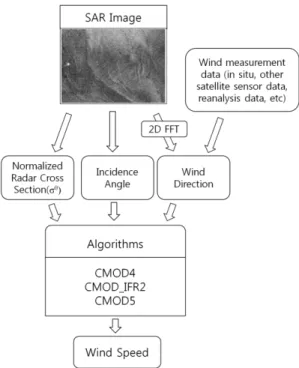
Figure 2 shows the schematic flow chart of SAR- derived wind retrieval procedure. First of all, the SIR- C SAR data was preprocessed to calculate normalized radar cross section (NRCS, σ

0

) values as well as incidence angles which were required to estimate wind speed and direction. Once after converting count values to the NRCS, SAR-derived wind retrieval algorithm requires wind direction information of the image. This can be derived from other measurement resources such as in-situ measurement, scatterometer wind data, or estimated values acquired from the imagery itself directly by using two-dimensional (2-D) Fourier transform spectrum analysis. In this study, we applied the last approach to obtain wind direction information.

After determinating the wind direction, we calculated wind speed from values of the NRCS by applying C-band algorithms such as CMOD4, CMOD_IFR2 (IFREMER-CERSAT, 1999), and CMOD5.

To validate and identify the characteristics of SAR- derived wind vector field, we compared the results

with the reanalysis data from ECMWF and NCEP/

NCAR.

Determination of Wind Direction

For performing the procedure of wind speed retrieval, it is necessary to obtain wind direction first prior to the speed of CMOD algorithms. As wind blows over the sea surface, linear features within km- scale are assumed to be caused by Langmuir circulations or roll vortices aligned with the mean wind direction (Gerling, 1972; Leibovich, 1983; Kim and Moon, 2002). Since the features are related to wind field observable on the SAR images, it is available to extract wind direction information from the SAR imagery directly by applying 2-D Fourier transform on the SAR image. Although the wind direction can be extracted directly from the SAR imagery, there is still a problem related to 180°

ambiguity. The 180

o

ambiguity can be removed by evidence within the image such as the lee due to wind shadowing (Thompson and Beal, 2000) or by comparing with climatological charts (Robinson, 2004). In this study, the 180

o

-ambiguity problem in the determination of wind direction was solved by selecting a direction nearest to the wind vector of ECMWF reanalysis data.

SAR Wind Retrieval Models

Many of experimental researches have been performed to characterize the relationship between surface wind and radar backscatter for decades. The data collected in these experiments formed the basis of the model functions used for the wind retrieval algorithms. Since the European Space Agency launched the ERS-1 SAR satellite, there have been attempts to retrieve wind vectors using SAR and the results of these works derived several well developed wind retrieval models. Among them, we used CMOD algorithms such as CMOD4, CMOD_IFR2, and CMOD5 algorithms appropriate for C-band frequency and VV polarization. These algorithms have been evaluated to characterize wind field relatively well.

The CMOD4 model is the most widely used form Fig. 2. Schematic flow chart of sea surface wind vector

retrieval procedure from SAR data.

(5)

out of the other models. This model was developed to fit the characteristics of to wind relationship observed from ERS-1 scatterometer by comparison with ECMWF model winds and conventional surface wind data from ship, buoy, or island reports. The functional form of relationship between and wind vector is given by the followings:

σ

0

=b

0

(1+b

1

cosφ+b

3

tanhb

2

cos2φ)

1.6

(1)

b

0

=b

r

10

α+γf1(ν+β)

(2)

f

1

(y)= (3)

where ν the wind speed, φ the direction of viewing relative to the wind direction which is φ=0

o

when viewing upwind, and α, β, γ, b

1

, b

2

, and b

3

are expanded as Legendre polynomials with 18 coefficients in total.

The CMOD_IFR2 model has been developed and used for wind product of ERS-1 and ERS-2 satellites.

In case of ERS satellite, a scatterometer sensor measures σ

0

from the fore-, mid-, and aft-beam over open water. As there was no relation between a measured σ

0

triplet at each beam model and a wind vector, the indirect process of inversion was used,

σ

0

=10

b0

(1+ b

1

cos φ+tanh(b

2

)cos(2 φ)) (4)

b

0

= α+β (5)

where α and β are coefficients as a function of an incidence angle as Legendre polynomials, and b

0

, b

1

, and b

2

are function of wind speed.

CMOD4 is known to underestimate high wind speeds. To solve this problem, new GMF (Geophysical Model Function) algorithm has been developed. The CMOD5 algorithm was established on the basis of the CMOD4 algorithm and optimized to estimate high wind speed sectors particularly. The form of CMOD5 model is:

σ

0

=b

0

(1+b

1

cosφ+b

2

cos2φ)

1.6

(6)

b

0

=10

α0+α1ν

f(a

2

ν, s

0

)

γ

(7)

f(s, s

0

)= (8)

where b

0

, b

1

, and b

2

are functions of wind speed and the incidence angle.

Results

Backscattering Coefficient

Before applying SAR-wind retrieval algorithms, SIR-C data was processed to extract the backscattering coefficients (NRCS values). For SIR-C multi-look complex full-polarization data, each pixel of digital number (DN) data has a format of 10 bytes. The DN values were decompressed to dimensionless power ratios by using a scale factor value at an each pixel.

The relationship between the decompressed value of power at an image pixel, I, and NRCS is as follows:

< I >=Kσ

0

+ KN(R)<N> (9) where < > indicates the spatial averaging of the pixel values around the target, K is an absolute calibration constant, KN(R) is noise gain of processor as a function of range R, and N is raw data noise power per a sample. In case of SIR-C calibration, the linear conversion factor K is given by value of 1 and the processor gain for noise data is given by 0. Hence, the decompressed power quantities were assumed to be NRCS values at the pixel. Out of the four polarization datasets, we selected σ

0

of VV polarization, most appropriate for wind retrieval, and converted to the NRCS values in a unit of dB.

Figure 1b shows the distribution of NRCS, where pixels with near-white colors are of larger values than those with gray or black colors. The values of σ

0

ranged from −25.4 dB to −6.0 dB and the mean of the values for the entire area amounted to −15.3 dB.

The upper part of the image has higher values (bright) while the bottom and middle parts have low values (dark). These features may be associated with oceanic phenomena at the sea surface. SST distribution in the study area as shown in Fig. 1a reveals that there are no significant fronts or eddies like the strong SST 10 y 10 ≤

10

y 10

10

< y ≤ 5 log

y 3.2 ⁄ y 5 >

⎩ ⎪

⎨ ⎪

ν

s s ⁄

0

( )

a

g s ( ) s s

0

, <

0

g s ( ) , s s ≥

0

⎩ ⎨

(6)

fronts off southeast coast of Korea induced by the northwestward-intruding the East Korea Warm Current. However, although the strength of the SST gradient is small in overall, eddy-like filaments and small-scale fronts are still weakly apparent in the central region of the study area. Abrupt changes in SST may modify wind speed and direction when winds blow across the fronts or eddies (Park and Cornillon, 2002; Park et al., 2006). The SSTs in the study region vary relatively within narrow range from 18 to 21°C. The distribution of the SSTs is not anticipated to affect or modify the wind vectors significantly.

Wind Direction

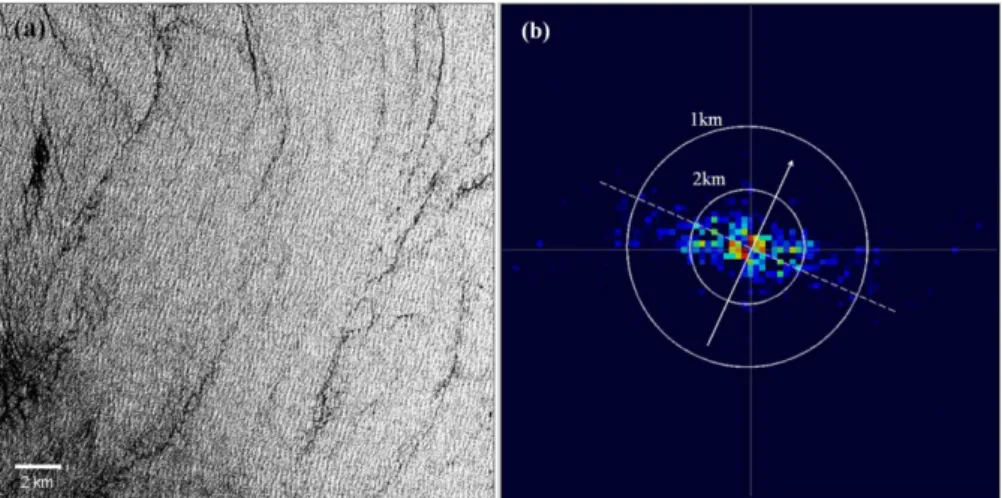
Figure 3a presents an example of a subset of SIR- C image with a size of 20 by 20 km. A number of linear streaks were shown over the whole of area and several thick dark streaks were also aligned in the image. It is known that Langmuir circulation or roll vortices align approximately with the mean wind due to the instability of MABL (Marine Atmospheric Boundary Layer) and these signatures tend to be shown up as dark and light streaks with km-scale on SAR images (Robinson, 2004). This fundamental knowledge enables us to estimate the wind direction

by performing 2-D Fourier transform analysis by using the SAR image data.

Figure 3b indicates the result of 2-D spectral analysis of the image in Fig. 3a. As the mean wind vector is reflected on the satellite image as linear features, energy spectra in a low wave-number domain was considered for determination of wind direction.

Since the direction passing through the spectral peaks is taken as normal to the local mean wind direction (Shuchman et al., 1994), there are two potential candidates of wind direction with 180

o

difference in angle as a dominant wind direction. We overcome the 180° ambiguity problem by comparing the two wind directions with those from reanalysis data and deciding one of the angles showing a lower direction difference between the estimated and the reanalysis ECMWF wind direction. In case of Fig. 3b, the estimated wind direction of the subset region was determined to 24.6

o

as designated as the arrow.

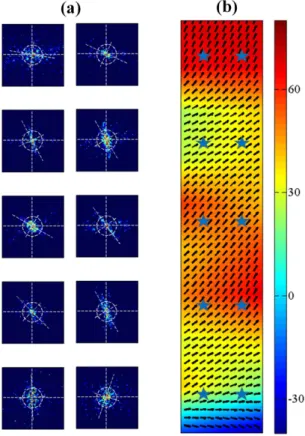
Figure 4a presents the examples of 2-D spectra of SIR-C image at 10 arbitrary stations marked as star- shaped symbols on Fig. 4b. The directions shown in Fig. 4b are the mean wind direction angles of a unit vector at each point. Those distribute from −37

o

to 69

o

, measured cyclonically from the radar look direction.

Fig. 3. (a) An image of normalized radar cross section of a small-size window extracted from the entire SIR-C image in the

study area, (b) 2-D FFT spectra of the image data (a), where the two white circles stand for radii of 1-km and 2-km wave-

length in a spatial domain and the arrow indicates wind direction perpendicular to the overall wind direction as marked in a

dashed line.

(7)

Retrieval of Wind Speed

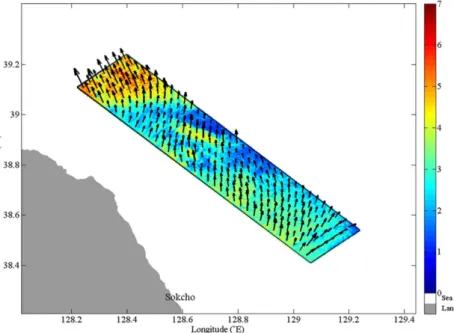
The magnitudes of wind vectors were estimated from SIR-C imagery by applying wind retrieval models. Fig. 5 demonstrates the SIR-C SAR wind retrieval result based on the CMOD4 algorithm.

Moderate winds (1 to 6 ms

−1

) were dominant in the study area in overall and relatively strong winds (>7 ms

−1

) appeared at the northern part of the image. Low winds of less than 1 ms

-1

were distributed on the right side of center partly, which were assumed to be in a calm sea state. The mean value and standard deviation of wind speeds were 3.0 ms

−1

and 1.14 ms

−1

, respectively.

In order to compare the result quantitatively, ECMWF and NCEP/NCAR wind vectors were extracted on the same date with SIR-C data because

we do not have any in-situ measurements in the study area. The extracted reanalysis wind vectors were linearly interpolated to 0.25

o

×0.25

o

grid. Figure 6 shows the wind vectors from ECMWF (Fig. 6a) and NCEP/NCAR (Fig. 6b) at 6h on 1 Oct 1994, where the colors of arrows stand for wind speeds in ms

−1

and the red box indicates the location of SIR-C image in this study. As a result of spatial interpolation, the vectors demonstrated the synoptic structure of wind field. SAR-derived wind result in Fig. 5 shows the detailed spatial distribution of wind field. RMS (root mean square) errors between the estimated wind values and reanalysis data were summarized in Table 2. Comparison of CMOD4-based winds with ECMWF data showed RMS errors by 1.30 ms

−1

and 63.43

o

. Concerning the wind direction, the error was extremely large of much greater than 20

o

as the permit range of the scatterometer winds.

Differences by Algorithms

Figure 7 shows wind vectors retrieved from the same SIR-C SAR data by using the different algorithms such as CMOD4, CMOD_IFR2, and CMOD5 models, where the background images are the magnitude of wind vectors. The general patterns of spatial distribution of wind speeds showed good agreement with each other, however, the magnitudes themselves revealed significant differences according to each applied algorithm. Out of the three algorithms, CMOD4 algorithm revealed significant difference from the result of CMOD_IFR2 or CMOD5. By contrast, there were no great differences between the results of CMOD_IFR2 and CMOD5.

In the case of CMOD_IFR2 and CMOD5, RMS Fig. 4. (a) Examples of 2-D spectra of SIR-C image at 10

arbitrary stations marked as star-shaped symbols on (b), where the two dash lines stand for the trends of dominant wind spectra direction and wind direction perpendicular to the spectra directions, and (b) the image of wind direction angles of a unit vector in degrees.

Table 2. RMS errors between retrieved wind vectors and reanalysis wind datasets of ECMWF and NCEP/NCAR for three different algorithms; CMOD4, CMOD_IFR2, and CMOD5

Algorithms ECMWF NCEP/NCAR

Wind speed (m/s)

CMOD4 1.30 1.31

CMOD_IFR2 1.64 1.69

CMOD_IFR2 1.67 1.72

Wind direction (deg) 63.43 73.64

(8)

errors of wind speed were 1.64 ms

−1

(CMOD_IFR2) and 1.67 ms

−1

(CMOD5), which were somewhat like but slightly larger than the result of CMOD4 with an rms error by 1.30 ms

−1

. In overall, SIR-C SAR wind retrievals satisfied the limit of accuracy of less than 2

ms

−1

, which is similar to the requirement of satellite scatterometry. In case of the comparison with NCEP/

NCAR data, RMS errors of wind speeds were 1.31 ms

−1

(CMOD4), 1.69 ms

−1

(CMOD_IFR2), and 1.72 ms

−1

(CMOD5), respectively, which had no great Fig. 5. Distribution of wind vectors off the east coast of Korea by CMOD4 algorithm applied for SIR-C SAR data, where col- ors are wind speed in m/s and arrows are wind direction in degrees.

Fig. 6. Distribution of interpolated near surface wind vectors from (a) ECMWF reanalysis data and (b) NCEP/NCAR reanaly-

sis data, where the red box indicates location of SIR-C image. These datasets were acquired at 6 h on 1 October 1994 and inter-

polated to 0.25

o

×0.25

o

grid with nearest neighbor method. The color stands for wind speed (m/s).

(9)

difference to the errors of the ECMWF result.

In order to understand differences between wind

speeds estimated by the different algorithms, we compared the wind fields by each pair among CMOD models. Figure 8 demonstrated that CMOD4 wind speeds were quite different from other models by showing its large differences as shown in Fig. 8b and 8c. When compared with CMOD_IFR2 results, CMOD4 model resulted in relatively large differences, CMOD4 minus CMOD_IFR2, from −0.90 to 1.76 ms

−1

. In case of comparison with CMOD5 result, the differences varied from −1.17 to 2.36 ms

−1

(Fig. 8c).

As shown in Fig. 8d, the results of CMOD_IFR2 and CMOD5 had relatively small differences ranging from

−0.91 to 0.98 ms

−1

, whereas the CMOD4 result tended to have large differences with the CMOD_IFR2 (Fig.

8b) and CMOD5 (Fig. 8c). Mean RMS errors of the differences between estimated wind speeds indicated 0.99 ms

−1

(CMOD4-CMOD_IFR2), 1.08 ms

−1

(CMOD4- CMOD5), and 0.33 ms

−1

(CMOD_IFR2-CMOD5), respectively.

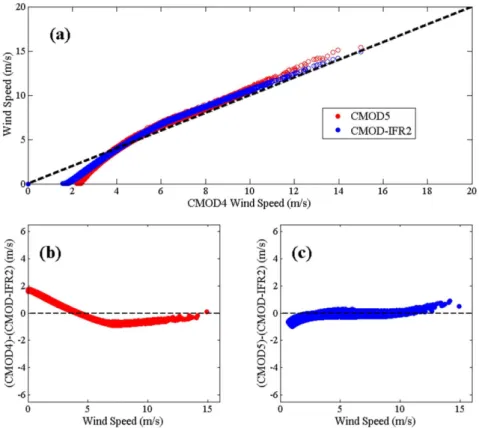
The differences between CMOD4 and CMOD_IFR2 results illustrated some dependence on the wind speeds (Fig. 8b). Large differences seemed to appear mainly at wind speed range of less than 3 ms

−1

(Fig.

8a, b). This implies that users should be cautious in the use of wind field particularly at low wind range.

The errors at the low wind range have been reported Fig. 7. Wind vectors retrieved from the same SIR-C SAR

data by using different algorithms such as (a) CMOD4, (b) CMOD_IFR2, and (c) CMOD5. Background colors show wind speed (m/s).

Fig. 8. (a) Wind speeds (m/s) from using CMOD4 and differences (m/s) of wind speeds between (b) CMOD4 and

CMOD_IFR2 (CMOD4 minus CMOD_IFR2), (c) CMOD4 and CMOD5 (CMOD4 minus CMOD5), and (d) CMOD_IFR2 and

CMOD5 (CMOD_IFR2 minus CMOD5).

(10)

by the previous literature for satellite scatterometer wind product (e.g. Freilich and Dunbar, 1999; Ebuchi, 2000). Due to the problem of CMOD4, the other algorithms like CMOD_IFR2 and CMOD5 have been developed in order to overcome the large errors in the low and high wind speed ranges (e.g. Hersbach et al., 2007). Fig. 9a shows a scatter plot of wind speeds of CMOD_IFR2 (blue) and CMOD5 (red) results versus CMOD4 result. The result from CMOD4 algorithm and others were well matched at moderate wind (4 to 10 ms

−1

), whereas apparent discrepancy appeared at low wind range (below 4 ms

−1

). As shown in Fig. 9b, it was found that wind speed of CMOD4 tended to be overestimated at low winds of less than 4 ms

−1

. By contrast, CMOD_IFR2 and CMOD5 yielded no significant wind speed differences at low wind range (Fig. 9c). This is believed that the low wind bias correction has been incorporated into the algorithms.

The CMOD5 algorithm has known to be developed to

solve bias at high wind regime, but we could not investigate the correction because the SIR-C image data do not have winds greater than 15 ms

−1

in the study area.

RMS errors of estimated wind vectors for each range of wind speed are summarized in Table 3. The RMS errors for moderate winds (4 to 8 ms

−1

) indicated 0.40 ms

−1

(CMOD4-CMOD_IFR2), 0.33 ms

−1

(CMOD4- CMOD5), and 0.16 ms

−1

(CMOD_IFR2-CMOD5), Fig. 9. (a) Comparisons of wind speeds by using CMOD5 (red) and CMOD_IFR2 (blue) with respect to CMOD4 and wind speed differences (m/s) of (b) CMOD4 and (c) CMOD5 versus CMOD_IFR2.

Table 3. RMS errors (m/s) of wind speed differences between CMOD4 and CMOD_IFR2, CMOD4 and CMOD5, and CMOD_IFR2 and CMOD5 for the three ranges of wind speeds, where ν is wind speed

Wind speed differences

RMS (m/s) Total RMS (m/s) 0< ν≤4 4<ν≤8 ν>8 CMOD4-CMOD_IFR2 1.07 0.40 0.66 0.99

CMOD4-CMOD5 1.20 0.33 0.68 1.08

CMOD_IFR2-CMOD5 0.36 0.16 0.18 0.33

(11)

which were much smaller than those of the entire wind range. Contrarily, the winds at an low wind range (below 4 ms

−1

) were of relatively large errors such as 1.07, 1.20, and 0.36 ms

−1

for the cases of CMOD4-CMOD_IFR2, CMOD4-CMOD5, and CMOD_

IFR2-CMOD5, respectively.

Discussion and Conclusion

In this study we estimated the wind field from SIR- C SAR data by using SAR wind retrieval models such as CMOD4, CMOD5, and CMOD_IFR2, and assessed the accuracy of wind vectors in terms of magnitude

and direction by comparing with ECMWF and NCEP/

NCAR reanalysis data. The retrieved results were analyzed to understand the error characteristics of wind speeds from different CMOD algorithms. The estimated wind speeds showed a good agreement with those of reanalysis dataset within an acceptable accuracy of 2 ms

−1

. In case of comparison with ECMWF data, RMS errors ranged from 1.30 ms

−1

(CMOD4) to 1.72 ms

−1

(CMOD5). NCEP/NCAR winds had no great difference with the result of the ECMWF winds.

Whereas, wind direction presented considerably high RMS errors which were much greater than 20

o

as a Fig. 10. Distributions of (a) estimated wind speeds as a function of wind direction and values from using CMOD4 algorithm.

Background color stands for wind speed in ms

−1

and (b) ratios of wind speeds divided by the minimum value of wind speeds

for a given value.

(12)

recommended limit of wind product by satellite scatterometry. One of the reasons may come from the existence of the ocean surface film modulation or ocean dynamics irrespective of winds (Robinson, 2004). This tends to create their own modulation features on the image so that SAR image may contain additional energy on the 2-D spectra of normalized radar cross section values. As a result, these kinds of error sources might be inherently contained in the SAR image.

It should be also noted that estimation of a wind speed relies on a wind direction retrieval in all of the CMOD algorithms. Fig. 10 illustrates retrieved wind speeds as a function of wind direction and σ

0

values in CMOD4 algorithm. For the same value of σ

0

, wind speed is diversely calculated depending on the wind direction determined by 2-D spectra. For example, when it has a σ

0

value of -15.3 dB which is the mean NRCS value of the image, the maximum difference of the estimated wind speeds amounts to 1.18 ms

−1

, which corresponds to 30-40% errors in magnitude of wind speed according to wind direction. These errors caused by difference of wind direction tend to increase as σ

0

increases till it reaches -10 dB approximately (Fig. 10b). Fig. 10b demonstrates ratios of wind speeds divided by the minimum value of wind speeds for a given σ

0

value. The ratios vary from 1.1 to 2, which implies that wind speed may be overestimated or underestimated strongly depending on the wind direction. The maximum difference of wind speed is found at about −10 dB. For a range of small NRCS values of less than −20 dB, the effect of wind direction is remarkably reduced to within 20% as compared to the minimum wind speed. Therefore, this suggests that careful manipulation of 2-D spectra should be taken and a new technology should be developed to reduce the errors in determination of wind direction, especially in the seas around Korea peninsula with complex coastal environment and relatively high spatial and temporal variations of ocean surface.

In addition, the error of estimated wind vectors may be caused by the effect of stability of MABL which

alters the magnitude of orientation between the geostrophic wind of MABL and the mean surface wind field (Ufermann and Romeiser, 1999). It is known that the mean surface wind tends to be shifted according to the stability of MABL (Alpers, 1995) and this could induce biases of wind directions between actual mean wind and estimated wind.

One of other potential causes may be originated from the wind product used in the development of CMOD4 algorithm, which has been commonly used so far. Wind field retrieved from CMOD4 model showed good agreement with those from other models of CMOD_IFR2 and CMOD5, but limited to a moderate wind range. For a low range of less than 4 ms

−1

, there is dominant discrepancy of CMOD4 model with the two other models. The CMOD4 algorithm has been developed by an empirical relationship with other wind products including scatterometer wind data.

However, the scatterometer winds themselves have large errors at low range winds (e.g. Freilich and Dunbar, 1999; Ebuchi, 2000). This should have been included in the establishment of CMOD4 algorithm.

Therefore, this study recommends CMOD_IFR2 and CMOD5 algorithms for estimating wind field at low wind range rather than CMOD4 algorithm.

This study is the first attempt to use SIR-C data for SAR-derived wind retrievals in the seas around Korea.

So far, wind vector retrievals from SAR data have

long been depended on only a single-frequency SAR

radiometer such as C-, L-, or X-band. Due to lack of

observations by a multiple-frequency SAR radiometer,

it has been difficult for us to perform inter-comparison

research for the same sea-surface phenomena measured

simultaneously. SIR-C/X SAR, with C-, L-, and X-

bands, has a capability of providing multi-frequency

SAR data which could be observed simultaneously

and appropriate for the inter-comparison. Thus, this

study may be expected to contribute to initiate the

development of SAR-wind retrieval methods considering

problems from different frequencies or different

algorithms as a future study. It is anticipated that

SAR-driven fine-scale wind field, based on more

precise algorithm after performing an intercalibration

(13)

research, might open up new opportunities to investigate the characteristics of small-scale oceanographic phenomena, particularly at coastal areas without no observation of scatterometry, and deep understanding of oceanic dynamics and air-sea interaction at the sea surface.

Acknowledgment

This work was supported by the Korea Aerospace Research Institute (KARI). Satellite SST image processing was supported by EAST-1 project of the Ministry of Land, Transport and Maritime Affairs of Korea (MLTM). Authors thank two anonymous reviewers for their helpful comments and corrections.

References

Alpers, W., 1995, Measurement of mesoscale oceanic and atmospheric phenomena by ERS-1 SAR. Radio Sci- ence Bulletin, 275, 14-22.

Ebuchi, N., 2000, Evaluation of NSCAT-2 wind vectors by using statistical distributions of wind speeds and direc- tions. Journal of Oceanography, 56, 161-172.

Freilich, M.H. and Dunbar, R.S., 1999, The accuracy of the NSCAT-1 vector winds: Comparisons with NDBC buoys. Journal of Geophysical Research, 104, 11231- 11246.

Gerling, T.W., 1972, Structure of the surface wind field from Seasat SAR. Journal of Geophysical Research, 91, 2308-2320.

Hersbach, H., 2003, CMOD5: An improved geophysical model function for ERS C-band scatterometry. ECMWF Technical Memorandum, 50 p.

Hersbach, H., Stoffelen, A., and de Haan, S., 2007, An improved C-band scatterometer ocean geophysical model function: CMOD5. Journal of Geophysical Research, 112, C03006, doi:10.1029/2006JC003743.

Hsu, S.A., 2005, Determining latent heat flux at sea: A comparison between wind-wave interaction and profile methods. Boundary-Layer Meteorology, 25, 417-421.

IFREMER-CERSAT, 1999, WNF products user manual

C2-MUT-W-01-IF. IFREMER-CERSAT, 86 p.

Kang, M.K., Park, Y.W., Lee, M.J., and Lee, H.Y., 2007, Study on the extraction of ocean wind, wave and cur- rent using SAR. Journal of Korean Navigation and Port Research, 31, 35-42.

Kim, D.J. and Moon, W.I., 2002, Estimation of sea sur- face wind vector using RADARSAT data. Remote Sensing of Environment, 80, 55-64.

Leibovich, S., 1983, The form and dynamics of Langmuir circulations. Journal of Fluid Mechanics, 15, 391-427.

Park, K.A. and Cornillon, P., 2002, Stability-induced modi- fication of sea surface winds over Gulf Stream Rings.

Geophysical Research Letters, 29, 2211-2214.

Park, K.A., Cornillon, P., and Codiga, D.L., 2006, Modifi- cation of surface winds near ocean fronts: Effects of Gulf Stream rings on scatterometer (QuikSCAT, NSCAT) wind observations. Journal of Geophysical Research, 111, C03021.

Robinson, I.A., 2004, Measuring the oceans from space:

The principles and methods of satellite oceanography.

Praxis, Chichester, UK, 669 p.

Shuchman, R., Johannessen, J., and Rufenach, C., 1994, Determination of wind speed, wind direction and atmo- spheric structure using ERS-1 SAR data during NORC- SEX’91. Geoscience and Remote Sensing Symposium IGASS’94, 3, 1259-1261.

Stoffelen, A. and Anderson, D., 1997, Scatterometer data interpretation: Estimation and validation of the transfer function CMOD4. Journal of Geophysical Research, 102, 5767-5780.

Thompson, D.R. and Beal, R.C., 2000, Mapping high-reso- lution wind fields using synthetic aperture radar. Johns Hopkins APL Technical Digest, 21, 58-67.

Ufermann, S. and Romeiser, R., 1999, Numerical study on signatures of atmospheric convective cells in radar images of the ocean. Journal of Geophysical Research, 104, 25707-25719.

Won, J.S., Jeong, H.S., and Kim, T.R., 1998, Wind field estimation using ERS-1 SAR data: The initial report.

International Symposium on Remote Sensing, 14, 286- 291.

Yoon, H.J., Park, K.S., and Kim, S.I., 2006, Ocean wind retrieval from RADAR SAR images in Korean seas.

Journal of the Korean Institute of Maritime Informa- tion and Communication Sciences, 10, 706-711.

Manuscript received: July 29, 2010

Revised manuscript received: September 2, 2010

Manuscript accepted: September 14, 2010

수치

Figure 2 shows the schematic flow chart of SAR- SAR-derived wind retrieval procedure. First of all, the  SIR-C SAR data was preprocessed to calculate normalized radar cross section (NRCS, σ 0 ) values as well as incidence angles which were required to esti
Figure 3a presents an example of a subset of SIR- SIR-C image with a size of 20 by 20 km
Figure 7 shows wind vectors retrieved from the same SIR-C SAR data by using the different algorithms such as CMOD4, CMOD_IFR2, and CMOD5 models, where the background images are the magnitude of wind vectors
Fig. 6. Distribution of interpolated near surface wind vectors from (a) ECMWF reanalysis data and (b) NCEP/NCAR reanaly- reanaly-sis data, where the red box indicates location of SIR-C image
+2

참조

관련 문서

Study of diabetes and the nutrition education and awareness of nutrition labels in Korean adults: Using data from the fifth Korea National Health and Nutrition Examination

Objective: This study was conducted to identify the association between vitamin D and osteosarcopenia among all adults in Korea using data from the Korea National Health

fully developed sea: unlimited fetch and duration of wind; wind energy input is balanced by energy dissipation due to wave breaking.. growing sea: limited fetch and

Temperature, Temperature difference between 10m and 300m, Humidity, Wind speed, Wind speed difference between 10m and 300m, Wind direction, Vertical Wind average,

▶ One example where the Rayleigh distribution naturally arises is when wind speed is analyzed into its orthogonal 2-dimensional vector components. Assuming that the magnitude

In this paper, it is implemented the image retrieval method based on interest point of the object by using the histogram of feature vectors to be rearranged.. Following steps

The Wind and Equivalent potential temperature of the East and West in Gwangju district on (a) 18UTC, (b) 20UTC and (c) 22UTC 26 Aug.. 남원을 제외하고 많은

“Evaluation of R&amp;D investments in wind power in Korea using real option.” Renewable and Sustainable Energy Reviews. &#34;Real Option Valuation of a Wind Power Project Based