
임차공간 설치 태양광 발전시스템 경제성 평가에 관한 연구
서미자*․이재환**․서태원*․한명희*․우제택***
A Study on leasing space to install solar power systems Economic Evaluation
Mi-Ja Seo*ㆍJae-Hwan Lee**ㆍTae-Won Seo*ㆍMyung-Hee Han*ㆍJe-Teak Woo***
요 약
태양광발전소의 급속한 보급과 다양한 설계, 개발, 시공, 유지보수 관련 기술과 기업이 다양하게 공존하며 2010 년 초반부터 구축된 최근의 태양광발전소는 발전단가의 하락에도 불구하고 주요 설비의 단가하락과 기술의 안정 화로 발전소의 구축이 지속적으로 추진되고 있다. 최근에는 한정된 지상공간을 대체하는 지붕과 구조물 상단을 임차하여 시공하는 형태의 태양광발전소의 건립이 늘어나고 있다. 공장의 지붕, 창고나 물류센터의 지붕 등의 임 차공간 설치 태양광발전소의 현황과 기술을 연구하고, 구축 시뮬레이션을 통하여 경제성을 분석하기 위한 검토와 연구를 진행 하였다.
ABSTRACT
The rapid spread and various design of solar power plants , development , construction, maintenance technology and business coexist variety and price decline and the recent solar power plants built since the early 2010 despite the decline in the power generation unit main equipment Construction of power plants to stabilize the technology has been continuously promoted . Recently, built in the form of a solar power plant to the construction and leasing the roof and upper structure to replace the limited ground space is increasing. Factory roof , studies such as warehouse and logistics center leased space in the roof installed solar plant status and skills, conducted a study to review and analyze the economy
키워드
Photovoltaic, Economic Evaluation, New Renewable Energy, Solar Power Plant 태양광, 경제성 분석, 신재생 에너지, 태양광 발전소
* (주)티앤테크([email protected], [email protected], [email protected])
** 교신저자 : (주)티앤테크
*** 대전대학교 컴퓨터공학과 ㆍ접 수 일 : 2015. 10. 06 ㆍ수정완료일 : 2015. 12. 13 ㆍ게재확정일 : 2015. 12. 24
ㆍReceived : Oct 06, 2015, Revised : Dec 13, 2015, Accepted : Dec 24, 2015 ㆍCorresponding Author : Jae-Hwan Lee
TNTech. Co., Ltd Email : [email protected]
Ⅰ. 서 론
태양광발전소의 급속한 보급과 다양한 설계, 개발, 시공, 유지보수 등 다양한 분야의 사업이 진행되고 있 으며 이로인한 태양광 생태계가 독창적인 비즈니스
모델로 조성되고 있다. 최근에는 시공단가의 현실적인 수준에서 하락효과와 장비의 개선으로 인한 발전효율 이 안정적으로 정착되었으며, 노후사업과 기업의 대규 모 발전소 건립 등 규모적인 비즈니스 분야로 각광방 고 있다. 최근 발전단가의 하락과 태양광 경기의 위축 http://dx.doi.org/10.13067/JKIECS.2015.10.12.1373
Dissertation title Main Content Study on solar power
systems Economic
evaluation of residential buildings(J.Kim, 2009)
Setting the growing trend of variables solar construction of residential buildings construction by presenting a diverse range of factors in the future profitability and economic evaluation study conducted Economic analysis research
for the photovoltaic business investment decisions of public authorities(C.Bae, 2010)
Proposed research and institutional complemented by economic analysis and public bodies apply to a large proportion of the solar power generation business in the importance of renewable energy and the depletion of fossil fuels Study on the Application of
the deployment of renewable energy systems and block by apartment houses(K. Lee,2006)
Ulsan classified material the House of Commons by the use of renewable energy targets in electricity and solar heat, solar, wind, and presented its analysis on the Utilization by applying a combination thereof
에도 불구하고 대형 규모의 발전소 건립과 새로운 형 태의 임차형 공간을 통한 건립도 추진되고 있다. 그 중 최근에는 한정된 지상공간을 대체하는 지붕과 구 조물 상단을 임차하여 시공하는 형태의 태양광발전소 의 건립이 늘어나고 있다. 공장의 지붕, 창고나 물류 센터의 지붕 등의 임차공간 설치 태양광발전소의 현 황과 기술을 연구하고, 구축 시뮬레이션을 통하여 경 제성을 분석하기 위한 검토와 연구를 진행 하였다.
예상되는 다양한 변수를 조사하여 평가범위를 정하 였고 이에대한 적용여부와 인값을 사전조사하여 선정 하였다. 태양광발전에서 발전량에 영향을 미칠 수 있 는 중요한 인자들 중에서 발전량을 결정짓는데 가장 많은 영향을 미치는 일사량을 비롯하여 어레이 경사 각 및 방위와 모듈의 온도,시스템효율 등이있다. 이 중 입지여건에 따라 결정되어지는 것은 일사량과 어 레이경사각 및 방위각이며,기술적으로 최상의 발전효 율을 달성하기 위해 주위 온도환경에 적합한 온도특 성을 갖는 모듈의 선정과 에너지 변환과정에서 손실 을 최소화 할 수 있는 노력이 필요하다.
표 1. 태양광발전 평가변수 및 인자 선정[1]
Table 1. PV evaluation variables and factors selected
division Key factors range
Solar power system variable
system
Average inverter
efficiency 90, 95, 99%
Miscellaneous power
conditioning losses 1, 3, 5%
install
System mounting
angle
Azimuch of PV
South, Southwest, West Slope of PV
array 0, 30, 45, 60
PV tracking mode Fixed,
A shaft, two shaft power usage
Variable power usage 400, 500, 600kWh
Economic variables
System Purchase/Installation
₩20,940,000
±10%
Government Grants purchase price 76.0%, ±10%
Annual maintenance costs
purchase price 0.5, 1, 2, 3%
Inflation 1, 3, 5%
Electricity prices rise 0.5, 1, 3, 5%
Discount rate 2.5, 5.0, 7.5%
Greenhouse gas reduction
benefits none
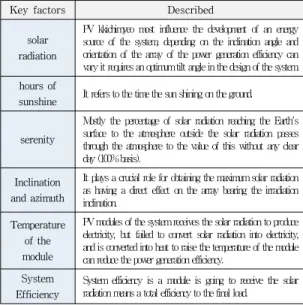
표 2. 평가변수별 주요 특징[2]
Table 2. By evaluated variables highlights
Key factors Described
solar radiation
PV kkichimyeo most influence the development of an energy source of the system, depending on the inclination angle and orientation of the array of the power generation efficiency can vary it requires an optimum tilt angle in the design of the system.
hours of
sunshine It refers to the time the sun shining on the ground.
serenity
Mostly the percentage of solar radiation reaching the Earth's surface to the atmosphere outside the solar radiation passes through the atmosphere to the value of this without any clear day (100% basis).
Inclination and azimuth
It plays a crucial role for obtaining the maximum solar radiation as having a direct effect on the array bearing the irradiation inclination.
Temperature of the module
PV modules of the system receives the solar radiation to produce electricity, but failed to convert solar radiation into electricity, and is converted into heat to raise the temperature of the module can reduce the power generation efficiency.
System Efficiency
System efficiency is a module is going to receive the solar radiation means a total efficiency to the final load.
Ⅱ. 관련연구
유사한 선행연구의 논문사례는 다음과 같으며 이로 인한 다양한 사례의 자료분석과 연구의 응용을 통하 여 객곽적이고 실용적인 연구결과를 얻기위하여 활용 하였다.
표 3. 선행연구 Table 3. Case study
A study on the economic evaluation of solar photovoltaic systems applied to architecture(J. Kim, 2006)
Was carried out by the economics of the Daegu city education materials and work facilities in BC analysis, the conclusion suggests considering the environmental cost of greenhouse gas emissions in order to ensure affordability
Solar power system payback period estimates of residential buildings(H.
Kim, 2007)
Annual energy development targeted a residential building in Seoul material, the initial investment costs, for the power savings of the electric power (generated power selling price) to conduct a sensitivity analysis and risk analysis estimates the payback period
Study on solar power
systems Economic
evaluation of the power consumption of residential buildings(J. Joo, 2008)
Power consumption targets for residential building materials Changwon area divided into three cases, the internal rate of return analysis and evaluation of solar power systems economics with paybacks, installation inclination is applied to 35〫
PV system performance and economic assessment program for research and development building(J.
Yoon, 2008)
TRNSYS-based solar power system analysis and economic evaluation of the program SimPV development and Daejeon residential installation prices and government subsidies for the building economy together, assuming the rate of inflation, such as a single condition, rated suspension
우리나라에서 태양광 발전소의 입지는 일조량이 풍 부한 남부지역을 중심으로 분포하고 있으며,전라남도 가 전국에서 설비용량 기준으로 1위(41%)이며 경상북 도(21%)및 전라북도가(19%)뒤를 잇고 있다.태양광 발 전설비는 93.9%가 발전용으로 건설ㆍ운용되고 있으 며,이는 곧 일반사업자가 태양광발전사업 투자를 통해 경제성을 기대할 수 있는 수준임을 유추해 볼 수 있 다.아울러,우리나라 실정에 맞는 경제성분석을 위해 에너지관리공단에서 개발하여 일반에 보급한 ‘CDM사 업 투자결정 경제성 분석 모형’을 활용하여 비용/편익 산정에 따른 경제성(편익/비용 비율,순현재가치,내부수 익률)을 분석하여 그 결과를 도출 하여 결과 분석에 활용하였다.
Ⅲ. 연구 및 분석
본 연구에서는 「1,000kW급 태양광발전 사업모 델」에 대한 경제성 분석을 위해 우리나라 주요 국책 사업의 타당성 및 경제성을 사전에 평가하고 심의하 는 제도인 ‘예비타당성조사(1999년도부터 시행)’에서 정한 방법 및 절차을 따르며,본 연구의 주제를 벗어나
는 정책적 분석과 다기준 분석 등은 제외하여 개별 사업추진에 따른 실질적인 경제성만을 분석 대상으로 한정하였다.
태양광발전사업에 대한 경제성분석을 위해 (주)티 앤테크에서 운영중인 부산 성진발전소(650kw급)와 울 산 유성발전소(390kW급)을 경제성분석 대상으로 선 정하였으며 대형 공장의 지붕을 임차하여 구축한 사 례로 본 논문의 주제와도 부합한다. 대상 발전소를 사 례로 투자금과 유지관리비, 임차비용 및 각종 부대비 용을 종합적으로 고려하였고 이에대한 경제성 분석 시뮬레이션 툴을 통하여 분석 및 결과를 취합하였다.
본 연구에서는 경제성분석 항목을 예비타당성조사 에서 활용하고 있는 편익/비용비율(B/C ratio)과 순현 재가치(NPV),그리고 내부수익률(IRR)분석을 통해 최 종 결과를 도출하고자 한다. 편익/비용 비율(B/C)은 총 편익과 총 비용의 할인된 금액의 비율로서 장래에 발생될 비용과 편익을 현재가치로 환산하여 편익의 현 재가치를 비용의 현재가치로 나눈 것으로 일반적으로
“편익/비용 비율 ≥ 1”이면 경제성이 있다고 판단한다.
(B/C)=
÷
(1) Bt : t Benefit of time, Ct : t Cost of time r : Discount rate n : Photovoltaic equipment
durability Year
순현재가치(NPV):사업에 수반된 모든 비용과 편익 을 기준년도의 현재가치로 할인하여 총편익에서 총비 용을 제한 값이며 “순현재가치 ≥ 0”이면 경제성이 있다는 의미로 해석한다.
(NPV) =
(2) Bt : t Benefit of time, Ct : t Cost of time r : Discount rate n : Photovoltaic equipment
durability Year
내부수익률(IRR)은 편익과 비용의 현재가치로 환산 된 값이 같아지는 할인율 R을 구하는 방법으로 사업 의 시행으로 인한 순현재가치를 “0” 으로 만드는 할 인율이다.내부수익률이 사회적 할인율보다 크면 경제 성이 있다고 판단한다.
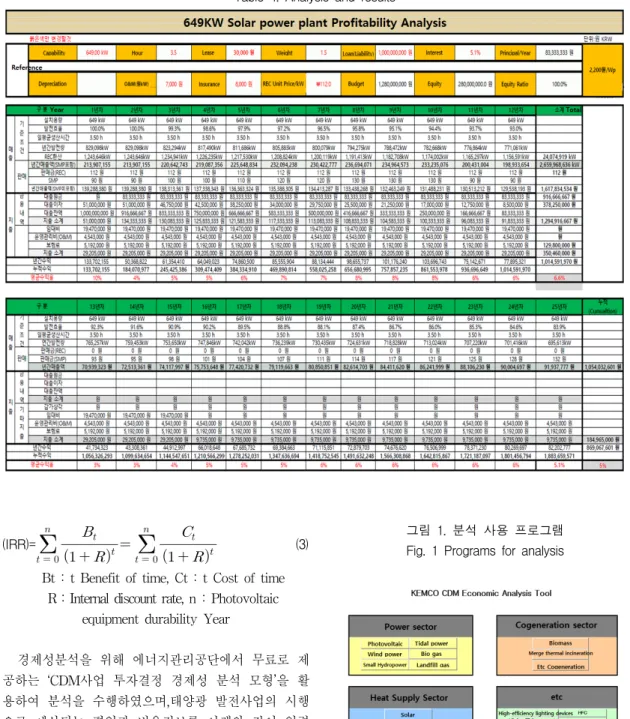
표 4. 분석 결과 Table 4. Analysis and results
(IRR)=
(3) Bt : t Benefit of time, Ct : t Cost of time
R : Internal discount rate, n : Photovoltaic equipment durability Year
경제성분석을 위해 에너지관리공단에서 무료로 제 공하는 ‘CDM사업 투자결정 경제성 분석 모형’을 활 용하여 분석을 수행하였으며,태양광 발전사업의 시행 으로 예상되는 편익과 비용정보를 아래와 같이 입력 하여 그 결과를 도출하였다. 지면의 한계로 참고 이미 지를 제공하고 분석결과를 서술하였다
.
그림 1. 분석 사용 프로그램 Fig. 1 Programs for analysis
표 5. 기초 데이터 Table 5. Basic data
division Input data
Inform ation
Business places Sungjin Busan plant ststem Grid-connected Power capacity 649kW Annual utilization 15%
Plant life(Year) 20 CDM Project period(Year) 21
Cost
Initial investment ₩1,233,100,000 Maintenance ₩57,1112,000
Taxes, etc. -
profit Sales revenue ₩143,268,000
결과 태양광 발전 시스템 경제성 평가에 대한 주요 투자분석 자료는 다음과 같이 산출되었다. IRR은 1.4%로 CEM없이 사업성이 있는것으로 분석되며 NPV는 157,434 천원, 투자회수기간은 14.31년으로 분 석되었다. 분석 모델로 선정한 성진발전소는 649kW 급으로 15.0%의 이용율을 기준으로 투자비는 대출을 포함하여 1,233,100천원을 투입하여 20년의 사업기간 을 운영으로 기준하여 감가상각 61,655천원, 연간 57,112천원의 운영비를 소요한다.
전력판매량은 852,786kWh에 대한 기준단가 168원 /kwh의 REC를 기준으로 SMP는 90원/kwh에 대하여 연간 발전수익은 76,751천원에 대하여 발전차액을 66,517천원을 지원받아 연간 총 143,268천원의 전력판 매 수익이 예상된다. 또한 25년간을 기준으로 수익성 분석을 실시하였고 이에 대한 기본데이터는 인수 대 상으로 분석중인 성진발전소 649kW급으로 일평균 발 전시간은 지역의 평균발전량을 참고하여 3.5시간으로 대입하고 부지의 임대료 및 보험료를 적용하였다.
대출금액을 1,000,000천원으로 가용한 금융을 최대 한 조달하여 1년의 거치기간과 11년의 상환기간을 산 정하였다. 이로인한 매년 상환금의 평균을 83,333천원 으로 하여 상용발전부터 12년차 까지 평균수익은 약 6.6%, 13년차부터 25년차까지 매년 투자금 대비 5%
의 평균수익률을 기대할 수 있었다.
Ⅳ. 개선점 도출 및 기술적 보완
분석된 데이터를 기초로 사업성과 예상 이익을 도 출하였으나 전체의 운영기간 동안 시스템의 최적화와 비용의 최소화를 통한 이익의 극대화 방안이 필요하 다. 또한, 태양광시스템의 상태를 모니터링하는 솔루 션으로 인버터에서 발생하는 진단정보, 발전정보에만 의존하고 있는 시스템적인 한계에 대하여 개선점 도 출이 필요하다. 태양광발전 시스템은 고전적인 시공방 식으로 지면에 시공하는 방법이 대다수를 이루었으며, 건물 신축 또는 개보수를 통하여 건축물의 옥상과 활 용가능 공간의 일부에 추가적으로 시공하였다. 최근에 는 대규모의 공장과 구조물의 옥상 등을 임차하여 대 규모의 태양광 설비를 시공하고 소정의 임챠료를 지 불 후 수익을 창출하고 있다. 이러한 방식은 건물 소 유자와 태양광 발전업자의 상생 구조로 각자 추가적 인 사업이익 창출이 가능하며 그동안 다소 무분별하 게 임야나 농지에 시공되던 태양광발전소의 이미지를 개선함과 동시에 공간의 낭비가 없는 최적회 된 신재 생에너지 사업모델로 정착되고 있다[3].
그림 2. 태양광발전 시스템 개요도 Fig. 2 Solar power system overview
그러나 앞에서 언급한 바와 같이 시스템의 운영상 태와 발전량, 애러상황 발생에 대하여 인버터의 신호 에만 의존하고 있으며 이로인하여, 장애발생을 뒤늦게 발견하거나 인버터 자체의 고장으로 인한 복구조치의 지연과 고장 원인 추적의 불가능으로 인하여 시스템 전반에 대한 점검 등으로 인한 발전 차질이 불가피 하였다. 대규모 태양광발전소의 경우 1일의 발전 장애
만으로도 수십~수백만원 이상의 수익 감소로 이어지 며 고장 원인을 찾기위한 시스템의 중단 시간도 상당 히 지연된다. 이를 보완하고 발전량의 정확한 계측과 고장구간의 신속하고 신뢰도 높은 추적, 인버터의 변 환효율의 급감과 장애 모듈의 근접한 추적이 가능한 솔루션을 기획하여 설계하였다.
그림 3. 원격관제 시스템 구성[4]
Fig. 3 Solar power plants operated remote control system
그림 4. 태양광 모니터링 시스템 구성도[7]
Fig. 4 Solar monitoring system schematic
선행연구를 통하여 위와 같이 기본적 개요와 설계 를 완료하였으며 전반적인 기술적 차별성은 크게 두 가지로 볼 수 있다. 첫 번째로 인버터에만 의존하지 않고 각각의 구간별 계측과 센싱을 실시한다. 이는 선 로에 존재하는 실측 데이터를 취합이 가능하며 설치 구간 내의 장애요인을 신속히 파악할 수 있다. 두 번 째로 인버터의 입력값과 계통으로 송전되는 출력값의 차이를 계측하여 변환효율과 인버터의 장애여부 등을
정확하게 검출하여 발전 중단이 발생하기 전에 고장 의 존재와 발생 가능성을 검출한다[5].
통합 게이트웨를 통한 신속한 데이터의 전송과 부 가적인 데이터로 일사량센서, 외기 온도센서, 모듈 온 도센서와 풍속 계측 취합을 통한 발전량 변경 인자와 가중치를 추정하고 장기간 고장과의 연계성을 분석 가능한 빅데이터 기반을 확보할 수 있다. 기본 설계와 시스템 구성은 다음과 같다[6].
설계의 내용과 같이 기존의 시스템에 추가적인 센 서와 구성 모듈 추가를 통하여 실측데이터를 취합하 고 DB에 저장한다. 이로 인한 데이터는 전용 게이트 웨이를 통하여 전송되며 추가적으로 시스템 이외의 요인에 대한 모니터링 자료를 수집하여 제공한다[8].
그림 5. 개발 화면구성 예시 Fig. 5 Screen configuration examples
Ⅴ. 결론
태양광발전소의 수익율과 경제성은 당분간은 더욱 열악해질 전망이다. 그의 대안으로 임대형 건물의 활 용가능 시설에 대한 저렴한 임차료와 유지보수의 절 감을 통한 수익성 보존과 함께 구조물의 상단에 위치 하는 가중치를 최대한 적용받아 경제성을 강화하는 방법이 최선의 대안이 될 것이다.
본 논문을 통하여 파악된 경제성은 향후 다른 형태 의 임차형 건물의 활용가능 공간을 더 발굴하고 사례 의 확대를 통해 효율성이 강화된 설비를 추가적으로 적용하여 발전단가의 하락과 육상 발전부지의 부족을 효과적으로 대체할 수 있을 것 이다.
아울러 지붕과 옥상의 복사열에 의한 패널 온도상승 으로 발전효율의 감소와 설비의 긴급한 고장에 대한 고장요인의 신속한 파악과 예방이 가능한 솔루션의 개 발과 적용은 추가적인 연구의 가능성을 제시하고 있다.
감사의 글
본 논문은 대전대학교 연구비 지원으로 수행 되었음
References
[1] J. Choi, J. Ju, and D. Kim, “A Study on the Economic Evaluation of Photovoltaic System in the Residential Building,“ J. of the Korean Solar Energy Society, vol. 29, no. 6, 2009, pp.
14-21.
[2] C. Bae, “A study on economic analysis of photovoltaic generation project for a public institution's investment decision,“ Master's thesis, Department of Control and Embedded Engineering, Graduate School, Kumoh National Institute of Technology, 2010.
[3] K. Kim, “Internet Management System for an Intelligent Remote Control and Monitoring,” J.
of the Institute of Internet, Broadcasting and Communication(JIIBC), vol. 10, no. 4, 2010, pp.
1-5.
[4] K. Park, E. Kim, K. Bahn, and S. Song,
“Cloud-based Intelligent Management System for Photovoltaic Power Plants,” J. of the Korea Institute of Electronic Communication Sciences, vol. 7, no. 3, 2012, pp. 591-596.
[5] J. Woo, J. Lee, T. Seo, M. Han, and M. Seo,
“A Study on standardized instrumentation for solar power plants operated remote control,”
J. of the Korea Institute of Electronic Communication Sciences, vol. 10, no. 6, 2015, pp. 707-712.
[6] M. Kim, B. Oh, E. Park, and Y. Kim, “A Study on Cooling System for Efficiency Improvements of 3kW Outdoor Type Photovoltaic Inverter,” J. of the Korea Institute of Electronic Communication Sciences, vol. 9, no.
5, 2014, pp. 617-623.
[7] K. Park, E. Kim, K. Bahn, and S. Song,
“Cloud-based Intelligent Management System for Photovoltaic Power Plants,” J. of the Korea Institute of Electronic Communication Sciences, vol. 7, no. 3, 2012, pp. 591-596.
[8] M. Kim and Y. Kim, “Temperature Characteristics Analysis of Major Heating Region According to Cooling Device Location
of Grid-Connected Photovoltaic Inverter,” J. of the Korea Institute of Electronic Communication Sciences, vol. 9, no. 7, 2014, pp. 799-804.
저자 소개
서미자(Mi-Ja Seo) 1995년 숭의여자대학교 문헌정보 학과 졸업(학사)
2015년 건국대학교 부동산대학원 석사과정 재학중
2014년 ∼현재 (주)티앤테크 이사
※ 관심분야 : 부동산개발, 인프라조성
우제택(Je-Teak Woo) 1993년 중앙대학교 기계공학과 졸업(공학사)
2001년 서강대학교 대학원 정보 통신공학과 졸업(공학석사) 2007년 서강학교 대학원 잔자공학과 박사 수료 2014년 한세대학교 대학원 IT융합공학과 졸업(공 학박사)
2013년 ~ 현재 대전대학교 컴퓨터공학과 조교수
※ 관심분야 : ICT융합, 분산처리시스템, 빅데이터
이재환(Jae-Hwan Lee) 2001년 건양대학교 정보전산공학 과 졸업(공학사)
2004년 한세대학교 대학원 정보 보호공학과 졸업(공학석사) 2014년 한세대학교 대학원 IT융합공학과 졸업(공 학박사)
2015년 (주)티앤테크 기술이사
※ 관심분야 : ICT융합, 사물통신
서태원(Tae-Won Seo) 1996년 중앙대학교 심리학과 졸 업(학사)
2015년 대전대학교 대학원 기술 경영공학과 재학중(공학석사) 2008년 ∼현재 (주)티앤테크 대표이사
※ 관심분야 : 무선통신시스템, 기술경영
한명희(Myung-Hee Han) 2014년 대전대학교 경영학과 졸 업(학사)
2015년 대전대학교 대학원 기술 경영공학과 재학중(공학석사) 2014년 ∼현재 (주)티앤테크 이사
※ 관심분야 : 신재생에너지, 기술경영

![그림 4. 태양광 모니터링 시스템 구성도[7]](https://thumb-ap.123doks.com/thumbv2/123dokinfo/5415567.424226/6.774.102.681.396.728/그림-태양광-모니터링-시스템-구성도.webp)
