• 검색 결과가 없습니다.

Effect of Jaeumkanghwatang (JEKHT), a Polyherbal Formula on the Pharmacokinetics Profiles of Tamoxifen in Male SD Rats (2) - Oral Combination Treatment of Tamoxifen 50 mg/kg with JEKHT 100 mg/kg on JEKHT 6-day Repeated Pretreated Rats with 8-day Repeated

N/A
N/A
Protected

Academic year: 2021

Share "Effect of Jaeumkanghwatang (JEKHT), a Polyherbal Formula on the Pharmacokinetics Profiles of Tamoxifen in Male SD Rats (2) - Oral Combination Treatment of Tamoxifen 50 mg/kg with JEKHT 100 mg/kg on JEKHT 6-day Repeated Pretreated Rats with 8-day Repeated "

Copied!
13
0
0

로드 중.... (전체 텍스트 보기)

전체 글

(1)

•접수 : 2016년 7월 2일 •수정접수 : 2016년 7월 13일 •채택 : 2016년 7월 14일

To whom co-correspondence should be addressed.

교신저자 : Sae Kwang Ku, DVM, PhD, Department of Anatomy and Histology, College of Korean Medicine, Daegu Haany University, #1 Haanydae-ro, Gyeongsan, Gyeongbuk, 38610, Republic of Korea

전화 : +82-53-819-1549, 팩스 : +82-53-819-1576, 전자우편 : [email protected]

Young Joon Lee, KMD, PhD, Department of Preventive Medicine, College of Korean Medicine, Daegu Haany University, #1 Haanydae-ro, Gyeongsan, Gyeongbuk, 38610, Republic of Korea

전화 : +82-53-819-1296, 팩스 : +82-53-819-1576, 전자우편 : [email protected]

Effect of Jaeumkanghwatang (JEKHT), a Polyherbal Formula on the Pharmacokinetics Profiles of Tamoxifen in Male SD Rats (2)

- Oral Combination Treatment of Tamoxifen 50 mg/kg with JEKHT 100 mg/kg on JEKHT 6-day Repeated Pretreated Rats with 8-day Repeated Co-administration -

Soo Jin Park

1),2)

, Min A Kwak

3)

, Sung Hwan Park

4)

, Young Joon Lee

2),5)✽

& Sae Kwang Ku

1),2)✽

1)Department of Anatomy and Histology, College of Korean Medicine, Daegu Haany University, Gyeongsan, 38610, Republic of Korea.

2)The Medical Research center for Globalization of Herbal Formulation, College of Korean Medicine, Daegu Haany University, Gyeongsan, 38610, Republic of Korea.

3)Department of Internal Medicine, College of Korean Medicine, Daegu Haany University, Daegu, 42158, Republic of Korea.

4)Department of Surgery, Catholic University of Daegu School of Medicine, Daegu, 42472, Republic of Korea.

5)Department of Preventive Medicine, College of Korean Medicine, Daegu Haany University, Gyeongsan, 38610, Republic of Korea.

Abstract

Objectives : The effects of Jaeumkanghwatang (JEKHT) co-administration on the pharmacokinetics of tamoxifen were observed after oral combination treatment of tamoxifen 50 mg/kg with JEKHT 100 mg/kg on JEKHT 6-day repeated oral pretreated rats with 8-day repeated co-administration to confirm the effects of JEKHT co-administration on the pharmacokinetics of tamoxifen.

Methods : Six days after pretreatment of JEKHT 100 mg/kg, tamoxifen 50 mg/kg was co-administered with JEKHT 100 mg/kg, once a day for 8 days within 5 min. The blood were collected at 30 min before administration, 30 min, 1, 2, 3, 4, 6, 8 and 24 hrs after end of first and last 8th tamoxifen treatment, and plasma concentrations of tamoxifen were analyzed using LC-MS/MS methods. PK parameters of tamoxifen (T

max

, C

max

, AUC, t

1/2

and MRT

inf

) were analysis as compared with tamoxifen single administered.

Results : Six-day repeated oral pretreatment of JEKHT and 8-day repeated oral co-administration of tamoxifen within 5 min did not influenced on the plasma concentrations and pharmacokinetic parameters of tamoxifen, oral bioavailability, as compared with tamoxifen single treated rats, except for some negligible effects.

Conclusions : It is concluded that JEKHT did not influenced on the plasma concentrations and pharmacokinetic

parameters, the oral bioavailability of tamoxifen. Therefore, it is considered that co-administration of JEKHT

and tamoxifen will be provide an effective novel treatment regimen on the comprehensive and integrative

medicine for breast cancer patients, if they showed favorable synergic effects on the pharmacodynamics or

(2)

reduce the tamoxifen treatment related toxicity and side effects in future studies.

Key words : Jaeumkanghwatang, Pharmacokinetics, Drug-drug interactions, Tamoxifen, Repeat oral dose, Repeated JEKHT pretreatment

I. Introduction

The research of combination therapies with other drugs to improve the side effects of tamoxifen or to achieve synergic effects, various drug-drug interactions of tamoxifen have been evaluated.

Because tamoxifen was metabolized by a sub- strate of CYP3A, 2C9, 2D6

1),2)

, it interacted with various drugs, namely, combinations containing any of the following medications, depending on the amount present, may also interact with aminoglutethimide – decreased plasma tamoxifen and N-desmethyltamoxifen concentrations

3)

, anticoagulants - enhanced warfarin effects

4),5)

, bromocriptine – increased plasma tamoxifen and N-desmethyltamoxifen concentrations

6)

, letrozole – decreased plasma letrozole concentrationsa

7)

, medroxyprogesterone – decreased plasma N-de- smethyltamoxifen concentrations but did not reduce plasma tamoxifen concentrations

8)

, phe- nobarbital – decreased plasma tamoxifen con- centrations

9)

, rifampin – decreased plasma tamo- xifen and N-desmethyltamoxifen concentrations

10)

, and cyclosporine, erythromycin, diltiazem and nifedipine – competitively inhibited formation of N-desmethyltamoxifen in vitro

11-13)

, respectively.

However, interactions with herbal products have not been established except for some restricted natural compounds; tamoxifen enhanced warfarin effects, and it is contraindicate that co-admini- stration of tamoxifen and wafarin

4),5)

.

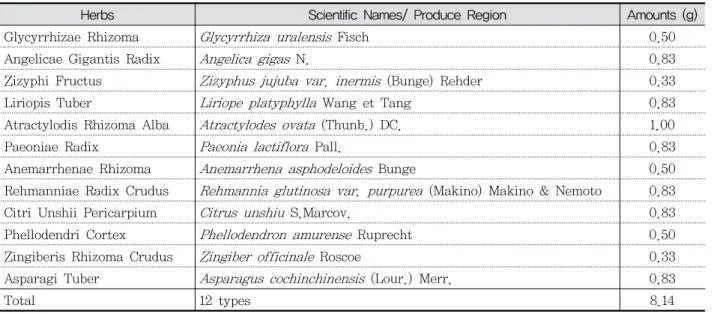
Jaeumkanghwatang (JEKHT) is a traditional yin-tonifying herbal medicine has been used for various oriental obstetrical and gynecological fields and it comprises of 12 kinds of herbs like

Glycyrrhizae Radix et Rhizoma, Angelicae Gigantis Radix, Zizyphi Fructus, Liriopis Tuber, Atract- ylodis Rhizoma Alba, Paeoniae Radix, Anemarr- henae Rhizoma, Rehmanniae Radix Crudus, Citri Unshii Pericarpium, Phellodendri Cortex, Zingi- beris Rhizoma Crudus and Asparagi Tuber

14)

. It is widely used in China, Japan, and Korea to treat bronchitis and tuberculosis

15)

with in some immune stimulation effects

14)

. JEKHT has been demonstrated anti-allergic properties in vitro study and they include suppression of secretion of inflammatory cytokines through blockade of NF-κb activation

16)

. In addition, it has been reported that JEKHT has beneficial effects in the treatment of patients with bronchial asthma

15)

and the relieving hot flush with JEKHT, repre- sentative side effect in tamoxifen treated patients with breast cancer, was reported recently

17)

.

Although co-administration of JEKHT with tamoxifen within 5 min did not influences on the absorption and excretion, the oral bioavail- ability of tamoxifen in our other study

18)

, the effects of JEKHT co-administration on the phar- macokinetics of tamoxifen were observed after 8-day repeated co-administration of tamoxifen 50 mg/kg with JEKHT 100 mg/kg to confirm the effects of JEKHT co-administration on the phar- macokinetics of tamoxifen, in this study.

II. Materials & methods

1. Animals and husbandry

Total ten male Sprague-Dawley (SD) rats (6-wk

old upon receipt, SLC, Japan) were used after

(3)

Table 1. Composition of JEKHT used in this study

Herbs Scientific Names/ Produce Region Amounts (g)

Glycyrrhizae Rhizoma Glycyrrhiza uralensis Fisch 0.50

Angelicae Gigantis Radix Angelica gigas N. 0.83

Zizyphi Fructus Zizyphus jujuba var. inermis (Bunge) Rehder 0.33

Liriopis Tuber Liriope platyphylla Wang et Tang 0.83

Atractylodis Rhizoma Alba Atractylodes ovata (Thunb.) DC. 1.00

Paeoniae Radix Paeonia lactiflora Pall. 0.83

Anemarrhenae Rhizoma Anemarrhena asphodeloides Bunge 0.50

Rehmanniae Radix Crudus Rehmannia glutinosa var. purpurea (Makino) Makino & Nemoto 0.83

Citri Unshii Pericarpium Citrus unshiu S.Marcov. 0.83

Phellodendri Cortex Phellodendron amurense Ruprecht 0.50

Zingiberis Rhizoma Crudus Zingiber officinale Roscoe 0.33

Asparagi Tuber Asparagus cochinchinensis (Lour.) Merr. 0.83

Total 12 types 8.14

JEKHT, Jaeumkanghwatang aqueous extracts were purchase from Hanzung Pharm. Co. (Daejeon, Korea) acclimatization for 23 days. Animals were all-

ocated five per polycarbonate cage in a tempe- rature (20-25℃) and humidity (40-45%) con- trolled room. Light : dark cycle was 12 hr : 12 hr and feed (Samyang, Korea) and water were supplied free to access. All animals were marked by picric acid, and overnight fasted (about 18 hrs; water was not restricted) before first and last treatment of test materials, and further fasted during 3 hrs after end of treatment. All labo- ratory animals were treated according to the national regulations of the usage and welfare of laboratory animals, and approved by the Insti- tutional Animal Care and Use Committee in Daegu Haany University (Gyeongsan, Gyeongbuk, Korea) prior to animal experiment.

2. Test articles and formulation

JEKHT, prepared and purchase from Hanzung Pharm. Co. (Daejeon, Korea), and tamoxifen (Hangzhou Tacon Co., Ltd, Hangzhou, China) was used as control drug as listed follows. In- dividual compositions of 12 kinds of herbs in JEKHT were listed in Table 1. Tamoxifen and powders of JEKHT extracts were stored in a

refrigerator at 4℃ to protect from light and de- generation until use. Both drugs are well dissolved (up to 20 mg/ml solutions in JEKHT and up to 10 mg/ml solutions in tamoxifen) in distilled water as vehicle, respectively.

3. Groupings and administration

Five rats per group (two groups) were used in

this study. The doses of test materials were sel-

ected based on their toxicity and pharmacody-

namics with the results of previous single co-

administration

18)

– 50 mg/kg of tamoxifen with

100 mg/kg of JEKHT. Six days after pretreat-

ment of JEKHT 100 mg/kg (once a day for 6

days), tamoxifen 50 mg/kg was co-administered

with JEKHT 100 mg/kg, once a day for 8 days

within 5 min. In Tamoxifen single treated rats,

only distilled water 5 ml/kg was orally admini-

stered during 6 days of JEKHT pretreatment

periods; after that 50 mg/kg of tamoxifen was

administered with distilled water, instead of

JEKHT, once a day for 8 days. Each tamoxifen

or JEKHT was orally administered, in a volume

of 5 ml/kg, dissolved in distilled water, and

bloods were sampled after first and last 8th

(4)

tamoxifen treatment, respectively.

4. Changes in body weights

Changes of body weight were daily measured from 1 day before initiation of JEKHT admini- stration to the last 8th co-administration of tamoxifen and JEKHT using an automatic elec- tronic balance (Precisa Instrument, Switzland).

At initiation of JEKHT pretreatment and first and last 8th co-administration, all experimental animals were overnight fasted (water was not;

about 12 hr) to reduce the differences from feeding. In addition, body weight gains during JEKHT pretreatment, co-administration and total 14 days of experiment days were calculated.

5. Plasma collections

All rats were slightly anesthesia under ethyl ether (Duksan Pure Chemical, Seoul, Korea) and blood samples (0.5 ml) were collected into 50 IU heparinized tubes via the orbital plexus at 30 min before treatment (as a control), 30 min, 1, 2, 3, 4, 6, 8 and 24 hrs after end of first and last 8th co-administration. Blood samples were immediately centrifuged for 10 min at 13,000 rpm and about 0.3 ml aliquots of plasma were stored in a −70℃ deep freezer until analysis of tamo- xifen.

6. Sample preparation and calibrations

Primary stock solution, 1.0 mg/ml of tamoxifen in 50% acetonitrile (Sigma, MO, USA) mixtures with distilled water and internal standard working solution, carbamazepine (Sigma, MO, USA) 500 ng/ml in acetonitrile were prepared. Working standard solutions were prepared by dilution with acetonitrile. All standard solutions were stored at -20℃ in the dark when not in use, and calibrated the standard samples as 100 μl of

blank plasma, working standard solutions and internal standard working solution were mixed with 100 μl of acetonitrile. The mixtures were mixed by vortex-mixing and centrifuged at 12,000 rpm for 10 min at 4℃. The clear supernatants were transferred to injection vials and the aliquot was injected into the LC-MS/MS system. In addition, 100 μl of sample plasma and internal standard working solution were mixed with 200 μl of acetonitrile. The mixtures were mixed by vortex-mixing and centrifuged at 12,000 rpm for 10 min at 4℃. Clear supernatants (5.0 μl) were directly transferred to injection vials and the aliquot was injected into the LC-MS/MS system.

7. LC-MS/MS conditions

Concentrations of tamoxifen in the rat plasma samples were determined LC-MS/MS method.

Chromatographic analysis was performed using an Agilent 1100 Series HPLC (Agilent Technologies, CA, USA) equipped with on-line degasser, binary pump, autosampler and column compartment.

Separation of the analyte from potentially inter- fering material was achieved at ambient tem- perature using Waters Xterra MS C18 columns (2.1×50 mm, 3.5 μm) (Waters Corp., MA, USA) at column oven 30℃. The mobile phase used for the chromatographic separation was composed of 5% acetonitrile/95% distilled water (0.1% formic acid) to 95% acetonitrile/5% distilled water (0.1%

formic acid), and was delivered isocratically at a

flow rate of 0.35 ml/min. The column effluent

was monitored using an API 2000 triple-quadruple

mass-spectometric detector (Applied Biosystems,

CA, USA). The instrument was equipped with an

electrospray interface in positive ion mode, and

controlled by the Analyst version 1.4.2 software

(Applied Biosystems, CA, USA). Samples were

introduced to the interface through a Turbo

IonSpray with the temperature set at 400℃. A

(5)

high positive voltage of 5.0 kV was applied to the ion spray. Nitrogen was used as the nebulizer gas, curtain gas, and collision gas with the settings of 12, 6, and 8, respectively. The multiple reaction monitoring (MRM) detection method was employed for the detection of tamoxifen;

the transitions monitored were carbamazepine (IS): m/z 237>194 (Retention time: 2.4 min), tamoxifen: 372>72 (Retention time: 2.3 min).

Calibration curves of tamoxifen were linear over the ranges studied with r

2

>0.999. The lower limit of quantification of the tamoxifen in the rat plasma was 1 ng/ml.

8. Pharmacokinetic analysis

The plasma concentration data were analyzed using a noncompartmental method on commercial pharmacokinetics data analyzer programs (PK solutions 2.0; Summit, CO, USA)

19),20)

. The elimi- nation rate constant (K

el

) was calculated by the log-linear regression of tamoxifen concentration data during the elimination phase, and the ter- minal half-life (t

1/2

) was calculated by 0.693/K

el

. The peak concentration (C

max

) and time to reach the peak concentration (T

max

) of tamoxifen in the plasma were obtained by visual inspection of the data in the concentration-time curve. The area under the plasma concentration-time curve (AUC

0-t

) from time zero to the time of the last measured concentration (C

last

) was calculated using the linear trapezoidal rule

21)

. The AUC zero to infinity (AUC

0-inf

) was obtained by adding AUC

0-t

and the extrapolated area was determined by C

last

/K

el

. The mean residence time infinity (MRT

inf

) was calculated by dividing the first moment of AUC (AUMC

0-inf

) by AUC

0-inf

.

9. Statistical analyses

All the means are presented with their standard deviation of five rats (Mean ± SD of five rats).

The pharmacokinetic parameters were compared using a non-parametric comparison test, Mann- Whitney U (MW) test, on the SPSS for Windows (Release 14.0K, SPSS Inc., USA). A p-value <

0.05 was considered statistically significant. In addition, the percent changes between tamoxifen single treated rats and tamoxifen with JEKHT co-administered rats were calculated to help the understanding of the effects of co-administration.

III. Results

1. Changes on the plasma concentrations of tamoxifen

No meaningful changes on the body weight and gains were detected in JEKHT and tamoxifen co-administered rats as compared with tamo- xifen single treated rats throughout experimental periods, respectively (Table 2, Fig 1).

2. Changes on the plasma concentrations of tamoxifen

Tamoxifen was detected from 30 min to 24 hrs

after end of first and last 8th co-administration

in the both tamoxifen single and co-administered

rats with JEKHT, regardless of JEKHT pretreat-

ment. No meaningful and no-significant changes

on the plasma tamoxifen concentrations were

detected in JEKHT co-administered rats as

compared with tamoxifen single treated rats after

first and last 8th co-administration of tamoxifen

50 mg/kg with JEKHT 100 mg/kg, regardless of

JEKHT pretreatment except for non-significantly

and slightly increased plasma tamoxifen concen-

trations at 30 min or 1 hr after end of first or

last 8th co-administration, detected in JEKHT

co-administered rats as compared with tamoxifen

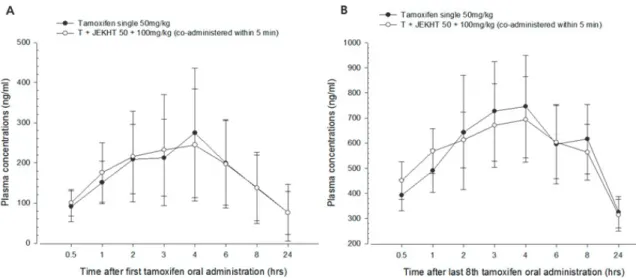
single treated rats, respectively (Fig 2A, B).

(6)

Table 2. Body weight gains during administration (from first to last treatment) of JEKHT with and without tamoxifen in male rats

Groups

Tamoxifen (50 mg/kg) Without JEKHT co-administration

(Distilled water)

With JEKHT co-administration (100 mg/kg) Body weights

At first JEKHT treatment [A] 310.20 ± 7.26 309.80 ± 5.76

At first co-administration [B] 330.20 ± 12.38 328.80 ± 6.61

At last 8th co-administration [C] 318.40 ± 12.56 315.00 ± 7.78 Body weight gains during

JEKHT pretreatment [B] – [A] 20.00 ± 5.70 19.00 ± 2.92

Co-administration [C] – [B] - 11.80 ± 3.77 - 13.80 ± 4.38

Experimental periods [C] – [A] 8.20 ± 7.19 5.20 ± 4.87 Values are expressed as mean ± SD of five rats. JEKHT : Jaeumkanghwatang aqueous extracts.

Figure 1. Changes on the body weights during co-administration of JEKHT with and without tamoxifen in male rats from 6-days repeated oral pretreatment of JEKHT. Values are expressed as mean ± SD of five rats (g).

All animals were overnight fasted before first and last treatment of test materials. Before means 1 day before first JEKHT treatment. (A) At first JEKHT treatment. (B) At first co-administration. (C) At last 8th

co-administration. JEKHT: Jaeumkanghwatang aqueous extracts, T: tamoxifen.

Figure 2. Plasma concentrations of JEKHT with and without tamoxifen after first co-administration (A) and last

8th co-administration (B) within 5 min in male rats from 6-days repeated oral pretreatment of JEKHT. Values

are expressed as mean ± SD of five rats (ng/ml). JEKHT: Jaeumkanghwatang aqueous extracts, T: tamoxifen.

(7)

Table 3. Pharmacokinetic parameters of JEKHT with and without tamoxifen after first co-administration within 5min in male rats from 6-days repeated oral pretreatment of JEKHT

Parameters

Tamoxifen (50 mg/kg) Without JEKHT co-administration

(Distilled water)

With JEKHT co-administration (100 mg/kg)

T

max

(hrs) 3.60 ± 0.89 2.80 ± 1.30

C

max

(μg/ml) 0.28 ± 0.16 0.32 ± 0.17

AUC

0-t

(hr•μg/ml) 3.23 ± 1.79 3.70 ± 2.22

AUC

0-inf

(hr•μg/ml) 4.86 ± 2.87 4.88 ± 4.09

t

1/2

(hr) 13.11 ± 5.77 12.47 ± 5.01

MRT

inf

(hr) 18.12 ± 5.71 17.16 ± 8.35

Values are expressed as mean ± SD of five rats. JEKHT : Jaeumkanghwatang aqueous extracts, C

max

: The peak plasma concentration, T

max

: Time to reach Cmax, AUC

0-t

: The total area under the plasma concentration-time curve from time zero to time measured, AUC

0-inf

: The total area under the plasma concentration-time curve from time zero to time infinity, t

1/2

: half life, MRT

inf

: mean residence to time infinity

Table 4. Pharmacokinetic parameters of JEKHT with and without tamoxifen after last 8th co-administration within 5 min in male rats from 6-days repeated oral pretreatment of JEKHT

Parameters

Tamoxifen (50 mg/kg) Without JEKHT co-administration

(Distilled water)

With JEKHT co-administration (100 mg/kg)

T

max

(hrs) 3.40 ± 0.89 3.80 ± 0.45

C

max

(μg/ml) 0.77 ± 0.22 0.70 ± 0.17

AUC

0-t

(hr•μg/ml) 12.39 ± 2.66 12.11 ± 3.24

AUC

0-inf

(hr•μg/ml) 21.50 ± 3.04 19.60 ± 2.60

t

1/2

(hr) 19.62 ± 5.84 18.68 ± 7.30

MRT

inf

(hr) 28.48 ± 8.53 26.85 ± 10.69

Values are expressed as mean ± SD of five rats. JEKHT : Jaeumkanghwatang aqueous extracts, C

max

: The peak plasma concentration, T

max

: Time to reach Cmax, AUC

0-t

: The total area under the plasma concentration-time curve from time zero to time measured, AUC

0-inf

: The total area under the plasma concentration-time curve from time zero to time infinity, t

1/2

: half life, MRT

inf

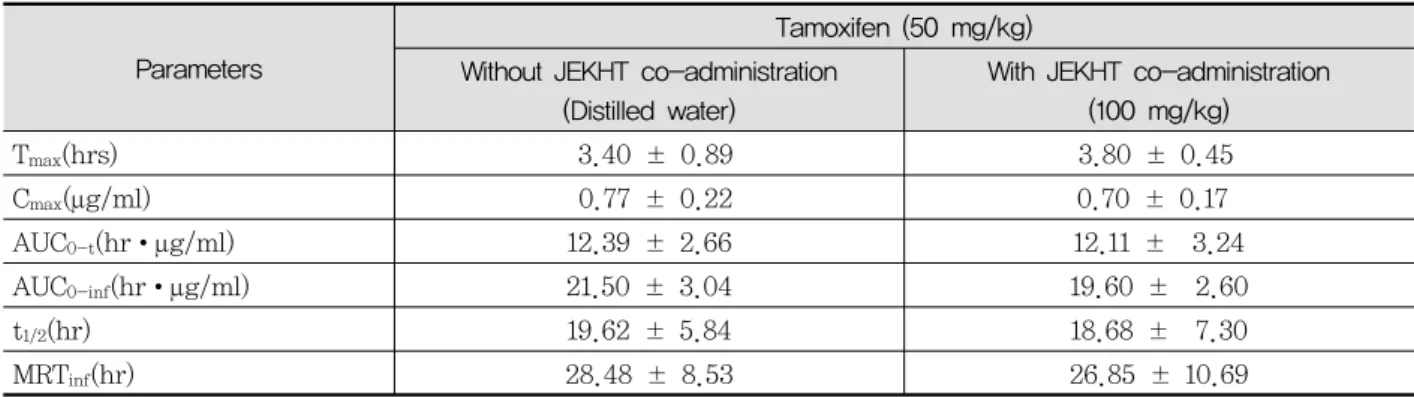
: mean residence to time infinity.

3. Changes on the T

max

of tamoxifen

The T

max

of tamoxifen was non-significantly decreased as -22.22% in co-administrated rats with tamoxifen 50 mg/kg and JEKHT 100 mg/kg (2.80±1.30 hr) as compared with tamoxifen single treated rats (3.60±0.00 hr) after end of first co-administration of tamoxifen 50 mg/kg with JEKHT 100 mg/kg from 6-days repeated oral pretreatment of JEKHT. However, the T

max

of tamoxifen after end of last 8th co-administration of tamoxifen 50 mg/kg with JEKHT 100 mg/kg from 6-days repeated oral pretreatment of JEKHT

was slight and non-significantly increased as 11.76% in JEKHT co-administrated rats (3.80±

0.45 hr) as compared with tamoxifen single treated rats (3.40±0.89 hr), in the present study (Table 3 and 4).

4. Changes on the C

max

of tamoxifen

The C

max

of tamoxifen in co-administrated

rats with tamoxifen 50 mg/kg and JEKHT 100

mg/kg (0.32±0.17 μg/ml) were non-significantly

changed as 17.39% as compared with tamoxifen

single treated rats (0.28±0.16 μg/ml) after end

(8)

of first co-administration from 6-days repeated oral pretreatment of JEKHT. In addition, the C

max

of tamoxifen was non-significantly decreased as -9.54% in JEKHT co-administrated rats (0.70±

0.17 μg/ml) as compared with tamoxifen single treated rats (0.77±0.22 μg/ml) after end of last 8th co-administration within 5min (Table 3 and 4).

5. Changes on the AUC of tamoxifen

The AUC

0-t

and AUC

0-inf

of tamoxifen were non-significantly changed as 14.32 and 0.40% in co-administrated rats with tamoxifen 50 mg/kg and JEKHT 100 mg/kg (3.70±2.22 and 4.88±4.09 hr•μg/ml) as compared with tamoxifen single treated rats (3.23±1.79 and 4.86±2.87 hr•μg/ml) after end of first co-administration from 6-days repeated oral pretreatment of JEKHT. In addition, the AUC

0-t

and AUC

0-inf

of tamoxifen were non- significant and slightly decreased as -2.26 and -8.83% in co-administrated rats with tamoxifen and JEKHT (12.11±3.24 and 19.60±2.60 hr•

μg/ml) as compared with tamoxifen single treated rats (12.39±2.66 and 21.50±3.04 hr•μg/ml) after end of last 8th co-administration (Table 3 and 4).

6. Changes on the t

1/2

of tamoxifen

The t

1/2

of tamoxifen was slightly and non- significantly decreased as -4.86% in co-admi- nistrated rats with tamoxifen 50 mg/kg and JEKHT 100 mg/kg (12.47±5.01 hr) as compared with tamoxifen single treated rats (13.11±5.77 hr) after end of first co-administration from 6-days repeated oral pretreatment of JEKHT. In addition, the t

1/2

of tamoxifen was also non-signi- ficantly decreased as -4.79% in co-administrated rats with tamoxifen and JEKHT (18.86±7.30 hr) as compared with tamoxifen single treated rats (19.62±5.84 hr) after end of last 8th co-admini-

stration (Table 3 and 4).

7. Changes on the MRT

inf

of tamoxifen

The MRT

inf

of tamoxifen slightly and non- significantly decreased as -5.30% in co-admini- strated rats with tamoxifen 50 mg/kg and JEKHT 100 mg/kg (17.16±8.35 hr) as compared with tamoxifen single treated rats (18.12±5.71 hr) after end of first co-administration from 6-days repeated oral pretreatment of JEKHT. In addition, the MRT

inf

of tamoxifen was also slightly and non-significantly decreased as -5.75% in co- administrated rats with tamoxifen and JEKHT (26.85±10.69 hr) as compared with tamoxifen single treated rats (28.48±8.53 hr) after end of last 8th co-administration (Table 3 and 4).

IV. Discussion

Six-day repeated oral pretreatment of JEKHT

and 8-day repeated oral co-administration of

tamoxifen within 5 min did not influenced on

the plasma concentrations and pharmacokinetic

parameters of tamoxifen, oral bioavailability, as

compared with tamoxifen single treated rats except

for some negligible effects as quite similar to

the results of the previous single co-adminis-

tration within 5 min study

18)

. These findings are

considered as direct evidences that JEKHT co-

administration did not influenced on the oral

bioavailability of tamoxifen, even if after repeated

co-administered within 5 min. It therefore, is

considered that co-administration of JEKHT

and tamoxifen will be provide an effective novel

treatment regimen on the comprehensive and

integrative medicine for breast cancer patients,

if they showed favorable synergic effects on the

pharmacodynamics or reduce the tamoxifen
treatment related toxicity and side effects in

future studies. All rats used in this study, showed

(9)

normal body weight increases ranged in normal age-matched rats regardless of treatment in the present study

22),23)

. In addition, no meaningful changes on the body weight and gains were detected in JEKHT and tamoxifen co-administered rats as compared with tamoxifen single treated rats throughout experimental periods, in the present study.

Tamoxifen was absorbed slowly following oral administration and T

max

of tamoxifen occur about 3-6 hrs after a single dose

24-26)

but it rapidly and extensively metabolized in the liver, through a substrate of CYP3A, 2C9, 2D626 including an active major metabolite, N-desmethyltamoxifen has biologic activity similar to that of the parent drug

27),28)

. Steady-state concentrations of tamo- xifen are attained after 3-4 weeks and those of N-desmethyltamoxifen, an active metabolite, are attained after 3-8 weeks

29)

. Tamoxifen excreted principally in feces as polar conjugates

30)

with about 5-7 days of t

1/2

in tamoxifen and 9-14 days in N-desmethyltamoxifen

25)

. Clearance of tamoxifen is higher in female children 2-10 years of age than in women

31),32)

. In the present study, T

max

of tamoxifen in tamoxifen single oral treated rats was detected as 3.60±0.89 hr after first co-administration from 6-days repeated oral pretreatment of JEKHT, and C

max

, AUC

0-t

, AUC

0-inf

, t

1/2

and MRT

inf

were detected as 0.28±

0.16 μg/ml, 3.23±1.79 hr•μg/ml, 4.86±2.87 hr•

μg/ml, 13.11±5.77 hr and 18.12±5.17 hr after first co-administration, respectively. In tamo- xifen with JEKHT co-administered rats, T

max

, C

max

, AUC

0-t

, AUC

0-inf

, t

1/2

and MRT

inf

of tamo- xifen were detected as 2.80±1.30 hr, 0.32±0.17 μg/ml, 3.70±2.22 hr•μg/ml, 4.88±4.09 hr•

μg/ml, 12.47±5.01 hr and 17.16± 8.35 hr; changed as -22.22, 17.39, 14.32, 0.40, -4.86 and -5.30%

as compared with tamoxifen 50 mg/kg single oral treated rats after first co-administration, respectively. These are means that repeated JEKHT pretreatment did not influenced on the

absorption and excretion of tamoxifen, when they were single co-administered within 5 min, quite similar to the results of the previous single co-administration within 5 min study

18)

. In addition, T

max

of tamoxifen in tamoxifen single oral treated rats was detected as 3.40±0.89 hr after last 8th co-administration from 6-days repeated oral pretreatment of JEKHT, and C

max

, AUC

0-t

, AUC

0-inf

, t

1/2

and MRT

inf

were detected as 0.77±0.22 μg/ml, 12.39±2.66 hr•μg/ml, 21.50±3.04 hr•μg/ml, 19.62±5.84 hr and 28.48±

8.53 hr after last 8th co-administration, respec- tively. In tamoxifen with JEKHT co-administered rats, T

max

, C

max

, AUC

0-t

, AUC

0-inf

, t

1/2

and MRT

inf

of tamoxifen were detected as 3.80±0.45 hr, 0.70±0.17 μg/ml, 12.11±3.24 hr•μg/ml, 19.60±

2.60 hr•μg/ml, 18.68±7.30 hr and 26.85±10.69 hr; changed as 11.76, -9.54, -2.26, -8.83, -4.79 and -5.75% as compared with tamoxifen 50 mg/kg single oral treated rats after last 8th co- administration, as direct evidences that repeated co-administration of JEHKT within 5 min also did not influenced on the oral bioavailability of tamoxifen, quite similar from the results of the previous single co-administration

18)

and pret- reatment rats in this study.

Tamoxifen rapidly and extensively metabolized

in the liver, through a substrate of CYP3A, 2C9,

2D626 to active major metabolite, N-desmethyl-

tamoxifen

27),28)

and, therefore, tamoxifen can be

interacted with various drugs like aminoglu-

tethimide

3)

, anticoagulants

4),5)

, bromocriptine

6)

,

letrozole

7)

, medroxyprogesterone

8)

, phenobarbital

9)

and rifampin

10)

. In addition the possibilities that

tamoxifen competitively interacted with cyclos-

porine, erythromycin, diltiazem and nifedipine

were also suggested in vitro experiments

11-13)

.

The severities of various side effects arise from

tamoxifen treatment, especially bone loss

33)

,

endometrial cancer

34)

, thromboembolism

35)

, fatty

liver

36)

, reduced cognition

37)

, semantic memory

scores

38)

and libido

39),40)

, premature growth plate

(10)

fusion

41)

, immune suppression

42),43)

and hypersen- sitivity

44),45)

are considered as directly co-related with absorption and excretion of tamoxifen or pharmacodynamics. In the present study JEKHT co-administration did not influenced on the oral bioavailability of tamoxifen, even if after repea- ted co-administered within 5min.

V. Conclusions

Based on the present and previous single co- administration study of JEKHT and tamoxifen, it is concluded that JEKHT did not influenced on the plasma concentrations and pharmaco- kinetic parameters, the oral bioavailability of tamoxifen. Therefore, it is considered that co- administration of JEKHT and tamoxifen will be provide an effective novel treatment regimen on the comprehensive and integrative medicine for breast cancer patients, if they showed favorable synergic effects on the pharmacodynamics or reduce the tamoxifen treatment related toxicity and side effects in future studies.
Conflicts of interest

The authors declare that there is no conflict of interest regarding the publication of this paper.

Acknowledgments

This study was supported by grant of Korea of Health & Welfare, Republic of Korea (Project No: 20-11-0-090-091-3000-3033-320).

References

1. Kim SY, Suzuki N, Santosh Laxmi YR, Rieger R, Shibutani S. a-hydroxylation of tamoxifen and toremifene by human and rat cytochrome P450 3A subfamily enzymes. Chem Res To- xicol. 2003;16(9):1138-1144.

2. Notley LM, Crewe KH, Taylor PJ, Lennard MS, Gillam EM. Characterization of the human cytochrome P450 forms involved in meta- bolism of tamoxifen to its a-hydroxy and a,4-dihydroxy derivatives. Chem Res Toxicol.

2005;18(10):1611-1618.

3. Lien EA, Anker G, Lønning PE, Solheim E, Ueland PM. Decreased serum concentrations of tamoxifen and its metabolites induced by aminoglutethimide. Cancer Res. 1990;50(18):

5851-5857.

4. Ritchie LD, Grant SM. Tamoxifen-warfarin interaction: the Aberdeen hospitals drug file.

BMJ. 1989;298(6682):1253.

5. Tenni P, Lalich DL, Byrne MJ. Life threa- tening interaction between tamoxifen and warfarin. BMJ. 1989;298(6666):93.

6. Lamberts SW, Verleun T, Hofland L, Oosterom R. Differences in the interaction between dopamine and estradiol on prolactin release by cultured normal and tumorous human pituitary cells. J Clin Endocrinol Metab. 1986;

63(6):1342-1347.

7. Dowsett M, Pfister C, Johnston SR, Miles DW, Houston SJ, Verbeek JA, Gundacker H, Sioufi A, Smith IE. Impact of tamoxifen on the pharmacokinetics and endocrine effects of the aromatase inhibitor letrozole in post- menopausal women with breast cancer. Clin Cancer Res. 1999;5(9):2338-2343.

8. Reid AD, Horobin JM, Newman EL, Preece PE. Tamoxifen metabolism is altered by simultaneous administration of medroxypro- gesterone acetate in breast cancer patients.

Breast Cancer Res Treat. 1992;22(2):153-156.

9. Dehal SS, Brodie AM, Kupfer D. The aro-

matase inactivator 4-hydroxyandrostenedione

(4-OH-A) inhibits tamoxifen metabolism by

rat hepatic cytochrome P-450 3A: potential

for drug-drug interaction of tamoxifen and

4-OH-A in combined anti-breast cancer

therapy. Drug Metab Dispos. 1999;27(3):389-

(11)

394.

10. West CM, Reeves SJ, Brough W. Additive interaction between tamoxifen and rifampicin in human biliary tract carcinoma cells. Cancer Lett. 1990;55(2):159-163.

11. Mani C, Gelboin HV, Park SS, Pearce R, Parkinson A, Kupfer D. Metabolism of the antimammary cancer antiestrogenic agent tamoxifen. I. Cytochrome P-450-catalyzed N-demethylation and 4-hydroxylation. Drug Metab Dispos. 1993;21(4):645-656.

12. Mani C, Pearce R, Parkinson A, Kupfer D.

Involvement of cytochrome P4503A in catalysis of tamoxifen activation and covalent binding to rat and human liver microsomes. Car- cinogenesis. 1994;15(12):2715-2720.

13. Williams JA, Ring BJ, Cantrell VE, Jones DR, Eckstein J, Ruterbories K, Hamman MA, Hall SD, Wrighton SA. Comparative meta- bolic capabilities of CYP3A4, CYP3A5, and CYP3A7. Drug Metab Dispos. 2002;30(8):883- 891.

14. Jung DY, Ha HK, Lee HY, Lee JA, Lee JK, Huang DS, Shin HK. Stimulation of the immune response by Yin-Tonifying formula.

J Korean Oriental Med. 2010;31:112-123.

15. Sekiya N, Hikiami H, Sakai S, Kainuma M, Goto H, Shibahara N, Shimada Y, Terasawa K. Experimental Application of Jiin-koka-to to Cases of Bronchial Asthma. Kampo Me- dicine. 2003;54(6):1097-1101.

16. Kim YK, Kim HJ, Kim WS, Park HJ, Moon G, Kim DW, Won JH. Inhibitory effect of Jaeumganhwa-tang on allergic inflammatory reaction. Korean J Orien Inter Med. 2004;

25:174-182.

17. Zheng H, Lee Y, Yoo H, Cho C. Case Study of a Breast Cancer Patient Accompanying with Hot Flush by Tamoxifen Whose Condi- tion Was Improved by Jayeumganghwa-tang.

Korean J Orien Inter Med. 2010;6:395-400.

18. Kwak MA, Park SJ, Park SH, Lee YJ, Ku

SK. Effect of Jaeumkanghwatang (JEKHT), a Polyherbal Formula on the Pharmacokinetics Profiles of Tamoxifen in Male SD Rats (1) - Single Oral Combination Treatment of Tamo- xifen 50 mg/kg with JEKHT 100 mg/kg within 5 min -. J Korean Med. 2016;37(2):1-11.

19. Gibaldi M, Perrier D. Pharmacokinetics. 2nd ed. Oxford: Taylor & Francis; 1982.

20. Bailer AJ. Testing for the equality of area under the curves when using destructive measurement techniques. J Pharmacokinet Biopharm. 1988;16(3):303-309.

21. Chiou WL. Critical evaluation of the potential error in pharmacokinetic studies of using the linear trapezoidal rule method for the calculation of the area under the plasma level-time curve. J Pharmacokinet Biopharm.

1978;6(6):539-546.

22. Fox JG, Cohen BJ, Loew FM. Laboratory Animal Medicine. Orlando: Academic Press.

Inc.; 1984.

23. Tajima Y, Horiuchi S. Biological reference data book on experimental animals. Tokyo:

Soft Science; 1989.

24. Adam HK, Gay MA, Moore RH. Measurement of tamoxifen in serum by thin-layer densi- tometry. J Endocrinol. 1980;84(1):35-42.

25. Adam HK, Patterson JS, Kemp JV. Studies on the metabolism and pharmacokinetics of tamoxifen in normal volunteers. Cancer Treat Rep. 1980;64(6-7):761-764.

26. Fabian C, Sternson L, Barnett M. Clinical pharmacology of tamoxifen in patients with breast cancer: comparison of traditional and loading dose schedules. Cancer Treat Rep.

1980;64(6-7):765-773.

27. Jordan VC, Bain RR, Brown RR, Gosden B, Santos MA. Determination and pharmacology of a new hydroxylated metabolite of tamo- xifen observed in patient sera during therapy for advanced breast cancer. Cancer Res. 1983;

43(3):1446-1450.

(12)

28. Murphy C, Fotsis T, Pantzar P, Adlercreutz H, Martin F. Analysis of tamoxifen and its metabolites in human plasma by gas chroma- tography-mass spectrometry (GC-MS) using selected ion monitoring (SIM). J Steroid Bio- chem. 1987;26(5):547-555.

29. Jordan VC. Metabolites of tamoxifen in animals and man: identification, pharmacology, and significance. Breast Cancer Res Treat. 1982;

2(2):123-138.

30. Sun D, Sharma AK, Dellinger RW, Blevins- Primeau AS, Balliet RM, Chen G, Boyiri T, Amin S, Lazarus P. Glucuronidation of active tamoxifen metabolites by the human UDP glucuronosyltransferases. Drug Metab Dispos.

2007;35(11):2006-2014.

31. AstraZeneca Pharmaceuticals. Nolvadex (tamoxifen citrate) prescribing information.

Wilmington, DE: 2003 June.

32. Hall WA, Doolittle ND, Daman M, Bruns PK, Muldoon L, Fortin D, Neuwelt EA. Osmotic blood-brain barrier disruption chemotherapy for diffuse pontine gliomas. J Neurooncol.

2006;77(3):279-284.

33. Vehmanen L, Elomaa I, Blomqvist C, Saarto T. Tamoxifen treatment after adjuvant chemo- therapy has opposite effects on bone mineral density in premenopausal patients depending on menstrual status. J Clin Oncol. 2006;24 (4):675-680.

34. Grilli S. Tamoxifen (TAM): the dispute goes on. Ann Ist Super Sanita. 2006;42(2):170-173.

35. Decensi A, Maisonneuve P, Rotmensz N, Bettega D, Costa A, Sacchini V, Salvioni A, Travaglini R, Oliviero P, D’Aiuto G, Gulisano M, Gucciardo G, del Turco MR, Pizzichetta MA, Conforti S, Bonanni B, Boyle P, Veronesi U, Italian Tamoxifen Study G. Effect of tamoxifen on venous thromboembolic events in a breast cancer prevention trial. Circu- lation. 2005;111(5):650-656.

36. Osman KA, Osman MM, Ahmed MH. Tamo-

xifen-induced non-alcoholic steatohepatitis:

where are we now and where are we going?

Expert Opin Drug Saf. 2007;6(1):1-4.

37. Paganini-Hill A, Clark LJ. Preliminary asse- ssment of cognitive function in breast cancer patients treated with tamoxifen. Breast Cancer Res Treat. 2000;64(2):165-176.

38. Eberling JL, Wu C, Tong-Turnbeaugh R, Jagust WJ. Estrogen- and tamoxifen-associated effects on brain structure and function.

Neuroimage. 2004;21(1):364-371.

39. Mortimer JE, Boucher L, Baty J, Knapp DL, Ryan E, Rowland JH. Effect of tamoxifen on sexual functioning in patients with breast cancer. J Clin Oncol. 1999;17(5):1488-1492.

40. Cella D, Fallowfield L, Barker P, Cuzick J, Locker G, Howell A, Group AT. Quality of life of postmenopausal women in the ATAC (“Arimidex”, tamoxifen, alone or in combi- nation) trial after completion of 5 years’

adjuvant treatment for early breast cancer.

Breast Cancer Res Treat. 2006;100(3):273- 284.

41. Karimian E, Chagin AS, Gjerde J, Heino T, Lien EA, Ohlsson C, Savendahl L. Tamoxifen impairs both longitudinal and cortical bone growth in young male rats. J Bone Miner Res. 2008;23(8):1267-1277.

42. Wilson SC, Knight PG, Cunningham FJ.

Evidence for the involvement of central conversion of testosterone to oestradiol-17b in the regulation of luteinizing hormone secretion in the cockerel. J Endocrinol. 1983;

99(2):301-310.

43. Nalbandian G, Paharkova-Vatchkova V, Mao A, Nale S, Kovats S. The selective estrogen receptor modulators, tamoxifen and raloxifene, impair dendritic cell differentiation and acti- vation. J Immunol. 2005;175(4):2666-2675.

44. Berstein LM, Wang JP, Zheng H, Yue W,

Conaway M, Santen RJ. Long-term exposure

to tamoxifen induces hypersensitivity to

(13)

estradiol. Clin Cancer Res. 2004;10(4):1530- 1534.

45. Rousset-Jablonski C, Thalabard JC, Gompel

A. Tamoxifen contraindicated in women with

hereditary angioedema? Ann Oncol. 2009;20

(7):1281-1282.

수치

Table  1.  Composition  of  JEKHT  used  in  this  study
Figure  2.  Plasma  concentrations  of  JEKHT  with  and  without  tamoxifen  after  first  co-administration  (A)  and  last  8th  co-administration  (B)  within  5  min  in  male  rats  from  6-days  repeated  oral  pretreatment  of  JEKHT
Table  4.  Pharmacokinetic  parameters  of  JEKHT  with  and  without  tamoxifen  after  last  8th  co-administration  within  5  min  in  male  rats  from  6-days  repeated  oral  pretreatment  of  JEKHT

참조

관련 문서

The results of the repeated measures ANOVA of health-related physical fitness suggested that the main effect based on test time had a significant difference

Mean arterial plasma concentration-time profiles of 4-hydroxytamoxifen after an oral administration of tamoxifen (10 mg/kg) to rats in the presence or absence

Pharmacokinetic parameters were determined following an oral administration of nateglinide (30 mg/kg) to rabbits in the presence and absence of calcium channel blockers

Mortality and clinical signs in SD rats about single oral administration after 3 weeks with callus extract ..... Hematological values in SD rats administered orally

1),2),3): p-values as a result of repeated measure ANOVA 1) time effect, 2) inter-group difference 3) interaction effect; 4),6),8): p-values as a result of Wilcoxon signed

In the present study, the behavior of Mg sheet with strain rates will be observed and the effect of microstructure, texture and PB treatment on high rate tensile

The main effect according to the results of the repeated measures ANOVA on physical fitness based on test time showed a significant difference in grip

Silicon atoms on Si (111) surface of a silicon single crystal form a repeated pattern (produced by STM)...