• 검색 결과가 없습니다.

Effect of Sesame Straw Biochar Application on Soil Physics and Nitrous Oxide Emission in Upland Soil

N/A
N/A
Protected

Academic year: 2021

Share "Effect of Sesame Straw Biochar Application on Soil Physics and Nitrous Oxide Emission in Upland Soil"

Copied!
6
0
0

로드 중.... (전체 텍스트 보기)

전체 글

(1)

Effect of Sesame Straw Biochar Application on Soil Physics and Nitrous Oxide Emission in Upland Soil

Se-Won Kang

, Ju-Sik Cho

1†

, Hyun-Tae Kim

1

, Dong-Cheol Seo

2

, and Sung-Dong Moon

3

* Department of Medicinal & Industrial Crops, Korea National College of Agriculture and Fisheries, Jeonju 54874, Korea

1

Department of Bio-environmental Sciences, Sunchon National University, Suncheon, 57922, Korea

2

Division of Applied Life Science, Gyeongsang National University, Jinju, 52828 Korea

3

Department of Industrial & Management Engineering, Kangwon National University, Samcheok, 25913, Korea

(Received: March 17 2016, Revised: June 13 2016, Accepted: June 14 2016)

The effect of biochar application on soil physics and nitrous oxide (N

2

O) emission from upland soil for broccoli cultivation was investigated. Sesame straw biochar (SB) was applied at amounts 0 (IF), 50 (SB50), 100 (SB100), 200 (SB200) kg 10a

-1

, respectively. SB addition to the upland soil decreased bulk density, and increased porosity and soil respiration. The N

2

O emission rates in all treatments were higher in the order of IF

≧ SB50 > SB100 ≧ SB200 treatments. Global warming potential in SB200 treatment decreased by 15.1%

compared to IF treatment. Therefore, SB application in upland soil can improve soil physics and reduce N

2

O emission.

Key words: Biochar, Bulk density, Porosity, Soil respiration, Nitrous oxide

Production and surface characteristics of sesame straw biochar.

p1)

*Corresponding author: Phone: +82335706586, Fax: +82335706580, E-mail: [email protected]

Both authors contributed equally to this work and are considered as co-first authors

§

Acknowledgement: This work was carried out with the support of “Cooperative Research Program for Agriculture Science & Technology

Development (Project No. PJ011227042016)”, Rural Development Administration, Republic of Korea. Also, this study is supported

by Kangwon National University (2015-10022).

(2)

Table 1. Chemical properties of experimental soil used.

pH EC O.M T-N Avail. P

2

O

5

Exch. cation

K Ca Mg

1 : 5H

2

O dS m

-1

--- g kg

-1

--- mg kg

-1

cmol

c

kg

-1

5.29 0.26 10.4 0.75 1.34 0.21 2.50 0.72

Table 2. Chemical properties of sesame straw (feedstock) and biochar used in the study.

pH Inorganic contents Elemental composition

T-N T-P K C H O N S

1 : 10H

2

O --- % --- --- % ---

Feedstock - 0.37 0.08 0.88 44.26 8.15 45.18 1.85 0.56

Biochar 10.01 1.09 0.16 1.52 71.07 4.42 23.05 1.26 0.20

Introduction

작물 생육을 위한 토양의 질 평가는 크게 토양의 물리적, 화학적 및 생물학적 특성으로 나눌 수 있다. 우리나라는 과거 에 작물 생산량 증진을 목적으로 토양의 비옥도를 증진시키는 연구를 주로 수행하여 왔다 (Cho et al., 2012). 토양 물리성 은 작물에 필요한 식물영양소는 아니지만, 물리성이 양호한 토양에서 토양내 양수분 이동과 공기의 흐름이 원활하고, 지 하부의 생육에 관여하는 것으로 알려져 있다 (Kim et al., 2004; Kim et al,, 2010). 하지만, 우리나라 농경지는 불규 칙한 경사지 형태, 여름철 집중 호우 및 잦은 경운으로 인해 토양이 유실되고 토양구조의 발달 미약 등 토양 물리성을 악화 시켜 작물의 생육에 악영향을 끼치고 있으며, 이러한 문제점은 밭토양에서 심각하게 나타나고 있다 (Cho et al., 2012; Kim et al., 2010).

바이오차는 버려지는 유기물질을 산소가 없는 조건에서 열 분해를 통해 얻어지는 고체 물질로, 2006년 “Black is the new green”과 2007년 “A handful of carbon”의 제목으 로 Nature에 발표되면서 전세계적으로 관심을 갖기 시작하였 다 (Woo, 2013). 바이오차는 여러 연구자들에 의해 기후변화 대응, 에너지 생산, 토양개량 및 폐기물 관리 등 다양한 측면 에서 바이오차에 대한 효과가 보고되고 있다 (Angst et al., 2014; Case et al., 2012; Yamato et al., 2006).

현재 국내에서는 바이오차를 이용하여 TCE, 중금속 등의 오염물질을 제거하기 위한 연구와 토양내 온실가스를 제거하 기 위한 바이오차 연구가 일부 진행되고 있다 (Ahmad et al., 2014; Choi et al., 2013; Park et al., 2015; Seo et al., 2012). 하지만 바이오차를 토양에 시용하여 물리적 특성 을 개선하기 위한 체계적인 현장중심의 연구가 진행된 적이 없다. 바이오차를 토양에 시용하여 토양의 물리성을 개선하 고, 밭토양에서 많이 발생되는 아산화질소 (N

2

O)를 저감시킬 수 있다면, 자원의 재활용과 더불어 밭토양의 물리성 개선, 온실가스 저감 등 다양한 측면에서 매우 이상적인 관리방안이

될 것으로 판단된다.

따라서 본 연구는 포트 실험을 통해 바이오차의 토양 시용 이 토양의 용적밀도, 공극률, 토양호흡량 및 N

2

O 발생에 미 치는 영향을 조사하여, 향후 밭토양 관리를 위한 기초자료로 활용하고자 하였다.

Materials and Methods

농업 부산물 바이오차 시용에 따른 토양의 물리성 변화와 N

2

O 발생량 변화를 조사하기 위해 사용된 공시 토양은 용적 밀도가 1.13 g cm

-3

이고, 공극률이 53.7%인 전라남도 보성 군 회천면에 위치한 밭토양을 이용하였다. 공시 토양의 화학 적 특성은 Table 1에서 보는 바와 같이 pH는 5.29이었고, O.M 및 T-N의 함량은 각각 10.4 및 0.75 g kg

-1

이었다.

본 시험에 사용된 농업 부산물은 참깻대를 사용하였으며, 제조된 참깻대 바이오차의 화학적 특성은 Table 2와 같다.

바이오차 제조는 전기로 (GK-1015 model ㈜STI KOREA) 를 사용하였으며, 내부 챔버에 부산물을 넣고, 질소가스 (10 psi)를 주입하여 산소함량을 0.5% 이하의 혐기상태로 만든 후 열분해 온도는 400

C 조건에서 4시간 동안 저속 열분해하 여 바이오차를 제조하였다.

본 연구는 가로, 세로 및 높이가 40, 32 및 22 cm인 포트 를 사용하였으며, 재배작물은 전라남도 순천에 위치한 성농그 린텍 육묘장에서 4주간 상토 재배한 브로콜리를 이식하였다.

본 시험을 하기 위한 처리조건은 표준처리구 (IF, N – P –

K = 22.2 – 6.4 – 11.0 kg 10a

-1

)와 참깻대 바이오차의 시

용량을 달리한 SB50 (sesame straw biochar 50 kg 10a

-1

+ NPK), SB100 (sesame straw biochar 100 kg 10a

-1

+ NPK) 및 SB200 (sesame straw biochar 200 kg

10a

-1

+ NPK) 처리구로 각각 나누었다. 참깻대 바이오차의

시용시기는 토양특성의 급격한 변화를 방지하기 위해 브로콜

리 이식 2주전에 시용하여 토양과 혼합하였다. 토양의 물리성

변화는 브로콜리 이식 후 60일째에 코어법을 이용하여 토양

(3)

Fig. 1. Changes of bulk density and porosity in tested soil with different application level of sesame straw biochar.

*Means by the same within a column are not significantly different at 0.05 probability level according to Duncan’s Multiple Range Test.

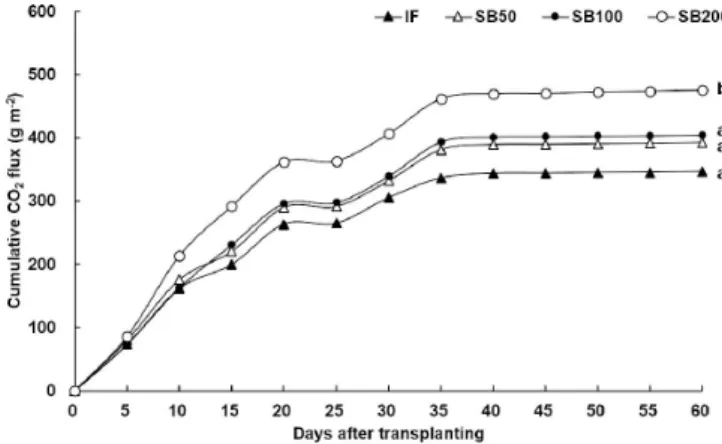
Fig. 2. Change of soil respiration in tested soil with different application level of sesame straw biochar.

*Means by the same within a column are not significantly different at 0.05 probability level according to Duncan’s Multiple Range Test.

의 용적밀도와 공극률을 조사하였고, CO

2

및 N

2

O 발생량은 면적이 0.02 m

2

, 높이가 0.5 m인 챔버를 사용하여 조사하 였다.

본 시험에 사용된 토양 및 바이오차의 화학적 특성은 농촌 진흥청의 토양 및 식물체 분석법 (NIAST, 2000)에 준하여 분석하였다. 브로콜리 재배기간 동안 발생된 CO

2

및 N

2

O 발 생량은 Closed chamber method (Rolston, 1986)를 이용 하여 Gas Chromatograph (GC-2014, Shimadzu)로 분 석하였다. 가스 샘플은 브로콜리 이식 후 5일 간격으로 채취 하여 CO

2

및 N

2

O를 조사하였으며, 재배기간 중 발생된 총 CO

2

및 N

2

O 발생량은 Singh 등 (1999)이 도입한 식을 이용 하였고, 총 N

2

O 발생량은 IPCC (2007)에 따라 지구온난화 지수로 산정하였다.

본 연구에서 도출된 모든 실험결과는 SPSS 22 버전을 사 용하여 5% 유의수준에서 Duncan’s multiple range test를 수행하였다.

Results and Discussion

참깻대 바이오차의 수준별 차이에 따른 토양내 용적밀도와

공극률을 조사한 결과는 Fig. 1에서 보는 바와 같다. 표준처 리구인 IF 처리구의 용적밀도는 1.04 g cm

-3

으로 처리구중 가장 높았고, 참깻대 바이오차 처리구는 바이오차의 시용량이 많아질수록 용적밀도가 감소하는 경향이었다. 이와 반대로 토 양내 공극률은 바이오차의 시용량이 가장 많은 SB200 처리 구가 61.6%로 가장 높았고, 바이오차를 시용하지 않은 IF 처 리구가 55.6%로 가장 낮았다.

본 연구와 직접적인 비교는 힘들지만, Jeon et al. (2010) 및 Yang et al. (2009)은 벼 재배실험에서 토양에 녹비작물 을 혼입한 결과 용적밀도는 낮아지고, 공극률은 증가되어 토 양 물리성이 개선되었다고 보고한 바 있다. 본 연구에서는 녹 비작물 대신 바이오차를 토양에 투입하였으며 이로 인해 용적 밀도는 감소하고, 공극률을 증가되는 결과를 보여주었다. Lee et al. (2010)은 용적밀도의 경우 토양 공극과 수분함량에 영 향을 미친다고 보고한 바 있는데, 이는 높은 용적밀도와 낮은 공극률은 토양의 통기와 수분 침투를 감소시켜 지하부의 생육 을 위한 작물의 근권 환경을 불리하게 만드는 것으로 판단된 다. 따라서 바이오차의 토양 시용은 작물의 생육을 위한 토양 물리성 개선에 도움을 주는 것으로 사료된다.

참깻대 바이오차의 시용량에 따른 토양 호흡량을 조사한

(4)

Fig. 3. Changes of N

2

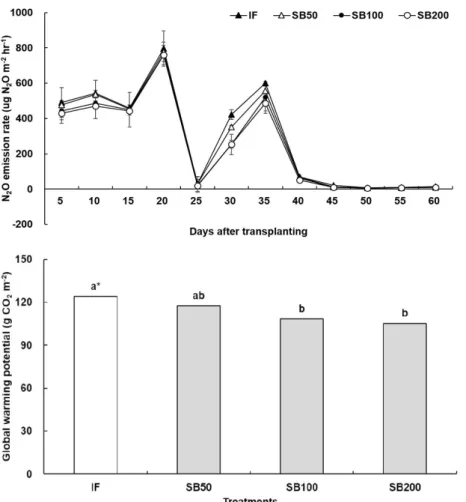
O emission rates and global warming potential in tested soil with different application level of sesame straw biochar.

*Means by the same within a column are not significantly different at 0.05 probability level according to Duncan’s Multiple Range Test.

결과는 Fig. 2와 같다. 누적 CO

2

발생량은 SB200 (474.9 g m

-2

) > SB100 ≧ SB50 > IF 처리구 순으로 바이오차의 시용량이 많을수록 누적 CO

2

발생량이 높았다. 이는 바이오 차의 토양 시용이 토양의 통기성과 공극률을 증가시켜 토양이 호기성 조건을 유지하여 미생물의 활성이 왕성한 것으로 판단 되었으며, Major et al. (2010)과 Rogovska et al. (2011) 의 바이오차 시용 연구결과와 유사한 경향으로 조사되었다.

참깻대 바이오차 시용량에 따른 N

2

O 발생량을 조사한 결 과는 Fig. 3과 같이 바이오차의 시용량이 많아질수록 N

2

O 발 생량이 약간 감소하는 경향이었다. N

2

O 발생량은 모든 처리 구에서 브로콜리 이식 후 20일째에 760∼796 ug m

-2

hr

-1

범위로 조사기간 중 가장 높은 N

2

O 발생을 나타내었다. 총 N

2

O 발생량은 IF ≧ SB50 > SB100 ≧ SB200 처리구 순 으로 높게 조사되었다.

Nelissen et al. (2014)은 바이오차의 재료와 열분해 조건 에 상관없이 바이오차를 시용한 처리구가 무처리구에 비해 누 적 N

2

O 발생량이 약 52∼84% 감소된다고 보고하였고, Mukherjee et al. (2014)은 콩 재배지에서 바이오차 처리구

가 무처리구에 비해 누적 N

2

O 발생량이 약 92% 감소된다고 보고한 바 있다. 이는 본 연구와 유사한 결과로, 본 연구에서 는 참깻대 바이오차의 시용량에 상관없이 바이오차 처리구가 무처리구에 비해 약 5.0∼15.1% 저감효과를 보였다. 토양에 서 바이오차를 이용한 N

2

O 저감은 토양 수분함량과 토양 통 기성에 관련이 있다. 토양 통기성의 개선은 탈질균의 기능과 다양성을 변화시킬 뿐만 아니라 미생물 활성에 영향을 준다고 알려져 있다 (Cavigelli and Robertson, 2001; Lai et al., 2013). 이는 바이오차가 가지고 있는 넓은 표면적과 수분보유 능력, 화학적 특성으로 인해 토양내 탈질균의 영향을 미쳐 N

2

O 발생량이 저감되는 것으로 판단된다 (Yanai et al., 2007).

Conclusion

본 시험은 참깻대 바이오차의 시용이 토양의 물리성과

N

2

O 발생에 미치는 영향을 조사하기 위하여 브로콜리 재배

토양에 바이오차 시용량을 각각 50, 100 및 200 kg 10a

-1

(5)

로 달리하여 시용하였다. 토양내 용적밀도는 바이오차의 시용 량이 많아질수록 감소하였고, 공극률과 누적 CO

2

발생량은 바이오차의 시용량이 많아질수록 유의성 있게 증가하는 경향 이었다. 또한, 총 N

2

O 발생량을 지구온난화지수로 환산하여 처리구별로 비교한 결과는 바이오차의 시용량이 많을수록 약 간 감소하는 경향으로 조사되었다. 본 연구는 비록 짧은 기간 동안 포트 실험으로 진행된 실험이지만, 농업에서 발생되는 부산물의 재활용, 토양의 물리성 개선, 온실가스 저감에 대한 측면에서 다양한 효과를 나타내고 있어 앞으로의 부산물과 밭 토양 관리를 위한 기초 자료로 활용될 수 있을 것으로 판단된다.

References

Ahmad, M., D.H. Moon, M. Vithanage, A. Koutsospyros, S.S.

Lee, J.E. Yang, S.E. Lee, C. Jeon, and Y.S. Ok. 2014.

Production and use biochar from buffalo-weed (Ambrosia trifida L.) for trichloroethylene removal from water. J. Chem.

Technol. Biotechnol. 89(1):150-157.

Angst, T.E., J. Six, D.S. Reay, and S.P. Sohi. 2014. Impact of pine chip biochar on trace greenhouse gas emissions and soil nutrient dynamics in an annual ryegrass system in California.

Agric Ecosyst Environ. 191:17-26.

Case, S.D.C., N.P. McNamara, D.S. Reay, and J. Whitaker.

2012. The effect of biochar addition on N

2

O and CO

2

emissions from a sandy loam soil–The role of soil aeration.

Soil Biol. Biochem. 51:125-134.

Cavigelli, M.A. and G.P. Robertson. 2001. Role of denitrifier diversity in rates of nitrous oxide consumption in a terrestrial ecosystem. Soil Biol Biochem. 33:297-310.

Cho, H.R., Y.S. Zhang, K.H. Han, H.J. Cho, J.H. Ryu, K.Y.

Jung, K.R. Cho, A.S. Ro, S.J. Lim, S.C. Choi, J.I. Lee, W.K.

Lee, B.K. Ahn, B.H. Kim, C.Y. Kim, J.H. Park, and S.H.

Hyun. 2012. Soil physical properties of arable land by land use across the country. Korean J. Soil Sci. Fert. 45(3):344-352.

Choi, I.K., D.C. Seo, S.W. Kang, S.G. Lee, Y.J. Seo, B.J. Lim, J.S. Heo, and J.S. Cho. 2013. Adsorption characteristics of heavy metals using sesame waste biochar. Korean J. Soil Sci.

Fert. 46(1):8-15.

IPCC. 2007. Changes in atmospheric constituents and in radiative forcing. In Climate Change 2007: The Physical Science Basis. Contribution of Working Group I to the Fourth Assessment Report of the Intergovernmental Panel on Climate Change. Solomon S, Qin D, Manning M, et al., Eds.

Cambridge University Press, Cambridge, UK.

Jeon, W.T., K.Y. Seong, M.T. Kim, G.J. Oh, I.S. Oh, and U.G.

Kang. 2010. Changes of soil physical properties by glomalin concentration and rice yield using different green manure crops in paddy. Korean J. Soil Sci. Fert. 43(2):119-123.

Kim, L.Y., H.J. Cho, and K.H. Han. 2004. Changes of physical properties of soil by organic material application in farm land.

Korean J. Soil Sci. Fert. 37(5):304-314.

Kim, M.K., S.O. Hur, S.I. Kwon, G.B. Jung, Y.K, Soun, S.K.

Ha, and D.B. Lee. 2010. Prediction of soil erosion from agricultural uplands under precipitation change scenarios.

Korean J. Soil Sci. Fert. 43(6):789-792.

Lai, W.Y., C.M. Lai, G.R. Ke, R.S. Chung, C.T. Chen, C.H.

Cheng, C.W. Pai, S.Y. Chen, and C.C. Chen. 2013. The effects of woodchip biochar application on crop yield, carbon sequestration and greenhouse gas emissions from soils planted with rice or leaf beet. J. Taiwan Inst Chem Eng. 44:1039-1044.

Lee, Y.H., B.K. Ahn, and J.H. Lee. 2010. Effects of rice straw application and green manuring on selected soil physical properties and microbial biomass carbon in no-till paddy field.

Korean J. Soil Sci. Fert. 43(1):105-112.

Major, J., J. Lehmann, M. Rondon, and C. Goodale. 2010. Fate of soil-applied black carbon: downward migration, leaching and soil respiration. Glob Chang Biol. 16:1366-1379.

Mukherjee, A. R. Lal, and A.R. Zimmerman. 2014. Effects of biochar and other amendments on the physical properties and greenhouse gas emissions of an artificially degraded soil. Sci Total Environ. 487:26-36.

Nelissen, V., B.K. Saha, G. Ruysschaert, and P. Boeckx. 2014.

Effect of different biochar and fertilizer types on N

2

O and NO emissions. Soil Biol Biochem. 70:244-255.

NIAST., 2000. Methods of soil and plant analysis, National Institute of Agricultural Science and Technology, RDA, Suwon, Korea.

Park, J.H., S.H. Kim, J.H. Shin, H.C. Kim, and D.C. Kim. 2015.

Competitive adsorption characteristics of cupper and cadmium using biochar derived from Phragmites communis. Korean J.

Environ Agric. 34(1):21-29.

Rogovska, N., D. Laird, R. Cruse, P. Fleming, P. Parkin, and D. Meek. 2011. Impact of biochar on manure carbon stabilisation and greenhouse gas emissions. Soil Sci Soc Am J. 75:871-879.

Rolston, D.E. 1986. Gas flux. In A. Klute (ed), Method of soil analysis. Part 1.2

nd

ed. Agron. Monogr. 9. ASA and SSSA, Madison, WI, pp.1103-1119.

Seo, Y.H., S.W. Kim, S.C. Choi, I.J. Kim, K.H. Kim, and G.Y.

Kim. 2012. Effect of green manure crop and biochar on nitrous oxide emission from red pepper field. Korean J. Soil Sci. Fert.

45(4):540-543.

Singh, S., J.S. Singh, and A.K. Kashyap. 1999. Methane flux from irrigated rice fields in relation to crop growth and N-fertilization. Soil Biol. Biochem. 31:1219-1228.

Woo, S.H. 2013. Biochar for soil carbon sequestration. Clean Technology. 19(3):201-211.

Yamato, M., Y. Okimori, I.F. Wibowo, S. Anshori, and M.

Ogawa. 2006. Effects of the application of charred bark of Acacia mangium on the yield of maize, cowpea and peanut, and soil chemical properties on South Sumatra, Indonesia. Soil Sci. Plant Nutr. 52:489-496.

Yanai, Y., K. Toyota, and M. Okazaki. 2007. Effects of

(6)

charcoal addition on N

2

O emissions from soil resulting from rewetting air-dried soil in short-term laboratory experiments.

Soil Sci. Plant Nutr. 53:181-188.

Yang, C.H., J.H. Ryu, T.K. Kim, S.B. Lee, J.D. Kim, N.H.

Baek, S. Kim, W.Y. Choi, and S.J. Kim. 2009. Effect of green manure crops incorporation with rice cultivation on soil fertility improvement in paddy field. Korean J. Soil Sci. Fert.

42(5):371-378.

수치

Table 2. Chemical properties of sesame straw (feedstock) and biochar used in the study.
Fig. 2. Change of soil respiration in tested soil with different application level of sesame straw biochar
Fig. 3. Changes of N 2 O emission rates and global warming potential in tested soil with different application level of sesame straw  biochar.

참조

관련 문서

Effect of biochar derived from barley straw on soil physicochemical properties, crop growth, and nitrous oxide emission in an upland field in South Korea.. Effect of

This study evaluated the effects of biochar from the pyrolysis pine on the soil microbial communities by fatty acid methyl ester (FAME) in upland field.. Compared to the NF, the

Keywords: Application levels, Inorganic fertilizer, Corn waste biochar, Corn cultivation, Soil

Changes of nitrous oxide (N 2 O) and carbon dioxide (CO 2 ) emission rates in relation to soil temperature at 10 cm depth during fallow season... The number of

The objective of this study was to evaluate carbon dioxide (CO 2 ) and nitrous oxide (N 2 O) emissions from soil after various biochars addition. The biochars were produced

This study aims at elucidation of influencing factors on measurement uncertainty of nitrous oxide concentrations measured by an automated open closed chamber method

BACKGROUND: Impact of incorporating hairy vetch into soil on mitigating nitrous oxide (N 2 O) emissions from maize field in South Korea has not been investigated, whereas

Effect of biochar application on nitrous oxide emission in the soil with different types of nitrogen fertilizer during corn (Zea may) cultivation.. Korean Journal of