*Corresponding author: Chang Oh Hong Phone: +82-55-350-5548; Fax: +82-55-350-5549;
E-mail: [email protected]
Korean J Environ Agric. 2018;37(3):172-178. Korean Online ISSN: 2233-4173
Published online 2018 September 30. https://doi.org/10.5338/KJEA.2018.37.3.28 Print ISSN: 1225-3537
고구마 재배 밭토양에서 가축분퇴비의 시용량이 아산화질소 발생에 미치는 영향
김성은1, 루앙카르스 추안핏1, 이현호1, 박혜진1, 홍창오1,2*
1부산대학교 생명자원과학대학 생명환경화학과, 2부산대학교 생명융합연구원
Effect of Application Rate of Composted Animal Manure on Nitrous Oxide Emission from Upland Soil Supporting for Sweet potato
Sung Un Kim1, Chuanpit Ruangcharus1, Hyun Ho Lee1, Hye Jin Park1 and Chang Oh Hong1,2* (1Department of Life Science and Environmental Biochemistry, Natural Resources & Life Science, Pusan National University, Miryang 54063, Korea, 2Life and Industry Convergence Research Institute, Pusan National University, Miryang 50463, Korea)
Received: 22 August 2018/ Revised: 10 September 2018/ Accepted: 21 September 2018 Copyright ⓒ 2018 The Korean Society of Environmental Agriculture
This is an Open-Access article distributed under the terms of the Creative Commons Attribution Non-Commercial License (http://creativecommons.org/licenses/by-nc/3.0) which permits unrestricted non-commercial use, distribution, and reproduction in any medium, provided the original work is properly cited.
ORCID Chang Oh Hong
http://orcid.org/0000-0001-6456-804X
172
Abstract
BACKGROUND: Composted animal manure applied to the arable soil for improving soil quality and enhancing crop productivity causes greenhouse gas emissions such as nitrous oxide (N2O) by processes of nitrification and denitrification. However, little studies have been conducted on determining effect of application ratio of composted animal manure on N2O emission rate and its annual emission pattern from upland soil in South Korea.
Therefore, this study was conducted to determine N2O emission rate and its annual emission pattern from upland soil supporting for sweet potato.
METHODS AND RESULTS: Composted animal manure was applied at the ratio of 0, 10, and 20 Mg/ha to an upland soil supporting for sweet potato (Ipomoea batatas). Nitrous oxide emission was examined during growing season and non-growing season from May 2016 through May 2017.
Daily N2O fluxes showed peaks right after applications of composted animal manure and inorganic nitrogen fertilizer.
Precipitation and soil water content affected daily N2O flux during non-growing season. Especially, N2O flux was strongly associated with water filled pore space (WFPS).
We assumed that the majority of N2O measured during growing season of sweet potato was produced from nitrification and subsequent denitrification. Annual cumulative N2O emission rate significantly increased with increasing application ratio of composted animal manure. It increased to 12.0 kg/ha/yr from 8.73 kg/ha/yr at control with 10 Mg/ha of composted animal manure and to 14.0 kg/ha/yr of N2O emission with 20 Mg/ha of the manure.
CONCLUSION: To reduce N2O emission from arable soil, further research on developing management strategy associated with use of the composted animal manure and soil moisture is needed.
Key words: Ammonium, Denitrification, Greenhouse gas, Nitrification, Pig manure
서 론
아산화질소(N2O)는 전 지구적으로 성층권의 오존을 파괴 하는 지구온난화가스 중의 하나이다. 2013년을 기준으로 대 기 중 N2O의 농도는 328 ppb[Intergovernmental Panel on Climate Change(IPCC), 2013]이며 향후 2100년에는
Research Article Open Access
pH (1:5)
OM (g/kg)
T-N (g/kg)
Av. P2O5
(mg/kg)
Exchangeable cation (cmolc/kg)
K Ca Mg
6.4 15.6 1.05 142 0.42 5.76 1.25
Table 1. Chemical properties of the soil before the test
Composted manure type T-N (g/kg) NH4+
(mg/kg) NO3-
(mg/kg) T-C (g/kg) C/N ratio
Pig 13.9 4,638 3.97 540 38.9
Table 2. Chemical properties of the composted manure
354-460 ppb까지 증가할 것으로 예상하고 있다. 농경지 토 양은 N2O의 주요 배출원이며 연간 4.3-5.8 Tg의 NO2-N을 배출하고 있으며 이 수치는 지구 전체 N2O 배출량의 23-31
%에 해당한다(Syalila and Kroeze, 2011). 근대에 들어 집 약적인 농업이 실시되면서 질소비료의 과다한 사용으로 인해 농경지 토양으로부터 N2O의 배출양은 증가해 왔다. 세계 인 구수의 증가에 따라 식량에 대한 요구량이 높아지고 이에 따 라 농업에서 높은 생산량 확보를 위해 질소비료의 사용량 또 한 높아진다. 질소비료의 사용량 증가에 따라 향후 미래에는 대기 중 N2O의 양은 지속적으로 증가할 것으로 예상된다.
Flynn and Smith (2010), Qin et al. (2012)의 보고에 따르 면 1990년부터 2005년 사이 세계식량공급량이 증가하면서 무기질 비료 및 퇴비의 사용량도 증가함으로써 대기 중 N2O 의 양이 17% 증가하였다고 한다. 따라서 농경지 토양에서 N2O 발생량을 적극적으로 저감시키기 위한 영농방법에 대한 연구가 요구되고 있는 실정이다.
N2O는 농경지 토양에 시용되는 가축분퇴비와 같은 유기 질비료나 무기질 질소비료에 의해 투입되는 질소가 토양 내 에서 질산화과정과 탈질과정을 거치는 과정 중에 발생한다.
특히, 농경지 토양에 유기물을 투입하는 것은 N2O의 주요한 배출원이 될 수 있다. 농경지 토양에 유기물을 투입하면 질산 화과정과 탈질과정에 필요한 질소와 탄소가 증가하게 되고 두 과정에 관여하는 미생물의 활성이 높아지게 된다(Granli and Bockman, 1994). 또한 IPCC의 methodology에 의하 면 농경지 토양에 시비되는 총질소 함량이 N2O 발생에 영향 을 미치는 주요 요인이라고 한다(Mosier et al., 1998).
다수의 해외에서 수행된 연구들은 토양에 유기물의 투입 은 N2O의 발생량을 증가시킨다고 보고해왔다(Wei-xin et al., 2007; Huang et al., 2004; Cabrera et al., 1994;
Chadwick et al., 2000; Chantigny et al., 2010; Dalal et al., 2010; Dittert et al., 2005; Liu and Power, 2012). 그 러나 국내에서는 가축분퇴비나 유기물의 투입에 따른 N2O의 발생량 조사에 대한 연구가 부족한 실정이다. 일부 기존에 국 내에서 실시된 연구결과들은 가축분퇴비 및 유기물 투입에 따른 지구온난화가스(CH4, CO2, N2O)의 발생량을 조사하였 으나 이들 연구는 N2O가 잘 발생되지 않은 논토양조건에서 연구가 실시되었다(Lee et al., 2005; Lim et al., 2012). 현 재까지 국내에서 밭토양조건에서 가축분퇴비의 시용량에 따 른 N2O 발생량에 대한 연구가 부족한 실정이며 향후 농경지
토양에서 N2O 발생량 저감을 위한 영농방법 개발을 위해서 는 밭토양조건에서 가축분퇴비의 시용량에 따른 N2O 발생량 에 대한 정확한 평가가 선행되어 이루어져야 한다. 따라서 본 연구는 고구마를 재배하는 밭토양 조건에서 가축분퇴비의 시 용량에 따른 연간 N2O 발생량과 배출특성을 조사하고자 실 시되었다.
재료 및 방법 공시토양 및 퇴비의 특성
본 연구를 수행하기 위해 경남 밀양시 부북면 오례리에 소 재하는 부산대학교 부속농장 밭토양(35°30'07.6"N 128°
43'16.0"E)을 공시토양으로 선정하였다. 대상지역의 토양은 용지통에 속하는 토양이었으며 점토의 함량은 12.1%, 미사는 44.5%, 모래는 43.4%로 토성은 양토이었다. 토양의 pH는 6.4이었으며 총질소 함량은 1.05 g/kg이였다. 자세한 공시토 양의 화학적 특성은 Table 1에 나타냈다. 공시퇴비는 JG바이 오에서 판매하는 돈분과 톱밥을 원료로하여 부숙한 가축분퇴 비를 시험에 사용하였다. 공시퇴비의 자세한 화학적 특성은 Table 2에 나타냈다.
시험포장 및 재배관리
각 처리구의 크기는 2.5 × 4 m (10 m2)이었으며 4 반복 으로 난괴법(Randomized complete block design)에 따라 처리구를 배치하여, 경운로터리 실시와 함께 두둑을 설치하였 다. 시험에 사용된 재배작물은 베니하루까 고구마(Ipomoea batatas)로 재식거리는 이랑폭 75 cm × 포기사이 20 cm였 으며, 2016년 6월 4일에 모종을 삽식하였고, 2016년 9월 29 일에 수확하였다. 토양수분관리는 자연강우량으로 하였다.
퇴비 및 무기질비료 시용
가축분퇴비의 시용량은 고구마의 표준시비량(RDA, 2010) 인 10 Mg/ha를 기준으로 0, 10, 20 Mg/ha를 시용하였다.
무기질비료의 시비량 또한 고구마 표준시비법(RDA, 2010)에 준하여 남해 화학에서 판매하는 요소(N), 풍농에서 판매하는 용성인비(P2O5), 대한비료에서 판매하는 황산가리(K2O)를 55-63-156 kg/ha으로 시비하였다. 가축분은 고구마 정식 2 주전에 시용하였으며, 무기질비료는 고구마 정식 후 7일 후에 시비하였다.
Parameter Operating condition
GC Shimadzu-2010plus
Detector ECD
Column 0.53 mm × 30 m, PLOT-Q columns Column flow 9.99 ml/min
Carrier gas N2, 112.9 ml/min
Oven 35℃(2.5 min), 200℃(8.4 min) Injection Splitless mode, 200℃
Split ratio 10 Retention time 1.76 min
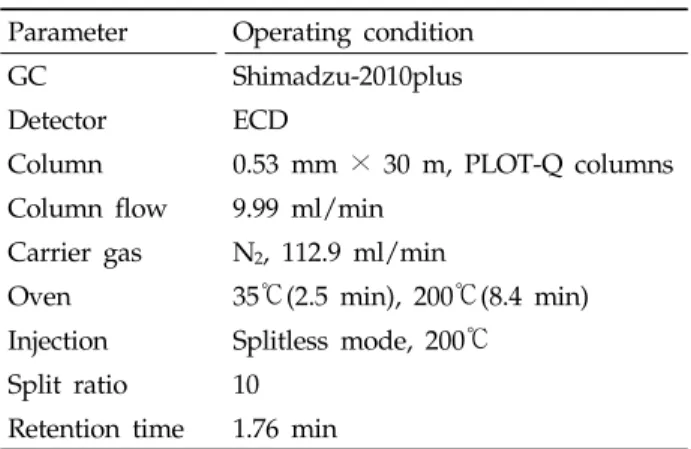
Table 3. Optimized operating condition of the gas chromatography(GC) for the measurement of N2O
챔버설치 및 N2O가스 채취방법
챔버는 static 챔버방법(Conen and Smith, 1998)을 사 용하였으며, 챔버면적은 0.05 m2으로 각 처리구 중앙두둑 위 에 0.05 m 깊이로 조심스럽게 설치하였다. 가축분 퇴비 처리 전 시험 토양의 기본 N2O 배출량을 확인하기 위해서 시험 전 토양에 각 반복구간을 대표할 수 있는 곳에 챔버 설치 후 가스시료를 채취하였다. 챔버는 각 처리구 두둑의 정중앙에 1 개의 챔버를 설치하였으며 1 주 간격으로 N2O 배출량을 측 정하였다. 재배기간 동안에는 챔버 안에 식물체가 자라지 않 게 하였다. 챔버설치 후 2 주 안정기를 가진 후 매주 1 회 간 격으로 N2O 배출량을 측정하였으며, 이벤트(가축분퇴비처리, 무기질비료처리, 집중강우) 후에는 주 2 회씩 시료를 채취하 였다. 가스시료채취(Consentino et al., 2013)는 오전 9:00부 터 오후12:00 사이에 실시하였으며, 가스채취 시간은 0, 40 분으로 하였으며(Chadwick et al., 2014) 가스시료채취 시 작 전, 후에 대기 중 가스시료도 채취하였다. 가스시료채취 시 각 처리구의 챔버 내 온도와 토양수분은 portable 토양 수분센서를 이용하여 측정하였다. 대기 중 N2O의 농도는 가 스크로마토그래피(Shimadzu 2010plus, Japan)를 이용하여 측정하였다. N2O가스의 분석조건은 Table 3과 같다.
N2O 배출량 및 water-filled pore space (WFPS) 계산 F=ρ×(V/A)×(Δc /Δt)×(273/T),
F는 N2O배출량, ρ는 가스밀도(mg/cm), V는 챔버 내 공 기체적(m3), A는 챔버바닥 면적(m2), Δc/Δt는 챔버 내 가스 농도의 평균증가속도(mg/m/hr), T 는 챔버 내 평균기온 (K).
WFPS%=(부피수분함량%/공극률%]×100 공극률%=[1-(bulk density/2.65)]×100 토양의 화학적특성 분석
공시토양의 이화학적 분석방법은 다음과 같은 방법으로 수행하였다: pH (1 : 5 토양 : 물), 유기물함량(Allison, 1965), 총질소함량(Kjeldahl method; Bremner, 1965), 치환성양이
온 K+, Ca2+, Mg2+ (1 N NH4-acetate pH 7.0, AAS, atomic absorption spectroscopy, Perkinelmer model 3300, Norwalk, CT, USA). 유효인산의 함량은 Lancaster 법 (RDA, 2000)을 이용하여 분석하였다.
토양 내 무기태 질소 분석방법은 다음과 같이 수행하였다:
토양 건조시료 5 g에 25 mL의 2 M KCl을 넣고 30분 동안 진탕한 후 Whatman No. 2로 여과하여 침출액을 각각의 실 험에 이용하였다. 암모늄태 질소(NH4-N)는 Indophenol- Blue 비색법(Searle, 1984)으로 측정하였다. 침출액 2 mL에 EDTA 용액을 0.5 mL, Salicylate 용액을 2 mL, Hypochlorite 용액 1 mL, 증류수 7 mL을 넣고 혼합한 후 37℃에 30분간 중탕시킨 후 UV/VIS Spectrophotometer (Optizen 3220 UV, Mecasy Co. Ldt, Korea)를 이용하여 667 nm의 파장 에서 측정하였다. 질산태 질소(NO3-N)는 brucine 법(Wolf, 1944)으로 측정하였다. 침출액 5 mL에 30% NaCl 1 mL와 5 mL H2SO4 (4:1, H2SO4:H2O)을 넣고 혼합한 후 10 분간 수냉하였다. 다음으로 brucine sulfanilic acid 0.25 mL를 넣고 혼합한 후 90℃에 20 분간 중탕시킨 후 수냉하였다. 충 분히 식힌다음 UV/VIS Spectrophotometer를 이용하여 410 nm의 파장에서 측정하였다.
통계분석
통계분석은 Statistix 통계프로그램(버전9)을 이용하여 실 시하였다. 처리간의 차이를비교하기 위하여 조사된 자료는 ANOVA 검증을 통하여 분석하였다. F-test 결과값이 P<
0.05의 범위에서 유의한 경우에만 최소유의차검정(LSD)을 실시하였다.
결과 및 고찰 N2O 일일 배출량
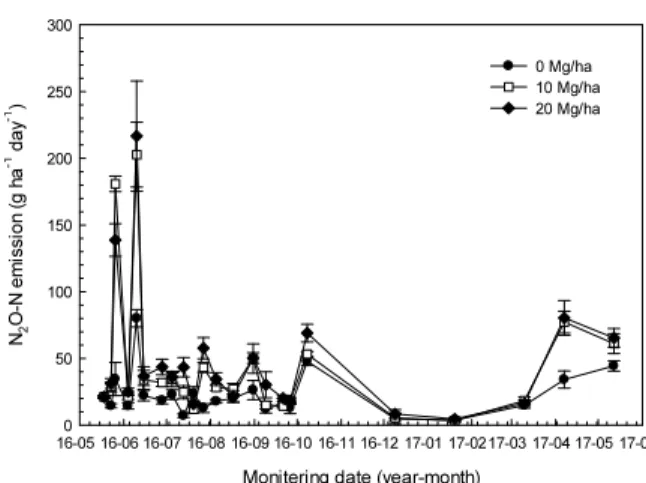
가축분퇴비의 시용량에 따른 N2O 배출량의 변화를 관찰 하기 위해 연간 N2O의 일일 배출량을 조사하였다(Fig. 1).
N2O의 일일 배출량은 5월과 6월에 각각 한번 씩 급격히 증 가하는 현상이 발생하였다가 6월말 이후 감소하는 경향을 나 타냈다. 두 번의 N2O 일일 배출량의 급격한 증가는 가축분퇴 비와 무기질비료의 시비 이후에 발생했다. 가축분퇴비는 2016년 5월 20일에 시용되었으며 첫 번째 N2O 일일 배출량 의 급격한 증가는 6일 후인 2016년 5월 26일에 발생하였다.
가축분퇴비 내 유기태 질소의 무기화율은 통기조건, 토양의 수분 조건, 미생물의 활성 등에 따라 달라지지만, 일반적으로 유기태질소가 무기태질소(NH4+-N과 NO3—N)로 무기화되기 까지 몇 주가 소요된다(Brady and Weil, 2010). 따라서 첫 번째로 발생한 N2O 일일 배출량의 급격한 증가는 가축분 퇴비 내 유기태질소의 무기화에 의한 것 보다는 가축분퇴비 내에 존재하고 있었던 무기태 질소에 의한 것으로 판단된다.
Table 2에 나타난 바와 같이 가축분퇴비 내 NH4+의 함량은 4,638 mg/kg으로 NO3-의 함량인 3.97 mg/kg 보다 훨씬 높았다. 가축분퇴비 내 높은 NH4+의 함량에 의해 N2O의 일
Monitering date (year-month)
16-05 16-06 16-07 16-08 16-09 16-10 16-11 16-12 17-01 17-02 17-03 17-04 17-05 17-06 N2O-N emission (g ha-1 day-1 )
0 50 100 150 200 250 300
0 Mg/ha 10 Mg/ha 20 Mg/ha
Fig. 1. N2O emission flux from soils amended with different rate of animal manure for 1 year.
Monitering date (year-month)
16-05 16-06 16-07 16-08 16-09 16-10 16-11 16-12 17-01 17-02 17-03 17-04 17-05 17-06
Soil water content (%, v/v)
0 10 20 30 40 50 60 70
Soil moisture WFPS
Fig. 3. Daily variation in soil water content and WFPS for 1 year.
(B)
Monitering date (year-month)
16-05 16-06 16-07 16-08 16-09 16-10 16-11 16-12 17-01 17-02 17-03 17-04 17-05 17-06
Precipitation (mm)
0 10 20 30 40 50 60 70 80 90 100 110 120 130 140 150 160 170
Monitering date (year-month)
16-05 16-06 16-07 16-08 16-09 16-10 16-11 16-12 17-01 17-02 17-03 17-04 17-05 17-06
Temperature (
o C)
-5 0 5 10 15 20 25 30 35 40 45
50 Air
(A) Soil
Fig. 2. Daily air and soil temperatures (A) and precipitation (B) for 1 year.
일 배출량이 급격히 증가한 것으로 판단된다. 요소비료는 2016년 6월 6일에 시비되었으며 두 번째 N2O 일일 배출량 의 급격한 증가는 4일 후인 2016년 6월 10일에 발생하였다.
두 번째 N2O 일일 배출량은 첫 번째 보다 훨씬 큰 것으로 조 사되었다. 이러한 이유는 요소비료로부터 무기태질소가 분해 되는 속도가 가축분퇴비로부터 무기태질소가 분해되는 속도 보다 더 빠르기 때문으로 판단된다.
기상환경 및 토양수분 함량
기상조건이 N2O의 배출량에 미치는 영향을 조사하기 위 하여 일일 대기와 토양온도, 강수량, 토양수분함량이 측정되 었다(Fig. 2와 3). 대기와 토양온도가 가장 높았던 2016년 8 월에 N2O의 일일 배출량이 크게 증가하지 않았으나 대기와 토양온도가 낮았던 2016년 12월과 2017년 1월에는 N2O의 일일 배출량이 크게 감소하였다(Fig. 1과 2(A)). 질산화과정 과 탈질과정에 관여하는 박테리아의 활성은 각각 5°C 와 2°C에서 현저하게 낮아진다(Brady and Weil, 2010). 본 연 구에서 토양온도는 2016년 12월과 2017년 3월 사이에 5°C 이하였고 2017년 1월과 2월 사이에 2°C 이하였다(Fig. 2(A)).
강수량과 토양수분함량은 고구마의 비재배기간 동안의 N2O 일일 배출량에 영향을 미쳤다. 무기질 질소비료의 추비 나 다른 질소원의 투입이 없었음에도 불구하고 2016년 10월 과 2017년 4월에 N2O 일일 배출량의 급격한 증가가 발견됐 다(Fig. 1). 흥미롭게도, 토양공극부피 내 토양수분이 차지하 는 비율(Water Filled Pore Space, WFPS)이 2016년 10월 과 2017년 4월에 60%를 초과하였다(Fig. 3). 이와 유사한 결 과가 Dobbie and Smith (2003)에 의해 발견되었으며 해당 연구결과에 따르면 초지 토양에서 WFPS가 60% 이상일 때 N2O 배출량이 유의하게 증가한다. WFPS는 호기적 미생물 과 혐기적 미생물의 활성을 나타내는 간접적인 지표가 될 수 있으며(Linn and Doran, 1984) WFPS에 의하여 질산화과 정과 탈질과정에 관여하는 미생물의 활성은 부분적으로 조절 될 수 있다.
N2O 연간 누적배출량
N2O 연간 누적배출량은 가축분퇴비의 시용량을 증가시킴 에 따라 유의하게 증가하였다(Fig. 4). 가축분퇴비의 시용량 을 추천량인 10 Mg/ha로 처리하였을 때 N2O 연간 누적배
Application rate (Mg/ha)
0 10 20
Cumulative N2O-N emission (kg/ha/yr) 0 6 8 10 12 14 16
c
b
a
Fig. 4. Cumulative N2O emission from soils amended with different rate of animal manure for 1 year.
(A)
NH4+ - N (mg kg -1)
0 5 10 15 20 25 30 35
0 Mg/ha 10 Mg/ha 20 Mg/ha
LSD0.05= 2.54
NS
NS
NS
NS
Soil sampling date
16/05/20 16/07/06 16/07/28 16/09/06 16/10/07
NO3- - N (mg kg -1)
0 2 4 6 8
10 0 Mg/ha
10 Mg/ha 20 Mg/ha
NS NS
LSD0.05= 0.74
NS
LSD0.05= 1.03
(B)
Fig. 5. Changes of NH4+
(A) and NO3-
(B) concentration in soil amended with different rate of animal manure during growing season of sweet potato.
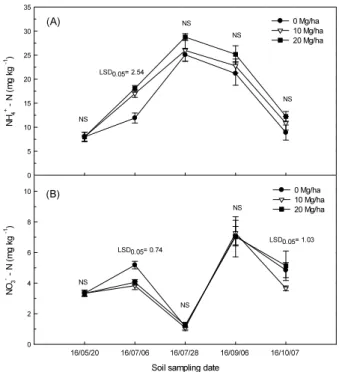
출량은 무처리의 8.73 kg/ha/yr에서 12.0 kg/ha/yr로 증 가하였으며 20 Mg/ha를 처리하였을 때 14.0 kg/ha/yr까 지 증가하였다. 가축분퇴비의 시용량 증가에 따른 N2O 연간 누적배출량의 증가는 가축분퇴비 내 존재하는 NH4+의 함량 에 의한 것으로 판단된다. Fig. 5 (A)에 나타난 바와 같이 가 축분퇴비의 시용량을 증가시킴에 따라 고구마 재배기간 동안 토양 내 NH4+의 함량은 증가하는 결과를 나타냈다. 또한 가 축분퇴비의 시용량 증가에 따라 연간 N2O 일일 배출량은 높 아지는 경향을 나타냈다(Fig. 1). 그러나, 가축분의 시용량 증 가에 따라 고구마 재배기간 토양 내 NO3-의 함량은 증가하는 경향을 나타내지 않았다(Fig. 5 (B)).
이상의 결과들로 미루어 볼 때 본 연구의 밭토양에서 배출 되는 N2O는 주로 가축분퇴비에서 기인된 NH4+가 NO3-로 전환되는 질산화과정 중에 발생되는 것으로 판단된다. 토양의 WFPS가 60% 이상일 때 N2O는 주로 탈질과정을 통해 발생 되는 반면에 토양의 WFPS가 30~60% 사이일 때 N2O는 주 로 질산화과정을 통해 발생된다(Bateman and Baggs 2005;
Kool et al., 2011). 본 연구에서 연간 일일 토양의 WFPS는 대부분 60% 이하로 나타났으므로 N2O는 주로 질산화과정을 통해 발생되어 진 것으로 판단할 수 있다(Fig. 3).
결 론
본 연구는 고구마를 재배하는 밭토양 조건에서 가축분퇴 비의 시용량에 따른 연간 N2O 발생량과 배출특성을 조사하 고자 실시되었다. N2O 연간 누적배출량은 가축분퇴비의 시 용량을 증가시킴에 따라 유의하게 증가하였다. 가축분퇴비의 시용량을 추천량인 10 Mg/ha로 처리하였을 때 N2O 연간 누적배출량은 무처리의 8.73 kg/ha/yr에서 12.0 kg/ha/yr 로 증가하였으며 20 kg/ha/yr를 처리하였을 때 14.0 kg/
ha/yr까지 증가하였다. N2O 일일 배출량의 급격한 증가는 가축분퇴비와 무기질비료의 시비 이후에 발생했다. 또한 강수 량과 토양수분함량은 고구마가 재배되는 않은 비작기기간 동 안의 N2O 일일 배출량에 부분적으로 영향을 미쳤다. 본 연구
의 밭토양에서 배출되는 N2O는 주로 가축분퇴비에서 기인된 NH4+가 NO3-로 전환되는 질산화과정과 그에 따른 탈질화 과정 중에 발생되는 것으로 판단된다. 추후 밭토양에서 주로 발생되는 지구온난화가스인 아산화질소를 적극적으로 감축시 키기 위해 가축분퇴비의 시용과 토양수분 관리 부분에 대한 보다 세부적인 연구가 필요할 것으로 판단된다.
Note
The authors declare no conflict of interest.
Acknowledgement
This study was carried out with the support of
“Research Program for Agricultural Science &
Technology Development (Project No. PJ01185504)”, National Academy of Agricultural Science, Rural Development Administration, Republic of Korea.
References
Allison, L., Bollen, W. B., & Moodie, C. D. (1965). Total carbon. Methods of soil analysis. Part 2. Chemical and microbiological properties, (methods of soil aanalysis), 1346-1366.
Bateman, E. J., & Baggs, E. M. (2005). Contributions of nitrification and denitrification to N2O emissions from
soils at different water-filled pore space. Biology and Fertility of Soils, 41(6), 379-388.
Brady, N. C., & Weil, R. R. (2010). Elements of the nature and properties of soils. pp. 366, third ed., Pearson, USA.
Bremner, J. M. (1965). Total nitrogen. In Methods of Soil Analysis PartⅡ (ed. Black, C. A.), pp. 1149-1178.
America Society of Agronomy Inc. Publ., Madison, WI, USA.
Cabrera, M. L., Chiang, S. C., Merka, W. C., Pancorbo, O.
C., & Thompson, S. A. (1994). Nitrous oxide and carbon dioxide emissions from pelletized and nonpelletized poultry litter incorporated into soil. Plant and Soil, 163(2), 189-195.
Chadwick, D. R., Cardenas, L., Misselbrook, T. H., Smith, K. A., Rees, R. M., Watson, C. J., McGepigj, K. L., Williams, J. R., Cloy, J. M., Thorman, R. E., & Dhanoa, M. S. (2014). Optimizing chamber methods for measuring nitous oxide emissions from plot-based agricultural experiments. European Journal of Soil Science, 65(2), 295-307.
Chadwick, D. R., John, F., Pain, B. F., Chambers, B. J., &
Williams, J. (2000). Plant uptake of nitrogen from the organic nitrogen fraction of animal manures: a laboratory experiment. The Journal of Agricultural Science, 134(2), 159-168.
Chantigny, M. H., Rochette, P., Angers, D. A., Bittman, S., Buckely, K., Masse, D., Belanger, G., Eriksen- Hamel, N., & Gasser, M. O. (2010). Soil nitrous oxide emissions following band-incorporation of fertilizer nitrogen and swine manure. Journal of Environmental Quality, 39(5), 1545-1553.
Conen, F., & Smith, K. A. (1998). A re‐examination of closed flux chamber methods for the measurement of trace gas emissions from soils to the atmosphere.
European Journal of Soil Science, 49(4), 701-707.
Cosentino, V. R. N., Fernandez, P. L., Figueiro Aureggi, S. A., & Taboada, M. A. (2012). N2O emissions from a cultivated Mollisol: optimal time of day for sampling and the role of soil temperature. Revista Brasileira de Ciência do Solo, 36(6), 1814-1819.
Dalal, R. C., Gibson, I., Allen, D. E., & Menzies, N. W.
(2010). Green waste compost reduces nitrous oxide emissions from feedlot manure applied to soil.
Agriculture, Ecosystems & Environment, 136(3-4), 273- 281.
Dittert, K., Lampe, C., Gasche, R., Butterbach-Bahl, K., Wachendorf, M., Papen, H., Sattelmacher, B., & Taube, F. (2005). Short-term effects of single or combined
application of mineral N fertilizer and cattle slurry on the fluxes of radiatively active trace gases from grassland soil. Soil Biology and Biochemistry, 37(9), 1665-1674.
Dobbie, K. E., & Smith, K. A. (2003). Nitrous oxide emission factors for agricultural soils in Great Britain:
the impact of soil water‐filled pore space and other controlling variables. Global Change Biology, 9(2), 204-218.
Flynn H. C., & Smith P. (2010). Greenhouse gas budgets of crop production-current and likely future trends.
International fertilizer industry association, pp. 1-67, Paris, France.
Granli, T., & Bockman, O. C. (1994). Nitrogen oxide from agriculture. Norwegian Journal of Agriculture Science, 12, 7-127.
Huang, Y., Zou, J., Zheng, X., Wang, Y., & Xu, X. (2004).
Nitrous oxide emissions as influenced by amendment of plant residues with different C:N ratios. Soil Biology and Biochemistry, 36(6), 973-981.
Huang, Y., Zou, J., Zheng, X., Wang, Y., & Xu, X. (2004).
Nitrous oxide emissions as influenced by amendment of plant residues with different C:N ratios. Soil Biology and Biochemistry, 36(6), 973-981.
Kool, D. M., Dolfing, J., Wrage, N., & van Groenigen, J.
(2011). Nitrifier denitrification as a distinct and significant source of nitrous oxide from soil. Soil Biology and Biochemistry, 43(1), 174-178.
Lee, K. B., Kim, J. G., Shin, Y. K., Lee, D. B., Lee, S. B.,
& Kim, J. D. (2005). Effects of livestock compost and soil conditioner application on greenhouse gases emission in paddy soil. Korean Journal of Environmental Agriculture, 24(2), 117-122.
Lim S. S., Choi, W. J., & Kim, H. Y. (2012). Fertilizer and organic inputs effects on CO2 and CH4 emission from a soil under changing water regimes. Korean Journal of Environmental Agriculture, 31(2), 104-112.
Linn, D. M., & Doran, J. W. (1984). Effect of water-filled pore space on carbon dioxide and nitrous oxide production in tilled and nontilled soils 1. Soil Science Society of America Journal, 48(6), 1267-1272.
Liu, Z., & Powers, W. (2012). Meta-analysis of greenhouse gas emissions from swine manure land application.
pp. 3829-3843, American Society of Agricultural and Biological Engineers Annual International Meeting 2012, American Society of Agricultural and Biological Engineers, doi:10.13031/2013.41918.
Mosier, A., Kroeze, C., Nevison, C., Oenema, O., Seitzinger, S., & Van Cleemput, O. (1998). Closing the global N2O
budget: nitrous oxide emissions through the agricultural nitrogen cycle. Nutrient Cycling in Agroecosystems, 52(2-3), 225-248.
Qin, S., Wang, Y., Hu, C., Oenema, O., Li, X., Zhang, Y.,
& Dong, W. (2012). Yield-scaled N2O emissions in a winter wheat–summer corn double-cropping system.
Atmospheric Environment, 55, 240-244.
Searle, P. L. (1984). The Berthelot or indophenol reaction and its use in the analytical chemistry of nitrogen. A review. Analyst, 109(5), 549-565.
Syakila, A., & Kroeze, C. (2011). The global nitrous oxide
budget revisited. Greenhouse Gas Measurement and Management, 1(1), 17-26.
Wei-xin, D., Lei, M., Zu-cong, C., & Feng-xiangc, H.
(2007). Effects of long-term amendment of organic manure and nitrogen fertilizer on nitrous oxide emission in a sandy loam soil. Journal of Environmental Sciences, 19(2), 185-193.
Wolf, B. (1944). Determination of nitrate, nitrite, and Ammonium Nitrogen rapid photometric determination in soil and plant extracts. Industrial and Engineering Chemistry Analytical Edition, 16(7), 446-447.