Bacillus amyloliquefaciens GR4-5 균주의 토양 내 정량 분석*
1)
김다연
**․김병용
***․안재형
**․원항연
**․김성일
****․김완규
**․송재경
*****Quantitative Analysis of Bacillus amyloliquefaciens GR4-5 in Soil
Kim, Dayeon․Kim, Byung-Yong․Ahn, Jae-Hyung․Weon, Hang-Yeon․
Kim, Sung-Il․Kim, Wan-Gyu․Song, Jaekyeong
Bacillus amyloliquefaciens GR4-5 was isolated from the rhizosphere soil of Korean ginseng and displayed broad-spectrum suppression of ginseng root rot pathogens.
The survivability of B. amyloliquefaciens GR4-5 in soil was investigated under three different conditions; indoor, outdoor ─ of which soil was put in 14 mL tube after treatment ─ and field environments. Soil samples were collected over a four- week period from three experimental designs, and assessed for 16S rRNA gene copy number by quantitative polymerase chain reaction (qPCR). In outdoor condi- tion, the 16S rRNA gene copy number of Bacillus spp. was 8.35 log copies g soil
-1immediately after the GR4-5 treatment. Two weeks later, the 16S rRNA gene copy number of Bacillus spp. (6.70 log copies g soil
-1) was similar to that of the control (6.38 log copies g soil
-1). In indoor condition, the 16S rRNA gene copy number of Bacillus spp. maintained in a certain level for a longer period than those in outdoor and field. The 16S rRNA gene copy number of Bacillus spp. in field experiment was reduced faster than that of outdoor condition. Our results show that B. amyloliquefaciens GR4-5 can survive in bulk soil for 1 week, indicat- ing its potential use as a biocontrol agent following 7 day application intervals.
This study presents that outdoor microcosm system design could be a useful method to assess easily the survivability of beneficial microorganisms.
Key words : bacillus amyloliquefaciens, microcosm, quantitative PCR, survivability
*
본 연구는 농촌진흥청 공동연구사업(과제번호 : PJ008987) 지원에 의해 수행되었음.
**
농촌진흥청 국립농업과학원
***
천랩
****
강원도농업기술원 인삼약초연구소
*****
Corresponding author, 농촌진흥청 국립농업과학원([email protected])
Ⅰ. 서 론
연작장해는 동일 토양에 동일 작물을 연속하여 재배함으로써 작물의 생육이나 수량이 감소하는 현상으로 그 원인으로는 미생물, 독소, 선충, 토양 이화학성의 악화 등이 보고되 었으며 현재는 미생물설과 독소설이 중심이 되고 있다(Yamada 2001; Jun et al., 2002). 다년 생 작물인 인삼은 연작을 극도로 기피하는 작물로, 연작장해에 따른 인삼뿌리썩음병의 발 생은 생산량 감소와 함께 농가소득 감소로 연결된다. 인삼 뿌리썩음병균 Cylindrocarpon destructans는 인삼 연작장해의 주요 원인균으로 밝혀져 있다(Chung, 1975). C. destructans의 토양 내 감염원은 월동이 가능한 내구성 구조의 후막포자로서 장기간 토양에 존재하여 인 삼에 연작장해를 일으킨다(Shin et al., 2012).
관행 농업에서는 연작장해 해소를 위해 토양 훈증제 처리와 살균제에 의한 화학적 방제 에 의존해 왔으나(Ohh and Park, 1980; Ahn et al., 1982) 최근 병해충 방제용 농자재로서 친 환경 미생물제제는 농약사용 감소로 인한 친환경 농업으로의 전환에 큰 역할을 하고 있다.
토양에서 분리한 Bacillus sp. 등 세균류를 이용한 식물병 방제 사례들이 꾸준히 보고되고 있으며 미생물의 길항성 대사산물에 관한 연구도 지속적으로 진행되고 있다(Weller 1988;
Ongena and Jacques 2008; Liu et al., 2015). 유용균들을 경작토양의 근권에 접종, 우점할 수 있도록 환경을 조성한다면 뿌리썩음병과 같은 토양병의 방제를 도모하면서 건전한 토양으 로의 개선을 위한 효율적인 토양관리를 가능하게 할 것이라고 생각된다.
건전한 토양이란 생물학적 다양성이 풍부하고 영양물질 순환이 원활히 이루어지는 토양 을 말하며(Doran and Zeiss, 2000), 이는 토양미생물 군집의 다양성과 관련되어 있다(Hwang et al., 2010; Lee and Lee, 2011). 건전한 토양과 작물근계에서 상대적으로 높은 개체군을 나 타낸다고 보고된 형광성 Pseudomonas, Bacillus spp., 방선균 등은 미생물과 식물 간 상호작 용을 촉진하는 매체로서의 기능을 수행한다(Kim et al., 1999; Doran and Zeiss, 2000). 특히, 식물 생장촉진 근권세균(PGPR)은 식물뿌리-토양-미생물이 상호작용하고 있는 근권에 생물 막을 형성하고 정착하여(Danhorn and Fuqua, 2007; Haggag and Timmusk, 2008; Krzyzanowska et al., 2012; Liu et al., 2014) 항생과 경쟁, 생장 촉진, 유도저항성 등의 방법으로 작물 생육 을 돕는다(Mahaffee and Backman, 1993; Raupach and Kloepper, 1998; Lugtenberg et al., 2001;
Szczech and Shoda, 2006; Park et al., 2010; Xu et al., 2013).
유용미생물이 근권에 군집을 형성하려면 토양에 접종한 뒤 필요한 기간만큼 토양 내에 서 살아남아야 하지만 짧은 시간 내에 그 수가 줄어든다(Ho and Ko, 1985; Van Veen et al., 1997). 즉, 처리 방법, 토양 특성, 뿌리 분비물, 온도 등 환경요인에 의해 균의 생존기간이 짧아질수록 식물 근권에서 정착하기 어렵다(Geels and Schippers, 1983; Seong et al., 1991;
Simons et al., 1997; Cao et al., 2009). 토양에 접종하는 유용균의 생존기간은 환경 영향뿐만 아니라 세균 종 특성의 영향을 받는다(Bennett et al., 2003; Dutta and Podile, 2010).
많은 유용미생물이 토양에 처리되고 있지만 이들의 생존 기간을 평가하기 위한 정량적 인 연구는 미흡한 실정이다. Quantitative polymerase chain reaction (qPCR) 기법은 균주 특이 프라이머를 이용하여 생존 범위를 좀 더 정밀하게 평가할 수 있다(Yu et al., 2014; Jesser et al., 2015). 본 연구에서는 인삼뿌리썩음병에 길항력이 있는 Bacillus amyloliquefaciens GR4-5 균주의 토양 처리 전 ․ 후의 토양 내 Bacillus spp. 밀도 변화를 qPCR을 이용하여 분석하였 다. 특정 미생물의 밀도 변화 양상을 파악함으로써 토양 내 유용미생물의 생존기간을 평가 하고, 이를 기반으로 하여 보다 효과적인 유용미생물의 현장적용 방법개발에 활용할 수 있 을 것으로 기대한다.
Ⅱ. 재료 및 방법 1. Bacillus amyloliquefaciens GR4-5의 배양
인삼뿌리썩음 병원균 중 하나인 Cylindrocarpon destructans에 대해 길항력이 있는 Bacillus amyloliquefaciens GR4-5는 본 실험실에서 이미 선발한 생물적 후보균으로서, 인삼 근권 토 양에서 분리되었다(Kim et al., 2012). B. amyloliquefaciens GR4-5를 LB 배지에 접종하여 28
℃에서 150 rpm으로 24시간 동안 배양하였다. B. amyloliquefaciens GR4-5 배양액은 8000 rpm에서 15분 동안 원심분리하였고, 상등액을 제거하고 남은 세포는 멸균한 0.03 M MgSO4
에 현탁하였다. 세포 현탁액은 0.03 M MgSO4를 이용하여 1.0×10⁶ cell mL-1 농도로 희석하 여 사용하였다.
2. 마이크로코즘(microcosm) 제작
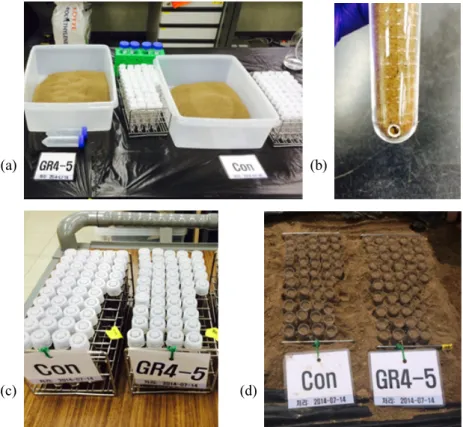
B. amyloliquefaciens GR4-5의 토양 내 생존능을 평가하기 위하여, 강원도 인삼약초연구소 의 인삼재배 토양을 이용하여 실내 및 실외 조건으로 마이크로코즘을 제작하였다. GR4-5 처리구는 토양 ㎏ 당 15 mL씩 세포 현탁액을 처리하였고, 무처리구에는 0.03 M MgSO4를 동일한 양으로 처리하여 토양에 골고루 혼합되게 하였다(Fig. 1(a)). 무균 상태의 14 mL 둥 근 바닥 튜브(SPL Life Sciences, Korea)에 토양을 11 mL의 눈금선까지 채운 뒤 20℃ 항온기 에 넣어 일정한 간격으로 시료를 채취하였다(실내배양시험; Fig. 1(c)). 실외매몰시험은 배 수를 용이하게 하기 위해 동일한 14 mL 튜브 아래쪽에 전기 드릴로 지름 1.5~2.0 ㎜의 구 멍을 3개 뚫어 수행하였다(Fig. 1(b)). 실내실험과 동일하게 처리한 후, 국립농업과학원 농업 생물부 시험포장(수원, 37°15'46.17"N, 126°59'12.70"E)에 튜브의 윗부분 약 1 ㎝ 정도만 남 기고 토양에 매몰하였다. 빗방울이 토양 표면에 직접적으로 떨어지면서 반복 간 토양이 섞
이는 것을 방지하기 위해 검은 차광망으로 감싼 바구니를 덮었다(Fig. 1(d)). 실험실에서 제 작한 마이크로코즘(실내, 실외 조건) 시험 결과와 비교분석 하기 위해 강원도농업기술원 인 삼약초연구소의 인삼 재배가 끝난 시험포장에서 GR4-5 처리구와 무처리구를 만들어 위와 같은 농도의 GR4-5 현탁액과 0.03 M MgSO4을 각각 토양표면에 살포 처리하였다.
(a) (b)
(c) (d)
Fig. 1. Microcosm procedure (a) soil sample and 14 mL round-bottom tube; (b) Each tube with three drainage holes for outdoor condition test; (c) Indoor condition;
(d) Outdoor condition.
3. 시료 채취 및 DNA 추출
마이크로코즘 시험과 인삼약초연구소 인삼 재배 토양으로부터 각각 3~4일, 6~7일 간격으 로 시료를 채취하였다. 인삼약초연구소 처리구에서 약 30 cm 간격으로 3지점에서 표토를 1 cm 가량 제거하고 약 10 cm 깊이의 토양을 채취하였다. 실내배양 및 실외매몰시험에서는 튜브 상단의 토양을 1 cm 가량 제거한 후 나머지 토양 모두를 이용하였다. 토양시료를 잘 혼합한 후 1.5 mL 튜브에 넣고 DNA 추출 및 장기보관을 위해 -80℃에 보존하면서 DNA 추 출에 사용하였다.
DNA를 추출하기 전에 각 시료 별 DNA 추출양의 차이를 보정하기 위하여 내부 표준 DNA로서 amoA 유전자가 삽입된 Topo vector (Invitrogen, USA) 로 클로닝된 E. coli (106 cell mL-1)을 100 µL씩 첨가하였다(Park and Crowley, 2005). 토양 DNA는 시료 별 각각 0.25 g의 토양 시료를 Power-soil DNA exraction kit (MOBIO, USA)를 이용하여 제조사의 매뉴얼에 따 라 추출하였다.
4. Quantitative-PCR 정량
추출한 DNA로부터 처리 미생물의 토양 내 밀도 변화를 조사하기 위해 qPCR 분석을 수 행하였다. B. subtilis group의 16S rRNA 유전자에 특이적인 염기서열(595 bp)을 증폭하기 위 하여 Bsub5F (5´-AAGTCGAGCGGACAGATGG-3´)와 Bsub3R (5´-CCAGTTTCCAATGACCCT CCCC-3´) 프라이머를 사용하였다(Wattiau et al., 2001). PCR 반응액은 GoTaq qPCR Master Mix 2X (Promega, USA) 10 µL, BSA (10 mg mL-1) 2µL, Dimethyl sulfoxide (Sigma) 1µL, Bsub5F와 Bsub3R 각각 0.5 µL를 포함하여 총량 20 µL이 되도록 멸균 증류수를 첨가하였다.
qPCR 반응은 95℃에서 3분 동안 열을 가한 후, 95℃ 15초, 64℃ 30초, 72℃ 30초 동안 40회 반복하여 반응시키고, 마지막 단계에서 80℃에서 15초 동안 열을 가하고 Ct 값을 측정하였 다(Lopez-Gutierrez et al., 2004). 표준화하기 위해 사용한 amoA 유전자를 정량하기 위하여 Topo vector의 프라이머인 T7과 M13R 을 이용하여 qPCR을 수행하였다. 95℃에서 2분 가열 후 95℃에서 1분, 60℃에서 1분, 72℃에서 1분(40회 반복) 및 72℃에서 1분 반응시켰다 (CFX96 Real-Time PCR Detection System, USA).
5. 통계분석
통계분석은 R 통계 프로그램(ver. 3.1.2)을 이용하였으며 평균 간 유의차 검증은 분산분석 (analysis of variance, ANOVA)한 후, α= 0.05 수준에서 던칸의 다중 범위 검정법(Duncan’s multiple-range test)을 실시하였다. 실외매몰시험 결과 값과 일별 강수량에 대해서는 Pearson 상관관계를 분석하였다.
Ⅲ. 결과 및 고찰 1. Bacillus subtilis group의 qPCR 정량분석
GR4-5 균주를 처리한 토양의 B. subtilis group의 16S rRNA 유전자 copy 수 변화를 분석
Indoor condition
0 6 12 18 24
5 6 7 8 9 10 11
Control GR4-5 treatment
a b b b b
x x x x x
y y y y y
Days after treatment
Log 16S rRNA gene copy number/g of soil (a)
Outdoor condition
0 2 4 7 14 21 28
5 6 7 8 9
0 50 100 150
Control GR4-5 treatment Daily precipitation
Daily pricipitation (mm)
aab
b
c c
c c
x x x
x x
x x
y y y
y x x x
Days after treatment
Log 16S rRNA gene copy number/g of soil (b)
Field condition
0 3 7 10 18 22
5 6 7 8 9 10
0 20 40 60 80 100
Control GR4-5 treatment
Daily precipitation (mm)
Daily precipitation a
b b b b
b x
y x
x x
x x x
x x xx
Days after treatment
Log 16S rRNA gene copy number/g of soil (c)
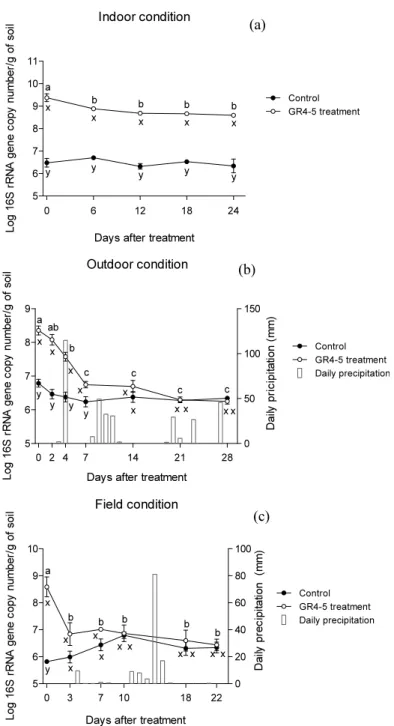
Fig. 2. Quantitative-PCR analysis on soil survivability of Bacillus amyloliquefaciens GR4-5 under the different conditions using soil-based microcosm system. Values are means ± standard error, n=3. Different letters (a, b and c) indicate significant differences (P<0.05) during time intervals and different letters (x and y) indicate significant differences between treatments (P<0.05). (a) indoor condition; (b) outdoor condition; (c) field condition.
하였다(Fig. 2). 세 가지 시험구에서 무처리구의 시기별 유전자 수의 통계 분석 결과, 유의 한 차이가 없었던 반면(P≥0.05), 모든 GR4-5 균주 처리구에서 시기별 평균의 통계적 유의 성이 인정되었다(P<0.05). 실내배양시험에서 GR4-5 균주의 처리 직후(9.37 log copies g soil-1)와 6일 뒤 시료의 유전자 수(8.88 log copies g soil-1)는 유의성 있게 감소하는 양상을 보였다. 그러나 그 후 12일째(8.68 log copies g soil-1)부터는 토양 내 B. subtilis group의 유전 자 수가 유지되었고, 4주째 까지도 무처리구보다 약 100배 많게 유지되었다(Fig. 2(a)).
실외매몰시험에서 B. subtilis group의 16S rRNA gene copy 수는 처리 직후로부터 7일이 되는 시점까지 꾸준히 감소하였지만 무처리구와 비교하였을 때 유의성을 나타내었고, 14일 째부터는 무처리구와 비슷한 수준으로 낮아졌다(Fig. 2(b)). 인삼 재배 토양에서는 GR4-5 처 리 후 유의한 차이는 없었지만 7일째까지 꾸준히 감소하였고 10일째에 B. subtilis group의 16S rRNA gene copy 수가 무처리구와 같은 수준으로 낮아졌다(Fig. 2(c)). 토양에 처리한 Azospirillum brasilense 균주 수가 처리 전과 같은 수준이 되는 데 약 35일이 소요된 Bashan et al. (1995)의 연구 결과와 비교할 때, B. subtilis group 의 토양 내 생존 기간은 A. brasilense 균주보다 짧은 것으로 추정되지만 배양법에 의한 결과이므로 본 연구결과와 비교하기는 어렵다. Binnerup et al. (1993)에 따르면 Pseudomonas fluorescens 균주를 토양 마이크로코즘 에 처리했을 때 균수가 빠르게 감소하여 처리 후 40일 째에는 최초 처리한 균주의 0.02–0.35%
정도 배양되었다. qPCR 정량 분석한 본 연구결과와 비교․분석하기는 어렵지만 토양에 접종하 는 유용균의 생존기간은 토양 환경과 세균 종 특성의 영향을 모두 받는 것으로 생각된다.
2. 상대정량분석
실내배양, 실외매몰시험과 포장시험에서 GR4-5 처리구의 B. subtilis group 생존 패턴을 비교하였다. GR4-5를 처리한 모든 처리구에서 B. subtili group의 16S rRNA 유전자 수의 감 소 속도는 각 처리구에서 다르게 나타났다. 실내배양시험에서는 균주 처리 후 6일째부터 마지막으로 시료를 채취했던 24일까지 B. subtilis group의 유전자 수가 실외매몰시험, 포장 시험보다 100배 이상 많게 유지되었다. 즉, 실외매몰시험과 포장시험에서 B. subtilis group 의 16S rRNA gene copy 수는 실내배양시험에서보다 빠른 속도로 감소되었다. 온도를 20℃
로 유지하였던 실내배양시험과는 달리 실외매몰시험의 평균 온도와 평균 일교차는 각각 25.7℃, 8.0℃이었고, 포장시험에서는 각각 25.0℃, 9.5℃이었으므로 B. subtilis group의 토양 내 생존에 대한 온도의 영향이 있는 것으로 생각된다. Vandenhove et al. (1991)의 연구에서 토양에 Pseudomonas fluorescens를 처리한 뒤 토양 온도를 15℃로 유지했을 때보다, 5℃에서 15℃로 하였을 때 토양 내 P. fluorescens 수가 더 빠르게 감소한 바 있다. B. amyloliquefaciens GR4-5 처리 직후 1주일 이내의 토양 내 B. subtilis group의 유전자 수의 감소는 포장시험에 서 가장 급격하게 진행되었다. 유의한 차이는 없었지만, 경향치로 보아 토양 내 B. subtilis
group에 대하여 GR4-5 처리구와 무처리구가 비슷한 수준이 되는데 걸리는 시간은 실외매 몰시험과 포장시험 모두 7일 내외로 나타났다.
3. Bacillus subtilis group의 토양 내 생존에 영향을 미치는 요인
각 처리구의 반복 간 16S rRNA 유전자 수의 차이는 실내배양시험(평균 표준오차: 0.09) 과 실외매몰시험(평균 표준오차: 0.10)보다 포장시험(평균 표준오차: 0.19)에서 크게 나타났 다(Fig. 2(a)-(c)). 마이크로코즘을 제작하였던 실내배양시험과 실외매몰시험에서는 균주 처 리 및 시료 채취 방법, 온도, 자외선 등의 요인이 각 처리구에 동일하게 관여하였기 때문에 포장시험보다 상대적으로 표준 오차 값이 낮은 것으로 생각된다. 실내배양 및 실외매몰시 험에서는 GR4-5 균주가 골고루 혼합 처리된 토양을 대상으로 시료를 채취하였다. 그러나 포장시험에서는 토양 표면에 살포처리 하였기 때문에 처리구 내 모든 지점에서 GR4-5 균 주가 같은 농도로 처리 되었다고 말하기 어렵다. 따라서 동일한 깊이의 토양 시료를 채취 하였음에도 오차 요인이 발생하였을 것이다. 온도와 자외선 등의 환경 요인 또한 토양미생 물의 생존에 영향을 주었을 것으로 판단되지만, Fig. 2(b)에서 보여지는 것처럼 강수량에 의 한 유전자 수의 변화는 거의 없는 것으로 나타났다. 토양에 접종한 B. amyloliquefaciens GR4-5의 생존과 일 강수량에 대한 Pearson 의 상관분석 결과, 두 변수 간에 상관관계가 매 우 낮았다(r2<0.1, P≥0.5). 즉, 강우에 의한 수분 함량 변화가 토양 내 B. subtilis group의 생 존에 미치는 영향력이 매우 낮은 것으로 나타났다. 한편 포장시험에서는 처리 후 7일째 이 후에 GR4-5 균주 처리구의 16S rRNA gene copy 수는 무처리구와 같은 수준으로 낮아졌고 강우는 주로 10일째 이후에 내렸으므로 B. amyloliquefaciens GR4-5의 생존과 일 강수량에 대한 상관관계를 분석할 수 없었다. Azospirillum brasilense 균주 처리 후 토양 내 생존에 관 한 연구(Bashan et al., 1995)에서 A. brasilense의 토양 내 생존 패턴은 토양의 건 ․ 습도 차이 와 관계가 없다고 보고한 바 있다. Zhu et al. (2005)는 미생물 처리방법에 따른 선충 방제효 과를 비교한 결과 Pasteuria penetrans를 표면살포 처리했을 때보다 토양혼합 처리했을 때 선충 방제효과가 높았는데, 이는 토양혼합 처리한 P. penetrans가 토양 내에 균일하게 분포 되었기 때문이라고 보고한 바 있다. 이들 결과를 종합하여 토양에 처리한 GR4-5 균주의 생 존에는 토양의 수분 함량 변화보다는 균주 처리 방법에 의한 영향, 즉 토양 표면살포보다 토양 혼합처리가 더 크게 작용하는 것으로 유추하였다.
Ⅳ. 요 약
인삼뿌리썩음병에 길항력이 있는 Bacillus amyloliquefaciens GR4-5 균주 처리 전 ․ 후의 토
양 내 Bacillus spp. 밀도 변화를 qPCR을 이용하여 분석하였다. 실내배양시험에서는 GR4-5 균주 처리 직후부터 4주째까지 Bacillus sp. group의 유전자 수가 무처리구보다 약 100배 이 상으로 유지되는 경향이었다. 실외매몰시험과 포장시험에서는 유의차는 없었지만 경향으 로 보아 GR4-5 처리구와 무처리구의 B. subtilis group 유전자 수가 비슷한 수준이 되는데 걸리는 시간은 7일 내외로 나타났다. 토양에 접종된 미생물의 생존에는 환경요인이 큰 영 향을 미치며 그 중에서도 온도와 미생물의 격리 정도가 가장 큰 인자로 추정된다. 또한 GR4-5 균주의 생존에는 토양의 수분 함량 변화보다는 균주 처리 방법에 의한 영향이 더 크 게 작용하는 것으로 보인다. 본 연구결과를 고려하면, B. amyloliquefaciens GR4-5 균주를 생 물적 방제제로 사용하고자 한다면 7일 간격으로 관주 처리하는 것이 식물병원균 억제 및 근권 정착에 유리한 환경을 조성할 수 있을 것으로 판단된다. 또한 본 연구에서 제작한 실 외 마이크로코즘 시스템은 제어하기 어려운 외부 환경 요인을 최소로 하여 유용미생물의 토양 내 생존 패턴을 분석하기 위한 간편한 방법으로서 유용하게 사용될 수 있을 것으로 판단된다.
[Submitted, November. 11, 2015 ; Revised, November. 19, 2015 ; Accepted, November. 26, 2015]
References
1. Ahn, Y. J., H. J. Kim, S. H. Ohh, and S. Y. Choi. 1982. Effect of soil fumigation on growth, root rot and red discoloration of Panax ginseng in replanted soils. J. Ginseng Res.
6: 46-55.
2. Bashan, Y., M. E. Puente, M. N. Rodriguez-Mendoza, G. Toledo, G. Holguin, R. Ferrera- Cerrato, and S. Pedrin. 1995. Survival of Azospirillum brasilense in the bulk soil and rhizosphere of 23 soil types. Appl. Environ. Microbiol. 61: 1938-1945.
3. Bennett, A. J., C. Leifert, and J. M. Whipps. 2003. Survival of the biocontrol agents Coniothyrium minitans and Bacillus subtilis MBI 600 introduced into pasteurised, sterilised and non-sterile soils. Soil Biol. Biochem. 35: 1565-1573.
4. Binnerup, S. J., D. F. Jensen, H. Thordal-Christensen, and J. Sørensen. 1993. Detection of viable, but non-culturable Pseudomonas fluorescens DF57 in soil using a microcolony epifluorescence technique. FEMS Microbiol. Ecol. 12: 97-105.
5. Cao, P., S. S. Shen, C. Y. Wen, S. Song, and C. S. Park. 2009. The effect of the coloni- zation of Serratia plymuthica A21-4 in rhizosphere soil and root of pepper in different soil
environment. Res. Plant Dis. 15: 101-105.
6. Chung, H. S. 1975. Studies on Cylindrocarpon destructans (Zins.) Scholten causing root rot of ginseng. Rep. Tottori. Mycol. Inst. 12: 127-138.
7. Danhorn, T. and C. Fuqua. 2007. Biofilm formation by plant-associated bacteria. Annu. Rev.
Microbiol. 61: 401-422.
8. Doran, J. W. and M. R. Zeiss. 2000. Soil health and sustainability: managing the biotic component of soil quality. Appl. Soil Ecol. 15: 3-11.
9. Dutta, S. and A. R. Podile. 2010. Plant growth promoting rhizobacteria (PGPR): the bugs to debug the root zone. Crit. Rev. Microbiol. 36: 232-244.
10. Geels, F. and B. Schippers. 1983. Selection of antagonistic fluorescent Pseudomonas spp.
and their root colonization and persistence following treatment of seed potatoes. J.
Phytopathol. 108: 193-206.
11. Haggag, W. and S. Timmusk. 2008. Colonization of peanut roots by biofilm‐forming Paenibacillus polymyxa initiates biocontrol against crown rot disease. J. Appl. Microbiol.
104: 961-969.
12. Ho, W. and W. Ko. 1985. Soil microbiostasis: effects of environmental and edaphic factors.
Soil Biol. Biochem. 17: 167-170.
13. Hwang, J. M., K. C. Park, and S. J. Kim. 2010. Contents of soil microbial phospholipid fatty acids as affected by continuous cropping of pepper under upland. Korean J. Soil Sci.
Fert. 43: 1012-1017.
14. Jesser, K. J., H. Fullerton, K. W. Hager, and C. L. Moyer. 2015. Quantitative PCR analysis of functional genes in iron-rich microbial mats at an active hydrothermal vent system (Lo’ihi Seamount, Hawai’i). Appl. Environ. Microbiol. 81: 2976-2984.
15. Jun, H. S., W. C. Park, and J. S. Jung. 2002. Effects of soil addition and subsoil plowing on the change of soil chemical properties and the reduction of root-knot nematode in continuous cropping field of oriental melon (Cucumis melo L.). Korean J. Environ. Agr. 21:
1-6.
16. Kim, B. Y., J. H. Ahn, H. Y. Weon, J. Song, S. I. Kim, and W. G. Kim. 2012. Isolation and characterization of Bacillus species possessing antifungal activity against ginseng root rot pathogens. Korean J. Pestic. Sci. 16: 357-363.
17. Kim, J. S., S. W. Kwon, S. J. Lee, B. G. Jung, J. Song, S. J. Go, and J. C. Ryu. 1999.
Analysis of microbial community structure in soil and crop root system: I. Analysis of bacterial community structure in the soil and root system of red pepper and tomato. Korean J. Soil Sci. Fert. 32: 319-325.
18. Krzyzanowska, D., M. Obuchowski, M. Bikowski, M. Rychlowski, and S. Jafra. 2012.
Colonization of potato rhizosphere by GFP-tagged Bacillus subtilis MB73/2, Pseudomonas sp. P482 and Ochrobactrum sp. A44 shown on large sections of roots using enrichment sample preparation and confocal laser scanning microscopy. Sensors-Basel. 12: 17608-17619.
19. Lee, Y. H. and S. T. Lee. 2011. Comparison of microbial community of orchard soils in Gyeongnam Province. Korean J. Soil Sci. Fert. 44: 492-497.
20. Liu, C., J. Sheng, L. Chen, Y. Zheng, D. Y. W. Lee, Y. Yang, M. Xu and L. Shen. 2015.
Biocontrol activity of Bacillus subtilis isolated from Agaricus bisporus mushroom compost against pathogenic fungi. J. Agric. Food Chem. 63: 6009-6018.
21. Liu, Y. P., N. Zhang, M. H. Qiu, H. C. Feng, J. M. Vivanco, Q. R. Shen, and R. F. Zhang.
2014. Enhanced rhizosphere colonization of beneficial Bacillus amyloliquefaciens SQR9 by pathogen infection. FEMS Microbiol. Lett. 353: 49-56.
22. Lopez-Gutierrez, J. C., S. Henry, S. Hallet, F. Martin-Laurent, G. Catroux, and L. Philippot.
2004. Quantification of a novel group of nitrate-reducing bacteria in the environment by real-time PCR. J. Microbiol. Methods. 57: 399-407.
23. Lugtenberg, B. J. J., L. Dekkers, and G. V. Bloemberg. 2001. Molecular determinants of rhizosphere colonization by Pseudomonas. Annu. Rev. Phytopathol. 39: 461-490.
24. Mahaffee, W. F. and P. A. Backman. 1993. Effects of seed factors on spermosphere and rhizosphere colonization of cotton by Bacillus subtilis Gb03. Phytopathology. 83: 1120-1125.
25. Ohh, S. H. and C. S. Park. 1980. Studies on Phytophthora disease of Panax ginseng CA Meyer; its casual agent and possible control measures. J. Ginseng Res. 4: 186-193.
26. Ongena, M. and P. Jacques. 2008. Bacillus lipopeptides: versatile weapons for plant disease biocontrol. Trends Microbiol. 16: 115-125.
27. Park, J. W., S. Jahaggirdar, Y. E. Cho, K. S. Park, S. H. Lee, and K. S. Park. 2010.
Evaluation of Bacillus subtilis native strains for plant growth promotion and induced systemic resistance in tomato and red-pepper. Korean J. Pestic. Sci. 14: 407-414
28. Park, J. W. and D. E. Crowley. 2005. Normalization of soil DNA extraction for accurate quantification of target genes by real-time PCR and DGGE. Biotechniques. 38: 579-586.
29. Raupach, G. S. and J. W. Kloepper. 1998. Mixtures of plant growth-promoting rhizobacteria enhance biological control of multiple cucumber pathogens. Phytopathology. 88: 1158-1164.
30. Seong, K. Y., M. Höfte, J. Boelens, and W. Verstraete. 1991. Growth, survival, and root colonization of plant growth beneficial Pseudomonas fluorescens ANP15 and Pseudomonas aeruginosa 7NSK2 at different temperatures. Soil Biol. Biochem. 23: 423-428.
31. Shin, J. H., B. D. Yun, H. J. Kim, S. J. Kim, and D. Y. Chung. 2012. Soil environment and
soil-borne plant pathogen causing root rot disease of ginseng. Korean J. Soil Sci. Fert. 45:
370-376.
32. Simons, M., H. P. Permentier, L. A. de Weger, C. A. Wijffelman and B. J. Lugtenberg.
1997. Amino acid synthesis is necessary for tomato root colonization by Pseudomonas fluorescens strain WCS365. Mol. Plant Microbe Interact. 10: 102-106.
33. Szczech, M. and M. Shoda. 2006. The effect of mode of application of Bacillus subtilis RB14‐C on its efficacy as a biocontrol agent against Rhizoctonia solani. J. Phytopathol. 154:
370-377.
34. Van Veen, J. A., L. S. Van Overbeek and J. D. Van Elsas. 1997. Fate and activity of microorganisms introduced into soil. Microbiol. Mol. Biol. Rev. 61: 121-135.
35. Vandenhove, H., R. Merckx, H. Wilmots and K. Vlassak. 1991. Survival of Pseudomonas fluorescens inocula of different physiological stages in soil. Soil Biol. Biochem. 23: 1133- 1142.
36. Weller, D. M. 1988. Biological control of soilborne plant pathogens in the rhizosphere with bacteria. Annu. Rev. Phytopathol. 26: 379-407.
37. Xu, Z. H., J. H. Shao, B. Li, X. Yan, Q. R. Shen and R. F. Zhang. 2013. Contribution of bacillomycin D in Bacillus amyloliquefaciens SQR9 to antifungal activity and biofilm formation. Appl. Environ. Microbiol. 79: 808-815.
38. Yamada, M. 2001. Methods of control of injury associated with continuous vegetable cropp- ing in Japan: crop rotation and several cultural practices. Jpn. Agric. Res. Q. 35: 39-45.
39. Yu, Z., Y. Zhang, W. Luo and Y. Wang. 2014. Root colonization and effect of biocontrol fungus Paecilomyces lilacinus on composition of ammonia-oxidizing bacteria, ammonia- oxidizing archaea and fungal populations of tomato rhizosphere. Biol. Fertil. Soils. 51: 343- 351.
40. Zhu, Y. Z., D. S. Park, M. R. Cho, J. H. Hur and C. K. Lim. 2005. Suppression of Meloidogyne arenaria by different treatments of Pasteuria penetrans. Korean J. Pestic. Sci.
9: 437-441.