파종밀도에 따른 직파재배 3년근 인삼의 수량 및 품질 특성
성봉재·김관후·김현호·김선익·한승호·이가순†
충남농업기술원 금산인삼약초시험장
Physicochemical Characteristics of 3-Year-Old Ginseng by Various Seeding Density in Direct-Sowing Culture
Bong Jae Seong, Gwan Hou Kim, Hyun Ho Kim, Sun Ick Kim, Seung Ho Han and Ka Soon Lee
†*
Geumsan Ginseng & Medicinal Crop Experiment Station, CNARES, Geumsan 312-804, Korea.
ABSTRACT : This study was carried out to investigate the physicochemical characteristics of 3-year-old ginseng (for Samgyetang product) cultured by various seeding density in direct-sowing culture. Ginsengs were cultured by the seeding density, 275, 300, 330 352 and 396 seeds per Kan, 180 × 90 ㎝ area. Survived rate (82.1%) were the highest in plot of 352 seeds sowed, length and leaf width were high in plot of 300 and 352 seeds. Root yield grain was increased with increase of the seeding density in direct-sowing culture except 352 seeds sowed. Average root weight and diameter were the highest in plot of 352 seeds sowed, 31.6 g and 18.4 ㎜ , respectively. Crude saponin and each ginsenosides content were the highest in plot of 275 seeds sowed. Rg1 content was decreased, Rc and Rb2 content were increased with increase of the seeding density. Total soluble sugar content was the highest in plot of 330 seeds sowed and the lowest in plot of 396 seeds sowed, and oligo- and dis- accaride content were high in plot of 330 and 352 seeds sowed. Reological characteristics of ginsengs cultivated according to various seeding density, hardness and springness were high and maximum fracture force was low with decrease of the seed- ing quantity.
Key Words : Ginseng, Seeding Density, Growth, Yield, Crude Saponin, Ginsenoside, Rheological Characteristics
서 언
최근 고려인삼 ( Panax ginseng C. A. Meyer) 에 대한 연구 가 상당량 이루어지고 있으며 아직도 인삼관련 연구내용은 재 배관련 연구가 중요한 비중을 차지하고 있다 (Park et al .,
2006). 그러나 세계 주요국가들의 인삼 소비실태와 인식에 관
한 조사 보고에 의하면 한국 인삼이 약용으로서 선호도가 가 장 좋다고 보고되고 있으나 최근에 중국과 캐나다에서 생산량 이 해마다 증가되고 있기 때문에 인삼의 수출확대를 증가시킬 방안을 모색하기 위해서는 새로운 인삼가공식품을 발굴하거 나 , 인삼을 이용한 식품을 세계로 홍보하여 소비를 촉진 시킬 필요가 있다 (Jeong et al ., 2005). 최근 인삼이 약용에서 식 용으로 용도가 확대되어감으로서 인삼이 각종 식품에 애용되 고 있다 . 그 중 전통적으로 내려오고 있는 여름철 보양식으로
섭취되고 있는 삼계탕은 현대 식생활에서도 좋은 건강식품으
로 소비자 기호도가 높은 식품으로 보고되고 있다 (Oh and
Yoo, 2001). 삼계탕은 육계에 인삼을 첨가하여 조리한 식품으
로 예전에는 저장기술이 미흡하였던 이유로 백삼을 주로 이용 하여 삼계탕을 조리하여 왔지만 , 최근에는 수삼을 그대로 삼 계탕 원료로 이용하고 있다 . 삼계탕으로 이용되고 있는 수삼 은 일반적으로 저년근인 3 년근을 이용하고 있는 실정인데 , 삼 계탕용 수삼의 경우 굳이 수삼의 체형을 고려할 필요가 없으 므로 직파재배한 수삼을 사용하고 있다 . 따라서 인삼을 직파 재배하여 노동력을 감소시킴으로써 단위면적당 생산량을 늘리 고 생산비를 줄일 수 있는 직파재배법 개발이 무엇보다도 필 요하다 . 인삼 직파재배기술을 개발하기 위해 Lee 등 (1998) 은 파종밀도가 생육 및 수량에 미치는 영향을 검토하였지만 이는 백삼 및 홍삼제조용 원료 생산을 위한 5 년근 인삼의 품질 특 성을 연구한 결과이며 , 삼계탕용 저년근 인삼을 이용하기 위 한 직파재배관련 연구 자료는 부족한 실정이다 . 한편 , 삼계탕 을 편의식품으로 개발하기 위한 신제품 개발 연구 (Oh and Yoo, 2001; Yoo et al ., 1998) 와 삼계탕 식품에 대한 연구 (Park et al ., 2003; Park et al ., 1993) 가 이루어져 왔으나 삼 계탕에 사용되어진 수삼은 일반적으로 시중에서 구입 사용하
†
Corresponding author: (Phone) +82-41-753-9923 (E-mail) [email protected]
Received 2009 December 22 / 1st Revised 2010 January 27 / Accepted 2010 February 1
여 수삼의 특성과 품질기준에 대한 정확한 언급을 찾아보기 어렵다 . 또한 현재까지 재배조건에 따른 수삼 수확량 및 성분
함량과의 상관관계에 대한 보고는 많으나 재배조건에 따른 물 성과 성분과의 상관관계에 대한 연구보고는 없으며 , Sohn 등
(1997) 이 한국인삼과 중국인삼의 뇌두에 대한 부러짐 강도에
대한 연구보고만 있는 실정이다 . 따라서 본 연구에서는 삼계 탕용으로 수삼을 재배할 경우 경제성을 향상시키기 위하여 인 삼을 파종밀도에 따라 직파재배한 후 재배학적 특성과 3 년근
수삼을 수확한 후 성분과 품질 특성을 조사 분석하였다 . 재료 및 방법
1. 실험재료 및 파종밀도
개갑된 재래종 인삼종자를 선별하여 11 월 상순에 칸당
(180 × 90 ㎝ ) 275 (11 행 25 열 ), 330 (11 행 30 열 ), 352 (11 행 32 열 ) 및 396 (11 행 36 열 ) 립으로 파종하였고 , 대조구로는 인삼
재배농가에서 밀식재배에 가장 많이 사용하는 파종밀도인
300(15 행 20 열 ) 립을 사용하였다 . 파종거리는 대조구는 주간을
6.0 ㎝ , 조간을 9.0 ㎝ 으로 하였고 , 처리구는 각각 주간을
8.2 ㎝ , 조간을 5.0, 5.6, 6.0 및 7.2 ㎝로 파종하여 동일한 조 건으로 3 년간 재배하였다 . 기타 재배관리는 농촌진흥청 인삼 표준경작법에 준하였다 . 본 실험에 사용된 인삼 시료는 칸당
재배한 인삼 전량을 2009 년 10 월 중순에 수확하여 파종 생육 ,
수량성 , 색도 , 물성 및 수분함량 등을 조사하는데 사용하였고 ,
성분분석은 전량을 모두 건조하여 분쇄 , 혼합한 후 시료로 사 용하였다 .
2. 수분, 조사포닌 및 진세노사이드 함량 분석
파종밀도별 인삼의 수분함량은 AOAC 법 (1995) 에 준하였
으며 , 성분분석을 위한 건조처리는 Lee 등 (2008) 의 방법에
따라 70 ℃의 온도에서 열풍건조한 인삼을 100 mesh 입자의 크기로 분쇄한 것을 이용하였다 . In 등 (2006) 및 Ando 등
(1971) 의 수포화부탄올 추출법으로 조사포닌을 추출 정량하였
으며 , 진세노사이드 조성 및 함량은 조사포닌 추출한 것을
HPLC 용 MeOH 에 용해한 후 이를 membrane filter (0.20 ㎛
pore size) 로 여과 , HPLC(Agilent 1200, USA) 에 10 ㎕ 씩
주입하여 분석하였으며 , 분석조건은 Lee 등 (2008) 의 방법과
같다 .
3. 가용성 당 조성 및 함량 분석
가용성 당 조성 및 함량은 Lee 등 (2009) 의 방법에 따라
일정 비율의 증류수로 추출 여과한 후 , 0.2 µM membrane
filter (Whatman Co., England) 로 여과한 것을 HPLC (Agilent 1200, USA) 에 10 ㎕ 씩 주입하여 유리당 함량을 분
석하였다 . HPLC 의 분석조건으로 칼럼은 Metacarb 87H
column (Varian. Co, USA.) 을 사용하였으며 , 칼럼온도는 35 ℃ 로 유지하였고 , 유출용매는 0.008 N H
2SO
4을 0.7 ㎖ /min 로 흘 려보냈으며 , 검출은 Refractive Index detector (Agilent 1200, USA) 를 사용하여 가용성 당을 분석하였다 .
4. 색도 측정
파종밀도에 따라 재배한 3 년근 인삼의 색도는 색차계 (Konica Minolta, CM-3600d, Minolta Co., Ltd., Osaka, Japan) 로 L 값 (lightness), a 값 (redness) 및 b 값 (yellowness)
을 측정하였다 .
5. 물성 측정
파종밀도에 따라 재배한 3 년근 인삼의 물성은 Texture analyser (TA-Plus, Lloyd Instruments Ltd., UK) 를 이용하여
hardness 를 포함하여 8 종의 물성 특성을 조사하였다 . 기기의 측정조건은 TPA (texture profile analysis) mode 에서 φ 4 ㎜
cylinder probe, test speed 100 mm/min, distance 시료두께의
50% 의 조건에서 측정하였다 .
결과 및 고찰
1. 생육특성 및 수량성
파종밀도별 인삼의 생육특성 및 수량성은 Table 1 과 2 와 같 다 . 생존율은 칸당 352 립 파종구가 82.1% 로 가장 높았고 , 엽 장과 엽폭은 300 립과 352 립 처리구가 가장 양호하였으며 , 경 장은 파종밀도가 높은 396 립 파종구에서 34.2 ㎝로 가장 높 았다 . 또한 , 파종밀도별 지하부 생육 중 주당근중과 동직경은
Table 1.
Growth characteristics of three-year-old ginseng cultured by various seeding density in direct-sowing culture.
Seeding density
(line×row, ea/kan, 180×90
㎝) Survived plant
(No./3.3
㎡) Survived rate
(%) Leaf length
(
㎝) Leaf width
(
㎝) Stem length
(
㎝) Stem diameter (
㎜)
25×11(275) 217 78.9 10.96 4.98 28.97 5.14
30×11(330) 216 65.5 11.52 5.07 29.00 5.14
32×11(352) 289 82.1 11.66 4.86 30.69 5.60
36×11(396) 315 79.5 10.45 4.74 34.23 5.58
20×15(300)
♩213 71.0 11.78 5.12 34.18 5.66
†Seeding date: March 20, 2007, investigation date: June 9, 2009.
♩: traditional practice (control)
칸당 352 립 파종구가 31.6 g, 18.4 ㎜로 가장 양호하였고 , 칸 당 (3.3 ㎡ ) 전체무게도 3.15 ㎏으로 가장 높아 유의성이 인정 되었다 . Lee 등 (1998) 이 파종밀도에 따른 직파재배 5 년근 인 삼의 생육 및 수량을 조사한 결과 생존주수는 파종밀도에 비 례하여 증가하였다고 하였는데 , 본 연구결과와 비슷한 결과를 보여주었다 . 이는 인삼재배 시 특별한 피해원인이 발생하지 않
을 경우는 파종립수가 많을수록 생존본수가 커짐은 당연한 결 과로 볼 수 있으며 , 파종밀도가 낮을수록 주당근중이 증가되 었다고 보고한 것과는 차이가 남을 알 수 있었다 . 이는 인삼 을 5 년 이상 재배할 경우 지근의 비대가 활발히 이루어져 파
종밀도가 높게 되면 개체 간 경합이 심하여 근생장이 억제된 다고 하였다 (Lee et al. , 1998). 따라서 파종밀도를 달리했을 때 연근에 따라 차이가 나타남을 볼 수 있기 때문에 최종적으 로 이용되는 수삼의 형태를 고려할 경우 파종밀도가 인삼 수 량 및 품질에 미치는 영향은 다르다고 볼 수 있다 .
또한 , 파종밀도별 동직경 분포를 조사한 결과는 Fig. 1 에서
나타낸 바와 같이 19~22 ㎜ 크기는 칸당 352 립과 275 립 파종
구가 많았고 , 18 ㎜ 이하의 동직경은 300, 330 립 및 396 립 파 종구에서 많았다 . 또한 , 15 ㎜ 이하 동직경 분포는 Table 3 에서 볼 수 있는 바와 같이 전체무게는 396 립 파종구가 많았지만 ,
Table 2.
Root growth characteristics of three-year-old ginseng cultured by various seeding density in direct-sowing culture.
Seeding density
(line×row, ea/kan, 180×90
㎝) Root weight
(g/plant) Root length
(
㎝) Tap root
diameter (
㎜) Survived plant
(Survived rate, %) Total weight (
㎏/3.3
㎡)
25×11(275) 26.8
b※23.8 17.6 191(69.4) 2.74
bc30×11(330) 27.6
b26.8 17.2 218(66.0) 2.87
ab32×11(352) 31.6
a24.5 18.4 210(63.6) 3.15
a36×11(396) 25.7
bc24.6 17.2 239(60.4) 2.97
ab20×15(300) 23.8
c23.9 17.2 183(61.0) 2.44
c†Seeding date: March 20, 2007, investigation date: June 9, 2009.
※
Value with different superscripts are significantly different (p < 0.05)
Fig. 1.
Distribution of root diameter of three-year-old ginseng(over 15
㎜of diameter) cultured by various seeding density in direct- sowing culture.
Table 3.
Yield characteristics of three-year-old ginseng(below 15
㎜of diameter) cultured by various seeding density in direct-sowing culture.
Seeding density
(line×row, ea/kan, 180×90
㎝) Survived plant
(No./3.3
㎡)/survived rate Total weight
(g/3.3
㎡) Average weight (g/ea, plant)
25×11(275) 136/49.5 1,499
9.07
30×11(330) 171/51.8 1,642 10.41
32×11(352) 159/45.2 1,382 11.50
36×11(396) 193/48.7 1,736 11.11
20×15(300) 141/47.0 1,354 10.41
개체당 평균무게는 352 립 파종구가 11.5 g 으로 가장 양호하였
다 . Lee 등 (2009) 이 배수등급이 불량한 논토양에서 재배한 3
년근 인삼의 생육 특성을 보고한 바와 비교할 때 근중 및 근장 등이 본 연구결과 값보다 낮은 값을 보여주었다 . 이는 인삼을 재배할 경우 배수등급이나 재식밀도 등 재배조건이 양호할 때 인삼의 생육 특성이 좋아지는 것을 시사하는 것으로 본 연구결 과로부터 3 년생 저년근 인삼의 상품화시 파종밀도 중 352 립 정 도까지는 양호한 수삼을 얻을 수 있을 것으로 생각된다 .
2. 수분, 조사포닌 및 진세노사이드 함량
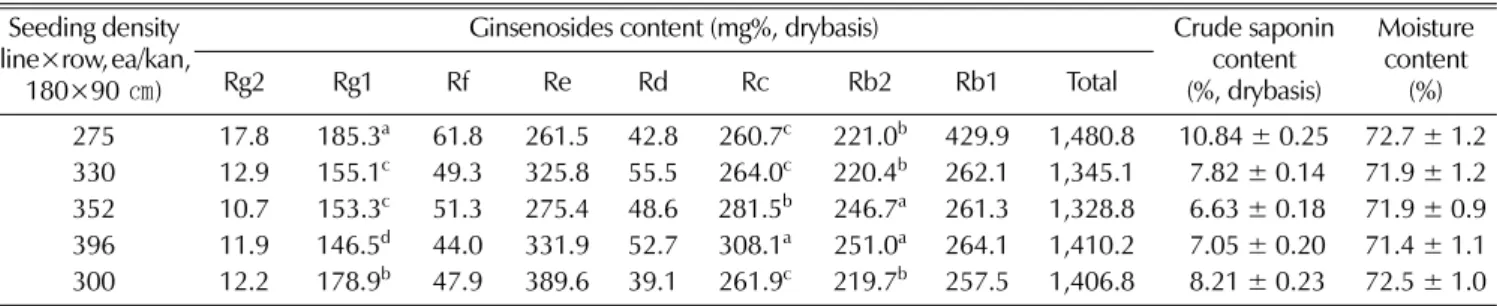
파종밀도별 3 년근 인삼의 수분 , 조사포닌 및 진세노사이드 함량을 측정한 결과는 Table 4 와 같다 . 수분함량은 파종밀도 가 가장 낮은 파종구인 275 립 처리구에서 72.7% 로 가장 높았
고 , 330 립 이상의 처리구에서는 수분함량이 미비한 차이를 보
여 파종밀도별 차이가 인정되지 않았다 . 조사포닌 함량도 파
종밀도가 낮은 275 립 처리구가 가장 높은 함량을 보였고 파 종밀도가 증가할수록 조사포닌함량이 낮아지는 경향을 볼 수 있었으며 , 352 립과 396 립 처리구에서는 유의적인 차이가 인정 되지 않았다 . 한편 , 진세노사이드 중에서 Rg1 은 파종밀도가 증 가할수록 낮았고 , Rc 와 Rb2 의 함량은 파종밀도가 증가할수록 증가하는 경향을 보였다 . 또한 Rb1 은 275 립에서 429.9 ㎎ % 로 타처리구에 비하여 월등히 함량이 높았고 타처리구에서 파종 밀도간에는 유의적인 차이가 인정되지 않았다 . 따라서 파종밀 도가 진세노사이드 조성 및 함량에 영향을 주는 요인이 될 수 있음을 알 수 있었다 .
3. 가용성 당 조성 및 함량
파종밀도에 따른 인삼의 가용성당의 조성 및 함량을 분석한 결과는 Table 5 와 같았다 . 파종밀도별 총유리당 함량은 330 립 처리구가 가장 높았고 396 립 처리구가 가장 낮게 나타났다 .
또 , 330 립과 352 립 처리구에서 가용성 올리고당과 이당류가
가장 높은 함량을 보였다 . 또 조사포닌 함량 및 진세노사이드 총함량과 비교해볼 때 사포닌함량이 가장 높았던 처리구인
275 립 처리구에서 가용성 당함량이 가장 낮은 결과를 보여주
었으며 이는 Lee 등 (2008) 이 보고한 사포닌함량과 유리당 함
량의 부의 상관 관계와 같은 결과를 보였다 . 특히 275 립 처리 구에서 가용성 당 중 올리고당과 이당류의 함량이 낮아 전체 적으로 당함량이 낮은 결과를 나타내었다 . 이는 275 립을 처리 한 파종밀도에서 생육 시 개체간 영양분 경합이 상대적으로 낮아져 생육대사가 활발히 이루어지기 때문으로 생각된다 .
4. 수삼조직의 물성 특성
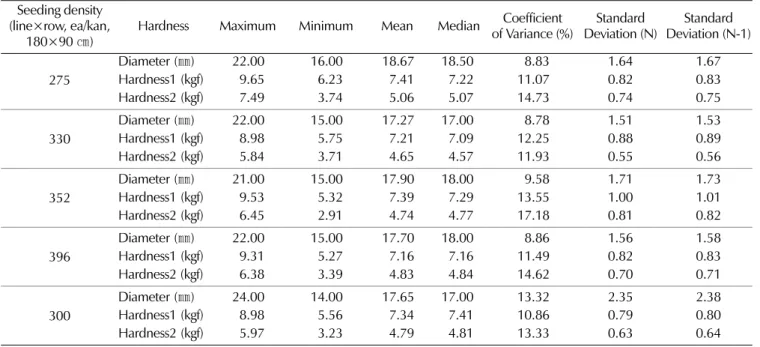
파종밀도별 인삼 조직의 경도값을 측정한 결과는 Table 6 과 같다 . 파종밀도 중 275 립 , 330 립 및 396 립 모두 직경의 변이 값은 8.78~8.83% 로 서로 비슷하였으며 , 낮은 값을 보였으나
352 립에서는 9.58% 로 약간 변이값이 컸으며 , 300 립에서
13.32% 로 개체 간 근직경의 변이값이 크게 나타났다 . 또한 경 도의 평균값은 275 립에서 제 1 경도값과 제 2 경도값이 각각 7.413 및 5.066 kgf 로 가장 높았으며 그 다음 352 립으로 제 1
경도 7.394 kgf 을 보여주었으며 , 제 2 경도값이 큰 것으로는 제
1 경도가 가장 낮은 처리구인 396 립 처리구이었다 . 따라서 수
Table 4. Moisture, crude saponin and ginsenoside content of three-year-old ginseng by various seeding density in direct-sowing culture.
Seeding density (line×row, ea/kan,
180×90
㎝)
Ginsenosides content (mg%, drybasis) Crude saponin content (%, drybasis)
Moisture content
Rg2 Rg1 Rf Re Rd Rc Rb2 Rb1 Total (%)
275 17.8 185.3
a61.8 261.5 42.8 260.7
c221.0
b429.9 1,480.8 10.84 ± 0.25 72.7 ± 1.2 330 12.9 155.1
c49.3 325.8 55.5 264.0
c220.4
b262.1 1,345.1 7.82 ± 0.14 71.9 ± 1.2 352 10.7 153.3
c51.3 275.4 48.6 281.5
b246.7
a261.3 1,328.8 6.63 ± 0.18 71.9 ± 0.9 396 11.9 146.5
d44.0 331.9 52.7 308.1
a251.0
a264.1 1,410.2 7.05 ± 0.20 71.4 ± 1.1 300 12.2 178.9
b47.9 389.6 39.1 261.9
c219.7
b257.5 1,406.8 8.21 ± 0.23 72.5 ± 1.0
※
Value with different superscripts are significantly different (p < 0.05).
Table 5.
Free sugar content of three-year-old ginseng by various seeding density in direct-sowing culture.
Seeding density
(line×row, ea/kan, 180×90
㎝) Soluble starch and
oligosaccharide Disaccharide Glucose Fructose Total
275 3.20
b10.80
b1.14
a1.67
a16.81
b330 4.46
a12.92
a1.06
b1.15
c19.59
a352 4.37
a12.51
a1.02
b1.27
b19.17
ab396 3.10
b10.91
b0.93
c1.12
c16.06
c300 3.57
b10.68
b0.87
c1.19
c16.31
c※
Value with different superscripts are significantly different (p < 0.05).
삼의 경도는 파종밀도가 가장 낮은 275 립 처리구가 가장 단 단하였고 , 그 다음이 352 립 처리구가 단단한 조직을 가짐을
알 수 있었다 .
한편 , 수삼조직의 기타 물성 특징을 살펴보면 Table 7 과
Table 6.Hardness of three-year-old ginseng by various seeding density in direct-sowing culture.
Seeding density (line×row, ea/kan,
180×90
㎝) Hardness Maximum Minimum Mean Median Coefficient of Variance (%) Standard
Deviation (N) Standard Deviation (N-1)
275 Diameter (
㎜) 22.00 16.00 18.67 18.50 8.83 1.64 1.67
Hardness1 (kgf) 9.65 6.23 7.41 7.22 11.07 0.82 0.83
Hardness2 (kgf) 7.49 3.74 5.06 5.07 14.73 0.74 0.75
330 Diameter (
㎜) 22.00 15.00 17.27 17.00 8.78 1.51 1.53
Hardness1 (kgf) 8.98 5.75 7.21 7.09 12.25 0.88 0.89
Hardness2 (kgf) 5.84 3.71 4.65 4.57 11.93 0.55 0.56
352 Diameter (
㎜) 21.00 15.00 17.90 18.00 9.58 1.71 1.73
Hardness1 (kgf) 9.53 5.32 7.39 7.29 13.55 1.00 1.01
Hardness2 (kgf) 6.45 2.91 4.74 4.77 17.18 0.81 0.82
396 Diameter (
㎜) 22.00 15.00 17.70 18.00 8.86 1.56 1.58
Hardness1 (kgf) 9.31 5.27 7.16 7.16 11.49 0.82 0.83
Hardness2 (kgf) 6.38 3.39 4.83 4.84 14.62 0.70 0.71
300 Diameter (
㎜) 24.00 14.00 17.65 17.00 13.32 2.35 2.38
Hardness1 (kgf) 8.98 5.56 7.34 7.41 10.86 0.79 0.80
Hardness2 (kgf) 5.97 3.23 4.79 4.81 13.33 0.63 0.64
†Each value was measured by 40 roots with over 15
㎜of ginseng diameter.
Table 7.
Rheological characteristics of three-year-old ginseng by various seeding density in direct-sowing culture.
Seeding density
(line×row, ea/kan, 180×90
㎝) 275 330 352 396 300
Cohesiveness 90.19±0.03 0.18±0.025 90.19±0.02 90.18±0.03 90.18±0.03
Springiness (
㎜) 98.11±0.93
a7.35±0.97
c97.55±0.99
b97.38±0.93
c97.37±1.32
cGumminess (kgf) 91.43±0.26
a1.30±0.24
c91.41±0.31
a91.34±0.28
bc91.36±0.26
bChewiness (kgf.
㎜) 11.74±3.26
a9.67±2.74
c10.85±3.22
b10.14±3.15
b10.20±3.31
bFracture Force (kgf) 90.23±1.04
a0.28±1.29
a90.23±1.08
a90.55±1.79
b90.45±1.54
bAdhesiveness (kgf.
㎜) 90.51±0.19
a0.58±0.27
b90.62±0.30
v90.57±0.257
b90.56±0.49
bStiffness (kgf.
㎜) 92.69±0.35
a2.61±0.34
b92.56±0.46
b2.528±0.32
c92.58±0.32
b†Data values are expressed as mean±SD(n=40, over 15 mm of ginseng diameter)
※
Value with different superscripts are significantly different(p<0.05)
Fig. 2.